Reformed Theology Rocks!

Reformed theology rocks, for a variety of reasons. I am currently reading Jan Rohls book Reformed Confessions: Theology from Zurich to Barmen. Columbia Series In Reformed Theology, which is a resource I briefly referenced in a chapter I wrote for our edited book Evangelical Calvinism: Essays Resourcing the Continuing Reformation of the Church. As I have been reading this book I have been getting encouraged again about why Reformed theology is such a boon for the weary theological soul.

Primarily the thing that has attracted me most to Reformed theology over the years is of a dogmatic interest; i.e. the Sovereign reality of who the Triune God is, and the primacy of grace serve to shape the Reformed theological trajectory in ways that other theological approaches do not, in my view. Truly, there are different ways to emphasize this reality within the Reformed approach[es], and we as evangelical Calvinists have our own unique way of emphasizing who God is for us in Christ, but in the main there is a common thread that unites all instances of Reformed theology; that common theme, again, is an emphasis upon who God is, and the primacy of grace in a God-world/Creator-creature relation.

For example there is something very comforting that arises from the words found in the Heidelberg Catechism, in regard to who God is, and what our relation to him is. When you are reading the Heidelberg Catechism you will immediately be confronted with question 1 that says this:

Question 1.

What is thy only comfort in life and death?

Answer.

That I with body and soul, both in life and death, (a) am not my own, (b) but belong unto my faithful Saviour Jesus Christ; (c) who, with his precious blood, has fully satisfied for all my sins, (d) and delivered me from all the power of the devil; (e) and so preserves me (f) that without the will of my heavenly Father, not a hair can fall from my head; (g) yea, that all things must be subservient to my salvation, (h) and therefore, by his Holy Spirit, He also assures me of eternal life, (i) and makes me sincerely willing and ready, henceforth, to live unto him. (j) (a) Rom.14:7,8. (b) 1 Cor.6:19. (c) 1 Cor.3:23; Tit.2:14. (d) 1Pet.1:18,19; 1 John 1:7; 1 John 2:2,12. (e) Heb.2:14; 1 John 3:8; John 8:34-36. (f) John 6:39; John 10:28; 2 Thess.3:3; 1 Pet.1:5. (g) Matt.10:29-31; Luke 21:18. (h) Rom.8:28. (i) 2 Cor.1:20-22; 2 Cor.5:5; Eph.1:13,14; Rom.8:16. (j) Rom.8:14; 1 John 3:3.

This is a perfect example of the kind of riches available for the Christian person who takes advantage of the heritage provided for in the Reformed Christian faith. There is a hope and a warmth in knowing God as Father, and that we are related to him as a result of his love for us in the dearly beloved Son Jesus Christ, and that our relationship to this Father-Son God is assured and guaranteed to us by the person and work of the Holy Spirit in our lives. It is this Triune reality that Reformed theology, from a Protestant vantage point, does such a good job of emphasizing.

On a personal note: One reason I find this so encouraging is that this heritage is such a harbinger to my weary soul as I engage with the world who rejects, by and large, thoughtfulness about life, and greater reality such as God represents. It is encouraging to know that I have somewhere to go to quench my thirst, theologically, and in a way that there is a depth dimension provided for in an through the people that God was ministering to centuries ago in his church in the Reformation period.

These are some reasons why I think Reformed theology rocks (there are many other reasons), and why I would like to commend it to you for your consideration, if you have never taken advantage of the deeper theological realities provided for in the Reformed angle of the Christian faith. soli Deo Gloria!


A Response to First Things’ Matthew Rose’s Barth’s Failure

David Congdon just responsed to Matthew Rose’s First Things article entitled: Karl Barth’s Failure. What Rose meant by failure is this:

Karl Barth was the greatest theologian since the Reformation, and his work is today a dead letter. This is an extraordinary irony. Barth aspired to free Christian theology from restrictive modern habits of mind but in the end preserved the most damaging assumptions of the ideas he sought to overcome. This does not mean he no longer deserves serious attention. Barth now demands exceptionally close attention, precisely because his failures can teach us how profound the challenges of modernity are for theology—and show us the limits of a distinctly modern solution to them.[1]

Congdon putatively demonstrates in his response that the real issue underlying Rose’s critique of Barth as a ā€˜modern theologian’ (which really is an unremarkable insight), is not that Barth was a modern in his theologizing, but that he was a Protestant (Rose is a certain style of Roman Catholic). Congdon concluded his insightful piece this way:

Put plainly:Ā modernity is Protestant, so to reject modernity is to reject Protestantism. Perhaps that is the underlying message of Rose’s article.Ā Barth finally fails, because he remains, at the end of the day, a theologian of the Reformation.[2]

With the fact that Barth was a modern theologian duly noted, and the reality that as Congdon has promoted, that for Rose what really is meant by ā€˜modern’ is ā€˜Protestant’ and his kind of scholastic Roman Catholic animus towards it (towards Protestant theology and epistemology in general). Let me focus on a particular strand of argument that Rose made to critique Barth’s modern approach toward appropriating knowledge of God. Rose writes of Barth:

Barth’s second and deeper mistake was to sever the mind’s speculative relation to God. He dissolved the classical synthesis of faith and reason, collapsing all theological understanding into an exercise of faith…. His basic error is evident in his rejection of natural theology, which holds that careful observation of contingent beings can disclose the necessary being of God. This argument comes in several permutations, most of which are sketched by Thomas Aquinas, but its success in demonstrating God’s existence was arguably a secondary concern. The primary purpose of traditional natural theology was to show the indissoluble connection between the human intellect and a transcendent God who is Being itself.[3]

Rose’s real concern with Barth is that Barth rejected what Thomas Aquinas became famous for, for his synthesis of Aristotelian metaphysics and epistemology therein, with Christian theology; this synthesis became known as classical theism. Within this synthesis of faith and reason, for Aquinas what was determinative was his idea of a hierarchy of ā€˜being’ (which we see Rose appealing to in the aforementioned quote), and how an interlocking relation obtains between being-positing-lower being, creating the possibility for lower being (human being) to reason its way back to highest being (God) through analogical inference (i.e. reasoning that through communicable aspects of God’s being in human being negated, that God’s inner being can be categorized and known through reflection upon human being and God’s works in general embedded in creation). Thomas Aquinas has written:

. . . the proposition that ā€œGod existsā€ is self evident in itself, for, as we shall see later, its subject and predicate are identical, since God is his own existence. But, because what it is to be God is not evident to us, the proposition is not self-evident to us, and needs to be made evident. This is done by means of things which, though less evident in themselves, are nevertheless more evident to us, by means, namely of God’s effects.[4]

It is this, it is the role that faith by grace (sola gratia), etc. that along with Congdon, I would suggest that Rose is bothered by (since Rose is committed to the kind of movement towards knowledge of God that Thomas Aquinas offers). But this is not a particularly modern V pre-modern (or critical) issue; again, it (as Congdon insightfully has pointed out) is really a rehashing of the counter-Reformation and the council of Trent’s salvo against the Reformed conception and formal principle of the Protestant Reformation, sola Scriptura. Barth, as a Reformed theologian, took his cues from these Reformed solas and principles; and in his modern mode he developed his particular theology of the Word from within these principles which are radically Christ-concentrated principles (V radically Church-concentrated pace Rose)—i.e. grace, faith, Scripture, etc.

One of Karl Barth’s greatest (if not the greatest!) English speaking students, Thomas Torrance (who Barth believed captured his own thought better than anyone else in his day) wrote this of Barth’s approach to theology, knowledge of God, and the role that the faith of Christ played in the revelational theology of Karl Barth:

… Barth insisted that revelation is rational event, for in revelation God communicates to us his Word, and conveys to us his truth, requiring of us a rational response in accordance with the rational nature of his Word, and also a self-critical relation to his truth as it calls us in question. Not only is revelation God’s act and his being in that act, but Logos, the source and fountain of all rationality. It follows that knowledge of God in his revelation is rational in its own right, rational in the ground of the supreme and self-sufficient rationality of its divine object, God-in-his-Word. Indeed, in revelation theology is concerned with a depth in objective rationality that transcends that of any other kind of knowledge and of every other science. Barth will have nothing to do, therefore, with some kind of faith-knowledge that is basically romantic and non-conceptual and which needs rationalizing through borrowed forms of ethics and philosophy. Knowledge of revelation is ab initio rational, for it is engagement in a divinely rational communication.[5]

What Torrance helps to substantiate is that Barth’s ā€˜revelational’ theology is not primarily developed through Kantian or modern categories (even though these are categories that Barth is indeed responding to and working with, in his own reified way), but that Barth’s trajectory is set through his engagement with Protestant principles, in particular with his development of a theology of the Word that rejects the Thomist (i.e. Rose) analogy of being (analogia entis) in favor of a Protestant analogy of faith.[6]

For Barth it is not a turn to ā€˜our subject’ (which would be the modern move that Barth is responding to), but a turn to God’s subject revealed to humanity through His eternal Word, Jesus Christ. Barth, as Torrance notes elsewhere, is essentially turning modern theology on its head by using classically Protestant themes, grounding faith & reason not in our subjects, but in God’s subject as the object and knowledge that breaks humanity free from the ā€˜bondage of our wills.’

Basically, my response here is a riff off of what David Congdon already cleared for us with his response to Matthew Rose. Karl Barth is as modern as Matthew Rose is a post-modern theologian. But this does not relativize Barth’s material and theological insights and critique, primarily, of classical theism’s failure to recognize that the only genuinely basic ground for knowing God cannot come from an a priori (a prior) ground latent within human being, but only through an a posteriori given that God graciously provides of himself in his Self-revelation in Jesus Christ. The access itself comes from a Godward direction, and the ā€˜faith’ or ā€˜knowledge of God’ (pace Calvin) that humanity comes to know God through is in that relation of faith (i.e. trust) inherent in the already relation of the Father and Son; so in other words, Barth offers up a robust and radical Christ-centered theology of the Word—theology that any self-respecting high-churchin Roman Catholic would find reprehensible.[7]


[1] Matthew Rose, http://www.firstthings.com/article/2014/06/karl-barths-failure, accessed 5-15-14.

[2] David Congdon, http://fireandrose.blogspot.com/2014/05/in-defense-of-modernity-response-to.html, accessed 5-15-14.

[3] Rose.

[4] Aquinas, Summa Theologiae, 7.

[5] Thomas F. Torrance, Karl Barth, Biblical and Evangelical Theologian (Edinburgh: T&T Clark, 1990), 45.

[6] I have written on this distinction further in my personal chapter in my edited book (with Myk Habets), see: Bobby Grow, ā€œAnalogia Fidei or Analogia Entis? Either Through Christ or Through Nature,ā€ in eds. Myk Habets and Bobby Grow, Evangelical Calvinism: Essays Resourcing the Continuing Reformation of the Church (Eugene, OR: Pickwick Publications An Imprint of Wipf and Stock, 2012), 94-113.

[7] There are Roman Catholics, though, of a different stripe from Matthew Rose; just to be clear.

‘Beyond What is Written’: What It Means to be in the ‘spirit’

I was just reading I Corinthians, and came across that sweet little clause from the Apostle in 4:6; you know: “…Ā so that in us you may learn not to exceedĀ what is written,…” Now in context, presumably, the Apostle is making a defense for his Apostleship in contrast to the false teaching and pseudo-Apostles who had crept into the church at Corinth. But there is a great principle here, and one that fits well with what it means to truly work within the ‘spirit’ of the reformed faith (and it is Barth who identifies this distinction of being in the ‘spirit’ of the reformed faith rather than the ‘letter’ which we all know too much of today, esp. in North America); the principle might be: that as Christians we are to sit under, in a ministerial way, (V. a magesterial wayĀ paceĀ Luther)Ā Holy writ,Ā and understand our posture, mode, and identity in relation to the dynamic reality that Scripture finds its source and sense from as it breaks off in its reality and power in Jesus Christ. This can often result in confession making, and in the history of the Reformed church, it has. But if Scripture is Christ’s delegate by the Spirit in our lives, then this always remains a dynamic and lively thing; it should never result in the absolutization of set of confessions or catechisms; it should never result in the repristination of a particular period of church history as the golden age, thus producing a golden guild of biblical interpreters. Scripture breaks off, it is not the end, but comes garbed in the ordained language of the end, theĀ Alpha & Omega,Ā Jesus Christ. Karl Barth writes of this reality well, here:

The Reformed confession points beyond itself. Its center of gravity,Ā if not in fact its very content, is not in itself but rather beyondĀ itself. Faith confesses. But it does not confess itself, but what isĀ written. In the Reformed church, confession is in its entiretyĀ ā€œtestimonyā€ [testificatio], a pointing toward. The object itself isĀ and remains something other, a second thing, something encounteredĀ outside oneself. This other issues a demand toward theĀ person, which is a power, a power that is a demand, a humiliationĀ that is a knowing, and a knowing that is a humiliation. One hasĀ called the Reformed church the church of the formal principle ofĀ the Reformation, the principle of Scripture . . . [Barth, The Theology of the Reformed Confessions, 38–9 inĀ Evangelical Calvinism: Essays Resourcing the Continuing Reformation of the Church,Ā eds. Myk Habets and Bobby Grow, 7.]

For me, personally, I am less interested in making sure everyone knows that I work as a reformed theologian, and instead would rather be known as someone who simply loves Jesus Christ, his word-enriched testimony (i.e. Scripture), his people (the body of Christ), and his people (the World for whom he pledged his life). But the principle is an important one for me; both the Apostle Paul understood its importance (as he applied it in a certain way), as does the Reformed faith (simpliciter), as did Karl Barth (as a Reformed theologian). We work within the bounds of Scripture and its reality, or we work as anonymous Christians (which there is no such thing).

What Does Doing Trinitarian Theology Really Mean, Bobby? Come on, We are all evangelicals here; we all affirm the Trinity!

To elaborate further on my last post, and a move (by myself, personally) into a Trinitarian jesusicon2theology approach towards doing theology, let me highlight what this means a little more extensively. I mean after all, what I am asserting (about doing Trinitarian theology) might sound strange to most evangelical theologians, and Christians in general, since all evangelicals affirm the doctrine of the Trinity as an article of the Faith; indeed when in seminary, when I told one of my evangelical profs that I was into Trinitarian theology (at that point for me it was mostly Colin Gunton’s work), he said: ā€œaren’t we all?ā€ But he wasn’t really grasping what I meant; and I am afraid his refrain might really be the common one among many evangelicals when they hear such things. So let me elaborate.

Michael Bird in his yet to be released (October 29th, 2013) systematic theology captures well what is going on when I refer to the doing of Trinitarian theology. And so let me quote him, and then quote Timothy Keller (so that I can appear less critical than I have been of Keller in a few prior posts to this one) who Bird quotes in his footnote to the quote that I am offering from him (Bird). He writes:

If the gospel is the anchor point for our study of God, we must start with the Trinity. We do not commence theology with apologetic arguments and theistic proofs that seemingly prove God’s existence since we are not going to let skeptics set the agenda for the order of our study. We do not open our theological project with bibliology or a doctrine of Scripture since that would make reasoning from Scripture our foundation, whereas the foundation for our knowledge of God is God himself as revealed in the gospel. Theology is about God; therefore, we must begin with the person of God as we encounter him in the gospel through his operations as Father, Son, and Holy Spirit.[1]

And Bird’s favorable quote from Timothy Keller and D. A. Carson:

We also thought it was important to begin our confession with God rather than with Scripture. This is significant. The Enlightenment was overconfident about human rationality. Some strands of it assumed it was possible to build systems of thought on unassailable foundations that could be absolutely certain to unaided human reason. Despite their frequent vilification of the Enlightenment, many conservative evangelicals have nevertheless been shaped by it. This can be seen in how many evangelical statements of faith start with the Scripture, not with God. They proceed from Scripture to doctrine through rigorous exegesis in order to build (what they consider) an absolutely sure, guaranteed-true-to-Scripture theology. The problem is that this is essentially a foundationalist approach to knowledge. It ignores the degree to which our cultural location affects our interpretation of the Bible, and it assumes a very rigid subject-object distinction. It ignores historical theology, philosophy, and cultural reflection. Starting with the Scripture leads readers to the over confidence that their exegesis of biblical texts has produced a system of perfect doctrinal truth. This can create pride and rigidity because it may not sufficiently acknowledge the fallenness of human reason. We believe it is best to start with God, to declare (with John Calvin, Institutes 1.1) that without knowledge of God we cannot know ourselves, our world, or anything else. If there is no God, we would have no reason to trust our reason.[2]

johnlockeThere are some things that I would take issue with in regard to what Carson and Keller communicate about the impact of the enlightenment; I do not see it as negatively as they do, even though, to be sure, there are some negative things about it—as there is with any period of ideational development. But in principle, what Bird, Carson and Keller affirm about doing theology, theocentrically, and more pointedly, in Bird, Trinitarianly is laudable!

In my own published writing, I have engaged with this in an even more pointed fashion by comparing and contrasting an analogy of faith/relation approach (pace Barth and Torrance) with an analogy of being approach (pace Thomas Aquinas and some of the post Reformed orthodox after him). After developing what these two disparate approaches are, I then compared how these have had the propensity to get cashed out into the making of some Reformed Confessions (Scots Confession, Westminster Confession, Belgic Confession), and one Catechism (the Heidelberg). Let me quote what I wrote in the last section of my chapter after doing the comparative work and some commentary on these Confessions & Catechism. I will have to follow this up later, with another post, since after I quote myself, this will make this post twice as long as the attention span is for most blog readers (which is usually about 1,000 words, and not any longer). The following then is taken from my chapter in our edited book (Evangelical Calvinism), the chapter is entitled:Ā Analogia Fidei or Analogia Entis?: Either through Christ or through Nature,Ā covering pp. 108-11:

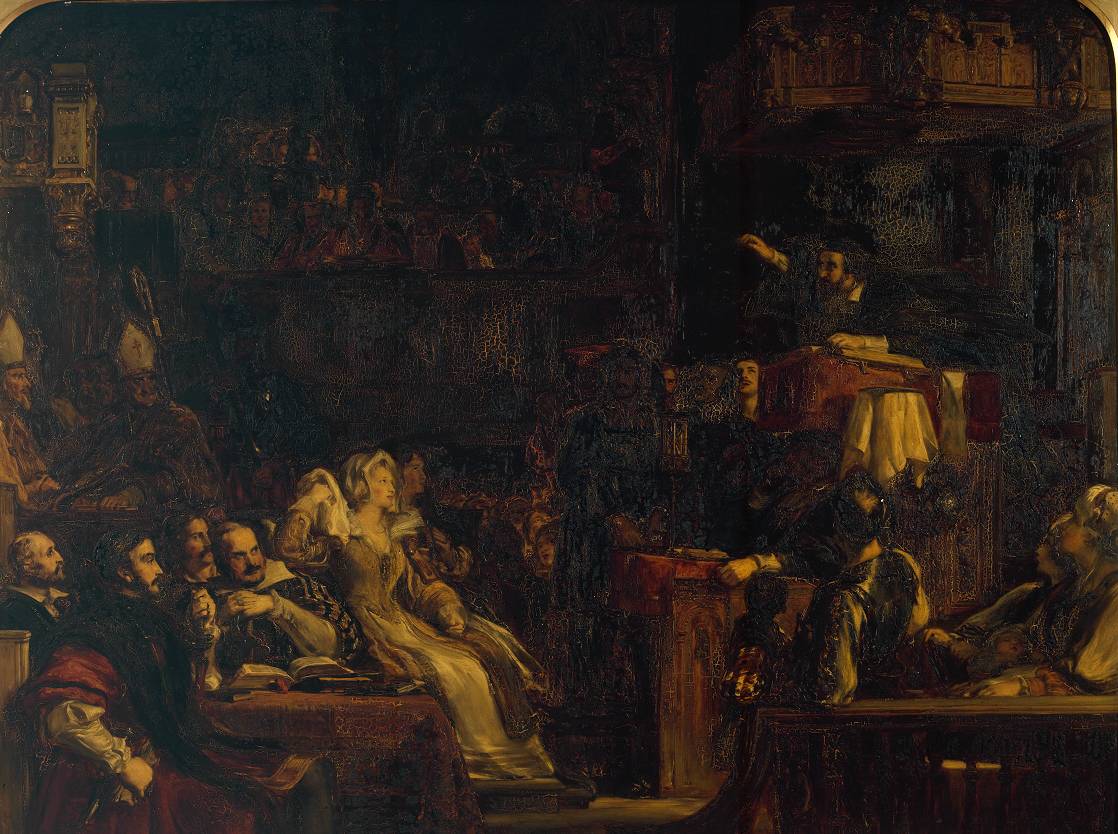
The Preaching of Knox before the Lords of the Congregation, 10th June 1559 1832 by Sir David Wilkie 1785-1841

At first blush there might not be much apparent difference between The Westminster Confession of Faith (WCF), The Belgic Confession of the Faith (BC), The Heidelberg Catechism (HC) and The Scott’s [sic] Confession 1560 (SC); but this requires further reflection. The ā€œWestminsterā€ tradition starts talking about God by highlighting his ā€œattributes,ā€ these are characteristics that are contrasted with what humans are not (analogia entis). We finally make it to God as ā€œFather, Son, Holy Spirit,ā€ but not before we have qualified him through ā€œourā€ categories using humanity and nature (analogia entis) as our mode of thinking about ā€œgodness.ā€ This is true for both the WCF and the BC. Jan Rohls provides a helpful insight on this when he speaks to the nature of the composition of many of the Reformed Confessions (including both the WCF and the BC):

It is characteristic of most of the confessional writings that they begin with a general doctrine of God’s essence and properties, and only then proceed to the doctrine of the Trinity. The two pieces ā€œOn the One Godā€ (De deo uno) and ā€œOn the Triune Godā€ (De deo trino) are thus separated from each other. . . .[3]

Nevertheless, this is not the case for all Reformed confessions and/or catechisms. We should consider the possibility of learning to read some confessions and catechisms together, relative to shared theological emphases.[4]

The Heidelberg Catechism and The Scots Confession both emphasize the Triune nature of God as Father; in other words, as Rohls notes above, these two statements do not separate God’s personal relations from his works or attributes—as does both The Belgic Confession of the Faith and The Westminster Confession of Faith. The emphasis of these documents is thus on the economic revelation of God in Christ as the ā€œeternal Son of Godā€ who exegetes God’s inner-life as loving Father of, Son, by the Holy Spirit as the shape of his being. James K. A. Smith picks up on this same reality as he comments on The Heidelberg Catechism, when he expresses his opinion that:

But I have to confess that when I discovered the Heidelberg Catechism, it was like discovering a nourishing oasis compared to the arid desert of Westminster’s cool scholasticism. The God of the Heidelberg Catechism is not just a Sovereign Lord of the Universe, nor merely the impartial Judge at the trial of justification; the God of the Heidelberg Catechism keeps showing up as a Father. For example, when expounding the first article of the Apostles’ Creed (ā€œI believe in God, the Father almighty, creator of heaven and earthā€), the Heidelberg Catechism discusses all the ways that God upholds the universe by his hand, but also affirms that this sovereign Creator attends to me, a speck in that universe. And it concludes the answer to question 26 by summarizing: ā€œHe is able to do this because he is almighty God; he desires to do this because he is a faithful Father.ā€ [5]

This illustrates the reason why, out of the Reformed Confessions and Catechisms, these reflect themes which are central to Evangelical Calvinism. It is the all important Doctrine of God embedded within these statements that Evangelical Calvinism believes is so important. In Smith’s words, it is the language of Father that should be emphasized; the Father of the Son by the Holy Spirit—or the Trinitarian nature of God. To repeat for sake of emphasis: according to Evangelical Calvinism, God is Father of the Son by the Holy Spirit—constituently—before he ever becomes or is known as Creator (Law-giver, etc.). God becomes Creator by a free act of gracious love for the other, and out of this free un-restrained act he graciously creates because he is a lover first; which shapes his creating (and saving and re-creating) activity in grace.

Thomas Torrance quite clearly understood how important this emphasis is to our understanding of God, especially as this is expressed in our confessional documents. He is worth quoting in full here:

Ā . . . in the Scots Confession as in John Knox’s Genevan Liturgy, the doctrine of the Trinity is not addedĀ on to a prior conception of God — there is no other content but the Father, the Son, and the Holy Spirit. There was no separation here between the doctrine of the One God (De Deo Uno), and the doctrine of the triune God (De Deo Trino), which had become Roman orthodoxy through the definitive formalisation of Thomas Aquinas. This trinitarian approach was inĀ line with The Little Catechism which Knox brought back from Geneva for the instruction of children in the Kirk. ā€œI believe in God the Father, and in Jesus Christ his Son and in the Holy Spirit, and look for salvation by no other means.ā€ Within this trinitarian frame the centre of focus in the Confession and Catechism alike is upon Jesus Christ himself, for it is only through him and the Gospel he proclaimed that God’s triune reality is made known, but attention is also given to the Holy Spirit. Here once again we have a different starting point from other Reformation Confessions. Whereas they have a believing anthropocentric starting point, such as in the Heidelberg Catechism, this is quite strongly theocentric and trinitarian. Even in Calvin’s Institute, which follows the fourfold pattern in Peter Lombard’s Sentences, the doctrine of the Trinity is given in the thirteenth chapter within the section on the doctrine of God the Creator. Calvin’s Genevan Catechism, however, understandably followed the order of the Apostles’ Creed. The trinitarian teaching in the Scots Confession was by no means limited to the first article for it is found throughout woven into the doctrinal content of subsequent articles.[6]

This delineates how Evangelical Calvinism substantially moves away from the Thomist doctrine of God presented by Classical Theism and Classical Calvinism. Torrance’s point on a wedge between the ā€œsingle substanceā€ of God versus the ā€œthrice personagesā€ of the Trinity within ā€œā€˜Classical’ Theologiesā€ is significant. In other words, as Torrance highlights, we should not start with a notion of ā€œgod,ā€ and then add on the hypostasis of the Trinity to that concept; instead Evangelical Calvinists believe, along with Torrance, that the ousia of God (de Deo uno) finds its shape in the coinhering inter-relations of the Father, the Son, and the Holy Spirit (de Deo trino).[7]


[1] Michael F. Bird, Evangelical Theology: A Biblical and Systematic Introduction (USA: Zondervan Publishing, 2013), 92-3.

[2] D. A. Carson and Timothy Keller, Gospel-Centered Ministry (Wheaton, IL: Crossway, 2011), 6 in Bird, Evangelical Theology, 93, n. 11.

[3] Jan Rohls, Reformed Confessions: Theology from Zurich to Barmen, (Louisville, Kentucky: John Knox Westminster Press, 1998), 48.

[4] Reading confessions and catechisms together is not a foreign practice in the Reformed churches, for example the Dutch Reformed church has, historically, read The Belgic Confession of the Faith, The Heidelberg Catechism, and The Canons of the Synod Dort together as an ecclesiological basis for ā€œunityā€ among the Reformed churches—known as ā€œThe Three Forms of Unity.ā€ Jonathan Neil Gerstner writes:

The Three Forms of Unity, the Belgic Confession, Heidelberg Catechism, and the Canons of the Synod of Dort, form the confessional basis of the Dutch Reformed Church. They also demonstrate how much the Dutch Reformed church was influenced by the broader Reformed community. The Canons of Dort were the only one of the three Dutch Reformed confessions composed in the Netherlands, and it included delegates from every Reformed church in Europe which were permitted to attend. The earlier two creeds reflect the two major strands of the Reformed tradition which merged in the Netherlands, the French and the German.

Ā Gerstner, The Thousand Generation Covenant, 11. For more discussion on various usages of the Reformed confessions and catechisms see Rohls, Reformed Confessions, 265–302. Given the subordinate nature of the Reformed confessions to Scripture, there is a flexibility that inheres with their relative usage. Just as the Dutch Reform church adopted three particular Reformed statements within the confessional framework; likewise, Evangelical Calvinists operate with the same liberty in appropriating The Heidelberg Catechism and The Scots Confession of Faith for theological purposes.

[5] Smith, Letters To A Young Calvinist, 55.

[6] Torrance, Scottish Theology, Ā 3–4.

[7] It is important to keep in mind that all ā€œProtestant Reformed Confessionsā€ intend on presenting a way to think about God that accurately captures who he has revealed himself to be. The point of contention then is not over an issue of intention, but instead whether or not the chosen philosophical apparatus actually allows some of these Confessions to present a doctrine of God that should be emphasized if in fact we are being sensitive to the Revelation of God in Jesus Christ; and all of the categories and emphases that are attendant with ā€œthatā€ Revelation.

‘From’ Christ, not ‘For’ Christ: “Why don’t you have a category for obedience?”

I have lots of people email (instead of comment) me about my various posts here at the blog. Recently I received an email from someone who wondered why I didn’t have a category (in my categories for the blog) designated as “obedience”? I haven’t emailed this person back yet, but I thought before I did that I would respond to this rather interesting observation here at the blog first (it seems fitting for me to do so).

adam-eve-garden-of-eden-1To start with, I do have a category entitled “ethics,” which deals with issues and instances of concrete instantiations of Christian obedience (or disobedience); and then I do deal with Christian obedience in many posts, but they aren’t under a specific category of “obedience,” but instead those can be found under the category of “salvation” (and then a lengthy process of weeding through this posts will ultimately yield results that show I have dealt with questions that are oriented around Christian obedience). But I would like to answer this question with more particularity, and clarity on why my blog does not emphasize this category (as important as it is!). My blog does not emphasize this category (in the way my interlocutor is wondering, I presume) because the way I think of our relation to God in Christ, has Christ in the way; and I mean in the way of you and me (logically, theo-logically). Historically, and classically, Evangelicals (given their hybrided dependence upon Reformed/Covenant theology) have emphasized relation with God through a mode of emphasizing law-keeping conditioned by forensic categories of thought (just read an Evangelical systematic theology if you don’t believe me). And insofar that I have eschewed this classical mode, I have abandoned emphasizing law-keeping (code for ‘obedience’, usually) as the emphasis by which I understood relationship with God, and how I conceive of Christian holiness (or obedience as its subsequent expression). To provide an example of where the Evangelical heritage comes from, theologically, in this regard; let me quote Kim Riddlebarger (a contemporary advocate of Covenant Theology, and member of the White Horse Inn radio broadcast, along with Michael Horton), as he sketches the original and lasting relationship and way that he (and the classically Reformed) think of how God and man (God/world) relate to each other through the Covenant of Works (or Creation):

[A]s redemptive history unfolded, the first Adam—the biological and federal representative of all humanity—failed to do as God commanded under the terms of the covenant of works. The Lord God said to Adam, “You must not eat from the tree of the knowledge of good and evil, for when you eat of it you will surely die” (Gen. 2:17). This covenant of works or, as some Reformed writers speak of it, the “covenant of creation” lies at the heart of redemptive history. Under its terms God demanded perfect obedience of Adam, who would either obey the terms of the covenant and receive God’s blessing—eternal life in a glorified Eden—or fail to keep the covenant and bring its sanctions down upon himself and all humanity. Adam’s willful act of rebellion did, in fact, bring the curse of death on the entire human race. This covenant of works is never subsequently abrogated in the Scriptures, a point empirically verified when ever death strikes. This covenant also undergirds the biblical teaching that for any of Adam’s fall children to be saved, someone must fulfill all the terms of the covenant without a single infraction in thought, word, or deed (Matt. 5:48; 1 Peter 1:16). [Kim Riddlebarger,Ā A Case for Amillennialism: Understanding The End Times,Ā 47.]

Much could be said in critique of this conception of things (and I have already said much, just check my category “critiquing classical Calvinism”), but in order to not get side-tracked from the point of this post, let me stay particular to my intention. In predictable form (since Covenant theology has Creation preceding Covenant), Riddlebarger allows Creation to condition Covenant instead of seeing Covenant (God’s life of gracious love) conditioning Creation (one serious fall out of this theological ordering is that Jesus becomes conditioned by creation instead of conditioning creation himself asĀ homoousion—I digress!). In other words, when Reformed thinkers like Riddlebarger, and his whole tradition, start theologizing and biblical exegeting they start where Riddlerbarger starts, with Law (or the Covenant of Works/Creation). And yet, as Ray Anderson has highlighted (along with others), what should be understood (first), is that God spoke and created (which is an act of grace as corollary with His overflowing life of Triune love). So what grounds any relation with God, first, is not Law-keeping, but the fact that God spoke (which is grace)! This might seem to be a subtle shift, but it is profound!

Following this shift of emphasis, what becomes primary is not my personal obedience (and Law-keeping), but God’s in Christ for us. As Thomas Torrance has written (as I just quoted this in a post below this one),

[…]Ā Under the gracious impingement of Christ through the Spirit there is a glad spontaneity about the New Testament believer. He is not really concerned to ask questions about ethical practice. He acts before questions can be asked. He is caught up in the overwhelming love of Christ, and is concerned only about doing His will. There is no anxious concern about the past. It is Christ that died! There is no anxious striving toward an ideal. It is Christ that rose again! In Him all the Christian’s hopes are centred. His life is hid with Christ in God. In Him a new order of things has come into being, by which the old is set aside. Everything therefore is seen in Christ, in the light of the end, toward which the whole creation groaneth and travaileth waiting for redemption. The great act of salvation has already taken place in Christ, and has become an eternal indicative. [see full textĀ here].

This does not mean that personal obedience is not important, but it frames it in a way that allows me to keep my eye on Christ instead of first looking at myself (and then reflexively looking at Christ: i.e. reflexive faith], as if I, myself, can somehow be abstracted out of the only true humanity which is Christ’s. So I “seek first His kingdom and righteousness, then all these other things will be added unto me” (and I only seek first, because He first loved (and sought) first that I might love Him, through Him by the Spirit). My relationship with God is not dependent upon my obedience, but Christ’s obedience for me (us); and so this ought to go along ways in illustrating why I don’t have a separate category (apart from Christology) for obedience in my sidebar. Thomas Torrance in his (posthumously published) bookĀ Atonement: The Person and Work of ChristĀ really captures the import of this shift and way of framing things from God’s gracious Self directed life for us in contrast to the Legalistic emphasis that the classical Covenant of Works flows from:

(iii) The holiness of the church is its participation through the Spirit in Christ’s holiness

Ā This holiness is actualised in the church through the communion of the Holy Spirit. He only is the Spirit of holiness, he only the Spirit of truth; and therefore it is only through his presence and power in the church that it partakes of the holiness of Jesus Christ. Since the holiness of the church is its participation through the Spirit in Christ’s act of self-consecration for the church, then that is the only holiness, the only hallowing of the church there is. That is the holiness which was actualised in the church when it was baptised with the Holy Spirit at Pentecost and the union of the church with Christ was fulfilled from the side of the church as well as from the side of Christ.

The church is not holy because its members are holy or live virtuous lives, but because through his presence in the Holy Spirit Christ continues to hallow himself in the midst of the church, hallowing the church as his body and the body as his church. Thus the true holiness of the members is not different from this but a participation in it, a participation in the holiness of Christ the head of the church and in the holiness of the church as the body hallowed by Christ. Participation in this holiness however involves for the members of the church a life of holiness, just as it involves a lifeĀ in Christ,Ā of faith relying upon his faithfulness, of love that lives from the overflow his love, of truth that comes from the leading of the Spirit. Because the church is the body of Christ in which he dwells, the temple of the Holy Spirit in which God is present, its members live the very life of Christ through the Holy Spirit, partaking of and living out the holy life of God. Therefore personal holiness, and all the qualities of the divine life and love found in their lives, are the fruits of the Holy Spirit. [Thomas F. Torrance,Ā Atonement,Ā edited by Robert Walker, 386-87.]

There is a lot to comment on here as well, but I must limit myself. I will just say that it is this reversal of things (i.e. placing the Covenant of Grace [God’s life Pre-destined]) from Law to Grace that explains why I don’t have a category explicitly labeled “obedience”. It isn’t because I don’t think Christian obedience is important, it is because I think the gr0und of this emphasis is roundly rooted in Jesus Christ for us (and thus I have a category for Christology instead). It isn’t that I don’t think personal obedience or holiness are important, I do! Instead, it is because I am persuaded that focusing on Christ and God’s Triune life of gracious love, and participating in that from the Spirit’s unioning activity will produce obedience and the life of Christ through the members of our bodies as they are constantly given over to the death of Christ that His life might be made manifest through the mortal members of our body. We obey, only because Jesus obeyed for us first. We don’t obey to ensure that we are one of the elect that God purchased from the mass of “perdituous” humanity; we obey because God loved us first that we might love Him back through the mediating and priestly Spirit anointed humanity of Jesus Christ. It is only through this framing of things that I feel I can live out this exhortation from St. Paul:

Ā It is for freedom that Christ has set us free.Ā Stand firm,Ā then, and do not let yourselves be burdened again by a yoke of slavery. ~Galatians 5:1

Without the freedom of God for us in Christ I live under a burdenouss yoke that really ends up being hell; which, I am pretty sure this is what Jesus came to save us from (ourselves), and for Himself (and His shared life in the Monarchia or God-head). So obey, but only from Christ by the Spirit, not for Christ so you can find God’s approval.

Silly Rabbit, Trix are for Kids: The Mythology of the Salvation-Atonement Distinction, ‘Sufficient for All, Efficient for the Elect’

Amongst the classically Reformed amongst us, it is common parlance to refer to a distinction, relative to the extent of the atonement of Jesus Christ (i.e. for whom did he die?, etc.), which goes like this: Christ’s death on the cross wasĀ sufficientĀ to save and redeem the whole world, but in reality it is onlyĀ efficientĀ to save the elect; those whom God gratuitously chose to be saved from before the foundations of the world. So there is recognition of the fact that God’s life in Christ for us has the potential capacity and power to save all, but it only has the actual reach to affect salvation in those whom God particularly chose to reach. There is a somewhat devious (I think) conception of God, and hisĀ willsĀ orĀ actsĀ that stands behind this kind of distinction between the ‘sufficiency’ of the atonement Versus its ‘efficiency’; maybe we will get into that at a later date.

TrixAreForKids

Following is part of an argument and description of this ‘distinction’ provided by R. Scott Clark of Westminster Theological Seminary California’s faculty; he writes of this sufficient/efficient dichotomy:

In the midst of controversy over the nature of God’s sovereignty, Godescalc of Orbais defended Augustine vigorously and suffered for it. He taught that there are two “worlds,” that which Christ has purchased with his blood and that which he has not. Thus when Scripture says that Christ died for the “world” (e.g., John 3:16) it is extensive of all those Christ has actually redeemed, but it does not include everyone who has ever lived.Ā 18Ā In the same way, those passages which seem to say that Christ died for all, in all times and places must but understood to refer to all the elect. Thus he saw 1 John 2:2 not as a problem passage, but a proof-text for definite atonement.19

The Lombard’s teaching on the atonement is most famous for his use of the distinction between theĀ sufficiencyĀ of Christ’s death and itsĀ efficiency. Though they are not familiar to many of us today, from their publication in the late 12th century until the late 16th century, Peter’sĀ SentencesĀ were the most important theological text in the Latin-speaking world. Theological students even earned Bachelor’s and Master’s degrees in theĀ Sentences.

In Book 3, distinction 20 he taught that Christ’s death was “sufficient” to redeem all (quantum ad pretii) but it is “efficient” only “for the elect” (pro electis).20Ā This distinction, though not followed by all Western theologians after Lombard, was adopted by most until the nominalist movement (e.g., William of Ockham, d. 1347) overturned the “Old School” (via antiqua).21

In his great work,Ā Summa Theologiae, Thomas distinguished between God’s will considered as hisĀ antecedentĀ will, by which he could be said to have willed the salvation of all; and his will considered asĀ consequent, i.e., what he actually decreed to exist, i.e., that only the elect would be saved and that some will be reprobated (damned).22Ā Later, Protestant theologians would revise this distinction to refer to his revealed and hidden will. With respect to his revealed will, God is said to desire certain things (i.e., that none should perish). It is his revealed will that we should know the existence of a hidden decree (who will be saved and who will perish) but the content of that decree is part of his hidden will.

Thomas also made it very clear that he adopted Lombard’s sufficient/efficient distinction but also taught unambiguously that Christ died effectively only for the elect.23Ā [full argument availableĀ here]

So as we can see, this distinction is a reality in theological parlance, first articulated by the seminal Roman Catholic theologian, Peter Lombard, in his infamousĀ SentencesĀ (which were the basis for subsequent Medieval and Protestant Reformed theologies to follow); and as observed, continue to have conceptual force for contemporary classically Reformed historians and theologians like Scott Clark. I thought of highlighting this distinction because I came across a rebuttal of it by Eastern Orthodox theologian David Bently Hart as I have been reading (10 pages from completion now) Matthew Levering’s bookĀ Predestination.Ā Reference is made to this ‘rebuttal’ of Hart by Levering in a footnote on the first page of the last chapter of the book. Let me share that now, and we will see what you think:

Hart, ‘Providence and Causality’, 47. Hart explains further: “This entire issue, of course, becomes far less involved if one does not presume real differentiations within God’s intention towards his creatures. For, surely, scripture is quite explicit on this point: God positively “wills” the salvation of “all human beings” (1 Tim. 2.4). That is, he does not merely generically desire that salvation, or formally allow it as a logical possibility, or will it antecedently but not consequently, or (most ridiculous of all) enable it “sufficiently” but not “efficaciously”. If God were really to supply saving grace sufficient for all, but to refuse to supply most persons with the necessary natural means of attaining that grace, it would mean that God does not will the salvation of all. If God’s will to save is truly universal, as the epistle proclaims, one simply cannot start from the assumption that God causes some to rise while willingly permitting others to fall; even if one dreads the spectre of universalism, one cat at most affirm that God causes all to rise, and permits all to fall, and imparts to all—the ability to consent to or to resist grace he extends while providentially ordering all things according to his universal will to salvation. Or, rather, perhaps one should say that God causes all to rise, but the nature of that cause necessarily involves a permission of the will’. [Cited by Matthew Levering,Ā Predestination,Ā 177-78 n. 2.]

I would like to elaborate further, especially on what Clark refers to as God’sĀ antecedentĀ andĀ consequentĀ will and how that relates to this soteriological distinction of ‘sufficient/efficient’. Hart, as you read his quotable, also refers to this supposed distinction between God’s ‘antecedent’ and ‘consequent’ will; apparently, and to be sure, it is this prior distinction, made by theologians, in God’s life that funds the conceptual hangers upon which these ‘theologians’ hang the ‘sufficient/efficient’ distinction relative to the extent of the atonement. Suffice it to say for now, to appeal to this sufficient/efficient distinction introduces a rupture or break into God’s life, into his will for us (I don’t like appealing to the language of ‘Will’, but I will for sake of discussion). The important thing, and this is what we as Evangelical Calvinists do, is to maintain a unity in God’s Triune life; so following Rahner, Barth, Torrance & co. the ontological TrinityĀ isĀ the economic Trinity (and vice versa)— or, there is a unity to God’s life. The ‘antecedent’ life of God is the ‘consequent’ life of God Self revealed in Jesus Christ—so then there is ‘no God behind the back of Jesus’! If we dispose of these ‘two-wills’ in God, then we dispose of the foundation upon which the sufficient/efficient distinction is built, where it lives, moves, and has its breath. And, if we follow Hart’s rebuttal of this distinction it is even more simply stated than I just did; i.e. it cannot be said that God genuinely wills the salvation of all, and at the same time hold that God only provides the means for some to be saved (unless you want to affirm prior to this discussion by logical priority, that God has such a thing as an ‘antecedent’ will and a ‘consequent’ wherein the former is somehow distinct from the latter—this has terrible problems, doctrine of God-wise for you–so I can understand why you want to fall back into a strict apophaticism and mystery at this point, but God’s Self-revelation in Christ won’t let you retreat so fast!). He either truly desires all to be saved or he doesn’t (paceĀ the modal law of logic: e.g. the law of non-contradiction).

We should discuss, at a later date, this idea and impact of God’s singular will, and the fact that who he is, how he acts in his inner (some would use the language of eternal) life, is exactly, univocally the same way he acts in Christ and the Holy Spirit in his outer life revealed in salvation history for us. We will talk about this soon, I have written on this in the past; but I will revisit it in the near future. Suffice it to say, ‘you don’t really believe that the atonement is sufficient for all, but only efficient for the elect’, do you? Silly rabbit, trix are for kids.

Placing Creation before Creator: Scripture before Jesus

Here is a video I have only watched 30 minutes of thus far (and don’t know if I’ll get further), it is a discussion hosted by doctoral student Camden Bucey with professor at Westminster Theological Seminary, K. Scott Oliphant and I believe Oliphant’s son (who is also connected with WTS). They are discussing, mostly, the doctrine of scripture and a theory of revelation; and of course they do so from a classically Reformed, and Westminster directed, understanding of this. In particular they are getting into the presuppositional approach of Cornelius van Til, and how this relates to his theory of revelation and scripture. One thing of note, a point that I disagree with them on, is that they collapse ‘Revelation’ into scripture (and thus absolutize the propositional and written words of scripture), and do not primarily associate Revelation with God’s Self-revelation in the person of Christ. This is not to say that they don’t think Jesus is an aspect of God’s revelation, it’s that they think that scripture, epistemologically, must precede Jesus so that we might ‘know’ that Jesus is indeed is revelation. So Jesus, in this approach becomes a predicate of scripture as revelation, instead of scripture becoming predicated as God’s Word only in and through its capacity to bear witness to Jesus, its reality and purpose (as is all of creation’s purpose, Jesus that is). So they show their methodological approach, clearly; they place creation (or scripture) before covenant, or God’s life; or they disconnect ontology from epistemology, or they don’t ground Creator/creature in the person of Jesus Christ. This is where, as a functional evangelical Calvinist, I move away from the classically Reformed; I want to move and breathe from the reality that Jesus is indeed the center, and that he precedes scripture’s giving and breathing as its reality from before historic time and into it as its ground and reality. Here is that video:

Creation, A Reason

In some of my posts, especially of late, we have been thinking about the Christian doctrine of Creation; as corollary, we have also been considering our relation to creation in and through Christ. The first step we ought to engage, in our consideration of such things; is to wonder about the God-world relation and what purpose he has always already intended for creation as the counterpoint to his gracious life of love, from which he created. It becomes quickly obvious, as we read the New Testament, and work out the theo-logical implications of Trintarian and Christo-logical assumptions, therein; that creation was created with Christ in mind, and us in Christ. So that God’s original intent, was in and through Christ, to bring all of creation (and humanity as the pinnacle of his creation) into his life of perichoretic (interpenetrating) love (self-giving, subject-in-distinction=Trinity). Scottish theologian, David Fergusson, helps us understand how all of this has played out in the history of interpretation:

The notion of ‘wisdom’ provides further evidence of the integration of creation and salvation in the Old Testament. As the creative agency of God, wisdom is celebrated in the Psalms, Proverbs, Job, and some of the deutero-canonical works. In some places, such as Proverbs 8, wisdom is personified as a divine agent. The divine wisdom by which the world is created is also apparent in the regularity of nature, the divine law, and human affairs. This notion of ‘wisdom’ is later fused with the Greek concept of ‘Logos’ and becomes vital for expressing the linking of creation and Christology in the New Testament. In the prologue to John’s Gospel the Word (Logos) of God is the one by whom and through whom the world is created. This Word which is made present to Israel becomes incarnate in Jesus Christ. In this cosmic Christology, the significance of Jesus is understood with respect to the origin and purpose of the created order. Already in Paul’s writing and elsewhere in the New Testament epistles, we find similar cosmic themes (e.g. 1 Cor. 8:6, Col. 1:15-20, Heb. 1:1-4). By describing creation as Christ-centred, these passages offer two related trajectories of thought. First, the origin and final purpose of the cosmos is disclosed with the coming of Christ into the world and his resurrection from the dead. Second, the significance of Christ is maximally understood reference to his creative and redeeming power throughout the created universe. Writers at different periods in the history of the church would later use this cosmic Christology to describe the appearance of the incarnate Christ as the crowning moment of history. No longer understood merely as an emergency measure to counteract the effects of sin and evil, the incarnation was the fulfillment of an eternal purpose. The world was made so that Christ might be born. This is captured in Karl Barth’s dictum that creation is ‘the external basis of the covenant’ (Barth 1958: 94). [David Fergusson, Chapter 4: Creation, 76-7 in The Oxford Handbook of Systematic Theology, edited by John Webster, Kathryn Tanner, and Iain Torrance]

In the history what David Fergusson is describing is known as the Scotist Thesis; viz. that the plan was always for Jesus to incarnate to bring humanity and creation into the divine dialogue and life of communion through union with the Son. The ‘Fall’ intensified the Incarnation in a way that is tragic, but rife with the redemptive hope of the resurrection and advent life! I follow the Scotist thesis on this front. My friend, brother in Christ, Evangelical Calvinist co-conspirator, and doctoral adviser, Myk Habets has written this to open up his essay entitled On Getting First Things First: Assessing Claims for the Primacy of Christ (Ā©The author 2008. Journal compilation Ā©The Dominican Council/Blackwell Publishing Ltd. 2008, 9600 Garsington Road, Oxford OX4 2DQ, UK, and 350 Main Street, Malden MA 02148, USA DOI:10.1111/j.1741-2005.2008.00240.x):

According to Christian tradition Jesus Christ is pre-eminent over all creation as the Alpha and the Omega, the ā€˜beginning and the end’ (Rev 1.8, 21.6; 22.13). This belief, when theologically considered, is known as the primacy of Christ.1 The specific issue this doctrine addresses is the question: Was sin the efficient or the primary cause of the incarnation? This essay seeks to model the practice of modal logic in relation to the primacy of Christ, not to satisfy the cravings of speculative theologians but to reverently penetrate the evangelical mystery of the incarnation, specifically, the two alternatives: either ā€˜God became man independently of sin,’ or its contradiction, ā€˜God became man because of sin’. . . .

Wouldn’t you agree that ‘the world was made so that Christ might be born’?

15Ā He is the image of the invisible God, the firstborn over all creation. 16Ā For by Him all things were created that are in heaven and that are on earth, visible and invisible, whether thrones or dominions or principalities or powers. All things were created through Him and for Him. 17Ā And He is before all things, and in Him all things consist. 18Ā And He is the head of the body, the church, who is the beginning, the firstborn from the dead, that in all things He may have the preeminence. 19Ā For it pleased the Father that in Him all the fullness should dwell, 20Ā and by Him to reconcile all things to Himself, by Him, whether things on earth or things in heaven, having made peace through the blood of His cross. 21Ā And you, who once were alienated and enemies in your mind by wicked works, yet now He has reconciled 22Ā in the body of His flesh through death, to present you holy, and blameless, and above reproach in His sight— 23Ā if indeed you continue in the faith, grounded and steadfast, and are not moved away from the hope of the gospel which you heard, which was preached to every creature under heaven, of which I, Paul, became a minister. ~Colossians 1:15-23

John Calvin contra ‘two wills in God’ Methodology

Here is J.K.S. Reid in hisĀ IntroductionĀ to his translation of John Calvin’sĀ Concerning The Eternal Predestination of God.Ā He is concerned with underscoring Calvin’s procedure of thought and method per his ā€œsystemā€ of things. Calvin’s appropriation by the post-Reformed (those who followed Calvin, through Beza, Zanchi, Perkins, Ames, and others) is a very ā€œlogicā€ driven system of coherence; i.e. they ā€œfinish offā€ where Calvin supposedly ā€œleft off.ā€ Certainly they could’ve, but then again they ā€œcould’ve not.ā€ This alerts us to the reality that Calvin, given his procedure, is open to multi-appropriations, which would explain why, in the history, there in fact are multiform articulations on Calvin’s theological trajectories — thus the existence of ā€œEvangelical Calvinismā€ in Scotland, and what Janice Knight has calledĀ The Spiritual BrethrenĀ in Old England (where they predominated for a time), and New America (where they were overshadowed byĀ The Intellectual Fathers,Ā or Federal/Classic Calvinists). Here is Reid:

. . . A good deal of nonsense is talked about Calvin, as though his system were logical in the sense of being rounded off and complete; and the statement by frequent repetition has become almost a commonplace. In fact his system has not this character at all. It is certainly logical in the sense that the argument moves carefully step by step from one point to the next. But, to do it justice, it must beĀ recognized as including elements not easily (or at all) capable of being harmonised — aĀ complexio oppositorum,Ā as H. Bauke says of it (see J. T. McNeill,Ā The History and Character of Calvinism,Ā Oxford University Press, New York, 1954, p. 202). Of special relevance to the purpose here is the following example. Pighius objects to Calvin that the dominical command to preach the Gospel universally conflicts with the doctrine of special eleciton (§VIII. I). Calvin’s brief answer to this conundrum is that Christ was ordained for the salvation of the whole world in such a way that only those who hear are saved. The universality of the grace of Christ is symbolised by a promiscuous preaching of the Gospel; the universality of the Mediator is paralleled by the universality of the call to penitence and faith. But at this point the harmony ends; the offer of salvation is made equally to all, but salvation itself is for those who are elect. It is the bare bones of the argument, then, that are exposed, even if the result manifests a certain awkward untidiness. There is no attempt to compel harmony or to systematise by force. That there is a consequent practical difficulty is obvious; and it is one which, whatever Calvin thought of it, was compelling enough to drive his opponents into another camp. The situation for Calvin is not really significantly relieved by what he adds to the argument. The universal offer of the Gospel does indeed have a meaning for those in whose case it is not effective. Quoting St Paul, Calvin says that for them it can only be a ā€œsavour of death unto death.ā€ The logicality of the exposition is so far preserved that the universal offer of salvation has at least some effective consequence in all cases. But the parallelism on analysis is found to be specious; the awkward untidiness reappears at a different point. It does not now consist in the fact that the same offer of the Gospel sometimes has and sometimes has an effect commensurable with its nature and with the purpose with which God designed it, and that sometimes, on the other hand, it has a quite opposite effect, incommensurable with its nature and the saving purpose of God — it precipitates death instead of life, destruction in place of salvation. This goes to show that Calvin’s first loyalty is directed, not to formal adherence to abstract logicality, but to the facts of the case and situation as he conceived them, or rather as he conceived the Scriptures to depict them. The logicality of his thought is dedicated not to the formation of a system, but rather to the eliciting of the meaning and the implications of those facts which, as it seemed to him, belong the body of Christian truth. (John Calvin, trans., J.K.S. Reid, ā€œConcerning The Eternal Predestination Of God,ā€ 13-14)

This fits well with Charles Partee’s point on Calvin as a ā€œconfessor,ā€ more than a dogmatician; Calvin certainly had a logic and method to his theologising, but it was driven by his ineluctable commitment to say what scripture says — even if coherence remains tenuous. Richard Muller and his followers, and those he follows in the history of post-Reformed orthodoxy, have sought to provide, by and large, the ā€œrounded-offness,ā€ or logical coherence to Calvin’s enthymemic (unstated premises) articulation. It is this crux upon which this school claims to be orthodox, its orthodoxy is proximate to its genealogical lineage to Calvin himself (and of course, Muller and co. also claim that the lineage that ā€˜orthodoxy’ stems from is broader than Calvin himself, nevertheless, Calvin plays a significant role in this regard, definitionally); or so goes the thinking. Of course this claim remains questionable at best, since enthymeme is by definition ā€œunstated;ā€ the danger with discerning the unstated is that we might ā€œstateā€ where or what Calvin, in this instance, never intended.

Since, if as Reid has stated, the ā€œlack of logicalityā€ is real in Calvin; the door is open for, as stated before, multiform appropriation of Calvin. My contention is not that the ā€œorthodoxā€ don’t have a credible claim on Calvin, instead that their’s is not to be understood as exclusive. The history of ā€œCalvinismā€ bears witness to this, amen, amen!

P.S. The theology that Reid brings up in the quote will have to be addressed at a later date, it is substantial.

*Repost: There has been some concern with my post on Matt Chandler’s and John Piper’s ‘two wills in god’ theology. The concern has been driven by a commenter named “Bri,” and another named “Jeremy” (whose comment I deleted, and whom I have banned for the moment from commenting at the blog given his assertions about my status of acting like a believer or not relative to how I responded to Bri … I found his comment to be unnecessary and ad hominen, and not something I am willing to allow at the blog; but he too, like Bri, have argued (rather pragmatically) for a two wills theology. I say pragmatically because both of their rationale is driven by the kind of rationale that John Calvin (according to Reid’s account and Partee’s) bucked in his own approach. In other words, when there is tension in the teaching of Scripture then it is best, by way of method, not to abstract a methodology from that tension and then impose that back upon God; that’s not following a scientific method of theology that takes its cues from what has been Revealed, but instead it is to shape God into our image answering our questions the way we have constructed them. This is why I am reposting this, because it illustrates, at least for Calvin (if Reid and Partee are right, which I think they are) how we just need to live with confessional tension versus scholastic math. **Jeremy, if you’re reading this, reconsider how you want to interact on the blog, and I might reconsider letting you interact here at the blog.

§3. Matt Chandler’s and John Piper’s ā€˜two-willed god’: There is a history!

*To catch up read my first and second installments, 1) here and 2) here.

II

This is my second installment (well third really) on Matt Chandler’s and John Piper’s ā€˜two-wills in God theology’. My last post on this sought to introduce us to the way that John Piper, in particular, and Chandler otherwise, understand a concept that they both articulate as ā€˜The TwoWills of God’. I registered my concern in that last post about where this approach leads, because of where it comes from; and because of what it implies about God’s nature, and how he relates to his creation (us) in what has been called salvation history. This post will briefly sketch the aspect of where Ā two wills in God theology came from; my next and last post in this mini-series will detail what the implications are of this approach (for Christology, soteriology [study of salvation], etc.), and in this detailing I will offer what I think is a corrective—which of course is what we advocate for as Evangelical Calvinists.

The history of two-wills in God theology can be seen given definition through the thought processes of a medieval theologian named William of Ockham. He believed, in a nutshell, that God was one way in eternity (God’s so called ā€˜absolute will’), and another way in time-space salvation history (God’s so called ā€˜ordained will’). What this does is introduce a wedge between the God of eternity and the God of spacio-temporal time; meaning that the God we see revealed in Jesus Christ could potentially be different than the God behind Jesus back up in eternity (understand that I am speaking in oversimplified ways and rather crudely)—or, there is no necessary link between how God acts in eternity, and how God acts in time. The result of this is to place a rupture into the very being of God. Here is how Steven Ozment summarizes Ockham’s view (and he also quotes a bit of Ockham for us); we will quote this at some length:

Ockham’s reputation as a revolutionary theological thinker has resulted from the extremes to which he went to establish the contingent character of churches, priests, sacraments, and habits of grace. He drew on two traditional sources. The first was Augustine’s teaching that the church on earth was permixta, that is, that some who appear to be saints may not be, and some who appear not to be saints may in fact be so, for what is primary and crucial in salvation is never present grace and righteousness, but the gift of perseverance, which God gives only the elect known to him. Ockham’s second source was the distinction between the absolute and ordained powers of God, the most basic of Ockham’s theological tools. Ockham understood this critical distinction as follows:

Sometimes we mean by God’s power those things which he does according to laws he himself has ordained and instituted. These things he is said to do by ordained power [de potential ordinata]. But sometimes God’s power is taken to mean his ability to do anything that does not involve a contradiction, regardless of whether or not he has ordained that he would do it. For God can do many things that he does not choose to do. . . . The things he is said to be able to do by his absolute power [de potential absoluta]. [Quodlibeta VI, q. 1, cited by Dettloff, Die Entwicklung der Akzeptations- unde Verdienstlehre, p. 282, and Courtenay, ā€œNominalism and Late Medieval Religion,ā€ p. 40.]

Ockham seemed to delight in demonstrating the contingency of God’s ordained power—what God had actually chosen to do in time—by contrasting it with his absolute power, the infinite possibilities open to him in eternity. According to his absolute power, God could have chosen to save people in ways that seem absurd and even blasphemous. For example, he could have incarnated himself in a stone or an ass rather than in a man, or could have required that he be hated rather than loved as the condition of salvation. . . .[1]

In order to keep this brief enough I will not elaborate too much, but let me give some reasons why I think this is important to know; and also for whom I am presenting this in the main:

1)Ā Ā Ā Ā Ā  I am introducing this for folks who have never had a Reformation Theology class in seminary, for example. So this is intended to provide exposure for all of those who have been unexposed heretofore.

2)Ā Ā Ā Ā Ā  My hope is that because of said exposure, the reader will understand that there is something more going on when they hear Piper and Chandler articulate two wills in God theology. In other words, the way that both Piper and Chandler present this, to the uninformed; the parishioner will walk away thinking that what Chandler just said about two wills in God is simply Gospel biblical truth without reservation or anyway to critically consider this. So my goal is rather minimal by reproducing Ozment’s thought for you; my goal is simply to alert the attentive reader and thinker that there is something more than ā€˜biblical truth’ going on in the in-formation of Piper’s and Chandler’s view on this particular topic.

3)Ā Ā Ā Ā Ā  I want the read to understand that there is a particular problem associated with thinking in these kind of Nominalist ways (which is what the philosophy is called that Ockham articulates) about the nature of God. As I noted earlier, it creates a potential schism (indeed necessary) between the God of eternity and the God of time revealed in Jesus Christ; so as my favorite theologian says (along with Barth before him), we end up ā€˜with a god behind the back of Jesus’ who is not necessarily the same God we see revealed in Jesus (so when Jesus says in John 14 that ā€˜when you see me you see the Father’, that may or may not be true according to the implications and logic associated with a two-wills in God theology).

Conclusion

My next and final post in this series will expand on the problems associated with this approach; elaborating upon my parenthetical point in point three in the aforementioned. I will notice how this approach, which is purported by both Piper and Chandler to resolve some apparent tensions in scripture; instead exacerbate things in scripture by undercutting the most important point and touchstone we work from as Christians—that is what has been called a Theology Proper or Doctrine of God. If we get this point wrong—e.g. who God is—then the rest of our theological thinking and biblical interpreting will be found to be built on sandy beaches and not the rocky jetty that will stand under the most tumultuous theological storm waves one could fathom.


[1] Steven Ozment, The Age of Reform 1250-1550: An Intellectual And Religious History Of Late Medieval And Reformation Europe, (New Haven and London: Yale University Press, 1980), 18.