On a James Whitean and Leighton Flowersian Naked Reading of the Bible

Thumbnail created originally by Leighton Flowers (Caleb)

I was listening to James White live today on his Dividing Line vlogcast, and what he reinforces over and over is that he is what some are calling a ‘biblicist,’ or what I would identify as a solo Scriptura or nuda Scriptura proponent, as far as the way that he approaches Scripture. In this way, James White and his archnemeses, Leighton Flowers, ironically affirm the same bibliology and its attending hermeneutic. It is both modern, postEnlightenment, and Lockean (i.e., tabula rasa) in orientation. That is, it sees Scripture and its reception in a historicist frame of reference. This frame leaves the history of interpretation (i.e., creeds, confessions, catechisms etc.) in the dust, in regard to how White and Flowers receive Scripture. This ironically lends itself to a modernist-naturalist appropriation of and engagement with Holy Scripture, insofar that the Bible, in such a frame, seems to be a ‘white-slate’ wherein the interpreter has some type of objectivist angle into its exegesis.

The aforementioned is problematic for a variety of reasons. One prominent reason is that it ends up working from a petitio principii (circular reasoning). That is to say, it presumes: 1) My interpretation just is the objective reading of the Bible, 2) my interpretation of the Bible is a five-point Calvinist reading of the Bible, 3) therefore the objective reading of the Bible just is a five-point Calvinist reading (or just replace five-point Calvinist with Provisionist reading in Flowers’ case). What this approach fails to appreciate, for one, is that nobody approaches Scripture as a presuppositionless blank-slate; human agents are subjects, and as such we bring a variety of preunderstandings and unchecked a priori commitments to theological paradigms as we read Scripture. We could call this the “hermeneutical dilemma.” Neither James White nor his compadre, Leighton Flowers, acknowledge this. And thus, all that they are left to do in their respective debates and correspondences is to sling Scripture right past each other; never critically identifying or checking their theological a prioris at the frontend of their respective readings of Scripture.

But like I was noting, James White, today, as he was talking, in this case about Catholicism, made an absolute distinction between reading Scripture and the history of interpretation of Scripture; as if they inhabit two distinct silos. But they don’t inhabit two distinct silos, instead the history and the biblical exegesis are mutually implicating realities; insofar that human agents are subjectively reading and receiving the text of Holy Scripture. Until White and Flowers can admit this, and until all of their acolytes can come to grasp this, this whole “debate” between them, on five-point Calvinism versus Provisionism, will remain a futile endeavor. Unfortunately, they have many followers, respectively, who they are doing a disservice to. They are teaching young and biologically old, in some cases, Christian hearts and minds to read Scripture rationalistically rather than confessionally (and thus Christologically and Trinitarianly).

In closing, let me refer us to Matthew Levering’s sketch on the Whitean and Flowersian reading of Scripture (viz., what he writes indirectly critiques the Whitean-Flowersian combine of biblical interpretation); as far as its intellectual development and background go. Here Levering also offers an alternative approach that is participatorily grounded in a genuinely christologically and trinitarianly conditioned reading of Holy Scripture.

What happens, then, when Scripture is seen primarily as a linear-historical record of dates and places rather than as a providentially governed (revelatory) conversation with God in which the reader, within the doctrinal and sacramental matrix of the Church, is situated? John Webster points to the disjunction that appears between “history” and “theology” and remarks on the “complex legacy of dualism and nominalism in Western Christian theology, through which the sensible and intelligible relams, history and eternity, were thrust away from each other, and creaturely forms (language, action, institutions) denied any capacity to indicate the presence and activity of the transcendent God.” Similary, Lamb contrasts the signs or concepts that can be grasped by modern exegetical methods with the moral and intellectual virtues that are required for a true participatory knowledge and love the realities expressed by the signs or concepts. Lacking the framework of participatory knowledge and love, biblical exegesis is reduced to what Lamb calls “a ‘comparative textology’ à la Spinoza.” Only participatory knowledge and love, which both ground and flow from the reading practices of the Church, can really attain the biblical realities. As Joseph Ratzinger thus observes, the meaning of Scripture is constituted when

the human word and God’s word work together in the singularity of historical events and the eternity of the everlasting Word which is contemporary in every age. The biblical word comes from a real past. It comes not only from the past, however, but at the same time from the eternity of God and it leads us into God’s eternity, but again along the way through time, to which the past, the present and the future belong.

This Christological theology of history, which depends on a metaphysics of participation inscribed in creation, provides the necessary frame for apprehending the true meaning of biblical texts.

In short, for the patristic-medieval tradition and for those attuned to it today, history (inclusive of the work of historiography) is an individual and communal conversation with the triune God who creates and redeems history—and the Bible situates us in history thus understood. (Levering, 23)

Reading the Bible Theologically versus Naturalistically

It has become almost self-evident that the way Christian persons are to interpret Holy Scripture comes from reconstructing history; through philological acumen; the ability to understand grammatical syntax, etc. While all of this, and more, is important towards culling the heft and riches of Scripture’s intent, in relation to its reality, Jesus Christ, it is not the only way to frame, nor I will suggest, the primary way we should approach the interpretation of the Bible.

jeromebible

And since I want this post to be meaningful, in a contemporary sense, I want to focus, once again, on how the above has been being played out at a popular level; particularly in and among Progressive Christians (which is a continuum of belief, no doubt) relative to Biblical interpretation. Suffice it to say, that the popular way, and not just for the Progressive Christians, to interpret Scripture is indeed by flattening Scripture out to a reduction of historical vignettes that are purely naturalist in orientation. In other words, the Providence of God, and his life in Christ as the telos or purposeful ground for all of reality, inclusive of biblical reality and history, is no longer considered viable when constructing a hermeneutical theory alongside a text-critical apparatus. What I am suggesting in this post, is that this has deleterious consequences for the way that we as modern Christians conceive of a theory of authority (i.e. God and his Word), alongside, as corollary, a theory of history.

The theory of history that has become the dominant one among modern day Christian biblical exegesis is purely ‘linear’ (we will explain what this is just below). As Hans Frei has noted according to Matthew Levering, in regard to biblical vitality for us today: “[biblical history] can be brought to the highest degree of probability or the greatest possible moral certainty in accordance with all the logical rules of a historical proof” (Levering, 21). So, again, the Bible no longer is situated, by way of its ontology (i.e. in its ordered relation to God’s providential relation to the world) within God’s purposeful orientation, in Christ, for history; instead human history has become a naturalist thing, something that belongs to humanity as its own end. As such, when Scripture is placed into this ‘linear’ or human-alone matrix for understanding the relevance of history, it no longer has the possibility of being primarily steered by God’s providence and life-imbuing meaning; instead we (humanity) gets to decide what Scripture means, and this based upon our reconstructions of natural/human history as ends in themselves. In summary, then, the linear theory of history has abstracted humanity and ‘natural’ history from God’s life as the ultimate and primary ground of all reality and history. Modern day Christian exegesis is attempting to take this linear approach, do the ‘natural’ work of historical reconstruction, and then stuff God back into that conception of things (i.e. natural theology).

Matthew Levering in his very insightful way brings everything we have been sketching above together; he helpfully draws out the implications of following this naturalist linear theory of history, and its impact upon us modern day Christian exegetes. In his way, Levering asserts a better way forward, one of ‘participatory history,’ a theory that ought to ground the linear way, and bring us back to a submissive reading of Scripture wherein God’s life is the ultimate res or reality for a truly principled Christian reading practice of Holy Writ. Levering writes:

What happens, then, when Scripture is seen primarily as a linear-historical record of dates and places rather than as a providentially governed (revelatory) conversation with God in which the reader, within the doctrinal and sacramental matrix of the Church, is situated? John Webster points to the disjunction that appears between “history” and “theology” and remarks on the “complex legacy of dualism and nominalism in Western Christian theology, through which the sensible and intelligible relams, history and eternity, were thrust away from each other, and creaturely forms (language, action, institutions) denied any capacity to indicate the presence and activity of the transcendent God.” Similary, Lamb contrasts the signs or concepts that can be grasped by modern exegetical methods with the moral and intellectual virtues that are required for a true participatory knowledge and love the realities expressed by the signs or concepts. Lacking the framework of participatory knowledge and love, biblical exegesis is reduced to what Lamb calls “a ‘comparative textology’ à la Spinoza.” Only participatory knowledge and love, which both ground and flow from the reading practices of the Church, can really attain the biblical realities. As Joseph Ratzinger thus observes, the meaning of Scripture is constituted when

the human word and God’s word work together in the singularity of historical events and the eternity of the everlasting Word which is contemporary in every age. The biblical word comes from a real past. It comes not only from the past, however, but at the same time from the eternity of God and it leads us into God’s eternity, but again along the way through time, to which the past, the present and the future belong.

This Christological theology of history, which depends on a metaphysics of participation inscribed in creation, provides the necessary frame for apprehending the true meaning of biblical texts.

In short, for the patristic-medieval tradition and for those attuned to it today, history (inclusive of the work of historiography) is an individual and communal conversation with the triune God who creates and redeems history—and the Bible situates us in history thus understood. (Levering, 23)

Conclusion

We have covered a lot of ground, and too quickly (but such is the medium). In conclusion I simply want to assert that there are better ways to approach the interpretation of the Bible over and against what we have been told is the only way to interpret the Bible today as modern Christians (typified, popularly by Progressive Christians); i.e. in the linear alone frame (as described above). Clearly, we have more work to do if we really want to understand what reading the Bible from a participatory frame of knowledge is all about. We have seen in the quote from Levering that there is a complex of factors involved in the history of ideas that have led us to where we are today; yet even though there is this complex it is possible to identify general shifts in trajectory that have led us here to where we are, even now. Nominalism was mentioned by Levering, that is key to understanding things further. We will have to unfold that later. But even better you could pick up Matthew Levering’s book Participatory Biblical Exegesis: A Theology of Biblical Interpretationand feast.

*repost


Thinking About the Intermediate Status: What Happens After We Die?

I am continuing to slowly read Matthew Levering’s book Jesus and the Demise of Death: Resurrection, Afterlife, and the Fate of the Christian. Levering is a Catholic thinker, an Aquinas expert, and as such thinks from this direction. Even so (haha), he offers some really excellent commentary on some very important theological topics. In this instance the issue is ‘death.’ I wanted to share something from him on the ‘intermediate state,’ or the status that obtains upon the death of a Christian person (or non-Christian, for that matter). Here we are at the end of one of his opening chapters where he has been sketching various approaches to this matter; approaches presented by important thinkers such as NT Wright, Pope Benedict XVI, Hans Urs von Balthasar, Thomas Aquinas et al. Let’s read his concluding remarks on these various sketches:

Wright emphasizes the eschatological renewal of space, time, and matter; he fears eschatologies that overspiritualize our future with God. At the same time, he holds that the New Testament attests to an intermediate state in which the dead are conscious prior to the general resurrection. He portrays this intermediate state as a place of uneventful happiness, and he denies that the intermediate state involves purification. By contrast, Balthasar envisions Christ experiencing all sin in solidarity with the damned in Sheol. Numerous Fathers, followed by Metropolitan, Hilarion, understand the intermediate state as marked by Christ’s preaching, opening up the possibility that those who reject Christ in this life may accept him in the intermediate state.

Aquinas likewise affirms the existence of an intermediate state. At the moment of his redemptive death, Jesus entered into the intermediate state and liberated the holy people of God who were waiting for him. His resurrection thus reveals the vindication not only of Jesus, but also of the people of God who welcome Jesus as the messianic King. The happiness of those who welcome him accounts for Jesus’ promise to the good thief that “today you will be with me in Paradise” (Luke 23:43) and for Paul’s remark that he “would rather be away from the body and at home with the Lord” (2 Cor 5:8). Although people can be happy in the intermediate state, nonetheless death retains its bitterness: Jesus experienced the separation of body and soul as a profound privation. In this regard at least, Aquinas’ position is not contrary to Calvin’s view that Jesus’ “descent into hell” describes his suffering the terrible penalty of death on behalf of all sinners.

Aquinas’ connection of Jesus’ entrance into the intermediate state with the vindication of holy Israel avoids Wright’s otherworldly portrait of inactive sameness. At the same time, Aquinas’ position does not overly historicize Jesus’ presence in the intermediate state. Jesus works in the intermediate state by the power of his Passion without having to undertake a new ministry or undergo further desolation. When Christ the king arrived in the intermediate state to await his resurrection as the first-fruits of ours, the joyful passage of faithful Israel—of all who “died in faith, not having received what was promised, but having seen it and greeted it from afar, and having acknowledged that they were strangers and exiles on the earth” (Heb 11:13)—had indeed begun.[1]

We see Levering, rightfully in my view, offering some critique of Wright’s overly-horizontalized depiction of the eschatological reality through Aquinas’s more metaphysically informed view. But that is not ultimately what I want to press. I simply wanted to broach this topic as an important piece of contemplation that seemingly most Christians (in the churches) never are exposed to. But this shouldn’t be so!

Clearly, there is a lacuna in the church’s teachings in regard to an issue that the global world is confronted with on a daily basis. We all suffer the losses of death, one way or the other and finally ultimate death as we succumb to whatever it is we are going to succumb to in regard to our last breath on this earth. I think it is an important to think about what we will face after we are absent from this body, present with the Lord. What in fact does ‘present with the Lord’ entail, particularly in the in-between time that the so called intermediate state symbolizes? Is the ‘life after life’ (as Wright notes it) just ‘more of the same’ just elevated? According to Levering and his Aquinas, no, the after-life and the eschatological consummate life to come, yet future, even for those in intermediate status, is of a greater sort; it is of a qualitative difference of the sort that only eyes of faith might begin to apprehend (which I agree with).

We will be engaging with this topic further in the days to come. But I wanted to register this now, so you, the reader, can start thinking about this issue. I will say this: “If Christ be not risen we are of all people most to be pitied.”

[1] Matthew Levering, Jesus and the Demise of Death: Resurrection, Afterlife, and the Fate of the Christian (Baylor University Press, 2012), 43 Scribd version.

Apostolic Succession, Theories of Ecclesial Authority, and Biblical Exegesis: Miscellanies

As I noted on my FaceBook wall I am planning on writing a mini-exegetical paper on the doctrine of Apostolic Succession, as held to by both Roman Catholics and the Eastern Orthodox in their own respective and distinct ways (i.e. please don’t think I’m assuming that RC and EO are just different sides of the same coin, I’m not. But they do share a similar view of Apostolic Succession in regard to their theory of the church and theory of authority). My exegetical paper will be an analysis of the locus classicus texts found in both Matthew 16 and 18. I will argue how and why 16 should be read in tandem with 18, and if read in this way, paying attention to the Greek grammar, the idea of Apostolic Succession is severely undercut; at least in the Dominical teaching of Jesus Christ. But my ultimate conclusion will remain chastened to the reality that Apostolic Succession and its attendant theory of the church is more complex than simply defeating it through an exegetical analysis of some Matthean texts.

The above noted, in this post I simply want to share something from Matthew Levering’s book Engaging the Doctrine of Redemption. In his introductory remarks he offers a quote from a Catholic scholar named O’Collins (of course that’s his name!); O’Collins is delineating how he sees tradition, church, and scripture working together as an organic whole. I thought something like this would be good to share particularly in light of my forthcoming paper on Apostolic Succession. Levering writes:

Regarding Tradition, O’Collins first shows that its practical necessity has been ecumenically accepted, and so the question now is how to distinguish authoritative Tradition. With respect to the relationship between Scripture and Tradition, he points out that “if the community’s tradition, along with the inspiration of the Holy Spirit, led to the formation of the Scriptures, one would expect tradition to remain active in interpreting and applying the Scriptures.”⁵⁵ The Bible in this sense cannot be separated from the Church, even though, as Dei Verbum affirms, the Church’s magisterium serves the scriptural word of God rather than the other way around. The Holy Spirit’s guidance of the Church includes working through the bishops (including uniquely—the bishop of Rome), rather than simply working through “individual believers reading the Scriptures, preachers expounding the Scriptures, and ministers using the Scriptures in administering the sacraments.”⁵⁶ It is the Holy Spirit that enables the Church to hand on Tradition—that is, to hand on the entirety of what has been revealed in Jesus Christ. O’Collins discusses eight elements that guide the Church and individual believers in discerning the true content of this Tradition: the magisterium, the Vincentian canon, the “sensus fidei,” continuity with the apostolic Church, the Nicene and Apostles’ Creeds, apostolicity, Scripture, and the risen Lord. He remarks that the Church of each generation inevitably hands on Tradition in a somewhat different form from that in which it had been received, although “an essential continuity is maintained.”[1]

This thickens things a bit, at least in regard to how I might be writing my mini-exegetical paper on Matthew 16 and 18. At the least it illustrates how my exegesis of Matthew 16 and 18 will not be the silver bullet in undercutting a doctrine of Apostolic Succession; my goal is not that triumphant. Really what I’m hoping to accomplish with my paper is to simply have something I can refer to, online, when I encounter people who appeal to that as proof positive for Apostolic Succession.

In regard to what I just shared from Levering and O’collins, it might be somewhat difficult to overcome the theologic being articulated if someone like Karl Barth hadn’t come along. Yes, the whole Post Reformed orthodox period of development has many direct responses to all of these claims and theologic provided for by Levering/O’Collins, with particular reference to the Scripture principle (which Barth himself appeals to in his book The Theology of the Reformed Confessions and in his CD etc.) and Sola Scriptura, but honestly I really don’t think Post Reformed orthodox theology (think of the work of Richard Muller and his Post Reformation Reformed Dogmatics) has the actual ecclesiological chops to move away from the pressure provided by the theologic of Levering/O’Collins. In other words, I think any theology that appeals to natural theology will have a hard time escaping the ecclesiocentric approach to things that Rome is funded by; the Westminster Reformed types have the same ecclesiocentrism present in their theology. It is Barth, and really, modernity itself that supplies the type of theological escape route that one needs to be able to critically move away from the type of ecclesiocentrism that we find in both Rome and Post Reformed orthodoxy (with its heavy reliance upon its Confessional magisterium etc.).


[1] Matthew Levering, Engaging the Doctrine of Redemption: Mediating the Gospel through Church and Scripture, 26 Scribd.

Reading the Bible Theologically and Participatorily, Not Naturalistically and Linearly: Against Modern Bible Reading Practices

It has become almost self-evident that the way Christian persons are to interpret Holy Scripture comes from reconstructing history; through philological acumen; the ability to understand grammatical syntax, etc. While all of this, and more, is important towards culling the heft and riches of Scripture’s intent, in relation to its reality, Jesus Christ, it is not the only way to frame, nor I will suggest, the primary way we should approach the interpretation of the Bible.

jeromebible

And since I want this post to be meaningful, in a contemporary sense, I want to focus, once again, on how the above has been being played out at a popular level; particularly in and among Progressive Christians (which is a continuum of belief, no doubt) relative to Biblical interpretation. Suffice it to say, that the popular way, and not just for the Progressive Christians, to interpret Scripture is indeed by flattening Scripture out to a reduction of historical venettes that are purely naturalist in orientation. In other words, the Providence of God, and his life in Christ as the telos or purposeful ground for all of reality, inclusive of biblical reality and history, is no longer considered viable when constructing a hermeneutical theory alongside a text-critical apparatus. What I am suggesting in this post, is that this has deleterious consequences for the way that we as modern Christians conceive of a theory of authority (i.e. God and his Word), alongside, as corollary, a theory of history.

The theory of history that has become the dominant one among modern day Christian biblical exegesis is purely ‘linear’ (we will explain what this is just below). As Hans Frei has noted according to Matthew Levering, in regard to biblical vitality for us today: “[biblical history] can be brought to the highest degree of probability or the greatest possible moral certainty in accordance with all the logical rules of a historical proof” (Levering, 21). So, again, the Bible no longer is situated, by way of its ontology (i.e. in its ordered relation to God’s providential relation to the world) within God’s purposeful orientation, in Christ, for history; instead human history has become a naturalist thing, something that belongs to humanity as its own end. As such, when Scripture is placed into this ‘linear’ or human-alone matrix for understanding the relevance of history, it no longer has the possibility of being primarily steered by God’s providence and life-imbuing meaning; instead we (humanity) gets to decide what Scripture means, and this based upon our reconstructions of natural/human history as ends in themselves. In summary, then, the linear theory of history has abstracted humanity and ‘natural’ history from God’s life as the ultimate and primary ground of all reality and history. Modern day Christian exegesis is attempting to take this linear approach, do the ‘natural’ work of historical reconstruction, and then stuff God back into that conception of things (i.e. natural theology).

Matthew Levering in his very insightful way brings everything we have been sketching above together; he helpfully draws out the implications of following this naturalist linear theory of history, and its impact upon us modern day Christian exegetes. In his way, Levering asserts a better way forward, one of ‘participatory history,’ a theory that ought to ground the linear way, and bring us back to a submissive reading of Scripture wherein God’s life is the ultimate res or reality for a truly principled Christian reading practice of Holy Writ. Levering writes:

What happens, then, when Scripture is seen primarily as a linear-historical record of dates and places rather than as a providentially governed (revelatory) conversation with God in which the reader, within the doctrinal and sacramental matrix of the Church, is situated? John Webster points to the disjunction that appears between “history” and “theology” and remarks on the “complex legacy of dualism and nominalism in Western Christian theology, through which the sensible and intelligible relams, history and eternity, were thrust away from each other, and creaturely forms (language, action, institutions) denied any capacity to indicate the presence and activity of the transcendent God.” Similary, Lamb contrasts the signs or concepts that can be grasped by modern exegetical methods with the moral and intellectual virtues that are required for a true participatory knowledge and love the realities expressed by the signs or concepts. Lacking the framework of participatory knowledge and love, biblical exegesis is reduced to what Lamb calls “a ‘comparative textology’ à la Spinoza.” Only participatory knowledge and love, which both ground and flow from the reading practices of the Church, can really attain the biblical realities. As Joseph Ratzinger thus observes, the meaning of Scripture is consituted when

the human word and God’s word work together in the singularity of historical events and the eternity of the everlasting Word which is contemporary in every age. The biblical word comes from a real past. It comes not only from the past, however, but at the same time from the eternity of God and it leads us into God’s eternity, but again along the way through time, to which the past, the present and the future belong.

This Christological theology of history, which depends on a metaphysics of participation inscribed in creation, provides the necessary frame for apprehending the true meaning of biblical texts.

In short, for the patristic-medieval tradition and for those attuned to it today, history (inclusive of the work of historiography) is an individual and communal conversation with the triune God who creates and redeems history—and the Bible situates us in history thus understood. (Levering, 23)

Conclusion

We have covered a lot of ground, and too quickly (but such is the medium). In conclusion I simply want to assert that there are better ways to approach the interpretation of the Bible over and against what we have been told is the only way to interpret the Bible today as modern Christians (typified, popularly by Progressive Christians); i.e. in the linear alone frame (as described above). Clearly, we have more work to do if we really want to understand what reading the Bible from a participatory frame of knowledge is all about. We have seen in the quote from Levering that there is a complex of factors involved in the history of ideas that have led us to where we are today; yet even though there is this complex it is possible to identify general shifts in trajectory that have led us here to where we are, even now. Nominalism was mentioned by Levering, that is key to understanding things further. We will have to unfold that later. But even better you could pick up Matthew Levering’s book Participatory Biblical Exegesis: A Theology of Biblical Interpretationand feast.


Towards a Biblical Doctrine of Inspiration

Yesterday I attended the Evangelical Theological Society’s regional meeting for the Pacific Northwest, held at Western Theological Seminary in Portland, OR. I made a new friend there with a brother who is like minded, and shares a lot of concerns that I do, theologically. His area of emphasis (as he heads into the beginning stages of PhD study), in regard to research, has to do with a Christian biblical doctrine and understanding of inspiration. He in fact delivered a paper, which I listened to, where he proposed a kind of trajectory for developing a Christian Dogmatic frame for locating biblical inspiration relative to God. After he finished reading his paper, as is customary at such conferences, there was a short Q&A period. During that time one of the questioners brought up the issue of how the words of Scripture are somehow properties of divine disclosure; divine discourse. This led further to an even more general consideration, brought up by my friend in response, in regard to: ‘How is Scripture God’s Word for us today?’

I think these are very pertinent questions, and as such I would like to provide some response; response in engagement with two lights in this particular area: John Webster and Angus Paddison. Throughout the rest of this post we will consider some ways that might be helpful toward thinking about what in fact inspiration actually is (from a Christian Dogmatic vantage point), and how God’s Word might be God’s Word for us today. Shall we begin?

I would submit that as Matthew Levering has duly noted and developed[1] the primary way that Scripture is God’s Word for us today reposes upon the reality that Scripture lives and breathes within the web of God’s present (not just past) life for us. In other words the category of participation becomes a powerful resource for how we should conceive of how Scripture not only has signified God’s Word for us from the past, but continues to do that for us in the present. In other words, Scripture itself has an ontology or is webbed into a relationship of discourse from on high; i.e. it participates in the Divine discourse as an embassy of God’s Triune speech, speech that is enlivened by the Holy Spirit as He (the third person of the Trinity) bridges the heavenly discourse with our discourse and knowledge of God. This introduces a host of directions we could take (like: the internal witness of the Holy Spirit, the complex of divine and human agency relative to inscripturation, etc.), but let’s try to focus our attention, in this post, in one dominant direction.

Signum and Res (‘Sign’ and ‘Reality’); these are the two categories that best help us, I submit, towards understanding how we ought to think of ‘inspiration’, theologically, and attendant to that (definitively) how God’s Word for us is his Word for us today. I could put this in my own words, and will (by way of reflection below), but let’s allow Angus Paddison a word on this:

Seeing Scripture is an exercise in seeing the actions in which it is a participant, and so we should properly seek of not just seeing Scripture but also of seeing beyond Scripture. Karl Barth’s category of Scripture as a ‘witness’ is helpful here in reinforcing the kind of vision required. To have one’s attention grabbed by a witness is to look away from her and towards that which she witnesses. The aim of reading a text written by a biblical author like Paul is not to seek out the putative historical circumstances behind this or that pronouncement, but to look towards the reality which so radically reorientated Paul’s life. Just as when we look out of a window at people staring upwards and yet cannot see the plane they are doubtless staring at, so too Paul ‘sees and hears something which is above everything, which is absolutely beyond the range of my observation and the measure of my thought’. Reading Paul as a witness upturned by grace, rather than prioritizing his status as author, is to follow the direction of his gaze, daring to see that which he points us towards. Good witnesses urge us to look not at them but at that which they indicate to us – a ‘successful’ witness is one who recedes as his object of attention begins to absorb our attention. Scripture is then not the end point of our vision, but is rather an invitation to see in what kind of contexts it is intelligible as Scripture.[2]

Paddison identifies at least three helpful hooks we might hang our doctrine of Scripture (vis-à-vis doctrine of inspiration) upon: 1) the category of ‘participation’, 2) the Barthian category of ‘witness’, and 3) the category of ‘vision’ or ‘reality’. As you think about it, what encompasses all of these categories is an uber-category of ‘instrumentality’; this a category not far removed from John Calvin’s own thinking about Scripture as spectacles. But let’s not stop here, lets push further into what Paddison introduces us to by hearing from Webster on how this might relate even further to developing a theological understanding and doctrine of biblical inspiration and how understanding the word’s of Scripture as ‘signs’ might accomplish this for us; indeed, Webster’s thoughts dovetail quite well with Paddison as he writes,

To speak of these signs as divinely instituted is to say that they are brought into being by an impulse which simultaneously employs and sublates human authorship. This, we shall see, does not compromise the integrity of text or authorship and authorial intention, but it does set those realities and activities in a movement whose primary agent is God himself. God initiates and directs this movement; to say anything less would be to compromise the notion of revelation. This divine direction is such that the biblical signs bear the divine Word to their hearers. The speeches of the prophets and apostles are not simply a sort of linguistic wager, rather perilously reaching towards divine speech. They are the actual occasion and mode of its utterance, and the presence of its authority to judge, command and bless. And this, not by way of conversion or confusion – the prophetic and the apostolic signs remain human, not divine or angelic words – but by way of the mystery of divine institution. Here, as Augustine puts it, God did not ‘broadcast direct from heaven’ but spoke ‘from his human temple’.

There is, therefore, a relation between the words of the biblical text and divine speech. It is not that the sermo humana is just occasionally or accidentally related to the sermo divina, or that the divine Word is so loosely annexed to the fallible human word that all we may legitimately discover in Scripture are traces of divine speech rather than God’s self-utterance. As a divinely instituted sign, Scripture is not a response to a distant Word, a Word which does not take determinate creaturely forms into its service; nor does Scripture signify the divine Word merely by traces of ‘excess’. If scriptural signs do, indeed, constitute the temple from which God makes divine utterances, then we need not be overzealous in separating divine Word and human service, or too pessimistic about God’s capacity to sanctify human texts. God so acts as to make the text capable, fitting and fruitful in the publication of his Word. This is part of what is meant by verbal inspiration: God’s Word is not at risk when spoken through the ministry of the prophets and apostles.[3]

Conclusion

I walk away from this engagement with these thoughts: 1) God’s Word is God’s Word for us insofar as we understand its participatory relationship (i.e. its ontology) within the web of God’s Triune speech and discourse for us today bridged by the Holy Spirit’s witness bearing role in relation to the publication of Scripture’s words; 2) that the primary category under which a confessional and principled Christian doctrine of Scripture and inspiration ought to be framed is ‘instrumentality’, in other words, Scripture is not an objective end in itself, but given its ontology in relation to its direct giveness by God, it becomes the sanctioned instrument through which God intends to make his reality known; and 3) the words of Scripture do not have any capacity in themselves to be ‘revealing things,’ but they only become this continuously as they by the Holy Spirit’s charge point us beyond themselves to their reality (the ‘signum’/’res’ matrix), their living reality found in God’s eternal Logos, as he communes among himself in Trinitarian discourse and bliss – so it would be wrong, then, to attempt to reduce the words of scripture themselves down into a ‘qualitative’ understanding as if the words themselves could serve as ‘containers’ or ‘receptacles’ of God for us, they cannot (this takes us, later, into a discussion about the impact that substance metaphysics has had upon the Western church in regard to developing not just our relative doctrines of Scripture, but everything else theological and ecclesiological as well).


[1] Matthew Levering, Participatory Biblical Exegesis: A Theology of Biblical Interpretation (Notre Dame, Indiana: University of Notre Dame Press, 2008), 1-310.

[2] Angus Paddison, Scripture a very Theological Proposal (New York, NY: T&T Clark. A Continuum Imprint, 2009), 2-3.

[3] John Webster, The Domain Of The Word: Scripture and Theological Reason (London/New York, NY: T&T Clark. A Continuum Imprint, 2012), 10.

Peter Enns and ‘Natural’ Bible Reading

Peter Enns just wrote a blog post in response to Andrew Wilson’s Christianity Today’s review of Enns’ new and rather controversial book (for many) The jeromebibleBible Tells Me So. In Enns’ article he identifies twelve rhetorical strategies “evangelicals” like Andrew Wilson use when responding to critiques of the Bible, like Enns’, where the Bible’s historical and textual contradictions are emphasized; emphasized through a certain historist-text-critical lens. Here Enns describes the “why” of these rhetorical strategies–deployed by evangelicals as they are–and in his description what Enns believes about Scripture (in contrast to his “evangelical” interlocutors) becomes apparent:

These strategies—which are not necessarily deployed consciously—are aimed at protecting evangelical theological boundaries but do so at the expense of those evangelicals, who, through the course of reading and studying scripture, come upon legitimate questions for which they are seeking thoughtful answers. Issues like the tribal violence of God, true (not apparent) contradictions, and historical problems are quite real and cannot long be kept at bay through these strategies.[1]

For the rest of this post, we will survey (sort of) some of the history that has led Enns to become an “anti-inerrantist,” which is ironic, to say the least.

Some Of The History

People haven’t always thought of the Bible through the lenses that people like Enns and inerrantists (usually associated with evangelical and Fundamentalist Christianity [being forwarded by today, most ardently, by neo-Reformed types like John Piper, Westminster Theological Seminary, et al]) do. Prior to the turn to enlightenment modernity, and the higher criticism of the bible that developed as a result (among other things), people used to think of the bible as the place where the God of history in Jesus Christ encounters and meets us; inviting us into his life which is history. Far from discounting the historical veracity of Scripture what was emphasized more was a participation of God’s people in the history of God’s life disclosed in Scripture which found its telos or ‘end’ (purpose) in his beloved Son, Jesus. Matthew Levering identifies this conception of biblical history (the one I just said that finds its ‘end’ in Jesus Christ) as a ‘participatory’ view of history; he labels the theory of history that Enns and the inerrantists follow (solely, as far as developing a doctrine of Scripture) as linear history. According to Levering (and others, many others) linear history by the eighteenth century had become the dominate way of thinking about the reality of Scripture and the way that people ought to approach it. Notice Levering (as he provides a brief survey and diagnosis on this very line of thought):

By the seventeenth century, the participatory understanding of historical reality was on its last legs among intellectuals, although the overall unity of the onward-marching linear-historical moments was still presumed.

Hans Frei finds a similar logistic conceptualism in Enlightenment biblical hermeneutics, although unlike Lamb he does not, so far as I know, draw the connection to late-medieval thought. Discussing the “supernaturalist” position on the Bible offered–within the context of the emergence of historical criticism–by the eighteenth-century Lutheran theologian Sigmund Jakob Baumgarten, Frei notes that for Baumgarten the accuracy of biblical history “ ‘be brough to the highest degree of probability or the greatest possible moral certainty in accordance with all the logical rules of a historical proof.’” By the eighteenth century, logical rules of historiography took priority over the Bible’s narrative as the ground on which Christians could understand themselves. These rules envisioned God’s action as radically “external” to human action, and thus extrinsic to historical accounts of Scripture’s genesis and meaning. In patristic and medieval hermeneutics, by contrast, not logical rules of historiography, but faith in a providential God grounded the assumption that the books of the Bible displayed the divine pattern of salvation. This faith nourishes and is nourished by the Church’s biblical reading, understood as a set of embodied and liturgical practices constituting the Church’s conversatio Dei.[2]

Just to reinforce Levering’s sketch of things, let me also refer to John Webster who writes similarly to Levering:

To simplify matters rather drastically: a dominant trajectory in the modern development of study of the Bible has been a progressive concentration on what Spinoza called interpretation of Scripture ex ipsius historia, out of its own history. Precisely when this progression begins to gather pace, and what its antecedents may be, are matters of rather wide dispute. What is clear, at least in outline, is that commanding authority gradually came to be accorded to the view that the natural properties of the biblical text and of the skills of interpreters are elements in an immanent economy of communication. The biblical text is a set of human signs borne along on, and in turn shaping, social religious and literary processes; the enumeration of its natural properties comes increasingly to be not only a necessary but a sufficient description of the Bible and its reception. This definition of the text in terms of its (natural) history goes along with suspension of or disavowal of the finality both of the Bible and of the reader in loving apprehension of God, and of the Bible’s ministerial function as divine envoy to creatures in need of saving instruction.[3]

Conclusion

Peter Enns and the “Inerrantists” come from this same trajectory, the linear historical one that both Levering and Webster highlight for us. Whether you are Enns or the inerrantist, Scripture is reducible to linear-historical reconstruction and the way that sentences are syntactically structured, etc. Enns and the inerrantists might want to get to a point where Scripture can become a ‘spiritual’ thing (Enns says as much at the end of that blog post of his I linked to above; and the piety of the inerrantists bears testimony to this exceedingly so … there is a heart warmed feeling and love for God, by both Enns and the inerrantists), but the bedrock of their doctrine of Scripture won’t ever really allow them to; there are too many hurdles to jump prior to ever getting there (to living in a participatory depth in regard to the Bible and what it is in relation to its order as given by God). And so Enns and the inerrantists end up developing theories of biblical interpretation (hermeneutics) that have taken shape by their acquiescence to the bible “as history,” natural history before it is supernatural history; and this ends up having a deleterious effect upon everything else.

It is because of this (and I am focusing on Enns in this post) that I see Enns as dangerous and not edifying to the larger evangelical body of Christ (the younger or millennial generation, so called, in particular).

I hope younger Christians, in particular, will turn to a more robust and participatory understanding of biblical history. Understanding that Scripture is part of God’s invitation to converse with him, the Triune God.


[1] Peter Enns, Source.

[2] Matthew Levering, Participatory Biblical Exegesis: A Theology of Biblical Interpretation (Notre Dame, Indiana: Notre Dame University Press, 2008), 21-2.

[3] John Webster, The Domain of the Word: Scripture and Theological Reason(London/New York: T&T Clark, A Continuum Imprint, 2012), 6.

The Christ Access to Biblical History and Hermeneutics

I think history is God’s history. And thus as Christians, why would we base our categories for engaging with the text of Scripture (and its historical location/locution) upon naturalistic assumptions about history, as if history does not have a Christological antecedent in God’s elect life for us; as if the ‘telos’ (purpose) of all creation, and all history is not Christ? As if what funds history is not God’s Triune and Providential life, but instead a metaphysical materialism wherein our universe is closed and natural history becomes absolutized and immanentized in way that becomes only accessible by empirical observation and reconstruction? Left to the natural mind (I Cor. 2), indeed, this would be the only access to biblical-history (and history in general) that we would have. But we have not been left to this (we are not orphans), and history is not naked; it is independently contingent upon God’s Triune life and His underlying speech, which is touchstoned in his everlasting Word, Jesus Christ. So the way the Christian engages with history, and the Bible’s location therein, is to access that through Christ; as if Scripture, and the history therein, is hung together, and contingent upon the contingency of the Incarnation of Christ for us. There is no neutral playground to engage the Bible from. And if the critical tools that we have developed over the years (esp. in the 19th century) are based upon naturalism, then in what way should these be viewed as the ‘primary’ means by which we are supposed to critically engage the text of Scripture as Christians? 

Real history is composed of human lives; and human life is metaphysics in act. To claim to constitute the science of history without any speculative preoccupation, or even to suppose that the humblest details of history could be, in the strict sense of the word, a simple matter of observation, is to be influenced by prejudices on the pretext of attaining to an impossible neutrality.[Blondel cited by Levering, p. 145]

I am not suggesting that the so called ‘critical tools’ have no value; but to me their value can really only be negative, in the sense that they illustrate their ineptitude to access the illumined reality of Scripture that only comes from the eyes of faith given vision by the Holy Spirit come conjoined with the vicarious humanity of Christ for us.

Sorry, this is just a quick teaser on a post I am planning on writing in the next couple of days :-).

Those Stupid Theologians, What Do They Know? ‘The Shepherd’s Voice’

Sixteenth century Jewish philosopher Baruch Spinoza didn’t like Christian Dogmatics or her theologian’s very much; in fact he sounds, unfortunately, very much so like many today—of course his reasons were a little different from many today, but not that much, at least not in the way that Matthew Levering describes it. Here is how Levering describes Spinoza’s relationship with the theologian:

spinoza

Yet, as Spinoza sees it, the salvation of these common people is seriously impeded by the nonsense taught by theologians. As Spinoza argues, with much evidence on his side, “people in general seem to make no attempt whatsoever to live according to the Bible’s teachings. We see that nearly all men parade their own ideas as God’s Word, their chief aim being to compel others to think as they do, while using religion as a pretext. We see, I say, that the chief concern of theologians on the whole has been to extort from Holy Scripture their own arbitrarily invented ideas, for which they claim divine authority.” Theologians not only do not live piously, loving their neighbor, but moreover their work, motivated by greed and lust for power, simply fosters controversies that result in the common people equally displaying hatred of neighbor. In their passion to be believed and followed, theologians claim that the most profound mysteries lie hidden in the Bible, and they exhaust themselves in unraveling these absurdities while ignoring other things of value. Having invented these false complexities in the Bible, theologians insist that others must follow their ideas, and “the bitterest hatred” and contention results among the common people. In light of the peril faced by the common people, Spinoza seeks to outline better principles for interpreting “what the Bible or the Holy Spirit intends to teach.” [Matthew Levering, Participatory Biblical Exegesis, 114-15.]

Wow, this hits so close to home. Being a student of Karl Barth, Thomas Torrance and other such theologians I have been accused more than once of the same kind of gibberish that Spinoza accuses theologians from his day of. In fact, this kind of accusation was actually just made toward me today.

There are speculative theologians around, but then there are also revelational theologians (of which tribe I am); theologians who follow what historically was identified as the via positiva (positive way)  and the kataphatic approach instead of the via negativa (negative way) and the apophatic approach. Revelational theologians, by and large, seek to work a posteriori from what has been given in God’s Self-revelation in Jesus Christ, who exegetes or explains (John 1.18) His life with the Father by the Holy Spirit. Thomas Torrance has identified this kind of positive way as theological science, something that he picked up from Karl Barth. Torrance describes this kind of mode in Karl Barth this way:

[. . .] Barth found his theology thrust back more and more upon its proper object, and so he set himself to think through the whole of theological knowledge in such a way that it might be consistently faithful to the concrete act of God in Jesus Christ from which it actually takes its rise in the Church, and, further, in the course of that inquiry to ask about the presuppositions and conditions on the basis of which it comes about that God is known, in order to develop from within the actual content of theology its own interior logic and its own inner criticism which will help to set theology free from every form of ideological corruption. [Torrance, Theological Science, 7 cited by Bobby Grow, Evangelical Calvinism: Essays Resourcing the Continuing Reformation of the Church Chapter 4, 102.

If only Spinoza would have been around later, he would have understood that the best of theologians think from Christ, and that Scripture is not a mystery waiting to be un-locked, but a hymn book waiting to be sung to its glorious reality, Jesus Christ.

It is this aspect that I would love to see many Biblical Studies folk and Theologians embrace; that is, that reading Scripture must be understood from its ultimate center (methodologically and in every way), in Jesus Christ (Jn. 5.39). And that doxology (worship) is the mode by which Scripture is most appreciated, as if the living voice of God in Christ can be encountered every time we crack its pages. This does not ignore that involving ourselves in this kind of koinonial (fellowshipping) exercise requires toil and hard work (II Tim. 2.15), and that there are critical tools available to engage in this process of encounter and sanctification; but it is to highlight that the purpose and aim of reading Scripture is only given shape by its Revealed reality and continual giver, God in Christ by the Spirit. And thus contra, Spinoza, and anyone else of like mind, approaching Scripture as a theologian is not intended as some sort of mysterious exercise of abstract speculation, but it is to repentantly and obediently to seek to hear from the Teacher and reality of Scripture in dialogical form. Because the sheep know their Shepherd’s voice and we listen!

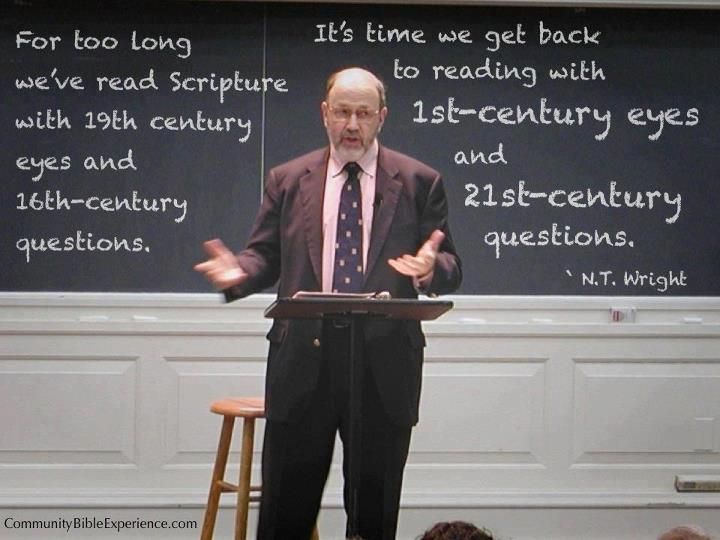
Reading Scripture Theologically: Providing Relief From NT Wright and also the LGH

It is important to remember that the text of Scripture is not just Literature, it is that, of course, with all of its conventions and literary devices, to boot; but it is more than this as well. My North American Evangelical tradition has adopted a mode of biblical interpretation (which I think is actually changing in some sectors) known as the Literal Grammatical Historical method; it is this method, by and large, that has given us the various expressions of the dispensational hermeneutic we have (as Americans) become all too familiar with—indeed it was this methodology that I was largely trained in, in both undergrad and Seminary (and my Master’s Thesis on I Corinthians 1:17-25 employs in slavish form). Here is how I described the LGH in another post I once wrote years ago, and then what, I then, in seminal form was coming to see as a better way forward (and still do):

wright1

I think our epistemological approach shouldn’t be rooted, necessarily, within a “rationalist” framework . . . which is where the LGH was shaped. That is, the LGH developed out of the “History of Religions” school of thought, at the turn of the 20th cent., and from other “rationalistic” streams of thought concurrent with this time period. Fundamentalists revolted against the “higher criticism” inherent to these schools, and combined with “Scottish Sense Realism” developed an Evangelically charged hermeneutic that (and I’m oversimplifying a bit here) was still consonant with their “liberal” brethren . . . albeit Evangelically charged! So instead of allowing arbitrary readings of history to primarily serve as the “epistemology” of scripture; I think it serves us better to approach it with Christ-centered spectacles which assumes a “positive” Christian hermeneutic provided in the scriptures. So that, the “history of Jesus” is indeed the history of scripture; and not various socio/cultural reconstructions. Furthermore, instead of doing biblical intepretation, or approaching scripture with socio-analysis as the primary methodological apparatus (which is where the LGH comes from); Karl Barth gives us the best way forward for approaching scripture (even though his points have to do with “theology”). His way forward is to start with the historical person, Jesus of Nazareth, as determinative of theology and its method. Here is T. F. Torrance on Barth:

Because Jesus Christ is the Way, as well as the Truth and the Life, theological thought is limited and bounded and directed by this historical reality in whom we meet the Truth of God. That prohibits theological thought from wandering at will across open country, from straying over history in general or from occupying itself with some other history, rather than this concrete history in the centre of all history. Thus theological thought is distinguished from every empty conceptual thought, from every science of pure possibility, and from every kind of merely formal thinking, by being mastered and determined by the special history of Jesus Christ. [Thomas F. Torrance, “Karl Barth: An Introduction to His Early Theology 1910-1931,” 196]

So as I was thinking then, I think now a better way forward to interpreting Scripture must have Jesus himself as the principled reality that serves as the rule and regulator of our interpretive decisions. Scripture should be viewed sacramentally in the sense that it is only a ‘sign’ of which finally gives way to its depth as it finds that in its ‘reality’, Jesus Christ. Matthew Levering provides further insight into how a flat kind of literal interpretive mode of operation came to find its existence in the history of ideas; he writes:

[…] Levine argues that Erasmus “began to think of the Bible principally as a record of history, rather than an arsenal of theological texts, above all as the story of Christ on earth—Christ as the supreme exemplar to be followed and imitated.” Behind Erasmus, Levine finds the mid-fifteenth-century humanist Lorenzo Valla: “For Valla, grammar was the supreme science, or at least the indispensable preliminary that was required for understanding any writing, and hence any doctrine…. In these crucial matters, the philologist was above the theologian.” [Matthew Levering, Participatory Biblical Exegesis, 22.]

I would say this is true in my experience, and it seems to be the continuing reality even as Evangelical exegesis continues to develop into more sophisticated expressions; like in NT Wright’s work for example. I have nothing against learning the Biblical Languages (I have), and using historical reconstruction etc. as part of the tool box that we use to interpret Scripture. But what I do have a problem with is when there is not proper attention given to the inner-logic and theological depth upon which Scripture turns, and wherein Scripture finds its reality; this would be like trying to ride a bike with just the spokes and wheel with no tire, you might be able to ride the bike, but it won’t move at optimum performance, it might hurt, and you probably will even crash and burn.

This is how I see the Evangelical obsession with appealing to NT Wright, and others in this camp, as the definitive way for reading Scripture. Scripture has Triune-Christological-depth as its ultimate context and canon. If we fail to see this reality as that which gives the text its ultimate sense and meaning, then we might be able to produce elaborate socio-cultural-historico reconstructions of the text, but in the end, there is really no dialogue taking place with the living author of the text, Jesus Christ. I see modern Evangelical exegesis, mostly, as an horizontal endeavor done in the name of vertical reality; and thus without vertical reality giving it the life it truly has in its ordained capacity to serve as the communicative medium and instrument that it is. I will offer more (later) on the better way, that I see as an alternative to the LGH, and now the critical movement provided by the likes of NT Wright and others.