
It is important to remember that the text of Scripture is not just Literature, it is that, of course, with all of its conventions and literary devices, to boot; but it is more than this as well. My North American Evangelical tradition has adopted a mode of biblical interpretation (which I think is actually changing in some sectors) known as the Literal Grammatical Historical method; it is this method, by and large, that has given us the various expressions of the dispensational hermeneutic we have (as Americans) become all too familiar with—indeed it was this methodology that I was largely trained in, in both undergrad and Seminary (and my Master’s Thesis on I Corinthians 1:17-25 employs in slavish form). Here is how I described the LGH in another post I once wrote years ago, and then what, I then, in seminal form was coming to see as a better way forward (and still do):
I think our epistemological approach shouldn’t be rooted, necessarily, within a “rationalist” framework . . . which is where the LGH was shaped. That is, the LGH developed out of the “History of Religions” school of thought, at the turn of the 20th cent., and from other “rationalistic” streams of thought concurrent with this time period. Fundamentalists revolted against the “higher criticism” inherent to these schools, and combined with “Scottish Sense Realism” developed an Evangelically charged hermeneutic that (and I’m oversimplifying a bit here) was still consonant with their “liberal” brethren . . . albeit Evangelically charged! So instead of allowing arbitrary readings of history to primarily serve as the “epistemology” of scripture; I think it serves us better to approach it with Christ-centered spectacles which assumes a “positive” Christian hermeneutic provided in the scriptures. So that, the “history of Jesus” is indeed the history of scripture; and not various socio/cultural reconstructions. Furthermore, instead of doing biblical intepretation, or approaching scripture with socio-analysis as the primary methodological apparatus (which is where the LGH comes from); Karl Barth gives us the best way forward for approaching scripture (even though his points have to do with “theology”). His way forward is to start with the historical person, Jesus of Nazareth, as determinative of theology and its method. Here is T. F. Torrance on Barth:
Because Jesus Christ is the Way, as well as the Truth and the Life, theological thought is limited and bounded and directed by this historical reality in whom we meet the Truth of God. That prohibits theological thought from wandering at will across open country, from straying over history in general or from occupying itself with some other history, rather than this concrete history in the centre of all history. Thus theological thought is distinguished from every empty conceptual thought, from every science of pure possibility, and from every kind of merely formal thinking, by being mastered and determined by the special history of Jesus Christ. [Thomas F. Torrance, “Karl Barth: An Introduction to His Early Theology 1910-1931,” 196]
So as I was thinking then, I think now a better way forward to interpreting Scripture must have Jesus himself as the principled reality that serves as the rule and regulator of our interpretive decisions. Scripture should be viewed sacramentally in the sense that it is only a ‘sign’ of which finally gives way to its depth as it finds that in its ‘reality’, Jesus Christ. Matthew Levering provides further insight into how a flat kind of literal interpretive mode of operation came to find its existence in the history of ideas; he writes:
[…] Levine argues that Erasmus “began to think of the Bible principally as a record of history, rather than an arsenal of theological texts, above all as the story of Christ on earth—Christ as the supreme exemplar to be followed and imitated.” Behind Erasmus, Levine finds the mid-fifteenth-century humanist Lorenzo Valla: “For Valla, grammar was the supreme science, or at least the indispensable preliminary that was required for understanding any writing, and hence any doctrine…. In these crucial matters, the philologist was above the theologian.” [Matthew Levering, Participatory Biblical Exegesis, 22.]
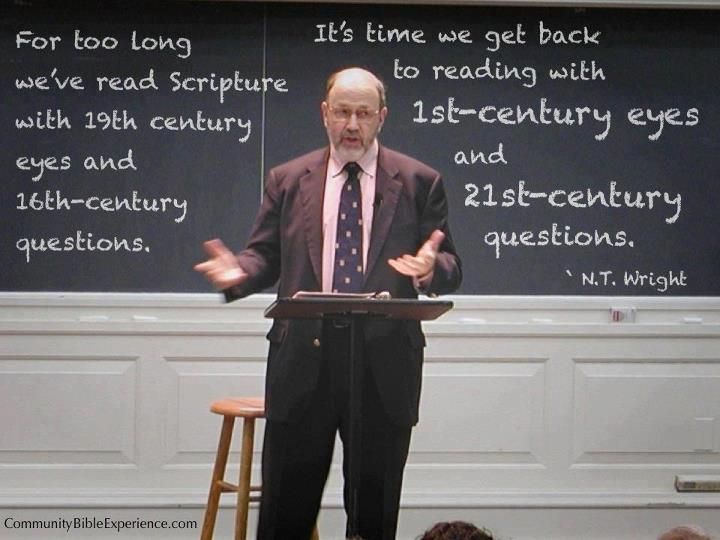
I would say this is true in my experience, and it seems to be the continuing reality even as Evangelical exegesis continues to develop into more sophisticated expressions; like in NT Wright’s work for example. I have nothing against learning the Biblical Languages (I have), and using historical reconstruction etc. as part of the tool box that we use to interpret Scripture. But what I do have a problem with is when there is not proper attention given to the inner-logic and theological depth upon which Scripture turns, and wherein Scripture finds its reality; this would be like trying to ride a bike with just the spokes and wheel with no tire, you might be able to ride the bike, but it won’t move at optimum performance, it might hurt, and you probably will even crash and burn.
This is how I see the Evangelical obsession with appealing to NT Wright, and others in this camp, as the definitive way for reading Scripture. Scripture has Triune-Christological-depth as its ultimate context and canon. If we fail to see this reality as that which gives the text its ultimate sense and meaning, then we might be able to produce elaborate socio-cultural-historico reconstructions of the text, but in the end, there is really no dialogue taking place with the living author of the text, Jesus Christ. I see modern Evangelical exegesis, mostly, as an horizontal endeavor done in the name of vertical reality; and thus without vertical reality giving it the life it truly has in its ordained capacity to serve as the communicative medium and instrument that it is. I will offer more (later) on the better way, that I see as an alternative to the LGH, and now the critical movement provided by the likes of NT Wright and others.
Or maybe the little blurb on the chalkboard should say:
“It’s time we get back to reading with [19th century method] which gives us our 1st century eyes and 21st century questions.” 😉
And the crazy thing is, I still can learn much and appreciate intensively the work that NT Wright is doing–even if, of course, I don’t always agree (which is my obligatory caveat 🙂 ).
NT needs to have some conversations with Alan Torrance who teaches where NT does!
Jerome,
I hope this happens, that’d be great! 🙂