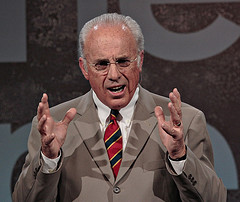
I just came across this quote from John Piper, yes that John Piper, the one I used to engage with constantly here at this blog and other iterations of my blogging life. In this quote you will read something quite despicable; but it’s not foreign to the Reformed tradition. It’s what you get when you have a decretal conception of a God-world relation; i.e. a conception of God that sees him  inter-linked to the world in a hierarchy of being, wherein he is Pure Being, and as such in order to keep him pristine he can only relate to the world, as Almighty, through a set of decrees that sovereignly order the world according to necessitarian and mechanical levers and handles of causation. In this conceiving of things God, in order for his ultimate sovereignty to be affirmed must be thought of as the author of all things; including the most heinous evils we could ever imagine. This is the type of God John Piper thinks from, and unfortunately he thinks this God for all who sit under his teaching. Take a look at this disturbing quote from him; you’ll find if you spend any time at all with Piper that quotes like this are common-place with him.

Disturbing right? This is what happens to your doctrine of divine providence when you have an underdeveloped or ontotheological (i.e. philosophically based) conception of Godself; you end up with a malformed notion of God that looks nothing like the God that has appeared in the face of Jesus Christ—indeed, as Thomas Torrance would say of Piper’s God, I’d imagine: ‘here we have a God behind the back of Jesus.’
I thought it might be instructive to share a bit from Cornelius van der Kooi and Gijsbert van den Brink about the important role that the Trinity must take if we are going to responsibly and Christianly speak about God’s relation to the world (his providence) without falling into the deplorable error that Piper does in his misguided discussion of God. They write (we catch them midstream in a discussion about the same issue we are discussing):
Thus, for a long time the doctrine of providence remained detached from any proper biblical context. Even Adolf Hitler could appeal to it during the Second World War when he declared that, by providence, Germany was entering the era of the Third Reich. This is a deplorable example of how belief in providence, when isolated from its biblical context, can become a brutal ideology that plays into the hands of dictators and repressors. For such reasons, when reflecting on our faith today, we must emphatically articulate God’s providence in Trinitarian terms, from beginning to end. For all God’s acts ad extra—that is, directed toward creation—take place “from the Father through the Son in the Spirit” (Gregory of Nyssa, Ad Ablabium; NPNF 5:334). The common conviction that nothing happens accidentally, since everything is guided by a higher power, is not shared by all Christians and by many other spiritually inclined people. The doctrine of providence is no articulus mixtus, no “mixed” article that even non-Christians can to some extent understand and support. It has its own unique setting in the Christian faith—a setting of trust in the God whom we have learned to know in Jesus Christ and who, through his Spirit, shapes us to reflect his image. Only from this perspective can bold statements be made about the unlimited scope of God’s care. These statements never convey neutral information but are statements of faith.[1]
Kooi and Brink provide a proper framework through which Christians ought to think of God’s relation to the world (in his providential care) in and through; they rightfully identify what Piper fails to. Yes, Piper uses the language of God, but the conception of God he communicates, the informing theology he thinks God from, has more to do with a Stoic conception of God than it does with the God Self-revealed and exegeted for us in Jesus Christ (Jn 1.18). If we think of God’s providential care and relation to the world properly, as Christians, we do so thoroughly situated in the filial bond of the Father to the Son by the Holy Spirit; from the life we’ve been graciously invited into by the effervescent and effulgent life of God. It’s within this ‘space’ where we think about God’s interaction with the world; with us. If we approach God this way we don’t end up attributing the monstrous things that Piper has to God. We understand that God’s relation to the world is cruciform in shape, and we see God’s love demonstrated that way. We don’t think of God’s all-power in terms of the Actual Infinite or Pure Being God that Piper thinks from; we think of God’s power in terms of a God who humbled himself, became obedient to the point of death, as a man, that he might exalt humanity with and in his vicarious humanity that he assumed in the mediatorial and priestly humanity of Jesus Christ.
Piper has a doctrine of God at work in his understanding of providence and a God-world relation, it’s just that it’s a conception that is based on the god of the philosophers and not the God revealed in Jesus Christ. He means well, but his good intentions don’t make up for the despicable God he recounts for us in his understanding of God’s providence. He needs Jesus to evangelize his conception of God; if Piper had that we wouldn’t have to write up these types of posts.
[1] Cornelius van der Kooi and Gijsbert van den Brink, Christian Dogmatics: An Introduction (Grand Rapids, Michigan: William B. Eerdmans Publishing Company, 2017), 238-39.
*h/t. John Flett for spotting the Piper quote on Twitter. Truly, if you read Piper just for a minute you will realize that this quote isn’t cherry-picked from him, it in fact characterizes the demeanor of his theology.

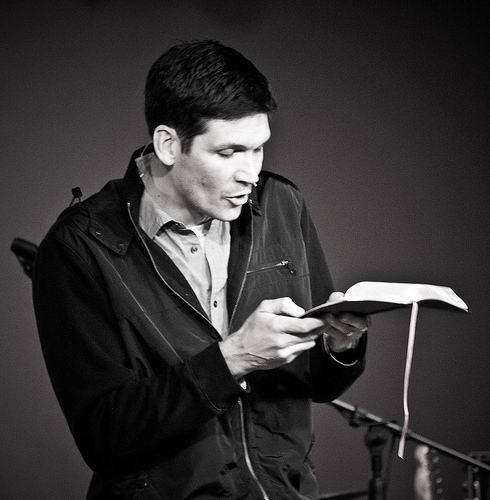


 There are a slew of ministries today that are promoting an enlivened Calvinism for the masses; whether that be by radio, books, pulpits, or the internet. Off the top I can think of just a few that are making quite the impact: