The Problem of God and Evil answered in Dramatic-Narrative Form and in the Wisdom of the Cross

One question that never seems to go away, even if we would prefer that it did; is the so called problem of evil and God. The Scottish philosopher par excellence, David Hume is famous for rhetorically musing:

“Is He willing to prevent evil, but not able? Then He is impotent. Is He able, but not willing? Then He is malevolent. Is He both able and willing? Whence then is evil?”

crucifiedMy usual response to this kind of Humian skepticism, when I encounter it usually in evangelistic situations, is that they are starting in the wrong place; more pointedly, that they are starting in the wrong story, and thus ultimately with the wrong conception and categories for thinking about who God is, and how this God acts, and how he has concretely acted for us in and through Jesus Christ. And not only as a past reality, but in a perfect tense, in an ongoing reality that flows from the particular event and act of God in Jesus Christ for us at the cross; which inaugurated and presupposed a whole bunch of things about God’s eschatological life breaking in on us then and now, and into the future. Basically all I want to highlight with this post is a quote from Michael Horton, he captures this kind of shifting-the-story approach when engaging with this purported problem of God and evil:

[O]ur question, therefore, could be transposed in the following manner: If God is a player at all in this drama, much less the playwright, why doesn’t he reduce the problems the characters encounter? In the “divine drama” model, the problem of evil needs to be reconfigured. Without determining the possible positions in advance, the root metaphor nevertheless resists metaphysical speculation. Here, the question is, given the facts ofĀ thisĀ play. It is a drama with its own plot: creation in the divine image, forfeiting the consummation by rebellion, a promised Messiah and a typological kingdom of God, the advent of the second Adam to rescue fallen image-bearers, and his return “at the end of the age” in order to consummate the forfeited kingdom forever. Its central actor is an unsubstitutable character, as Hans Frei would say. And its answer to evil is practical (acted out) rather than theoretical. No other story could be substantiated to make basically the same point. [Michael S. Horton,Ā Covenant and Eschatology: The Divine Drama,Ā 92.]

Obviously, this kind of narrative-shifting approach to dealing with this philosophical and ethical dilemma of God and evil, is situated in a kind of presuppositionalist mode; which in some ways needs to be corrected a bit. But that notwithstanding, the general principle of this approach is laudable, precisely because it discerns the underlying problem at the center of conceiving of God and the problem of evil. Contrary to Hume’s approach—one that starts in a story wherein humanity’s autonomous reason and rationality reigns supreme—the theo-dramatic approach highlighted by Horton presupposes one crucial thing; that the story is not one of our making, but God who is Lord over creation (not able then to be collapsed into His creation as hyperimmenant approaches do), and this story (creation, in general/salvation-history, in particular) is His story; and His story has cruciform shape come hidden and at the same time revealed in the sullen vicarious humanity of Jesus Christ for us.

So far, Ā from evil being in competition with a Holy God; what the right story does for the interested reader, is that it reorients the starting questions to those that God Himself has provided in His-tory; and the antecedent reality to this-story is really His kind of life that He has always already shared with His dearly beloved Son bonded in the communing love of the Holy Spirit. An inner life that is shaped by the kind of cross-shapedness that is fitting and fitted for what is finally revealed as the ultimate fulcrum for which creation was originally made; that is to participate in this kind of cruciform life in union with Christ for all eternity. This is the wisdom of God, logos tou staurou, the cross of Christ, the wisdom of the cross.

One consequence of holding to this ‘right story’ is that we come to understand that through God’s Self-revelation in Jesus Christ, and the story that is funded by that (our lives in relation to His), is that creation/nature has not ever impinged upon God’s character. Our sin did not determine how God has decided to determine Himself for us. What this story underscores is that God has always already, in His wise life, been in the shape that could answer and engage with whatever proclivities His creation might conjure up under its own contingent independence—say starting in the Garden of Eden. Because God is love (i.e. in free Self-given mode), and because He is grace (which is what creation is under-girded by), anything that occurs in this sphere (including evil and its adjunct, sin) has no independent ontology of its own; in other words, sin and evil are always realities that are within the scope of the answer provided by God’s life. Not as if sin and evil determine God’s life, nor in the sense that God determines what evil and sin are; but in the sense that God’s life in its singular core, in its Triune relation, has the overwhelming capacity to answer such things in a way that is fitting to His life of humility and exaltation all in one moment of gracious time.
Good Works, The Work of the Great Deceiver

I am starting to become less and less convinced that Christians, at least in America, actually struggle with things like I am about to highlight in this post. It seems as if a folkism has overtaken American Evangelicalism in a way that pragmatism and utilitarianism rues the day, and principle and doctrinal concerns no longer, for some reason are important—I am somewhat rabbit trailing from where I want to take this post. I hit on this because I think that what this post is going to talk about might be down on the pole of significance for many of us; in fact I think that American Evangelicalism, in general, has so imbibed our feel good pop culture that the concept of ‘good works’ and right standing before God really have no functional meaning for people’s daily lives and spirituality. We are so busy with everyday concerns, trying to make ends meet, watching TV, and entertaining ourselves to death; that serious reflection about doctrinal concerns—like the relation between good works and saved by faith alone—really have no place of import in our lives.

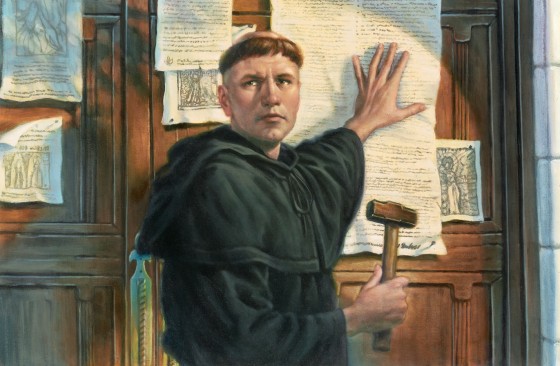
Nevertheless, for those who might be the exception to my sketch above, this post might mean something to you. As you might have already picked up, I want to bring up the issue of ‘good works’ in the Christian’s life. And in particular, I want to get more insight into what Martin Luther, the Reformer thought, who is primarily known for emphasizingĀ sola fide,Ā ‘faith alone’. Maybe though, maybe I am wrong about what I was getting at in my first paragraph above; maybe in fact good works for Christians are alive and well, maybe good works (whatever those are) are what provides salvation,Ā psychologically, for so many of us. Maybe when we do good things we feel good before God (coram Deo), and maybe when we do bad things we feel guilty before God; so maybe that’s why we try to comfort ourselves by the good that we do, and brushing the bad under the good in a way that makes us feel ‘justified’ before God (and of course we attribute the good to the power of God in our lives, and thus we even feel more justified when we see our good works; in fact we start to look at our good works as the basis for our assurance of salvation). According to John Webster, Martin Luther would totally disagree with you—if you think your good works are a sign of your salvation or something—here is how Webster describes Luther’s view here:

[…] Luther’s doctrine of justification b grace through faith severs the bond between acceptance and self-realization which he found in scholastic anthropology; in effect, his moral ontology calls into question the notion that self-conscious, self-actualizing selfhood is anthropologically primary. Indeed, in a crucial phrase he notes how, in good works as traditionally understood (i.e. as ‘religious’ works), ‘the self has been set up as an idol’. He acutely sees that religious works, and the understanding of the human person through which their significance is expounded, have become an exercise in self-preservation; good works are in league with human egotism, and their consequence is accordingly the deepening of human depravity and not release from it. For such works have become ‘merely acts of appeasement and self-righteous attempts at self-salvation. Luther recognised the depth of the corruption of the self which attempts to turn all goods to itself’. The target of Luther’s critique is thus the prudential calculation of benefits which might accrue to the agent on the basis of certain kinds of moral performance; acts undertaken in anticipation of rewards areĀ ipso factoĀ disqualified asĀ goodĀ works, because within them lurks the sinful, self-realizing ego. If the Christian is related to his or her good works ‘self-centeredly’, the result is that chronic inflammation of the self which is the curse of sin. [John Webster,Ā Barth’s Moral Theology,Ā 163.]

This seems like a dilemma! If good works aren’t the sign of my salvation; if good works can’t provide me with assurance of salvation, then what or who can? If good works which are done by natural Pelagian impulse only serve to really further my own self-deception about how sinful I am—as T. F. Torrance would say ‘all the way down’—then I am of all men most to be pitied.

Of course the answer is ‘faith’, the faith of Christ at work in us by the Spirit. This is the ground of assurance, it is the faith of and the faith in Christ that resolves the dilemma. Good works, the ones we have been recreated in, in Christ (Eph. 2:10); are a result of the overflow of relationship that we already have with Christ. We don’t look to our good works as if those are our ‘Yes’ before God, He already said ‘No’ to them at the cross; instead, with the Apostle Paul we look to Christ where ‘all the promises of God find their Yes in him. That is why it is through him that we utter ourĀ Amen to God for his glory’ (II Cor. 1:20).

What Luther’s emphasis can provide is a way out of a moralistic Christian spirituality that can only produce introspective navel gazing Christians who ultimately are driven by angst, instead of the power of God, which is the true Gospel of Jesus Christ; the one that we are not ashamed of (Romans 1:16).

The Sermon on the Mount [and Barth]: Living the Obedient Life, Now or Later?

The Sermon on the Mount, so called, is one of the most recognizable pieces of scripture ever to be written; even pagans (well some) have heard of it. There are many ways into this sermon, many interpretations and frames of it; but since I am reading on how Karl Barth interpreted this section of scripture, we will focus on his ‘way in’. Indeed, Barth’s resonance with this area of holy writ is resonate with my own understanding of this passage; Barth, of course, offers a Christ-centric reading of the sermon, and he does so biblically theologically. In other words, Barth sees Jesus as the fulfillment, the New Moses, who went up Mount Sinai and received the Decalouge; and yet in the case of Christ, for Barth, Jesus is the subject and fulfillment of the Law, he is the embodiment and particular point of the Law. Christ is the only ‘human’ who had a chance to fulfill the dictates of the Law, for us; and now we are invited to echo Christ’s life as we have been united to his mediating gracious humanity by the Holy Spirit’s recreative and ‘unioning’ work in our lives (this is my gloss). Here is the account of Barth’s reading that A. Katherine Grieb provides:

Barth insists that the Sermon on the Mount, like any other biblical text, must be read in light of its context, that is, in a special connection with the theme of God’s reign as it has come in the person of Jesus Christ in fulfillment of Old Testament prophecy. This is as true of the Sermon on the Mount as it is of the other great discourses in Matthew. Now it is Jesus himself who defines the sphere in which he is present with those whom he calls. The order that constitutes the life of the people of God, for that is what the Sermon on the Mount is, as it repeats and confirms the Ten Commandments and the rest of the Law, is now fulfilled by God in Christ for human salvation (II/2, 687). So even if the Sermon seems to be concerned with problems of human life (marriage, swearing, enemies, almsgiving, praying, and fasting), this is incidental and by way of illustration — which is why it has always proved impossible to construct a picture of the Christian life from these directions. The picture they offer is the picture of the One who gives these directions and of the one who receives them. The picture shows God’s reign, Jesus Christ, and the new human creature. They point, as the Ten Commandments point, to what God has done and is doing in Jesus Christ (II/2, 688).

So Barth can say: “If the Ten Commandments state where [humanity] may and should stand before and with God, the Sermon on the Mount declares that [it] really has been placed there by God’s own deed. If the Ten Commandments are a preface, the Sermon on the Mount is in a sense a postscript (II/2, 688). The only question now is whether the church will live or not live in the fullness of life already granted to it. The Sermon on the Mount declares: “God has irrevocably and indissolubly set up the kingdom of [God’s] grace … which as such is superior to all other powers, to which, in spite of their resistance, they belong, and which they cannot help but serve” (688). [Katherine A Grieb,Ā Chapter 6: “Living in Righteousness: Karl Barth and the Sermon on the Mount,102 inĀ Thy Word Is Truth: Barth On Scripture,Ā edited by George Hunsinger.]

So in contrast to something like my lullabies, those that I was weaned on as a dispensationalist exegete, Barth does not see the Sermon on the Mount as an annex only to be realized by the Jewish people in the coming millennial kingdom (a theme which Grieb also highlights in this, her chapter I have just quoted from); no, Barth sees theĀ ethosĀ andĀ LogosĀ (two loci that Grieb also highlights as she appropriates Aristotle’s ‘pathos, ethos, and Logos’ from Jarisov Pelikan’s application of these to Augustine’s, Chrysostom’s, and Luther’s interpretation of this ‘Sermon’) of the Sermon on the Mount as Jesus himself. So we can see the difference between something like the dispensational approach (or even the ‘Liberal’ approach), and Barth’s. Barth offers a highly realized notion and application of this sermon; because he sees the ideals of the Sermon already fulfilled, already completed in the person of Jesus Christ. The Sermon, then, isn’t something we are waiting for; the Sermon has already come, and it is preached everyday, afresh and anew as we live from and through the Spirit anointed humanity of Jesus Christ. We have been called to an Spirit inspired obedience that is truly counter cultural (and I mean counter church cultural in many ways). We (if we follow Barth on this) understand that this world has already been crucified to us, and us to the world (to borrow a Paulinism from Gal. 6); and so we don’t do what might be considered expedient, instead we stand on and in the obedience of Jesus Christ. This obedience is an eschatological obedience that breaks in on us every morning when we wake up; it is an obedience that is waiting for us with Spirit formed breath and life; it is obedience, like poetry, that has already been written, just waiting for us to read, act, and respond from. It is an obedience, the obedience of Christ, that has contradicted this world system and everything this world system believes is real (which is an illusion in light of the reality of Christ!).

We ought, then to live from the obedience of Jesus Christ, from his humanity for us — which is still for us, just read Hebrews 7:25 — we aren’t waiting for the Sermon to be fulfilled; the Sermon’s reality is in the New Humanity of which Jesus Christ is its first fruits.

6Ā So then, just as you received Christ Jesus as Lord,Ā continue to live your lives in him,Ā 7Ā rootedĀ and built up in him, strengthened in the faith as you were taught,Ā and overflowing with thankfulness.8Ā See to it that no one takes you captive through hollow and deceptive philosophy,Ā which depends on human tradition and the elemental spiritual forcesĀ of this worldĀ rather than on Christ. ~Colossians 2:6-8 (NIV)

John Calvin, John Cotton on Assurance

*Repost on John Calvin number three.

English Puritanism was a ā€œdivided houseā€, there were those who followed William Perkins, and those who followed Richard Sibbes and John Cotton. The issue of division was oriented primarily around the concept of ā€œassuranceā€ of salvation. Sibbes and Cotton held that this issue was resolved with an ā€œassurance of faithā€ (or simply knowledge of God and the objective criteria of God’s Word—illuminated in the heart of the believer); versus Perkins (and camp) who believed that sanctification and the practical syllogism, or external works, served as the final basis for determining if indeed a person was elect or not. John Cotton believed that John Calvin was in the former camp, and that ā€œgood worksā€ or the ā€œpractical syllogismā€ were not the basis for determining one’s election, note:

And seeing we all profess . . . to hold forth protestant doctrine, let us hold it forth in the language of Calvin and others [of] our best protestants, who speak of purity of life and growth in grace and all the works of sanctification as the effects and consequents of our assurance of faith . . . . And therefore if we will speak as protestants, we must not speak of good works as cause or ways of our first assurance. . . . [Y]et indeed you carry it otherwise. . . . Which, seeing it disallowed by the chief protestant writers, if you contrary to them do hold it forth for protestant doctrine, that we may gather our first assurance of justification from our sanctification, it is not the change of words that will change that matter. (Ron Frost, unpublished PhD Dissertation, Richard Sibbes’ Theology of Grace and the Division of English Reformed Theology, King’s College, University of London 1996, 13, quoting Hall, Antinomian, 133-34, quoting John Cotton’s, Rejoinder)

Here Cotton is responding to the charge that he is an antinomian.

What I want to highlight is that historically ā€œCalvinismā€ has more nuance to it than popularly understood today. There were ā€œFree Grace Calvinistsā€ (e.g. Richard Sibbes, John Cotton, et al), and there were ā€œFederalist Calvinistsā€ [ā€Law-Keepingā€] (e.g. William Perkins, William Aames, et al). I appreciate the former, and believe with both Cotton and Calvin, that assurance of salvation is solely and objectively based upon the witness of GOD’S WORD, emphasizing God’s faithfulness in salvation, rather than my own. Like Cotton, I see justification as distinct, yet inseparably related to sanctification, and consequently hold that sanctification does not serve as the BASIS for anyone’s assurance of salvation . . . but that sanctification, in scripture, is the instrumental means through which the light of Christ is brought to bear on exposing the darkness of this world system. The consequence of sanctification, primarily, is to cause unbelieving man to see the Christian’s good works and glorify and praise God.

Ā 

Peter’s Denial, Jesus’ Love

This is a rererepost. This post seems to get hits on an ongoing basis more than any other post I think that I have ever posted. I think I originally wrote this post probably 5 years ago. I might tweak the way I said some things, but all-in-all I still stand by what I originally communicated in this post. It is reassuring to me to know that God’s faithfulness in Christ is the objective and subjective ground upon which I stand in relation to him. I stand on and in the solid rock of Jesus’ mediating gracious humanity as the anchor of my soul. There is nothing that can separate us from the love of God in Christ Jesus; because if God be for us, in Christ, and he does not condemn us, then who can be against us?

I am quite certain that there are many people in the church today, because of bad teaching and theology, who struggle with issues surrounding assurance of salvation. In fact this is not a new phenomenon, but is as ancient as the rambunctious Apostle, Peter. Remember the emphasis of the “Last Supper,” and Jesus’ prediction that one of His disciples would deny any relationship to, or knowledge of Himself. And we all know what happened, Peter most certainly denied any knowledge of or relationship with Jesus (see Mk. 14:66-72, amongst the other synoptics and the Gospel of John); and of course his response was one of sheer horror, and remorse. I think at that moment, and the immediate time following this incident, Peter was most unassured that he would have any further part in the “Kingdom of God.”

But you see, his relationship with Jesus was not dependent on his faithfulness to any kind of commitment or “covenant” that he may have made with God, and His Son; oh no, rather the relationship was completely dependent on Yahweh’s covenant faithfulness to His people (in fact all of humanity, objectively speaking). Let’s go back to the Old Testament for a moment to further substantiate Yahweh’s faithfulness, indeed Jesus’ faithfulness to humanity. In fact there are so many examples of this throughout the Old Testament, that we have our pick, so to speak; lets quickly look at Ezekiel 36 verses 22-32 (click on citation for full text). Here we come across Yahweh speaking to Israel, and coming to them in a time of great, great, sustained unfaithfulness, on their part. He admonishes them, and makes clear His intention to bring judgment on them (per the Levitic curses, Lev. 26; Deut. 28–30); but, and this is the hopeful part, He shows Himself faithful to them, inspite of their unfaithfulness to Him. In fact He promises to bless them beyond belief, at His initiation, and because of who He is, in Himself, inspite of their own unbelief and outright disobedience. Let’s just get a sampling of Yahweh’s staggering, and gracious nature towards an unbelieving people:

Therefore say to the house of Israel, ‘Thus says the Lord God, ‘It is not for your sake, O house of Israel, that I am about to act, but for My holy name, which you have profaned among the nations where you went. 23. I will vindicate the holiness of My great name which has been profaned among the nations, which you have profaned in their midst. The then nations will know that I am the LORD, declares the Lord God, when I prove Myself holy among you in their sight. 24. For I will take you from the nations, gather you from all the lands and bring you into your own land. 25. Then I will sprinkle clean water on you, and you will be clean; I will cleanse you from all your filthiness and from all your idols. 26. Moreover, I will give you a new heart and put a new spirit within you; and I will remove the heart of stone from your flesh and give you a heart of flesh. . . . (Ez. 36:22-26ff)

Notice the “I–you” pattern, in the section above; this pattern continues on through verse 32 of this chapter another seven times. This is an important pattern, and is used for emphasis in this passage. It is a movement, a unilateral one, where Yahweh is seen to be the One who is always faithful, and does everything because of His love (which we know defines His nature as Father loving Son, Son loving Father, and Holy Spirit loving both bringing communion amongst the three); which we creatures partake of as He showers us with His surplus and super-abundance. So then, when we come to Peter and Jesus we should not be surprised that Jesus responds just as graciously to a fearful Peter, cowering in remorse and sheer angst of soul. Notice the response, and special notice paid to Peter in Mark 16:7 (this is the angel’s message, just after Jesus has resurrected):

. . . But go, tell His disciples and Peter, He is going ahead of you to Galilee; there you will see Him, just as He told you. . . .

And Paul in his first epistle Corinthians also makes this special distinction of Peter:

. . . and that He appeared to Cephas [Peter], then to the twelve. 6. After that He appeared to more than five hundred brethren at one time, most of whom remain until now, but some have fallen asleep; . . . (I Cor. 15:5, 6)

The point to take away from this, is that even though Peter denied Him, Jesus remained faithful in His love for Peter. This is illustrated by the pin-pointed pursuit by God to single out a desperate despairing Peter. The LORD pursues us, and He keeps us as His, no matter what. This relationship between Peter and Jesus was presupposed by who Jesus was (in relationship to the Father and Holy Spirit), and is for us; instead of who Peter (and we are) was and is for Jesus.

What this incident further illustrates is that “assurance of salvation” is not even a scriptural category. In other words, we don’t see this ever communicated as a viable situation in the scriptures. The scriptures presuppose Yahweh’s faithfulness, as well as humanity’s unfaithfulness; which is the point of the cross. It is the cross that reverses the curse and the subsequent doom and gloom of humanity’s fallen situation. Our response to the Father, is firmly located in Jesus’ response to the Father on the cross, “. . . Father into thy hands I commit my spirit. . . .” It is not until much later, within church history that “assurance of salvation” becomes a doctrinal “pastoral” category. The next post will further touch on the system of theology (esp. as developed in English Puritanism) that brought us this deplorable teaching on “assurance.”

Stand firm today in the confidence that it is not our faithfulness, but His faithfulness, and LIFE, that is the source of our confidence and hope!

Creation, A Reason

In some of my posts, especially of late, we have been thinking about the Christian doctrine of Creation; as corollary, we have also been considering our relation to creation in and through Christ. The first step we ought to engage, in our consideration of such things; is to wonder about the God-world relation and what purpose he has always already intended for creation as the counterpoint to his gracious life of love, from which he created. It becomes quickly obvious, as we read the New Testament, and work out the theo-logical implications of Trintarian and Christo-logical assumptions, therein; that creation was created with Christ in mind, and us in Christ. So that God’s original intent, was in and through Christ, to bring all of creation (and humanity as the pinnacle of his creation) into his life of perichoretic (interpenetrating) love (self-giving, subject-in-distinction=Trinity). Scottish theologian, David Fergusson, helps us understand how all of this has played out in the history of interpretation:

The notion of ‘wisdom’ provides further evidence of the integration of creation and salvation in the Old Testament. As the creative agency of God, wisdom is celebrated in the Psalms, Proverbs, Job, and some of the deutero-canonical works. In some places, such as Proverbs 8, wisdom is personified as a divine agent. The divine wisdom by which the world is created is also apparent in the regularity of nature, the divine law, and human affairs. This notion of ‘wisdom’ is later fused with the Greek concept of ‘Logos’ and becomes vital for expressing the linking of creation and Christology in the New Testament. In the prologue to John’s Gospel the Word (Logos) of God is the one by whom and through whom the world is created. This Word which is made present to Israel becomes incarnate in Jesus Christ. In this cosmic Christology, the significance of Jesus is understood with respect to the origin and purpose of the created order. Already in Paul’s writing and elsewhere in the New Testament epistles, we find similar cosmic themes (e.g. 1 Cor. 8:6, Col. 1:15-20, Heb. 1:1-4). By describing creation as Christ-centred, these passages offer two related trajectories of thought. First, the origin and final purpose of the cosmos is disclosed with the coming of Christ into the world and his resurrection from the dead. Second, the significance of Christ is maximally understood reference to his creative and redeeming power throughout the created universe. Writers at different periods in the history of the church would later use this cosmic Christology to describe the appearance of the incarnate Christ as the crowning moment of history. No longer understood merely as an emergency measure to counteract the effects of sin and evil, the incarnation was the fulfillment of an eternal purpose. The world was made so that Christ might be born. This is captured in Karl Barth’s dictum that creation is ‘the external basis of the covenant’ (Barth 1958: 94). [David Fergusson, Chapter 4: Creation, 76-7 in The Oxford Handbook of Systematic Theology, edited by John Webster, Kathryn Tanner, and Iain Torrance]

In the history what David Fergusson is describing is known as the Scotist Thesis; viz. that the plan was always for Jesus to incarnate to bring humanity and creation into the divine dialogue and life of communion through union with the Son. The ‘Fall’ intensified the Incarnation in a way that is tragic, but rife with the redemptive hope of the resurrection and advent life! I follow the Scotist thesis on this front. My friend, brother in Christ, Evangelical Calvinist co-conspirator, and doctoral adviser, Myk Habets has written this to open up his essay entitled On Getting First Things First: Assessing Claims for the Primacy of Christ (Ā©The author 2008. Journal compilation Ā©The Dominican Council/Blackwell Publishing Ltd. 2008, 9600 Garsington Road, Oxford OX4 2DQ, UK, and 350 Main Street, Malden MA 02148, USA DOI:10.1111/j.1741-2005.2008.00240.x):

According to Christian tradition Jesus Christ is pre-eminent over all creation as the Alpha and the Omega, the ā€˜beginning and the end’ (Rev 1.8, 21.6; 22.13). This belief, when theologically considered, is known as the primacy of Christ.1 The specific issue this doctrine addresses is the question: Was sin the efficient or the primary cause of the incarnation? This essay seeks to model the practice of modal logic in relation to the primacy of Christ, not to satisfy the cravings of speculative theologians but to reverently penetrate the evangelical mystery of the incarnation, specifically, the two alternatives: either ā€˜God became man independently of sin,’ or its contradiction, ā€˜God became man because of sin’. . . .

Wouldn’t you agree that ‘the world was made so that Christ might be born’?

15Ā He is the image of the invisible God, the firstborn over all creation. 16Ā For by Him all things were created that are in heaven and that are on earth, visible and invisible, whether thrones or dominions or principalities or powers. All things were created through Him and for Him. 17Ā And He is before all things, and in Him all things consist. 18Ā And He is the head of the body, the church, who is the beginning, the firstborn from the dead, that in all things He may have the preeminence. 19Ā For it pleased the Father that in Him all the fullness should dwell, 20Ā and by Him to reconcile all things to Himself, by Him, whether things on earth or things in heaven, having made peace through the blood of His cross. 21Ā And you, who once were alienated and enemies in your mind by wicked works, yet now He has reconciled 22Ā in the body of His flesh through death, to present you holy, and blameless, and above reproach in His sight— 23Ā if indeed you continue in the faith, grounded and steadfast, and are not moved away from the hope of the gospel which you heard, which was preached to every creature under heaven, of which I, Paul, became a minister. ~Colossians 1:15-23

§3. Matt Chandler’s and John Piper’s ā€˜two-willed god’: There is a history!

*To catch up read my first and second installments, 1) here and 2) here.

II

This is my second installment (well third really) on Matt Chandler’s and John Piper’s ā€˜two-wills in God theology’. My last post on this sought to introduce us to the way that John Piper, in particular, and Chandler otherwise, understand a concept that they both articulate as ā€˜The TwoWills of God’. I registered my concern in that last post about where this approach leads, because of where it comes from; and because of what it implies about God’s nature, and how he relates to his creation (us) in what has been called salvation history. This post will briefly sketch the aspect of where Ā two wills in God theology came from; my next and last post in this mini-series will detail what the implications are of this approach (for Christology, soteriology [study of salvation], etc.), and in this detailing I will offer what I think is a corrective—which of course is what we advocate for as Evangelical Calvinists.

The history of two-wills in God theology can be seen given definition through the thought processes of a medieval theologian named William of Ockham. He believed, in a nutshell, that God was one way in eternity (God’s so called ā€˜absolute will’), and another way in time-space salvation history (God’s so called ā€˜ordained will’). What this does is introduce a wedge between the God of eternity and the God of spacio-temporal time; meaning that the God we see revealed in Jesus Christ could potentially be different than the God behind Jesus back up in eternity (understand that I am speaking in oversimplified ways and rather crudely)—or, there is no necessary link between how God acts in eternity, and how God acts in time. The result of this is to place a rupture into the very being of God. Here is how Steven Ozment summarizes Ockham’s view (and he also quotes a bit of Ockham for us); we will quote this at some length:

Ockham’s reputation as a revolutionary theological thinker has resulted from the extremes to which he went to establish the contingent character of churches, priests, sacraments, and habits of grace. He drew on two traditional sources. The first was Augustine’s teaching that the church on earth was permixta, that is, that some who appear to be saints may not be, and some who appear not to be saints may in fact be so, for what is primary and crucial in salvation is never present grace and righteousness, but the gift of perseverance, which God gives only the elect known to him. Ockham’s second source was the distinction between the absolute and ordained powers of God, the most basic of Ockham’s theological tools. Ockham understood this critical distinction as follows:

Sometimes we mean by God’s power those things which he does according to laws he himself has ordained and instituted. These things he is said to do by ordained power [de potential ordinata]. But sometimes God’s power is taken to mean his ability to do anything that does not involve a contradiction, regardless of whether or not he has ordained that he would do it. For God can do many things that he does not choose to do. . . . The things he is said to be able to do by his absolute power [de potential absoluta]. [Quodlibeta VI, q. 1, cited by Dettloff, Die Entwicklung der Akzeptations- unde Verdienstlehre, p. 282, and Courtenay, ā€œNominalism and Late Medieval Religion,ā€ p. 40.]

Ockham seemed to delight in demonstrating the contingency of God’s ordained power—what God had actually chosen to do in time—by contrasting it with his absolute power, the infinite possibilities open to him in eternity. According to his absolute power, God could have chosen to save people in ways that seem absurd and even blasphemous. For example, he could have incarnated himself in a stone or an ass rather than in a man, or could have required that he be hated rather than loved as the condition of salvation. . . .[1]

In order to keep this brief enough I will not elaborate too much, but let me give some reasons why I think this is important to know; and also for whom I am presenting this in the main:

1)Ā Ā Ā Ā Ā  I am introducing this for folks who have never had a Reformation Theology class in seminary, for example. So this is intended to provide exposure for all of those who have been unexposed heretofore.

2)Ā Ā Ā Ā Ā  My hope is that because of said exposure, the reader will understand that there is something more going on when they hear Piper and Chandler articulate two wills in God theology. In other words, the way that both Piper and Chandler present this, to the uninformed; the parishioner will walk away thinking that what Chandler just said about two wills in God is simply Gospel biblical truth without reservation or anyway to critically consider this. So my goal is rather minimal by reproducing Ozment’s thought for you; my goal is simply to alert the attentive reader and thinker that there is something more than ā€˜biblical truth’ going on in the in-formation of Piper’s and Chandler’s view on this particular topic.

3)Ā Ā Ā Ā Ā  I want the read to understand that there is a particular problem associated with thinking in these kind of Nominalist ways (which is what the philosophy is called that Ockham articulates) about the nature of God. As I noted earlier, it creates a potential schism (indeed necessary) between the God of eternity and the God of time revealed in Jesus Christ; so as my favorite theologian says (along with Barth before him), we end up ā€˜with a god behind the back of Jesus’ who is not necessarily the same God we see revealed in Jesus (so when Jesus says in John 14 that ā€˜when you see me you see the Father’, that may or may not be true according to the implications and logic associated with a two-wills in God theology).

Conclusion

My next and final post in this series will expand on the problems associated with this approach; elaborating upon my parenthetical point in point three in the aforementioned. I will notice how this approach, which is purported by both Piper and Chandler to resolve some apparent tensions in scripture; instead exacerbate things in scripture by undercutting the most important point and touchstone we work from as Christians—that is what has been called a Theology Proper or Doctrine of God. If we get this point wrong—e.g. who God is—then the rest of our theological thinking and biblical interpreting will be found to be built on sandy beaches and not the rocky jetty that will stand under the most tumultuous theological storm waves one could fathom.


[1] Steven Ozment, The Age of Reform 1250-1550: An Intellectual And Religious History Of Late Medieval And Reformation Europe, (New Haven and London: Yale University Press, 1980), 18.

The Bible and Science and Evangelism: A Boat Too Far and the Literality of the Biblical Stories?

I continue to do the work of an Evangelist; it is a challenge and gift of being a Christian that I thoroughly enjoy, and from which I draw personal telos or purpose in my ongoing adventure as a Christian person soli Deo gloria!Ā One of my most recent contacts has an interesting brew (if I can say it like that) of beliefs about reality and his own personal purpose in this amazing complexity known as life. An aspect that seems to bother, this my interlocutor, is what appears to him to be an over-literal reading of, for one thing in the Bible, the Genesis account of human origins and the related stories therein—namely, and particularly troubling for my friend, the story of Noah and the Ark. He cannot even begin to fathom how any rational (vs. rationalist) person could suppose to believe that any modernly informed person could take this literal—he seems to think that this is not physically possible (see how Ken Ham seeks to answer this apparent conundrum here, this seems to be a very reasonable explanation—proviso, I am not generally a fan of Ken Ham). I would like to expand this conversation out a bit, for my friend, myself, and anyone else who is reading; and I will do this by drawing our attention to a recently released book by Brazos Press entitled: Evolution of Adam, The: What the Bible Does and Doesn’t Say about Human Origins by Peter Enns.Ā  Here is how Enns describes some of his gist in this book:

And here is how Sandra Collins of Library Journal synopsizes the general themes of the book:

“[Enns’s] basic argument is this: modern creation arguments that focus on either the literal historical truth of the Bible or evolutionary perspectives are wrong. The Bible, including its creation accounts, represents a comprehensive theological worldview. It’s neither a literal accounting nor is it science. And it was never intended to be either of these two things. . . . Academically minded Christians looking to bridge this intellectual divide will appreciate the tone and bibliographic references here.”

I have once written on this topic here; and my thesis, taken from former seminary professor Al Bayliss, sound very similar to the way that Collins describes Enns’ primary theses in his book. Yet, my sense is that my conclusions will probably end up differently than Enns; my conclusion would be informed by the idea that a ‘theological worldview’ and ‘literal reality’ correlate with each other. That there is a ratio thatĀ  inheres between the rational (and literal) uncreated reality of God, and that which has been given expression in the contingent, and ordered reality of creation itself; so created order and rationality is given its rationality by definition of its contingence upon God’s rationality that he built into creation through Divine fiat. My point, I can’t follow this dualism, that is often posited, between theological reality and created reality; if for no other reason, but because we have these two realities in the conjoined hypostatic union of the Non-contingent/contingent reality of the Divine/human in the person of Jesus Christ—or that I see all of reality conditioned by the primacy of this kind of ‘unioned’ life. I am digressing a wee bit.

So this issue of origins, and the literal nature of the Genesis account, in particular, and for my friend; the literal nature of Biblical accounting in general continues to be an ongoing issue. Enns’ latest book and the work of the foundation of which he is an integral part, Biologos, illustrates the ongoingness of this continued struggle (or not) between modern science and modern biblical and theological studies—in fact Brian LePort, a blogger here in Portland, Oregon has just recently posted on a very related question here.

I write all of the foregoing to come up against the question that prompted me to write this in the first place; do you think that evolution, one way or the other, should be an issue that hinders or in fact fosters the ‘intellectual’ space for someone to have the room to entertain a belief in Jesus Christ as the historic orthodox person of Christian proclamation? In other words, if evolution (neo-Darwinian) stands in the way, intellectually (whatever that means, theologically), of someone being able to give a hearing to Jesus, do you think we should be softer on this issue and allow for the fact that it is possible to both affirm modern scientific theories and claims, and the claims of Jesus Christ? I know of plenty of believing Christians (like Peter Enns, or even my beloved T.F. Torrance) who believe in macro-evolution, and also are thoroughgoing Christians—I shared this, briefly with my friend, I think he was encouraged by this.

Anyway, what do you think?

The Special Nature of Scripture, is only Special, First, Because of Jesus: The Order

Let me quote a friend of mine, Darren Sumner (a PhD student at Aberdeen, almost done) on Karl Barth’s understanding of Scripture—I will be getting into what Darren is sketching further, as I provide some quotes and reflection from T.F. Torrance on Scripture and its humanity later today — all of this is in continued response to a friend whom I work with, who still seems quite skeptical about the Special witness of Scripture amongst the range that a pluralistic world and society and cultures provide relative to other books that claim to be Holy … so his concern continues to be, ‘okay, but what makes the Christian Bible most holy, or exclusively holy?’; and of course my answer has to do with what Sumner highlights below—relative to Barth’s view and usage of Scripture—that is, the centrality that Jesus Christ is to the whole of Scripture. As Carl Henry underscored for us the other day, Jesus himself and his personal view of Scripture ought to be determinative for how others (Christians and non-Christians alike) seek to understand and engage the authority and formative role of Scripture. So the problem for the higher critic or plain old non-believing person is not ultimately with the Special nature of Scripture, but instead; it is with the Special reality of the personal-work of Jesus Christ—who is the reality of Scripture’s witness. So this ultimately becomes an issue of first order V. second order consideration; Jesus and who he is is of first order importance, if you reject who he is, then it will only make sense that you will reject the second order and derivative specialty of Scripture—sense Scripture, for the Christian, is not an self-enclosed book of aphorisms and ‘historicisms’, but instead it is a book that like John Calvin’s spectacles is opened up towards it reality, Jesus Christ. So my friend from work (who is reading this šŸ˜‰ ), we need to talk about something even that much more basic and fundamental; that is your rejection of Jesus as the Self-revealing, Self-interpreting personal loving gracious God who became fully man (and remained fully God) in the man from Nazareth, Jesus Christ. Our discussions are always, at least from me, going to be conditioned by this central reality. Without further ado then, let us hear from Darren on Barth’s view of Scripture; and then later today or tomorrow I will follow with some dovetailing (and even a bit more pointed for my friend) comments from Scottish born (and student of Karl Barth) theologian Thomas Forsyth Torrance. Sumner writes:

[B]arth is often criticized for having a low view of the nature of Scripture — that it is ā€œmereā€ witness to God’s revelation, and not revelatory itself. (See this post for a bit more on this topic.) What we see here is that Barth’s view of the function of Scripture (read: its authority for believers) is, in fact, quite high. From its sermons and teachings to its theology, from its worship to its sacramental practice and its mission in the world, the church stands under the authority of Holy Scripture. It cannot do an end-run around the Bible and appeal to Jesus Christ or the Holy Spirit in any form other than the one in which they present themselves to us.

But the church’s speech, including its historic creeds, is derivative of this.Ā  In short, the church only speaks truth in the formulation of dogma insofar as it is faithfully explicating the Word of God in Scripture. The standard by which the rightness of doctrine — or ā€œorthodoxyā€ — is to be measured is ultimately not the creeds but the Scripture to which they point. This was the view of the Reformers. The creeds and confessions of the tradition do play a regulative role, of course, but this role is largely sociological. [Darren O. Sumner, see full post here]

So this is rather self authenticating, which is the point, about the nature of Scripture. This doesn’t get into what has been called ‘Text, Canon, & Transmission’ issues of Holy Scripture, but it does get us to the premise from which those issues (of Scriptural formation) ought to be understood; again, that is relative to the central role that Jesus Christ himself has as the ground upon which these other issues of canonization take their tenor and form. Without Jesus taking up the Old Testament promises as their New Testament fulfillment, and without his self-conscious understanding of all of this; the Scriptures we have today would never have taken shape or form, there would have been no Church and no Apostolic witness to give something form in the first place. In other words, the Church and Scriptures must of necessity presuppose upon the fact that Jesus is & was both their author and finisher. So my friend from work šŸ™‚ … we are going to have to talk more about Jesus before we can talk about canon. If you’re concern is that we wouldn’t have Jesus without the canon of Scripture, as I just noted, that would be to fail to recognize the proper order that must be present in order for the conditions of the canonization of the Scriptures to be present in the first place. So there is a self-authenticating sense to the formation of the Scriptures, but only insofar as that self-authenticity is given its reality through its special witness bearing capacity towards its subject matter; that is the person of Jesus Christ. More to come …

The Problem of Sin and the Last Word, The Death of Death

I don’t know about you, but I grow weary of sin; I (we) face an ongoing battle every breath that we take. Whether it be perverse thoughts, dark deep secrets that plague the conscience, actions that result in destruction for you and all those related to you, systemic evil that permeates the very fabric of society (this is probably most insidious since we are conditioned by it in ways that give it a normalcy and thus societal and then personal acceptance); the Apostle can relate,

23But I see another law in my members, warring against the law of my mind, and bringing me into captivity to the law of sin which is in my members. 24O wretched man that I am! who shall deliver me from the body of this death? Romans 7:23, 24

We battle on. But how do we know what we battle; how do we gauge the target, how do we even know that there is a target to hit? How do we realize that evil isn’t some just mysterious lurking principle ‘out there’ that ultimately is outside of me, and not something that actually implicates my very being to its deepest depths—even when I engage in the evil ‘out there’ occasionally or situationally? How do I know, even if I can index concrete and ongoing instantiations of evil ‘out there, that the evil is indeed me? And that this all encompassing wickedness and deprivation consumes my inner self, which organically shapes my outer self—since really ourselves (body/soul) are integrated wholes. In other words, I am sin to the depths, and the reason there is sin, evil, wickedness ‘out there’; it is mostly because it has a context ‘in here’, in me. But how can I say such things, how can I ground such assertions beyond some sort of psychological intuition? We know that we are blind when the impression of light intensifies our darkness; when Jesus acts the way he does, and did, we know we are indeed blind. We come to the realization that for all our good, for all our posturing toward ourselves; that the next to the last word is that we live in a state of No, or blindness to the fact that what we see the Apostle Paul giving voice to can only come when faced with the depth of our problem as we participate in the life of Christ. The One who took our No, our blindness, and indeed our sin unto himself ‘by becoming sin for us that we might become the righteousness of God in him’ (II Cor. 5:21). As Calvin so perceptively knew, we only truly have knowledge of ourselves (and our abysmal state), when we first have knowledge of God through Christ, God the Redeemer.

It is this that John Webster masterfully elucidates as he engages Karl Barth’s vision of a christologically conditioned knowledge of sin in its most depth dimension. Let me quote Webster, who is commenting on Barth’s Church Dogmatics & Ethics, and the moral anthropology embedded therein:

[B]arth’s Christological determination of sin is not so much an attempt to dislocate ‘theological’ from ’empirical’ reality, as an argument born of a sense that human persons are characteristically self-deceived. Human life is a sphere in which fantasy operates, in which human persons are not able to see themselves as they truly are. The ‘man of sin’

thinks he sits on a high throne, but in reality he sits only on a child’s stool, cracking his little whip, pointing with frightful seriousness his little finger, while all the time nothing happens that really matters. He can only play the judge. He is only a dilettante, a blunderer, in his attempt to distinguish between good and evil, right and wrong, acting as though he really had the capacity to do it. He can only pretend to himself and others that he has the capacity and that there is any real significance in his judging. (CD IV/1, p. 446.)

This theme of concealment surfaces frequently in paragraph 60 (and elsewhere). Believing ourselves to see clearly, even allowing ourselves to suppose our sight to be sharper than that of our fellows, we are blind to the reality of our own selves. Barth acutely perceives that moral earnestness frequently rests upon clouded vision and lack of self-awareness and self-distrust. And so, once again, we return to the Christological basis for the treatment of human sin: ‘Compared with Him we stand there in all our corruption … The untruth in which we are men is disclosed … We are forced to see and know ourselves in the loathsomeness in which we find ourselves exposed and known.’

Human sinfulness, then, entails an ability to disentangle ourselves from our acts in such a way that they are no longer really ours. As Barth puts it in a passage in Church Dogmatics IV/2, we allow ourselves to believe that:

The sinful act is regrettable but external, incidental and isolated failure and defect; a misfortune, comparable to one of the passing sicknesses in which a healthy organism remains healthy and to which it shows itself to be more than equal. On this view, the individual — I myself — cannot really be affected by the evil action. I do not have any direct part in its loathsome and offensive character. In the last resort it has taken place in my absence. I myself am elsewhere and aloof from it. And from this neutral place which is my real home, I can survey and evaluate the evil that has happened to me in its involvement with other less evil and perhaps even good motives and elements; in its not absolutely harmful but to some extent positive effects; in its relationship to my other much less doubtful and perhaps even praiseworthy achievements; and especially in my relationship to what I see other men do or not do (a comparison in which I may not come out too badly); in short, in a relativity in which I am not really affected at bottom. I may acknowledge and regret that I have sinned, but I do not need to confess that I am a sinner.Ā  (CD IV/2, p. 394)

These clarifications of the forms of human self-deception (which are by no means intended to underrate the ambiguity of the moral situation) are an important background to Barth’s treatment of original sin. His objection to some formulations of that doctrine is, at heart, that they are deficient in their account of positive evil. And his refusal of an independent locus peccati, his rejection of anything other than a Christologically determined account of sin, is directed by precisely the same concern. Far from averting attention from evil as fact, Christology is intended to furnish a means of clarifying our vision and dissolving our illusions about our own moral integrity. [John Webster, Barth’s Moral Theology: Human Action in Barth’s Thought, 69-70.]

The Apostle Paul concurs with this kind of assessment about the deleterious effects of sin upon a life that knows that it only knows its true state of affairs because of the One who finally has given the last wordĀ  to our No-being by his Yes to the Father for us—viz. a Yes that is given concrete form through his death, burial, and most importantly resurrection-ascension. The Apostle Paul, with his eyes wide open, as we noted earlier, gives a final sigh of relief when he writes:

Ā 25I thank God through Jesus Christ our Lord. So then with the mind I myself serve the law of God; but with the flesh the law of sin. Romans 7:25

The Apostle knew, that he knew sin, not ultimately because of the Law; but ultimately, because of Christ who penetrated deeper than the Law could on its own—viz. into the cavernous depths of the human soul which left to itself continues to look at evil and wickedness as if its ‘out there’, while all along failing to realize that they’ve never even seen sin and evil and wickedness in its most grotesque form; that’s because they’ve never presumed that maybe, just maybe the most insidious form of evil, in the end, dwells where they can’t peer, where they dare not, in themselves.