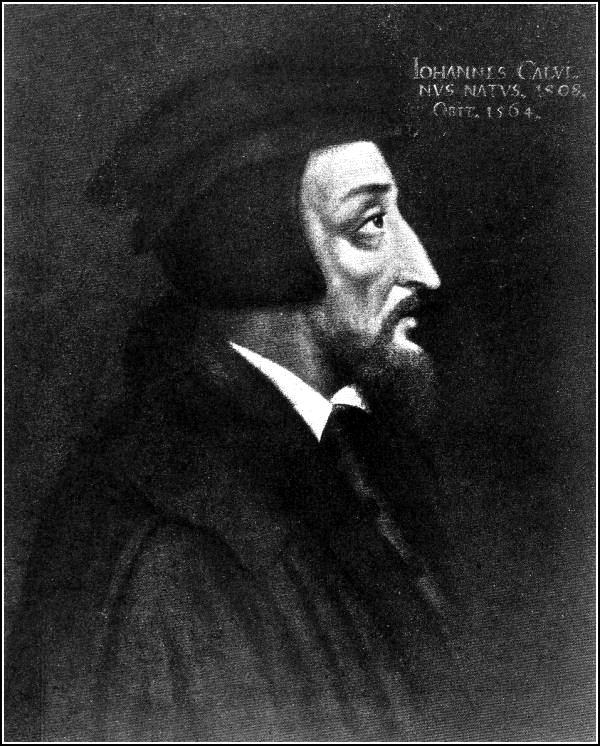
Still rereading Julie Canlis’s magisterial work Calvin’s Ladder. I wanted to share her introduction to her second chapter, which is entitled Creation: The Ground and Grammar of Ascent. Here she is going to develop Calvin’s doctrine of creation and communion, and the way that implicates a doctrine of ascent or koinonia and/or fellowship with God. I’ll share the quote, and then comment a bit  further on the other side.
Because ascent has been misconstrued over the years — indeed, the metaphor has been used to devalue and escape creation for centuries — it is essential to begin with Calvin’s doctrine of creation. We begin with concept of the world as a place of communion, the “trysting place” between God and humanity. Creation is revealed to be a space overflowing with the fatherhood of God, the mediation of Christ, and the tending of the Spirit. It is only when this is established that a correct understanding of Christ’s ascent, our incorporation into him, and ascent in the Eucharist can be grasped properly.
Creation, as the sphere of koinōnia, is the ground and grammar of an ascent that is not away from materiality but a deepened experience of communion within it. This issues forth in a concept of creation that is anything but static and impersonal. Instead, Calvin’s theological vision is a dynamic interplay of God, creation, and humanity, where the creation-call on humanity and the delight and communication of God hold center stage. From the proleptic thrust of Calvin’s doctrine of creation, to his projective concept of the imago as “toward” (ad), to Adam’s dynamic koinōnia existence and then the forceful inversion of sin and the metaphor of falling (the Fall), Calvin is anything but amorphous. Communion is the groundwork of creation, the purpose of anthropology, and the telos toward which all creation strains.[1]
When Canlis concludes ‘Communion is the groundwork of creation, the purpose of anthropology, and the telos toward which all creation strains’ it becomes clear why she fits so well with us Evangelical Calvinists. As I’ve noted previously, dialogical theology, or what Barth terms dialectical theology (in his Göttingen Dogmatics), is a sort of touchstone for Evangelical Calvinism’s theological method (prolegomenon). While it seems to be a pre-dogmatic locus, in fact the method itself is given as the material gift of salvation in the concrete reality of Jesus Christ. It is here, and constantly consistently here where God has spoken (Deus dixit), and continues to speak; as such, this is where Evangelical Calvinists intentionally sit still and attempt to listen before we speak.
Of interest, also, is the idea that Canlis draws from Calvin’s theology; viz. the idea that ascent comes to have an aethereal reality and instead a palpable/material reality in the descent and ascent of the incarnated and ascended Christ. This is important in moving beyond an untethered metaphysics that attempts to discursively think God from effects to cause. Instead, as with Canlis’s Calvin, so for us Evangelical Calvinists, we necessarily affirm the goodness of recreation in Jesus Christ; as such our prayers and dialogues with the living God in the risen Christ do not flutter to the heavens on the wings of wistful butterflies, but instead in and through the flesh and blood and risen body of Jesus Christ. It is through the broken body of the lively Christ wherein the veil has been torn, and we come to have eyes to see and ears to hear the Shepherd’s voice. Dialogical theology is one bounded in koinonia, in the communion of the saints grounded in the Saint of God for us who is Jesus Christ. Here we hear God speak. This is the basis of any sound theology; one that listens through the new ears given for us in the recreated ears of Jesus Christ. As God has spoken and speaks in the humanity of Christ we hear God.
[1] Julie Canlis, Calvin’s Ladder: A Spiritual Theology of Ascent and Ascension(Cambridge, U.K.: William B. Eerdmans Publishing Company, 2010), Loc. 582, 586, 591.