God’s Beauty in Jonathan Edwards’ Theology: With a Flourish of Inspired Worship

A word from American theologian par excellence, Jonathan Edwards, on the beauty of the triune God:

It is unreasonable to think otherwise, than that the first foundation of a true love of God, is that whereby He is in Himself lovely, or worthy to be loved, or the supreme loveliness of His nature. This is certainly what makes Him chiefly amiable. What chiefly makes a man, or any creature lovely, is his excellency; and so what chiefly renders God lovely, and must undoubtedly be the chief ground of true love, is His excellency. God’s nature, or the Divinity, is infinitely excellent; yea it is infinite beauty, brightness, and glory of itself. But how can that be true love of this excellent and lovely nature, which is not built on the foundation of its true loveliness? How can that be true love of beauty and brightness which is not for beauty and brightness’ sake?[1]

For our purposes we will ignore the implicit analogia entis procedure of negative knowledge of God in Edwards’ above rumination, and simply focus on his conclusions.

Along with Edwards I think we need to ‘Make the Beauty of God Great Again’ (MBGGA). Not that we can predicate anything of God, but indeed, we must bear witness to the reality that is in fact lovely, beautiful. In the above statement Edwards refers to brightness as a synonym of beauty with reference to God. What this conjures for me is Genesis 1, and the Light of God’s Grace made known at God’s first Word: ‘In the beginning God created the heavens and earth.’ God’s Light is the primordial Light of the world, indeed the Light that will finally make the Sun and Moon no longer necessary in the Eschatological Light of the Son of Man as His presence in the abode of the Father by the Holy Spirit is unquenchably diffuse throughout the New Heavens and Earth, the Heavenly Zion as that spans the expanse of a de-futilized creation.

Further, implicit and at the base of God’s life for Edwards is that God’s beauty is fitting in the sense that God is a perichoretic relationship of interpenetrating filial and pneumic subject-in-being onto-relating Self-givenness one in the other eternal life. But it is precisely this, for Edwards, at least in my riff of him, that God’s love is indeed beautiful; that is, that God is not a philosophical monad, but instead a relationship of eternal persons in koinonial singular being as Father, Son, and Holy Spirit. As such it is the mysterium Trinitatis that is deserving of all praise and worship. The mystery of God’s eternal life to be basked in by His creatures in Christ, in a doxological wash of bliss and beholdenness. The beauty of the triune God becomes the purpose of the human ensouled body. It is here, in this magnificent beauty of the Father, the Son in His bosom, hovered over by the Holy Spirit that the people recreated in His image in the face of the Son, Jesus Christ, that the sons of God long for; indeed, the revealing of the sons of God as they are unfurled from their bodies of death, and finally brought into the consummate participatory Beatific vision of the triune God. And for the Christian why wait? Even though our bodies of death attempt to keep us clinging to the dust of our earthly origin, the excellency of God’s life in us raises up over and again in the intercession the Son continuously makes for those who will inherit eternal life.

Amen.

[1] Jonathan Edwards cited by Nick Needham, 2000 Years of Christ’s Power: The Age of Enlightenment and Awakening 18th Century, Volume 5 (Great Britain: Christian Focus Publications Ltd., 2023), 364.

A Critique of John MacArthur’s ‘Word Faith Theology’: On the Relationship Between Five Point Calvinism and Human Psychology

I work the graveyard shift at work. I have a work vehicle I drive around in all night. And so, I often will listen to Christian radio. The lineup of pastors they have preaching throughout the night includes John MacArthur’s Grace To You broadcast. The broadcast for January 6th, 2023 was a sermon MacArthur originally delivered back in 1989. The sermon title is: Spiritual Stability, Part 3: Humility and Faith—Phil. 4:5-6a. So, he’s clearly going to be discussing anxiety, and its cure by trusting and resting in Christ. And absolutely, the Lord, as we humbly and boldly come to His throne room of grace, is always ready and present to be with us, especially as we walk through the fire and deep waters of life; after all, the Christian God is the cruciform God. Because of this MacArthur, rightly, is critical of secular humanism, and an aspect of its religion: i.e., psychology. What he would be referring to is the type of therapeutic self-helpism that our ‘secular age’ has turned to as its way of coping with life; a way that isn’t a turn out to Jesus Christ, but a way that is corollary with the fallen self: the homo incurvatus in se. I agree, generally speaking, that many of the anxieties people deal with are self-generated, and end up being because the person only pushes deeper into themselves rather than flying higher out of themselves as they look to Christ, and receive, ecstatically, His life as theirs, moment-by-moment.

And yet, MacArthur is sloppy. He lumps “behavioral” generated anxieties in with anxiety in general. He engages in a sweeping generalization in his discussion on anxiety and depression (and other ailments). He doesn’t account for the physiological processes, the biological lacuna that might be present in some individuals. In other words, he doesn’t leave space for certain psychological issues to be related to actual medical deficiencies a person is born with; and this, indeed, because of the fallen bodies we inherit as a fallen humanity. That is to say, he doesn’t seem to recognize that there are people who lack the capacity to release adequate levels of serotonin in their brains, which, by God’s design, allows people to more readily operate at a ‘normal’ or base level of biological and human functionality. There are masses of people, Christian people included, who suffer with what is called MTHFR (I am one of them); this condition contributes to an inability to biologically produce the levels of serotonin the brain needs to function at a normal level. It is no different than someone who, say, suffers from an overly active histamine production in their bodies (I am also one of them). As a result, in order to quench the over-active histamine production some of us have to take not just anti-histamines, but also histamine-blockers, in order to avoid constant sinus and other respiratory infections and disorders. As corollary, people who suffer from MTHFR (this is just one example), or other biological and physiological lacunas, might need medical support in order to allow the brain to operate at a normal baseline level. Without this type of intervention, the consequences can be dire; as dire as suicide, or simply living with overwhelming anxiety and panic attacks (along with depression). I have lived with an ‘anxiety disorder’ for at least thirty years. The Lord has been gracious to me, and brought me through untold terror and misery; I don’t even understand how. And yet, He never ‘cured’ me of the physiological source standing behind all of this. And so, I have had seasons, over the years, of various anxiety and panic attacks that can be debilitating (almost). In light of that, here’s part of the transcript of MacArthur’s sermon noted above:

Now, let me tell you something, folks.  The Lord is near and this is the Lord who is near, the capable God of the Scripture, and if you will delight yourself in Him and if you will meditate on His law day and night, on His Word day and night, you will then know the God that He is, and you will know how He acts, and that will be the source of your own confidence.

Now, what is the result of knowing the Lord is near?  “Be anxious for” – what? – “nothing.”  What am I going to be worrying about?  Something God can’t handle?  Wait a minute, that’s blasphemy.  If you fret, worry, are in trauma, are unstable, if you launch off into everything from anorexia to schizophrenia and all kinds of things, you are really saying, “I can’t cope with life.  I can’t handle life.”  And if you – whatever mechanism you use to manifest that inability, the real demonstration – and I want to say this with love and graciousness – the real underlying demonstration is you really don’t trust whom?  God.

That’s a form of blasphemy.  Two ways.  One, if you imagine that God can’t help you, then you have created a god other than the true God, and that’s blasphemy.  You have created a god who is not God.  Two, if you believe that God could help you but won’t, that’s blasphemy, too, because you’re questioning not His character but His integrity and His Word.  So the key to a stable, firmly planted life – back to Psalm 1 – is to be delighting in the Lord – I delight in who He is – and meditating on His law, I become very familiar with how He acts.  And as I understand who He is and how He acts, I can look at my life and say, “That’s the one who’s near, this is who He is, this is how He acts; I’m not going to worry.”  And again I go back to what I said:  The great weakness of the Christian church today is a lack of understanding about who God is and how God acts.  They do not understand the majesty of His wonderful attributes, and that is why we have such wholesale instability.  Because we do not know God, we do not trust God to act consistently with His revealed character and His revealed history of acts.

So what do we do?  In the church, we’ve got all these unstable people with all their problems.  Instead of giving them God and His character and His attributes and the history of how He functions and how He acts and the amazing integrity of all of His acts, we try to give clever human solutions to the instability, which in the long run projects that instability into a way of life and gives no solution at all.

In the last generation, A. W. Pink in his book Gleanings in the Godhead wrote, “The God of this century no more resembles the sovereign of holy writ than does the dim flickering of a candle resemble the glory of the mid-day sun.  The God who is talked about in the average pulpit, spoken of in the ordinary Sunday school class, and mentioned in so much of the religious literature of the day and preached in most of the so-called Bible conferences, is a figment of human imagination and invention of maudlin sentimentality,” end quote.

We aren’t even giving people a knowledge of the true God in His character and His works.  As a result, there is a tremendous lack of confidence in Him.  No wonder people have guilt, fear, and anxiety, have an inadequate knowledge of God and an inadequate trust in God – both are blasphemous.  If you imagine God to be other than He is, that’s an idol, that’s blasphemy.  If you imagine God to do other than what is consistent with His own character and promise to His people, that, too, is blasphemy; it questions His integrity.  And instead of teaching God and getting people into the Word of God, most churches are trying to patch up the unstable by giving them human solutions and worst of all, psychology, of which even psychologists say it has no answers.[1]

In general, do I believe that knowing who God is, more accurately, meditating on Scripture, deeply, can assuage the most anxious minds and hearts of deep anxiety and depression? Absolutely! But that said, this does not account for the actual medical/physiological aspects that we as a fallen people are often strapped with, by no choice of our own. I have seen the Lord intervene on my behalf a thousand times over, over the last thirty years and more! But He hasn’t ‘healed me,’ per se, of the underlying physiological source that stands behind so much of the angst and hell I’ve walked through. He has formed and shaped me in certain distinct ways through the forging fires of many deep waters, but He hasn’t healed me. More recently I have been confronted with another season of deep anxiety and panic, of an irrational sort (the fear behind it). It has been as if this time the Lord has said it’s enough, and has led me to seeking a medical support (one I should’ve done thirty years ago, but the Christian subculture, along with the secular, had so stigmatized that type of medical support, that it didn’t seem like a viable option). This time, it is as if the Lord is saying it is time to deal with this in a different way, so I can work through you in a different way. Just as with my terminal cancer diagnosis back in 2009. The Lord ultimately, and miraculously healed me, but not till after going through a hellish medical protocol that literally almost killed me multiple times. He could have foregone that, and simply healed me miraculously from the get-go. Instead He chose that I walk through a fire, that He would see me through; and He decided that He would work through the medical route, with the scars and trauma to the body in tow. Similarly, it seems this time He is using a medical route to finally provide the support I have needed for decades, in regard to helping with my MTHFR and the physiological lack that has produced in regard to a balanced brain functionality. For me, my anxiety and panic hasn’t been a matter of not knowing who God is, not meditating on Scripture (which I’ve read through fifty times, memorized books of, prayed through, so on and so forth); for me it has been a physiological issue, that indeed becomes a hook for a spiritual attack, which the Enemy will exploit, and attempt to use, in order to destroy me (and those with similar physical makeup). And so, this time the Lord has seen fit to bring me to the point of recognizing that it is time to make a medical move.

I share part of my story only to illustrate how MacArthur’s sermon fails to be sensitive to the general population out there. All anxiety and panic, and other ailments, aren’t simply a matter of not trusting the Lord enough. The ironic implication of this, if MacArthur followed his logic through, would land MacArthur in the Word Faith tribe. This is ironic because MacArthur is a vocal critic (as he should be) of such “theology.” And yet that is exactly the implication of what he is saying: i.e., that if you have enough faith you’re going to necessarily be a stable well-balanced individual. Ironically, again, this thinking pushes the person deeper into introspection, and thus deeper into the abyss God in Christ came to save the person from.

MacArthur’s approach is corollary with his prior theological commitments, and ironically, his respective doctrine of God. He broadly receives what in Puritan times was known as experimental predestinarianism. This doctrine is adjunct to a doctrine of predestination, election/reprobation, wherein God decrees that a certain number of individuals are elect, and the others are reprobate (whether actively or passively). In order for the elect to know they are elect, subsequent to God’s absolute decree (decretum absolutum), the person engages in a lifetime of ‘experimentation’ to see if they have enough good works, or enough fruit of the Spirit to determine whether or not they are indeed one of the elect of God, or maybe they only appear to be that, and end up having a ‘temporary faith’; thus being one of the reprobate. This thrusts the person into a mode and lifestyle of performance and introspection that could cause the deepest types of anxieties and depressions. Indeed, someone who lived under this teaching in the Puritan days, a man named, Humphrey Mills, wrote of his despair, that is until he was relieved of this teaching through the correction pastor and theologian, Richard Sibbes brought to him:

I was for three years together wounded for sins, and under a sense of my corruptions, which were many; and I followed sermons, pursuing the means, and was constant in duties and doing: looking for Heaven that way. And then I was so precise for outward formalities, that I censured all to be reprobates, that wore their hair anything long, and not short above the ears; or that wore great ruffs, and gorgets, or fashions, and follies. But yet I was distracted in my mind, wounded in conscience, and wept often and bitterly, and prayed earnestly, but yet had no comfort, till I heard that sweet saint . . . Doctor Sibbs, by whose means and ministry I was brought to peace and joy in my spirit. His sweet soul-melting Gospel-sermons won my heart and refreshed me much, for by him I saw and had muchof God and was confident in Christ, and could overlook the world . . . My heart held firm and resolved and my desires all heaven-ward.[2]

MacArthur’s soteriology is of a species with the type that Humphrey Mills languished under for years; that is until he was presented with a more accurate way of the Gospel by Richard Sibbes. It is a performance based, highly introspective ‘Gospel’ wherein a person becomes swamped by their own failures and bruises, such that the abstract subject becomes overwhelmed by their own inadequacies and “traumas.” The irony of this, again, is that MacArthur et al. push people into a “self-help” type of the Gospel precisely because of their inadequate doctrine of God.

The genuine Gospel does not push a person to introspection and performance based living, wherein a contract is achieved (as in Federal theology). The genuine Gospel recognizes that all of humanity is born in a helpless status, and always already inhabits that status, every day they inhabit the fallen bodies of death they were born with (cf. Rom. 7). As such, our only hope is to look to God in Christ, and His performance therein, moment-by-moment, and understand that He alone, Grace as He is, is the one who vicariously stands in our stead, lives our life for us, as He is the ground and reality of all human life in His archetypal humanity. This is our hope! And it is a dynamic organic hope that is ongoing. It isn’t some static thing of the past (MacArthur’s doctrine) that the human person is supposed to somehow emulate through self-performance and exemplar modulation. No, the Gospel is living and active, and is currently grounded by the One seated at the Right Hand of the Father, where He continuously makes intercession for each and every one of us; those of us united to Him spiritually by the Holy Spirit.

MacArthur, if anything, is consistent with his commitment to an abstract notion of a God-world relation. Not only does this impact his soteriology, but it equally implicates his thinking on matters like we have been touching upon throughout this article. At base, if your idea of a God-world relation is grounded in the idea that God relates to the world, as a matter of structure, through an abstract decree, rather than in the concrete of His life for us in Jesus Christ, then you will end up with a performance-based Christianity, through and through, which will affect the way you not only exegete Scripture, but culture at large. This article is intended to be an example of how a bad doctrine of God (such as MacArthur’s) leads to other bad fruit in regard to the way things get generalized, and thus communicated to the body of Christ writ large. The consequences of this can literally be deadly; not just eternally, but here and now. A baby Christian, who struggles say with MTHFR, who comes into MacArthur’s church, and hears the above the sermon, might think they are in sin for taking an SSRI (or whatever is suited for the particular brain deficiency to function more properly), stop taking it, be thrust into a world of overwhelming fear and anxiety (because of a physiological problem), and commit suicide. This is the type of dire consequences MacArthur’s theology could potentially have in the life of those who might be the most bruised among us. And this is why I am writing this post, as a censure, once again, of the type of bad theology MacArthur et al. promote.

[1] John MacArthur, Spiritual Stability, Part 3: Humility and Faith—Phil. 4:5-6a, accessed 01-07-2023.

[2] Ron Frost, The Devoted Life: An Invitation to the Puritan Classics, citing, John Rogers, Ohel or Bethshemesh, A Tabernacle for the Sun (London, n.p., 1653).

The Monad’s Banqueting Table: On Classical Theism’s Affectionless God

Classical theism is once again a hot-topic. If you scroll through theo-Twitter you will find an in-house debate on the entailments of a classical theism. But this isn’t just reducible to the debate between the Reformed Baptists, and the impact that Thomas Aquinas has had upon the development of their respective types of Reformed and/or Calvinist theology. This debate is ongoing amongst philosophical theologians like Ryan Mullins, Steven Nemes et al., and whatever their alternative offering might be—whether that be an ‘open theistic’ understanding, or something more phenomenal. And then of course we have the charge against folks like Barth, Torrance, and even me, that we are modern theistic personalists; that is, that we construe God in a way wherein he has passions, feelings, emotions, affections, so on and so forth. Theistic personalists, in certain ways, could be construed by way of appeal to a spectrum. The classical theists who pejoratively charge people like me with being theistic personalist, see us on the same spectrum alongside the open theists, and anyone else who isn’t stridently classical theistic in thickly Thomistic ways.

All of that is fine and dandy, but what in fact do these so-called classical theists see as their hallmarks in regard to thinking God? Let’s allow post-Barthian, Bruce McCormack to give us a nutshell summary of the entailments of a classical theism:

Classical theism presupposes a very robust Creator-creature distinction. God’s being is understood to be complete in itself with or without the world, which means that the being of God is “wholly other” than the being of the world. Moreover, God’s being is characterized by what we might think of as a “static” or unchanging perfection. All that God is, he is changelessly. Nothing that happens in the world can affect God on the level of his being. He is what he is regardless of what takes place—and necessarily so, since any change in a perfect being could be only in the direction of imperfection. Affectivity in God, if it is affirmed at all, is restricted to dispositional states which have no ontological significance.[1]

The above reflects Thomas’ [Aquinas] synthesis of Aristotelian categories with the sacra doctrina of the Holy Church. R. Michael Olson comments with reference to Aristotle’s thinking of God as the ‘Unmoved mover’:

Aristotle conceives of God as an unmoved mover, the primary cause responsible for the shapeliness of motion in the natural order, and as divine nous, the perfect actuality of thought thinking itself, which, as the epitome of substance, exercises its influence on natural beings as their final cause. These two aspects of God reflect the two defining aspects of Classical Greek Philosophy: the experience of the intelligibility of the natural order and the search for the first principle(s) responsible for its intelligibility, on the one hand, and the experience of nous both as the capacity to behold nature’s intelligibility and as the source of order in the human soul, soul itself being a source of shapely motion in the natural order. This article comments on each of these aspects of Aristotle’s conception of God, indicating that he finds evidence for his speculative-metaphysical conception in the experience of the rational soul.[2]

The point being that the Aristotelian God, or its Thomist iteration, even as that is received by the Post Reformed orthodox theologians of the 16th and 17th centuries, and as that has funded the thinking of the Westminster Reformed, and as that is now being recovered by various Reformed Baptists, particularly those committed to the London Baptist Confession of Faith (the Baptist version of Westminster), is a God who reposes in monadic pure being (actus purus) and actuality (i.e., ‘Actual Infinite’).

For an example of how this type of classical theism has been received and articulated by a Post Reformed orthodox theologian, here we have William Perkins speaking to God’s election vis-à-vis His “affections,” or, as the case is, lack thereof:

Object. Election is nothing else but dilection or love; but this we know, that God loves all his creatures. Therefore he elects all his creatures. Answer. I. I deny that to elect is to love, but to ordain and appoint to love. II. God does love all his creatures, yet not all equally, but every one in their place.[3]

Further:

I answer that affections of the creature are not properly incident unto God, because they make many changes, and God is without change. And therefore all affections, and the love that is in man and beast is ascribed to God by figure.[4]

No matter, whether you’re a Westminster Federal Calvinist, or a Reformed Baptist who affirms the London Baptist Confession of Faith, the above, as reflected in Perkins’ thinking is how you must speak God. God has no affections in the classical theistic schemata. This is what classical theists claim corresponds univocally with the God of the Bible, the God Self-revealed and exegeted in the Son of Man, Jesus Christ.

Some folks are okay, even jubilant, triumphant about proclaiming the Good News of the Monadic god of the scholastics and the philosophers. You will find them fretting about, moving to and fro with haste all over the interwebs; especially these days on Twitter. If you’re okay with worshipping the Unmoved mover, believing in the Actual Infinite of pure being, then you might want to look this type of classical theism up. They will freely receive you, with an abundance of affection, even if their god won’t. But the above is the naked reality. I don’t think many initiates have really gone down history enough to grasp what in fact they have signed up for. Some have, surely the theologians who are peddling this notion of God have; but I think many of them even have simply been led like innocent lambs to the Monad’s banqueting table, not ultimately realizing there are better ways to be theologians of the Word (or more simply, Protestant).

[1] Bruce L. McCormack, ed., Engaging the Doctrine of God: Contemporary Protestant Perspectives (Grand Rapids, Michigan: Baker Academic, 2008), 186-87.

[2] R. M. Olson (2013), “Aristotle on God: Divine Nous as Unmoved Mover” in: Diller, J., Kasher, A. (eds) Models of God and Alternative Ultimate Realities (Springer, Dordrecht https://doi.org/10.1007/978-94-007-5219-1_9).

[3] William Perkins, Golden Chaine 1. 109, cited by R. N.  Frost, 62.

[4] William Perkins, God’s Free Grace 1.723, cited by Frost.

Understanding and Critiquing Paleo-Covenant Theology: Do Contemporary Covenant Theologians Genuinely Represent Old School Federal Theology?

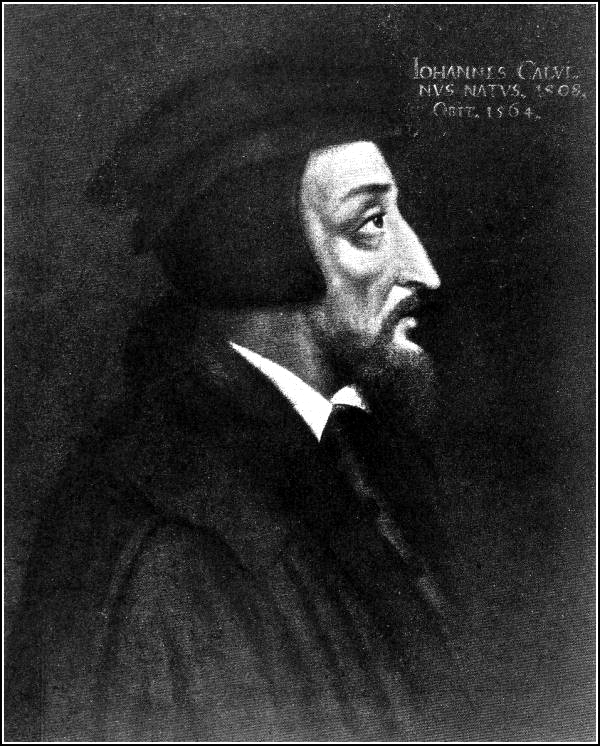
Heinrich Bullinger

Heinrich Bullinger

There has certainly been a resurgence of Reformed theology in the last ten to fifteen years or so; one notable, at a popular level is the so called: Young, Restless, and Reformed. The evangelical Calvinism that Myk Habets and I have promoted through our edited book (we have a volume two at the publishers), and what I have done here at the blog, is an aspect of this type of resurgence (of course ours is from a very distinct Barthian/Torrancean approach). And now we see Oliver Crisp with his two new books: Deviant Calvinism and Saving Calvinism also contributing to this type of resurgence of Reformed theology by attempting to alert folks to the expansive nature of Reformed theology itself (something we evangelical Calvinists are also interested in doing).

For anyone who has read our Evangelical Calvinism book, or for anyone who has read my blog with any kind of regularity you will know that evangelical Calvinists offer some material theological (as well as formal) critique  of what is generally understood to be representative of “classical Reformed” theology; i.e. the type we find articulated in the Westminster Confession of Faith, or at places like Westminster Theological Seminary, Westminster Seminary California, Trinity Evangelical Divinity School, Reformed Theological Seminary, etc. More than offering critique of the popular 5-Point Calvinism, it is more of a critique of “classical” Federal or Covenant theology; i.e. the Covenant of Works, and the Covenant of Grace (with the Covenant of Redemption included). To that end for the rest of this post we will engage with a historical sketch and critique of Federal theology, and how that seminally developed in the Zurich reformer, Heinrich Bullinger’s Covenant theology; and then how that impacted, in general ways, Post Reformation Reformed orthodox theology. What will concern us in this exercise will be the critique that someone like Thomas Torrance himself (along with his brother James) makes of the bilateral nature of the Covenant of Works and the Covenant of Grace[1], and how those two implicated each other in such a way that, at least for Bullinger and the orthodox, according to Stephen Strehle[2], there is a contingency built into the Covenant of Grace (i.e. its reception among the elect) such that the conditions of the Covenant of Works remain conditions to be met by the ostensibly elect person if and fact the elect person is truly one of the elect of God. Contemporary Reformed Federal theologians often push back at this, but I will contend, through reliance on Strehle’s research that they are not pushing back at me or the Torrance brothers, or Barth et al. but instead they are pushing back against the theology and the theologians they claim to represent themselves.

Strehle writes of Bullinger’s and the Post Reformed orthodox’s understanding of the Covenant of Works and Grace; here he is offering a fifth point of analysis in regard to Henrich Bullinger’s theology (at length):

Fifth, he so stresses a human component in the fulfillment of God’s work that he verges upon the synergism of humanistic teaching. In creation he speaks of God as working through certain creaturely means to achieve his end so that even if he is to be praised as the author of all good things in man, he does not accomplish his work without human cooperation. Following Augustine Bullinger is now inclined to employ the term “free will” (liberum arbitrium) as he recounts the stages of man’s relationship to God: 1) Adam is said to have been created with free will, 2) fallen man is said to do his evil through it, and 3) the regenerate is said to be renewed in it, “not by the power of nature but through the power of divine grace.” In salvation he speaks of man’s complicity in the entire process from his initial acceptance to his final perseverance. He can speak of repentance as a “preparation” for faith, faith as a “requirement” for receiving grace, and grace as less coercive and more resistible than that which Paul had experienced on the Damascus road. Once saved the faculty to serve God is said to be restored and the faithful are said to “actively,” not “passively” work with grace unto the salvation of the entire man. God as  our “helper” gives to us his cooperation (gratia cooperans), not to circumvent our participation or insure our perseverance but to provide what is necessary in a process that remains contingent upon us. We must therefore endeavor to work with God, for all is lost if we do not continue in the grace once received.

This synergism comes to a most definitive expression in his doctrine of a bilateral covenant between God and man. Zwingli had previously set forth a doctrine of covenant in order to unify the promises and precepts of God to man, but he never spoke as if this was a bilateral or contingent compact. It is Bullinger who decides to recast the doctrine in this way through the synergistic tendencies and thus coordinate what is promised by God and exacted of man. God and man are now to be understood as confederated into a relationship of mutual responsibility, contingent not only upon the faithfulness of God but also upon that of man. While God might have initiated the relationship, man has his “conditions” to fulfill in order to receive the blessings offered.

The text states the conditions under which they bound themselves together, specifically that God wished to be the God of the descendants of Abraham and that the descendants of Abraham ought to walk uprightly before God.

The second condition of the covenant prescribes to man what he should do and how he should conduct himself toward the initiator and his fellow member of the covenant (confoedo), namely God. “Walk,” he says, “before me and be whole.” They walk before God who purposes throughout their whole life to always say and do the will of God. This is what makes us “whole.” That wholeness is being produced by faith, hope, and love. In these things every duty of the blessed confederation is comprehended. [Bullinger]

While these conditions are found throughout scripture, the charge to Abraham is considered its most succinct and important form. And yet, regardless of the form, the same essential conditions are necessary to secure divine favor. According to Bullinger, upon fulfilling these conditions we are now in a position to expect God to fulfill his part and thus receive his blessings. If we spurn them, we become disinherited (i.e. we lose our salvation).

This doctrine of covenant, we cannot say, is central to the overall theology of Bullinger, but we can say that through his monumental work on the covenant, The One and Eternal Testament or Covenant of God (1534), it did become an important and permanent fixture of Reformed theology. The influence of Bullinger has already been noted among the Puritan elders of Massachusetts Bay and can be noted also among the Scholastics of Continental Europe. These Scholastics speak of the covenant in much the same way, even if more subtle in expression.

However, strictly and properly it denotes the covenant of God with man, through which God by his goodness promises above all eternal life and he demands from man in turn his service and worship, with certain outward signs which provided for confirmation. It is said to be two-sided or reciprocal because it consists from the reciprocal obligation of the two members of the covenant: from the side of God, a promise, and from the side of man, the demand of a condition.

In that covenant there is mutual obligation, both in regard to God to be gracious and in regard to man to present his penance.

The covenant generally speaking is a mutual pact between two parties by which one member binds himself to do, give, or receive something under certain conditions. In order to confirm this promise and make it inviolable, external signs and symbols are attached as a most solemn testimony. [Ursinus]

They can even speak of God as man’s debtor.

In the covenant of God with man, there is something which God does and another which man does. God by his most eminent right commands or demands from man a service, love of himself and compliance, and promises life to the one who loves and complies. By agreeing (astipulando) man promises to love and be obedient to God who demands and prescribes his duty, and by demanding in return (restipulando) from God he claims and expects with confidence life by right of the promise. [J. Heidegger]

The tensions between the doctrine of a bilateral covenant and other staples of Reformed orthodoxy, such as unconditional election and justification by faith—doctrines that exalt in divine grace—did summon their theologians to employ their skills in concocting some sort of a solution. Sometimes the sovereignty of God was invoked in order to emphasize that faith or whatever condition might be exacted of us does not arise out of our own strength but is a product of God’s work within us, making it, in their words, an a posteriori condition. Such a solution, however, did not eliminate the problem since divine favor was still made to depend upon a condition wrought within us—no matter how irresistible this grace was conceived. Luther and Protestantism had originally sought to eliminate any basis within man for his justification, and such a solution did raise this specter again. Other times a Franciscan concept of covenant was invoked in order to mitigate the value of any human contribution before God. In other words, faith and whatever condition might be exacted of man was seen to receive its reward, not so much in accordance with strict justice as if worthy of eternal life (meritum ex condign), but through a God who voluntarily condescends by his covenant to accept the mere pittance that we render to God beyond its just due. However, such a solution did not utterly eliminate the conditional force of the covenant, for something—no matter how disproportionate to its reward—must still be offered to God in exchange for salvation. Salvation was still made contingent on something we do.[3]

In referring to Bullinger, Ursinus, and others Strehle is depending upon the fathers, as it were, when it comes to Federal or Covenant theology. His point is basic, and demonstrable (which he does extensively by appeal to primary sources in the Latin in the footnotes): Bullinger’s and the Post Reformed orthodox Covenant theology, as a subsequent development (historically), offers a covenantal scheme of salvation that makes justification not simply contingent upon faith, but contingent upon keeping the conditions of the covenantal frame. In other words, there is a move away from a radically Christ-centered focus on salvation, and one that collapses into an eye toward the self.

Concluding Remarks

I have read people like Scott Swain et al try to reify this classical type of federal theology for today’s ears, but to me that is not really coming to terms or at least honestly presenting the rawness of what classical federal theology actually entails. It is understandable why contemporary Reformed thinkers, who are “federal” would want to soften the old Federal theology indeed; but again, let’s have an honest conversation about the component parts of what makes a federal theology. I think Stephen Strehle’s analysis helps us to do that, and allows us to see some serious pitfalls associated with old and I would contend new Federal theology.

Karl Barth saw these pitfalls, as did the Torrance brothers, and Barth in particular Christ concentrated and did indeed reify covenant theology in ways that Bullinger et al could never have imagined (see Barth’s little book The Humanity of God to see an example of how Barth uses covenant in a principled Christ focused way).

It would be great to get some push back to Strehle’s analysis, I’ve never seen any in print. To be clear, Strehle is not a Barthian, nor a Torrancean, nor a Brian Armstrongian, et al. he is making a case from direct engagement with primary sources and distilling that in his most excellent book. I would tell you to take up and read, except last I looked at Amazon Strehle’s book is going for around $1,100.

I think the reason this all matters is because it’s not just academic. I know some think that that’s what this is, but it is not. All of this type of stuff trickles down and impacts real life Christians and spirituality. We started this post out with notation of the fact that Reformed theology has and is making a resurgence. I’m hopeful that posts like this will help people to ask critical types of questions about just what genre of Reformed theology they are getting themselves into. Evangelical Calvinism and Crisp’s Deviant Calvinism, and the more resourcing mood those alternatives offer, have open arms. At the end of the day I cannot accept classical or contemporary Federal or Covenantal theology, but that’s not to say that I cannot accept Reformed theology. Indeed, Reformed theology is not monolithic, it is expansive with many tributaries and inlets. One common theme of Reformed theology is the primacy of God’s grace; this is a reality that we can all rally around. How that gets fleshed out later can remain one of intramural engagement, but that’s not to say we won’t have sharp and basic differences among ourselves.


[1] See Thomas Torrance Objects to Federal Calvinism, and So Do I!

[2] I would like to thank Ron Frost, a former seminary professor, and a mentor of mine, for turning me onto Stephen Strehle’s research.

[3] Stephen Strehle, The Catholic Roots of the Protestant Gospel: Encounter between the Middle Ages and the Reformation (Leiden/New York/KÜln: E.J. Brill, 1995), 55-61.

Affective Theology, A Seedbed for My Style of evangelical Calvinism

The following is a post I first wrote about a year into my blogging, back in 2006 (started blogging in 2005). I like to introduce folks to this every now and then because it serves, theologically, as the impetus that led me to the mood of evangelical Calvinism I am in now. As you read this you will see some things that might not jive exactly with the theology I currently promote here at the blog, and in our Evangelical Calvinism book; but there is lots of constructive material available here that I think can be fitted together with some of the contours of thought and theological theses that we have in evangelical Calvinism (as articulated by Myk Habets and myself in our “theses” chapter in our book). Also, beware that as you read this there are some spelling and grammar errors, as well as bibliographic formation problems. I plan on following up this post with another one that gets further into the issue of “created grace” (that you will see mentioned in this post—I have that section emboldened below). Here we go:

Here is a brief sketch to a historical system of theology that I was first introduced to while in seminary, under the tutelage of Dr. Ron Frost. This theology is known as Affective Theology (or even Free Grace Theology—not of the Zane Hodges’ style. I am a proponent of this form of theological engagement (qualified at a few points, I actually like to assimilate this with the “Scottish Theology” of Thomas F. Torrance), and believe that it beautifully captures the intention of scripture relative to things salvific and God’s nature. This framework was communicated in Puritan England by people such as Richard Sibbes and William Erbery amongst others. This was a movement that was responding to the stringent “precianism” of Federal Theology (Calvinism) articulated by fellows such as William Perkins and William Aames. Notice a testimonial offered by a man named Humphrey Mills, someone who knew what it meant to live under the unbearable burden of the moralistic proving ground spawned by the inevitable consequence of “Perseverance of the Saints” and “Limited Atonement/Election”, here he speaks in his own words about the freedom of conscience he finally felt under the teaching/preaching of Sibbes:

I was for three years together wounded for sins, and under a sense of my corruptions, which were many; and I followed sermons, pursuing the means, and was constant in duties and doing: looking for Heaven that way. And then I was so precise for outward formalities, that I censured all to be reprobates, that wore their hair anything long, and not short above the ears; or that wore great ruffs, and gorgets, or fashions, and follies. But yet I was distracted in my mind, wounded in conscience, and wept often and bitterly, and prayed earnestly, but yet had no comfort, till I heard that sweet saint . . . Doctor Sibbs, by whose means and ministry I was brought to peace and joy in my spirit. His sweet soul-melting Gospel-sermons won my heart and refreshed me much, for by him I saw and had muchof God and was confident in Christ, and could overlook the world . . . My heart held firm and resolved and my desires all heaven-ward.[1]

Here’s a heart freed from the constant burden of looking to self for assurance of salvation; and prompted to look up to Christ for freedom and salvation.

Sibbes was one of the key-note articulates against the popery he observed with the moralistic tradition provided framework through the Calvinist doctrines. Sibbes believed, along with others, that external works should never be the basis for assurance of salvation–in fact Sibbes believed that assurance of salvation should not even be a functional premise within a soteriological construct; such as Calvinism provided. Sibbes was part of a movement known as Free-Grace, this was ” . . . the party of Puritans who opposed any idea that grace is conditioned by human cooperation.” (Frost, The Devoted Life, 81). Notice this quote offered by William Erbery, a contemporary of Sibbes, as he discusses progression of Purtian thought ending with that kind of Free-Grace preaching exemplified most clearly by Sibbes, note:

I observed four great steps of God’s glorious appearance in men’s preaching. First, how low and legal were their teachings as they learned the way of preaching from Mr. Perkins, Bolton, Byfield and Dod and Dike. . . . Next the doctrine of free grace came forth, but with less success or fruit of conversion by Doctor Preston, Sibs [Sibbes], [and] Crisp. . . . Thirdly the letter of scripture, and flesh of Christ hath been highly set up by both the famous Goodwins: . . . [Thomas] excels in spiritual discourses of Christ’s death, resurrection, ascension, and intercession, yet much according to the flesh, for he meddles not with the mystery of Christ in us. . . . [The fourth step] is the knowledge of Christ in the Spirit.[2]

As Erbery highlights, Sibbes’, amongst the other Free-Grace teachers, was not taken as seriously as the predominate moralistic (Calvinist) teachers, i.e. Perkins, Bolton, et al. But notice where Erbery’s quote leaves off, “the knowledge of Christ in the Spirit”, to this we now turn. This is an important point of departure for the teaching of Affective Theology, as defined by Sibbes, i.e. the immediacy of the Holy Spirit in the person’s life.

While Sibbes believed works were an aspect of salvation, he did not believe that these should be a barometer for determining a person’s salvation. Furthermore he believed constant obsession with such thinking was a product of an unscriptural understanding foisted on the laity of Puritan England by the Calvinist Divines. Note Ron Frost’s assessment of Sibbes’ approach here:

While Sibbes acknowledged some biblical support in calling Christians to obedience as a duty (Erbery’s category of ‘low and legal’ preaching) Sibbes clearly understood that duty can only be sustained if it is supported by the motivation of desire. Thus Sibbes featured God’s winsome love more than his power: the Spirit accomplishes both conversion and sanctification by a single means: through the revelation of God’s attractiveness by an immediate, personal disclosure. This unmediated initiative was seen to be the means by which God draws a response of heartfelt devotion from the elect.”[3]

Notice the relational nature of the salvific event, the Holy Spirit comes to the heart of the “elect” and showers the heart of the sinner with the beautiful person of Jesus Christ. It is as the heart of the sinner is enflamed a love by the work of the Holy Spirit that the sinner responds back in love–given the overwhelming attractiveness of the sweet Savior. Another thing of note, is that the primary instrument used for disclosing sweet Jesus to the heart of the sinner is through the Holy Scriptures. Furthermore, notice the centrality that heart, motive, and desire play in the thought of Sibbes’ as articulated by Frost. This to me is very important, because it takes seriously what God takes seriously, and alone searches, the hearts and motives of men (see Jer. 17:9 and many other passages). This is God’s concern, the motives, and desires of men and women; this is contrary to the system that emphasized external moralistic duties as the basis of determining one’s election (which by the way had horrific ramifications for Christian ethics as well)– Calvinism. Sibbes’ approach, and his affective anthropology, i.e. the defining feature of man (i.e. where values and motives take shape), was directly contrary to the Calvinist anthropology that saw the intellect and will as the defining features of man, and actually saw the “affections” as that which was the weakest part of man. In Calvinist thought it is within the will via interaction with the intellect that becomes enlivened by a “created quality” or Grace. It is through this created quality of Grace that man is able to cooperate with God and thus keep the duty driven moralistic standards consequently proving one’s election and salvation (like Humphrey Mills lived under).

Conversely, Sibbes saw grace as a relational characteristic of God imbued upon the heart of man. It is through this transformative intervention that man’s heart is changed (II Cor 3), and drawn to God. Note Frost’s description here, as he contrasts the Calvinist understanding of grace and the historic Free-Grace (Affective Theology) understanding of grace (as articulated by Sibbes):

In this framework some additional theological assumptions were revised. For instance, Sibbes understood grace to be God’s love offered immediately (rather than mediately) by the Spirit to the elect. By identifying grace primarily as a relational characteristic of God—the expression of his goodness—instead of a created quality or an empowerment of the will, Sibbes insisted that God transforms human desires by the Spirit’s immediate love and communion. Faith, for Sibbes, was not a human act-of-the-will but a response to God’s divine wooing. God’s laws, Sibbes argued, must be ’sweetened by the gospel’ and offered within a framework of ‘free grace.’ He also held a moderately developed form of affective anthropology (which is as further explained by Frost: Augustine’s affective position emerged in the Pelagian debate. Augustine held sin to be concupiscence of the heart—an enslavement to a love of self rather than God. In Augustine’s anthropology the heart is held to generate values; the mind uses the heart’s values to consider its options and to offer its best judgments; the will uses those judgments to engage in action. . . .”)[4]

This represents the touchstone, and most basic understanding of historic Free-Grace theology, or Affective Theology. Some highlights to take away: Affective Theology (AT) believes man heart is in total bondage to self-love; AT believes that man cannot cooperate whatsoever with God in salvation; AT believes that until the heart is transformed by God’s love through the Holy Spirit’s enflaming work, man will never find rest or salvation; AT believes contra historic Calvinist teaching that the emphasis of salvation is relationally based given the identification of God’s gift of grace with the work and person of the Holy Spirit; AT believes, given the relational basis, is not obsessed with proving one’s election since works are not the foundational component of AT’s framework of salvation.

I’ll leave it here for now, there is much more to be said about this perspective . . . especially about the framework that served as the touchstone for Affective Theology. That touchstone is found in Ephesians 5, and the Pauline marriage discussion. The marital framework provided in this beautiful epistle is picked up by AT and pressed into as the picture, but more than a picture (actually an ontological reality), of what union, and thus communion with Christ, is all about. I.e. this is contrary to the covenental framework provided by Calvinism, and the “contractual” implications provided by such a system (e.g. you keep your end of the contract, and God will keep His). The marital framework, rooted in the New Covenant, is no longer obsessed with personal performance–but instead is overwhelmed with the beauty of her bride-groom [Jesus]–marriage presupposes relationship, i.e. nothing to prove, just something to grow in–ultimately finding consummation in glorification and celebrated at the marriage supper feast of the Lamb.


[1] Ron Frost, The Devoted Life: An Invitation to the Puritan Classics, Frost is quoting from: John Rogers, Ohel or Bethshemesh, A Tabernacle for the Sun (London, n.p., 1653).

[2] Frost, The Devoted Life, quoting from: William Erbery, The Testimony of William Erbery (London: n.p. 1658).

[3] Frost, The Devoted Life, 82.

[4]Frost, The Devoted Life, 82.


Proof of Life: My Good Works; Really?!

If I hear, one more time, that ‘my good works’ are proof and evidence of my salvation, I think I might loose it! When someone asserts that (as a Protestant) that my good works–even though still tainted–are evidence and proof that I am one of the elect or “saved,” I always wonder what in the heck! they are asserting; other than platitudes that are just that. This is common refrain from our Puritan bogus past of experimental predestinarianism, practical syllogisms, etc.; but how in fact this can actually be the case, either theologically, or even exegetically is incredible to me. I am not ranting from, necessarily, an exegetical vantage point at the moment (but theological? Yes!); I am ranting from the crass reality of lived life–the observable kind! If good works are the standard and proof of Christianity, proof of life, my good works and your good works; then I would say we are all damned, serious! If this proof of life, of election, by good works, just has to do with motive, then we are damned (we don’t have good motives apart from Christ’s from whence we participate). If this proof of life, of election, by good works is manifested concretely by good actions that I do, then who is to say that these were not just done out of deontology and duty driven motives (like keeping the law), and not actual Christ centered? And if this mix is so hard to discern, then how in the heck am I supposed to find certitude of my election, of my salvation, by looking at manifest good works in my life; and further, how am I supposed to discern this in your life?!

The above scenario is absolutely bogus! If you have a system of salvation that requires you to look at your good works, first, and then only reflexively at Christ, then you have a bogus system of salvation, and you should repent of it and repudiate it. You should quit telling people that this is what the Bible teaches, because it surely does not! The Bible teaches what our hermeneutic says it does, what our prior theological commitments dictate it does. I don’t see any way around this. I am irked as I write this, because I have grown very weary of this irresponsible non-sense being foisted on the body of Christ at large. If you are telling people that they need to demonstrate their salvation by their good works, you are preaching a false gospel, that in my strong opinion is anathema!

Does this mean that I am accepting, then, an anti-nomian gospel? No, it means that I am affirming a Christ-concentrated conception of the gospel. See my last post. Are good works part of being a Christian? Yes! But that is just it, they are part of being a Christ[ian], part[icipation] in Christ’s sufficient/efficacious good works for us. His good works have demonstrated that He is the only One who is truly good, God. Good works bear witness (Mt 5) to His life, to His full and complete “saved” life and vicarious humanity. Does this objectify salvation? Absolutely! Good works are witness bearers to the only one who is truly good, and truly saved; Jesus Christ.

Rant, over. I feel a little better now. Proceed with the rest of your day now.

John Calvin, John Cotton on Assurance

*Repost on John Calvin number three.

English Puritanism was a “divided house”, there were those who followed William Perkins, and those who followed Richard Sibbes and John Cotton. The issue of division was oriented primarily around the concept of “assurance” of salvation. Sibbes and Cotton held that this issue was resolved with an “assurance of faith” (or simply knowledge of God and the objective criteria of God’s Word—illuminated in the heart of the believer); versus Perkins (and camp) who believed that sanctification and the practical syllogism, or external works, served as the final basis for determining if indeed a person was elect or not. John Cotton believed that John Calvin was in the former camp, and that “good works” or the “practical syllogism” were not the basis for determining one’s election, note:

And seeing we all profess . . . to hold forth protestant doctrine, let us hold it forth in the language of Calvin and others [of] our best protestants, who speak of purity of life and growth in grace and all the works of sanctification as the effects and consequents of our assurance of faith . . . . And therefore if we will speak as protestants, we must not speak of good works as cause or ways of our first assurance. . . . [Y]et indeed you carry it otherwise. . . . Which, seeing it disallowed by the chief protestant writers, if you contrary to them do hold it forth for protestant doctrine, that we may gather our first assurance of justification from our sanctification, it is not the change of words that will change that matter. (Ron Frost, unpublished PhD Dissertation, Richard Sibbes’ Theology of Grace and the Division of English Reformed Theology, King’s College, University of London 1996, 13, quoting Hall, Antinomian, 133-34, quoting John Cotton’s, Rejoinder)

Here Cotton is responding to the charge that he is an antinomian.

What I want to highlight is that historically “Calvinism” has more nuance to it than popularly understood today. There were “Free Grace Calvinists” (e.g. Richard Sibbes, John Cotton, et al), and there were “Federalist Calvinists” [”Law-Keeping”] (e.g. William Perkins, William Aames, et al). I appreciate the former, and believe with both Cotton and Calvin, that assurance of salvation is solely and objectively based upon the witness of GOD’S WORD, emphasizing God’s faithfulness in salvation, rather than my own. Like Cotton, I see justification as distinct, yet inseparably related to sanctification, and consequently hold that sanctification does not serve as the BASIS for anyone’s assurance of salvation . . . but that sanctification, in scripture, is the instrumental means through which the light of Christ is brought to bear on exposing the darkness of this world system. The consequence of sanctification, primarily, is to cause unbelieving man to see the Christian’s good works and glorify and praise God.


§3. Matt Chandler’s and John Piper’s ‘two-willed god’: There is a history!

*To catch up read my first and second installments, 1) here and 2) here.

II

This is my second installment (well third really) on Matt Chandler’s and John Piper’s ‘two-wills in God theology’. My last post on this sought to introduce us to the way that John Piper, in particular, and Chandler otherwise, understand a concept that they both articulate as ‘The TwoWills of God’. I registered my concern in that last post about where this approach leads, because of where it comes from; and because of what it implies about God’s nature, and how he relates to his creation (us) in what has been called salvation history. This post will briefly sketch the aspect of where  two wills in God theology came from; my next and last post in this mini-series will detail what the implications are of this approach (for Christology, soteriology [study of salvation], etc.), and in this detailing I will offer what I think is a corrective—which of course is what we advocate for as Evangelical Calvinists.

The history of two-wills in God theology can be seen given definition through the thought processes of a medieval theologian named William of Ockham. He believed, in a nutshell, that God was one way in eternity (God’s so called ‘absolute will’), and another way in time-space salvation history (God’s so called ‘ordained will’). What this does is introduce a wedge between the God of eternity and the God of spacio-temporal time; meaning that the God we see revealed in Jesus Christ could potentially be different than the God behind Jesus back up in eternity (understand that I am speaking in oversimplified ways and rather crudely)—or, there is no necessary link between how God acts in eternity, and how God acts in time. The result of this is to place a rupture into the very being of God. Here is how Steven Ozment summarizes Ockham’s view (and he also quotes a bit of Ockham for us); we will quote this at some length:

Ockham’s reputation as a revolutionary theological thinker has resulted from the extremes to which he went to establish the contingent character of churches, priests, sacraments, and habits of grace. He drew on two traditional sources. The first was Augustine’s teaching that the church on earth was permixta, that is, that some who appear to be saints may not be, and some who appear not to be saints may in fact be so, for what is primary and crucial in salvation is never present grace and righteousness, but the gift of perseverance, which God gives only the elect known to him. Ockham’s second source was the distinction between the absolute and ordained powers of God, the most basic of Ockham’s theological tools. Ockham understood this critical distinction as follows:

Sometimes we mean by God’s power those things which he does according to laws he himself has ordained and instituted. These things he is said to do by ordained power [de potential ordinata]. But sometimes God’s power is taken to mean his ability to do anything that does not involve a contradiction, regardless of whether or not he has ordained that he would do it. For God can do many things that he does not choose to do. . . . The things he is said to be able to do by his absolute power [de potential absoluta]. [Quodlibeta VI, q. 1, cited by Dettloff, Die Entwicklung der Akzeptations- unde Verdienstlehre, p. 282, and Courtenay, “Nominalism and Late Medieval Religion,” p. 40.]

Ockham seemed to delight in demonstrating the contingency of God’s ordained power—what God had actually chosen to do in time—by contrasting it with his absolute power, the infinite possibilities open to him in eternity. According to his absolute power, God could have chosen to save people in ways that seem absurd and even blasphemous. For example, he could have incarnated himself in a stone or an ass rather than in a man, or could have required that he be hated rather than loved as the condition of salvation. . . .[1]

In order to keep this brief enough I will not elaborate too much, but let me give some reasons why I think this is important to know; and also for whom I am presenting this in the main:

1)      I am introducing this for folks who have never had a Reformation Theology class in seminary, for example. So this is intended to provide exposure for all of those who have been unexposed heretofore.

2)      My hope is that because of said exposure, the reader will understand that there is something more going on when they hear Piper and Chandler articulate two wills in God theology. In other words, the way that both Piper and Chandler present this, to the uninformed; the parishioner will walk away thinking that what Chandler just said about two wills in God is simply Gospel biblical truth without reservation or anyway to critically consider this. So my goal is rather minimal by reproducing Ozment’s thought for you; my goal is simply to alert the attentive reader and thinker that there is something more than ‘biblical truth’ going on in the in-formation of Piper’s and Chandler’s view on this particular topic.

3)      I want the read to understand that there is a particular problem associated with thinking in these kind of Nominalist ways (which is what the philosophy is called that Ockham articulates) about the nature of God. As I noted earlier, it creates a potential schism (indeed necessary) between the God of eternity and the God of time revealed in Jesus Christ; so as my favorite theologian says (along with Barth before him), we end up ‘with a god behind the back of Jesus’ who is not necessarily the same God we see revealed in Jesus (so when Jesus says in John 14 that ‘when you see me you see the Father’, that may or may not be true according to the implications and logic associated with a two-wills in God theology).

Conclusion

My next and final post in this series will expand on the problems associated with this approach; elaborating upon my parenthetical point in point three in the aforementioned. I will notice how this approach, which is purported by both Piper and Chandler to resolve some apparent tensions in scripture; instead exacerbate things in scripture by undercutting the most important point and touchstone we work from as Christians—that is what has been called a Theology Proper or Doctrine of God. If we get this point wrong—e.g. who God is—then the rest of our theological thinking and biblical interpreting will be found to be built on sandy beaches and not the rocky jetty that will stand under the most tumultuous theological storm waves one could fathom.


[1] Steven Ozment, The Age of Reform 1250-1550: An Intellectual And Religious History Of Late Medieval And Reformation Europe, (New Haven and London: Yale University Press, 1980), 18.

John MacArthur is at it Again …

My “e-friend,” Randy Boswell has posted and made a good observation on John MacArthur’s recent rant against the Young, Restless, & Reformed crowd. I haven’t been in the mood lately to comment on Mac, but I’m glad someone still is:

John MacArthur and the Young, Restless, and Reformed Movement

Go over there and give it a read. Unfortunately, I think MacArthur has pretty much framed himself as a guy standing in the corner. Not even fellow 5 pointers are good enough for MacArthur. Beyond doctrinal issues, MacArthur’s gripe against the YRR crowd is the way they dress and talk. I think MacArthur was born in the wrong era, he would’ve been better off in the 17th century Puritan England, or better, America. That way his Lordship salvation, his functional practical syllogism & experimental predestinarianism would not only have legs in Sun Valley, California; but it would also be interwoven into the society and culture at large.

I do believe that holiness is sorely lacking in the American church, but I don’t think that the issue is whether or not someone has holes in their jeans; it is an issue of the heart, and posture toward God and others that the Lord cares about.