
Here Paul Molnar gives a good summary overview of some of the reasons that T.F. Torrance objected to ‘Federal’ or ‘Westminster’ Calvinism:
Torrance’s objections to aspects of the “Westminster theology” should be seen together with his objection to “Federal 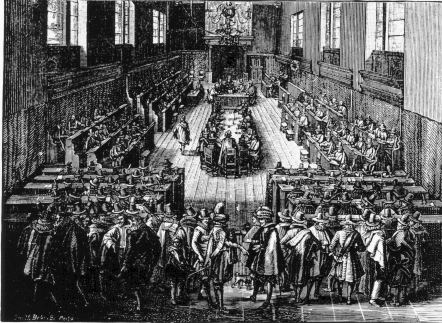 Theology”. His main objection to Federal theology is to the ideas that Christ died only for the elect and not for the whole human race and that salvation is conditional on our observance of the law. The ultimate difficulty here that one could “trace the ultimate ground of belief back to eternal divine decrees behind the back of the Incarnation of God’s beloved Son, as in a federal concept of pre-destination, [and this] tended to foster a hidden Nestorian dualism between the divine and human natures in the on Person of Jesus Christ, and thus even to provide ground for a dangerous form of Arian and Socinian heresy in which the atoning work of Christ regarded as an organ of God’s activity was separated from the intrinsic nature and character of God as Love” (Scottish Theology, p. 133). This then allowed people to read back into “God’s saving purpose” the idea that “in the end some people will not actually be saved”, thus limiting the scope of God’s grace (p. 134). And Torrance believed they reached their conclusions precisely because they allowed the law rather than the Gospel to shape their thinking about our covenant relations with God fulfilled in Christ’s atonement. Torrance noted that the framework of Westminster theology “derived from seventeenth-century federal theology formulated in sharp contrast to the highly rationalised conception of a sacramental universe of Roman theology, but combined with a similar way of thinking in terms of primary and secondary causes (reached through various stages of grace leading to union with Christ), which reversed the teaching of Calvin that it is through union with Christ first that we participate in all his benefits” (Scottish Theology, p. 128). This gave the Westminster Confession and Catechisms “a very legalistic and constitutional character in which theological statements were formalised at times with ‘almost frigidly logical definiton'” (pp. 128-9). Torrance’s main objection to the federal view of the covenant was that it allowed its theology to be dictated on grounds other than the grace of God attested in Scripture and was then allowed to dictate in a legalistic way God’s actions in his Word and Spirit, thus undermining ultimately the freedom of grace and the assurance of salvation that could only be had by seeing that our regenerated lives were hidden with Christ in God. Torrance thought of the Federal theologians as embracing a kind of “biblical nominalism” because “biblical sentences tend to be adduced out of their context and to be interpreted arbitrarily and singly in detachment from the spiritual ground and theological intention and content” (p. 129). Most importantly, they tended to give biblical statements, understood in this way, priority over “fundamental doctrines of the Gospel” with the result that “Westminster theology treats biblical statements as definitive propositions from which deductions are to be made, so that in their expression doctrines thus logically derived are given a categorical or canonical character” (p. 129). For Torrance, these statements should have been treated, as in the Scots Confession, in an “open-structured” way, “pointing away from themselves to divine truth which by its nature cannot be contained in finite forms of speech and thought, although it may be mediated through them” (pp. 129-30). Among other things, Torrance believed that the Westminster approach led them to weaken the importance of the Doctrine of the Trinity because their concept of God fored without reference to who God is in revelation led them ultimately to a different God than the God of classical Nicene theology (p. 131). For Barth’s assessment of Federal theology, which is quite similar to Torrance’s in a number of ways, see CD IV/1, pp. 54-66. (Paul D. Molnar, “Thomas F. Torrance: Theologian of the Trinity,” 181-2 [fn. 165])
Some great insightful stuff on Torrance here. Let me know what you think.
Also, something worth noting, while it is possible (although not totally understandable) to be ‘Evangelical Calvinist’ without being ‘Torrancean’; it would be hard-pressed to understand why you wouldn’t want to at least learn a bit from Torrance. In case it is not obvious, I am unapologetically a beneficiary of Torrance’s thinking and direction, on many fronts. The king of ‘EC’ you are getting exposed to here at “The Evangelical Calvinist,” is most certainly shaped by the contribution that Torrance has made in this direction. I really only mention this, because there are some who would claim to be ‘EC’; and at the same time not come to their ‘EC’ conclusions by looking to Torrance much (or, at all).
Bobby:
This is a very helpful summary. [Or should I thank Molnar for it? 😉 ]
There’s something almost Hobbesian in the idea that the deductive conclusions of the WCF are to be treated of the same class as their propositions, the latter being extrapolated from biblical proof texts. (Hobbes–working at roughly the same time–based his Leviathan upon the deductive proofs of geometry.)
…And we can see these same unspoken epistemological presuppositions at work today, as well, and the forced reinterpretation or waving away of verses or whole passages of Scripture that don’t fit the derived framework….
Stefan,
Glad you like Molnar’s summary; yeah, you can thank him for this one 😉 .
Yes, rationalism is like an acid; once released it can’t be stopped. People’s only hope is to removed completely from rationalism’s reach!
I think our hermeneutics, if they are sensitive to Christ, will always be in an open-structured focus. Meaning that as we grow in the grace and knowledge of Christ our exegesis will grow and turn and twist accordingly. I do believe there is one meaning to the text of Scripture, and that meaning happens to be a person (instead of a proposition); and of course his name is, Jesus!