Making a Distinction Between Two Types of a Christ-centered Hermeneutic: And My Continued Thoughts Toward a Proposal

Here is more on what I am thinking in regard to approaching biblical interpretation christocentrically (‘Christ-centerdly’). I am using a distinction that David Gibson uses in his PhD dissertation on Barth and Calvin, that helps kjvhim nuance how both Calvin and Barth were both christocentric in approach, but christocentric in their respective ways. It is this nuance, in its respective articulation that is helping me to form my own kind of christological approach to exegetical practice. That said, I am still on the way in this regard, and so throwing posts out here like this help me along my own path of development in this regard.
Here is how David Gibson describes the differences between Calvin’s and Barth’s respective christocentric approaches to biblical interpretation:

[…] Calvin’s hermeneutical approach to the biblical text is christologically extensive: although he reads the whole of the Bible’s plot-line in connection with Christology and finds the gospel which the text reveals to be inseparably connected to Christology, he does not always read every aspect of election through a christological lens. Underlying this approach is Calvin’s doctrine of revelation. Calvin has a conception of revelation which never exclusively identifies the Word of God with the person of Jesus, but sees revelation more extensively as also a property of the biblical text. This is different from Barth. His hermeneutics of election may be described as christologically intensive: he both finds the text to speak about Christ at those moments where Calvin speaks more generally about God or the decree, and finds the text to speak about election where Calvin would find the text to speak only about Christology. Likewise, we will see that driving this hermeneutical approach is a doctrine of revelation which  more intensively identifies revelation with Jesus the Word of God than does Calvin. [emboldening mine] [David Gibson, Reading the Decree: Exegesis, Election and Christology in Calvin and Barth, 16.]

My proposal, instead of placing Calvin against Barth, or Barth against Calvin in their respective christoformed hermeneutics is to instead posit that both approaches should be viewed as present in a thick and theologically rich account and understanding of exegesis. So the extensiveness of Calvin and the intensiveness of Barth can both be present if we take as a bridge of sorts, the vicarious humanity of Christ. What I see in this Gibsonian distinction is a dogmatic distinction between soteriology (so Calvin’s christocentrism), and christology (so Barth’s christocentrism), but if I am going to constructively engage with this, I think the better way forward (instead of emphasizing disparity between the two) is to work from an analogy of the vicarious humanity of Christ. In this way, a hermeneutic can be formed that is Christologically shaped with soteriological expression. Meaning that we can be both intensive in principle (Barth), de jure, and extensive in exegetical practice (Calvin), de facto. And one of the matrices that I think is helpful here, for drawing these together Christologically, is what Matthew Levering identifies as the ‘linear-historical’ and ‘participatory-historical’; and yet even more specific than Levering’s development of his helpful identification, what regulates the relation between the particularity of the text (Calvin’s extensive approach) and the universality of the text (Barth’s intensive approach) finds rapproachment  through the unio personalis of the person of Jesus Christ so that within his person we have God-ward and man-ward movements all taking place within the conversation of His hypostatically united life for us (pro nobis). And by the Spirit we participate in this movement and conversation—so our hermeneutic.

Anyway, my time and thus thinking have to break off right here. Alas, this is a blog, and so it always stays unfinished. More later.
A Working Proposal Toward a Christ-centered Reading of Scripture

What does it mean to have a Christ-centered reading of Scripture? I have a post in the works where we will work through this question a bit. Let me just foreshadow that post by offering a simple reflection of what I think this might mean.

thewordA Christ-centered reading of Scripture does so with the full realization that nothing else, for a Christian, could ever be the same when engaging with the text of Scripture. We don’t read the Scriptures as Rabbinic Jews, we don’t read the Scriptures as modern Jews; instead we want to read the Scriptures the way the Apostles did, as if the whole Old Covenant and its promises finally makes ultimate sense in light of its fulfillment in Jesus Christ. So for me, a Christ-centered reading of Scripture involves careful attention to the way the Apostles and the New Testament authors read the Old Testament, and attempting to understand what kind of Jewish modes of interpretation these early Jewish (Apostolic) Christians employed in their arsenal of demonstrating that Jesus is indeed the promised Messiah of Israel, the promised new Prophet (Moses) as it were. Within this linear reading, I also understand a Christ-centered reading to be one that pays attention to the ongoing conversation Christians have been having with the living voice of God and Christ encountered in Scripture over the centuries. So this kind of reading places the  early-Apostolic reading within a larger-living metaphysical frame wherein it should be understood that Jesus is actually the living text that gives the language of the text its reality and meaning. And so a Christ-centered reading for my money must be aware of both of these prongs; the linear-historical, and what Matthew Levering calls the participatory-historical. The ultimate shaping frame of this kind of Christ-centered reading of Scripture is provided by the realization that the text is given orientation and sense by the reality of Deus dixit ‘God has spoken’ (of which the history of interpretation in the Christian church provides attestation), and the filling out of what it means for God speaking is provided traction by way of the text’s Apostolic interpretation deposited in the New Testament; and the New Apostolic interpretation is also a result of a special kind of encounter that the Apostles had with the living voice of God in their seminal context.

I am incorporating some stuff I have been reading from various authors like: Levering, Webster, Barth, Torrance, Blomberg, Gibson, Nigh, Bavinck, et al. I look forward to fleshing this out further.

The Problem with Canonical Critical Biblical Interpretation: Applied to NT Wright and Others [Making Sure Scripture’s Meaning is Not History Contingent, But Instead Christ Contingent]

When I was in undergrad (Bible College) there was this ongoing debate between almost all of the profs with one stand out prof (and I mean from the other profs). The debate orbited around a theory of hermeneutics/exegesis. It was a debate, in my context, that had its own idiosyncrasies, but those notwithstanding, in general, it is a debate that goes beyond those and offers some questions that are applicable beyond the particular ones that were 32e97-simoninherent to the ones being debated on my Bible College campus. The debate was between the majority of profs who endorsed the [Literal] Grammatical-Historical approach V. the minority position, held by this one stand out prof, who argued for a Canonical critical approach to Biblical interpretation—the ‘minority’ approach was actually the most popular on the campus, largely because this one stand out prof was simply an excellent communicator and teacher.

The Canonical approach articulated by this one prof came from his relationship (as a colleague and friend) with John Sailhamer; and Sailhamer was/is largely influenced by Brevard Childs’ Canonicalism.  The simplistic and basic thesis of the Canonical approach really finds a lot of resonance with what Hans Frei and the Lindbeckian Yale school of thought has to offer in regard to cultural-textual-linguistic reality. In short, and in basic form, the canonical approach taught at my school (undergrad) was that we didn’t need any historical reconstruction, maps, socio-cultural reconstruction etc. in order to interpret Scripture; in fact, as it was argued, these things could actually distort Scripture’s meaning. The supposition that stands behind this, is that Scripture has its own self-referential, narrative-rich environment, that does not need extraneous material to source its intended meaning. And thus there is a heavy emphasis upon literary studies, and the connections those provide intra/intertextually in the text. So in summary, this approach assumes that the text is sufficient by itself, to convey the meaning that God has always intended it to have.

It has become clear to me over the years that this approach, in principle, is a better approach than simply relying on the Grammatical-Historical approach; even though the Canonical approach, in a qualified ways, is relying on the GH as well (in the sense that language itself is shaped by its historical locatedness etc.). The problem with the ‘Yale’ canonical approach, though, is that it is too reductionistic (too structuralist); it is too reductionistic towards placing all of meaning in the text, and the text was given shape by its cultural-textual-linguistic organization and setting; so the text’s final referent for positing its locution and meaning becomes the community that interprets it—the community and people of God become its regulative reality.

A better and constructive way to locate the text’s regulative meaning and reality is not to locate it in the people of God, or its canonical shape simpliciter; but the better place is to place it in a doctrine of God, and to see Christ as the regulative center wherein the text finds its ultimate source of meaning. This way the text does not become something owned by the community, but it is owned by its giver (God); and as such, He is able to actually speak to us through the text of scripture, as something and an instrument that belongs to His reality, which He has graciously invited us to as participants in His life through the mediatorial life of His beloved Son. One benefit of this, is that the text and its interpretation and regulation is not contingent upon our discovery of new manuscripts, archaeological finds, etc.

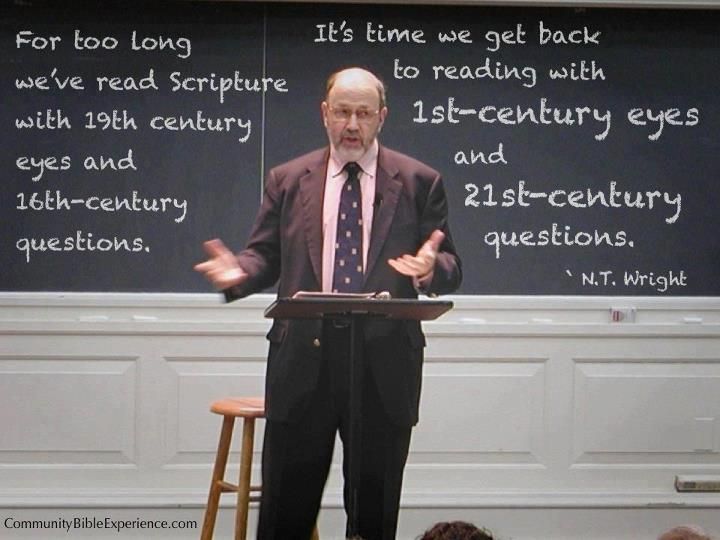
And it is this one benefit that I think should place people like N.T. Wright and all the historical projects that count as Biblical studies today into perspective. N.T. Wright is all the rage today (and rightfully so, his output of material is astonishing). But what is interesting to me is the instability, really, of what N.T. Wright’s proposal has built into it. That is, all of this ‘New’ stuff that Wright is offering in regard to understanding Christian salvation etc. is contingent upon the uncovering of historical data and its reconstruction. In other words, what is built into Wright’s groundbreaking work is idealistic assumption that not only can all of these various threads of the Second Temple Judaism period be uncovered, but then he as an historian (and all of these others in Wright’s discipline) can construct an appropriate framework in which to place this historical data; thereby creating a matrix which purportedly has the capacity to fund and inform Biblical exegetical conclusions in a certain way—indeed, an determinative way.

Ironically, Wright’s approach really gets us back to the cultural-textual-linguistic approach, a community driven/contingent approach, to biblical interpretation. The Bible’s meaning is contingent upon OUR recovery of the historical data, and OUR capacity to reconstruct that data in a way that gives the text its proper meaning. So the text (of Scripture) and its meaning is not contingent upon God in Christ, but upon OUR reconstruction of the historical data, as the Christian community; and as such, the center for meaning in the text of Scripture is not ultimately Jesus Christ, and thus the text becomes the possession of the community, in a way that can leave God out—or in the least, it makes God’s voice contingent upon the proclivities of human and natural history, and our discovery and appropriation of it.

So in principle I think my one prof was onto something. But ironically his approach was funded (by the ‘Yale school’) by an approach that ultimately bottoms out in a kind of community driven interpretation of the text (the difference between my prof’s approach and Wright’s is that my prof simply reduced everything to the Literary/Literal, and Wright reduces the text to the Historical—and both of these are finally reduced to the Community’s capacity to manipulate both the Literary and the Historical). What my prof was onto though was that the text and its meaning is not ultimately contingent upon historical reconstruction (because if it is, then we would have to ask: Whose reconstruction should we view as normative?); but his answer and way out was not adequate (i.e. Literary only), and in fact, ironically comes back to the same problem that He was/is intending to critique—the community becomes the norm.

The way forward is to understand Scripture and its ontology as Theological! To understand Scripture’s location and giveness from the center of God’s life in Jesus Christ, and to see Scripture as the product of God’s triune speech within the realm of gracious salvation and sanctification (so John Webster’s thesis). This way Scripture’s meaning is not ultimately generated by our reconstruction of human history, or our capacity to do literary work; but Scripture’s rule of faith is Christ.

I will have to end it here. Thanks for enduring my reflections on this. This post helped me get some of this out and think it through further, hopefully it has helped you out too.

Conversational [Dialogical] Theology: Being a Catholic Interpreter, with Advice for N.T. Wright

If the Christian life is dialogical, or shaped by conversation with God and His people; which it is (I would argue). And if Jesus Christ, according to Paul, promised that He would build His Church up by providing it with teachers/elders, evangelists, et al (Eph. 4); which He did. And this promise has come to fruition through all of the centuries since Jesus ascended, and into the present; then how can we ignore the fact that the Christian faith, and its self-understanding is catholic (i.e. universal, and reaches across all periods of the Christian church)?

I have learned much through engagement with N.T. Wright, but one lacuna or gap in his thinking (intentionally so on his part), is his failure to properly or thickly appreciate my point in the paragraph above. His common quip is that the Medieval church (and the early Reformed one) ‘got the right answers, but asked the wrong questions’ in regard to understanding the nature and ontology of Christian salvation. And that this, then, has had a distorting affect upon the subsequent development of the Christian church, since. And so, by and large (other than a head-nod, when he is pressed), Wright waves his hand over this whole period (from at least the 14th century into much of the present time—and he even goes after the ecumenical councils and the Greek Church Fathers), and acts as if he (and in many ways, he alone) can recover Christian truth about salvation, in particular, that had heretofore been lost; as if the gates of hell had prevailed against the Church of Christ, until he (and some of his company) have recently come on scene. Surely this is problematic, and overwrought! I have learned much from Wright, but Jesus has capably and conceptually been forming His church without Wright and our current situation, just as He said He would, through the teachers He has provided His church with through the centuries.

Thomas Torrance offers a better perspective on how to think about the dialogical nature of Christian interpretation and conversation/fellowship with God and His people. You will notice that in what Torrance communicates, he does not denigrate historical studies (which is what N.T. Wright’s discipline is), but gives them their rightful place; but he expands this idea of historical studies out beyond Second Temple Judaism, and into the history of the Church and history of interpretation, as if Jesus really has been offering fresh encounters with His people over all of the centuries of the churches’ existence. Torrance writes:

(iii) It is the combination of historical and ecumenical studies that is particularly valuable. Historical studies are necessary for the understanding of our brethren from another historical tradition, and yet it is only by engaging in conversation with those who belong to a Church that has embodied another historical tradition that we can fully understand the history of the Church. This applies not only to the separated Churches of the Evangelical world, but to the relations between so-called “Evangelical” and so-called “Catholic” Churches, between East and West, and indeed between the people of the New Covenant and the people of Israel who persist in living only according to the Old Covenant. It is thus that theological activity is enabled as fully as possible to engage still in conversation with the fathers of the Old Testament, with the Greek and Latin fathers of the ancient and mediaeval Church, and with the fathers of the Reformation in all its branches. We have to take very seriously the requirement of God to appear before Him, and to engage in conversation with Him, not alone, but with the whole company of God’s people past and present. It is thus that it belongs to the very nature of theology to be essentially catholic, and it is enabled to be that by historical and ecumenical dialogue with the fathers and brethren alike. [Thomas F. Torrance, The School of Faith: The Catechisms of the Reformed Church, lxviii-lxix.]

It is clear how Torrance thinks about this then. And I think it is much more of a healthy and balanced alternative than the sense that N.T. Wright often portrays in his own thinking. Ironically, I would note, Wright does not actually move away from the classic redemptive-historical-soteriological mode of Reformed-covenantal exegesis; instead he simply reorients it, by re-shaping it, a bit, through his historical reconstructive work of Second Temple Judaism. So he hasn’t really asked new questions from the Reformers, he has simply come up with new answers, albeit largely in the same ecclesio-soterio/centric frame that many of the ‘Reformers’ were working through.

The difference that Torrance offers, from Wright, is that he grounds his dialogical approach to theology/hermeneutics in a doctrine of Christ/God; which has to be the hermenutical order we follow. We must follow a Christ-centered hermeneutic as the key to providing the proper frame through which the right questions can finally be asked. As Torrance also writes of the best of the Reformed tradition:

[…] It is in that light that the Reformation as a movement for theological reform is to be understood, that is, as a thoroughgoing criticism of all the received doctrines in the light of correspondence to the Gospel and coherence with the central doctrine of Christ, and a radical reforming and correcting of these doctrines by bringing them into obedient conformity to the doctrine of Christ. It was in that movement of faithfulness to Christ and His Gospel that Reformed theology came to understand both the nature of true theology and the nature of its systematic presentation through consistent obedience to the Truth as it is in Christ Jesus. [Thomas F. Torrance, “The School of Faith,” lix-lx.]

So it isn’t that Torrance, like Wright, is receiving medieval categories and thought forms uncritically; it is just that Torrance (unlike Wright) is critically ‘receiving’ the history of Christian thought by submitting it to the reality of Jesus Christ Himself. So the methodology is a principled Christological one, and one that is in constant flux as it is given fresh voice through conversation with God in Christ by the Spirit. We don’t need to toss the whole thing and start over (which is often the impression that comes across through Wright), but we need to be in submission to the Lordly voice of the Christian heritage and present, in a way that we operate, as Torrance would say, with ‘repentant’ thinking; Jesus’ voice, the voice of the living God, being that which regulates our reception of His voice given in the past through and to His people. So as in dialogue, healthy ones, this is an ongoing reality.

Does the ‘Greek’ Support Pre-Tribulational Rapture Theology and the Left Behind Series?

My background is in Dispensational-Pre-Tribulational-Rapture-Premillennial theology. My alma mater (Multnomah Bible College and Multnomah Biblical Seminary) find their heritage squarely ensconced within this orbit; indeed, so much so, that Multnomah has at points been called ‘mini-Dallas’ (Theological Seminary)—in fact Multnomah’s origins are inimically tied into Dallas, by way of its founder[s], and its faculty (which is largely changing nowadays!). Anyway, I thought I would post something that is related to the kind of theology that both Multnomah and Dallas have helped to promulgate over the years through their sending of pastors, missionaries, teachers, evangelists etc.; and in particular what I am going to broach is the fine (and even idiosyncratic–for some) point that has to do with the theory of the Pre-Tribulational rapture. If you are unfamiliar with it, then just think of the story told in the popular Left Behind  series; except in the rendition I will share here, we will experience the more academic side of what stands behind ‘Left Behind’ rapture theology.

parousia

Daniel B. Wallace has written one of the standard New Testament Greek Grammars, and it served as the basis of much of my advanced Greek education in both Bible College and Seminary. At the end of his chapter on Articles, he provides an example of how a proper understanding of the Greek grammar can actually support the Pre-Tribulational rapture theory—which foists an idea that there is a distinction between the Rapture of the Church and the Second Coming of Jesus Christ (which happens Post-Tribulation). Here is what Wallace writes:

2 Thess 2:1 ‘Ἐρωτῶμεν δὲ ὑμᾶς, ἀδελφοί, ὑπὲρ τῆς παρουσίας τοῦ κυρίου ἡμῶν Ἰησοῦ Χριστοῦ καὶ ἡμῶν ἐπισυναγωγῆς ἐπ’ αὐτόν,

Now we ask you, brothers, concerning the coming of our Lord Jesus Christ and our gathering together with him

This text impacts the discussion in some American evangelical circles over the time of the rapture. Many postribulationalists/non-dispensationalists have considered the two to have the same referent precisely because of their misunderstanding of Sharp’s rule and its specific requirements.

Since the TSKS construction involves impersonal substantives, the highest degree of doubt is cast upon the probability of the terms referring to the same event. This is especially the case since the terms look to concrete temporal referents (the parousia and the gathering of the saints), for the identical category is unattested for concrete impersonals in the NT.

This is not to say that one could not see a postribulational rapture in the text, for even if the words do not have an identical referent, they could have simultaneous ones. Our only point is that because of the misuse of syntax by some scholars, certain approaches to the theology of the NT have often been jettisoned without a fair hearing. [Daniel B. Wallace, Greek Grammar Beyond the Basics: An Exegetical Syntax of the New Testament With Scripture, Subject, and Greek Word Indexes, 290.]

So even if you fully repudiate Pre-Tribulational rapture theology (as I now do—I am Post-Tribulational, and some days Covenantal/Historic-Premil and other days Amillennial 😉 ), at least you will realize that so called rather disparagingly Left Behind rapture theology actually has some Greek and academic rigor behind it. That said, even as Wallace notes, in the end, the referent of ‘the coming’ and ‘gathering together’ could be synonymous. The only way we can really conclude which way to go with this is not the Greek Grammar (even though it helps lay out the critical options), but by situating the grammar within its larger theological-canonical place in regard to understanding the overall movement of God as given reference in the first coming of Jesus Christ.

I am out of time for this edition, there is always more to be written, but never enough time to write it!

Reading Scripture Theologically: Providing Relief From NT Wright and also the LGH

It is important to remember that the text of Scripture is not just Literature, it is that, of course, with all of its conventions and literary devices, to boot; but it is more than this as well. My North American Evangelical tradition has adopted a mode of biblical interpretation (which I think is actually changing in some sectors) known as the Literal Grammatical Historical method; it is this method, by and large, that has given us the various expressions of the dispensational hermeneutic we have (as Americans) become all too familiar with—indeed it was this methodology that I was largely trained in, in both undergrad and Seminary (and my Master’s Thesis on I Corinthians 1:17-25 employs in slavish form). Here is how I described the LGH in another post I once wrote years ago, and then what, I then, in seminal form was coming to see as a better way forward (and still do):

wright1

I think our epistemological approach shouldn’t be rooted, necessarily, within a “rationalist” framework . . . which is where the LGH was shaped. That is, the LGH developed out of the “History of Religions” school of thought, at the turn of the 20th cent., and from other “rationalistic” streams of thought concurrent with this time period. Fundamentalists revolted against the “higher criticism” inherent to these schools, and combined with “Scottish Sense Realism” developed an Evangelically charged hermeneutic that (and I’m oversimplifying a bit here) was still consonant with their “liberal” brethren . . . albeit Evangelically charged! So instead of allowing arbitrary readings of history to primarily serve as the “epistemology” of scripture; I think it serves us better to approach it with Christ-centered spectacles which assumes a “positive” Christian hermeneutic provided in the scriptures. So that, the “history of Jesus” is indeed the history of scripture; and not various socio/cultural reconstructions. Furthermore, instead of doing biblical intepretation, or approaching scripture with socio-analysis as the primary methodological apparatus (which is where the LGH comes from); Karl Barth gives us the best way forward for approaching scripture (even though his points have to do with “theology”). His way forward is to start with the historical person, Jesus of Nazareth, as determinative of theology and its method. Here is T. F. Torrance on Barth:

Because Jesus Christ is the Way, as well as the Truth and the Life, theological thought is limited and bounded and directed by this historical reality in whom we meet the Truth of God. That prohibits theological thought from wandering at will across open country, from straying over history in general or from occupying itself with some other history, rather than this concrete history in the centre of all history. Thus theological thought is distinguished from every empty conceptual thought, from every science of pure possibility, and from every kind of merely formal thinking, by being mastered and determined by the special history of Jesus Christ. [Thomas F. Torrance, “Karl Barth: An Introduction to His Early Theology 1910-1931,” 196]

So as I was thinking then, I think now a better way forward to interpreting Scripture must have Jesus himself as the principled reality that serves as the rule and regulator of our interpretive decisions. Scripture should be viewed sacramentally in the sense that it is only a ‘sign’ of which finally gives way to its depth as it finds that in its ‘reality’, Jesus Christ. Matthew Levering provides further insight into how a flat kind of literal interpretive mode of operation came to find its existence in the history of ideas; he writes:

[…] Levine argues that Erasmus “began to think of the Bible principally as a record of history, rather than an arsenal of theological texts, above all as the story of Christ on earth—Christ as the supreme exemplar to be followed and imitated.” Behind Erasmus, Levine finds the mid-fifteenth-century humanist Lorenzo Valla: “For Valla, grammar was the supreme science, or at least the indispensable preliminary that was required for understanding any writing, and hence any doctrine…. In these crucial matters, the philologist was above the theologian.” [Matthew Levering, Participatory Biblical Exegesis, 22.]

I would say this is true in my experience, and it seems to be the continuing reality even as Evangelical exegesis continues to develop into more sophisticated expressions; like in NT Wright’s work for example. I have nothing against learning the Biblical Languages (I have), and using historical reconstruction etc. as part of the tool box that we use to interpret Scripture. But what I do have a problem with is when there is not proper attention given to the inner-logic and theological depth upon which Scripture turns, and wherein Scripture finds its reality; this would be like trying to ride a bike with just the spokes and wheel with no tire, you might be able to ride the bike, but it won’t move at optimum performance, it might hurt, and you probably will even crash and burn.

This is how I see the Evangelical obsession with appealing to NT Wright, and others in this camp, as the definitive way for reading Scripture. Scripture has Triune-Christological-depth as its ultimate context and canon. If we fail to see this reality as that which gives the text its ultimate sense and meaning, then we might be able to produce elaborate socio-cultural-historico reconstructions of the text, but in the end, there is really no dialogue taking place with the living author of the text, Jesus Christ. I see modern Evangelical exegesis, mostly, as an horizontal endeavor done in the name of vertical reality; and thus without vertical reality giving it the life it truly has in its ordained capacity to serve as the communicative medium and instrument that it is. I will offer more (later) on the better way, that I see as an alternative to the LGH, and now the critical movement provided by the likes of NT Wright and others.

Simon the Zealot, A view of Zealotry I never knew of until now

Here’s a different kind of post for me (at least it has been awhile)—this is a post I posted at a blog I recently attempted to start, but is now defunct; I don’t think anyone ever read this post there, so I brought it over here.

Simon the ‘Zealot’

Here is something new I just learned about Simon the ‘Zealot’, and I bet it will be something new for you; unless of course you have read Richard Bauckham on this, or maybe other critical New Testament historians. I am currently reading Bauckham’s book Jesus and the Eyewitnesses, and in particular I am currently reading his chapter 12 entitled The Twelve. Here Bauckham is discussing the names of the Twelve and how they have come to be and function in the Gospel narratives; in the particular instance I am going to quote, Bauckham is talking about Simon the Zealot, and what in fact would have characterized Simon’s kind of zealotry situated as he was in his historical context (this point is contrary to how I have been taught, in the past, to think of Simon’s zealotry, and thus represents something new that I have learned about Simon the Zealot). Here is Bauckham:

[…] It is now widely recognized that, since a specific political party with the name Zealots does not appear in our sources until after the outbreak of the Jewish revolt in 66 CE, the term applied to Simon here must have the broader sense, current in this period, of “zealot for the law” (cf. Acts 21:20; 22:3, 19), often implying that such a person would take violent action to punish flagrant violation of the Torah. Such violence, however, would normally be aimed against fellow Jews rather than the Romans. We should probably presume that Simon already bore this nickname before becoming a disciple of Jesus. Meir points out that “the only instance in prerabbinic Judaism of an individual Israelite bearing the additional name of ‘the Zealot’  is found in 4 Macc 18:12, where Phinehas (the grandson of Aaron) is called ‘the Zealot of Phinehas’ (ton zeloten Phinees). Perhaps Simon’s nickname amounts to calling him “a new Phinehas.” However, although Phinheas was indeed, for Jews of this period, the archetypal “zealot,” the usage in 4 Maccabees 18:12 is probably a description rather than strictly a nickname. Another possible parallel that has not previously been noticed is the name of the owner inscribed on a stone jar from Masada. The two words (yhwsp qny) can be translated either as “Joseph (the) zealot” (qannay) or as “Joseph (the) silversmith” (qenay). [Richard Bauckham, Jesus and the Eyewitnesses, 104-05.]

This is an interesting tid bit of historical insight that helps me to re-think what kind of zealotry characterized Simon’s, Jesus’ disciple, and one of the Twelve Apostles. This would, interpretively, be significant to me in the sense that it would make even more sense for Simon to align with Jesus; only if he (Simon) believed that Jesus was the meaning and fulfillment of the ‘Torah’ in a very depth dimension kind of way. Such that Jesus’ person would finally make sense of the Torah in ways that Simon the ‘Zealot’ had never considered before; providing a Zealotry filled with a true knowledge of the God and Yahweh of the Torah which he felt he must defend with utter stridency.

For those unclear, the typical way of understanding Zealotry in relation to Simon, has usually been to think of him as someone who was looking for a Messianic figure to come in and overthrow the Roman empire (so an anti-Imperialist) [which Bauckham highlights as well in the quote above]. But in point of case, if Bauckham is correct, to be a zealot in the period that Simon, Jesus, and the others inhabited, would mean to be a vigorous defender of a text; God’s text given to the Jewish people. This insight, from Bauckham, definitely re-situates Simon’s person and aspirations; and it helps me, at least, to think about Simon in ways differently than I had been taught to, heretofore.

Learning How To Read Scripture As Christians, Through Understanding Scripture’s Proper Placement

If you have ever struggled with biblical interpretation and hermenutical theory (i.e. your philosophy of Biblical interpretation), maybe part of that struggle has been because of unconscious captivity to a certain mode or bible-cover-pagephilosophy of Biblical interpretation that you have inherited from your own Christian tradition (denomination, etc.). Maybe it is because you have been holding to a doctrine of Scripture (and an ontology or ‘reality’ of Scripture) that has been hindering you from fully engaging in a genuinely Christian attempt at reading Scripture.

I think my above hypothesis is probably true for most of us Evangelical Christians, in particular; but also true for so called Liberal Christians, neo-Orthodox Christians, and whatever other variety of Christian there might be. If so, then John Webster provides a good picture of the differences between the typical approach (with various expressions) of Biblical interpretation—and how that is previously related to a prior commitment to a particular doctrine of Scripture—and a truly and principled Christian reading of Scripture (as related to Scripture’s placement within a theological account). Here is what John Webster communicates:

[I]n Christian theological usage, Scripture is an ontological category; to speak of the Bible as Holy Scripture is to indicate what it is. In applying the designation ‘Scripture’ to the biblical writings, we are not simply or primarily indicating something about the place which these texts occupy in the religious or moral world of their readers; nor are we describing our own intentions and those who make use of these texts. ‘Scripture’ is not merely a morally or socially evaluative term, an epithet of honour which draws attention to the veneration bestowed upon these writings by a particular community. To say ‘Scripture’ is to say ‘revelation’, not just in the sense that these texts are to be handled as if they were bearers of divine revelation, but in the sense that revelation is fundamental to the texts’ being. Revelation engenders Scripture, and in that relation of being engendered Scripture is what it is. By ‘revelation’ here is meant the communicative presence of the risen one in the Spirit, his resounding divine voice ‘like the sound of many waters’ (Rev. 1.15; cf. Ezek. 43.2). Scripture has its being in the ‘word’  (the magisterial self-utterance) of the risen one. Brought into being by that word, made resonant by it, the biblical texts are caught up in the exalted Christ’s proclamation of himself and his glory.

Such affirmations resist the historical naturalism to which accounts of the nature of Scripture quickly succumb. Once the historia scripturae is allowed to be determinative of the way in which the ontology of Scripture is conceived, then the biblical texts become a subset of the larger category of ‘texts in general’. They may still, of course, be distinguished by certain contingent properties which pick them out from other members of the class; but in a naturalist textual ontology such properties indicate the attitudes, policies or evaluations of the users of the biblical texts, but do not give any direct indication of the place of the texts in a divine economy. The biblical texts may be lifted beyond other texts by virtue of their content (doctrinal, moral, experiential); but explanation of this difference remains at the level of interpretive or religious intention. No language of divine action is required for determining what the texts are, for they are essentially ‘historical’ entities. They are to be conceived as the products of human religious agency, occupying and doing their work in an immanently conceived communicative field. As such, investigation of their natural properties and the natural properties of the agents of their production, dissemination and interpretation, is sufficient. To such investigations, evaluations of their religious significance may be contingently attached, but must remain subsidiary to the definition of what the biblical texts are. [John Webster, The Domain Of The Word, 39.]

Most of what counts today as Biblical exegesis, even among Evangelical Christians has been given its reality by way of ‘historical naturalism’. Indeed, I could think of many academic Christian Biblioblogs, for example, that are given shape by this very mode of Biblical interpretation. It does not normally take its form from intentional Christian thinking about the Bible, instead it has allowed various historical-cultural forces (primarily from the 18th, 19th and early 20th centuries) to impinge upon its existence as a discipline of Christian exegesis. This same drift is true and evidenced in Christian theology in general; except in this arena, the exemplification of this is that Philosophers of Religion and Philosophy of Religion (and all of its assumptions) are baptized for Christians, as their theologians—but there is nothing methodologically significant about this, since these same Philosophers of Religion, if they happen to be Muslim, could take their same mode and practice and just apply it in the direction of Islam instead of Christianity. So there is nothing unique or special, either about this kind of typical “Christian” Biblical exegesis, and/or this type of “Christian” theology. Matthew Levering identifies similar things as Webster does, when he writes:

[…] By the eighteenth century, logical rules of historiography took priority over the Bible’s narrative as the ground on which Christians could understand themselves. These rules envisioned God’s action as radically “external” to human action, and thus extrinsic to historical accounts of Scripture’s genesis and meaning. In patristic and medieval hermeneutics, by contrast, not logical rules of historiography, but faith in providential God grounded the assumption that the books of the Bible displayed the divine patter of salvation. This faith nourishes and is nourished by the Church’s biblical reading, understood as a set of embodied and liturgical practices constituting the Church’s conversatio Dei. [Matthew Levering, Participatory Biblical Exegesis: A Theology of Biblical Interpretation, 21-2.]

Neither, Webster, Levering, or myself are suggesting that engagement with the historical, grammatical and literary realities of the text of Scripture should not be the primary means by which we exegete Scripture. But what is being suggested is that without a proper understanding of Scripture’s placement (ontology) within God’s relationship to us (so Dogmatic), given its clothing by the humanity of Christ by His Spirit spiration, then Scripture and its interpretation becomes dislocated and lost in the wilderness of human proclivity; lost because it is not first and intentionally grounded in its reality in Christ. And thus Scripture is no longer read through the faith of Christ, but instead through the disorderly turns of natural history and man’s own disposition.

A quote from John Webster on Resurrection and Interpretation

“The nature of Holy Scripture, and of its interpreters and their acts of interpretation, may all be understood out of the resurrection of Jesus Christ. The task of biblical interpretation is a function of the nature of Scripture; the nature of Scripture is a function of its appointment as herald of the self-communicative presence of the risen one. Scripture is to be read as what it is, a complex though unified set of texts through which the risen Christ interprets himself as the one in whom the entire economy of God’s dealings with creatures has its coherence and fulfilment. The ground and substance of the church’s confession is his majestic and luminous perfection: ‘he fills all things’ (cf. Eph. 4.10). Scripture and its interpreters have their being within the compass of this all-embracing reality; acts of interpretation are undertakings within the history of reconciling and revealing grace over which the exalted Christ presides. Such acts are becoming when they conform to the order of being in which they are ventured, and disorderly when they misunderstand or disavow that order of being and treat Scripture as something other than the address of the risen Christ to the saints.”
–John Webster, “The Domain Of The Word: Scripture and Theological Reason,” (London/New York: T&T Clark, 2012), 32..

N.T. Wright on Dispensationalism/Pretribulationalism and the Nation of Israel

Jerusalem besieged, 70 A. D.

I thought this was an interesting point made by N. T. Wright in his book Paul: Fresh Perspectives, he is discussing the nation of Israel and how Israel functions in the theology of the Apostle Paul. The point I am lifting from Wright here is a point that illustrates his dismay over North American Dispensational readings of Paul’s theology, in particular his conception of the second coming of Christ. Here is what Wright writes:

[…] For some, alas, the very phrase ‘second coming’, and even perhaps the word ‘eschatology’ itself, conjures up visions of the ‘rapture’ as understood within some branches of (mostly North American) fundamentalist or evangelical Christianity, and as set out, at a popular level, in the ‘Left Behind’ series of novels by Tim F. Lahaye and Jerry B. Jenkins, and the theology, if you can call it that, which those books embody. That scheme of thought, ironically considering its fanatical though bizarre support for the present state of Israel, is actually deeply un-Jewish, collapsing into a dualism in which the present wicked world is left to stew in its own juice while the saints are snatched up to heaven to watch Armageddon from a ringside seat. (p. 145, Nook edition)

And then he goes on in the next paragraph to develop the Apostle Paul’s actual thinking, in contrast to dispensationalism, on such things; he continues to write:

This is massively different from anything we find in Paul [referring to the dispensationalist reading he just mentioned], for all that the central text for the ‘rapture’ theology is of course I Thessalonians 4.16-17. What we find in Paul at this point is four things, in each of which we see the still-future Jewish eschatology redrawn around the Messiah…. (p. 145, Nook edition)

He goes on to develop his ‘four things’, which I don’t want to get into at this point. Instead, I simply want to draw attention to the way that N. T. Wright (unsurprisingly) thinks of dispensational theology. I have come to agree with Wright about my former dispensationalism (I am an American Evangelical after all). But what does Wright mean when he writes ‘That scheme of thought, ironically considering its fanatical though bizarre support for the present state of Israel, is actually deeply un-Jewish, collapsing into a dualism in which the present wicked world is left to stew in its own juice while the saints are snatched up to heaven to watch Armageddon from a ringside seat’? It is something that I have harped on for quite some time, whenever I write about dispensationalism; that is, this neo-Platonic, hard and fast distinction between Israel and the Church (the Church=for Wright ‘the saints snatched up’). It is this distinction that ironically, but not, makes the Church God’s saints, and the nation of Israel his Covenant People; such that the latter are judged (even though Jesus already was … he was the Jew, wasn’t he) by God in the ‘Great Tribulation’ (Daniel’s so called 70th Week, or Jacob’s Trouble, cf. Jer. 30:7), and the former are the beneficiaries of Christ’s death for them on the cross. So we end up with this strange dualism between God’s “two people,” with the result that one still has to go through a blood letting of unimaginable depth, and the other has been released from such blood letting (the Church) through their Savior, Jesus Christ. My depiction might seem crude, but this is the inevitable conclusion to consistent and honest classical dispensational theology.

Wright, in the end, is right that dispensational theology offers a bizarre picture of what it means to ‘support’ the nation of Israel. Their theological framework has abstracted the nation of Israel out from Christ (in this dispensation, anyway … i.e. the so called “Church Age”), and essentially placed them into a situation that has them facing something akin to a medieval Roman Catholic conception of purgatory; but instead dispensationalists have named it, ‘The Great Tribulation’, riffing on Jesus’ words in the Olivet Discourse.

What say you Dispensationalist?

PS. In the end, though, I think Wright unhelpfully ends up offering an ecclesiocentric view of God’s people, instead of grounding God’s people (the Pauline ‘One New Man’ cf. Eph. 2.11ff) in God’s life in Christ as his new creation in his covenant life of grace. So I think Wright is still in need of some dogmatic reflection, and I am happy to see that he seems to be open to some correction by some of his more recent interaction with Kevin Vanhoozer (esp. in areas having to do with union with Christ theology).

**This is a repost from another blog of mine. I wrote this many months ago.