Reading Scripture In the Life of the Trinity, In Theosis

I must admit, ever since encountering Patristic theology and their hermeneutics in seminary (back in 2002) for the first time, my compass for hermeneutical theory began to take a tailspin. And then a little later, as I continued to dig, and engage with Thomas Torrance, Karl Barth, John Webster, Matthew Levering, and even some Puritans, my compass became even more erratic. I was trained, informally, as an evangelical (growing up as the son bible-compassof a Baptist pastor), to study the Bible inductively, and really through the rationalist history of religions school and German higher criticism that sliced and diced Scripture into manageable, and even unrelated pieces. When I entered Bible College (the first time in 1992, and then 1996-97 at Calvary Chapel Bible College, and then finally my alma mater 1998-2001 at Multnomah Bible College) I began to be taught, formally, how to interpret Scripture, again, in a fragmented way, which could only at the end of my Bible study attempt to integrate Jesus into my biblical interpretation somehow. This culminated for me (which at this point looks like it will be my terminal degree), in 2002-03, when I entered seminary at Multnomah Biblical Seminary; I began work on an MA in Biblical Studies, which included course work, crowned with a Master’s thesis paper, which I had to defend in order to earn my MA. I chose to do my thesis paper on I Corinthians 1:17-25, which was an exegetical analysis of that pericope. I successfully defended that in 2003, and earned my MA in Biblical Studies. But what this paper did (100 pages as it was), was demonstrate and illustrate how I used to study the Bible back then; very analytically, inductively, expositionally, verse by verse, and through hermeneutical premises that were and have been largely absent from the bulk of the Christian church. In other words, even though my passage of consideration was about Jesus and the cross, my method of interpretation was not premised, hermeneutically, upon the reality of Jesus and the cross; instead it was premised upon premises provided for evangelical Bible study that were provided for it by people who are not evangelical (historically and even culturally understood), and who might even be antagonistic to the Christian faith. In the end I actually liked what I was able to produce for my Master’s thesis paper (my examiners did too), but I wonder what it would have looked like if it had been given shape under hermenutical pressure that was more intentionally Christ centered?

Is it even possible to exegete under a ‘Christ-centered’ and Trinitarian pressure? The early church believed it was possible, and proceeded without apology to exegete the Old Testament as if it was all about Christ; and under the Apostolic mantle provided for that method by the authors of the New Testament themselves. Donald Fairbairn (a Patristics expert par excellence) has just helped me, immensely, to think about this issue once again, in a very helpful and definitive way. My compass has been wandering here and there, hermeneutically, I have been deeply influenced, as I mentioned, by T. F. Torrance, and in particular to this issue, by his book Divine Meaning: Studies in Patristic Hermeneutics; but I have had problems, quite frankly, trying to practically conceive of a way to interpret and apply Scripture in a way that is genuinely Christ centered, hermeneutically, and at the same time, critically available to the tools provided by what might be called ‘modern’ exegesis (literary, canonical, historical, etc.). This is where what Fairbairn, in a straightforward and succinct way has helped me with today; he has placed hermeneutics, at least in the way I am appropriating it, within the realm of the Greek Christian understanding of theosis, so in the domain of Christian salvation (soteriology)–this would fit well, in some respects, with Matthew Levering’s idea of participatory history. Let me share the two paragraphs from Fairbairn that have helped and edified me today; I hope they will be edifying for you too:

Roots Of Patristic And Modern Old Testament Interpretation

At this point, we as evangelicals should notice a significant incongruity latent in our situation. We accept (albeit with reservation) a method of biblical interpretation that historically arose among scholars who rejected most of our core convictions about the Bible–that it is from God, that it is a book telling a single story, that its various writings are fundamentally unified, that its central subject is Christ. Furthermore, without giving the matter a lot of thought, we reject allegory as a way of interpreting the Hebrew Bible, a way that is found in the New Testament and that was widely used in the early church, even though that kind of interpretation grows out of the same convictions that we share. It is indeed ironic that when a church father who shares all of our basic convictions argues for a connection between this Old Testament passage and that New Testament reality, we reject his argument out of hand because our masters in the school of modern interpretation (masters who do not share our convictions) have branded such exegesis as allegory. And it is even more ironic that our adherence to a plain-sense, nonallegorical method is so intense that the New Testament itself disturbs us when it connects the Testaments in a way that sounds like allegory to us. We wind up thinking that Paul and Matthew were allowed to handle the Old Testament this way because they were divinely inspired, but surely we must not handle the Old Testament this way.

If we recognize the incongruity I have been discussing, then we should also see that there is more than “mere allegory” going on when the church fathers interpret the Old Testament. In contrast to modern liberals (who might see no unifying theme in Scripture) and in partial contrast to modern conservatives (who tend to organize Scripture around concepts such as the covenant or the dispensations which have governed God’s dealings with humanity), the church fathers tended to see the scarlet thread, the unifying theme of Scripture, as Christ. Again, this unifying theme places the emphasis in a rather different place than we do. We today start with ourselves and ask how God relates to us. The church fathers started with God, and especially with Christ, and asked how we participate in Christ. This is why virtually all of patristic thought saw theōsis–humanity’s becoming somehow a participant in the divine life–as the link between God and humanity. Furthermore, this is why one strand of patristic thought, the one I think is most fruitful for us today, understood theōsis in terms of the Father’s relationship to the Son and saw our participation in this relationship as the scarlet thread of the Christian faith. If one does theology in the way the church fathers did, with the life of the three trinitarian persons at the heart, then one will seek to find those trinitarian persons–especially the preincarnate Son–throughout the Old Testament.[1]

This is the way that T.F. Torrance sought to interpret Scripture (just read his two volumes: Incarnation & Atonement), and it is the way that I personally believe is the most fruitful and edifying way for Christians to engage in as exegetes.

So instead of using dispensations (as I was trained to do), or ‘the covenant’ (as people who attend places like Westminster Theological Seminary are trained to do) as hermeneutically regulative for the biblical interpretive process; along with Fairbairn, Torrance, the Patristics, Barth, Webster, Levering and others, it is better, in my estimation, to allow our hermeneutical theory and practice to be established by the One who has given revelation of Himself to begin with; and it is better to practice exegesis from within this relationship, within the realm of ‘salvation’ or ‘reconciliation’ and ‘participation’ in God’s triune life mediated through Christ. Does this mean that we cannot employ modern critical tools while doing exegesis? I don’t think so. But what it means is that we won’t let those tools (whatever they are) be the basis for our hermeneutical theory. In other words we won’t just read Scripture ‘as literature’ (because it is more not less than literature, it has a different location from other literature,  what might be called ‘profane literature’); we won’t just read Scipture ‘as history’ (because it is more not less than history, it is where God providentially has interpreted through His Son for us, His life for us, and our life for Him through the vicarious humanity of Christ through Apostolic Deposit); and we won’t, then, read Scripture but within the domain of grace, and in particular faith, which is established by its rule in Jesus Christ.


[1] Donald Fairbairn, Life in the Trinity: An Introduction To Theology With The Help Of The Church Fathers (Downers Grove, IL: IVP Academic, 2009), 114-15.

What Did Lessing, Schleiermacher, and Kant do to the Bible and the Way we Interpret It?

How did we get to where we have gotten theologically exegetically in our current state, whether ‘Liberal’ or ‘evangelical’ in the modern-post/modern period? How has a ‘reasonable faith’ impeded upon a revealed faith such kantthat either we must attempt to jump Lessing’s historical ditch by our own intellectual prowess, or acknowledge thus propping up revealed theology (i.e. what is given in the Bible) by our own rationales?

These are questions I will briefly deal with and sketch in the rest of this kind of abstract (an abstract without an essay).

As Murray Rae describes the impact of Lessing, Schleiermacher, and Kant upon where ‘modern’ exegetical practice is at today the above questions will be addressed, and then I will follow this up with my own reflection upon Rae’s observations.

Lessing’s troubled skepticism about whether the Gospel narratives—concerning events now inaccessible to our experience—could be sufficiently trustworthy to warrant the total submission of one’s life and intellect to the truth proclaimed by Christianity helped to generate among Schleiermacher’s contemporaries, at least in the universities, an impatience with theological claims—about Jesus in particular—that relied solely on the quotation of Scripture and that could not be confirmed by the deliberations of human reason. That mood was also given impetus by Immanuel Kant’s (1724–1804) insistence that we have no direct experience of things as they are in themselves but only of things as they appear to us. The way appearances of things are ordered into a coherent picture of the world depends upon the data of perception but crucially too upon the conceptualizing activity of our own intellects. With respect to theology, Kant contended that we have no direct experience of God, but our experience of moral obligation only makes sense if we postulate the existence of God (along with individual freedom and immortality). The existence of God is, in other words, a condition of the intelligibility of our moral experience.

Kant proceeded to explain that there are two forms of theology, the revealed or biblical theology of the church containing all the historical and symbolic material upon which Christian theology has been constructed, and the rational theology which Kant himself presumed to develop in Religion within the Limits of Reason Alone (1793). These two forms of theology are related as two concentric circles: the outer being revealed theology, the inner being rational theology. The rational theologian, Kant argued, must “waive consideration of all experiences,” which is to say, the rational theologian must proceed without reliance upon the historical material of the Bible. There is, in revealed theology, a timeless essence with which the rational theologian is concerned, but it is discoverable in principle without recourse to the historical testimonies that attend Christian theology, as also the theology of other faiths. The essence of all faiths, allegedly, is their moral significance, which is derivable a priori from reason alone.[1]

Present in all proposals, whether Lessing, Schleiermacher, Kant, et. al. there is redolent a kind of dualism between history (linearly conceived), and a subject’s engagement with it vis-à-vis reason; and the more circumspect or reliable or accessible of the two is humanity’s reason. And so beyond the categories supplied by reason there is nothing reliable and thus anything beyond reason remains off limits and inaccessible toward being a ground upon which humanity can build anything stable and flourishing.

As Rae underscores, what this does, in particular with a Kantian accessibility to reality and ‘truth’ is that it subjectivizes it in a way that historical data, for example, no longer has the capacity to duly inform how we ought to conceive of God; instead that is left to our experience and ordering of reality through our own rationales. So God becomes subject to our subject, and Scripture is discarded as a husk that only reflects the kernel of other human being’s attempt to think God. God orbits in our world, we do not orbit in his, in other words.

Actually I made some assertions about ‘Liberals’ and ‘evangelicals’ in my opening statements to this abstract, I am going to leave those dangling in light of what I just presented.

[1] Murray Rae, “Salvation in Community: The Tentative Universalism of Friedrich Schleiermacher (1768–1834),” in ed. Gregory MacDonald, All Shall Be Well: Explorations in Universalism and Christian Theology, from Origen to Moltmann (Eugene, OR: Cascade Books, 2011),

You Can’t Have Jesus Without Faith

You can’t simply do historical analysis of the New Testament and expect to come to right conclusions about Jesus. And yet this is where so much of ‘Evangelical’ scholarship (and Christian scholarship in general) resides. patristicjesusYou can’t use analogies that start with yourself and work your way to Jesus from there, and expect to find the genuine Jesus; you’ll just end up finding the Jesus who looks oh so much like yourself–the Jesus molded in your own image. So the irony of what I just asserted is that I am saying that you can’t ‘solely’ rely on historical Jesus studies and expect to find the true Jesus, and at the same time I am asserting that we must avoid somehow importing our own historical culturally situadedness back onto the face of Jesus. So what’s the answer to this dilemma? What get’s us beyond this impasse of dualism between studying Jesus through historical empericism and isolated subjectivism? I mean isn’t Christianity a religion based in history? Yes. But history by itself does not have the proper traction or orientation to provide humanity–embedded within history–with the proper epistemological antennae needed to penetrate the depths which gives history its right relation to the one who gave us history to begin with. Am I speaking too cryptically for you yet?

Here Thomas Torrance speaks somewhat less cryptically about how we ought to dogmaticallyconsider the relation between history and revelation through the optic of Faith:

All this means that any christological approach that starts from the man Jesus, from the historical Jesus, and tries to pass over to God, and so to link human nature to God, is utterly impossible. In fact it is essentially a wrong act: for it runs directly counter to God’s act of grace which has joined God to humanity in Christ. All Attempts to understand Jesus Christ by starting off with the historical Jesus utterly fail; they are unable to pass over from man to God and moreover to pass man to God in such a way as not to leave man behind all together, and in so doing they deny the humanity of Jesus. Thus though Ebionite christologies all seek to go from the historical Jesus to God, they can make that movement only by denying the humanity of Jesus, that is by cutting off their starting point, and so they reveal themselves as illusion, and the possibility of going from man to God is revealed as likewise illusory.

No, it is quite clear that unless we are to falsify the facts from the very start, we must face with utter and candid honesty the New Testament presentation of Christ to us, not as a purely historical figure, nor as a purely transcendental theophany, but as God and man. Only if we start from that duality in which God himself has already joined God and man, can we think God and humanity together, can we pass from man to God and from God to man, and all the time be strictly scientific in allowing ourselves to be determined by the nature of the object. [Thomas F. Torrance, Incarnation,edited by Robert Walker, 10]

So Torrance’s premise is that what has happened in the incarnation is totally unique, and has only been made accessible through the purview of faith. Not blind faith, but faith that takes it shape as it is given to us through the revelation of God himself in and through the vicarious humanity of Christ for us; the humanity that grounds all of humanity as the image of God (Colossians 1:15)–so faith is the eyes to see and the ears to hear with that Jesus so often challenges his audiences to employ.

What does this tell us about historical Jesus studies that seek to tell us the truth about Jesus, but then fail to do so through the mode of faith? It tells me that these approaches are trying to find a public square, a common ground through which to substantiate and situate Jesus in such a way that he has respectability amongst the world. Once this respectability has been established, and Jesus rightly reconstructed, then we can attend to the issues of faith (so there is an implicit competition, then, in this scenario, between the Jesus of Faith and History). To be clear, none of this is to reject the usage of historical tools, but it is to call attention to the need that these tools have; the need is to provide for them a prior Christian dogmatic order that will allow those tools to not chisel a Jesus into something he is not (e.g. first a man, then God added on). He is God first, who becomes man; and this is such a unique event that it in itself can only be its own analogy.

There is more to say about the TF Torrance quote above; especially about the affirmation of creation and humanity that is provided for it through the incarnation of Christ. Maybe another time, or in the comments.

This is a post I had buried at another blog.

Miscellanies: On the Extent of the Atonement, ‘From Heaven He Came and Sought Her’, The Power of Dogmatic, and Galatians 3:16

I am still reading David Gibson’s and Johnathan Gibson’s just recently released book on ‘Definite Atonement’ (aka Limited Atonement) From Heaven He Came and Sought Her. I am at chapter 8, but skipped ahead and brownjesusskimmed Jonny Gibson’s first (of two) chapter, which attempts to deal with the particularistic texts as well as the universalistic texts offered by Scripture. I am not going to review what he has written, yet (because I haven’t finished his chapters in full, yet). I will say, though, that my general impression is (and unsurprisingly) that Gibson’s theological assumptions are largely framing his way into his exegesis of said passages, and thus his exegetical conclusions—although to be fair he takes a less triumphalistic approach, and simply argues from a more minimalist (and easier) thesis, which is that even if he can’t definitively prove that definite atonement is present in the universalistic passages, that at least in a complementary way, these passages can be read together with the particularistic passages in a way that, at least, demonstrates that they are open to the more definitive particularistic passages (which is where Gibson’s theology comes in again; i.e. his privileging of ‘definite atonement’ theology, which becomes the frame for him).

Anyway, this is as far as I am going to get into commenting on his chapter at this point. In lieu of further commentary on the aforementioned book, and to make this post even more disjointed (even if thematically it is coherent); let me share something I posted on my Facebook wall last night off the top (as a quick reflection on the topic of limited atonement as it related to my Scripture reading last night, and in particular involving Galatians 3:16). Here is what I wrote:

Limited atonement/particular redemption/definite atonement; my view in summary:

“Now the promises were spoken to Abraham and to his seed, He does not say, And to seeds, as referring to many, but rather to one, And to your seed, that is, Christ.” Galatians 3:16

Atonement is limited to Christ’s life, not to the many. Atonement, the resurrection life that is produced by dying, going into the ground, and rising up as the first fruits of the harvest, the firstborn from the dead is the One particular Person who reconciles all into the Father by His shed blood. Atonement is definitely limited to Christ alone, and Christ is for all without exception, or He is for none. The Father’s choice was limited to His Son, and His Son’s choice was for humanity; His assumed, and in His assumed, ours.

My way into this discussion, then, in contrast to Jonny Gibson’s way in, is going to start with Christ as the ‘analogy of faith’ by which I order and regulate my reading of Scripture. Some might argue that this is a dogmatic/systematic theological imposition and thus eisogetical approach toward engagement with the text of Scripture. But I would counter by agreeing that, indeed, it is a kind of dogmatic or confessional engagement with the Text, but then, so is everyone’s engagement with the Text. And for my money, if engagement with the Text of Scripture is necessarily Dogmatic (as it is, indeed: even reading Scripture as Scripture admits and presupposes that we are starting from a necessarily Dogmatic or Confessional frame with a our respective doctrines of Scripture), then it is best to be intentional about that, and to be as Christianly Dogmatic about such things—while honoring the integrity and contours of the Text—as we can. It seems better to me, then, to start things out (when approaching Scripture), with a doctrine of God, which leads to and from (dialectically) a doctrine of Christ, which leads then to a doctrine of creation, which leads then to a doctrine of theo-anthropology, which leads then to a doctrine of Scripture, etc. In other words, lets be very up front about what informs our Confessionalism (and Gibson is, really), and proceed from there. It just happens, then, that if we follow the theology of Jonny Gibson’s Dogmatic theology out to its conclusion, that there is a major flaw (one that Thomas Torrance and Karl Barth never tire of calling out); viz. (for Gibson’s approach) that creation predicates God’s grace instead of vice versa (I would have to argue for this later, and have done so suggestively in other posts ad infinitum).

So I digressed. What I put up on Facebook was simply to note that God’s choice in election (to use the classical language), has to do with His choice of His Son, and both of their choice for the Son to elect humanity for Himself. This is where the “tension” of Scripture finds repose and resonance, and this is where this discussion ought to stay; in Christ. I’ll leave this here for now.

Reading the Bible: Dogmatically or non-Dogmatically, but Dogmatically

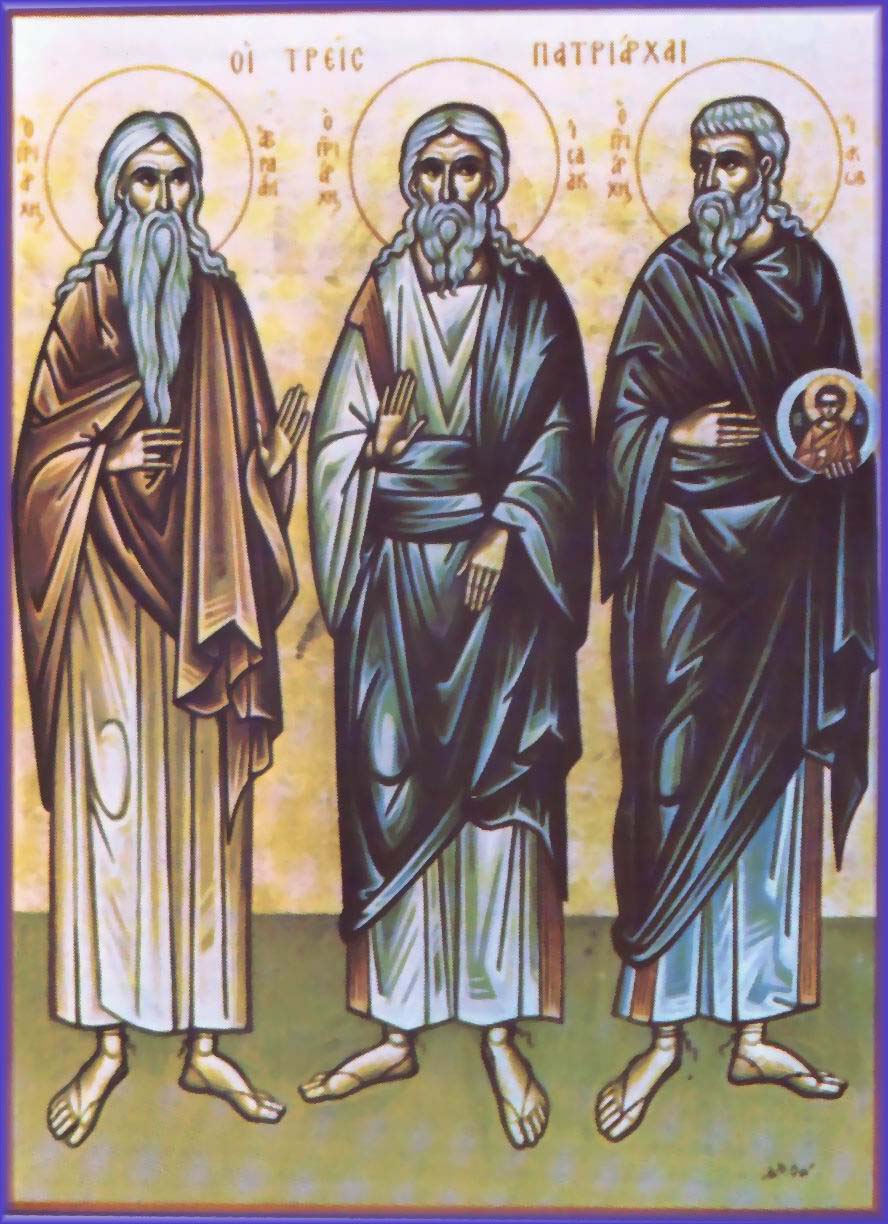
Is following a purported “Christ-centered” hermeneutic—of which there is more than one alternative—a dogmatic or systematic theological imposition, or even a “creedal” one over the text of Scripture? Is following a patriarchpurported methodological or principled Christ centered hermeneutic an artificial way to read the Scriptures, with the result of flattening out the various caverns and contours offered by the oft rough edges of Scripture? This is not so easy of a question for me to answer at the moment, but my inclination is to say, NO! It is not artificial, and it is not a theological imposition. Why? Because Jesus apparently offered this kind of hermeneutic himself (cf. John 5:39; Luke 24:44), and the early church seemed to follow an incipient confessional hermeneutic that saw all of the promises made in the Hebrew Bible (TaNaKh) as fulfilled in Jesus, which we now have deposited for us in the New Testament. Indeed what the early church seemed to have been operating with—early on—was a very theological (albeit pre-Nicene) Christ-centered, and quite apocalyptical hermeneutic and reading of the Scriptures. Someone who imbibes this kind of ‘rule-of-faith’ (the early Christ creedal approach) reading of Scripture is none other than Irenaeus (c. 130–c. 202); he was a second century biblical theologian who is known for his run ins with the proto-Gnostics (a dualist sect). As well, he is also known as a disciple of Polycarp, who is purported to be the disciple of the Apostle John; and so he has a rather unique Christian pedigree, and a closeness to the early church that is quite intimate. Irenaeus developed his own style of a Christ-centered hermeneutic in his recapitulation mode of interpretation (which he took over from the Apologist, Justin Martyr), which was given shape as a result of his frequent battles with these incipient Gnostics. Brevard Childs helpfully sketches the main contours of Irenaeus’ approach, which I want to share. Here is Childs on Irenaeus:

Central for Irenaeus was the biblical emphasis that God’s order for salvation had extended from creation to its fulfillment in Christ, as God progressively made himself known in creation, law, and prophecy through the divine Logos. Christian scripture bore witness to Jesus Christ as God’s son and saviour who was from the beginning with God and fully active throughout this entire history (IV .20.1ff). All the economies of God reveal this history of revelation according to its stages which led the church from infancy to perfection. Indeed in his doctrine of ‘recapitulation’ Irenaeus pictured Christ’s joining the end of time with the beginning and thereby encompassing within himself fully the entire experience of Israel and the church (III.21.10–23.8). Because of the unity of God’s salvation, it was absolutely essential to the faith that the two testaments of the Christian Bible be seen as a harmonious witness to the one redemptive purpose in history. Through his use of ‘types’ (IV .14.3) and prophecy (IV .10.1) Irenaeus sought to demonstrate that the two covenants were of the selfsame substance and of the one divine author (IV .9.1). [Brevard S. Childs, Biblical Theology of the Old and New Testaments: Theological Reflection on the Christian Bible (Minneapolis: Fortess Press, 1993), 31.]

So early on we see a kind of dogmatically rendered hermeneutic that starts with the reality of Christ as the center which serves as the substance and reality of both the Old Testament and what became the New Testament. For Irenaeus, the so called ‘rule-of-faith’ did not represent something that was in competition with Scripture, but in fact reflected apostolic witness to the reality of Scripture that bridged both the Old and New Testament.

What I am wrestling with, is a challenge I was recently given in this regard. I was actually moving along, happily on my way, with a certain constructive view toward a Christ centered (‘depth dimensioned’) hermeneutic that I thought had an ancient pedigree. Indeed, I still think this; but I am having to wrestle, still with what this means beyond principle, and in actual practice. And I want to wrestle with what this means in regard to dealing with the Bible as literature (even if it is unique and sacred). The Bible itself has an ontology (as John Webster likes to point out), and a dogmatic orientation and giveness and place; and so this placement itself supposes upon a certain dogmatic principle (i.e. that God is gracious, and that God has spoken and speaks; triunely so). I simply think it is impossible, and really not advisable, to try and engage with Scripture, hermeneutically, as if it can or should be done non-Dogmatically and non-Ecclesiastically; and more importantly, then, non-Christically. I think to approach Scripture through all of these “non” ways, is really more Englightenment generated, and thus anthropologically generated (which itself is a kind of naturalist Dogmatic approach), than my interlocutors would like to think. Really, though, I don’t think my interlocutors are all that Enlightenment formed; they are just Augustinian, and want to follow a certain salvation-history and pietistic relational reading of the text of Scripture. But let’s be honest, we all follow a dogmatically construed understanding of Scripture; that really isn’t the issue (it is an understood, or should be). The question is: Who is following a more faithful ordering of the dogma? And which dogma (or theological schema) is one following? I hate how this always has to come back to these methodological questions, but it does; and once engaged with at this level, we are better ready to engage the text on its given level—which is to do so ‘in Christ.’

In short: To presume that reading Scripture “Christ-centeredly” is an artificial theological imposition, would be a double edged sword; since reading Scripture as if God has spoken therein is just as much of a theological imposition, respectively. It is better just to be honest, to level the playing field, and admit that reading Scripture as Christians is a highly theological endeavor. The only other alternative, really, is to read it from a naturalist frame of some kind, and who wants to do that?

Rationalist Bible Study–A Mini-Critique

I thought this represented a particularly pertinent critique of theologians who go beyond Scripture in their constructive theologizing; ironically, the quote is in discussion of Hegel’s critique of rationalist theology and biblical exegesis. Hegel had certain folk in mind, in his critique; but I think, in general is still calls us to take some pause in our own theologizing. If we are going to be truly ‘Reformed’ Christian theologians and biblical exegetes, we will need to take our ‘material’ from that disclosed and given shape by Scripture itself; of course, the next question is how do we avoid collapsing our theologies into Scriptural exegesis (eisogesis) V. reading them out of it (exegesis)? This is something that Hegel is not naive to; note Hodgson’s recounting of Hegel,

Hegel attends in the 1824 lectures to both the exegesis and dogmatics of theological rationalism, as represented by J. F. RĂśhr, J. A. L. Wegscheider, and especially H. E. G. Paulus. Rational exegesis professes only to promote an understanding of the Word of God contained in scripture (1:122-3). But Hegel points out that where interpretation goes beyond a mere explanation of words to a discussion of the contents and an elucidation of the sense, it introduces its own thoughts and prejudices and is more than mere exegesis. Thus ‘the most sharply opposed views are exegetically demonstrated by theologians on the basis of scripture, and in this way so-called holy scripture has been made into a wax nose’, twisted into one shape or another (1:123). Theologians naively believe they are exposing scripture when in fact they are merely displaying their own presuppositions and interests. [Peter C. Hodgson, Hegel & Christian Theology: A Reading of the Lectures on the Philosophy of Religion, 60.]

Is there a genuinely Christian way then to read Scripture? Or are we doomed to always and only reading our a priori (prior) theological commitments into Scripture? I would suggest that we follow what the Patristic Theologians (Church Fathers) called the Regula Fidei (the Rule of Faith). The ‘rule of faith’ should be what Jesus identified in his own understanding of Scripture, as found in John 5.39:

39 You studythe Scriptures diligently because you think that in them you have eternal life. These are the very Scriptures that testify about me, …

This comes back to the points I have been making about canon & Scripture in some previous posts; viz. that Jesus understood himself as the reality of Scripture (both Old Testament and the Apostolic giving of the New Testament). This is how we can avoid the problem that Hegel rightly was wary of in his own day. The reason I said this was pertinent, is because I would suggest that most American Evangelical exegesis today (if it is done at all!) suffers from the same kind of rationalism that Hegel was facing in his own heyday of rationalism. Evangelicals, in general, have inherited this mantle of interpreting scripture through, ironically, the Fundamentalist rejection of so called ‘Liberal’ rationalist exegesis. Fundamentalists tried to counter rational exegesis by way of out-rationalizing their ‘Liberal’ counterparts; this is part of the American Evangelical inheritance from its founding fathers in American Fundamentalism.

*A repost, originally posted here.

Let God Be True and Every Man a Liar: Dispensationalistm, Inerrancy and a Doctrine of God

I was just thinking about dispensationalism—I’m sure you ‘just’ do the same all the time ;-)—it is in my life blood, as I have shared multiple times before. It is interesting, maybe you haven’t made this connection before, Bible Pagedispensationalism is necessarily a product of a Christian Fundamentalist doctrine of Scripture, and in particular, a staunch and idiosyncratic adherence to verbal plenary inspiration, and thus then, the inerrancy of Scripture. What’s at the bottom of what Charles Ryrie has called the sine qua non of Dispensationalism—i.e. adherence to a wooden literalistic form of interpreting Scripture—is that whatever God has said in the any part of Scripture, must occur with positivistic emperical fulfillment, or God has lied. And so when God promises in Jeremiah 31 that the nation of Israel will always be His covenant nation, then it is impossible to read this sensu plenior through a fuller meaning in light of its literal fulfillment in Jesus Christ, and in the way the New Testament authors interpret New Covenant language in that light. So Israel must be the focal point of prophetic history, and as most classic Dispensationalists maintain, there are multiple prophecies yet to be fulfilled; even though, it would appear that the New Testament believes the substance of those have already been fulfilled quite literally in Christ.

In short: What’s at stake for Dispensationalists is the belief in the integrity and Sovereignty of God. If one jot or tittle of an OT prophecy is not fulfilled wooden-literally in the nation of Israel; then God is a liar, the Bible is errant, and we are of most people most to be pitied. Maybe this will give you better insight into what’s at stake for the Dispensationalist hermeneutic; a doctrine of Scripture, and more importantly, a doctrine of God.

The Christ Access to Biblical History and Hermeneutics

I think history is God’s history. And thus as Christians, why would we base our categories for engaging with the text of Scripture (and its historical location/locution) upon naturalistic assumptions about history, as if history does not have a Christological antecedent in God’s elect life for us; as if the ‘telos’ (purpose) of all creation, and all history is not Christ? As if what funds history is not God’s Triune and Providential life, but instead a metaphysical materialism wherein our universe is closed and natural history becomes absolutized and immanentized in way that becomes only accessible by empirical observation and reconstruction? Left to the natural mind (I Cor. 2), indeed, this would be the only access to biblical-history (and history in general) that we would have. But we have not been left to this (we are not orphans), and history is not naked; it is independently contingent upon God’s Triune life and His underlying speech, which is touchstoned in his everlasting Word, Jesus Christ. So the way the Christian engages with history, and the Bible’s location therein, is to access that through Christ; as if Scripture, and the history therein, is hung together, and contingent upon the contingency of the Incarnation of Christ for us. There is no neutral playground to engage the Bible from. And if the critical tools that we have developed over the years (esp. in the 19th century) are based upon naturalism, then in what way should these be viewed as the ‘primary’ means by which we are supposed to critically engage the text of Scripture as Christians? 

Real history is composed of human lives; and human life is metaphysics in act. To claim to constitute the science of history without any speculative preoccupation, or even to suppose that the humblest details of history could be, in the strict sense of the word, a simple matter of observation, is to be influenced by prejudices on the pretext of attaining to an impossible neutrality.[Blondel cited by Levering, p. 145]

I am not suggesting that the so called ‘critical tools’ have no value; but to me their value can really only be negative, in the sense that they illustrate their ineptitude to access the illumined reality of Scripture that only comes from the eyes of faith given vision by the Holy Spirit come conjoined with the vicarious humanity of Christ for us.

Sorry, this is just a quick teaser on a post I am planning on writing in the next couple of days :-).

‘What It Meant’ ‘What It Means’: Biblical Theology in Discussion

What the text of Scripture ‘meant’ and what it ‘means’ has been one rubric by which Biblical Theology (as a  movement) has sought to identify a working definition of what it means, in fact, to do Biblical Theology (especially in the 19th century and onward into the present). Without adequate attention to the history of this dialectic (between meant/means), we all too often can repeat history, and not appreciate the kind of material impact that uncritical acceptance of these kinds of formal questions can have on our own conditioned and particular interpretation of Scripture today. I have N.T. Wright in mind, but he is not the only one. What I want to consider further (and not much deeper than just posing a question and my own thoughts here), is if there has been thorough enough attention given to the someone like Wright’s own appropriation of his conditioned employment of past hermeneutical practice? In other words, I often hear many of Wright’s most vocal proponents repeating and building upon his material exegetical and historical conclusions; but I am just curious as to whether or not enough attention has been given to the actual methodology that Wright is indeed employing to come to the theological conclusions that he is coming to in his own project—as he attempts to mediate ‘what it meant’ with ‘what it means’?

My questions about Wright above could be applied to many contemporary Biblical Theologians of our day. I suppose I simply want to register my own hesitation in regard to whether or not enough critical self-reflection has been maintained among Wright’s & companies’ proposals in regard to bridging the gap between what it mean and what it means (and in fact if this gap ought to be bridged at all); and furthermore, whether or not this is indeed what Wright is attempting to do? And if so, how is he doing it? Does he have a well thought out prolegomenon (hermeneutical methodology) that indeed engages with these kinds of more formal questions; or is Wright & co. so focused on their material conclusions, that they simply presume upon a certain mode of: What it meant, must be what it means? This seems to me to be the mode that Wright & co. often operate in; a mode that does not attend strongly enough to some deeper and important methodological questions—I realize that I am generalizing quite heavily (esp. when I write Wright & co.), but I think some generalization here, at least in order to provide heuristic purchase, is necessary.

In light of some of these questions, I thought that I would do a series of posts that seek to engage with them a bit. Let me offer a quote from Gerhard Hasel as he offers something from D. H. Kelsey in regard to the dialectic of what it meant and what it means; Kelsey’s questions for this dialectic are meant to be critical, and in fact to problematize in such a way, that ‘what it meant’ ‘what it means’ is shown to be too reductionistic of way to attempt to relate meaning in the text of Scripture.

[I]t is evident that the distinction of modern times between “what it meant” and “what it means,” i.e., theological interpretation which is normative, is problematical in both its distinction and its task. D. H. Kelsey, for example, has stated succinctly that there are several ways in which both “what it meant” and “what it means” can be related to each other with varying results. First, it may be decided that the descriptive approach that seeks to determine “what it meant” by whatever methods of inquiry is considered to be identical with “what it means.” Second, it may be decided that “what it meant” contains propositions, ideas, etc. that are to be decoded and translated systematically and explicated and that this is “what it means,” even though those explications may never have occurred to the original authors and might have been rejected by them. Third, it may be decided that “what it meant” is an archaic way of speaking dependent upon its own culture and time that needs to be redescribed in contemporary ways of speaking of the same phenomena, and that this redescription is “what it means.” “This assumes that the theologian has access to the phenomena independent of scripture and ‘what it meant,’ so that he can check the archaic description and have a basis for his own.” Fourth, it may be decided that “what it meant” refers to the way in which early Christians used Biblical texts and that “what it means” is simply the way these are used by modern Christians. In this case there is a genetic relationship. Kelsey notes, “None of these decisions can itself be either validated or invalidated by exegetical study of the text, for what is at issue is precisely how exegetical study is related to doing theology.” If this is the case, then one must ask on what grounds one makes a theological judgment in favor of one over the other of these or other ways of relating “what it meant” to “what it means.” [Gerhard Hasel, Old Testament Theology: Basic Issues In The Current Debate, 37-8.]

Far from merely critiquing N. T. Wright, these questions take issue with all would be exegetes and theologues who see Scripture as something significant enough to take serious. And I am not trying to totally critique Wright by offering these questions; he is just the nearest, most public and popular and prominent Biblical Theologian of our day who makes himself readily available as foil for such considerations as I am offering in this post. My concern with Wright is what is asked by Hasel in the last clause above, “If this is the case, then one must ask on what grounds one makes a theological judgment in favor of one over the other of these or other ways of relating “what it meant” to “what it means.” I am not sure that Wright & co. attend themselves enough with this concern. It seems to me that he/they usually just presume upon whatever their theological predisposition is, and then act as if all they are doing is Biblical study; but then of course this begs the question that Hasel gives voice to.

I will continue this series of posts by following Hasel’s subsequent and developing thought in the directly subsequent paragraphs to the one I just shared. Stay tuned …

We All Do Theological Exegesis, and Trinitarian Exegesis, Or It Isn’t ‘Christian’ Exegesis

Something that the whole movement being spawned by N.T. Wright and company is failing to emphasize (and in fact is undercutting) is the reality that theology has in biblical exegesis. As Christian interpreters, we do so from a certain vantage point; we, along with the rest of historical orthodox Christianity affirm that God is Triune, and that He has Self-revealed in hypostatically unioned person, His Son, Jesus Christ. Neither one of these bedrock conceptual realities about the Christian God are something that can simply be read off of the pages of Scripture; nevertheless, this reality is the ultimate one that shapes all of the writings found in the Holy Scriptures. And it is this reality, at a fundamental level, that tenses the way we interpret and think as Christians; and yet it is not something that is contingent, per se, upon recovering or reconstructing history, it is contingent on who God is. Every Christian affirms this reality about who God is, and thus it behooves us to be consistent in our hermeneutical thrust; viz. in the way that construct our hermeneutical posture. The history of second Temple Judaism certainly offers enlightening insights into the text of Scripture, but to pretend as if these insights are definitive and ultimate and terminal relative to the reality of the Gospel needs to be re-considered; because really, all of the history is contingent and given meaning by something and someone else. 

The following is a repost that I wrote that was seeking to illustrate how it is that all Christians do theological exegesis; and I use the Trinity to illustrate this.

Inner Logic is an important concept to realize when approaching Scripture and its interpretation. These two words actually signify another way of saying theological exegesis; yet I find that many in my own tradition of “Evangelicalism” shy away from such thinking when it comes to Biblical interpretation. There is this unspoken (but often spoken) belief that when we interpret scripture that it is simply a staightforward exercise (of course the multitudinous interpretations of scripture put this belief to death quickly). The irony of this perspective is that so many of our Essential Christian Beliefs are grounded in anything but straightforward exegesis. Let me provide an example:

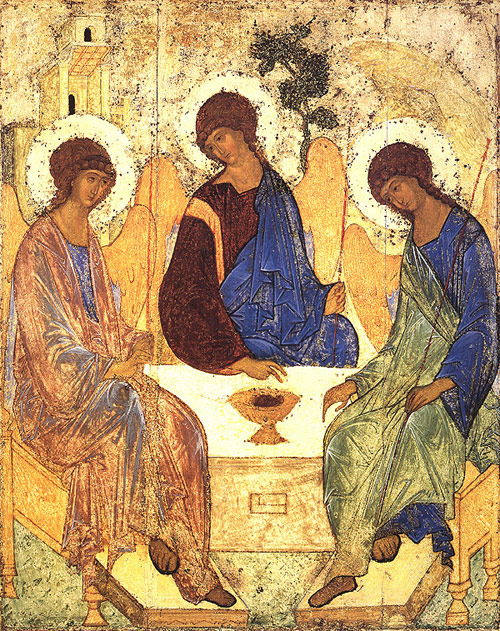
trinity-icon

One of the bedrock, touchstone foundations of Historic Christian Belief is the doctrine of God known as the Trinity. Of course nowhere in the Bible will we find the nomenclature of Trinity; in fact one of the so called church Fathers, Tertullian, coined the term Trinitas very early on in the Churches’ genesis; here’s what J. N. D. Kelly says:

. . . He, too, is a ‘Person’, so that the Godhead is a ‘trinity’ (trinitas: Tertullian is the first to employ the word). The three are indeed numerically distinct, being ‘capable of being counted’. . . . Thus Tertullian can state: ‘We believe in on only one God, yet subject to this dispensation, which is our word for economy, that the one only God has also a Son, His Word, Who has issued out of Himself . . . which Son then sent, according to His promise, the Holy Spirit, the Paraclete out of the Father’; and later in the same context he can balance the divine unity with ‘the mystery of the economy, which distributes the unity in Trinity, setting forth Father, Son and Spirit as three’. (J.N.D. Kelly, “Early Christian Doctrines,” 113)

I mention this to further substantiate that the language of Trinity, itself, is indeed foreign to the text of scripture; in fact as Kelly notes it came from a church Father. What I would like to further add, in flow with the context of this post, is that while the language of “Trinity” may be foreign to the text of Scripture; indeed, the grammar or concept is not. This brings us back to the language of inner logic or theological exegesis. In other words, how did Tertullian and the other church Father’s come to conclude that God is not only one (de deo uno); but in fact He is three (de deo trino) in one and one in three? Simple they read scripture, and discerned that when they read the Apostle Paul, for example, that there was an unstated theological concept about God that Paul was assuming in order to make benedictions like this:

“The grace of the Lord Jesus Christ, and the love of God, and the communion of the Holy Spirit be with you all. Amen.” ~II Corinithians 13:13

As you engage the rest of Paul’s writings (like all of II Corinthians for example) there is this constant assumption that the Father, Son, and Holy Spirit are at work in salvation. This is what discerning the inner logic leads to; i.e. key and fundamental doctrines upon which the Christian faith hangs — starting in the early church and into the present.

So there is more to scripture interpretation and exegesis than engaging in exegetical and syntactical analysis of the Koine Greek of the New Testament; there in fact is an inner logic that holds the text of scripture together. It is the theologian’s job to discern and lay bare this “logic” and work out the implications of that “inner logic” for the church and all of her exegetes. The Trinity is just one example of working out the inner logic of scripture; all of Scripture actually hangs together on Christo-logic, but this is discussion for another post.

I hope folks realize the depth embedded within the scriptures themselves; if you do you will be set up to enjoy the richness and freshness that scripture has to offer.