The Vicarious Humanity of Christ and the Reality of Salvation

I just received a review copy of Christian D. Kettler’s book The Vicarious Humanity of Christ and the Reality of Salvation from James Stock at Wipf & Stock Publishers. I will be doing a full review here at the blog immediately following my completion of this book (let me say thank you though to James Stock for getting me this book!). Christian Kettler is someone I look to being in contact with once I start getting a bit further into my doctoral research on this doctrine (the vicarious). This book represents his PhD dissertation which he did at Fuller Theological Seminary (some years back now) under the watchful eyes of Ray Anderson and Geoffrey Bromiley. Kettler also had the opportunity to serve as Thomas Torrance’s Teaching Assistant for a bit while at Fuller (presumably) in the 80’s. I just wanted to share the brief blurb from the back cover of this book:

In this book, the problem of the reality of salvation is addressed by T. F. Torrance’s doctrine of “the vicarious humanity of Christ.” Through this approach, salvation as humanization is affirmed, yet without the problems of anthropocentric theologies. This book is unique in that it offers both a survey of contemporary Christian thinking on salvation as well as a constructive alternative based on Torrance’s doctrine, a significant yet neglected contribution to modern theology.

This book is one of the best places I can think of to officially kick off my doctoral research on the vicarious humanity of Christ! Kettler’s approach seems to deal much more closely with this doctrine within its modern theological context and discussion. My research will press, in contradistinction a bit, back further into the Tradition of the Church; and will develop and unearth how this doctrine first received its legs through seminal figures scattered throughout the span of Church history starting in at least the 4th century A.D., and moving through the Reformation period into the Modern (with Thomas Torrance), finally placing all of this into the discussion that Kettler mostly focuses on in his own research.

I was thinking of sharing the Table of Contents from this book, but I think I’ll do that later.

Christian Knowledge of God, John Knox and Thomas Torrance

In commenting on Evangelical Calvinist, John Knox’s understanding of God; Thomas Torrance offers a profound statement of what all of this entails:

[K]nowledge of the one and only God, as far as it is true knowledge, enshrines the mystery of God, and so is confessed and acknowledged as God eternal, infinite, immeasurable, incomprehensible, omniscient, invisible. This God whom we know cannot be fitted into our knowledge. God cannot be commanded by our reasons — cannot be comprehended by our minds. It is certainly to our minds that God reveals himself but only in such a way that he remains eternal, infinite, incomprehensible, etc. Knowledge of God cannot be put into precise words. God’s majesty defies definition or description — all theological language is apocalyptic in so far as it is genuine. That is true above all of the Trinity — knowledge of this God is infinitely open. Thus in faith the human reason is opened wide to the infinite and incomprehensible being and majesty of God as the Father, the Son and the Holy Spirit. [Thomas F. Torrance, Scottish Theology: From John Knox to John McLeod Campbell, (T&T Clark: Edinburgh, 1996), 6 — A review copy provided graciously by T&T Clark]

You will quickly notice which direction Torrance believes knowledge of God comes from; not from our epistemological schemas, but from God to us through Christ and into the Triune life of God himself. This approach to knowing God runs against the construing God from thinking of him through his works in creation or something. Or trying to find analogies in creation, or in humanity that in latent ways allow us to think and speak about God. No! Knowledge of God for Torrance, and as he would contend, John Knox, is a gift from God in Christ for us through the Spirit. There is never one-to-one correspondence between our theological language and God’s being. Instead, theological language is something that is constantly given to us anew as God continues to break in on our world, on our conceptions; and re-orders and re-orientates our grammar in a way that puts to death anything we had conceived of prior to this encounter in Christ. He provides a ground for knowing him that is completely out of this world (but decidedly and concretely in this world); the God-Man. He presents us with concepts that breaks up and re-orders our imaginations in ways that place us upon the precipice of heaven’s throne; Ezekiel knows what I’m talking about.

Just a little reflection . . .

Torrance objects to Federal Calvinism, and So Do I

Here Paul Molnar gives a good summary overview of some of the reasons that T.F. Torrance objected to ‘Federal’ or ‘Westminster’ Calvinism:

Torrance’s objections to aspects of the “Westminster theology” should be seen together with his objection to “Federal Theology”. His main objection to Federal theology is to the ideas that Christ died only for the elect and not for the whole human race and that salvation is conditional on our observance of the law. The ultimate difficulty here that one could “trace the ultimate ground of belief back to eternal divine decrees behind the back of the Incarnation of God’s beloved Son, as in a federal concept of pre-destination, [and this] tended to foster a hidden Nestorian dualism between the divine and human natures in the on Person of Jesus Christ, and thus even to provide ground for a dangerous form of Arian and Socinian heresy in which the atoning work of Christ regarded as an organ of God’s activity was separated from the intrinsic nature and character of God as Love” (Scottish Theology, p. 133). This then allowed people to read back into “God’s saving purpose” the idea that “in the end some people will not actually be saved”, thus limiting the scope of God’s grace (p. 134). And Torrance believed they reached their conclusions precisely because they allowed the law rather than the Gospel to shape their thinking about our covenant relations with God fulfilled in Christ’s atonement. Torrance noted that the framework of Westminster theology “derived from seventeenth-century federal theology formulated in sharp contrast to the highly rationalised conception of a sacramental universe of Roman theology, but combined with a similar way of thinking in terms of primary and secondary causes (reached through various stages of grace leading to union with Christ), which reversed the teaching of Calvin that it is through union with Christ first that we participate in all his benefits” (Scottish Theology, p. 128). This gave the Westminster Confession and Catechisms “a very legalistic and constitutional character in which theological statements were formalised at times with ‘almost frigidly logical definiton'” (pp. 128-9). Torrance’s main objection to the federal view of the covenant was that it allowed its theology to be dictated on grounds other than the grace of God attested in Scripture and was then allowed to dictate in a legalistic way God’s actions in his Word and Spirit, thus undermining ultimately the freedom of grace and the assurance of salvation that could only be had by seeing that our regenerated lives were hidden with Christ in God. Torrance thought of the Federal theologians as embracing a kind of “biblical nominalism” because “biblical sentences tend to be adduced out of their context and to be interpreted arbitrarily and singly in detachment from the spiritual ground and theological intention and content” (p. 129). Most importantly, they tended to give biblical statements, understood in this way, priority over “fundamental doctrines of the Gospel” with the result that “Westminster theology treats biblical statements as definitive propositions from which deductions are to be made, so that in their expression doctrines thus logically derived are given a categorical or canonical character” (p. 129). For Torrance, these statements should have been treated, as in the Scots Confession, in an “open-structured” way, “pointing away from themselves to divine truth which by its nature cannot be contained in finite forms of speech and thought, although it may be mediated through them” (pp. 129-30). Among other things, Torrance believed that the Westminster approach led them to weaken the importance of the Doctrine of the Trinity because their concept of God fored without reference to who God is in revelation led them ultimately to a different God than the God of classical Nicene theology (p. 131). For Barth’s assessment of Federal theology, which is quite similar to Torrance’s in a number of ways, see CD IV/1, pp. 54-66. (Paul D. Molnar, “Thomas F. Torrance: Theologian of the Trinity,” 181-2 [fn. 165])

Some great insightful stuff on Torrance here. Let me know what you think.

Also, something worth noting, while it is possible (although not totally understandable) to be ‘Evangelical Calvinist’ without being ‘Torrancean’; it would be hard-pressed to understand why you wouldn’t want to at least learn a bit from Torrance. In case it is not obvious, I am unapologetically a beneficiary of Torrance’s thinking and direction, on many fronts. The king of ‘EC’ you are getting exposed to here at “The Evangelical Calvinist,” is most certainly shaped by the contribution that Torrance has made in this direction. I really only mention this, because there are some who would claim to be ‘EC’; and at the same time not come to their ‘EC’ conclusions by looking to Torrance much (or, at all).

Evangelical Calvinism Re-iterated

Here is something taken from my EC Themes that I wanted to reiterate. I am planning on blogging through a central book for Evangelical Calvinism (in fact it is where the language of Evangelical Calvinism comes from); that is Thomas F. Torrance’s Scottish Theology. And the quote in this post from Torrance comes from said book. I have taken some heat from fellow Calvinists for trying to draw a hard and fast distinction between Calvinisms like I do in this post (following TFT’s lead). That is because many Calvinists have bought into Richard Muller’s thesis, in toto, that Calvinism in its finished form comes to fruition in the Westminster Standards. I do not follow Muller on this reading of things (that’s not to say I don’t think Muller has nothing good to say, I do … to a degree). Here is the body of the post:

Here is a quote from T. F. Torrance, from the preface of his book Scottish Theology. This really captures the distinction and nuance that I am trying to make through this blog for the uninitiated (thus far). That indeed there is a rift between what has been called Federal Calvinism (or what I’ve been calling “Classic”), and Evangelical Calvinism (or “Scottish Theology”). TFT is introducing his book, and giving some of the rationale for writing it.

In Chapter One on John Knox and the Scottish Reformation, I have offered a general account of the deep doctrinal change that took place, but in the succeeding chapters I have tried to focus on the main issues that arose as a result of the adherence of the Church of Scotland to the Westminster Confession of Faith. Following upon the teaching of the great Reformers there developed what is known as ‘federal theology’, in which the place John Calvin gave to the biblical conception of the covenant was radically altered through being schematised to a framework of law and grace governed by a severely contractual notion of covenant, with a stress upon a primitive ‘covenant of works’, resulting in a change in the Reformed understanding of ‘covenant of grace’. This was what Protestant scholastics called ‘a two-winged’, and not ‘a one-winged’ covenant, which my brother James has called a bilateral and a unilateral conception of the Covenant. The former carries with it legal stipulations which have to be fulfilled in order for it to take effect, while the latter derives from the infinite love of God, and is freely proclaimed to all mankind in the grace of the Lord Jesus Christ. It was the imposition of a rigidly logicalised federal system of thought upon Reformed theology that gave rise to many of the problems which have afflicted Scottish theology, and thereby made central doctrines of predestination, the limited or unlimited range of the atoning death of Christ, the problem of assurance, and the nature of what was called ‘the Gospel-offer’ to sinners. This meant that relatively little attention after the middle of the seventeenth century was given to the doctrine of the Holy Trinity and to a trinitarian understanding of redemption and worship. Basic to this change was the conception of the nature and character of God. It is in relation to that issue that one must understand the divisions which have kept troubling the Kirk [church] after its hard-line commitment to the so-called ‘orthodox Calvinism’ of the Westminster Standards, and the damaging effect that had upon the understanding of the World of God and the message of the Gospel. . . . (Thomas F. Torrance, “Scottish Theology,” x-xi)

This encapsulates the motivation for the blog here; my desire is to alert folks to the reality that TF is speaking to. Here TFT highlights the development of a tradition of Calvinism that is particular to Scotland; but, also want to note that this phenomenon was not unique to the Scots. This kind of development was also, contemporaneously, at play in England as well; Janice Knight has identified this branch of development within Calvinism, as The Spiritual Brethren (as opposed to The Intellectual Fathers — the Westminster Divines).

Calvinists of today, need to know, that they aren’t the only Calvinist ‘orthodoxy’ around; that history is not on their side, per se. Even more importantly, beyond history, I really do not believe that scripture is on their side — by and large.

Anyway, I hope this quote gives you more insight on where many of my cues have been and are coming from. I also hope that if you are into ‘federal theology’ that this will at least make you pause.

Discontinuity Between Calvin’s Hermeneutic on the Atonement from the Calvinists

I just read this essay Hermeneutical discontinuity between Calvin and later Calvinism by Kevin D. Kennedy from Southwestern Theological Seminary in Fort Worth Texas in the Scottish Journal of Theology Volume 64 (2011) – page 299. Unfortunately I didn’t have the chance to make a copy of it (I read this while I was at my alma mater’s theological library today — Multnomah University), but I would like to try and provide a synopsis of his thesis and argument (as I can recall).

Basically, Kennedy argues that John Calvin and the later Calvinists (post-Reformed orthodox) function with discontinuity relative to their hermeneutics on the extent of the atonement. For Calvin, as Kennedy convincingly argues, he held to a universal atonement, but not universal salvation; for the “Calvinists,” according to Kennedy, they hold to a limited (particular) atonement, and a particular salvation. As part of Kennedy’s “ground clearing work,” he notes Richard Muller’s work in this area; as well as the work of Paul Helm and Roger Nicole (their rejoinder to R.T. Kendall’s work on Calvin). He recognizes that said scholars need to be acknowledged for their work in the area of Calvin studies (especially Muller), but that in this particular area they all over-state things when it comes to Calvin’s view of the extent of the atonement. Kennedy demonstrates that Calvin’s hermeneutics, both in his commentaries (on the salient passages), and in his little book Concerning the Eternal Predestination of God consistently argues for a universal atonement (but not salvation). In particular, Kennedy looks at Matthew 20.28 which says:

[j]ust as the Son of Man did not come to be served, but to serve, and to give His life a ransom for many.

Kennedy demonstrates (by quoting Calvin’s commentary), that Calvin believes that the word ‘many’ is not referring to a limited class of people (the elect), or that it is excluding one group of people from the other (elect from the reprobate)—as, he notes, John Owen, along with the rest of the post-Reformed orthodox Tradition would argue—but that Jesus is providing dominical teaching by making a contrast between himself as the One over and against the Many for whom he died pro nobis (or would be dying, given the historical present in context). Kennedy goes on to look at other passages in Calvin’s commentaries that are pertinent to this topic; all illustrating this same point. For Calvin, when the word ‘many’ is used in these contexts it is not intended to exclude one class of people from the other; but instead, it is to contrast Christ’s death for us, over and against ‘us’ the many (or the point that Jesus wasn’t dying for himself, but for us). Kennedy, then, moves on and takes a look at the more universalist passages in Paul’s corpus (like I Tim. 2.4 etc.); he notes that Calvin, qualifies the word ‘all’ (like God desires that ‘all’ men be saved) in a way that speaks, not to his view of the extent of the atonement; but to Calvin’s view that not all will believe. So the limiting, for Calvin, according to Kennedy, has to do with appropriation of salvation and not the extent of the atonement as the post-Reformed orthodox interpret Calvin (so Muller, Helm, Nicole, et al).

Kennedy concludes that the post-Reformed have imposed their later developed hermeneutic of particularism onto Calvin’s hermeneutic of the atonement. He suggests that a more fruitful way forward, while noting that there are some continuities between Calvin and the Calvinists (per Muller’s exhaustive argument, like in his After Calvin), would be not to gloss over the genuine discontinuities that are present between Calvin and the Calvinists. In this instance the primary distinction is between Calvin’s view of the extent of the atonement (which is universal), and the particularist view of the atonement held by the Calvinists (the Reformed orthodox ones).

In closing, what is very enlightening with Kennedy’s essay, is that it helps to substantiate what we Evangelical Calvinists, Thomas Torrance amongst us, have been arguing in regard to Calvin’s view of the atonement. This helps substantiate Thomas Torrance’s reading of many of the Scottish theologians in his book “Scottish Theology;” which argues that there is a whole strain of development of Calvinism in Scotland that follows and develops this teaching on the atonement first articulated by Calvin. Again, it is important to note that Calvinism has a variegated currency; and much of this is because Calvin left the doors open for more than one trajectory. In other words, his method was not scholastic.

Theosis in the Theology of Thomas Torrance

In his recently published book, Dr Myk Habets offers an intriguing look at Theosis in the theology of T. F. Torrance. I’ve only just begun the read (thanks to Ashgate and Myk Habets and the ‘Pacific Journal of Baptist Research’), and thus far it has been compelling and quite informing. Habets says in the first couple paragraphs of the Preface:

The Christian tradition, both East and West, has developed various models and theories of the atonement as explanations of what it means to speak of the reconciling activity of God in Christ. Central to these has been athanasiusthe claim that God has reconciled the world to himself in Christ. One way of testifying to the reconciling love of God has been the adoption of the metaphor theosis (‘divinisation’, ‘deification’) as an explanation of salvation. While central to Eastern Orthodoxy, a doctrine of theosis also has a rich tradition within Western, especially Reformed theology.

The Reformed theologian, Thomas Forsyth Torrance, represents an attempt to construct a soteriology that incorporates both Eastern and Western models of the atonement around the controlling metaphor of theosis. A close reading of his theology presents a robust and clearly articulated doctrine of theosis as a key way of expressing God’s reconciling activity in Christ. As the true Man and the last Adam, Christ represents the arche and telos of human existence, the one in whose image all humanity has been created and into whose likeness all humanity is destined to be transformed from glory to glory. Through the Incarnation the Son becomes human without ceasing to be divine, to unite humanity and divinity together and effect a ‘deification’ of human nature, mediated to men and women who are said to be ‘in Christ’ by the work of the Holy Spirit. By means of a ‘wonderful exchange’ Christ takes what is ours and give us what is his. For Torrance, this is the heart of atonement.

— Myk Habets, Theosis in the Theology of Thomas Torrance, Ashgate Publishing Company2009, ix

See, intriguing. This book represents Habet’s PhD dissertation at the University of Otago in New Zealand. It is the first study of its kind, and, I think, promises to be a pioneering work in the yet, mostly uncharted research of the theology of TFT.

The language of theosis may offend some Christians, especially of the ‘Western bent’; but I think once you engage what in fact, and how in fact TFT was using this language (certainly appropriated from the Eastern church, but not exclusively so, see Augustine) your prejudice will be dispelled into perspective. I’m looking forward to posting more on this topic, and plan to.

*This is a repost from a long time ago at another blog. I am still supposed to write a review for this book for a specific journal, and plan to πŸ˜‰ . This post is taken from a blog I plan to transition to, like I said, February 1st. Here’s the url to that blog: “Behind The Back”

The cues for Evangelical Calvinism

**I wanted to repost this for some of you who just recently started reading here; and as a refresher for those who haven’t**

Here is a quote from T. F. Torrance, from the preface of his book Scottish Theology. This really captures the distinction and nuance that I am trying to make through this blog for the uninitiated (thus far). That indeed there is a rift between what has been called Federal Calvinism (or what I’ve been calling “Classic”), and Evangelical Calvinism (or “Scottish Theology”). TFT is introducing his book, and giving some of the rationale for writing it.

In Chapter One on John Knox and the Scottish Reformation, I have offered a general account of the deep doctrinal change that took place, but in the succeeding chapters I have tried to focus on the main issues that arose as a result of the adherence of the Church of Scotland to the Westminster Confession of Faith. Following upon the teaching of the great Reformers there developed what is known as ‘federal theology’, in which the place John Calvin gave to the biblical conception of the covenant was radically altered through being schematised to a framework of law and grace governed by a severely contractual notion of covenant, with a stress upon a primitive ‘covenant of works’, resulting in a change in the Reformed understanding of ‘covenant of grace’. This was what Protestant scholastics called ‘a two-winged’, and not ‘a one-winged’ covenant, which my brother James has called a bilateral and a unilateral conception of the Covenant. The former carries with it legal stipulations which have to be fulfilled in order for it to take effect, while the latter derives from the infinite love of God, and is freely proclaimed to all mankind in the grace of the Lord Jesus Christ. It was the imposition of a rigidly logicalised federal system of thought upon Reformed theology that gave rise to many of the problems which have afflicted Scottish theology, and thereby made central doctrines of predestination, the limited or unlimited range of the atoning death of Christ, the problem of assurance, and the nature of what was called ‘the Gospel-offer’ to sinners. This meant that relatively little attention after the middle of the seventeenth century was given to the doctrine of the Holy Trinity and to a trinitarian understanding of redemption and worship. Basic to this change was the conception of the nature and character of God. It is in relation to that issue that one must understand the divisions which have kept troubling the Kirk [church] after its hard-line commitment to the so-called ‘orthodox Calvinism’ of the Westminster Standards, and the damaging effect that had upon the understanding of the World of God and the message of the Gospel. . . . (Thomas F. Torrance, “Scottish Theology,” x-xi)

This encapsulates the motivation for the blog here; my desire is to alert folks to the reality that TF is speaking to. Here TFT highlights the development of a tradition of Calvinism that is particular to Scotland; but, also want to note that this phenomenon was not unique to the Scots. This kind of development was also, contemporaneously, at play in England as well; Janice Knight has identified this branch of development within Calvinism, as The Spiritual Brethren (as opposed to The Intellectual Fathers — the Westminster Divines).

Calvinists of today, need to know, that they aren’t the only Calvinist ‘orthodoxy’ around; that history is not on their side, per se. Even more importantly, beyond history, I really do not believe that scripture is on their side — by and large.

Anyway, I hope this quote gives you more insight on where many of my cues have been and are coming from. I also hope that if you are into ‘federal theology’ that this will at least make you pause.

'Father'


Here is a quote on God as ‘Father’ versus ‘Creator’, this is important, so I am quoting this in length:

. . . The center of the New Testament is the relationship between Jesus Christ and the One he addresses as Father. The communion between Jesus and his heavenly Fatherly is an utterly unique relationship, of which we can know nothing apart from Jesus’ own testimony.

God is thus Father not by comparison to human fathers, but only in the Trinitarian relation, as Father of the Son. Whenever Father is used of God it means “the One whom Jesus called Father.” The paradigm text is John 1:18: “No one has ever seen God. It is God the only Son, who is close to the Father’s heart, who has made him known.” In Greek, the word for “made him known” is exegesato. Jesus “exegetes” or “interprets” the Father. The term does not denote a generic title for God outside of the Father-Son relationship. Father thus functions in Trinitarian language not as a descriptive metaphor but as a proper name, whose home is the relationship that exists from all eternity between the first and second Persons of the Trinity. That is a relationship to which we as creatures have not immediate knowledge or access.

But by an astonishing gift of grace, Jesus invites us to be united with himself in the power of the Holy Spirit so that in union with him we may come to share in his utterly unique relation of Sonship to the Father. By ourselves we have absolutely no right or ground to address God as “Father.” It is only as we are united with Christ, partaking of his communion with the Father, that we can truthfully address God in this way ourselves. In Paul’s words,

For all who are led by the Spirit of God are children of God. . . . When we cry, “Abba! Father!” it is that very Spirit bearing witness with our spirit that we are children of God, and if children, then heirs, heirs of God and joint heirs with Christ. (Rom. 8:14-17)

We know God only in and through Christ’s relationship of Sonship, into which he invites us as participants (“Pray then like this: Our Father, who art in heaven . . .”). This means that salvation is understood as our communion with the Father through the Son in the power of the Holy Spirit. As Fanny Crosby’s hymn put it, “O come to the Father through Jesus the Son, and give him the glory: great things he hath done!” Our knowledge of God and our hope for salvation are directly Trinitarian in their scope.

The traditional naming of the Trinitarian God as Father, Son, and Holy Spirit is sometimes replaced today by the functional titles of Creator, Redeemer, and Sustainer. This works as an occasional use, describing God’s acts, but not as a substitute for the Trinitarian Name. The Fatherhood of God is tied utterly to Jesus’ naming of his own relationship to God, into which relationship we, by the Spirit, participate.

It was St. Athanasius who noted that the only reason we have for calling God “Father” is that God is so named by Jesus in the Bible. This points to the historical shape that the Gospels too: Christian faith is a biblical faith and a Jesus-based faith. God’s Fatherhood was understood relationally in an through Jesus Christ as self-giving love, and not as a human image or concept projected onto God. There is, in fact, an appropriate “thinking away” of that which is inappropriate in this terminology. By this we mean explicitly thinking away all biological and sexual imputation whatsoever into the theological concept of God. God the Father revealed in Scripture is Spirit. God has no sexual identity; sexuality, after all, is part of creation. The imago Dei (image of God) is not reversible; God is not created in our likeness! The personalized language of Trinitarian theology intends to bear witness in Christ to the liberation of humankind from all patriarchal idols and divinized ideologies. Where this did not and does not happen, there is a perversion of intent that must be utterly rejected on the ground of the nature and reference of Trinitarian language itself. (Andrew Purves and Mark Achtemeier, “Union in Christ: A Declaration for the Church,” 34-36)

There is so much in this that could be noted. I am only going to touch on some of the implications of what is being said here; I am going to reflect (below) with (1) Theological Implications, and then (2) Pastoral Implications.

Theological Implications

Certainly it should at least be highlighted that thinking like that articulated in the quote flows from a prior commitment to a certain mode of theological discourse, in fact methodology or prolegomena. Purves and Achtemeir are in the, what Barth has called, analogia fidei (or analogy of faith) versus the Traditional approach, best articulated by Thomas Aquinas called the analogia entis (or analogy of being). Instead of discussing what the distinctions are, in general here, I am going to focus on how these two disparate approaches play out theologically; and for our purposes, Confessionally. What happens if a particular theologian, or school of theologians, follows Aquinas’ approach versus the more Luther[an], Calvin[ian], Barth[ian], Torrance[an] approach? Here’s how the WCF starts out discussion on God and Trinity:

I. There is but one only,[1] living, and true God,[2] who is infinite in being and perfection,[3] a most pure spirit,[4] invisible,[5] without body, parts,[6] or passions;[7] immutable,[8] immense,[9] eternal,[10] incomprehensible,[11] almighty,[12] most wise,[13] most holy,[14] most free,[15] most absolute;[16] working all things according to the counsel of His own immutable and most righteous will,[17] for His own glory;[18] most loving,[19] gracious, merciful, long-suffering, abundant in goodness and truth, forgiving iniquity, transgression, and sin;[20] the rewarder of them that diligently seek Him;[21] and withal, most just, and terrible in His judgments,[22] hating all sin,[23] and who will by no means clear the guilty.[24] (WCF, 2/I)

And the Belgic Confession:

Article 1: The Only God

* We all believe in our hearts and confess with our mouths that there is a single and simple spiritual being, whom we call God — eternal, incomprehensible, invisible, unchangeable, infinite, almighty; completely wise, just, and good, and the overflowing source of all good.

Article 8: The Trinity

* In keeping with this truth and Word of God we believe in one God, who is one single essence, in whom there are three persons, really, truly, and eternally distinct according to their incommunicable properties– namely, Father, Son, and Holy Spirit. The Father is the cause, origin, and source of all things, visible as well as invisible. (Belgic Confession)

Contrast the above with the Heidelberg Catechism:

Of God The Father

9. Lord’s Day

Question 26. What believest thou when thou sayest, “I believe in God the Father, Almighty, Maker of heaven and earth”?

Answer: That the eternal Father of our Lord Jesus Christ (who of nothing made heaven and earth, with all that is in them; (a) who likewise upholds and governs the same by his eternal counsel and providence) (b) is for the sake of Christ his Son, my God and my Father; (c) on whom I rely so entirely, that I have no doubt, but he will provide me with all things necessary for soul and body (d) and further, that he will make whatever evils he sends upon me, in this valley of tears turn out to my advantage; (e) for he is able to do it, being Almighty God, (f) and willing, being a faithful Father. (g) (Heidelberg Catechism)

And the Scots Confession:

Chapter 1 – God

We confess and acknowledge one God alone, to whom alone we must cleave, whom alone we must serve, whom alone we must worship, and in whom alone we must put our trust; who is eternal, infinite, immeasurable, incomprehensible, omnipotent, invisible; one in substance and yet distinct in three persons: the Father, the Son, and the Holy Spirit; by whom we confess and believe all things in heaven and earth, visible and invisible to have been created, to be retained in their being, and to be ruled and guided by his inscrutable providence for such end as his eternal wisdom, goodness, and justice have appointed, and to the manifestation of his own glory. (Scot’s Confession, 1560)

At first blush there might not be much discernable difference between the WCF/BC and the HC/SC, but that’s what I want to reflect on for a moment. The “Westminster” tradition starts talking about God by highlighting His “attributes,” these are characteristics that are contrasted with who man is not. We finally make it to Him as “Father, Son, Holy Spirit,” but not before we have qualified Him through “our” categories using man (“analogy of being”) as our mode of thinking about “Godness.” This is true for both the WCF/BC. Contrarily, the HC/SC both immediately speak of God as Father; which is to say that these approach God through an (“analogy of faith” to speak anachronistically). Meaning that the emphasis is on the economic Revelation of God in Christ as the ‘eternal Son of God’ who exegetes God’s inner-life as loving Father, Son, by the Holy Spirit as the shape of his ‘being’ (ousia).

I hope the significance of this is not lost on you. It almost seems nit-picky, I am sure for some of you, that I would try and draw this distinction; but I want to assure you, that it is real — and that it would serve as one of the reasons that Purves and Achtemeir felt it necessary to make the point they do in the quote I provide from them above. The next question might be, what difference does this shift in “emphasis” and approach make in real life; in “pastoral situations?”

Pastoral Implications

I have a friend who is in the midst of “hellish” personal circumstances (a divorce with extraordinary circumstances surrounding it). We meet almost weekly to talk and pray. He has previously (for the past few years) sat under teaching that is self-consciously promoting theology that lines up with the Westminster approach to articulating God; his pastors teach through the theological grid that both John MacArthur and John Piper provide (in general). He is totally relying on the Lord, for this is really all he has, through this terrible season. And often, in our conversation he brings up the issue of “why” if God is sovereign would He allow or decree or appoint or cause the things that are happening to happen in his life in the way that they are. It is hard for my friend to conceptualize a God who is loving Father before He is sovereign Creator. So, like the “WCF” my friend primarily thinks about God through God’s attributes; instead of think of God through His relationship as Father, Son, Holy Spirit. This has real life consequence upon how my friend is trying to process his circumstances, and I must say not for the good. I am glad that I have been able to point him to a way to think about God as loving Father who is sovereign in relation to His Son versus thinking about God as sovereign Creator who deals with humanity through his unqualified attributes as if this is what defines the “essence” of “who” God is. My friend, I think, is starting to see what a difference this makes in trying to think about God in right ways!

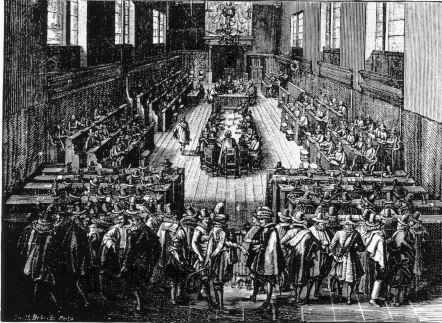
Letham's problem with Torrance, and 'Evangelical Calvinism' or Scottish Theology

Just so you don’t think I am paranoid or something — in regards to those who continually bad-mouth Torrance and his “Scottish Theology” — let me quote something from Robert Letham in his new book: The Westminster Assembly (Kevin Davis has already done a fine job highlighting some deficiency with Letham’s critique of Torrance). Letham is basically describing the nature of Torrance’s critique of “Covenant Theology,” and the shallowness that he evinces in so doing:

The criticisms of T. F. Torrance in his Scottish Theology are pertinent at this point. We will address them more directly in chapter 6. Torrance has a programmatic, ideological opposition to federal theology. He regards the development of covenant theology in the seventeenth century as a distortion of the earlier, pristine theology of Calvin, Knox, and the Scots Confession. Torrance reserves his opporobium for the Westminster Confession and says little about the Larger Catechism, which takes a rather different approach and obviates many of the alleged deficiencies he highlights. His comments about the Trinity in the Confession are well-taken. He deprecates its subordinate appearance. It is unfortunate, I agree, that the Trinity is not considered until WCF 2.3. However, Torrance does not mention that the Larger Catechism has a strongly Trinitarian doctrine of Scripture (LC 1-6). He does not even begin to consider the relationship of the Assembly to the Thirty-Nine Articles. As we have noted, the chapter in the Confession on God and the Holy Trinity is simply an expansion of the first article of the Thirty-Nine Articles (see Excursus 1), which dated from a time when Torrance claims that a dynamic Christocentric theology prevailed. Furthermore, he imposes on the Assembly the idea of a controlling central dogma — the dual framework of a covenant of works and a covenant of grace — whereas the idea of central dogmas only emerged in the nineteenth century, among German scholars, and was far from the minds of the Westminster divines. (Robert Letham,”The Westminster Assembly: Reading Its Theology In Historical Context,” 85)

1)Β Click Kevin Davis’ name, above, for a fine discussion on Letham’s point on the realtion between the WCF and LC.

2) Letham’s point on the Thirty-Nine Articles juxtaposed with the Westminster Confession of Faith is also, well-taken; nevertheless, this still remains a glaring problem for the WCF as it identifies a methodology and order of thought that is less than desirable relative to its emphasis upon a Trinitarian Doctrine of God.

3) Letham’s problem with the imposition of a central dogma (the usual one being that the Westminsters read God through a rigid predestinarian system of thought, inter-locking through a logical-causal system of decrees) is indeed something to be wary of — viz. we should want to avoid anachronistic reasoning in order to categorize thinking to our own terms and our own concerns. But, the so called “centraldogma” should not be totally jettisoned based upon its origin in linear history; if in fact it can be demonstrated that certain “dogmas” dominated trains of thought in the past. In fact Letham himself admits that the Westminster ‘divines’ were operating from largely exegetical and pastoral concerns; and that what in fact shaped the “order” of their thinking was the order of “revelation” or Scripture itself. I do not think it is a stretch at all to say that as a result certain themes emerged (like predestination and election) that served to shape the way these divines thought and talked about God (there is no doubt that the way the WCF Assembly articulated their exegetical work was through Aristotelian causal language which necessarily brought the kind of form to their work that Torrance sought to identify, describe, critique, and constructively overcome through his appeal to certain Scottish theologians of the era). While I do agree that ‘centraldogmas’ should not be emphasized, per se; if the “material” critique that those so called ‘centraldogmas’ symbolize fit the critique, then I think it is too quick to assume that this approach has no conceptual merit that needs to be dealt with (which is what Letham assumes).

4) Most curious to me, though, is Letham’s point on the Covenant of Works and Grace; and Torrance’s critique of this whole paradigm that was present in both the WCF and Larger Catechism. Letham wants to say that Torrance’s critique was un-founded at this point (back in chptr. 5 where I take the quote from above), and that there was much diversity amongst the ‘orthodox Reformed’ theologians on this issue; that in fact it was not ‘as present’ as Torrance would have us believe, and thus Torrance’s critique of these divines is ‘shibboleth’. Letham surveys, in great detail (in chaptr. 10) the diversity amongst these theologians upon this salient point of a Covenant of Works and its programmatic abscense in much of the development leading up to the Westminster Assembly. But then in Chapter 11, Letham says this:

WCF 7.2 introduces the covenant of works, made by God with man before the fall. This is the first major confessional document in which this covenant is expressly mentioned. In it, God promised life to Adam and in him to his posterity on condition of perfect obedience. Hence, in LC 20 the covenant is called the covenant of life, focusing on the promise held out to Adam. The term covenant of works draws attention instead to the means by which Adam was to attain the promise. The condition expressed in LC 20 is personal, perfect, and perpetual obedience. In short, obedience was to be sustained for an unspecified period of time, upon the completion of which life would result in accordance with God’s promise. (Letham, 226)

Letham cannot understand why Torrance would critique the ‘Assembly’ for holding to a ‘centraldogma’ — like a ‘dual covenant of works and grace’ — that the Assembly never held, since this is only a methodological straw man read back from the 19th and 20th centuries upon these divines. But, Letham contradicts himself; quite clearly, in fact. He wants to say that there was diversity on “Covenant theology” and its development, thus Torrance goes astray in his critique of ‘orthodox Reformed’ theology at this point. Yet, Torrance’s critique was of the ‘Confession’ itself; which by Letham’s own admission, the WCF is “the first major confessional document in which this covenant is expressly mentioned.”

There are some other faux-pauxs in Letham’s critique of Torrance. In the main, he misses the crux of Torrance’s primary critique of Westminster theology; the critique that Torrance makes over and again in his book “Scottish Theology,” the critique that he finds in Scottish theologians contemporaneous with the Westminster ‘divines’. This is another failure on Letham’s part, Torrance certainly does have an aversion to ‘federal covenant theology’; but Torrance grounds his critique — in his book “Scottish Theology” — in voices that are present at the same time that the Westminster Assembly convened. What would give Letham’s diatribe against Torrance some force, is if Letham challenged Torrance’s reconstruction and interpretation of the various Scottish theologians whom Torrance engages and uses to highlight similar problems that the so called 19th and 20th century dogmaticians have marshalled through their ‘centraldogmas’ towards Westminster theology. In other words, either Torrance is playing fast and loose with “his Scottish theologians” (again just to substantiate his critique of the Westminsters); or, he has identified something that Letham has failed to, and that is that the “centraldogmatists” have a consonant and correlative voice found in these ‘Scottish Theologians’Β — grounded in the history.

PS. This is not even to mention the fact that there were other andΒ alternative voices amongst “Calvinist” and Reformed theologians of this era; voices that were as anti-Westminster theology as the ‘Scots’ that Torrance develops in his book “Scottish Theology”. Letham would do well to take a look at Janice Knight’s book: Orthodoxies in Massachusetts: Rereading American Puritanism.Β This book has been out for quite a few years now, and it makes the same critique, in many ways that Torrance and the so called “older scholarship” (the “centraldogmatists”) have made; albeit from a different vantage point. People like Muller,Β R. Scott Clark, Letham et al. have completely ignored her scholarship in this area; so you tell me, who is driven by an ideological agenda? Is it those who follow Torrance (and crew), or maybe it is Muller/LethamΒ & co. who have a certain agenda? We might as well be completely honest . . .

Torrance 'objects' and so do I, to 'Federal Theology'

Here Paul Molnar gives a good summary overview of some of the reasons that T.F. Torrance objected to ‘Federal’ or ‘Westminster’ Calvinism:

Torrance’s objections to aspects of the “Westminster theology” should be seen together with his objection to “Federal Theology”. His main objection to Federal theology is to the ideas that Christ died only for the elect and not for the whole human race and that salvation is conditional on our observance of the law. The ultimate difficulty here that one could “trace the ultimate ground of belief back to eternal divine decrees behind the back of the Incarnation of God’s beloved Son, as in a federal concept of pre-destination, [and this] tended to foster a hidden Nestorian dualism between the divine and human natures in the on Person of Jesus Christ, and thus even to provide ground for a dangerous form of Arian and Socinian heresy in which the atoning work of Christ regarded as an organ of God’s activity was separated from the intrinsic nature and character of God as Love” (Scottish Theology, p. 133). This then allowed people to read back into “God’s saving purpose” the idea that “in the end some people will not actually be saved”, thus limiting the scope of God’s grace (p. 134). And Torrance believed they reached their conclusions precisely because they allowed the law rather than the Gospel to shape their thinking about our covenant relations with God fulfilled in Christ’s atonement. Torrance noted that the framework of Westminster theology “derived from seventeenth-century federal theology formulated in sharp contrast to the highly rationalised conception of a sacramental universe of Roman theology, but combined with a similar way of thinking in terms of primary and secondary causes (reached through various stages of grace leading to union with Christ), which reversed the teaching of Calvin that it is through union with Christ first that we participate in all his benefits” (Scottish Theology, p. 128). This gave the Westminster Confession and Catechisms “a very legalistic and constitutional character in which theological statements were formalised at times with ‘almost frigidly logical definiton'” (pp. 128-9). Torrance’s main objection to the federal view of the covenant was that it allowed its theology to be dictated on grounds other than the grace of God attested in Scripture and was then allowed to dictate in a legalistic way God’s actions in his Word and Spirit, thus undermining ultimately the freedom of grace and the assurance of salvation that could only be had by seeing that our regenerated lives were hidden with Christ in God. Torrance thought of the Federal theologians as embracing a kind of “biblical nominalism” because “biblical sentences tend to be adduced out of their context and to be interpreted arbitrarily and singly in detachment from the spiritual ground and theological intention and content” (p. 129). Most importantly, they tended to give biblical statements, understood in this way, priority over “fundamental doctrines of the Gospel” with the result that “Westminster theology treats biblical statements as definitive propositions from which deductions are to be made, so that in their expression doctrines thus logically derived are given a categorical or canonical character” (p. 129). For Torrance, these statements should have been treated, as in the Scots Confession, in an “open-structured” way, “pointing away from themselves to divine truth which by its nature cannot be contained in finite forms of speech and thought, although it may be mediated through them” (pp. 129-30). Among other things, Torrance believed that the Westminster approach led them to weaken the importance of the Doctrine of the Trinity because their concept of God fored without reference to who God is in revelation led them ultimately to a different God than the God of classical Nicene theology (p. 131). For Barth’s assessment of Federal theology, which is quite similar to Torrance’s in a number of ways, see CD IV/1, pp. 54-66. (Paul D. Molnar, “Thomas F. Torrance: Theologian of the Trinity,” 181-2 [fn. 165])

Some great insightful stuff on Torrance here. Let me know what you think.

Also, something worth noting, while it is possible (although not totally understandable) to be ‘Evangelical Calvinist’ without being ‘Torrancean’; it would be hard-pressed to understand why you wouldn’t want to at least learn a bit from Torrance. In case it is not obvious, I am unapologetically a beneficiary of Torrance’s thinking and direction, on many fronts. The king of ‘EC’ you are getting exposed to here at “The Evangelical Calvinist,” is most certainly shaped by the contribution that Torrance has made in this direction. I really only mention this, because there are some who would claim to be ‘EC’; and at the same time not come to their ‘EC’ conclusions by looking to Torrance much (or, at all).