
Flesh-n-Bone, 'Christ conditioned Election or unions'

Torrance is describing an “Old School Evangelical Calvinist’s” — John Craig’s — understanding of election and union with Christ. Of note is that, like Calvin, Craig (according to Torrance) emphasizes union with Christ as a ‘centraldogma’ (of sorts) in regards to understanding the mechanics of salvation and our relation with Christ through His relation with us in the Incarnation. This emphasis, ‘union with Christ’, I believe is something that sets us apart from Federal/Westminster Calvinism; indeed is something of a hallmark or touchstone for us in respect to both our theological construction as well as our linkage into the theology of John Calvin, and more so, into the theology of ‘union with Christ’ in the Apostle Paul’s ‘in Christ’ paradigm. In the following quote you will notice something that has been mentioned here before, the idea of ‘carnal union’ and ‘spiritual union’ with Christ. Let’s hear from Torrance on Craig:

. . . Distinctive also is the fact that Craig regarded election as bound up more with adoption into Christ, with union with him, and with the communion of the Spirit, than with an eternal decree. The union of people with Christ exists only within the communion of the redeemed and in the union they conjointly have with Christ the Head of the Church. ‘All who are united with Christ are joined with the Church. Which of these two unions is the first and cause of the other? The mystical and spiritual union with Jesus Christ. For we are all saints of God, because we are joined first with Christ in God.’

Union with Christ and faith are correlative, for it is through faith that we enter into union with Christ, and yet it is upon this corporate union with Christ that faith and our participation in the saving benefits or ‘graces’ of Christ rest. John Craig held that there was a twofold union which he spoke of as a ‘carnal union’ and a ‘spiritual union’. By ‘carnal union’ he referred to Christ’s union with us and our union with Christ which took place in his birth of the Spirit and in his human life through which he sanctifies us. The foundation of our union with Christ, then, is that which Christ has made with us when in his Incarnation he became bone of our bone and flesh of our flesh; but through the might power of the Spirit all who have faith in Christ are made flesh of his flesh and bone of his bone. It is only through this union, through ingrafting into Christ by faith and through communion with him in his Body and Blood, that we may share in all Christ’s benefits — outside of this union and communion there is no salvation, for Christ himself is the ground of salvation. . . . (Thomas F. Torrance, “Scottish Theology: From John Knox to John McLeod Campbell, 51-52)

Does anything stand out to you, in contrast to how you typically hear ‘Calvinism’ explained? I think the primary point of departure for EC from Federal Calvinism is highlighted here, and that is the point where ‘Christ himself is the ground of salvation’. For EC things are deeply ‘personal’ and quite intimate. Union with Christ (Pauline ‘marriage language’ cf. Eph. 5) is at the core of EC salvation, this is the nexus wherein Christ takes our wrags and we take His riches. Everything turns on this one point for EC. Christ’s Incarnation and Atonement are inseparably linked, since the moment He ‘carnally’ takes on our humanity; He begins, by the Holy Spirit, to set us apart for communion with Himself and the Father. This consummates, as it were, in ‘mystical’ or ‘spiritual’ union whereby we enter into the full union with Christ through faith by the Spirit. Interestingly, as Torrance notes for Craig, there is a correlation between union with Christ and faith; union with Christ (‘carnally’) is the prerequisite wherein faith assumes its gusto. It is through Christ’s penetration into our sinful states, that He, as our mediator (Priest) makes a move we would never make for ourselves (grace) — left to ourselves — He say’s ‘Yes’ to the Father by the Spirit. As we are confronted with this ‘Yes’ by the Spirit from the Son for us, we then become ‘respondents’ to God’s love showered upon us in His Son (cf. Eph. 1:3; Rom. 5:5), and cry out “Abba Father, Yes!” In short, election, union with Christ are inextricably united for Craig — and for Evangelical Calvinists — the logic of grace that stands behind this is, again, the idea that salvation and all of its attendant relations are profoundly, personally, and Triunally grounded in Jesus Christ! What could be better than that?

Let me mention one more point that should be clarified for those who read here regularly, and are still befuddled by aspects of EC, sorry πŸ™‚ . As we just surveyed, EC follows this idea of ‘carnal and spiritual union’ respectively. What you will notice, even in the quote above, is that ‘carnal union’ is universal — that is, Christ ‘carnally’ assumes all of humanity, real humanity (into its sinful depths); the assumption then, for EC, is that ‘spiritual union’ will follow. EC only really speaks in this positive vein when constructing her soteriology, the fact that people, who are now oriented to God in Christ through ‘carnal union’ with Him (who even go to the cross with Him — cf. the ontological atonement), reject the ‘ground of this union’ (Christ) for themselves makes absolutely no sense for the EC . . . this presents a true dilemma, one that we cannot explain, nor try to. The fact that certain folks stay on the ‘shadow-side’ of Calvary is a deep mystery, but the point should be made: they are now oriented to God in Christ (later Evangelical Calvinists say that these folks, for some strange reason — because of unbelief — experience ‘Gospel-wrath’). It is at this point that the non-logico-causal approach of EC shows up, once again; we don’t refer to a set of impersonal ‘absolute decrees’ when speaking about salvation. Which means that we don’t have a ‘decree for the Fall’ to repose upon; which further means that any discussion about ‘why’ or ‘where’ sin (rejection of God) enters the picture is a non-starter (to ask an EC’r why someone would reject their ‘recreation in Christ’ should expect the same answer to the question “why did the Fall happen in the first place?” or “why did Adam and Eve reject their original ‘creation’ in Christ [cf. imago dei]?”).
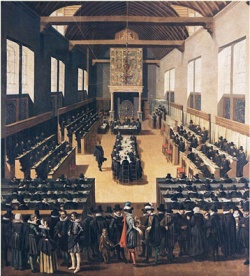
The 'Cues' for Evangelical Calvinism

**I wanted to repost this for some of you who just recently started reading here; and as a refresher for those who haven’t**

Here is a quote from T. F. Torrance, from the preface of his book Scottish Theology. This really captures the distinction and nuance that I am trying to make through this blog for the uninitiated (thus far). That indeed there is a rift between what has been called Federal Calvinism (or what I’ve been calling “Classic”), and Evangelical Calvinism (or “Scottish Theology”). TFT is introducing his book, and giving some of the rationale for writing it.

In Chapter One on John Knox and the Scottish Reformation, I have offered a general account of the deep doctrinal change that took place, but in the succeeding chapters I have tried to focus on the main issues that arose as a result of the adherence of the Church of Scotland to the Westminster Confession of Faith. Following upon the teaching of the great Reformers there developed what is known as ‘federal theology’, in which the place John Calvin gave to the biblical conception of the covenant was radically altered through being schematised to a framework of law and grace governed by a severely contractual notion of covenant, with a stress upon a primitive ‘covenant of works’, resulting in a change in the Reformed understanding of ‘covenant of grace’. This was what Protestant scholastics called ‘a two-winged’, and not ‘a one-winged’ covenant, which my brother James has called a bilateral and a unilateral conception of the Covenant. The former carries with it legal stipulations which have to be fulfilled in order for it to take effect, while the latter derives from the infinite love of God, and is freely proclaimed to all mankind in the grace of the Lord Jesus Christ. It was the imposition of a rigidly logicalised federal system of thought upon Reformed theology that gave rise to many of the problems which have afflicted Scottish theology, and thereby made central doctrines of predestination, the limited or unlimited range of the atoning death of Christ, the problem of assurance, and the nature of what was called ‘the Gospel-offer’ to sinners. This meant that relatively little attention after the middle of the seventeenth century was given to the doctrine of the Holy Trinity and to a trinitarian understanding of redemption and worship. Basic to this change was the conception of the nature and character of God. It is in relation to that issue that one must understand the divisions which have kept troubling the Kirk [church] after its hard-line commitment to the so-called ‘orthodox Calvinism’ of the Westminster Standards, and the damaging effect that had upon the understanding of the World of God and the message of the Gospel. . . . (Thomas F. Torrance, “Scottish Theology,” x-xi)

This encapsulates the motivation for the blog here; my desire is to alert folks to the reality that TF is speaking to. Here TFT highlights the development of a tradition of Calvinism that is particular to Scotland; but, also want to note that this phenomenon was not unique to the Scots. This kind of development was also, contemporaneously, at play in England as well; Janice Knight has identified this branch of development within Calvinism, as The Spiritual Brethren (as opposed to The Intellectual Fathers — the Westminster Divines).

Calvinists of today, need to know, that they aren’t the only Calvinist ‘orthodoxy’ around; that history is not on their side, per se. Even more importantly, beyond history, I really do not believe that scripture is on their side — by and large.

Anyway, I hope this quote gives you more insight on where many of my cues have been and are coming from. I also hope that if you are into ‘federal theology’ that this will at least make you pause.

Evangelical Calvinism is Better than Federal Calvinism

**This is a post I wrote quite some time ago for my other blog, I thought I would repost it here — I realize there are things and characterizations in this post that some of you disagree with, but I still hold that there is a distinguishable difference between ‘Federal Calvinism’ and ‘Evangelical Calvinism’ (which is akin to ‘Scottish Theology’) . . . and that this difference, no less, flows from a distinct doctrine of God (the Federal understanding being Thomistic, the Evangelical, Scotist)**

I have been reading a book by T. F. Torrance called Scottish Theology: From John Knox to John McLeod Campbell, and it has been quite elucidating. How many of you realized that Scotland, and many of her theologians offered a Reformation trajectory much different from that offered, later on, by what we today know as “Reformed doctrine” articulated at Dort and in the Westminster Catechisms? In other words one of the touchstones that we have inherited as “Reformed Dogma” is the TULIP and its emphasis upon God’s decrees and logico/causal relationships (like William Perkins’ Golden Chaine represents). I.e. the emphasis upon God as the unmoved mover who has decreed all of salvation history in time and space; one of these decrees being that God elected some in eternity past, and subsequently died for only these “special” people (e.g. limited atonement). Without going into too much detail, this abstract notion of God’s nature as the divine despot who decrees all of reality in a syllogistic style; was challenged by some of Scotland’s “Evangelical” “Reformed” theologians. One of these theologians was named Jonathan Fraser of Brae (1638-1698), Torrance describes Fraser’s thought on the topic of “assurance of salvation” and the “extent of the atonement” as he summarizes one of Fraser’s books:

. . . His great book, Justifying Faith, has two main parts. 1) The main part is devoted to the ground of faith in which it is shown that it is not faith itself that justifies us but Christ in whom we have faith. The ultimate grounds of believing are ‘the Attributes of God, his Power, and Faith, Fulness and Wisdom’, but ‘the immediate grounds of believing are the gracious promises in the Gospel: But my Belief of the Truth of the Promises is founded on Christ’s Faith, Fulness, the Bottom and Pillar of all Divine Faith [“Justifying Faith 2”, p. 3]. Of particular significance here is the correlation of our faith with the faith of God and the faith of Christ—human faith derives from, rests on, and is undergirded by divine faithfulness. Great stress was laid from the outset, by Fraser, on ‘Christ’s all Sufficiency’, in that ‘He is able to save them to the uttermost, that come unto God by him [“Justifying Faith,” p. 11]’. (2) The second and longer part of Fraser’s work is called an ‘Appendix’ devoted to the object of Christ’s death. In it he shows that Christ died for all people, and not for a limited number as it was claimed in the so-called ‘covenant of redemption’ made between the Son and the Father. He rejected the distinction between a covenant of grace and a covenant of redemption [“Justifying Faith”, p. 170]—the former, as he said again and again, is absolute in its nature and universal in its extent. Throughout his book Fraser differed at crucial points sharply with Samuel Rutherford and James Durham, as also with William Twisse the Prolocutor of the Westminster Assembly, not to mention the puritan divine John Owen. But reference is made to several others like William Fenner in connection with their support for the biblical teaching that Christ died for all men. This had to do sometimes with a subtle form of Pelagianism in their understanding of faith. “It is an Error oftentimes in our Faith, that it is not built purely and only on the Grace of Christ, but we seek secretly other Props, and so to set some other thing on Christ’s room, and this is as it is derogatory to Christ, and evidence of Distrust in him [“Justifying Faith”, p. 295]’. (T. F. Torrance, “Scottish Theology,” 184-85)

Here we have an example of what a Reformed theologian looked like, who thought outside the constraints imposed upon scripture by Westminster. Interestingly, many today would not consider this kind of thinking “Reformed,” but this would be circular wouldn’t it? Since one would have to assume that Westminster is the ‘historic’ standard of what being Reformed actually entails, in order to deny that people like Brae and many others also represented the variegated mainstream of the burgeoning “Reformed Tradition”—I digress.

Let me highlight a few points that Brae offers in opposition to Westminster Calvinism—that is if they aren’t apparent enough—1) notice the emphasis that Brae places on Christ as the “objective” basis of salvation. This gets into issues of ontology, union with Christ, and faith as an immediate reciprocating response” from Christ and to Christ as humanity is brought into union with Him through the incarnation. 2) This leads to the the far reaching extent of the atonement, in line with scripture (I think), Brae holds to a universal atonement (objectively), thus Christ can be called the Savior of all men; and the offer of salvation genuinely made to all people.

This is all contrary to the salvation framework provided by Westminster. For Westminster assurance came from reflecting upon ‘my good works’ (Perseverance of the saints), and then reflexively (after looking at my ‘behavior’) by faith I can find assurance that I am one of those elect for whom Christ died. This is the kind of theology that Brae was writhing against, this is what he calls “Pelagianism,” since in this construct, methodologically, man is driven to self before he gets to Christ; in other words, the decree gets in the way of Christ. Not only that, but we also end up with a rather “Nestorian” outlook, relative to election, since the incarnation was not representative of all humanity but only for the “elect”—which is problematic.

It might be surmised that Brae was a universalist (that all humanity will be saved), but he was not. Instead he believed that all humanity who believed would be saved on the basis of Christ’s universal salvation—being a direct corollary of the incarnation (and its universal extent and representation). A Westminster Calvinist would say, but wait, if Christ died for all, then all will be saved. But Fraser would respond that that is only true if you are straightjacketed by the rigid logico-causal system that has shaped the articulation and thought process of Westminster/Federal Calvinism. In other words, Fraser’s Calvinism (and he was a Calvinist) had “scriptural evangelical tension” in it—something that Westminster Calvinism just can’t live with.

John Knox's 'Ordinance of Grace' and God's "Immutability"

Here is TF Torrance describing John Knox’s view on what Knox called God’s ‘ordinance of Grace’, and how that related to his view of God’s immutability.

John Knox never wearied of affirming the immutability of God. He ever remains the same God, true and faithful to his ‘joyful promise’ to Adam that seed of the woman would break down the serpent’s head. This took the form of an ordinance of grace in which God provided a way within the history of mankind for deliverance and redemption. It is indeed upon the ordinance of grace that the whole order of creation depends, for it remains the same in the midst of man’s sin, and in spite of it, the ordinance of grace assumed the character of the promise. The promise involves judgment — the seeking out of man, his calling, his rebellion and conviction of sin, but throughout all judgment and wrath, through all calamity and disaster, God’s purpose for mankind was being worked out. In the first instance this took historical form in the calling of Israel to be the medium of God’s self-revelation to mankind, and it is that ordinance which proved to be the centre around which all things revolve and in relation to which they cohere. He is the God who brough Israel out of Egypt and destroyed Pharaoh in the Red Sea, who sent the Jews into exile, and brought them back as a remnant into Palestine. God is immutable and his ancient Word still holds sway — his ancient ways still appear in his dealings with man. But this is no immutability conceived in philosophical categories — it is the immutability of God’s purpose, will and action, for God is above all the living God who is at work in his creation, whose hand disposes nations and kingdoms. His divine ordinance of grace took historical shape in his covenanted relations with the people of Israel through whom a way was prepared for its ultimate fulfilment in the Incarnation and in the inauguration of the Church. No theologian has had a more vivid and dramatic or a more powerful realisation of direct divine action in history than Knox, and of its ultimate soteriological character. It is here that his theology stands out in such contrast to medieval teaching — its dynamic outlook indicates that there had taken place a radical move away from the rather static categories of the medieval frame of mind. This is vividly evident in his acceptance of the influence of the Old Testament and its significance for his own times in Scotland. The very same God of whom we learn in the Old Testament Scriptures, not least through the great prophets, and in the New Testament Scriptures in the original mission of the Church, now deals with men and nations through the mighty acts of his saving Word. (Thomas Torrance, “Scottish Theology,” 8-9)

There is alot in this quote. Torrance covers Knox’s themes of a ‘Doctrine of God’, Soteriology, and Eschatology; and he notes how all of these points are shaped by the life of God which is grace. This provides a basis for speaking about God’s activity in salvation history, so that we can have a God who is involved with His creation in dynamic ways; without sacrificing His immutable character. We see how Knox, through Torrance’s commentary, jettisoned the rather static God of medieval scholasticism who only was able to interact with His creation through a demeanor of stasis (or being static); which led to the development of thinking of God through decrees (this way God could remain “unmoved” and thus non-contingent by His creation).

Both Federal and Classic Calvinism are still stuck in the latter mode of understanding God, in other words they try to work through the categories provided by medieval scholasticism; which I think is at odds with scripture. I favor Torrance’s Knox, and his approach.

John Knox's 'Ordinance of Grace', later today

I have this great quote from TFT on John Knox, and his ‘ordinance of grace’; and how Knox saw all of salvation history saturated by this ‘ordinance’. It is a beautiful quote, and highlights what Knox thought of God’s immutability; he clearly believed in it, but not in the typical Thomistic/medieval static terms that so many before him had conceived. I’ll share this tomorrow . . . too late now!

Evangelical Calvinism's "Doctrine of God" and Her Approach

Here is T. F. Torrance describing John Knox’s view of God’s uniqueness:

God is ‘the one only God’, absolutely unique. It is to him only that we must cleave, and him only that we must serve and worship, and in him alone put all our trust. It was in these terms that the Scots Confession [authored by John Knox] opened its articles of faith. That needed to be said, and Knox was never weary of saying it — God is alone in his ineffable majesty and can lend majesty to no one. It belongs to God as God to be utterly unique in the exaltation of his Being and nature. God is only like God, and will have no other gods before him, and no images of God can have any place in our knowledge and worship of him. The unique God can only be confessed and acknowledged. It was John Duns Scotus, the hero of John Major, who said (as well as Aquinas) ‘God is not in a genus’ . . . which means that we cannot know him in any general way or speak of him in general terms. The unique God can be known only through himself in the light of his own majesty and glory. [brackets mine]Β (Thomas Torrance, “Scottish Theology,” 5)

This quote, beyond the sense of worship it should evoke (just thinking about who God is, His beauty and majesty, His ways which are beyond finding out), helps exemplify the approach to God that ‘Evangelical Calvinism’ intends. It is what is called in Latin (and from Medieval days) the via positiva, or the “positive way.” What this means is that EC wants to approach any knowledge of God by allowing God to impose Himself upon us; we believe that God’s self-revelation in Christ is the only mediation of God that has any merit towards constructing a ‘Doctrine of God’ and any subsequent doctrines. This means that approaching God through “negative ways” (via negativa) is a dead end. Thus, EC is at odds with Federal Calvinism, Roman Catholicism, and any other system of theology that tries to develop a doctrine of God through preconceptions of what a God who can create, for example, should be like. Simply put, ‘EC’s approach is positive and grounded in ‘revelation’ (not philosophy).

Hope you have found this informative.

The Trinitarian God of Evangelical Calvinism versus the Monadic God of Classic Calvinism

Here is a lengthy quote from Thomas Torrance describing how an Evangelical Calvinist ‘Doctrine of God’ differs from a Classic/Federal/Roman Catholic ‘Doctrine of God’. He is taking a look how John Knox articulated this difference in the ‘Scots Confession’; you’ll notice how important “order” is, relative to the differing emphases of the disparate confessions and catechisms being considered.

In this Reformation theology of John Knox and his colleagues there took place a radical shift from the medieval set of mind, away from an abstract theology of logically ordered propositions to a lively dynamic theology, addressed not primarily to the salvationΒ  of the individual soul, but to the nation as a whole. It involved a radical change in the doctrine of God. This is very evident in the first article of the Confession on the doctrine of the Holy Trinity: ‘ane onlie God . . . ane in substance, and zit distinct in thre personnis, the Father, the Sone, and the holie Gost’. Thus in the Scots Confession as in John Knox’s Genevan Liturgy, the doctrine of the Trinity is not addedΒ  on to a prior conception of God — there is no other content but the Father, the Son, and the Holy Spirit. There was no separation here between the doctrine of the One God (De Deo Uno), and the doctrine of the triune God (De Deo Trino), which had become Roman orthodoxy through the definitive formalisation of Thomas Aquinas. This trinitarian approach was inΒ  line with The Little Catechism which Knox brought back from Geneva for the instruction of children in the Kirk. ‘I believe in God the Father, and in Jesus Christ his Son and in the Holy Spirit, and look for salvation by no other means.’ Within this trinitarian frame the centre of focus in the Confession and Catechism alike is upon Jesus Christ himself, for it is only through him and the Gospel he proclaimed that God’s triune reality is made known, but attention is also given to the Holy Spirit. Here once again we have a different starting point from other Reformation Confessions. Whereas they have a believing anthropocentric starting point, such as in the Heidelberg Catechism, this is quite strongly theocentric and trinitarian. Even in Calvin’s Institute, which follows the fourfold pattern in Peter Lombard’s Sentences, the doctrine of the Trinity is given in the thirteenth chapter within the section on the doctrine of God the Creator. Calvin’s Genevan Catechism, however, understandably followed the order of the Apostles’ Creed. The trinitarian teaching in the Scots Confession was by no means limited to the first article for it is found throughout woven into the doctrinal content of subsequent articles. (Thomas Torrance, “Scottish Theology,” 3-4)

Still here? This delineates how “EC” substantially moves away from the Thomist doctrine of God presented by Classic Calvinism (as well as most of “Evangelical” theology — meaning in the vein of Ryrie, Grudem, Erickson, et al.). I won’t say much here, except to highlight the importance of Torrance’s point on ‘Classical’ theologies’ separation or wedge between the “single substance” of God versus the “thrice personages” of the Trinity. In other words, “EC” doesn’t start with a notion of “God,” and then add on the persons of the trinity to that notion; instead “EC” grounds the being of God in the very relation of the Father, Son, and Holy Spirit.

That’s all I’ll say for now, for questions, or objections I’ll see you in the comment meta . . .

Preacher-Theologians, Where Are They?

I really like this statement about John Knox as a ‘preacher-theologian’. So often there is a wedge placed between these two, and clearly God has called some to be professional theologians (i.e. teachers); but I think what really is missing amongst pastors today is that they fail to see their role as a theologian (out of necessity — teaching God’s Word requires this). No, no, I’m not saying the pastor needs to be an “academic,” but that he should be serious about communicating who God is (thus the theologian part). Anyway here is how TF Torrance talks about John Knox in this vein:

John Knox himself was essentially a preacher-theologian, one who did not intend to be a theologian, but who could not help being a theologian in the fulfilment of his vocation. He regarded his vocation: a) as a preacher of the Gospel, someone burdened with the lively Word of God, which he had to proclaim in a correspondingly lively manner; b) as a steward of the mysteries, or ‘a steward of the mystery of redemption’ (one of his favourite expressions).

The price of Christ Jesus, his death and passion is committed to our charge, the eyes of men are bent on us, and we must answer before the Judge, who will not admit everie excuse that pleaseth us, but will judge upryghtly, as in his words he hath before pronounced . . . Let us be frequent in reading (which allace, over many despise) earnest in prayer, diligent in watching over the flock committed to our charge, and let our sobrietie and temperate lyfe eshame the wicked, and be example to the godly . . .

The desperate earnestness with which Knox took his calling demanded theological earnestness: . . . (Thomas Torrance, “Scottish Theology,” 2-3)

If only we had preacher-theologians like Knox today. Too often it seems we have preachers who are preacher-CEO’s or something . . . ah, enough Evangelical bashing; but you know what I mean, right?

Trying to Engage some MacArthurites with 'Theology'

This post is kind of just a vent. I’ve been over at a John MacArthur blog trying to engage folks there on Evangelical Calvinism, it hasn’t been working very well. I actually spent the time trying to elucidate the difference between a Scotist understanding of God and the Thomist understanding (which is tied into the Westminster framing of things); here is what I said:

Scotist Approach (the one I advocate)

1. I assume that creation has always been eschatologically oriented.

2. Which means that the “eternal Son” has was always going to be incarnated no matter what, the Fall just intensified His need to come — thus the point on eschatological purpose for creation above.

3. This means that the Incarnation was not contingent upon the Fall of man.

4. This further means that God had always and eternally in Christ freely determined to “become man” in order to achieve the eschatological purpose of creation.

5. This all means that Jesus Christ is the same yesterday, today, and forever. So that when we see Him in time, this is always who He has been and well be in eternity. And this is all based, again, on the eschatological purpose of creation.

Contrary to this, the traditional view holds that God is likewise non-contingent (doesn’t need us to be who He is) on His creation. But the way the Trad. view vouchsafes this ‘non-contingency/dependence’ is by positing a series of decrees (theologically appropriated) between God and man. Let me try to bullet-point this:

Thomist Approach

1. In this approach, the Fall of man is the reason the Son Incarnates.

2. But somehow we have to continue to maintain God’s non-dependence on creation.

3. This is where decrees or Aristotle’s causation is appealed to. The decrees allow for God to deal with man in a way that allows Him to remain untouched by His creation.

4. So with these decrees God has an apparent wedge between His life in eternity, and His creation in time.

5. The problem enters in when Jesus, God the Son, enters into time under the dictates set out by the decress (and Covenants, like works/grace in the typical Federal Calvinist framework). At this point He becomes man, not freely determined by the dictates of God’s life; but instead by a set of decrees that have been set out with the sole purpose of keeping God separate from His creation.

6. The problem is, is that Jesus is God, and now has become submissive to decrees that were set out to govern creation; but instead, when He becomes man in the Incarnation, these same decrees end up shaping who He is to be (i.e. how He is to act in time). This leaves this approach with the unattendended consequence of the very decrees that were to keep God separate (and immutable/impassible) from His creation as those that shape who He is in the Incarnation (if we hold to the homoousion, which we all do that Jesus is of the same substance of the Father and Holy Spirit) then this is really problematic. It means that God turns out to be contingent upon His creation, inspite of trying to avoid these very consquences (a catch 22).

7. A consequence of this understanding is that when we see Jesus we don’t really see who God is; we only see a God, in time, who is who He is as set out by His obedience to these decrees (i.e. to become man because of the Fall).

In the end, there is a disconnect between God’s so called ontological or immanent nature (in eternity) and His economic or evangelical nature (in time).

So the trad view disconnects this reality of God (his ontological/economic nature) by positing decrees/secondary causes as the way that God relates to and in time. In so doing who Jesus is in time (because of the decrees) isn’t who He really is in eternity (because He is only acting out the demands of the decrees which aren’t grounded immediately in God’s life but are only abstracted instruments that subsist in a way for God to interact with time w/o actually being contingent upon it).

The response to this is that my view somehow is Arminian, which I have no idea how that was the conclusion; or that it is just plain old wrong because the interlocuters there just can’t wrap their heads around it. I think some skepticism can be helpful, but to move on from that, and just assume a view is wrong simply because it makes the mind hurt to try and understand seems to be a very easy way out. And this is the kind of response I rountinely get from folks over at the Pyromaniacs blog. There are some good brothers and sisters over there — some a bit snipey — but I think what is lacking in that camp of thought is an ability or desire to think dogmatically (this camp doesn’t really seem to see the value of thinking theologically at all, unless of course when it comes to the hypostatic union or something — and then it stops right there).

Actually I think it’s kind of becoming a waste of time to try and convince people to think theologically, and to try and persuade people/Christians of its significance. Either they see it or they don’t (even though, whether or not they see it as significant, they engage in theological thought all the time — they should be committed to doing that in good ways instead of bad ways, whether a layman or not).

PS. I toke the graphics from the Pyros blog.

Evangelical and Federal Calvinism, at odds

**This is a post I wrote quite some time ago for my other blog, I thought I would repost it here — I realize there are things and characterizations in this post that some of you disagree with, but I still hold that there is a distinguishable difference between ‘Federal Calvinism’ and ‘Evangelical Calvinism’ (which is akin to ‘Scottish Theology’) . . . and that this difference, no less, flows from a distinct doctrine of God (the Federal understanding being Thomistic, the Evangelical, Scotist)**

I have been reading a book by T. F. Torrance called Scottish Theology: From John Knox to John McLeod Campbell, and it has been quite elucidating. How many of you realized that Scotland, and many of her theologians offered a Reformation trajectory much different from that offered, later on, by what we today know as “Reformed doctrine” articulated at Dort and in the Westminster Catechisms? In other words one of the touchstones that we have inherited as “Reformed Dogma” is the TULIP and its emphasis upon God’s decrees and logico/causal relationships (like William Perkins’ Golden Chaine represents). I.e. the emphasis upon God as the unmoved mover who has decreed all of salvation history in time and space; one of these decrees being that God elected some in eternity past, and subsequently died for only these “special” people (e.g. limited atonement). Without going into too much detail, this abstract notion of God’s nature as the divine despot who decrees all of reality in a syllogistic style; was challenged by some of Scotland’s “Evangelical” “Reformed” theologians. One of these theologians was named Jonathan Fraser of Brae (1638-1698), Torrance describes Fraser’s thought on the topic of “assurance of salvation” and the “extent of the atonement” as he summarizes one of Fraser’s books:

. . . His great book, Justifying Faith, has two main parts. 1) The main part is devoted to the ground of faith in which it is shown that it is not faith itself that justifies us but Christ in whom we have faith. The ultimate grounds of believing are ‘the Attributes of God, his Power, and Faith, Fulness and Wisdom’, but ‘the immediate grounds of believing are the gracious promises in the Gospel: But my Belief of the Truth of the Promises is founded on Christ’s Faith, Fulness, the Bottom and Pillar of all Divine Faith [“Justifying Faith 2”, p. 3]. Of particular significance here is the correlation of our faith with the faith of God and the faith of Christ—human faith derives from, rests on, and is undergirded by divine faithfulness. Great stress was laid from the outset, by Fraser, on ‘Christ’s all Sufficiency’, in that ‘He is able to save them to the uttermost, that come unto God by him [“Justifying Faith,” p. 11]’. (2) The second and longer part of Fraser’s work is called an ‘Appendix’ devoted to the object of Christ’s death. In it he shows that Christ died for all people, and not for a limited number as it was claimed in the so-called ‘covenant of redemption’ made between the Son and the Father. He rejected the distinction between a covenant of grace and a covenant of redemption [“Justifying Faith”, p. 170]—the former, as he said again and again, is absolute in its nature and universal in its extent. Throughout his book Fraser differed at crucial points sharply with Samuel Rutherford and James Durham, as also with William Twisse the Prolocutor of the Westminster Assembly, not to mention the puritan divine John Owen. But reference is made to several others like William Fenner in connection with their support for the biblical teaching that Christ died for all men. This had to do sometimes with a subtle form of Pelagianism in their understanding of faith. “It is an Error oftentimes in our Faith, that it is not built purely and only on the Grace of Christ, but we seek secretly other Props, and so to set some other thing on Christ’s room, and this is as it is derogatory to Christ, and evidence of Distrust in him [“Justifying Faith”, p. 295]’. (T. F. Torrance, “Scottish Theology,” 184-85)

Here we have an example of what a Reformed theologian looked like, who thought outside the constraints imposed upon scripture by Westminster. Interestingly, many today would not consider this kind of thinking “Reformed,” but this would be circular wouldn’t it? Since one would have to assume that Westminster is the ‘historic’ standard of what being Reformed actually entails, in order to deny that people like Brae and many others also represented the variegated mainstream of the burgeoning “Reformed Tradition”—I digress.

Let me highlight a few points that Brae offers in opposition to Westminster Calvinism—that is if they aren’t apparent enough—1) notice the emphasis that Brae places on Christ as the “objective” basis of salvation. This gets into issues of ontology, union with Christ, and faith as an immediate reciprocating response” from Christ and to Christ as humanity is brought into union with Him through the incarnation. 2) This leads to the the far reaching extent of the atonement, in line with scripture (I think), Brae holds to a universal atonement (objectively), thus Christ can be called the Savior of all men; and the offer of salvation genuinely made to all people.

This is all contrary to the salvation framework provided by Westminster. For Westminster assurance came from reflecting upon ‘my good works’ (Perseverance of the saints), and then reflexively (after looking at my ‘behavior’) by faith I can find assurance that I am one of those elect for whom Christ died. This is the kind of theology that Brae was writhing against, this is what he calls “Pelagianism,” since in this construct, methodologically, man is driven to self before he gets to Christ; in other words, the decree gets in the way of Christ. Not only that, but we also end up with a rather “Nestorian” outlook, relative to election, since the incarnation was not representative of all humanity but only for the “elect”—which is problematic.

It might be surmised that Brae was a universalist (that all humanity will be saved), but he was not. Instead he believed that all humanity who believed would be saved on the basis of Christ’s universal salvation—being a direct corollary of the incarnation (and its universal extent and representation). A Westminster Calvinist would say, but wait, if Christ died for all, then all will be saved. But Fraser would respond that that is only true if you are straightjacketed by the rigid logico-causal system that has shaped the articulation and thought process of Westminster/Federal Calvinism. In other words, Fraser’s Calvinism (and he was a Calvinist) had “scriptural evangelical tension” in it—something that Westminster Calvinism just can’t live with.

I am happy to say that I am Reformed in the “Evangelical way” represented by Fraser. In fact I think Fraser, and others, are the kind of fellows that Karl Barth picked up on in his thinking on soteriology. If not, the similarity is quite shocking.