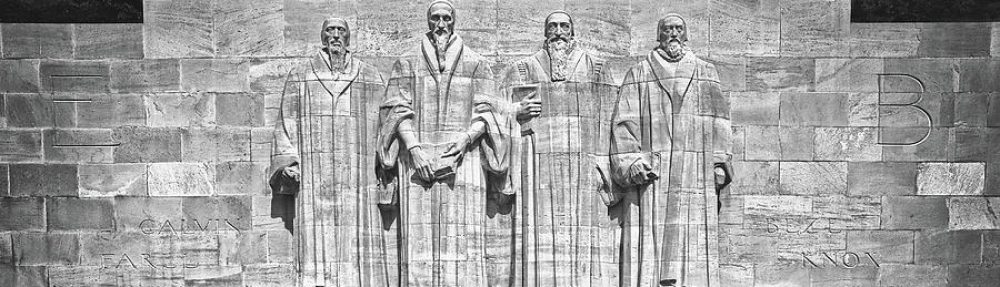
Learning to Read Scripture as if Jesus is its Meaning and Context: Along with Athanasius and the Fathers

We all interpret. Whether it be while driving down the street, and stopping at a stop sign, or reading the various sections of a newspaper. We bring readerly expectations and conditions to our daily lives that inform how we arrive at our interpretive conclusions. But for some reason when it comes to biblical interpretation many people in the churches place that into a special mystical, even magical category; as if said people can simply open the text, read it, and receive it as is without interpretation. But this is false of course. We are all faced with interpretive dilemmas, particularly when it comes to the text of Scripture.

At the very beginning, when a confessing Christian opens the Bible to read they are approaching it from an a priori (prior) interpretation, and thus confession (as orthodox Christians). They are approaching Scripture from the context that it is Holy and the place where God has ordained to speak to His people, and to the world. That is, based on an interpretation of the Bible that not all share, of course! Atheists don’t approach Scripture as if it is the triune God’s Word for humanity. The atheist, clearly, approaches Scripture through a negation, through skepticism, through unbelief; and so because of their approach (interpretation) they visit its reading with different readerly expectations than an orthodox biblical Christian does.

Once it is has been established that Christians read Scripture itself from a confession, based on an interpretation, it should be easier to persuade the reader of what I hope to throughout the brief body of the following post. Confessional Christians ought to read Scripture through God’s interpretation and reality for Scripture in His Self-revelation in Jesus Christ. This is what the early church fathers presumed; viz., that Scripture was about Jesus, and the triune God He revealed. They further believed that because of this Christological condition of Scripture that it required that as the church, as God’s confessional people, that they attempt to interpret Scripture with reference to articulating its reality in the who of Jesus Christ and the triune God. This motivation was propelled with greater urgency in the face of many of the early heretics who were present within the church’s walls (think Arius, Eunomius, Pelagius et al.) And so through a series of various circumstances church councils were convened in order to develop and codify grammar wherein who Jesus was, as both God and Man, could be articulated in such a way that would ally the heretics and edify the faithful at the same time. We see these conciliar articulations, and thus theological grammar develop in such key councils as: Nicaea, Constantinople, Ephesus, Chalcedon, so on and so forth. These councils led to what came to be understood as the limiting grammar for how to think of the singular person of Jesus Christ as both fully God and fully human (i.e., the hypostatic union and homoousios). For our purposes what I want to press is the way the fathers went about interpreting Scripture in this instance.

To help us wade into this massive locus let me introduce us to a thought Peter Leithart has on the reality of theological interpretation of Scripture. He points to Athanasius as a particular and early example of a church father who definitively engaged in the type of biblical interpretation I have been calling our attention to previously. He writes:

Theological interpretation of Scripture thus involves respect for the premodern interpretation, attention to the doctrinal tradition of the church, recognition that Bible scholarship takes place within the church and exists for the edification of the church, and acknowledgment that interpretation is not a clinical scientific enterprise but a form of piety and properly preceded and followed by prayer, praise, and worship. Athanasius is among the precritical interpreters of Scripture whom contemporary theological readers of Scripture seek to emulate. Lessing’s ditch was unknown to him, as was Benjamin Jowett. Of course, so too was the Nicene tradition to which Reno appeals. Athanasius does appeal to the authority of the “fathers” at Nicaea, but he is one of the key formulators of the Nicene tradition, rather than an heir of it. His biblical interpretation is therefore of peculiar importance, since by following his lead we can discover some of the paths by which he moved from Scripture’s narrative, law, gospel, and epistle to the metaphysical claims inherent in Nicene theology.[1]

Leithart recognizes the inherent reality of interpretation of the biblical text as we approach it as confessional Christians; that is, that we do so from an already vantage point that we have definitionally as Christians. He points us to Athanasius, the great stalwart for christological orthodoxy at the Council of Nicaea in 325 ad. Athanasius understood, 1) that Scripture’s reality was funded by Christ (cf. Jn 5.39); 2) that Scripture itself, while funded by the reality of Christ, didn’t explicitly, but only implicitly taught what we have come to know as dogma or sacra doctrina today; 3) thus, Athanasius knew, as Leithart underscores, that in order to speak explicitly about the divinity and humanity of Christ together, just as sure as Scripture is oriented by both realities singularly, there would have to be some sort of intelligible grammar developed in order to make clear what was, explicitly present in the text, but left in implicit and inner-theological ways. He along with many others, as they were engaging what came to be understood as heretical christologies, gave the church the theological grammar the orthodox churches deploy to this day. As such, when confessional Christians think about Jesus, and the triune God in the 21st century, if they are orthodox, are thinking from these early theological grammars developed by the fathers with reference to who Jesus is vis-à-vis the triune God. This shouldn’t be taken for granted (as it so often is!)

My basic point in this post is to confront the idea that people simply read Scripture as if tabula rasa; i.e., as blank slates who re-create and re-interpret the biblical interpretive wheel as if magic fallen from the heavens as fairy-dust. Orthodox (little ‘o’) Christians are part of a continuous history established by God in Christ, just as sure as He has established His church. That is, we receive by listening to the past. For many Christians in the 21st century they are only interested in receiving from the Post-Enlightenment past, thus, and again, reading Scripture from rationalist, naturalistic lenses wherein their personal experiences and rationality becomes the standard by which Scripture is interpreted. But in fact, confessional Christians, as Leithart noted for us, read along with the ‘faithful’ from all periods; particularly as that has been funded by the conciliar past, and the christological and theological proper grammars developed thereat.

My hope is that the reader walks away from this post with the recognition that there is more going on with the text of Scripture than simply knowing the languages (while very important), or understanding literary and narratival theory, or simply understanding biblical grammar and philology. All of that is important towards being a good exegete of Scripture, but what is most important is to approach Holy Scripture as if it is Holy; which is to say, to approach Scripture as from the confessional standpoint that the early Christians and church fathers did. That is, to approach Scripture as if its ultimate context and thus determinative for meaning is indeed Jesus Christ and the triune God. If we don’t read Scripture this way, just as the fathers did, then we will imbue ‘our’ meanings and contexts into the text, and allow our ‘responses’ to determine its meaning and theological conclusions. We will make Scripture an instance of self-projection wherein it fits our desires and wishes (which would help Feuerbauch with his case), rather than allowing it to be enflamed with God’s voice, as we encounter it with each page turned; wherein the Spirit brings the risen Christ’s face into ours and says both Yes and No. But I would argue that the orthodox Christian cannot and should not read Scripture apart from its orthodox frame as presented by the conciliar fathers. We can receive the limits they presented, and positively and constructively build off of those, but they should never be left behind. If we are going to be catholic (universal) Christians, we will affirm said orthodoxy, and the type of confessional and devotional heart and mindset that was formed by that, and allow who Christ is as the meaning of the text to inform the way we proceed in our exegesis and thus conclusions about what the text is saying for us today—and we will receive that from the Right Hand of the Father as that has been given formation, afresh anew, through the corridors of the church’s history. We will Listen to the Past as Stephen Holmes has so sagaciously alerted us to.

We will close with someone who understands the significance of engaging the ‘drama’ of Scripture in the way I have been describing previously:

In sum, the Gospel is ultimately unintelligible apart from Trinitarian theology. Only the doctrine of the Trinity adequately accounts for how those who are not God come to share in the fellowship of Father and Son through the Spirit. The Trinity is both the Christian specification of God and a summary statement of the Gospel, in that the possibility of life with God depends on the person and work of the Son and Spirit. The doctrine of the Trinity thus serves both as an identification of the dramatis personae and as a precis of the drama itself. “He is risen indeed!”[2]

[1] Peter J. Leithart, Athanasius, 28.

[2] Kevin Vanhoozer, The Drama of Doctrine, 43-44.

‘The 5 Points of Arminianism’ and How Evangelical Calvinists are Neither classical Calvinist or Arminian

We hear a lot about the so called 5 points of Calvinism, but rarely, if ever do we hear of the 5 points of the Remonstrants or Arminianism. This is ironic, since the 5 canons or points of Calvinism were in response to the points of Arminianism; this is why the Calvinists had 5 points at all. The Calvinist points were developed at the internationally shaped Council of Dort, held in the Netherlands. The Calvinists felt compelled to respond because the Remonstrants (or Arminians) were gaining too much theological and political ground, and so the Calvinists knew they needed to offer a united front in response. What is interesting about the 5 points of the Remonstrants, is that when you read them what the reader might be surprised by is just how “Calvinist” many of the points sound. For those aware, this makes sense, since historically, Arminius, and his followers were situated in the same sort of theological milieu as their Reformed counterparts. Arminius himself had an elevated view of John Calvin’s Institutes, and in many ways reflects many of the themes, that Calvin developed, in his own work. Further, the Remonstrants, were couched in the scholastic Reformed world, or what has now come to be called Post Reformation Reformed Orthodoxy. As such, the Arminians, as far as their grammatical soundings and theological material and method, will sound and look a lot like the scholastics Reformed. Of course, the Remonstrant theology veers rather dramatically away from Calvinist theology; particularly when it comes to the doctrine of predestination and election. Let’s read what the 5 points of Arminianism entail, and then reflect a bit further on the other side of that:

  1. In the decree of election, God has purposed to save those whom He foreknows will believe and persevere in faith to the end.
  2. Christ by His death has purchased salvation equally for all, but this salvation is enjoyed only through faith.
  3. Fallen human beings are enslaved to sin, and have no innate power to think, will, or do anything spiritually good, unless they are first regenerated by the Holy Spirit.
  4. Divine grace alone enables fallen sinners to think, will, or do anything good; yet this grace is always able to be resisted. The difference between the righteous and the unrighteous is that the former cooperate with grace, but the latter resist it.
  5. Believers are given all the help of grace to persevere to the end; but whether a true believer can reject this grace, return to his sin, and be for ever lost, is a question requiring further investigation from Scripture.[1]

If the reader is interested in reading Arminius’s theological developments in these areas, as those stand behind the 5 points, I would recommend they read his Declaration of Sentiments. It becomes clear why Calvinists would reject these points out of hand; as the TULIP (a 20th century acronym used to make the 5 canons of Dort more memorable) makes unmistakably clear.

As an Evangelical Calvinist I reject the Remonstrant points as they ostensibly make God’s election contingent upon the ‘seen’ faith of people who will believe and persevere; I think this does indeed collapse God’s will into the human will much too closely. Of interest, though, is point 3: it is here that the Calvinists and Arminians can hold hands with great affection. Often Arminians are charged with being Pelagian, or that they grant neutrality to the human will in regard to its capacity to be for God or against Him. As point 3 ought to clarify, this couldn’t be further from the truth. The problem that Calvinists have with the Remonstrants though, on this particular point, is how the Arminians develop that in point 4. The idea that someone could resist God’s grace when offered to them is intolerable to the Calvinist. The Calvinist has a heavy emphasis on God’s brute power as that is given form, in a God-world relation, in the so called decretum absolutum. If a person can thwart God’s will in salvation, which the Calvinist believes point 4 above entails, then the conception of God as almighty and sovereign is undercut; according to the Calvinist. This, of course, is why, in the 5 points of Calvinism (TULIP), we get the “I” of Irresistible Grace.

Some people have charged Evangelical Calvinism, as we have described that, as being more Arminian than Calvinist. They make this claim, because like the Arminian we affirm a universal atonement. They also seem to think that we can be construed as Arminian-like (so Kevin Vanhoozer’s critique of us) because we reject the absolute decree (decretum absolutum) of election and reprobation, at least as those are understood in the Reformed orthodox tradition. Vanhoozer, in particular, maintains that since we have the concept of universal atonement operative in our ‘system’ that this necessarily leads to the idea that either all people will ultimately be ‘saved.’ Since we reject universalism, Vanhoozer and Roger Olson, believe that we operate with an irrationalism in regard to election; since, for Vanhoozer, we don’t have a coherent strategy for understanding why not all will end up repenting, and on the other hand, for Olson, because we likewise do not ostensibly have a limiting factor in regard to who will end up turning to Christ. In other words, because Vanhoozer reads these things through his metaphysic of primary and secondary causation (and Aristotelian frame), he believes that if we affirm a universal atonement, that it only makes sense that all will end up turning to Christ; since there is a one-for-one causal relationship between God’s will in atonement, and God’s will in regard to whom the atonement is for. I.e. If God in Christ dies for all, eo ipso all MUST repent and receive Christ; or, God’s sovereignty has been thwarted and defeated by His creation.

But Evangelical Calvinists evade Vanhoozer’s critique, in particular, and the classical Calvinist critique, in general, insofar that we repudiate the ‘logico-causal necessitarian’ theory of causation that they operate from. In other words, we think it is artificial to think that God must operate from an Aristotelian or Newtonian, or mechanical understanding of a God-world relation. This is not required by Scripture’s disclosure, and more significantly, the Self-revelation of God in Christ of the triune relationship of Father, Son, and Holy Spirit ought to indicate to the theologian that God’s relationship to the world, as His relationship has eternally been in se, is a filial and personal one. As such, if we are going to strictly follow the implications of God’s Self-revelation as the only means by which we might come to know God’s way in Himself and for us, we ought to reject the metaphysic that Vanhoozer and the rest of the classical Calvinists (along with the classical Arminians) operate with; viz. the theory of causation that thinks in the mechanistic terms we have already alluded to. Because Evangelical Calvinists reject the so called ‘classical metaphysic’ of the Great Tradition, and opt for a reified conception of that as that is understood within a so-called ‘Chalcedonian Pattern,’ we elide, indeed, the logico-causal critique against us as if we are Arminian. We might affirm similar things in regard to the extent of the atonement, but that is only a semantic connection, not a material one.

Truth told: classical Calvinists and Arminians have more in common with each other than we do with either Calvinism or Arminianism. Since they both operate from the same intellectual heritage, and seemingly have become stuck in the web of 13th century through 17th century theological metaphysics, they are unable to adequately read the Bible’s reality for all its worth. Thomas Torrance, patron saint of us Evangelical Calvinists, has charted a better way forward, in regard to constructively appropriating modern metaphysical insight towards the reification of theological concepts. In other words, as Torrance notes, we do not live under a Ptolemaic or Newtonian mechanical system; we have arrived at an Einsteinian moment wherein the theory of relativity has undone the way we think about the time-space continuum. Ah, this leads us into another blog post for another time.

[1] Nick Needham, 2000 Years Of Christ’s Power: Volume 4: The Age Of Religious Conflict (Scotland, UK: Christian Focus Publication, 2017), 134.

The Babylonian Captivity: The Church Programmed by the Culture Makers Rather than sola Scriptura

In one of Martin Luther’s famous treatises he speaks of the church’s Babylonian Captivity. In his context this was in reference to the way the Gospel (and thus the church) had become conditioned to be what it was, programmed is even better, to imagine that the way people had been told things are by the Church, simply was the way it is. The people, en masse, had no real critical resource to imagine that what they had been told might not be the case; that the Gospel reality, and the Church of Jesus Christ might be much different than what they had been led to believe by their authorities (the magisteria of the Roman church). They simply lived in a world that was shaped by propaganda that led them into a captivity they believed simply was normal life. But Luther, following in the steps of the ad fontes (back to the sources!) movement, largely fostered by Lorenzo Valla et al., began to read the New Testament Greek afresh and anew. In Luther’s case, as he did this, he came to realize that what the church had programmed him to believe about God and the Gospel simply was not the case. As many of us know his story, he was an Augustinian monk living a tortured faith, believing that God could only be angry with him because he was such a dreadful sinner. As the church had taught him, the iustitia Dei (God’s righteousness), and the iustitia Christi (Christ’s righteousness), or the merits won by Christ for those who, by an infusion of faith, through created grace, dispensed by the sacraments of the church, were able to perdue in a way that they might finally merit Christ’s righteousness for them, thus allowing them to meet God’s righteousness, resulting in an eternal reward of beatific vision. This was what Luther agonized under, until at the direction of his spiritual father, Johann von Staupitz, he found the truth of the Gospel held captive in the pages of the New Testament, breaking free as it mediated him to the Mediator between God and humanity, Jesus Christ. Luther had a break through! He was finally able to imagine a conception of God that was outside the walls of the cell the church had built for him, and so many, for the centuries.

We are not unlike Luther back then. As North American (Western) Christians we live in a secular and post-secular world that programs us to think in narrow bounded terms informed by a meta-narrative that proclaims the evangel of humanity’s ability to live like gods; to live the way we want; to live under the dictates of what our desires tell us are the true and the beautiful and the good. The people narrating for us have become our authorities. They are the magisteria for us, just as the Romish religion was for the late mediaeval world that Luther and the people of that time were for them. We might not recognize our ‘social engineers’ this way, indeed, we wouldn’t even want to think, particularly as American Christians, that we might be being programmed by others in a way that comes close to the authorities of Luther’s day. But as Luther once noted: ““It is not unusual in the world for villains and rascals to occupy every office and station in society and to abuse it.” Christians seem to have a hard time admitting that they could be held captive by a cultural conditioning that comes close to resembling the sort of outright programming the mediaeval world had in the ex-cathedra of Rome. If this is you, or if you know of the types I am are referring to, maybe you ought to think again.

Kevin Vanhoozer, to my delight, hits upon these very themes in his new little book: Hearers & Doers: A Pastor’s Guide to Making Disciples Through Scripture and Doctrine. The section we will hear from him is him attempting to convict pastors, and Christians in general, to become alive to the idea that maybe, just maybe, they have become captivated by a type of Babylonian reality that has programmed them, and thus quenched their capacity to imagine that the world and reality of Holy Scripture, could in fact be the more concrete and real world; and that the vanilla status quo world they have come to think of as real and comfortable, or even just manageable, might not be the real world at all. As Vanhoozer notes, people, might be okay with affirming Scripture as God’s Word, but then function in ways that betrays this because they have become ensnared by the secular world that is indeed anti-Christ and anti-thetical to what Christian’s affirm about the Bible. Vanhoozer writes:

Holy Scripture and the Disciple’s Imagination

As I mentioned above, many churches are suffering from malnourished imaginations, captive to culturally conditioned pictures of the good life. Chapter 2 focused on wellness, health, and fitness, but these are only symptomatic of other things that have dominated the social imaginary, like celebrity, wealth, and social power. Christians want to believe the Bible—they do believe it and are prepared to defend doctrinal truth—but they nevertheless find themselves unable to see or feel their world in biblical terms (“I believe; help my unbelief!” Mark 9:24). Consequently, they experience a disconnect between the world they actually inhabit and the world of the biblical text whose truth they confess. Their professions of faith are out of whack with their lived practices. If faith’s influence is waning, then it is largely because of a failure of the evangelical imagination to connect the biblical and cultural dots. Pastors can help, especially by reminding their congregations again and again what the Bible is and what it is for: Sola Scriptura is a shorthand way of doing this insofar as it reminds us that Scripture alone should exercise supreme authority over Christian faith and life, including the imagination.

In his essay “The Demise of Biblical Civilization,” historian Grant Wacker claims that during the twentieth century, the average American did not renounce the Bible but simply stopped using it as the primary plausibility structure with which to make sense of the world. People began to understand the meaning of events in terms of this-worldly historical processes rather than in terms of divine providence. The demise of biblical civilization was a failure of the imagination to read our world in terms of God’s word. The demise of biblical civilization is related to the replacement of sola Scriptura in the social imaginary of the West by other stories.

Christian imaginations are captive to nonbiblical stories that do not lead us to Christ and thus fail to nourish our souls. We need to call these stories out and expose their shortcomings, for there is no other gospel (Gal 1:7). We cannot hide behind orthodox theology and pretend that we are invulnerable to the cultural programming that is happening to us 24/7. We need to know that the church is in competition with the powers and principalities that are trying to capture our imagination, and from thence our body, heart, and soul.

The gospel, especially the dramatic announcement that God has raised Jesus from the dead, sets the captive imagination free. What we might call the “evangelical” imagination—an imagination ruled by the story of the gospel—frees us to see, judge, and act in faith, in accordance with the way things really are rather than the way secular science or Madison Avenue say they are. It is all those other words and all that noise in contemporary culture that disorient and deserve to be called vain imaginings. The evangelical imagination alone opens up the real possibility of living along the grain of reality: according to what is really the case “in Christ.”[1]

The Christian mind and heart are largely in captivity to the Babylonian culture we inhabit. This is a real captivity inhabited by real spiritual dark entities (Eph 6:12) who really do shape and condition and inform people who actively inhabit the ‘kingdom of darkness’ (Col 1:13). Their penetration is deeper, broader, and more intimate to our daily lives than we could ever begin to imagine; that is outwith our reliance upon and obedience to the reality of Scripture, Jesus Christ. This is why, currently, I am so shocked by people’s willingness to simply believe, as gospel truth, what the culture-makers are telling them. It is as if we are even suspicious about the depths of the coronavirus, and the numbers used to fear people into a lockdown and economic destruction of the sorts that a globalized economy has never seen before, that we are now “coronavirus truthers” (which I was recently called by a PhD in theology on Facebook).

But this is exactly the point, I think of what Vanhoozer is after. The Bible gives the Christian the “social imaginary” to think that the world we inhabit is indeed intent on conditioning us with messaging that forms us into its image. Once we become captive to this messaging, once we are thoroughly shaped by this world’s kingdom, we no longer have the spiritual capacity to imagine that something very sinister is in control of this ‘evil age’; and that that is not some abstraction, but in fact is something the enlightened civilized West is held captive to in ways that make the Canannites of old look tame. This is how what Vanhoozer is getting impacts me. I look out at a world, a “Christian” world that is consumed by materialism, and its perceived capacity to master the elements for its own purposes and creature comforts. This is the way of the nihilist and the demonic, not the via crucis (way of the cross). I’m afraid that pastors and Christians reading Vanhoozer will walk away from what he has written with no real felt sense of the depth of what the world is up against; and thus we will not have an urgency about just how needed the power of God, which is the Gospel, is needed to confront and contradict the powers and principalities that seek to suck off the world, at all costs, to its final drop.

This is why I have been so vocal about the “coronavirus,” and the messaging promoting it. It is part of the same Deus ex Machina that has been programming us for years. The Bible’s reality allows us to critically, other-worldedly, see things that this world system, and those in its clutches cannot see. But the church has become too much of this programmed world to even begin to see this. This present misinformation scam on the world will result in real life doom and destruction, and the church will simply sit there and bow the knee to its caesars; not Jesus Christ. This is a deep and broad Babylonian captivity. I pray many in the churches will be able to wake up, through the lens of Holy Scripture, and see what is for what it is. Soli Deo Gloria

[1] Kevin J. Vanhoozer, Hearers & Doers: A Pastor’s Guide to Making Disciples Through Scripture and Doctrine (Bellingham, WA: Lexham Press, 2019), 109-10.

A Reforming Catholic Confession: On a Doctrine of Holy Scripture: Infallible rather than Inerrant?

I just signed what is called A Reforming Catholic Confessionas I understand it, it was mostly written by Kevin J. Vanhoozer, in consultation with a steering committee led by Jerry Walls. It is an attempt, as it states, to offer a Mere Protestant Confession wherein the ‘highest common denominator’ between all Protestants is being sought in regard to doctrinal agreement. One of the impetuses for this confession is that we are coming up on the 500 year anniversary of the beginning of the Protestant Reformation (i.e. when Martin Luther nailed his theses on the Wittenberg door on October 31st, 1517). The part of the confession that speaks to a doctrine of Scripture says this:

HOLY SCRIPTURE

That God has spoken and continues to speak in and through Scripture, the only infallible and sufficiently clear rule and authority for Christian faith, thought, and life (sola scriptura). Scripture is God’s inspired and illuminating Word in the words of his servants (Psa. 119:105), the prophets and apostles, a gracious self-communication of God’s own light and life, a means of grace for growing in knowledge and holiness. The Bible is to be believed in all that it teaches, obeyed in all that it commands, trusted in all that it promises, and revered in all that it reveals (2 Tim 3:16).[1]

Surprisingly, to me, I actually signed this confession, as I already noted. I say surprising because much of what is being communicated these days by evangelicals and the classically Reformed is tied down to some very absolute ways of understanding the Protestant and in particular the Reformed faith (think again of The Gospel Coalition). But I think this confession, largely because of the wisdom of Kevin Vanhoozer, is sensitive to many of the hot-issues out in the evangelical Protestant church at large; and one of those involves the language of inerrancy. As you can see the confession intentionally avoids using this language, and instead uses the more traditional language of infallible. Many evangelicals don’t like that language; they think it’s too vague and flexible. But when measured by the historic Protestant faith and the view of the reformers such language is appropriately fitting for a catholic (meaning universal) confession of faith that is intended to have the capacity to represent large swaths of Protestant Christians from a broad spectrum of traditions and denominations. That notwithstanding there are many out there who won’t sign this confession simply because the language of infallibility is used rather than inerrancy; for the reasons I already noted. That’s too bad.

In this context I thought I would repost something I wrote many years ago in regard to my own understanding on inerrancy. I was one of five or six people representing different traditions questioned by a popular blogger back then (2010) about how we understood the language of inerrancy’; as I recall I was representing the Reformed-Barthian-Torrancean mood, but still of course as an evangelical. The following represents my response from back then, and as I reread it I don’t think I would really change much; I’d probably just make it longer and develop it further. But as far as the lineaments go, in regard to my view, I still would say that this represents my position pretty well. Let’s turn to that now.

Do you use the word “inerrancy” to describe your understanding of Scripture? Why or why not? (If not, can you explain your “doctrine of Scripture?”)

I grew up ardently advocating for this terminology; it has only been over the last few years that I have taken a different approach to my doctrine of Scripture vis-á-vis an ontology of Scripture. While maintaining my identity as an evangelical (Reformed) Christian, and some of the received history that this entails (including the intention that inerrancy sought to capture–e.g. the trustworthiness of Scripture), I would probably eschew emphasizing the language of inerrancy relative to my position (even though I remain sympathetic to it, and those who still feel the need to use it).

In a nutshell: I see Scripture within the realm of soteriology (salvation), and no longer (as the classically Reformed and evangelical approach does) within the realm of epistemology (or a naked philosophy). Meaning that I think a proper doctrine of Scripture must understand itself within its proper order of things. So we start with 1) Triune God, 2) The election of humanity in the Son (Covenant of Grace), 3) Creation, Incarnation (God’s Self-revelation), 4) The Apostolic Deposit of Christian Scripture (e.g. the New Testament re-interpretation of salvation history [i.e. Old Testament] in light of its fulfillment in Christ). This is something of a sketch of the order of Scripture’s placement from a theological vantage point (I don’t think the tradition that gave us inerrancy even considers such things). So I see Scripture in the realm of Christian salvation (sanctification), and as God’s triune speech-act for us provided by the Son, who comes with the Holy Spirit’s witness (through Scripture). Here is how John Webster communicates what I am after:

First, the reader is to be envisaged as within the hermeneutical situation as we have been attempting to portray it, not as transcending it or making it merely an object of will. The reader is an actor within a larger web of event and activities, supreme among which is God’s act in which God speaks God’s Word through the text of the Bible to the people of God, as he instructs them and teaches them in the way they should go. As a participant in this historical process, the reader is spoken to in the text. This speaking, and the hearing which it promotes, occurs as part of the drama which encloses human life in its totality, including human acts of reading and understanding: the drama of sin and its overcoming. Reading the Bible is an event in this history. It is therefore moral and spiritual and not merely cognitive or representational activity. Readers read, of course: figure things out as best they can, construe the text and its genre, try to discern its intentions whether professed or implied, place it historically and culturally — all this is what happens when the Bible is read also. But as this happens, there also happens the history of salvation; each reading act is also bound up within the dynamic of idolatry, repentance and resolute turning from sin which takes place when God’s Word addresses humanity. And it is this dynamic which is definitive of the Christian reader of the Bible.[2]

So I see Scripture as God’s second Word (Jesus the first and last Word) for His people the church. From this perspective inerrancy becomes a non-starter, since Scripture is no longer framed apologetically; but instead, Christologically, and as positive witness for the church.

If you were to provide a brief definition of the doctrine of inerrancy what would it include?

Millard Erickson has provided the best indexing of inerrancy[s]; he has: 1) Absolute Inerrancy, 2) Full Inerrancy, and 3) Limited Inerrancy (see Millard Erickson, “Introducing Christian Doctrine [abridged version],” 61). Realizing that there is nuance then when defining a given inerrancy, I would simply assert that inerrancy holds to the plenary verbal inspiration of Scripture; meaning that Scripture is both Divine-human speech, or Divine revelation (or God’s Words). And since God cannot lie, Scripture must be totally without any error; because if it has error then God has lied.

Can there be a doctrine of inerrancy divorced from the Chicago Statement on Biblical Inerrancy? If so, what are the “practical” consequences? If not, why?

I think the Chicago Statement, given its recognition for literary and genre analysis of the text of Scripture has effectively allowed for the possibility of qualifying inerrancy to the point that you might end up with my current view.

How does your doctrine of Scripture impact your hermeneutics? Can you use Genesis 1-11 as a case study/example?

I would simply say that I see Genesis 1–11 as the first instance of the LORD’s first Word of grace; viz. we have God introduce himself as the personal God who created, and for the purpose of creation communing with him by and through the Son (Gen. 3:15). So, no, I don’t follow Henry Morris and the Institute of Creation Research in defending a wooden literal reading of this section of Scripture. I see it literally, but as God’s  introduction of himself to his covenant people such that His people might know what he intends for his creation; viz. that we commune with him through the Son. It is through this purpose for creation that all other idolatrous parodies (like those in the Ancient Near East) fall by the way side and are contradicted by creation’s true purpose, in Christ.

Recommendation For Further Reading

I would recommend John Webster’s little book: Holy Scripture: A Dogmatic SketchHis book articulates and informs my view on this like no other I have ever come across.

I am highly sympathetic to the impulse that charged the construction of inerrancy (i.e. to defend the reliability of Scripture as God’s words to humanity), but I ultimately think there are better ways to frame Scripture rather than from the defensive and largely reactive posture that gave inerrancy rise. To be totally frank; when I read Scripture I still cannot but read it as if (because I believe this to be the case) it is indeed completely accurate relative to the standards of accuracy it originally intended to be accurate by.


[1] A Reforming Catholic Confession of Faith, accessed 09-15-2017.

[2] John Webster, “Hermeneutics in Modern Theology: Some Doctrinal Reflections,” Scottish Journal of Theology, 336.


Personal Faith and Union with Christ Theology in Evangelical Calvinism: In Response to Kevin Vanhoozer

The following will address three issues in Kevin Vanhoozer’s critique of evangelical Calvinism: 1) how union with Christ theology is detailed and works in evangelical Calvinist theology; 2) how person/nature relate to each other in Christ in the work of redemption; 3) how individual faith, by the Holy Spirit, is important in evangelical Calvinist theology, particularly as it is grounded in the calvinpostagevicarious humanity of Jesus Christ. After we work through this, briefly, the reader should understand better what a Christ conditioned salvation looks like in evangelical Calvinism. And at the same time, the reader will see how Kevin Vanhoozer’s critique on some of these key points misses the mark.

Analysis

Here we catch up with Vanhoozer in his critique of EC, as he is describing, from his perspective, what election, atonement, and union with Christ have to do one with the other; particularly as that has to do with the evangelical Calvinist articulation of that in our book Evangelical Calvinism (2012):

To say what is in Christ is both to proclaim the gospel and to make an ontological statement. The key soteriological principle for Torrance is the patristic maxim “the unassumed is the unhealed.” Election and atonement alike are thus a matter of incarnation – hence the importance of “natural” union with Christ. Indeed, Habets devotes the longest section (six pages) in his essay on election to the topic of union with Christ.

What is “evangelical” about this new perspective on Calvinism is the insistence that all human beings are elect in Jesus Christ by virtue of the Son’s assumption of human nature: humans “can no more escape from [God’s] love and sink into non-being than they can constitute themselves [persons] for whom Christ has not died.” This is because, for Torrance and the Evangelical Calvinists, there is only one union with Christ, namely, the Incarnation: “spiritual union is a sharing in the one and only union between God and humanity wrought out in Jesus Christ.” This one union, moreover, is ontological: “human beings have no being apart from Christ.” To be precise, there is one union with two aspects: the objective aspect is the incarnational or ontological union that God has done and that humans cannot undo; the subjective aspect pertains to the Holy Spirit actualizing in individuals what is objectively already the case. Christ’s atoning work is for all human beings even if some reject it.[1]

Here is what Vanhoozer may have been looking at when he wrote the above paragraph; it comes from thesis five (‘Election is christologically conditioned’), which Myk and I co-wrote. TF Torrance is reflecting upon Scottish Calvinist, John Craig’s, understanding of salvation with reference to union with Christ. You will note the two aspects that Vanhoozer is critiquing in the above paragraph: i.e. ‘carnal’ union (which has to do with the incarnation of Christ), and ‘spiritual’ union (which for us evangelical Calvinists has to do with what first took place in Christ’s humanity by the Spirit—something which Vanhoozer does not mention, which is unfortunate). Here’s the quote:

Thomas F. Torrance is instructive as he comments on Scottish Calvinist, John Craig’s approach to articulating what a christologically conditioned doctrine of election looks like; with a carnal and spiritual union providing its orientation:

Craig regarded election as bound up more with adoption into Christ, with union with him, and with the communion of the Spirit, than with an eternal decree. The union of people with Christ exists only within the communion of the redeemed and in the union they conjointly have with Christ the Head of the Church. . . . Union with Christ and faith are correlative, for it is through faith that we enter into union with Christ, and yet it is upon this corporate union with Christ that faith and our participation in the saving benefits or “graces” of Christ rest. John Craig held that there was a twofold union which he spoke of as a “carnal union” and a “spiritual union.” By “carnal union” he referred to Christ’s union with us and our union with Christ which took place in his birth of the Spirit and in his human life through which took place in his birth of the Spirit and in his human life through which he sanctifies us. The foundation of our union with Christ, then, is that which Christ has made with us when in his Incarnation he became bone of our bone and flesh of our flesh; but through the mighty power of the Spirit all who have faith in Christ are made flesh of his flesh and bone of his bone. It is only through this union, through ingrafting into Christ by faith and through communion with him in his Body and Blood, that we may share in all Christ’s benefits—outside of this union and communion there is no salvation, for Christ himself is the ground of salvation. . . .[2]

Vanhoozer misses the most important aspect of this (which I alluded to earlier), he fails to recognize that Torrance and evangelical Calvinists hold that both the objective and subjective, both the carnal and spiritual unions have been realized in Christ pro nobis (for us). Vanhoozer skips that part, and simply says: “the subjective aspect pertains to the Holy Spirit actualizing in individuals what is objectively already the case.” No, the subjective aspect of union, for evangelical Calvinists, pertains to what the Holy Spirit accomplished in Christ’s vicarious humanity for us. As I shared in my last post, as Dawson cites Barth, precisely as concerns this point:

deriving from Jesus Christ, i.e., His resurrection, there is a sovereignly operative power of revelation, and therefore of the transition from Him to us, of His communication with us; a power by whose working there is revealed and made known to us our own election as it has taken place in Him … and therefore the deliverance and establishment of our own being, so that our existence receives a new determination. It is by the operation of this power that we become and are Christians.[3]

This is a significant point and should not be glossed over; particularly because it elides the charge of Vanhoozer when he claims (in one of his comments at the blog here): “The main pushback I have is that in TFT there seems to be (sometimes) a conflation of person/nature, such that Jesus’ human nature is doing all the soteriological work, including believing on our behalf.” There is no conflation of person/nature in Torrance, or Barth, on this; the point for them, as for us: is that the believing, or the vicarious faith of Christ is indeed that, but this is not to suggest that individual persons or people do not have to believe themselves by the Holy Spirit. Instead it is to say that because of God’s “grace all the way down,” as Torrance would say, humanity can now say yes to God, because Jesus has said yes first for us in his mediatorial and priestly humanity.

Vanhoozer, prior to what we just addressed, wrote this as he sketched Calvin’s conception of union with Christ:

Surprisingly enough, Calvin agrees with Vermigli that there is also an incarnational or “natural” union that relates all human beings, saints and sinners, to Jesus Christ by virtue of their shared humanity: “That the Son of God put on our flesh, in order that He might become our Brother, par-taker of the same nature, is a Communion on which I do not mean to speak here.” However, Calvin says he is “entirely in agreement” with Vermigli’s qualification of this physical union as “very general and feeble [de-bilis]”). Elsewhere Calvin is adamant: “For we know that the children of God are not born of flesh and blood but of the Spirit through faith. Hence flesh alone does not make the bond of brotherhood.” Paraphrasing Calvin, we might say that the Son’s humanity, a merely “natural” or ontological union, is a necessary but not sufficient condition for the kind of union with Christ that Calvin (and Paul) typically have in view in the context of soteriology. This natural or “incarnational” union with Christ is “the platform upon which redemption is carried out but [is] not . . . independently redemptive.”[4]

Again, Vanhoozer wants to suggest, or more forcefully, argue that evangelical Calvinists are at odds with the Apostle Paul and Calvin, while his classical Calvinism with its emphasis on individual faith is not. But in the very book and in the very section that Vanhoozer is critiquing (in our theses chapter), Myk and I also wrote this (represents our thesis ten in full):

Evangelical Calvinism places an emphasis upon the doctrine of union with/in Christ whereby all the benefits of Christ are ours.

Whether one wishes to adopt a formal ordo salutis or not, there is evident in any work of systematic theology at least a rudimentary historia salutis or even a via salutis, in the sense that one must distinguish between various aspects of reconciliation and an implicit logical (and chronological) articulation of them. From the foundational event of union with Christ several corollaries follow, and it is these corollaries which we may view as an implicit ordo salutis within an Evangelical Calvinism. As such union with Christ configures the ordo salutis, not some abstract, secret, and hidden Divine decree as propounded by the likes of Theodore Beza and William Perkins, et al. It is not that this becomes the central dogma or a philosophical centrum, but from union with Christ all the blessings and benefits of Christ flow—such as justification, sanctification, and glorification. In this we follow Calvin when he states:

Therefore, that joining together of Head and members, that indwelling of Christ in our hearts—in short, that mystical union—are accorded by us the highest degree of importance, so that Christ, having been made ours, makes us sharers with him in the gifts with which he has been endowed. We do not, therefore, contemplate him outside ourselves from afar in order that his righteousness may be imputed to us but because we put on Christ and are engrafted into his body—in short, because he deigns to make us one with him. For this reason, we glory that we have fellowship of righteousness with him.

According to William Evans:

It is here that a concrete soteriological approach is called for. In contrast to the abstractions of the ordo salutis framework, in which justification and sanctification are not “in Christ” but rather occur somehow “on the basis of what Christ did,” there is a need to reflect more deeply on the relationship of the person and work of Christ. Once again, the Pauline materials provide food for thought. R. B. Gaffin has argued that for St. Paul, all of the traditional loci of Reformed soteriology—justification, sanctification, adoption, and glorification—are comprehended in the experience of Christ as the resurrected Second Adam. Furthermore, the Pauline perspective here is that the redemptive experience of Christ is not only paradigmatic for the Christian, but also is constitutive of the believer’s experience (the believer will not merely be raised like Christ, but is crucified and raised with and in Christ, Rom. 6:4–10; Eph 2:4–7). If these insights are to be utilized in Reformed dogmatics, then all of salvation is in a sense “participatory,” that is, a participation in the redemptive experience of Christ. All is to be found, as T. F. Torrance rightly suggests, in the “vicarious humanity of Christ.”

Evans continues:

A decisive break with the ordo salutis thinking that has vitiated Reformed thought since the early seventeenth century is clearly implied here. This historical record shows that as long as justification is viewed as taking place at a specific point in time (either in eternity or upon the exercise of faith) it is nearly impossible to find a meaningful relationship between justification and the economy of faith (the ongoing life of faith and obedience). Only when the traditional ordo salutis is eschewed can a truly forensic and synthetic doctrine of justification that is at the same time relational and dynamic be articulated.

Union with Christ and how that relates to salvation is one of the key pillars upon which Evangelical Calvinism rests. This nuance serves to differentiate Evangelical Calvinism from other approaches. Using Thomas Torrance as something of a guide here we can clearly see how our choice for God (conversion) is first grounded in Jesus’ choice for us, and is acted out in his Spirit-constituted-humanity in-our-stead (substitution):

Based upon the mutual mediation of Son and Spirit, there is both a God-humanward movement and a human-Godward movement and Jesus through the Spirit mediates both. This means . . . “the Spirit not only brings to us the objective effects worked out in the vicarious life of Christ, but also the subjective effects worked out in his humanity. That is, the Spirit enables us to share in Jesus’ own faithful response to the Father.” Torrance’s doctrine of human response as previously analyzed provides a foundation for what is developed here by way of the Holy Spirit. . . . Through the Spirit we share in Christ’s response to the Father. The Spirit empowers the believer to cry “Abba, Father,” in the same way that comes naturally to the Son of God; for to be “in the Spirit” is to be “in Christ”. . . . according to Torrance, “our whole lives in every part are constituted a participation: a dynamic life of union and communion with God.” Torrance insists that our holiness or sanctification is realised in Christ by the Holy Spirit: our repentance, faith, and obedience are actualised in Christ by the Holy Spirit; every part of our relationship with and response to God is thus achieved in, through, and by the Son and the Spirit. Not only is the Holy Spirit instrumental in justification, but now, also, to sanctification. Critically, however, both are located in Christ. Here we have, in effect, the other side of redemption: “the side of the subjectification of revelation and reconciliation in the life and faith of the church. That means the Spirit is creating and calling forth the response of man in faith and understanding, in thanksgiving and worship and prayer. . . .”

Of keynote importance is how all the typical concepts—election, limited atonement, sola fide, sola gratia, solus Christus, etc.—which are usually placed in the absolutum decretum—are reified so that it is all grounded in God’s life in Christ by the Spirit. Humans, in this schema, do not cooperate with God through grace (as if grace is something given to humanity that they can cooperate with Christ through) to appropriate salvation (which is the way Classic Calvinism construes it); instead the response is through the “free” response of Jesus Christ to the Father by the Holy Spirit on our behalf. Humanity is placed into, united to Christ, by the “person” of the Holy Spirit; it is through this union that humanity’s response is first instantiated, first accomplished in Christ’s mediation for us. Union with Christ is an integral part of Evangelical Calvinist theology because it holds that God’s life itself is salvation (not meeting the dictates of some decrees), thus if humanity is going to “be saved” it must be in union with this life. And that is what happens through Christ’s humanity by the Spirit first; then humanity is united to his humanity by the Spirit, and it is out of this recreated humanity that we say “Yes” to the Father—“thy will be done”![5]

Conclusion

In light of all this it is hard to see how Vanhoozer’s critique holds much weight in regard to:  our apparent failure to detail how union with Christ works, to properly relate union with Christ theology to the Apostle Paul and John Calvin, and our supposed conflation of person/nature (after Torrance). As this post hopefully lays to rest, none of these points of critique by Vanhoozer work.

There is one more aspect I want to respond to in particular, but we have run out of space. Vanhoozer will later, in the same context go on and argue this:

The differences between Classical and Evangelical Calvinism here come into sharp contrast. First, as concerns election: Classical Calvinists associate being chosen in Christ with the Spirit’s uniting people to Christ through faith, whereas Evangelical Calvinists associate being chosen in Christ with the Son’s assumption of humanity in the Incarnation. Second, as concerns union with Christ: Classical Calvinists tend to follow Pauline usage, for whom “in Christ” serves as referring to the Spirit’s incorporation of saints into Christ (and hence the life of the triune God) through faith (i.e., a covenantal union of persons), whereas Evangelical Calvinists tend to follow a distinctly non-Pauline usage, viewing being “in Christ” as a necessary implication of the incarnation (i.e., an ontological union of natures, our humanity with Christ’s).[6]

We have already addressed some of this particularly in the last paragraph of our thesis ten; i.e. where we mention the absolutum decretum. It is hard for me not to launch into another response at this point particularly when Vanhoozer states that: “Classical Calvinists tend to follow Pauline usage, for whom “in Christ” serves as referring to the Spirit’s incorporation of saints into Christ (and hence the life of the triune God) through faith (i.e., a covenantal union of persons), whereas Evangelical Calvinists tend to follow a distinctly non-Pauline usage, viewing being “in Christ” as a necessary implication of the incarnation (i.e., an ontological union of natures, our humanity with Christ’s).”[7] That is troubling indeed! We have just shown that we affirm the centrality of personal faith; and we have also shown how that is personalized (and thus in line with the Apostle Paul’s focus on faith) in the vicarious humanity of Christ. When Vanhoozer makes the audacious claim that classical Calvinists have a much greater and Pauline emphasis upon personal faith, it is hard to take that; particularly when I know how decretal theology informs the classical Calvinist framework.

Alas, enough; next time.


[1] Kevin J. Vanhoozer, “The Origin of Paul’s Soteriology: Election, Incarnation, and Union with Christ in Ephesians 1:4 (with special reference to Evangelical Calvinism),” in Benjamin E. Reynolds, Brian Lugioyo, and Kevin J. Vanhoozer eds., Reconsidering the Relationship between Biblical and Systematic Theology in the New Testament: Essays by Theologians and New Testament Scholars (Germany: Mohr Siebeck).

[2] Myk Habets and Bobby Grow, “Theses on a Theme,” in eds.  Myk Habets and Bobby Grow, Evangelical Calvinism: Essays Resourcing the Continuing Reformation of the Church (Eugene, Oregon: Pickwick Publications, 2012), 433.

[3] Karl Barth CD IV/2, p. 317 cited by Robert Dale Dawson, The Resurrection in Karl Barth (Burlington, VT: Ashgate Publishing Company, 2007), 148.

[4] Kevin J. Vanhoozer, “The Origin of Paul’s Soteriology: Election, Incarnation, and Union with Christ in Ephesians 1:4 (with special reference to Evangelical Calvinism),” in Benjamin E. Reynolds, Brian Lugioyo, and Kevin J. Vanhoozer eds., Reconsidering the Relationship between Biblical and Systematic Theology in the New Testament: Essays by Theologians and New Testament Scholars (Germany: Mohr Siebeck).

[5] Myk Habets and Bobby Grow, “Theses on a Theme,” in eds.  Myk Habets and Bobby Grow, Evangelical Calvinism: Essays Resourcing the Continuing Reformation of the Church (Eugene, Oregon: Pickwick Publications, 2012), 441-44.

[6] Kevin J. Vanhoozer, “The Origin of Paul’s Soteriology: Election, Incarnation, and Union with Christ in Ephesians 1:4 (with special reference to Evangelical Calvinism).”

[7] Ibid.

*[see index to all five of my responses to K.J. Vanhoozer, here]

Another Response to Kevin Vanhoozer: Reformed Theology, the Genus — Evangelical Calvinism and Classical Calvinism, the Species

This is a second installment to a post where I offered some more response to Kevin Vanhoozer in regard to his chapter length critique of evangelical Calvinism—you can (and should) read that post here. Graciously, Vanhoozer responded to my post in the comments section of that post (you can of course read those there). In one of his comments he succinctly summarizes his ongoing and lingering question (and problem) with evangelical Calvinism and our approach to salvation issues. Professor Vanhoozer commented:

I suppose my lingering question is this: if the Incarnation means that  all humans are elect (because the Son assumes/elects human nature), and if the atoning work of Christ benefits all human twotonecalvinbeings, and if Jesus’ vicarious humanity includes his faith on my behalf, then it would seem that his saving work is sufficient for all.

The usual response at this point is that I am imposing a Western logico-causal framework onto the discussion, whereas I’m only trying to think clearly!

This type of lingering question is not actually unique to Vanhoozer, it has been the primary push-back I have received here at the blog over the last seven years (ever since I started this particular blog). It is the type of question that is worthy of a PhD dissertation, one that maybe I’ll research and I write someday. But until then all you’re going to get are blog posts J.

In Responsio

I think the simple response to what Vanhoozer writes, particularly when it comes to his point about ‘sufficient for all’ is to say: no. No, we are not, of course, affirming of that old Peter Lombardian adage of ‘sufficient for all, efficient for the elect’ that many a Reformed has used to speak of the efficacy (or in-efficacy) of the atoning work of Christ. Since this post isn’t just intended to be a direct response to Vanhoozer, but also informative for others, let me share a description and some history on this adage of ‘sufficient for all, efficient for the elect.’ Escondido theologian, and church historian, R. Scott Clark explains it this way:

In the midst of controversy over the nature of God’s sovereignty, Godescalc of Orbais defended Augustine vigorously and suffered for it. He taught that there are two “worlds,” that which Christ has purchased with his blood and that which he has not. Thus when Scripture says that Christ died for the “world” (e.g., John 3:16) it is extensive of all those Christ has actually redeemed, but it does not include everyone who has ever lived. 18 In the same way, those passages which seem to say that Christ died for all, in all times and places must but understood to refer to all the elect. Thus he saw 1 John 2:2 not as a problem passage, but a proof-text for definite atonement.19

The Lombard’s teaching on the atonement is most famous for his use of the distinction between the sufficiency of Christ’s death and its efficiency. Though they are not familiar to many of us today, from their publication in the late 12th century until the late 16th century, Peter’s Sentences were the most important theological text in the Latin-speaking world. Theological students even earned Bachelor’s and Master’s degrees in the Sentences.

In Book 3, distinction 20 he taught that Christ’s death was “sufficient” to redeem all (quantum ad pretii) but it is “efficient” only “for the elect” (pro electis).20 This distinction, though not followed by all Western theologians after Lombard, was adopted by most until the nominalist movement (e.g., William of Ockham, d. 1347) overturned the “Old School” (via antiqua).21

In his great work, Summa Theologiae, Thomas distinguished between God’s will considered as his antecedent will, by which he could be said to have willed the salvation of all; and his will considered as consequent, i.e., what he actually decreed to exist, i.e., that only the elect would be saved and that some will be reprobated (damned).22 Later, Protestant theologians would revise this distinction to refer to his revealed and hidden will. With respect to his revealed will, God is said to desire certain things (i.e., that none should perish). It is his revealed will that we should know the existence of a hidden decree (who will be saved and who will perish) but the content of that decree is part of his hidden will.

Thomas also made it very clear that he adopted Lombard’s sufficient/efficient distinction but also taught unambiguously that Christ died effectively only for the elect.[1] 

Vanhoozer is implying since not all believe, and yet Christ died for all humanity (so EC), then it would seem that, according to Vanhoozer’s logic, that evangelical Calvinists are majoring on one half of the equation: i.e. that Christ’s death is sufficient for all, but only hypothetically efficient for the elect. But of course this is where we so disparately depart from one another; i.e. evangelical Calvinists from classical Calvinists (such as Kevin Vanhoozer).

To take this in another direction a bit I am going supply a few quotes, and provide some reflection on them in the context of this response to Vanhoozer. As Vanhoozer rightly observes the vicarious humanity of Jesus Christ is the key for evangelical Calvinists. This doesn’t, at a first order level, have to do with the question Vanhoozer is concerned with in regard to his conclusion that our view leads to a ‘Christ sufficient for all’ view, but it absolutely implicates it. So, as has been cycled through over and over here at the blog, we see Jesus as both the object and subject of God’s election and reprobation; we see Jesus as archetypal humanity before God, as such we do not think of humanity in abstraction, we think it from Christ’s humanity as the imago Dei. As such redemption and reconciliation (and all that attends that) has been exhaustively realized in Jesus Christ’s humanity. George Hunsinger unpacks this reality well as he explains Barth’s thinking at this very point:

To say that Jesus Christ is the “pioneer of faith” (Heb. 12:2), Barth suggests, is not to say that his faith is merely the exemplar of ours, but that it is the vicarious ground and source of our faith. “There is vicarious faith,” writes Barth, “… only in the form of the faith which Jesus Christ established for us all as the archegos tes pisteos (Heb. 12:2), who empowers us for our own faith, and summons us to it, even as he stands there in our stead with his faith. Through his faith, we are not only moved but liberated to believe for ourselves” (IV/4, 186). Our faith may be said to exist “as a predicate” of his in the sense that whatever is real and true “in this Subject” is the foundation for whatever is correspondingly real and true in us (cf. II/2, 539). In short, our subjective apprehension of God does not exist independently, but only insofar as its source, mediation, and ground are found in the humanity of Jesus Christ.[2]

We might say that in Christ, the second Adam (the greater Adam cf. Rom. 5): what it means to be human has a brand new horizon. In other words, what it means to be human before God, is what Christ’s humanity is for us; truly the One for the all; not just sufficiently (to use the Lombardian language), but efficiently—since his humanity is the all of what it means to be genuinely human before and with God. But Vanhoozer’s issue is how does what Christ did in his vicarious humanity work its way into the rest of humanity; if this re-birth (or re-creation) has happened then how does that implicate all other humans? The answer to that question is the Holy Spirit, and by individual faith. Robert Dale Dawson does a superb job of explaining how this Spirit breathed miracle takes place in the theology of Barth; he writes:

The Miraculous Character of the Power of Transition

The power of the resurrection is, therefore, in Barth’s view, the power of the transition from Jesus Christ in himself pro nobis to human persons. Not only is the power of the resurrection active as a revelatory event, it is also clearly a miraculous power. It is not to be understood as a factor or phenomenon, albeit extraordinary and striking, in the closed nexus of world occurrence. Nevertheless, it is a definite power with a definite character, the power and character of resurrection. It is the power of God:

The power of the transition on which the New Testament counts when it looks from the basis and origin of its witness in Jesus Christ to its goal in the existence of Christians is absolutely unique as the power of the resurrection of Jesus Christ.

Barth describes the particular character of this power of transition as light, liberation, knowledge, peace and life. Summarizing, he asserts: ‘It aims at enlightened, liberated and understanding life which is at peace in all dimensions. … The power of the resurrection of Jesus Christ may be known by the fact that it snatches man upwards.’ That is to say, this power is ‘the power which proceeds from His resurrection, and He Himself as the Resurrected.’ As such, this power sows ‘a seed which is not only psychical by physical, and gives nourishment which is not only spiritual but material – a whole preservation of the whole man.’

As this miraculous power of transition, the resurrection of Jesus Christ enables human persons to live in the hope of their own resurrection and eternal life. The proof of the power of the resurrection, according to Barth, lay in the fact that it reveals the life of the man Jesus as ‘exalted to participation in the eternal life of God’ and in so doing it effectively brings the human person ‘the promise of eternal life which is given in it, making it his own, and moving him for his part to make it his own, to grasp it, to allow it to be the comfort and confidence and hope of his life as he still lives it in the shadow of death.’ No other force can bring about this miraculous result, that is, the enabling of men and women, who receive and possess the promise, ‘to live a life which already defies death, and arrests that discontinuity, and persists even in that flight through the times.’

It is on account of this miraculous power of God, says Barth, that it is both possible and actual that a human person becomes and is a Christian. The answer to our plaguing question can only be that:

deriving from Jesus Christ, i.e., His resurrection, there is a sovereignly operative power of revelation, and therefore of the transition from Him to us, of His communication with us; a power by whose working there is revealed and made known to us our own election as it has taken place in Him … and therefore the deliverance and establishment of our own being, so that our existence receives a new determination. It is by the operation of this power that we become and are Christians.

Once again, it is in his description of the particularity and definiteness of the miraculous power that Barth adds force to his argument that the resurrection of Jesus Christ from the dead is indeed the transition of reconciled human being and action in him to the remaining anthropological sphere.[3]

Whatever, then, is possible for the ‘remaining anthropological sphere’ is only so because it first became realized in the humanity of Jesus Christ for all.

Evangelical Calvinists, such as myself, are fundamentally at odds with Vanhoozer’s more classical Reformed perspective right from the starting block. In other words, we might use much of the same lexicon, but per Barth’s radical reformulation of that lexicon, insofar as evangelical Calvinists imbibe that vibe, we depart. We are much more Eastern (and even patristic) in many ways in contrast to what I would suggest is the more Western (and mediaeval) character of classical Reformed theology; the type that I think Vanhoozer is critiquing evangelical Calvinism from.

Patristic theologian par excellence, Donald Fairbairn, offers a way forward (from a patristic theological vantage point), with particular reference to the issue of predestination, extent of atonement, so on and so forth that I think the feeling of evangelical Calvinism coheres with quite well. Fairbairn writes:

To spell this idea out a bit more, I suggest that in our discussion of election/predestination, we should not place such priority on God’s choosing particular people that we imply he has nothing to do with those he will not ultimately save. Conversely, I suggest that we not place such priority on God’s universal desire to save that we imply that he deals exactly equally with everyone and all differences between people are due to their own responses to God (responses that God foreknows). Rather, I suggest that we place the priority on God’s eternal decision to honor his own relationship with his beloved Son and his Spirit by bringing people into that relationship. God’s eternal will was, first and foremost, a will to accomplish human redemption through the person and work of his Son and his Spirit. That eternal will included within its determination all that God ordained to happen, all that he knew would happen, all that both he and we would do. This means that when a person begins to trust in Christ or a believer prays for the salvation of others or someone proclaims the gospel, these people are privileged to share in what God has from all eternity determined that he would do. We are not merely the means by which he achieves his purpose, we are somehow privileged to be a part of the determination of that purpose, the establishment of the will of God in connection with his Son Jesus Christ. Such a way of looking at the relation between election and human action may help to ease the logjam the Western discussions of this issue have created for a millennium and a half. But even if it does not succeed in doing that, such a way of looking at the issue does place the emphasis where Scripture indicates it should lie–not on a seemingly arbitrary decree or on allegedly independent, free human action but instead on Christ the beloved Son of the Father, the one in whom we are chosen to participate.[4]

Along with the patristic trajectory offered by Fairbairn, along with Karl Barth’s focus, along with T.F. Torrance’s resourcefulness; evangelical Calvinists are not concerned with answering the ‘who’ question of election when that is in reference to individual people. We are not concerned with explaining a theory of causation (like classical Calvinism does with primary and secondary causation, etc.); we are content to simply attribute salvation to all that has been done in Christ, and to the work that the Holy Spirit brings to that as he miraculously creates space for all of humanity to echo in the yes of God, in Jesus Christ. This might well sound Arminian, but of course Arminianism works within the same theological and metaphysical sphere that we find funding classical Calvinism; evangelical Calvinists simply do not fit into that mold of conception or analysis.

Summary

In brief, I think at the end of the day (not to shut discussion down), evangelical Calvinism is doing something much different than classical Reformed theology. While we do have, on the negative side of things, critical points of departure from (and critique of) classical Federal theology (or Westminster Calvinism); on the other side, the positive side, we are proposing a style of Reformed theology that thinks from a wholly other starting point—from a fundamentally different hermeneutic. Does that mean we are not open for critique? No. But it does mean that the level of critique needs to be at the more formal level, I suppose. It’s hard to say that Calvin’s or the Apostle Paul’s emphasis is more this or that, when in order to say that, the informing hermeneutic helps us to reach that conclusion; i.e. in other words, it is hard to say the Apostle Paul says this or that without engaging in petitio principii, at least if that’s the basis of the critique (even if its not the only basis of critique).

Professor Vanhoozer, I very much so appreciate your willingness to interact with me, and the evangelical Calvinists. I do think it is possible, by way of mood, for us to constructively engage with each other; but at least for my money, in many ways, as I’ve been iterating over and again, we are probably different species even if within the same genus.


[1] R. Scott Clark, resource is no longer available. I originally posted this quote in this blog post.

[2] George Hunsinger, How To Read Karl Barth: The Shape of His Theology, 96, Nook.

[3] Robert Dale Dawson, The Resurrection in Karl Barth (Burlington, VT: Ashgate Publishing Company, 2007), 147-48.

[4] Donald Fairbairn, Life in the Trinity: An Introduction to Theology with the Help of the Church Fathers (Downers Grove, IL: IVP Academic, 2009), 197-98.

In Response to Kevin J. Vanhoozer’s Critique of evangelical Calvinism: No We Don’t Hold to Ontological Union Alone

Kevin J. Vanhoozer (KJV) has offered a chapter length critique of the evangelical Calvinism that Myk Habets and I present in our book Evangelical Calvinism: Essays Resourcing the Continuing Reformation of the Church. I’ve responded a bit to it in the past, and here I will again. KJV’s primary critique is that we uncritically ontologize salvation, whereas say the Apostle Paul and John Calvin do not. Vanhoozer writes, “3. As to the crucial concept “being in Christ” – the font from which all spiritual blessings flow (Eph. 1:3) – Evangelical Calvinism
kingjamesonlyontologizes what for Paul (and Calvin) is ultimately a personal union wrought by the Holy Spirit, the giver of life (and faith).”[1]
He unpacks this further by saying,

According to Calvin (and Paul), the Holy Spirit is the bond that unites us to Christ by as it were “breathing” faith into the elect: “he unites him-self to us by the Spirit alone.” Evangelical Calvinism’s language of incarnational union conflicts with that of the New Testament at precisely this point: one is “in Christ” not by virtue of the first creation through the Logos, nor by virtue of the sheer humanity of Christ, but rather by virtue of sharing in the new creation through Spirit-enabled faith….[2]

This obviously is a problem in the mind of Vanhoozer, but I don’t think it accurately understands our position; or at least my position. Along these same lines, Vanhoozer writes more:

“By the Spirit”: Salvation as (ontic) union with Christ

Despite what some might take to be the logic of their position, Evangelical Calvinists universally deny universalism. They also universally deny particularism: “If Christ died only for some then he would not be the Savior of the world but rather an instrument in the hands of the Father for the salvation of a chosen few.” The question, then, is how all people can be both “in” Christ in one sense (ontologically) and not in another (salvifically). John Colwell’s reminder about the way Barth handles this problem may help Evangelical Calvinists too: Barth “clearly prohibits too simplistic a relationship between the ontological definition of man as elect in Jesus Christ and the actual election of individual men.”120 He does so by distinguishing one’s objective (ontological) election in Christ from its subjective (ontic, existential) realization. On this view, the Spirit’s role is limited to opening our eyes, minds, and hearts to what is already objectively the case in Christ.[3]

Do you see the problem that Vanhoozer is highlighting and critiquing? He thinks that we, as evangelical Calvinists, maintain that Christ objectively and substitutionarily represents all of humanity by simple virtue of just being; of just becoming human in the incarnation. But this flattens things out prematurely in my view. If what Vanhoozer is saying was accurate, then he might be onto something, but things are more fluid for us in evangelical Calvinism; we are a project on the way.

What I personally maintain is that Jesus in the incarnation surely is the ontic ground of what it means to be human coram Deo, and thus his history (as Barth develops) is human history simpliciter; but I don’t see this penetration, by God in Christ, into humanity as a strong-arm move—like what we see in the patristic physical theory of the atonement. The physical theory as described by John Anthony McGuckin is,

… The Logos descended to earth in order to teach the paths for souls to ascend once more on high. His death was an exemplary one. In patristic writing this does not mean “merely” or only exemplarist, for Origen certainly combines his pedagogical theory with sacrificial views and notions of transactional redemption. After the fourth century the Alexandrian theory witnessed in Athanasius, and later brought to a pitch by Cyril of Alexandria and the Byzantine theologians, begins to dominate Eastern patristic thought. This has been called the “physical theory” of atonement, whereby the entrance of the divine Word into the fabric and condition of the flesh so radically constitutes the humanity of the race that the mortal is rendered immortal. The image of Christ’s fleshly body (his finger or spittle, for example) becoming a divine medium of grace and power (healing the blind man or calling Lazarus back to life) is taken as a paradigm for what has happened to the humanity of all people after the transfiguration of Jesus’ own humanity. Irenaeus described it in terms of: “Out of his great love, he became what we are, so that we might become what he is” (Adversus haereses 5 praef.). And Athanasius repeated it more succinctly: “He [the Logos] became human that humans might become God” (De incarnation 54). After the fourth century the theory of deification (theopoiesis) dominated the Byzantine religious imagination….[4]

While patristic theology is deeply informing and attendant to what we are about in evangelical Calvinism, we do not uncritically appropriate some of these apparent implications or aspects of patristic theology. Because this is important to get a handle on, particularly in light of Vanhoozer’s misreading of us, let’s look at how Myk Habets responds to the ‘physical theory’ charge as he distinguishes Thomas Torrance’s conception of this (and thus the evangelical Calvinist’s) from the patristic:

Beyond a physical theory of redemption. Given Torrance’s stress on incarnational redemption it will pay us to return to the mistaken charge that Torrance presents a physical theory of redemption. Like Athanasius, Torrance understands the uniting of the divine Logos and human nature in the one person of the Son (hypostatic union) to divinise human nature. If this same process were applied to men and women generally, it would amount to a ‘physical theory’ of redemption. However, according to the way in which Torrance adopts patristic theology, the physical theory, mistakenly first put forward by Irenaeus,  is not what is in mind.

According to the physical theory of theosis human nature is immortalised (aphtharsia) and thus divinised by the fact of the ultimate contact that the incarnation establishes between it and the divine nature of the Word. This would make human beings indistinguishable from God and deification would be automatic. At the very least a strict adherence to a physical theory of the atonement postulates deification by contact. In place of a physical theory whereby ‘deification’ or theosis occurs automatically or naturally within human persons, Torrance presents an ontological theory of incarnational redemption, as we have seen. This ontological atonement, mediation, or redemption forms the first stage of theosis proper in Torrance’s theology, characterised by the theopoiesis of Christ’s own human nature. As Torrance articulates it:

[Christ] had come, Son of God incarnate as Son of man, in order to get to grips with the powers of darkness and defeat them, but he had been sent to do that not through the manipulation of social, political or economic power-structures, but by striking beneath them all into the ontological depths of Israel’s existence where man, and Israel representing all mankind, had become estranged from God, and there within those ontological depths of human being to forge a bond of union and communion between man and God in himself which can never be undone.

At the cross God meets, suffers, and triumphs over the enmity entrenched in human existence once and for all in Jesus Christ. Ontological atonement has been achieved in the incarnate life and death of the Son of God, confirmed in the resurrection from the empty tomb, and in the sending of the Spirit at Pentecost.

The human life of Christ contains redemptive value in the sense that it completes the efficacy of the incarnation. For full redemption and reconciliation to occur the incarnate Logos assumed our natural – fallen – human condition in order to divinise the human life in its various stages. That is to say ‘he lived it personally’. This does not imply that Torrance’s conception of the matter has any form of mechanical theosis for men and women, the physical theory simpliciter. There are processes or stages to be followed by which human beings in general may be ‘deified’, including the sacraments and the Christian life. This will be considered later in the study. Before that, Torrance constructs the basis for theosis to occur; it must first of all be a reality in the life of the incarnate Word, Jesus Christ. The work of theosis is supremely the work of Christ (and the Holy Spirit), to whom the initiative goes completely.[5]

What Myk, and Torrance, rightly develop is a differentiation between Christ’s humanity as his (enhypostatic) humanity, while at the same time maintaining that what Christ has done as archetypal humanity in his assumed humanity pro nobis (for us) is accomplish, de jure, salvation and reconciliation with God all the way down. For evangelical Calvinists Jesus Christ in his unio personalis is who he is in relation to God by nature; and yet his assumption of humanity is an expression of God’s grace for us. Even though our humanity is what is, before God, and even though we embrace our full humanity in Christ, it is only by grace, it is not by nature. In other words, we do not conflate nature and person, as Vanhoozer claims we do, but instead we see Jesus’s humanity as the objective ground of what it means for all humanity to be truly human before God. In other words, contrary to what Vanhoozer writes, along with Paul and Calvin, we do affirm the need for personal faith for someone to fully participate in the humanity of God in Christ (e.g. it is not automatic in the incarnation), and thus experience the full benefits of reconciliation and salvation with God in Christ. It is just that evangelical Calvinists believe that all that is required for humans to be “saved” or ‘justified’ has already happened fully in Christ (which is not discordant from Calvin’s duplex gratia and unio cum Christo theology).

In brief, we do not hold to the physical theory of the atonement as Vanhoozer mistakenly presumes about us. He seems to think, as we’ve been noting, that by virtue of the eternal Logos becoming human, that we believe that justification/salvation is both objectively and subjectively accomplished—so the physical theory—for all of humanity ipso facto; which is why Vanhoozer is so baffled by the fact that we reject universalism.

Closing

I was going to explain how we can hold what we hold, and at the same time not affirm universalism. If we reject the physical theory—which hopefully this post has laid to rest—then how do we think it possible for only some people to affirm their election in Jesus Christ, and not all? What place do we have in our theology for the person and work of the Holy Spirit in transitioning us from our unbelieving states into believing states; and how does what has already happened in Jesus’s humanity work its way into ours? Since this post has run too long already, I will answer this question in the next post (so a mini-series). Stay tuned.


[1] Kevin J. Vanhoozer, “The Origin of Paul’s Soteriology: Election, Incarnation, and Union with Christ in Ephesians 1:4 (with special reference to Evangelical Calvinism),” in Benjamin E. Reynolds, Brian Lugioyo, and Kevin J. Vanhoozer eds., Reconsidering the Relationship between Biblical and Systematic Theology in the New Testament: Essays by Theologians and New Testament Scholars (Germany: Mohr Siebeck).

[2] Ibid.

[3] Ibid.

[4] John McGuckin, The Westminster Handbook to Patristic Theology (Louisville/London: Westminster John Knox Press, 2004), 38-39.

[5] Myk Habets, Theosis in the Theology of Thomas Torrance (Burlington, VT: Ashgate Publishing Company, 2009), 57-58.

Holy Pactum Salutis Batman and Vanhoozer!: Why Love and Marriage are Better than Law and Magistrates

There has been some talk recently, in the blogosphere, about the pactum salutis; primarily Darren Sumner’s good post on it with reference to the eternal functional subordination debate. That has prompted me to post this, as an elaboration on the pactum; and to offer another angle into the pactum rather than just the EFS debate.

The pactum necessarily has a forensic or ‘legal’ character to it, and those who appeal to it in the Reformed faith, seem to think that this is the only way to think of things in the Reformed faith. But that is simply not true. Marriage mysticism, for example, was alive and well, and even prominent in English Puritan and Post-Reformed orthodox (so called) days. The Reformed faith is much broader than people think, it is not just an anachronistic re-reading of the Protestant Reformed history by modern theologians who make it so. This [re]post points to the broadness of the Reformed heritage, and in doing so offers critique of the pactum salutis as if it is the most biblical way to go.

There are many images, metaphors in the Bible to depict God’s relationship to his creation, humanity. There is the law-court pactumsalutisbatmanimagery, the Shepherd-sheep picture, and so on and so forth. But what undergirds all of it is who God in Jesus Christ is, and that reality–who he is–has been most clearly revealed in Jesus Christ; we know then that he is love, and thus it is God as love that comes before everything else, every other image and relationship depicted of him and us in the Bible. If this is the case it behooves us then to drive deep into this reality (God as triune love) as the interpretive grid through which we construct our primary understandings of how he acts and who he is; it beckons us to live under this pressure as the mode through which we develop our theological frameworks. These frameworks then need to bear up under the given reality of who God has revealed himself to be; we must take our cues from there, and not elevate subsidiary imagery in the Bible over this prime reality of who God is for us in Jesus Christ. And yet this, I would suggest, is the very thing that has dogged, in particular, the Protestant Reformed tradition. A tradition that has taken the imagery of the law-court, and legal metaphors in the Bible and used that as the primary interpretive grid through which God is understood and articulated. Of note, in this vein, is what has been called Covenantal (or Federal Foedus) theology; this framework developed in the 16th century, primarily under the oversight of Heinrich Bullinger and Caspar Olevianus. The basic premise of this framework is described well by Dewey Wallace:

A second development in English Calvinist thought, also international in its scope, was the rising importance of federal theology. Federal theology built upon the covenant theology of the Reformers, especially that of Heinrich Bullinger, Zwingli’s successor of at Zurich, and also of Calvin. For Bullinger, God had made one covenant with humanity, the covenant of grace, known by anticipation in the times of the Old Testament and by remembrance after the coming of Christ. For Calvin too there was but one covenant, that of Grace, but he stressed its testamentary character whereas Bullinger spoke of it as more conditional, although for both the covenant was the means in a history of salvation by which God unfolded his purposes. At the end of the sixteenth century, the Heidelberg Reformed theologians Zacharias Ursinus, Caspar Olevianus, and Franciscus Junius shaped the idea of a covenant of works distinct from and preceding the covenant of grace. Important English Calvinists, beginning with Dudley Fenner and including many later Puritans, adopted this double covenant federal theology with its covenant of works made with Adam, the federal head of humanity, to be followed, after the fall of Adam, with the covenant of grace, which was anticipated in Moses and fulfilled in Christ, the federal head of redeemed humanity. This federal theology was not only a pedagogically useful and biblically warranted scheme for organizing theology but also “a useful vehicle of the gospel message,” closely related to the flowering of Calvinist piety.[1]

So we get this kind of bilateral covenantal understanding of the Bible and salvation history; we get this legal understanding of God as the prominent interpretive grid through which we understand God’s dealings and relationship with humanity. The covenant of works essentially (as the story goes) was a covenant God originally made with Adam and Eve wherein they were to obey his Word, his Torah, his Law, by not eating of the tree of the knowledge of good and evil. Of course they disobeyed God, they ate of the tree, broke God’s holy law, and thus incurred God’s penalty which was death. Fortunately, in this accounting of things, God had already ratified another covenant, the so called covenant of grace, wherein Jesus Christ, the second Adam, would come along, pay the penalty of Adam’s sin, and legally purchase back (i.e. redeem) an elect group of individual humans who the Son and the Father had bargained for in eternity past; the only payment required then was the Son’s active obedience for this elect people, climaxing in his passive obedience of death on the cross for these elect people. At this point, God’s holy law and the penalties incurred by humanity (through Adam’s disobedience) have been remitted, and this elect group of people bargained for by the Son and the Father are finally purchased by the Son, and they have legally become his and thus legally rightly related to God who ultimately relates to people by his Holy Law (even if it is said to be motivated by his love).

With all of this background in place, I wanted to underscore all of it by quoting theologian Kevin Vanhoozer’s defense of this legal framework as the primary means through which he believes (along with the rest of the classically Reformed tradition) we should understand God’s relationship to and with humanity. Remember I just quickly (above) mentioned the ‘bargaining’ that took place for these elect group of people between the Father and the Son? This has been called the pactum salutis (or the Covenant of Redemption), and it serves as the middle term between the Covenant of Works and Grace that helps forward this epic Covenantal story between the Father and the Son; it helps to keep the logic of legal Covenantal thinking moving, and fills in the blanks even further (Robert Letham in his book The Westminster Assembly gets into how the ‘Pactum Salutis’ developed among some of the later Westminster divines). Here is what Kevin Vanhoozer has to say about the significance of this ‘pact’ for contemporary understanding of how Christians in general, from his perspective, should understand God’s relationship to humanity:

There are good biblical reasons to expand the idea of an eternal divine decree in a more dialogical direction. This, at least, was the conclusion of the post-Reformation Reformation theologians who discerned, through a careful reading of Scripture, a pactum salutis (i.e. the intra-Trinitarian “pact of salvation”) between the Father and the Son. Consider, for example, Paul’s reference to “the plan of the mystery hidden for ages in God, … in accordance with the eternal purpose that he has carried out in Jesus Christ our Lord” (Eph. 3:9, 11). To be sure, Scripture does not wear the notion of a pactum salutis on its sleeve, but like the doctrine of the Trinity, it appears to be a necessary implication of what is said explicitly. Minimally, it says that both the Father and the Son freely formed a partnership, agreeing on a plan from before the foundation of the world that would be executed on the stage of space-time history: “You were ransomed … with the precious blood of Christ…. He was destined before the foundation of the world, but was revealed at the end of the ages for your sake” (1 Pet. 1:18-21). The historia salutis is thus the dramatic representation in space and time of the eternal pactum salutis. This is all to say that the eternal divine decree is dialogical, the work of more than one communicative agent.[2]

Remember above as I opened this little essay up how I highlighted how we, in my estimation, should think interpretively through God’s life of triune love instead of elevating other subsidiary biblical imagery as the lens through which we interpret God’s relationship to humanity in Christ? It appears that Kevin Vanhoozer, along with the post-Reformed Reformers, has opted to take this subsidiary imagery as the primary lens through which he believes that we should understand God’s relationship with us.

A consequence of this, among many of them, is that who God is for us, for fallen humanity ends up getting distorted. A subsidiary picture of God’s dealing with humanity (the legal picture) becomes the frame, when this is not the frame that God has chosen to reveal himself through in the prime. God has chosen to reveal himself to us as personal triune love in his eternal Son Jesus Christ; any idea of Law-giver, or any other picture must be framed by this reality: that God is love, and because he is and because he loved us first we can love him through the Son as the mediator.

I submit to you that this framework that Vanhoozer claims to be a necessary implication of biblical truth, as necessary (implicitly so) as the Trinitarian conclusion, ought to be rejected. The ‘pactum salutis’ (‘pact of salvation’) is only a necessary conclusion about the Father’s relationship to humanity through the Son, if and only if we first and in an a priori way commit ourselves to this kind of classically conceived Covenantal construction of salvation. But why should we? The Apostle Paul used other imagery (and it is a canonical imagery through and through) to depict our relationship to God in Jesus Christ; the imagery of marriage. Why wouldn’t we follow this imagery instead? It better proximates the theological reality of who God genuinely is for us in Jesus Christ; the lover of our souls. And this imagery is in the garden before the tree of the knowledge of good and evil; the imagery is first appealed to in Genesis 2 (i.e. marriage), while the ‘tree’ imagery is provided for in Genesis 3. If there is a primary covenant then it is framed, even in a straightforward and linear reading of Scripture, in the imagery of marriage; and so we end up with a covenant framing our understanding and relationship with God, a singular covenant of grace, which pre-temporally fits better with God’s choice to not be God without us but with us in the election of our humanity for himself in Jesus Christ (the ultimate bridegroom).

Something to think about then …

[1] Dewey D. Wallace, Jr., Shapers of English Calvinism 1660-1714: Variety, Persistence, and Transformation,(New York: Oxford University Press, 2011), 16-7.

[2] Kevin J. Vanhoozer, Faith Speaking Understanding, kindle loc. 1997, 2003, 2009.

Any Other Gospel Other than the Trinitarian Gospel is a False Gospel

There are certain “Christian” belief systems that assert that the Trinity is a man-made distortion of who God is. They assert that Jesus is either: a creation of God, an exalted Angel, a demiurge, a mode or expression of the one God. They assert much more, and there are many more views of who Jesus is, that are under or beyond whom Jesus really is as disclosed in Scripture. Conversely, it is those who make such assertions about who Jesus is, whom preach a different gospel — since Jesus is the gospel. And if we get who Jesus is, wrong, then we get the Gospel wrong. If Jesus isn’t the second person of the Trinity, then we end up with a gospel that necessarily starts with man. It took God assuming humanity to himself to bridge the gap between sinful man, and a holy God. If Jesus is just a creation, or a mode, then he is unable to bridge this gap … since He “really” cannot represent us before God — this requires a God-Man. Thankfully Jesus is the second person of the Trinity, which makes the Gospel a predicate of the Trinity. The Gospel is necessarily Trinitarian. Vanhoozer says this way more succinctly than I:

In sum, the Gospel is ultimately unintelligible apart from Trinitarian theology. Only the doctrine of the Trinity adequately accounts for how those who are not God come to share in the fellowship of Father and Son through the Spirit. The Trinity is both the Christian specification of God and a summary statement of the Gospel, in that the possibility of life with God depends on the person and work of the Son and Spirit. The doctrine of the Trinity thus serves both as an identification of the dramatis personae and as a precis of the drama itself. “He is risen indeed!” [Kevin Vanhoozer, “The Drama of Doctrine,” 43-44]

This illustrates my point above, that in order for man to truly be brought into the presence of a holy God, requires that God bring us into his very life! Which He did, in Christ. Unfortunately, this means that LDS, Jehovah’s Witnesses, Apostolic Oneness Pentecostals, Unitarians, et al. all preach a different gospel than the one proclaimed by the Apostles in the New Testament. The Gospel is exclusive by definition, to Trinitarians.

*repost from six years ago.

Responding Further to Kevin J. Vanhoozer’s Critique that Evangelical Calvinism Fails: With Appeal to Karl Barth as an Accessory to Thomas Torrance.

It is time to respond a bit further to Kevin J. Vanhoozer’s[1] critique of Evangelical Calvinism. Remember I wrote that post awhile ago letting you all know about the chapter length critique KJV offered of us in the edited book he was a contributor to entitled: Reconsidering the Relationship between Biblical and Systematic Theology in the New Testament: Essays by Theologians andPICKWICK_TemplateNew Testament Scholars; his particular chapter title is: The Origin of Paul’s Soteriology: Election, Incarnation, and Union with Christ in Ephesians 1:4 (with special reference to Evangelical Calvinism). If you do not remember the post I am referring to where I got into this then click here. For the remainder of this post I am going to respond to his most basic, and I think he thinks, damning critique of the whole Evangelical Calvinist project and premise (in regard to both Christology and its implicate soteriology).

KJV, and many others by the way, believes that the theo-logic of Evangelical Calvinism necessarily leads to some form of Christian Universalism, and if it doesn’t, KJV believes that there is a glaring incoherence. Here is what he writes:

Torrance does not want to say that Christ died “sufficiently for all, but efficiently only for the elect.” However, what he does say, in agreement with John Cameron (1579–1625), is remarkably similar, namely, that Christ died “conditionally for all, absolutely for the elect.” The difference is important inasmuch as it describes two different ways of construing the plan of salvation, two different meanings of “the purpose of his will” (Eph. 1:5). The outstanding challenge for Evangelical Calvinists is to explain, from Scripture, how God elects all but not all are saved, for at present there is a troubling incoherence between the ontological objectivity of incarnational redemption in Christ and the non-universal scope of salvation, as well as confusion in the way they conceive the place of human faith and its relationship to grace. Specifically, does divine grace take the place of freedom, enable libertarian freedom, or secure freedom? As we have seen, human freedom is a libertarian link in the chain of Evangelical Calvinism’s ordo salutis, the weakest link that reintroduces the very contingency into the ordo that the notion of incarnational union was designed to eliminate.[2]

To clarify, initially, we don’t subscribe to an ordo salutis or order of salvation in the classical sense that KJV or ‘classical Calvinists’ in general would; I will have to explain that aspect of our approach some other time.[3] But even being able to highlight this helps illustrate what KJV’s critique is ultimately missing; i.e. it is missing the point that Evangelical Calvinism is not working from vanhoozereither the formal or material prolegomenon (theological methodology) nor theologoumena (learned theological opinions present within the Post-Reformation Reformed orthodox theologian’s judgments) that impinges upon and shapes KJV’s own commitments. Does this mean that KJV, or others, cannot  attempt to make material critiques of our (Evangelical Calvinist’s) theological conclusions; that we have been hermetically sealed off from any heat or light that someone might want to apply to us and our theological theses? Nein! No!, it doesn’t mean that, and we are open to critique. But it is important, again, to clear ground (as I did in my first post in response to KJV) and let everyone know that if the ruler being used against us is only a twelve inch ruler and we start operating on the twenty-fourth inch then the measurement (critique) really does not even get started.

That notwithstanding, KJV’s critique does need to be responded to. This is the problem that I would say almost everyone has with Evangelical Calvinism; if indeed someone has a problem with it, it is this point. It is the question that KJV highlights in what I quoted from him: i.e. if God in Christ elects all of humanity for salvation in His election of humanity for Himself which is temporally realized and given concrete expression in the Incarnation; and if Jesus dies for all of humanity at the cross; and if Christ’s union with us in our humanity is more than declarative, juridical, or forensic, but it is also ontological, meaning the eternal Word, Jesus Christ assumes all that humanity is, at ontic depth, and redeems it from there; then how can it be said that some, even the many are doomed, damned, and not eternally “saved?” For someone like KJV, a classically Reformed/Calvinist, there is a logical-causal deterministic relationship between who Jesus dies for on the cross, and who ends up getting “saved” through union with Him; which is why for his system of thought it is so important to major on the idea that there are individually elect people who Jesus died for. So we can see what is informing the premise upon which KJV is attempting to critique the Evangelical Calvinist’s ontological theory of the atonement; if we followed his logic it looks like this: Jesus dies for you=you will be saved in an irresistible beyond a shadow of a doubt way (because you are elected to it). But you will notice further, that in KJV’s critique he also thinks that our only way out of this dilemma, since we indeed repudiate Christian universalism (e.g. eventually all people will be “saved” through Christ even post-mortem), is to fall back into some form of libertarian free agency, which would end up making us look something like an Arminian and consequently undercut the objective de jure reality for all of humanity that Christ ostensibly accomplished in His choice to elect humanity for Himself, and thus be for all Humanity resulting in the reconciliation of all things unto God (Col. 1:15ff).

But, not so fast! It is important to remember something, what we have identified as Evangelical Calvinism comes from a theological tradition; especially in regard to election and salvation. When Vanhoozer critiques Evangelical Calvinists at the point that he does, he also, of course is critiquing the one who has inspired the language of Evangelical Calvinism, Thomas F. Torrance (which Vanhoozer clearly understands), but he is also critiquing the ‘founder’, as it were, of the tradition that Evangelical Calvinism largely works from: i.e. Karl Barth.

Thomas Torrance responds that something like Vanhoozer’s critique fails because he (TFT) is not bound to the metaphysics or logico-causal necessitarian deterministic mechanics that Vanhoozer is, and thus on those grounds alone Torrance would demur. But he would go further than that; he might say (my paraphrase): Indeed, all of humanity has been elected/assumed by the humanity of Jesus Christ, and thus He died for all, and all the conditions are present for all of humanity to be saved, but not all humanity in the end is saved; and all we can say is that this is a ‘surd’ that sin is inexplicable and a mystery, and this is why people reject what has been done for them in Christ—we cannot explain that. But we can explain why people say yes to their election and salvation in Jesus Christ, because of the Holy Spirit’s vivifying activity in people’s lives bringing them to repentance and salvation through the vicarious repentance and salvation accomplished for them in the vicarious humanity of Jesus Christ. So Torrance’s response turns on an asymmetrical response to Vanhoozer’s question: i.e. we have a positive answer for ‘why’ someone says yes to Christ, and a negative answer to ‘why’ someone else says no to Christ. But this is not satisfactory to Vanhoozer.

Beyond Torrance, though, we have Karl Barth, and Torrance gets much of his thinking on this particular point straight from Barth. As such, it is fitting to understand how Barth would respond to a similar critique of his view of election applied to soteriological questions and the work of the Holy Spirit in the lives of individual people.

Karl Barth has of course as many critics, if not more, than Thomas Torrance; some of those critics are more charitable in their critiques (as far as tone) than others. W. Travis McMaken (a friend of mine over the years through blogging) wrote his PhD dissertation on Barth and Baptism, and it has recently been published by Fortress Press; it is an excellent book! In his development of various ‘Barthian’ themes throughout the body of his book he engages with and develops how Barth has responded to similar critics of Torrance, especially in regard to human free agency and how that gets worked out in Barth’s view of election. As I have already noted, but to reiterate, Barth and Torrance are open to the same types of critiques. McMaken highlights three critics of Barth on election, soteriology, and human free agency; the same theological loci that Vanhoozer thinks is the Achilles heel in Torrance’s presentation. These three critics of Barth are Nate Kerr, Suzanne MacDonald, and Michael Horton. In a fundamental way these three critique Barth the same way Vanhoozer critiques Torrance. For them they wonder how it is that Barth can maintain the universal scope of election, atonement, and the offer of salvation for all and at the same time not fall into universalism and/or give way to some sort of libertarian free agency. Here is how McMaken (in an abridged form) responds to MacDonald and Horton (he responds more to Kerr just prior to what I am going to share from him here):

signofgospelThis raises the second aspect of the “twofold diminution in the Spirit’s role” that McDonald finds in Barth’s theology, namely, that Barth’s understanding of the Spirit as the one in whose power the individual awakens to faith implicitly reestablishes something like the traditional Reformed double-decree.

Given that the Spirit awakens some but not others, and given that Barth credits this awakening to divine power in the mode of the Holy Spirit, does it not follow that God has made some unknown decision about whom to awaken and whom to pass over? Of course, Barth wants to do no such thing. Part of his criticism of Calvin’s doctrine of election concerns how it functions to make sense of precisely that sort of question. For Barth’s money, however, basing one’s doctrine of election on “a datum of experience” such as this is “decidedly to be rejected” (CD II/2, 38;
KD II/2, 39–40). All this does play into Barth’s reticence in affirming universal salvation, however. He honors this observation, but locates its meaning not in any lack of divine action but in a persisting disobedience on the human side—and this persistence is not to be taken lightly. But Barth insists in the very next paragraph that the possibility of universal salvation should not be renounced (see CD IV/3, 477–78; KD IV/3, 549–51).

Some believe that Barth’s refusal to simply affirm universalism as the logical consequence of his doctrine of election ultimately smuggles a deus absconditus back into Barth’s theology. For instance, consider the following comment from Michael Horton, who asserts that Barth’s holding back from universalism “presents . . . [the] ominous threat of a breach between the hidden and revealed God. Barth holds that, despite one’s being chosen, redeemed, called, justified, and sanctified, it is at least possible that one may not at last be glorified but will be reprobate after all.”

Horton incorrectly implies that Barth is reticent about the eternal condition of those who have awakened to faith. In truth, Barth is more interested in a fundamental optimism about those who have not yet awakened. But the logic of Horton’s argument deserves fuller treatment: (1) Barth argues that all are elect in Jesus Christ, (2) some people seem to have faith while others seem not to, (3) those who seem to have faith only have it—if they do—because the Holy Spirit awakened them to it, (4) this means that those who seem not to have faith—if they do not—lack it because the Holy Spirit has not awakened them, (5) such selective pneumatological deployment must depend on a divine decision concerning whom to awaken and whom not to, (6) this decision must be independent of election in Jesus Christ, or else all would be awakened, and (7) ergo, a rather traditional Reformed predestinarianism lies hidden in Barth’s theology.

This criticism is misguided, however. Barth’s intention is not to introduce a gap between humanity’s election in Christ and the eternal condition of individuals; rather, it is to recognize humanity’s eschatological location. As those baptized by the Spirit and living under the second form of the parousia, we do not yet know what the parousia’s third form will be.

We cannot explain why it is that some people, and even the vast majority of people, seem not (yet?) to have come to faith in Jesus Christ. Some things we do know, however: we know what Jesus Christ has accomplished for us, we know of our election—and of all humanity’s election—in him, and we know that election includes not only our own but also their baptism by the Spirit. In other words, we know that the eschatological consummation will be the consummation of Jesus Christ, of his history. All this we know and confess by faith, without understanding how God will close the gap between what we see and what we believe. To attempt closure of this gap ourselves would be to cease treating Jesus Christ as a living and active agent, and to transform him into a principle.

We can only live as those who confess by faith that Spirit baptism is always already on the way to each and every human being and, perhaps even more strikingly, that this renewal is likewise always already on the way to us. Consequently, and as Hunsinger puts it, “we will not abandon hope for anyone, not even for ourselves.”[4]

I am certain that this will also and equally be just as dissatisfying of a response to Vanhoozer as is Torrance’s. Especially given the universalistic tone of Barth’s (according to McMaken) trajectory. The thing is, the Apostle Paul has a universalistic tone throughout his epistolary corpus; and Paul only gets really particular when he qualifies that type of discussion of his with “in Christ.”

Conclusion

We have run way too long for a blog past, in fact the word count on this almost makes this 3x longer than an acceptably lengthed blog post of a thousand words.

Kevin J. Vanhoozer believes that us Evangelical Calvinists have misread the Apostle Paul and Calvin, he writes, “It is not self-evident that Evangelical Calvinists have understood either Paul or Calvin, or that they have done a better job at explaining the relationship between election, incarnation, and redemption than their Calvinist forbearers.”[5] You will have to read his whole argument at some point to see if this statement is a bit triumphalistic or not. But maybe we are not necessarily trying to out-narrate our “Calvinist forebearers,” maybe we are attempting to identify a parallel possibility and reading of things, from within the Reformed tradition, of the Apostle Paul and Calvin that is resourceful, constructive, and faithful to the implications of the Gospel of Jesus Christ itself.

Hopefully at the very least what this exercise has done, appealing to McMaken’s Barth as I have, will throw KJV’s critique of us Evangelical Calvinists and Thomas Torrance into some critical relief. That there is a way to respond to the charges made by those who I call “classical Calvinists,” and that the theological well provided for by the Gospel is deeper than the Hellenists could have ever imagined. When we abandon modes of theological methodology that require us to fit the Gospel into predetermined a priori philosophically derived categories (like those that Vanhoozer’s tradition work from) we have the freedom to stand in front of the Lamb slain before the foundation of the world, and say at points: ‘I don’t know.’ This does not usually sit well with the theological types, but we should be excited to realize that even when we come to a point where we must say ‘I don’t know because the Bible hasn’t told me so … and neither has the Revelation of God in Jesus Christ’, like Torrance and Barth do, particularly on this issue, that it is still possible to have over six hundred published works on theological issues as Torrance accomplished in his life, or to have written six million words on Jesus, as Barth did in his Church Dogmatics, and still satisfy the longing that every theologian has which is: to know God in Jesus Christ. Take heart!

[1] KJV hereafter, or if you prefer Textus Receptus. 😉

[2] Kevin J. Vanhoozer, The Origin of Paul’s Soteriology: Election, Incarnation, and Union with Christ in Ephesians 1:4 (with special reference to Evangelical Calvinism) in Benjamin E. Reynolds, Brian Lugioyo, and Kevin J. Vanhoozer eds., Reconsidering the Relationship between Biblical and Systematic Theology in the New Testament: Essays by Theologians and New Testament Scholars (Germany, Tubignen: Mohr Siebeck, 2014), 33 [pagination does not correlate to published volume].

[3] At most it could be said that Evangelical Calvinists subscribe to a via historia (way of history relative to salvation’s unfolding and temporal expression).

[4] W. Travis McMaken, The Sign of the Gospel: Toward an Evangelical Doctrine of Infant Baptism After Karl Barth (Minneapolis: Fortress Press, 2015), 357 Scribd version.

[5] KJV, 34 [pagination does not correlate to published volume].