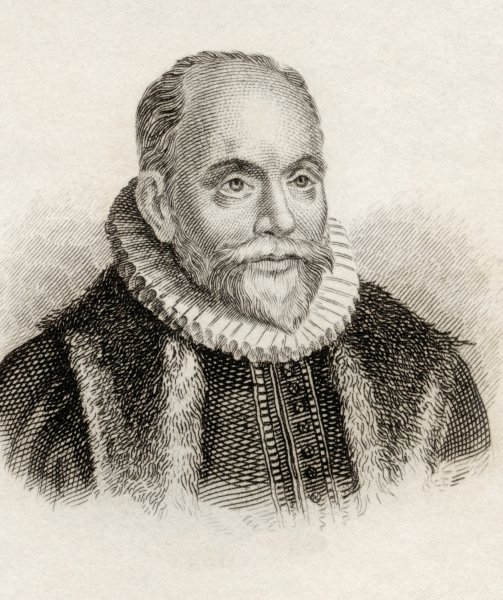
Just because evangelical Calvinism affirms universal atonement some have concluded, or might conclude that we are essentially a sub-set of Arminian theology; if not, at the least, Amyrauldian—but this could not be further from the truth. Evangelical Calvinists, such as myself, follow a thoroughly different prolegomenon (or theological methodology) than what we will find funding the  thinking of Arminians, Arminius, or even the classically Reformed (who take their cues from scholasticism Reformed, and Thomist intellectualism [as did Arminius himself, in a modified form]). I have written on our dialectical approach to theology, and analogy of faith method, with Myk Habets and personally in our 2012 edited book Evangelical Calvinism: Essays Resourcing the Continuing Reformation of the Church.
In order, though, to illustrate my point further let me highlight Arminius’ personal approach to how he thinks of knowledge of God and how that implicates God’s dealing with humanity in salvation in a God-world relation. I will appeal to a rather lengthy section from Richard Muller’s book on Arminius; in this section Muller elucidates Arminius’s appropriation of Molina’s (et al.) ‘middle knowledge,’ and how Arminius used this to foreword his own uniquely styled understanding of God, foreknowledge, predestination, and salvation. What this sketch from Muller should illustrate is how Arminius, much like his scholastic and Reformed contemporaries worked from within a logico-causal mechanistic and deterministic Aristotelian (if not Stoic) understanding of metaphysics (it is precisely this that evangelical Calvinists, following the lead of Barth and Torrance through their respective actualism[s], repudiate).
Muller writes (in full):
This problem, resident in Thomist theology, had become a focus of discussion at the University of Louvain after the publication of John Driedo’s De concordia liberi arbitrii et praedestinationis divinae in 1537. Driedo argued that divine grace and human freedom ought not to be severed in the work of salvation and, indeed, that “the right use of free will, foreknown by God, ought to be the basis for election to the grace of “justification” and that, therefore, predestination could be defined as the divine decree “to call and to aid human beings in such a way as to bring about their obedience.” Driedo found it necessary to distinguish between the prior divine intention to save all human beings which establishes the priority of grace and rests all salvific acts of human beings on the effective movement of God as first cause and the divine foreknowledge of the success or failure of that grace, inasmuch as those who are called do not respond equally to the divine offer of salvation. The ultimate ground of predestination is the divine good pleasure, but this ultimate ground cannot conflict with the divine demand that human beings freely choose to live rightly. Driedo’s views were carried forward by his students at Louvain and were, beginning in 1556, adopted by the Jesuit teacher, Fonseca, as the basis for his refutation of Calvin’s teaching, De praedestinatione, libero arbitrio et gratia contra Calvinium (Paris, 1556). By 1565, Fonseca had provided a full description of the concept of a divine scientia media, prior to the divine decrees and, therefore, having the character of a noncausal knowing, distinct from the categories of scientia necessaria and scientia libera.
It was precisely this ultimately causal character of the divine intellect—that God knows all possibilities and, granting the priority of intellect over will knowingly ordains which possibilities he will actualize—that Molina strove to overcome in his debate with the somewhat radicalized Augustinianism of Bañez and with the Dominican interpreters of Thomas Aquinas. Whereas Thomism generally and Bañez in particular “began with metaphysical principles,” with God “as first cause and prime mover,” Molina began with the problem of the free consent of the will and assumed as his task the explanation of “divine foreknowledge and the action of grace in such a way that the freedom of the will is not explained away or tacitly denied. Molina’s Concordia liberi arbitrii cum gratiae donis, divina praescientia, providential, praedestinatione et reprobatione, published in 1588, argued that God’s foreknowledge of future contingents must be understood not as a knowledge of contingencies created or ordered as such by the direct action of the divine will (and therefore a category of scientia libera) but as a knowledge of contingencies standing prior to “any free act of his will” and resting on a clear and certain knowledge of the act of the creature.
Thus , Molina argues the existence of a divine knowledge or foreknowledge
Mediate between the free and the purely natural knowledge of God by which … God knew, before any free act of his will, what would come to pass conditionally (ex hypothesi) by the agency of the created will in the order of things, granting that he had decided to place these angels or men in a particular situation; if, moreover, the created will were able to do the contrary, by [this foreknowledge] he would know the contrary.
This divine knowledge, therefore, rests entirely upon the acts of creatures. No divine determination enters into the scientia media. Thus, God is capable of foreknowing the way a given creature will act, given certain conditions—and capable, therefore, of acting upon this foreknowledge of future contingents by establishing those conditions accordingly. Molina refers specifically to the statement of Origen that “a thing will happen not because God knows it as future; but because it is future, it is on that account known by God before it exists,” as cited by Aquinas had categorically refused to view the future event as the cause of something in God or as standing outside of the divine causality.
A crucial element, therefore, in the transition from Aquinas’ view to the modified Thomism—on this point, radically modified—of the Jesuit theologians, was the denial of the causal nature of the divine knowing. Molina insisted on the utter omniscience of God and rested the divine foreknowledge of future contingents on the “unlimited perfection of the divine intellect.” In other words, God so utterly knows the entire realm of possibility that, beyond his willing some things to be and other things not to be, God also knows, simply because of his own infinite cognitive powers, the actual results of all contingent causes prior to their actualization. Suárez, whose formulation of the problem Arminius also probably read, chose not to rest his argument purely upon the nature of divine cognition. Suárez argued that God, in foreknowing the nature or character of his creatures, foreknows how creatures will be disposed to act in any given situation, and therefore foreknows with certainty the actual result of a future creaturely choice.[1]
While this represents interesting historiography and theological development relative to the Protestant scholastics (inclusive of the Reformed and Arminius in particular), it should be illustrative of my point which I made to start this post out. Evangelical Calvinism does not think from the type of a priori speculative metaphysics and theory of causation we see funding this sketch by Muller. I don’t really think critics of evangelical Calvinism (if they have engaged at all) get this, not at all. Roger Olsen’s engagement with evangelical Calvinism (i.e. our book) doesn’t get this; Kevin Vanhoozer in his engagement with evangelical Calvinism (in published form) doesn’t really appreciate this (he thinks our appeal to a “Barthian” or “Torrancean” mode of dialogical/dialectical theology does not serve as the pressure valve we think it does). I say this because these critics of evangelical Calvinism continue to try and force us to operate from the type of metaphysics we see funding what Muller just described of the scholastics Reformed, the Molnisits, Arminius et al. But to me this is thoroughly disingenuous, especially if both Olson and Vanhoozer, among others can recognize that we do indeed work from other theological methodological grounds (which attendant to that comes with its own set of self-referential criterion of coherences).
Evangelical Calvinists, at least this one (me), after Barth think from the scandal and particularity of Jesus Christ. Instead of thinking a priori from ad hoc speculative metaphysics and schemata, we attempt to think all things theological from the depth dimension of God Self-revealed and interpreted in Jesus Christ; so we think a posteriori. We aren’t attempting to think out all of these types of abstract causal relations in a tightly wound conception of a God-to-world relation that is informed by a mechanical theoretical conception of causation (from God to humanity). Thomas F. Torrance gets at how an evangelical Calvinist understanding of causation, if we have one, is totally at odds with what we find funding classical Calvinism and Arminianism. Torrance writes:
It is this interweaving of natural processes and human agencies, of nature and rational intention, that gives history its complicated patterns. The course of events has often quite unforeseen results, for human acts may fail to achieve what would have been expected or may achieve far more than would or could have been anticipated. But in our interpretation of history we must never forget that in the heart of historical events there is free happening which bears the intention in which the true significance of history is to be discerned. Thus while we must appreciate fully the physical factors involved, we must penetrate into the movement of time in the actual happening in order to understand the event in the light of the intentionality and spontaneity embedded in it. The handling of temporal relation has proved very difficult and elusive in the history of thought, for it has so often been assimilated to logical relation and so transposed into something very different. The confusion of temporal with logical connection corresponds here to that between spontaneity and causal determinism in natural science. We can see this error recurring, for example, in notions of predestination where the free prius of the divine grace is converted by the scholastic mind into logico-causal relation, while the kind of time-relation with which we operate between natural events is imported into the movements of divine love and activity. It is a form of the same mistake that people make in regard to the resurrection, when they think of its happening only within the logico-causal nexus with which they operate in classical physics.[2]
In other words for the evangelical Calvinist, there are unseen, unknown contingencies built into the nature of things themselves that make it impossible to accurately infer a stable causal chain of events from the event back to the cause itself. The answer to this, in relation to knowledge of God, is to see the event and cause conjoined together in the person-act of Jesus himself. It is from this vantage point that we then are set up to know God, in Christ, but no longer as some sort of deterministic causal agent; but instead, as personal, triune Divine agent who apocalyptically breaks into the contingencies of history re-creating them towards their telos or created purpose in Christ (cf. Col. 1:13ff) — the resurrection, then, being the instantiation of this within time-space history. So we are forced to think from the mystery of God made flesh itself. What this does is to set up a whole other set of questions, ones that have to do with Godself and Christ revealed, rather than abstract speculative questions that cause thinkers to construct the types of theories of causation and metaphysics that we see funding classical Calvinist and Arminian theologies (among others).
I could share more, particularly with reference to how actualism works, at least in my style of evangelical Calvinism. But hopefully what has been shared will allow the reader to appreciate how at odds evangelical Calvinism is with its kissing cousins in the classical forms of Calvinism and Arminianism (and other so construed expressions of classical theistic theology). I know it is tempting for folks committed to the classical metaphysic to force evangelical Calvinists into their conceptual playground, but that’s just simply a dishonest requirement. We all work within and from self-referential coherentist constructs of thought, as such it is appropriate that we recognize that and then test the “coherence” of said frameworks from within the parameters of their own conceptual houses. Having said that, not all conceptual frameworks are equal; I contend that evangelical Calvinism has the capacity to think more responsibly from the implications and conceptual impositions of the Gospel itself, in contrast to what we find in the classical frameworks, which work from a prioris not necessarily related to the God of the Bible or the Gospelself.
[1] Richard A. Muller, God, Creation, and Providence in the Thought of Jacob Arminius: Sources and Directions of Scholastic Protestantism in the Era of Early Orthodoxy (Grand Rapids, Michigan: Baker Book House, 1991), 158-61.
[2] Thomas F. Torrance, Atonement: The Person and Work of Christ, edited by Robert T. Walker (Downers Grove, Illinois: IVP Academic, 2009, 249-50.

 Ironically, and historically, the Arminians, particularly, Arminius himself, weren’t outwith, but within the Reformed halo. As is commonly understood, Arminius was intent on engaging with the theological-anthropological conundrum of human freedom vis-à-vis God’s ostensible sovereignty (as the Calvinists were wont to press in their own stylized way). It wasn’t, of course, that Arminius was attempting to undercut the Calvinist notion that God is sovereign—God forbid it!—but instead, he was challenging the character and way of God’s sovereignty related to human freedom. Jaroslav Pelikan offers nice coverage on this: