Historical Theology as Fundamental for the Theologian’s Task

Something that drastically changed my theological development and life was and is historical theology; I first engaged with it in my seminary Reformation and Patristic theology classes. For the first time (at that point), pieces really began to fall into place for me (including my undergrad Bible College experience which didn’t get into, so much, actual historical detail [just generalities]), and it enabled distanciationĀ for me in a way that allowed for critical space wherein I was finally able to identify the conceptual and historical forces that had brought me to where I was at peanutstheologythat seminal point (i.e. my first exposure to historical theology). What good historical theology does is primarily engage in descriptive detail; in other words good historical theology carefully and slowly attends to reconstructing as accurately as possible how theological ideas formed in various periods and strata of the Christian tradition. Once this step is taken, then we are able to resource the categories and emphases present in whatever period we are looking at, and bring all of those threads into a constructive framework that helps serves the present purposes of the advancement and articulation of the Gospel. What engaging in historical theology also has the capacity for (as I already alluded) is to provide a kind of third party perspective on my (our) own theological approach. In a sense, historical theology can marginalize a theological notion or trajectory that I might think is novel; and it can marginalize in a Ā way that helpfully keeps me from going down a path that might in the end be fruitless, and ultimately a real waste of the time I am supposed to be redeeming. So historical theology can serve as a regulative control on how and what I research, and more prominently it can give me insight into whether or not I am on a fruitful orĀ dilapidated trajectory.

So historical theology is a very important discipline that I think any serious Christian theologian and exegete must attend to. But one danger of historical theology is that we forget that God still speaks. We can get so caught up into listening to the past that we can forget that there is a present. Ā So good historical theology will, in my view, always give way to Constructive Christian Dogmatic Theology. Which means that we will not only soberly engage with the past, but in this sober engagement we will be doing so with a purpose; the purpose is to listen to the living voice of God as it provides continuous communication from the past into the present. And it is this coming into the present by incorporating the voice of God from the past (so theological remembrance, a very biblical motif) into the present that we are able to constructively join in to the diaologic of the voices present in the people of God. In other words, good historical theology, while providing necessary perspective and fruitful lines of thought, should never be seen as an end in itself; and that is because good Historical Theology is framed by a doctrine of God that is understood as Triune and lively. And God Himself, in Christ, ought to be the One who sets the stage for how we go about engaging in the conversation of His people the Church.

And so in the end, obviously, my view of historical theology is that if it is going to be a fruitful endeavor must be understood from a genuinely Christian frame of reference. Good historical theology provides perspective because it is an act of humbling ourselves, and accepting the fact that God has meaningfully (and is) spoken to our brothers and sisters in the past. And since God has meaningfully spoken in the past, this guarantees the integrity of what has been communicated in the past since it is not ultimately contingent upon whatever period God’s voice was spoken in and through; but truly, it is contingent upon the integrity of God’s voice. This is not to deny the various modes, expressions, and periods of history in which this voice was given; but it is to recognize that God has spoken (Deus dixit), and we need to listen whenever He speaks.

*This is a post I originally wrote a few years ago.Ā 

Reading Scripture In the Life of the Trinity, In Theosis

I must admit, ever since encountering Patristic theology and their hermeneutics in seminary (back in 2002) for the first time, my compass for hermeneutical theory began to take a tailspin. And then a little later, as I continued to dig, and engage with Thomas Torrance, Karl Barth, John Webster, Matthew Levering, and even some Puritans, my compass became even more erratic. I was trained, informally, as an evangelical (growing up as the son bible-compassof a Baptist pastor), to study the Bible inductively, and really through the rationalist history of religions school and German higher criticism that sliced and diced Scripture into manageable, and even unrelated pieces. When I entered Bible College (the first time in 1992, and then 1996-97 at Calvary Chapel Bible College, and then finally my alma mater 1998-2001 at Multnomah Bible College) I began to be taught, formally, how to interpret Scripture, again, in a fragmented way, which could only at the end of my Bible study attempt to integrate Jesus into my biblical interpretation somehow. This culminated for me (which at this point looks like it will be my terminal degree), in 2002-03, when I entered seminary at Multnomah Biblical Seminary; I began work on an MA in Biblical Studies, which included course work, crowned with a Master’s thesis paper, which I had to defend in order to earn my MA. I chose to do my thesis paper on I Corinthians 1:17-25, which was an exegetical analysis of that pericope. I successfully defended that in 2003, and earned my MA in Biblical Studies. But what this paper did (100 pages as it was), was demonstrate and illustrate how I used to study the Bible back then; very analytically, inductively, expositionally, verse by verse, and through hermeneutical premises that were and have been largely absent from the bulk of the Christian church. In other words, even though my passage of consideration was about Jesus and the cross, my method of interpretation was not premised, hermeneutically, upon the reality of Jesus and the cross; instead it was premised upon premises provided for evangelical Bible study that were provided for it by people who are not evangelical (historically and even culturally understood), and who might even be antagonistic to the Christian faith. In the end I actually liked what I was able to produce for my Master’s thesis paper (my examiners did too), but I wonder what it would have looked like if it had been given shape under hermenutical pressure that was more intentionally Christ centered?

Is it even possible to exegete under a ā€˜Christ-centered’ and Trinitarian pressure? The early church believed it was possible, and proceeded without apology to exegete the Old Testament as if it was all about Christ; and under the Apostolic mantle provided for that method by the authors of the New Testament themselves. Donald Fairbairn (a Patristics expert par excellence) has just helped me, immensely, to think about this issue once again, in a very helpful and definitive way. My compass has been wandering here and there, hermeneutically, I have been deeply influenced, as I mentioned, by T. F. Torrance, and in particular to this issue, by his book Divine Meaning: Studies in Patristic Hermeneutics; but I have had problems, quite frankly, trying to practically conceive of a way to interpret and apply Scripture in a way that is genuinely Christ centered, hermeneutically, and at the same time, critically available to the tools provided by what might be called ā€˜modern’ exegesis (literary, canonical, historical, etc.). This is where what Fairbairn, in a straightforward and succinct way has helped me with today; he has placed hermeneutics, at least in the way I am appropriating it, within the realm of the Greek Christian understanding of theosis, so in the domain of Christian salvation (soteriology)–this would fit well, in some respects, with Matthew Levering’s idea of participatory history. Let me share the two paragraphs from Fairbairn that have helped and edified me today; I hope they will be edifying for you too:

Roots Of Patristic And Modern Old Testament Interpretation

At this point, we as evangelicals should notice a significant incongruity latent in our situation. We accept (albeit with reservation) a method of biblical interpretation that historically arose among scholars who rejected most of our core convictions about the Bible–that it is from God, that it is a book telling a single story, that its various writings are fundamentally unified, that its central subject is Christ. Furthermore, without giving the matter a lot of thought, we reject allegory as a way of interpreting the Hebrew Bible, a way that is found in the New Testament and that was widely used in the early church, even though that kind of interpretation grows out of the same convictions that we share. It is indeed ironic that when a church father who shares all of our basic convictions argues for a connection between this Old Testament passage and that New Testament reality, we reject his argument out of hand because our masters in the school of modern interpretation (masters who do not share our convictions) have branded such exegesis as allegory. And it is even more ironic that our adherence to a plain-sense, nonallegorical method is so intense that the New Testament itself disturbs us when it connects the Testaments in a way that sounds like allegory to us. We wind up thinking that Paul and Matthew were allowed to handle the Old Testament this way because they were divinely inspired, but surely we must not handle the Old Testament this way.

If we recognize the incongruity I have been discussing, then we should also see that there is more than ā€œmere allegoryā€ going on when the church fathers interpret the Old Testament. In contrast to modern liberals (who might see no unifying theme in Scripture) and in partial contrast to modern conservatives (who tend to organize Scripture around concepts such as the covenant or the dispensations which have governed God’s dealings with humanity), the church fathers tended to see the scarlet thread, the unifying theme of Scripture, as Christ. Again, this unifying theme places the emphasis in a rather different place than we do. We today start with ourselves and ask how God relates to us. The church fathers started with God, and especially with Christ, and asked how we participate in Christ. This is why virtually all of patristic thought saw theōsis–humanity’s becoming somehow a participant in the divine life–as the link between God and humanity. Furthermore, this is why one strand of patristic thought, the one I think is most fruitful for us today, understood theōsis in terms of the Father’s relationship to the Son and saw our participation in this relationship as the scarlet thread of the Christian faith. If one does theology in the way the church fathers did, with the life of the three trinitarian persons at the heart, then one will seek to find those trinitarian persons–especially the preincarnate Son–throughout the Old Testament.[1]

This is the way that T.F. Torrance sought to interpret Scripture (just read his two volumes: Incarnation & Atonement), and it is the way that I personally believe is the most fruitful and edifying way for Christians to engage in as exegetes.

So instead of using dispensations (as I was trained to do), or ā€˜the covenant’ (as people who attend places like Westminster Theological Seminary are trained to do) as hermeneutically regulative for the biblical interpretive process; along with Fairbairn, Torrance, the Patristics, Barth, Webster, Levering and others, it is better, in my estimation, to allow our hermeneutical theory and practice to be established by the One who has given revelation of Himself to begin with; and it is better to practice exegesis from within this relationship, within the realm of ā€˜salvation’ or ā€˜reconciliation’ and ā€˜participation’ in God’s triune life mediated through Christ. Does this mean that we cannot employ modern critical tools while doing exegesis? I don’t think so. But what it means is that we won’t let those tools (whatever they are) be the basis for our hermeneutical theory. In other words we won’t just read Scripture ā€˜as literature’ (because it is more not less than literature, it has a different location from other literature, Ā what might be called ā€˜profane literature’); we won’t just read Scipture ā€˜as history’ (because it is more not less than history, it is where God providentially has interpreted through His Son for us, His life for us, and our life for Him through the vicarious humanity of Christ through Apostolic Deposit); and we won’t, then, read Scripture but within the domain of grace, and in particular faith, which is established by its rule in Jesus Christ.

Ā 


[1] Donald Fairbairn, Life in the Trinity: An Introduction To Theology With The Help Of The Church Fathers (Downers Grove, IL: IVP Academic, 2009), 114-15.

“It isn’t voluntary”: Our Parents, Our History

One thing that really helped me in learning to be a more “critical” theological thinker was to be immersed into the world of historical theology, in particular Reformational and Patristic theology, in my seminary days. Prior to this kind of immersion I felt somewhat aloof, kind of wandering around in a theological smorgasbord wherein I as the informed (because I had earned, at that point, a BA degree with a double major in Bible and Theology and a minor in NT Greek) agent, and ‘Free’ thinking Free church member had all the regal resources of something like the Wesleyan Quadrilateral at my fingertips; I had a kind of relative omniscient capacity to philosophically, and in a suspended kind of disposition, analyze the theological and exegetical options, and by my own voluntary act insert myself into whatever theological trajectory or narrative that I so desired. Okay, I am overstating this a little. My point is to highlight the kind of voluntary nature of my position prior to being introduced to the problematization of that provided by gaining a historical and critical perspective of things.

churchfatherssmall

What I realized as I began reading and studying the developments of the early Christian church (the Patristic era), is that things were so much more dynamic, so much less cut and dry than things seemed to me prior to this engagement. I began to realize that I was part of a continuous move of God in Christ in His church that wasn’t something that was voluntary, but something that was highly intentional and given ongoing eschatological force by the continuous in-breaking of God’s life upon His people; and that by my participation in this move of God in Christ, I had entered into something that was not of my own making, nor of my own decision. I had entered into something that was of God’s making, and of his work, and by entering into this work of His (in His church), I have become attached to a body of humanity that is not our own. In other words, for good or for ill, I have become part of a reality that transcends me, but decisively includes me, in personal ways, in this particular transcendence, in Christ. An implication of this is that in some ways I don’t have a say in what has come before (just as children don’t have a say in who their parents are); I don’t have a say in whether or not I like the fact that part of God’s movement in Christ in His people the church has included decisions, arguments, and subsequent development of grammar that has become known as the TraditionĀ of the church or theĀ Apostolic Doctrine. But for good or for ill, this is the reality; I can kick and scream against this reality, OR, I can engage in dialogue with this reality with hopes of building upon and growing through the nourishment available through this work of God in His church. This does not mean I cannot critically engage with my inheritance, as part of this great continuum and move of God in Christ, but it does mean that I have to recognize that I am not the Master (even if I have a Master’s degree), and I don’t get to say who my ‘parents’ are; they simply are.

I think the thrust of my points here are twofold: 1) We cannot just look over the past and history of the Church as one monolithic blob that has no real import for me today, we have to engage with this blob, and in so doing our own posture will be problematized sufficiently in such a way that we will realize that the past is our present, as we are in continuous dialogue with God through His people, both past and present; 2) More simply, we will gain a proper orientation toward our own and personal theological development, as we realize that the past often critiques our present held beliefs, and at the same time provides new critical and thus fruitful ground upon which to constructively build and engage with contemporary churchly concerns that have real life consequent for our fellowship one with the other.

The Catholic Roots of the Protestant Gospel

I once read a book entitled The Catholic Roots of the Protestant Gospel: Encounter Between the Middle Ages and the Reformation (Studies in the History of Christian Thought)Ā by Stephen strehleStrehle. Unfortunately this title is now out of print (I have access to it still though). And yet even the title itself is provocative a certain reality, even for those who follow the New Paul Perspective[s]. As I recall, Strehle works through some of the magesterial Reformers, like Luther, Calvin, Zwingli, and others; and he highlights how the grammar used by the Reformers was language taken from their Roman Catholic forbears.

The point that I want to highlight though is this: the Protestant movement originally is not what it has become today in Fundamentalist and/or neo-Evangelicalism and theĀ FreeĀ church movement. The fissure present between Roman Catholics (Eastern Orthodox) and the Protestants I don’t think has changed much over time (except for the distance between then and now); especially in regard to conceptions regarding ecclesiology, and then subsequent thinking on salvation. Nevertheless, this notwithstanding, there remains continuity between Protestants and Roman Catholics insofar as the Protestant church is intended to be a reforming movement within the Roman Catholic church and not without it. What recognizing this orientation does, is that it grounds the Protestant heritage in the historic and orthodox faith of the church that finds continuity with the so called ecumenical councils of the church; the councils that gave us the relative grammar for the Trinity, the hypostatic union of Jesus Christ (God-man), etc.

From what I have observed, the Free Protestant church has absolutized the fissure between Rome and themselves (doctrinally) in such a way that not only have they apparently disabused themselves of the idea that the catholic faith is no longer binding, but they have, in general, presumed that the Roman Catholic church is really a totally different belief framework, such that Evangelicals can speak of Catholics as if they are not even Christians, while they as the Evangelical are.

Really all I am trying to suggest is that such a Pervasive Interpretive Pluralism has taken hold in the American Evangelical church, that every interpreter does what is right in their own eyes (even if this means to begin to question the moorings of the catholic faith, which is the Trinitarian faith).

Reflections on Historical Theology

Something that drastically changed my theological development and life was and is Historical Theology; I first engaged with it in my seminary Reformation and Patristic Theology classes. For the first time (at that point), pieces really began to fall into place for me (including my undergrad Bible College experience which didn’t get into, so much, actual historical detail [just generalities]), and it enabled distanciationĀ (critical space) for me in a way that allowed for critical space wherein I was finally able to identify the conceptual and historical forces that had brought me to where I was at that seminal point (i.e. my first exposure to Historical Theology). What good Historical Theology does is primarily engage in descriptive detail; in other words good Historical Theology carefully and slowly attends to reconstructing as accurately as possible how theological ideas formed in various periods and strata of the Christian Tradition. Once this step is taken, then we are able to resource the categories and emphases present in whatever period we are looking at, and bring all of those threads into a constructive framework that helps serves the present purposes of the advancement and articulation of the Gospel. What engaging in Historical Theology also has the capacity for (as I already alluded) is to provide a kind of third party perspective on my (our) own theological approach. In a sense, Historical Theology can marginalize a theological notion or trajectory that I might think is novel; and it can marginalize in a Ā way that helpfully keeps me from going down a path that might in the end be fruitless, and ultimately a real waste of the time I am supposed to be redeeming. So Historical Theology can serve as a regulative control on how and what I research, and more prominently it can give me insight into whether or not I am on a fruitful orĀ dilapidated trajectory.

So Historical Theology is a very important discipline that I think any serious Christian theologian and exegete must attend to. But one danger of Historical Theology is that we forget that God still speaks. We can get so caught up into listening to the past that we can forget that there is a present. Ā So good Historical Theology will, in my view, always give way to Constructive Christian Dogmatic Theology. Which means that we will not only soberly engage with the past, but in this sober engagement we will be doing so with a purpose; the purpose is to listen to the living voice of God as it provides continuous communication from the past into the present. And it is this coming into the present by incorporating the voice of God from the past (so theological remembrance, a very biblical motif) into the present that we are able to constructively join in to the diaology of the voices present in the people of God. In other words, good Historical Theology, while providing necessary perspective and fruitful lines of thought, should never be seen as an end in itself; and that is because good Historical Theology is framed by a doctrine of God that is understood as Triune and lively. And God Himself, in Christ, ought to be the One who sets the stage for how we go about engaging in the conversation of His people the Church.

And so in the end, obviously, my view of Historical Theology is that if it is going to be a fruitful endeavor must be understood from a genuinely Christian frame of reference. Good Historical Theology provides perspective because it is an act of humbling ourselves, and accepting the fact that God has meaningfully (and is) spoken to our brothers and sisters in the past. And since God has meaningfully spoken in the past, this guarantees the integrity of what has been communicated in the past since it is not ultimately contingent upon whatever period God’s voice was spoken in and through; but truly, it is contingent upon the integrity of God’s voice. This is not to deny the various modes, expressions, and periods of history in which this voice was given; but it is to recognize that God has spoken, and we need to listen whenever He speaks.

Conversational [Dialogical] Theology: Being a Catholic Interpreter, with Advice for N.T. Wright

If the Christian life is dialogical, or shaped by conversation with God and His people; which it is (I would argue). And if Jesus Christ, according to Paul, promised that He would build His Church up by providing it with teachers/elders, evangelists, et al (Eph. 4); which He did. And this promise has come to fruition through all of the centuries since Jesus ascended, and into the present; then how can we ignore the fact that the Christian faith, and its self-understanding isĀ catholicĀ (i.e. universal, and reaches across all periods of the Christian church)?

I have learned much through engagement with N.T. Wright, but oneĀ lacunaĀ or gap in his thinking (intentionally so on his part), is his failure to properly or thickly appreciate my point in the paragraph above. His common quip is that the Medieval church (and the early Reformed one) ‘got the right answers, but asked the wrong questions’ in regard to understanding the nature and ontology of Christian salvation. And that this, then, has had a distorting affect upon the subsequent development of the Christian church, since. And so, by and large (other than a head-nod, when he is pressed), Wright waves his hand over this whole period (from at least the 14th century into much of the present time—and he even goes after the ecumenical councils and the Greek Church Fathers), and acts as if he (and in many ways, he alone) can recover Christian truth about salvation, in particular, that had heretofore been lost; as if the gates of hell had prevailed against the Church of Christ, until he (and some of his company) have recently come on scene. Surely this is problematic, and overwrought! I have learned much from Wright, but Jesus has capably and conceptually been forming His church without Wright and our current situation, just as He said He would, through the teachers He has provided His church with through the centuries.

Thomas Torrance offers a better perspective on how to think about the dialogical nature of Christian interpretation and conversation/fellowship with God and His people. You will notice that in what Torrance communicates, he does not denigrate historical studies (which is what N.T. Wright’s discipline is), but gives them their rightful place; but he expands this idea of historical studies out beyond Second Temple Judaism, and into the history of the Church and history of interpretation, as if Jesus really has been offering fresh encounters with His people over all of the centuries of the churches’ existence. Torrance writes:

(iii) It is the combination of historical and ecumenical studies that is particularly valuable. Historical studies are necessary for the understanding of our brethren from another historical tradition, and yet it is only by engaging in conversation with those who belong to a Church that has embodied another historical tradition that we can fully understand the history of the Church. This applies not only to the separated Churches of the Evangelical world, but to the relations between so-called “Evangelical” and so-called “Catholic” Churches, between East and West, and indeed between the people of the New Covenant and the people of Israel who persist in living only according to the Old Covenant. It is thus that theological activity is enabled as fully as possible to engage still in conversation with the fathers of the Old Testament, with the Greek and Latin fathers of the ancient and mediaeval Church, and with the fathers of the Reformation in all its branches. We have to take very seriously the requirement of God to appear before Him, and to engage in conversation with Him, not alone, but with the whole company of God’s people past and present. It is thus that it belongs to the very nature of theology to be essentially catholic, and it is enabled to be that by historical and ecumenical dialogue with the fathers and brethren alike. [Thomas F. Torrance,Ā The School of Faith: The Catechisms of the Reformed Church,Ā lxviii-lxix.]

It is clear how Torrance thinks about this then. And I think it is much more of a healthy and balanced alternative than the sense that N.T. Wright often portrays in his own thinking. Ironically, I would note, Wright does not actually move away from the classic redemptive-historical-soteriologicalĀ mode of Reformed-covenantal exegesis; instead he simply reorients it, by re-shaping it, a bit, through his historical reconstructive work of Second Temple Judaism. So he hasn’t really asked new questions from the Reformers, he has simply come up with new answers, albeit largely in the same ecclesio-soterio/centric frame that many of the ‘Reformers’ were working through.

The difference that Torrance offers, from Wright, is that he grounds his dialogical approach to theology/hermeneutics in a doctrine of Christ/God; which has to be the hermenutical order we follow. We must follow a Christ-centered hermeneutic as the key to providing the proper frame through which the right questions can finally be asked. As Torrance also writes of the best of the Reformed tradition:

[…] It is in that light that the Reformation as a movement for theological reform is to be understood, that is, as a thoroughgoing criticism of all the received doctrines in the light of correspondence to the Gospel and coherence with the central doctrine of Christ, and a radical reforming and correcting of theseĀ doctrines by bringing them into obedient conformity to the doctrine of Christ. It was in that movement of faithfulness to Christ and His Gospel that Reformed theology came to understand both the nature of true theology and the nature of its systematic presentation through consistent obedience to the Truth as it is in Christ Jesus. [Thomas F. Torrance, “The School of Faith,” lix-lx.]

So it isn’t that Torrance, like Wright, is receiving medieval categories and thought forms uncritically; it is just that Torrance (unlike Wright) is critically ‘receiving’ the history of Christian thought by submitting it to the reality of Jesus Christ Himself. So the methodology is a principled Christological one, and one that is in constant flux as it is given fresh voice through conversation with God in Christ by the Spirit. We don’t need to toss the whole thing and start over (which is often the impression that comes across through Wright), but we need to be in submission to the Lordly voice of the Christian heritage and present, in a way that we operate, as Torrance would say, with ‘repentant’ thinking; Jesus’ voice, the voice of the living God, being that which regulates our reception of His voice given in the past through and to His people. So as in dialogue, healthy ones, this is an ongoing reality.

classical Calvinism juxtaposed with Affective Theology: Comparing and Contrasting William Perkins and Richard Sibbes

*This is a repost that I am sure almost none of you have read. I am feeling pretty undermotivated to write blog posts at the moment, so this will have to suffice. I have added a caveat to this post in an addendum at the end of the post. Don’t worry I have fresh posts coming (I always do), but I would imagine that for most of you this will be quite fresh (meaning that this will be the first time you have ever read this post, so it might as well be a new post.

puritans12

The following is a lengthy quote highlighting the differences between Federal [Classic]Ā Calvinism and Free-Grace Calvinism [Affective Theology]. William Perkins represents the Federal “Vision” side, while Richard Sibbes the “Free-Grace” perspective. The quote is taken from Ron Frost’s unpublished PhD dissertation on Richard Sibbes and English Puritanism. He is providing conclusion to a discussion he had previously undertaken where he had articulated, in detail (with bibliographic support), the disparate “covenantal approaches” reflected by Perkins and Sibbes. The primary disjunction between the two is how they framed the Adam-motif (i.e. first and second Adam theology, see Rom. 5, etc.); and the different trajectories this placed their soteriological outlooks upon. Perkins forwarded the “Federal” model, which assumes continuity between the “law-keeping” of the first Adam and second Adam (i.e. think “Covenant of Works”); while Sibbes forwarded the “Marital Mystical” construct, which assumes some discontinuity between the “two Adams;” viz. while Christ truly represents us before the Father (juridical–i.e. forensic or legal), He also takes us as His spouse, which is presupposed by a real union with Him. The main difference, then, between Perkins and Sibbes, according to Frost, is that Perkins framed salvation purely as legal and “juridical”, which did not assume a “real union” with Christ; while Sibbes framed his view, not just as legal, but beyond that, as a Marriage framework, which is presupposed by a “real union” with Christ.

A Brief Glossary of Terms: **Privative Sin = the privation or absence of God’s righteousness [negative definition of sin] — **Positive Sin = Self love vs. God’s love.

Enough said on my part, lets hear from Frost:

Some final observations may be made about the positive and privative views of sin. The two approaches differ fundamentally on the reason for sin; while man is identified as responsible for sin in both views, he tends to be portrayed more as a pliable innocent overcome by the serpent’s deceit in the privative model. It is Adam presented as inadequate, not because he was unable to fulfill the law, but, because, in his mutability as a creature, he was vulnerable to moral change. This the serpent exploited while God was willfully away. In scholastic terms, the formal cause of sin was twofold, given the double causality associated with God’s sovereignty. God, as the primary agent for all things, determined the outcome by his withdrawal. In this he was arbitrary but just. The second agent, Adam, failed to apply the grace he had available and thus was culpable for his own fall, albeit as something of a victim. In both considerations the issue of grace is pivotal in its absence. For the privative model, as seen in both Thomistic and Reformed theology, this leads to a greater emphasis on the acquisition and application of grace in hypostatized or commodity-like terms, and a tendency toward Aristotelian moralism — the establishing of one’s righteousness through righteous actions based on grace. To the degree that grace becomes an impersonal quality, the greater the impression one has that something worthy of appreciation, if not merit, is being accomplished.

The doctrine of positive sin, on the other hand, rejects any tendency to see man as a victim; Adam is always the culprit in that he willfully replaced the Creator with the creature as the object of absolute devotion. It also recognizes human mutability as a fact which allows the fall, but rejects it as a meaningful explanation. The fall, in positive sin, remains an impenetrable mystery; Adam is not portrayed as deceived and God is not portrayed as withholding grace. In the positive model sin is always a competition: Adam seeks to usurp God’s role while God confounds Adam’s autonomy.

Thus, the most important difference between the two models is found in the way God is portrayed. In the privative view, as Aquinas and Perkins have it, he remains a supplier of grace — withholding what is needed for salvation except to the elect. He even remains parsimonious to the elect but, as their efforts prevail, is increasingly generous. In the positive view, on the other hand, he is an enemy until conversion which comes by the Spirit’s direct intervention. He invites the elect to see God as he really is: righteous, strong, and loving. Conversion, in fact, is a litmus for the two views: the privative model generally adopts a catechetical process which culminates in an affirmation of faith. The positive model, while recognizing that the Spirit uses prevenient stirrings, expects a more distinct Paul-light conversion which displays the moment in which selfish autonomy melts before God’s self disclosure. For the one, nature remains very much in view; for the other, God, once unveiled by grace, dominates the scene.

The importance of the affections for Sibbes and the nomists differed in profound ways. For Sibbes the affections were both the avenue by which sin entered the world and the avenue by which God, through the Spirit, restores the fallen soul. Slavery of the will was seen to be an enslavement by one’s own desires, something broken only by transforming vision of God as more desirable than anything human autonomy offers. Perkins and the nomists, on the other hand, saw the affections as a subordinate element of the will; they also provided a suitable theology for the prominent will by adopting the Thomist privation-enablement model of sin and grace.

Perkins and the nomists thus established human responsibility as the center-theme of salvation; the moral law became the locus of the soul in the process of sanctification. The belief that the covenant of grace is essentially a legal contract shaped all spirituality into a restorative stance: life is seen as an effort to regain and sustain Adam’s original obedience through the Spirit-enabled will. This generated a Christology which emphasized the juridical work of Christ to the point that, for pastoral ministry, the purpose of restored communion was easily reduced into the preaching of moralist endeavor.

Against this view, Sibbes, in line with Augustine, emphasized the place of Christ as much more than the source of justification, but primarily as one to be loved. The promise of the indwelling Spirit, whose ministry in Christ’s life is now allocated to the Christian, gives promise of a greater hope than the nomists offered: full and eternal intimacy of the Godhead through a true, although mystical, union with Christ. The feet of the soul are the affections and the affections are meant for communion with God. (Ron Frost, “Richard Sibbes’ Theology of Grace and the Division of English Reformed Theology,” [unpublished Ph.D. dissertation, 1996 University of London Kings College], 94-96)

I realize this was quite long, but if you made it to this point, great! I really appreciate Sibbes’ approach, and find it to be much more scriptural. Hopefully you noticed some of the discontinuity I alluded to earlier. For Sibbes in the second Adam (Christ), we go beyond what the first Adam had with God. For Sibbes, we are brought into the very life of God, through Christ; for Perkins we enter a quid pro quo contractual relationship with God . . . likened to the first Adam’s relationship with God (this is Covenant theologies’ Covenant of Works).

If you have any questions then please let me know, I will do my best to answer them. There are quite a few quotes I would like to share from Sibbes, provided by Frost which he used to support what his conclusion, above, summarizes so neatly–maybe another time. I wish I could just tell you to go buy Frost’s dissertation at Amazon, but unfortunately it was never published. Anyway I hope some of you find this helpful.

Addendum:Ā I wrote this post before I was exposed to Thomas Torrance and the idea of the vicarious humanity of Christ, and a ‘Christ conditioned’ way. But this is an example of the kind of stuff that I will bring into conversation with the themes we have been articulating through evangelical Calvinism.

Addendum1:Ā I really like what Sibbes has to offer (as mediated through my mentor Ron Frost). But here is the area that I plan on bringing into constructive conversation, in regard to the way Frost construes Sibbes’ Augusintianism; read:

[A]gainst this view, Sibbes, in line with Augustine, emphasized the place of Christ as much more than the source of justification, but primarily as one to be loved. The promise of the indwelling Spirit, whose ministry in Christ’s life is now allocated to the Christian, gives promise of a greater hope than the nomists offered: full and eternal intimacy of the Godhead through a true, although mystical, union with Christ. The feet of the soul are the affections and the affections are meant for communion with God.

It will be to simply bring together the person and work of Christ; instead of dualistically locating the ‘indwelling Spirit’ in elect individuals (as Sibbes does), I believe it ought to be located in Christ’s vicarious humanity for us (pro nobis). I think the ChristologicalĀ isĀ the Soteriological, that RevelationĀ isĀ Reconciliation, and so I think Sibbes offers an excellent way forward, but that he needs a little help in being a little more radical and Christologically personalist by thinking from the humanity of Christ, and all of the beautiful bridal language and framing that is attendant (and rightly and biblically so) prior to thinking of the rest of us. I actually don’t think my proposal here will be that difficult to develop. Whereas Torrance was about personalising classical (Federal) theology, or as Leithart might say, ‘evangelising metaphysics’, I think it is even better if we follow the “classical” trajectory available from someone like Sibbes (and marriage mysticism), and do the same as Torrance was doing with Federal theology; that is, to ‘Christify’ it, or place the marital framework of Sibbes (Luther, Bernard, the Apostle Paul et al) into a dogmatically rich Christ conditioned frame.

So now you know further what I will be attempting to do.
 

The ‘thing’ Is Historical Theology

You know the ‘thing’ in my last post, it is going to be a let down for you, I am sure! But it isn’t for me. The ‘thing’ that changed my life (other than Jesus, of course!), that I am referring to isĀ Historical Theology.Ā Until I entered seminary I had never really engaged with historical theology, except for working through some Church History (which is different). My exposure level, before seminary, from my Bible College undergrad experience was to augustine1Systematic Theology, which came from Millard Erickson; so my experience was rooted in Analytical-Evangelical-Systematic-Theology. But I had never really dealt with the history of ideas, or even much of the history of interpretation, when it comes to biblical exegesis. Seminary, and Dr. Ron Frost were the turning points for me. It was this exposure that opened me up to the wonderful reality that there is actually a development behind the Calvinist/Arminian debate; it was anĀ exhilarating thing to understand that there was a richness to the Christian faith and heritage that before this exposure I never knew really existed. And so it was this turn in my life that literally changed everything for me (and this is no overstatement). I became open to the teachings of Thomas Torrance (and his Trinitarian theology, in particular) and Karl Barth because I first became a student of Historical Theology. I would never ever have been able to appreciate Torrance and/or Barth without first having the exposure that I did to the development and history of ideas that I did, through the discipline known as Historical Theology.

Some books that kicked all of this adventure into historical theology off for me were:

Steven Ozment’sĀ : The Age of Reform, 1250-1550: An Intellectual and Religious History of Late Medieval and Reformation EuropeĀ (We used this book for the main text of my Reformation Theology class).

J. N. D. Kelly’s: Early Christian DoctrinesĀ (We used this for my Patristic Theology class).

Geoffrey Bromiley’s:Ā Historical Theology: An IntroductionĀ 

And these were just some starters into this wonderful world! I hope, if you haven’t, that you will expose yourself to the cultivation of doing Historical Theology in your own life. I have somewhat neglected it over the last couple of years (because I have been reading Torrance and Barth etc. so much, and other things were going on), but I fully intend on remedying this in the days to come. And so my blog ought to start to reflect this. To be sure I will still be reading and quoting TFT, and Uncle Barth (as Jason Goroncy refers to him); but I want to get back into the discipline of Historical Theology in a much more intentional way. To kick this off I am rereading Ron Frost’s doctoral dissertation on Richard Sibbes and English Puritanism (which deals with Augustine, Luther, Calvin, Bernard, et al.), and I also plan on publishing (here at the blog) a proposal that I mentioned on Facebook last night that involves bringing some of the themes that Frost has identified with those articulated by Torrance and Barth. So a bringing together of the Scottish Theology that Torrance has noted (and developed in his own theological project), with some of the shared impulses that were similarly being engaged from within English Puritanism (and from one side of that reality). It will be interesting, because what this is really going to be doing is placing Augustine and Athanasius into conversation with each other, and through some of their primary interpreters and readers. Stay tuned.

‘From’ Christ, not ‘For’ Christ: “Why don’t you have a category for obedience?”

I have lots of people email (instead of comment) me about my various posts here at the blog. Recently I received an email from someone who wondered why I didn’t have a category (in my categories for the blog) designated as “obedience”? I haven’t emailed this person back yet, but I thought before I did that I would respond to this rather interesting observation here at the blog first (it seems fitting for me to do so).

adam-eve-garden-of-eden-1To start with, I do have a category entitled “ethics,” which deals with issues and instances of concrete instantiations of Christian obedience (or disobedience); and then I do deal with Christian obedience in many posts, but they aren’t under a specific category of “obedience,” but instead those can be found under the category of “salvation” (and then a lengthy process of weeding through this posts will ultimately yield results that show I have dealt with questions that are oriented around Christian obedience). But I would like to answer this question with more particularity, and clarity on why my blog does not emphasize this category (as important as it is!). My blog does not emphasize this category (in the way my interlocutor is wondering, I presume) because the way I think of our relation to God in Christ, has Christ in the way; and I mean in the way of you and me (logically, theo-logically). Historically, and classically, Evangelicals (given their hybrided dependence upon Reformed/Covenant theology) have emphasized relation with God through a mode of emphasizing law-keeping conditioned by forensic categories of thought (just read an Evangelical systematic theology if you don’t believe me). And insofar that I have eschewed this classical mode, I have abandoned emphasizing law-keeping (code for ‘obedience’, usually) as the emphasis by which I understood relationship with God, and how I conceive of Christian holiness (or obedience as its subsequent expression). To provide an example of where the Evangelical heritage comes from, theologically, in this regard; let me quote Kim Riddlebarger (a contemporary advocate of Covenant Theology, and member of the White Horse Inn radio broadcast, along with Michael Horton), as he sketches the original and lasting relationship and way that he (and the classically Reformed) think of how God and man (God/world) relate to each other through the Covenant of Works (or Creation):

[A]s redemptive history unfolded, the first Adam—the biological and federal representative of all humanity—failed to do as God commanded under the terms of the covenant of works. The Lord God said to Adam, “You must not eat from the tree of the knowledge of good and evil, for when you eat of it you will surely die” (Gen. 2:17). This covenant of works or, as some Reformed writers speak of it, the “covenant of creation” lies at the heart of redemptive history. Under its terms God demanded perfect obedience of Adam, who would either obey the terms of the covenant and receive God’s blessing—eternal life in a glorified Eden—or fail to keep the covenant and bring its sanctions down upon himself and all humanity. Adam’s willful act of rebellion did, in fact, bring the curse of death on the entire human race. This covenant of works is never subsequently abrogated in the Scriptures, a point empirically verified when ever death strikes. This covenant also undergirds the biblical teaching that for any of Adam’s fall children to be saved, someone must fulfill all the terms of the covenant without a single infraction in thought, word, or deed (Matt. 5:48; 1 Peter 1:16). [Kim Riddlebarger,Ā A Case for Amillennialism: Understanding The End Times,Ā 47.]

Much could be said in critique of this conception of things (and I have already said much, just check my category “critiquing classical Calvinism”), but in order to not get side-tracked from the point of this post, let me stay particular to my intention. In predictable form (since Covenant theology has Creation preceding Covenant), Riddlebarger allows Creation to condition Covenant instead of seeing Covenant (God’s life of gracious love) conditioning Creation (one serious fall out of this theological ordering is that Jesus becomes conditioned by creation instead of conditioning creation himself asĀ homoousion—I digress!). In other words, when Reformed thinkers like Riddlebarger, and his whole tradition, start theologizing and biblical exegeting they start where Riddlerbarger starts, with Law (or the Covenant of Works/Creation). And yet, as Ray Anderson has highlighted (along with others), what should be understood (first), is that God spoke and created (which is an act of grace as corollary with His overflowing life of Triune love). So what grounds any relation with God, first, is not Law-keeping, but the fact that God spoke (which is grace)! This might seem to be a subtle shift, but it is profound!

Following this shift of emphasis, what becomes primary is not my personal obedience (and Law-keeping), but God’s in Christ for us. As Thomas Torrance has written (as I just quoted this in a post below this one),

[…]Ā Under the gracious impingement of Christ through the Spirit there is a glad spontaneity about the New Testament believer. He is not really concerned to ask questions about ethical practice. He acts before questions can be asked. He is caught up in the overwhelming love of Christ, and is concerned only about doing His will. There is no anxious concern about the past. It is Christ that died! There is no anxious striving toward an ideal. It is Christ that rose again! In Him all the Christian’s hopes are centred. His life is hid with Christ in God. In Him a new order of things has come into being, by which the old is set aside. Everything therefore is seen in Christ, in the light of the end, toward which the whole creation groaneth and travaileth waiting for redemption. The great act of salvation has already taken place in Christ, and has become an eternal indicative. [see full textĀ here].

This does not mean that personal obedience is not important, but it frames it in a way that allows me to keep my eye on Christ instead of first looking at myself (and then reflexively looking at Christ: i.e. reflexive faith], as if I, myself, can somehow be abstracted out of the only true humanity which is Christ’s. So I “seek first His kingdom and righteousness, then all these other things will be added unto me” (and I only seek first, because He first loved (and sought) first that I might love Him, through Him by the Spirit). My relationship with God is not dependent upon my obedience, but Christ’s obedience for me (us); and so this ought to go along ways in illustrating why I don’t have a separate category (apart from Christology) for obedience in my sidebar. Thomas Torrance in his (posthumously published) bookĀ Atonement: The Person and Work of ChristĀ really captures the import of this shift and way of framing things from God’s gracious Self directed life for us in contrast to the Legalistic emphasis that the classical Covenant of Works flows from:

(iii) The holiness of the church is its participation through the Spirit in Christ’s holiness

Ā This holiness is actualised in the church through the communion of the Holy Spirit. He only is the Spirit of holiness, he only the Spirit of truth; and therefore it is only through his presence and power in the church that it partakes of the holiness of Jesus Christ. Since the holiness of the church is its participation through the Spirit in Christ’s act of self-consecration for the church, then that is the only holiness, the only hallowing of the church there is. That is the holiness which was actualised in the church when it was baptised with the Holy Spirit at Pentecost and the union of the church with Christ was fulfilled from the side of the church as well as from the side of Christ.

The church is not holy because its members are holy or live virtuous lives, but because through his presence in the Holy Spirit Christ continues to hallow himself in the midst of the church, hallowing the church as his body and the body as his church. Thus the true holiness of the members is not different from this but a participation in it, a participation in the holiness of Christ the head of the church and in the holiness of the church as the body hallowed by Christ. Participation in this holiness however involves for the members of the church a life of holiness, just as it involves a lifeĀ in Christ,Ā of faith relying upon his faithfulness, of love that lives from the overflow his love, of truth that comes from the leading of the Spirit. Because the church is the body of Christ in which he dwells, the temple of the Holy Spirit in which God is present, its members live the very life of Christ through the Holy Spirit, partaking of and living out the holy life of God. Therefore personal holiness, and all the qualities of the divine life and love found in their lives, are the fruits of the Holy Spirit. [Thomas F. Torrance,Ā Atonement,Ā edited by Robert Walker, 386-87.]

There is a lot to comment on here as well, but I must limit myself. I will just say that it is this reversal of things (i.e. placing the Covenant of Grace [God’s life Pre-destined]) from Law to Grace that explains why I don’t have a category explicitly labeled “obedience”. It isn’t because I don’t think Christian obedience is important, it is because I think the gr0und of this emphasis is roundly rooted in Jesus Christ for us (and thus I have a category for Christology instead). It isn’t that I don’t think personal obedience or holiness are important, I do! Instead, it is because I am persuaded that focusing on Christ and God’s Triune life of gracious love, and participating in that from the Spirit’s unioning activity will produce obedience and the life of Christ through the members of our bodies as they are constantly given over to the death of Christ that His life might be made manifest through the mortal members of our body. We obey, only because Jesus obeyed for us first. We don’t obey to ensure that we are one of the elect that God purchased from the mass of “perdituous” humanity; we obey because God loved us first that we might love Him back through the mediating and priestly Spirit anointed humanity of Jesus Christ. It is only through this framing of things that I feel I can live out this exhortation from St. Paul:

Ā It is for freedom that Christ has set us free.Ā Stand firm,Ā then, and do not let yourselves be burdened again by a yoke of slavery. ~Galatians 5:1

Without the freedom of God for us in Christ I live under a burdenouss yoke that really ends up being hell; which, I am pretty sure this is what Jesus came to save us from (ourselves), and for Himself (and His shared life in the Monarchia or God-head). So obey, but only from Christ by the Spirit, not for Christ so you can find God’s approval.

A Boring Post: Are Evangelical Calvinists more ‘Scholastic’ than the Scholastics of Today?

This post will probably be a little boring for most; but hey, I’m boring (I guess you’ll have to read it to find out).

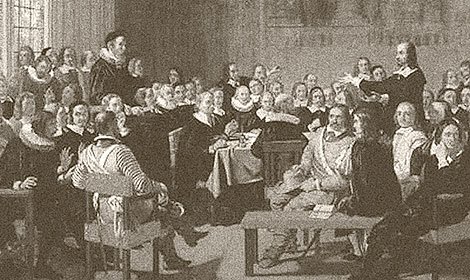
Jon Hoglund (a PhD student at Wheaton College) recently wrote a review of Richard Muller’s newly released bookĀ Calvin and the Reformed Tradition: On the Work of Christ and the Order of SalvationĀ (which now I must read). westminsterassemblyIf you have read me for more than a few years, you will quickly recognize Muller’s name; I have engaged with Ā him quite frequently in the past—here is the Muller category (from my blog) to prove it, and this post (Let Historians be Historians, & Theologians be Theologians) in particular anticipates the gist of this current post (which illustrates that I have been thinking about this error of Muller and others for awhile). Also in line with all of this; I used to engage with R. Scott Clark (a faculty member at Westminster Theological Seminary california), when he had his blog (before the elders of his church apparently made him take it down—at least that’s what I heard happen). I used to challenge Clark on the grounds that I will be speaking of in this current post; that is, that simply reconstructing the history of the Reformed period (i.e. doing genetic and genealogical work in the area of history of ideas and Reformed theology in particular) does not materially undercut contemporary theologies of retrieval that seek to constructively appropriate various themes, motifs, and foci presented by said period of theological development.Ā 

Getting back to Hoglund’s review of Muller’s book; what really makes it interesting, is that he actually references me and Myk and our book (and the ‘mood’ that Myk and I, and the authors who make up our edited work are advocating for), and Evangelical Calvinism (in a somewhat derisive way (I say this because as you will read there seems to be a negative underlying presupposition behind Hoglund’s rhetoric implying that we haven’t actually engaged Calvin or the Reformed tradition on its own material and even formal grounds), relative, again, to this notion that because Muller has written a work of history that anyone who appeals to Calvin must only appeal to Calvin’s theology through Muller’s authoritative reconstruction of him … i.e. story over, Hoglund and others think). Here is what Hoglund wrote:

The great contribution of this book [Muller’s] is to refocus study of Reformed orthodoxy on the exegesis from which dogmatic formulations sprung. Muller’s use of example expostions [sic] of biblical texts presents a fruitful approach to understanding these early modern theologians. Muller’s reading of the early Reformed presents a direct challenge to contemporary movements likeĀ Evangelical CalvinismĀ that appeal to a particular narrative of Calvin and Reformed orthodoxy in order to explain their own position.Ā Anyone who makes claim to the 16th century Reformed traditon [sic] for a doctrine of salvation needs to be familiar with this book.

Myk registered a great comment in response to Hoglund’s review, and critique of us (and also in defense, somewhat, of both Charles Partee and Julie Canlis, who Muller apparently goes after as Calvin scholars who don’t really “get” Calvin [not like Muller & co. do]—both Partee and Canlis are contributors to our book!); and then I followed suit. Myk threw it down in his comment (which was very nice to see!), and challenged Muller & co. the way Muller and family ought to be challenged; that is, if you want actually challenge Evangelical Calvinism, and people who Myk and I would associate with that; then you are going to have to do more than historical work. You see, Myk and I are more concerned withĀ CONSTRUCTIVELYĀ retrieving and engaging with the Reformed voices of the past (inclusive of Calvin, Barth, Torrance, and many others),Ā THEOLOGICALLY.Ā As I noted above, it won’t do to simply do historical work (like Muller, Clark, et al), and then believe that you have undercut or engaged with the material proposals we are putting forward, working from within the Reformed mood as we are.

Ironically, I have just picked up a book I have engaged previously; it is entitledĀ Scholasticism Reformed: Essays in Honor of Willem J. van AsseltĀ (of which Muller and Carl Trueman are contributors—of course!). I was just reading the first chapter this morning written by Martijn Bac and Theo Pleizier, entitledĀ Teaching Reformed Scholasticism In The Contemporary ClassroomĀ (exciting stuff, eh). I say ironically, because as they outline how scholasticism should be taught today in theological classrooms, they develop how scholastics of the past retrieved authoritative voices for their own material and theological purposes. They highlight, interestingly, that the scholastic mode of retrieval is very much so like ours (as far as methodology, not conceptually, ultimately) (and not like Mullers, Trueman’s, Clark’s et al). That the concern, more than simply reconstructing the history of ideas and theological development; was to engage the concepts of said voices by appropriating themes and motifs that fit their broader concerns to forward the cause of theological truth. In other words, the greater concern was to organically move within the trajectory and mood set out by the past in order to constructively engage the present and future by developing the ideas of these past voices by placing them within the burgeoning and developing movement of Reformed theology (hey, that’s what we are about “Essays Resourcing the Continuing Reformation of the Church”Ā semper reformanda). Here is what they wrote in regard to the scholastic method, and what was called ‘reverential exposition’:

[R]eformed theologians did not read their sources of Scripture and tradition in a historical sense, i.e., as part of an ongoing tradition, but rather as ‘authorities’ of truth. Until the breakdown of scholasticism and the historical revolution, sources were not quoted in a historical way, be they the Bible, Aristotle, Augustine, or Thomas Aquinas. A quotation did not indicate a correct historical understanding of what its original author had meant, but was read systematically as bearer of truth. From this it follows that contradictions among authorities were solved logically rather than hermeneutically. (p. 39)

I find it highly ironic that people like Muller (Hoglund), and others, would critique Myk, myself, and Evangelical Calvinism (and others who could be so associated) for imbibing the ‘spirit’ of even the post-Reformed orthodox faith (methodologically) more than their apparent heirs (Muller & co.). Although, I would not go as far as to say that we are not sensitive to the importance of getting history right; but we are even more concerned with the ‘truth’ and ideas that were presented by various voices of the past (esp. Calvin’s). If there are themes and motifs present in Calvin (like his union with Christ theology) that are open for further development; then what is wrong with seeking to develop that motif in a way that situates it within a continuing development of this theme from within a Reformed trajectory?

Here is one more example of how these authors, Bac and Pleizier, develop this idea of reverent exposition:

[T]herefore, these texts had to be explained with reverence (exponere reverenter), that is, not in historical conformity with a tradition or with the author’s expressed intention but in conformity with truth, i.e., reverently denoted in correspondence with established theological and philosophical truth. This method of reverent exposition involved a hermeneutical procedure that went back to the patristic period. To be sure, there was room for some exegesis but, as de Rijk has noted, the scholastics used the hermeneutical norm of objective truth (of the debated subjects:Ā veritas rerum) in addition to a kind of philological exegesis employing semantic criteria for interpretation. This resulted in an incorporation of the authoritative text into one’s own conceptual framework. [Scholasticism Reformed,Ā p. 40]

So the scholastic methodology was not about repristinating and absolutizing a period as the norming norm, but it felt the freedom to fluidly engage with the past in a way that had relevance for the present; and in a way that organically built from the trajectory provided for in the past. Or, as Barth would argue (in Ā his ‘The Theology of the Reformed Confessions’) to operate within the ‘spirit’ of the Reformed faith (subordinate to Scripture and thus always reforming), and not the ‘letter’, which is to appeal to a sort of repristinated procrustean bed of perceived static truth that can simply be inherited but not developed in any kind of new or meaningful way.

In summary, I would simply want to suggest that Evangelical Calvinism is actually imbibing the spirit of the Reformed faith even more so than those who are most visibly associated with the Reformed faith today (Muller & co., and others). And our mode is to primarily engage the past (Calvin and the crew) constructively with the goal of engaging the truth which transcends (but does not elide) the historical situadedness of particular people, simpliciter); but at the same time, doing so in a way that is seeking dialogical engagement with the past in order to provoke the present with themes that most magnify the name of Jesus. If Muller and company want to critique Evangelical Calvinism (and those of like mind), then they will need to be truly scholastic in form, and not just historians.