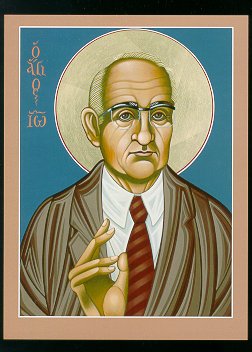
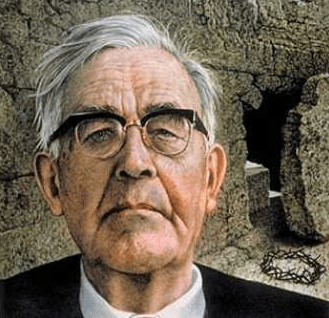
Christian Knowledge of God, John Knox and Thomas Torrance

In commenting on Evangelical Calvinist, John Knox’s understanding of God; Thomas Torrance offers a profound statement of what all of this entails:

[K]nowledge of the one and only God, as far as it is true knowledge, enshrines the mystery of God, and so is confessed and acknowledged as God eternal, infinite, immeasurable, incomprehensible, omniscient, invisible. This God whom we know cannot be fitted into our knowledge. God cannot be commanded by our reasons — cannot be comprehended by our minds. It is certainly to our minds that God reveals himself but only in such a way that he remains eternal, infinite, incomprehensible, etc. Knowledge of God cannot be put into precise words. God’s majesty defies definition or description — all theological language is apocalyptic in so far as it is genuine. That is true above all of the Trinity — knowledge of this God is infinitely open. Thus in faith the human reason is opened wide to the infinite and incomprehensible being and majesty of God as the Father, the Son and the Holy Spirit. [Thomas F. Torrance, Scottish Theology: From John Knox to John McLeod Campbell, (T&T Clark: Edinburgh, 1996), 6 — A review copy provided graciously by T&T Clark]

You will quickly notice which direction Torrance believes knowledge of God comes from; not from our epistemological schemas, but from God to us through Christ and into the Triune life of God himself. This approach to knowing God runs against the construing God from thinking of him through his works in creation or something. Or trying to find analogies in creation, or in humanity that in latent ways allow us to think and speak about God. No! Knowledge of God for Torrance, and as he would contend, John Knox, is a gift from God in Christ for us through the Spirit. There is never one-to-one correspondence between our theological language and God’s being. Instead, theological language is something that is constantly given to us anew as God continues to break in on our world, on our conceptions; and re-orders and re-orientates our grammar in a way that puts to death anything we had conceived of prior to this encounter in Christ. He provides a ground for knowing him that is completely out of this world (but decidedly and concretely in this world); the God-Man. He presents us with concepts that breaks up and re-orders our imaginations in ways that place us upon the precipice of heaven’s throne; Ezekiel knows what I’m talking about.

Just a little reflection . . .

Knowing God: Being versus Faith

I have recently been having a discussion with someone that has revolved somewhat around what has been called the analogia entis or “the analogy of being.” My book chapter for our forthcoming book also orbits around this same place of discussion. The “analogy of being” was first given cogent articulation by medieval theologian par excellence, Thomas Aquinas. Since Thomas there have been other iterations of this same basic approach to knowledge of God. In its most basic form the “analogy of being” canย be said to be a way of knowing God that looks to the creation for providing basic building blocks for entering into an understanding of God. In other words, reality is seen in hierarchical terms so that all of reality is interconnected in a way that allows for humanity to reason its way back or up to the “Unmoved Mover,” or God. Another way of explaining the analogy of being would be to note that it is a philosophical system of thought wherein man reasons from the effects of creation to what the cause of said effects must require in order for the cause to be the cause. In other words by a series of negations man looks at creation, reflects upon what kind of power it must have taken to accomplish the feat of creation; looks at man himself, identifies that man does not have this kind of all encompassing, power, knowledge, and foresight thus positing that what they are, the cause of creation must not be. Instead the cause of creation must be much much greater than humanity. This then provides the categories for how we ought to conceive of God (according to the analogy of being).

Karl Barth, of all people, did not agree with this approach; he was a proponent of what he appropriated as the analogia fidei or the analogy of faith. Stated simply, the analogy of faith holds that knowledge of God must proceed from God’s self-revelation; not the creation. The push back to this from those who follow the analogy of being is that creation is all that we have as humans to know God through, and thus to posit any other idea of knowing God apart from this reality is the height of naivete. They would argue that even the self-revelation of God in Christ—the Incarnation—involves creation, given the fact that Jesus assumes a real human body and nature in order to communicate God to humanity. This seems to pose a problem for those who would want to maintain the analogy of faith (like I do). Modern Roman Catholic theologian Hans Urs von Balthasar thinks so, and he directs his concern towards Barth. Bruce McCormack doesn’t think so, and he responds, in Barth’s defense, to Balthasar’s problem with Barth by articulating how Barth avoided the analogy of being (even though Balthasar didn’t think so) in a way that elides Balthasar’s belief to the contrary. Here is McCormack and Balthasar:

In his famous 1951 book on Barth’s theology, Hans Urs von Balthasar concluded that Barth had not been able to eliminate the “analogy of being” after all; indeed, the “analogy of faith” as taught by him required an “analogy of being” to complete it.

If revelation is centered in Jesus Christ, there must be by definition a periphery to this center. Thus, as we [Roman Catholics] say, the order of the Incarnation presupposes the order of creation, which is not identical with it. And, because the order of creation is oriented to the order of the Incarnation, it is structured in view of the Incarnation; it contains images, analogies, as it were, dispositions, which in a true sense are the presuppositions for the Incarnation. For example, interhuman relationships—between man and woman or between friends—are a true presupposition for the fact that Jesus can become our brother. It is because man is a social being that he is capable in the first place of entering into a covenant with God, as God intended. And this natural order is for its part only possible on the basis of God’s interpersonal nature, his triune nature, of which the human being is a true image. [Hans Urs von Balthasar, The Theology of Karl Barth, 163]

Von Balthasar is right to find an “analogy of being” in Barth, but he is right for all the wrong reasons. That the order of the incarnation presupposes the order of creation, that Jesus can become our brother because human being is by nature (i.e., as created) interpersonal, and that humans are able to enter into a covenant with God only becauseย  of their (inherent?) sociality—-all of these claims give expression to an “analogy of being’ which remained throughout Barth’s life utterly foreign to his thinking. But there is a true “analogy of being” in Barth’s thought which was first adumbrated as the predicate of the divine act of relating to the human creature and which was then given concreteness in the doctrine of election set forth in CD II/2. “Analogy of being,” understood in Barthian terms, is an analogy between an eternal divine act of Self-determination and a historical human act of self-determination and the “being” (divine and human) which is given in each. Human being in the act of faith and obedience in response to the covenant of grace corresponds to the being of the gracious God; this is the shape of the analogy. Barth’s conflict with the Roman Catholic version was and always remained a conflict between his own covenant ontology and the essentialist ontology presupposed by the Catholic tradition, which von Balthasar’s thought continued to embody. To that extent, it was also a conflict between modern and, in its way, “historicized” mode of reflection on the being-in-act of God, on the one hand, and tradition theism, on the other. . . . [Bruce L. McCormack, Orthodox And Modern: Studies In The Theology of Karl Barth, 199-200]

Ultimately the conflict that Barth was seeking to avert was to make God’s being and persons dependentย upon creation. The fear, simply stated; was that if the analogy of being was given creedance, then who we know God to be is not Self-determined by Him, but instead, it would be Pre-determined by the categories man had constructed based upon man’s reflection upon creation. Barth’s genius was to conceive of a theological grammar that honors both God’s Self-determinating freedom to be who He is in Himself, and at the same time that honors man’s self-determining freedom to be who He is through Christ’s decision to be human (election). As it can be observed by McCormack’s analysis; Barth operated with an actualistic metaphysic that grounds God’s being in His choice to be man in Christ (Covenant of Grace). And it is the execution of this choice in historic time wherein the corresponding Yes to this choice (of God for man, and not God without man) by the God-Man, that the analogy of faith finds its proper orientation. In this way there is space for God to be God for creation (not because of it), and for man to know this choice through the actualisation of it in Christ. It is in this relationship that God has freely chosen to give Himself being, and in theย process of this giving; He has given humanity their being by electing their humanity for Himself. This is the realm wherein creation finds its taxis, and it is within this ‘order’ that knowledge of God comes to fruition; that is, by God acting on us, for us. In so doing the only ‘being’ that provides interpretive friction for knowing God, is His own being given to us in the God-Man, Jesus Christ.

The only reason I wrote this out like this, really, was to engage in an exercise that would make me articulate my own interpretation of what I just read. If this has beenย  helpful to you; then good! If not, sorry ๐Ÿ™ !

Contextual Theology, A Reflection for Karl Barth

There is often an attack on the reality that theology is contextual; this is a point that folks often bring out when they want to marginalize a theologian or a theological system that they don’t especially appreciate. This tactic, in my experience, is most often brought in to play when discussing Karl Barth’s theology. Again, as a result of a discussion I had yesterday, I have been prompted to reflect upon this once again. The point is usually made that because Karl Barth’s theology (for example) took shape in lieu of the Kantian ‘Modern’ backdrop, and in particular the Natural Theology abused by the Third Reich and Nazi Germany in World War II; that Barth’s theological approach was shaped ‘in response’ to these all compelling external forces which impinged upon the way Barth theologized. This claim is also made by folks who call themselves ‘post-colonial’ theologians (really post-modern), who want to marginalize what they consider to be an imperialistic hegemony of theological kingsmanship; which is to say that they think that Anglo-European/American dominated theological power-structures have imposed themselves on the way we think theologically, and thus the best way to relativize this power is to identify the ‘power’ that gave shape to the Anglo-European theologies in the first place. In Barth’s case, the usual suspect of “Evangelicals” and “post-Colonialists,” it is again, to go back to Barth’s time and place, and suggest (argue) that because Barth was located where he was; that his theology can really only speak to the context in which he worked. The charge is that the categories that Barth used (like Kantian) place his theology in an obsolete book-shelf somewhere in Berlin wherein the dust and moth-balls ought to have their due-course. The suggestion is that since we can now identify the forces that compelled Barth’s theology into existence; that now we can discard Barth’s theology (or only look at it from a distance) for something “cheezier,” or better — i.e. “their theology.”

Part of a counter-reply I would offer to this non-sense; is that simply identifying the contextual realities that were in place in a particular theologian’s life pretty much is meaningless. If by doing so, the critic thinks he/she has successfully de-legitemized said theologian’s offerings as a theologian. If we followed this practice to its logical conclusion, it would make all theologians irrelevant and incredible; since we are all locally situated in our particular contexts. And yet, these same critics fail to realize that given their own locatedness, that they themselves are making claims that some how transcend their personal situadeness in order to condemn the situadedness, in our case, of Karl Barth. In other words, these critics method is the height of circular reasoning (petitio principii). [Beyond that, these critics, ironically, are appealing to Kantian categories themselves]

Beyond this, some critics can agree with what I just said; but they still, as a result of identifying the contextual forces on Barth, want to challenge his material out-put as a theologian. Meaning that his insights and grammar do not hold sound or credible force for today because his family (theologically) affiliation represents a time and an era that these critics find to be incredible. In other words, they think working through Kant or Heiddeger and others to be an “unsalvagable” move that ultimately denies Barth a voice that says something that is “true.”

My own approach would simply be to respond: Indeed, we are all products of our times; we are all contextualized persons; and we all speak in response to other voices. So what! I would suggest that because of God’s concursus Dei, or his providential work alongside creation (creating situation and space for his purposes to be accomplished within his creation), that it is precisely because of our context and situadedness that we can speak about what matters about God. That through various crises and problems that this world situation throws up at God’s people; that in response to these crises, we encounter God’s Word to us anew. This can be witnessed throughout the history of interpretation in the Church of Christ; most notably, as I reflect, during the times of the Church Councils. The ones that were prompted by heresy against the truth of God’s Word in Christ. We have people like Athanasius who have come to be known as Christians who have stood in the face of dogmatic crises presented by people like Arius and others. Or we have had people like Martin Luther stand up against ecclesiopolitical-doctrinal crises, and in so doing he encounters the Word of God in Christ afresh and anew. Examples can be multiplied exponentially. The point is, is that all of these people were contextually located; and because of their contextual-historico location they were in a providential position wherein they encountered a fresh Word from God that (given one’s perspective) has resulted in a fruitful way forward for the body of Christ catholic (or universal). The ultimate example of this is of course the eternal Word’s incarnation. It was through his particularity and contextual situation (cf. Gal. 4, “the fullness of time”) that he provided universal hope for all times and places. It is this same ‘Word’ that breaks in upon us in our various contexts that allows us to speak theological truth that can have force for “all.” This is how I would seek to salvage Barth from the unsavory approaches that would like to marginalize him.

I, ultimately, don’t agree with everything that Barth has written or taught; but at the same time, the ground upon which I would disagree with Barth (if I do) is not to contextualize his theology out of existence. Instead, I would have to disagree with Barth the same way I would have to disagree with any other theologian—whether that be in 4th century Latin church, or the 21st century Post-modern church—it would have to be on material theological grounds; and not merely on genetic-causal grounds. The task for the theologian-historian is to help describe how a certain theologian’s ideas may have come to be; but the next task for the constructive-critical-theologian is to make a judgment about said theologian’s ideas based upon (for the Protestant theologian) the Reformed principle of sola scriptura. That is, how well does the theologoumena (theologian’s opinions) proximate to the teaching of God’s second Word in Scripture? This is the standard! It is not to make Barth irrelevant by appealing to contextual-cultural forces. If we were consistent with this method; then we could ultimately rub Jesus and the Bible out of the realm of the credible as well. Oh wait, that’s what some have sought to do . . .

I am really just venting here . . . thanks for paying attention ๐Ÿ™‚ !

Scripture in the Salvation Frame

John Webster is commenting on Dietrich Bonhoeffer’s understanding of our relation to Scripture. It’s not as if we give scripture its ground through imbuing it with our exegetical prowess; no, it’s that our ground is given footing as we find ourselves related to God in Christ through the Scripture’s story. This fits with the point that Webster is driving at, over-all, throughout his little book; that Scripture should be seen as an aspect of soteriology โ€” sanctification in particular. And that Scripture is a part of God’s triune communicative act, ‘for us’; caught up in His self-Revelation itself. In other words, for Webster, as for Bonhoeffer (per Webster); Scripture shouldn’t be framed as a component of our epistemological foundation (wherein we put Scripture in its place, in effect), but Scripture is a mode of God’s gracious speech that acts upon us by the Spirit. And it is through this divine speech, that is grace, that we find ourselves โ€” outside ourselves โ€” in Christ, and thus in the Story of Scripture. This should have the effect of placing us under Scripture (which Luther would call ministerial) versus over Scripture (magisterial) โ€” to simplify. Here’s the quote (a little introduction by Webster, and then a full quote of Bonhoeffer [also, notice the idea of vicariousness that Bonhoeffer appeals to as well]):

. . . More than anything else, it is listening or attention which is most important to Bonhoeffer, precisely because the self is not grounded in its own disposing of itself in the world, but grounded in the Word of Christ. Reading the Bible, as Bonhoeffer puts it in Life Together, is a matter of finding ourselves extra nos in the biblical history:

We are uprooted from our own existence and are taken back to the holy history of God on earth. There God has dealt with us, with our needs and our sins, by means of the divine wrath and grace. What is important is not that God is a spectator and participant in our life today, but that we are attentive listeners and participants in God’s action in the sacred story, the story of Christ on earth. God is with us today only as long as we are there.

Our salvation is ‘from outside ourselves’ (extra nos). I find salvation, not in my own life story, but only in the story of Jesus Christ . . . What we call our life, our troubles, and our guilt is by no means the whole of reality; our life, our need, our guilt, and our deliverance are there in the Scriptures. (John Webster, “Holy Scripture,” 83 citing Dietrich Bonhoeffer, “Life Together,” 62.)

God’s Non-Necessity and Ockham

Justin Stratis over at the new theoblog, Out Of Bounds, has recently thrown up a post that is quite provocative. He is thinking out loud about a thesis of his about the world and its contingency; and what this does to our knowing about God and ourselves. He writes:

For several months, Iโ€™ve been reflecting on the place where God might โ€œfitโ€ in our attempts to think about, and ultimately know, ourselves and the world. Consequently, Iโ€™ve come to believe that God is formally unnecessary to such attempts. My thesis is that because the world is a finite and contingent thing, God need not be posited in order to make sense of it. (see full post here)

Justin seems to be probing from a more Modern theological position, and I would imagine that his further thoughts on this will mostly be from this vantage point. Nevertheless, as you read what Stratis is saying in full (so follow the link I provide, and do that — read the ensuing comments too), it sounds eerily similar to the kinds of thoughts that Medieval Scholastic theologian Ockham posited; at least relative to God’s non-necessity to the world, and our relative knowledge of it. Just recently I have begun to review a text we used for my Reformation Theology class in seminary (years back), and I have just happened upon Steven Ozment’s accounting of Ockham’s approach; very similar stuff to what Justin Stratis is working through (we’re just looking back a bit further into the history than I would gather Justin is working from). Here is how Ozment describes Ockham’s approach:

Ockham thoroughly rejected the metaphysic of essences and the metacategories so popular among thirteenth-century scholastics, which he believed had entangled God, man, and the world in a great chain of presumed ontological links and forces. He described “divine ideas” as merely the knowledge God could be said to have of the particular things he had created; just as man’s ideas or concepts reflected his encounter with and ordering of the world he intuited, so God “knew” the world he created. There was no grand system of divine ideas interlocking divine, human, and physical reality as with Augustine, Aquinas, and even Scotus. “Ideas,” Ockham wrote, “are not in God really, as part of his very nature [subiective et realiter], but only as objects [in ipso objective]—as the individual things he knows.” Universals as eternal archetypes really in the mind of God and in individual things as principles of their being and intelligibility fell away. Universals were distinctly human phenomena confined to the ordinary processes of a finite mind interacting with its perceived environment. The “secularization” of the knowing process begun by Aquinas here reached a true completion.

For Ockham, traditional philosophical and theological problems no longer opened onto such vast horizons as they had done with his predecessors; Ockham forced speculation to become more modest. Theological conclusions that came easily for Aquinas became impossible in the new Ockhamist world. If one cannot believe that the particular things of the world are essentially connected with their ultimate cause, then it becomes difficult to argue confidently from finite effects to the existence of God. For Ockham, there was no more rational basis for belief in God’s existence or the immortality of the soul than there was for the existence of intelligible species and common natures. All such things become genuine matters of faith. [Steven Ozment, The Age Of Reform 1250-1550: An Intellectual And Religious History Of Late Medieval And Reformation Europe, (New Haven: Yale University Press, 1980), 60-1]

To be clear, this post is not intended to challenge or characterize what Stratis is reflecting upon. Instead, Justin’s post is simply more of a springboard that got me thinking about the issue of God’s relation to the world; which led me to consider how someone in the history had similar sentiments at play in his own reflections and constructive theologizing. Obviously Ockham has the two-wills (absoluta, ordinata) at work in his mode of thought; and Ockham had never heard of Karl Barth’s actualistic metaphysic (for lack of a better term) and a post-metaphysical approach — and my hunch is that these are the categories (Barth’s, Jรผngel’s, and other Moderns) that Stratis will be working through. Nevertheless, it is at least interesting to note some corollaries between the kinds of Modern questions that Stratis is positing; with the Pre-Modern/Critical ones that somebody like Ockham similarly articulated. I suppose in some ways the Teacher’s dictum of “there is nothing new under the sun” is apropos (maybe its just that some ideas are closer to the sun than others ๐Ÿ˜‰ ).

I am just thinking . . .