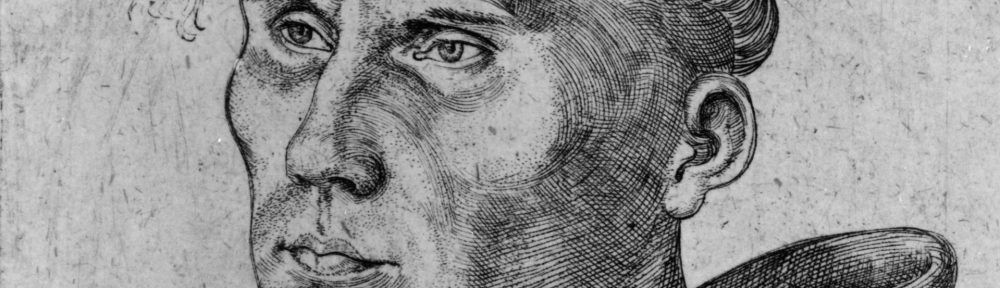
Justin Stratis over at the new theoblog, Out Of Bounds, has recently thrown up a post that is quite provocative. He is thinking out loud about a thesis of his about the world and its contingency; and what this does to our knowing about God and ourselves. He writes:
For several months, I’ve been reflecting on the place where God might “fit” in our attempts to think about, and ultimately know, ourselves and the world. Consequently, I’ve come to believe that God is formally unnecessary to such attempts. My thesis is that because the world is a finite and contingent thing, God need not be posited in order to make sense of it. (see full post here)
Justin seems to be probing from a more Modern theological position, and I would imagine that his further thoughts on this will mostly be from this vantage point. Nevertheless, as you read what Stratis is saying in full (so follow the link I provide, and do that — read the ensuing comments too), it sounds eerily similar to the kinds of thoughts that Medieval Scholastic theologian Ockham posited; at least relative to God’s non-necessity to the world, and our relative knowledge of it. Just recently I have begun to review a text we used for my Reformation Theology class in seminary (years back), and I have just happened upon Steven Ozment’s accounting of Ockham’s approach; very similar stuff to what Justin Stratis is working through (we’re just looking back a bit further into the history than I would gather Justin is working from). Here is how Ozment describes Ockham’s approach:
Ockham thoroughly rejected the metaphysic of essences and the metacategories so popular among thirteenth-century scholastics, which he believed had entangled God, man, and the world in a great chain of presumed ontological links and forces. He described “divine ideas” as merely the knowledge God could be said to have of the particular things he had created; just as man’s ideas or concepts reflected his encounter with and ordering of the world he intuited, so God “knew” the world he created. There was no grand system of divine ideas interlocking divine, human, and physical reality as with Augustine, Aquinas, and even Scotus. “Ideas,” Ockham wrote, “are not in God really, as part of his very nature [subiective et realiter], but only as objects [in ipso objective]—as the individual things he knows.” Universals as eternal archetypes really in the mind of God and in individual things as principles of their being and intelligibility fell away. Universals were distinctly human phenomena confined to the ordinary processes of a finite mind interacting with its perceived environment. The “secularization” of the knowing process begun by Aquinas here reached a true completion.
For Ockham, traditional philosophical and theological problems no longer opened onto such vast horizons as they had done with his predecessors; Ockham forced speculation to become more modest. Theological conclusions that came easily for Aquinas became impossible in the new Ockhamist world. If one cannot believe that the particular things of the world are essentially connected with their ultimate cause, then it becomes difficult to argue confidently from finite effects to the existence of God. For Ockham, there was no more rational basis for belief in God’s existence or the immortality of the soul than there was for the existence of intelligible species and common natures. All such things become genuine matters of faith. [Steven Ozment, The Age Of Reform 1250-1550: An Intellectual And Religious History Of Late Medieval And Reformation Europe, (New Haven: Yale University Press, 1980), 60-1]
To be clear, this post is not intended to challenge or characterize what Stratis is reflecting upon. Instead, Justin’s post is simply more of a springboard that got me thinking about the issue of God’s relation to the world; which led me to consider how someone in the history had similar sentiments at play in his own reflections and constructive theologizing. Obviously Ockham has the two-wills (absoluta, ordinata) at work in his mode of thought; and Ockham had never heard of Karl Barth’s actualistic metaphysic (for lack of a better term) and a post-metaphysical approach — and my hunch is that these are the categories (Barth’s, Jüngel’s, and other Moderns) that Stratis will be working through. Nevertheless, it is at least interesting to note some corollaries between the kinds of Modern questions that Stratis is positing; with the Pre-Modern/Critical ones that somebody like Ockham similarly articulated. I suppose in some ways the Teacher’s dictum of “there is nothing new under the sun” is apropos (maybe its just that some ideas are closer to the sun than others 😉 ).
I am just thinking . . .
Very interesting thoughts here and over at the Out Of Bounds blog. This just reminds me once again of how much I need to get a better handle on medieval theology. To truly understand Torrance’s concerns and the whole prelude to the Reformation, it is essential to get a grasp of the trajectories of theological development from Augustine up through Calvin. Perhaps Ozment would be the one good book that would cover that and of course there is always the need for reading in primary sources. Do you think Ozment and Torrance read Ockham and scholastic theology in a similar way or are their interpretations radically different?
My first exposure to Ockham was in Torrance’s writings, specifically where he was delineating his concern about dualism. He credits Ockham with asking important questions making way for the development of modern science, but ultimately rejects Ockham’s break with realism. The connections between that and science, theology and our knowledge of God is not yet something I really grasp. I really need to read Divine and Contingent Order and much more.
In regard to Stratis’ post, I think the world is rationally intelligible on its own, but that understanding is incomplete without an proper accounting of the creation’s relationship to God. Science is all about understanding the world without relying on God or an account of God for its explanations. However, this is also dominated by naturalism’s elimination of the place of God altogether. For Christians that leaves the naturalistic explanation of the world incomplete, but I could not demonstrate that philosophically.
Hey Jon,
No, Ozment is more of a historian vs. Torrance as a dogmatic theologian. I think you could really benefit from Ozment’s book, I have!
It is very true that Ockham’s nominalism operates with the dualist understanding of God’s two-wills front and center. Yet, a helpful thing, is how he provides a way for speaking of God in non-necessetarian ways, or through covenants; vs. a Thomistic natural theology. But even Thomas and his analogical way of talking about God provides some critical space for constructing a theory of knowledge of God that can be appropriated in more realist and Christian ways than either Ockham or Thomas, left to themselves, allow for.
I think Stratis is trying to conceive a way to think about God w/o having to recourse creation. So in reality he is trying to press out what Barth has called the analogia fidei, or analogy of faith (which TFT followed as well). I think Justins’ method, to his question or thesis, was to start from a rather negative vantage point; which threw me for a loop at first blush.
I ordered a good used copy for $5. It will be a good reference. Thanks.
Great, Jon, I think you’ll find it very instructive; and it is a good reference resource as well. Although I had to be consumed and saturated by it for a whole semester in my Reformation class. That was good for me 🙂 !
Thought I’d pop over here to see what’s become of this. Thanks for your thoughts Bobby – appreciate your attentiveness to our blog (and all blogs it seems!).
As a point of clarification – I’m definitely not trying to find a way to conceive God without recourse to creation (I think maybe by using the word “contingency” in my post I kind of threw things into the sphere of Torrancian discourse that may have muddled things up a bit). I just wanted to say that the world – that which we epistemologically encounter in our own “natural” way – the world’s intelligibility can be defended hypothetically without reference to God. But as you perceived, this really was kind of a backdoor way to the positive claim that the theological conception of the world as creation can only come about (and, in faith, does come about) as a result of revelation.
Anyway – thanks again dude.
Justin,
Thanks for stopping by, and providing further clarification. I finally came around to understanding what you were getting at; it just took me a minute. I agree with your assessment on the theological conception of the world; it is hard for me to think of things apart from theological conception. Which then, made it more of a challenge to think with you in your post for me.
I really like your guys’ blog, and I like all of the bloggers represented there! I do attend to “some” blogs 😉 … unfortunately I don’t have the face-to-face community (theologically speaking, I do have a good church body) you all have at Aberdeen so I have to resort to the virtual. Keep up the good work.
Thanks Bobby – looking forward to reading your E-Calvinism volume.
Thanks, Justin. By the way, I’m reading some Jüngel, and I see how what he says is oriented around the kind of stuff you were probing with your post.