The Calvin and Servetus Drama, The Ecclesiopolitical Tale

Here’s a short post on John Calvin and the infamous Michael Servetus (if you don’t know the story read it here). Basically all I want to do is broach this topic, and try to provide some marginal room for what Calvin was about with dealing with Servetus.

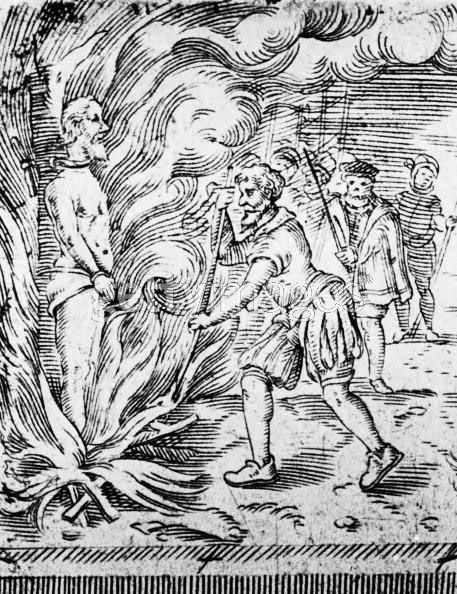
Servetus was a highly intelligent guy, a medical doctor, and student of theology who felt the need to challenge Calvin, in particular, on the doctrine of the Trinity — Servetus believed the Trinity to be heretical. He challenged Calvin through various media — the spoken word, and mostly by way of letter — wherein he revealed his true colors. At this point there were many “Reformers” who had concluded — legally — that Servetus was a heretic who needed to be dealt with. An aside, it is important to bear in mind that the socio-cultural milieu of that day was what can be termed ecclesiopolitical; so that the pressing political concerns of that day were very much so intertwined with the intense theological struggles of the day — thus verdicts that we would reserve for murderers today, could be used for theological heretics then (this is the cultural climate Calvin inhabited). Conversely, Servetus was eventually captured and put to death in Geneva (with the full approval of many Christian leaders, not just Calvin). Here is how John T. McNeil characterizes this issue relative to Calvin’s invovlement:

Embittered anti-Calvin writers deny the well-attested fact that Calvin had sought to have the Council decree death by the sword rather than the flames. Farel [Calvin’s compatriot in Geneva] had indeed reproached him (8 September) for his undue leniency in taking this position, though Farel appears to have shared it later. When the sentence was rendered Calvin noted that his effort had been in vain. Calvin wanted Servetus killed, but by a more merciful death than the flames. Yet when challenged by some who deplored the whole business, he followed the event with a book (Defense of the Orthodox Faith, 1554), in which, like the most obdurate inquistor, he declares that in cases of heresy the glory of God must be maintained regardless of all feelings of humanity. [brackets mine]Β (John T. McNeil, “The History and Character of Calvinism,” 176)

There is no doubt that Calvin ultimately approved of Servetus’ death — albeit he desired a more humane way of handling that — but I often think it is too quick or anachronistic (i.e. to impose our standards of language and culture on another period of time as if they are parallel) to say that Calvin was some sort of murderous shrewd. In fact the indictment might go the other way; it might indict us today, who look at theological things as if they are a game we can play versus a reality that represents real life and eternal consequences. The gravity of this situation with Servetus is probably without parallel in our own historical enclaves, today; therefore, I think it behooves anyone who might want to take Servetus’ case as the mallot that destroys Calvin’s character to do a double-take. While I wouldn’t condone this kind of activity today; Calvin doesn’t live in today, he lives in the yesterday of history wherein the norms and dictates of the day were very much so shaped by an ecclesiopolitical paradigm. Think again!

"Happiness is Being a Calvinist"

I enjoy being a Calvinist, it means I have a corner on the truth; and I have figured out all the angles of the Gospel. Being a Calvinist means that if anyone disagrees with me then they disagree with the Gospel; and I can rest assured that these sectarians are clearly afield of the truth — probably not even really Christians. As a Calvinist I’m allowed to refer people to our standard theologians whenever the finer points of doctrine are questioned; and I can rest in certain confessions and catechisms as representative of the settled truth that they are. When I read the Scriptures, as a Calvinist, I don’t even have to do exegetical work anymore — it’s already been done — all I have to do is look up the voluminous amounts ofΒ the variegated works ofΒ “my” Church Fathers (starting in the 17th century in particular)Β to know what kind of interpretive decisions I should make when reading my Bible (it’s a breeze). I’m so glad I’m a Calvinist . . . I’m glad I’m not like those other people (you know Arminians, Evangelicals, et al) πŸ˜‰ .

Reformed Confessions, Ecumenical Creeds, and Sectarian Collaborations

Confessionalism can lead to sectarianism, have you ever thought of that? Maybe you’re a “confessional Christian,” a Christian who sees a set of “Confessions” (Belgic Confession, London Baptist Confession, Helvetic Confession, Book of Common Prayer, Westminster Confession, etc.) as codifying Orthodox Christian doctrine. The consequence, if followed to strictly (and it is by over-zealous adherents), is that any “Christian” who does not affirm these disparate Confessions as representative of “orthodoxy;” these “Christians” are either seen as heterodox, at best, or not true Christians at worst.

I would suggest, that elevating various “Reformed” confessions as equal to what have been called Ecumenical councils (which confessions of sorts were born out of), is certainly off the mark. I say this because those “Ecumenical councils” (Nicaea, Chalcedon, Constantinople, etc.), that have been termed as such, are indeed labeled this way because they dealt with issues around who God is, who Christ is, the Trinity, etc.; the Confessions of the ‘Reformed’ church’s are different, they aren’t universally oriented. What I mean is, is that they aren’t articulating who God is (per se); instead they are articulating points on salvation that “Christians” can actually disagree over and still be Christian. This is unlike the “Ecumenical council’s” determinations, in the sense that a Christian could not deny who Christ was/is and still be considered to be operating within an ‘orthodox’ Christian realm.

Now I’m not saying that the “Ecumenical councils” trump scripture, instead that insofar as they faithfully capture who the scriptures disclose God to be; then their articulations are indeed binding — of course this same line of thinking should be applied to the “Reformed Confessions.” Again, though, I see a difference between the Ecumenical and Reformed Confessions (the former being universally oriented, and the latter being particularly and idiosyncratically oriented).

John Calvin and the 'Classroom' and the 'Body'

Before I get to Scottish Theology, let me ask you a question; do you think that John Calvin’s classical training as a humanist and the emphasis that he brought to the pulpit and church service by way of framing it as a ‘classroom’ was a healthy move or unhealthy for the church? As I recall, Steven Ozment, in his book The Age of Reform, makes this claim about Calvin and his ecclesiastical approach — that the ‘church service should be seen as a classroom’.

If this claim is true, and by no means do we “suffer” from doctrinal teaching today; but I would say, by-in-large, most of our churches our set up in a class-room style. Of course it wasn’t Calvin who invented exposition or teaching, in fact it is quite biblical; since anybody knows that good practice (orthopraxy) flows from ‘Biblically sound doctrine’ (orthodoxy). So maybe my question is misguided; maybe the rather isolated-individualistic church services that represent most of American Evangelicalism (and Reformed) can be blamed on just that — the ‘American psyche’ of Individualism. I just can’t help but wonder what impact Calvin had upon the church formation today; that is in regards to thinking of the church service as a ‘classroom’ instead of a ‘worship service’ where fellowship and communion around Christ and His Word is emphasized. Maybe Ozment is wrong.

My pondering stems from reflecting on I Corinthians 12 and the body life described therein. So many Christians are suffering, as we should be (or the Bible lied about it); yet I don’t see the cross having much play in our worship services today. If we are suffering (say like with cancer, or many other an ailment — physical-mental-or emotional), how is the church service and the time immediately following the service set up in a way where the body can be the body? How is the church service set up in a way that real communion around Jesus and the Word can happen in a way that “when one member of the body is suffering, all of the body suffers?” Is it because the church service is more like a ‘classroom’ that this isn’t happening, is it ‘American Individualism’, or am I just barking up the wrong tree, or something else?

Does John Calvin have any impact upon the way we do church today?

The Language of Calvinist

Labels are interesting things, and I’ve spoken of this before here, so I won’t get into this too much; but I just wanted to address this issue again, a little. I’m wondering if you think the language of “Calvinist” is helpful, or do you maybe think it is too sectarian in orientation (in other words, too devisive)? Maybe using the language of ‘Reformed’ would be better, but of course this comes with its own baggage as well. Or maybe just being known as “Christian,” which I’m more than happy with, is the best way forward. Of course within the history of Christianity there are so many nuances and traditions represented within Christendom that saying “Christian” isn’t specific enough, maybe? What do you think, do you think using the label “Calvinist” is a necessary evil; or do you think its unhelpful?

"Cultural Calvinism", Its Appeal

**Comments back on, starting with this post**

What is it that draws Calvinists to Calvinism? I suppose there are an array of responses that could legitimately answer that question. This post is going to be a probing one, suggesting some hunches that I have towards answering this question — one word of clarification, the question is speaking of Calvinists who are Classic in orientation (you know, the “Westminster” Five-Point kind).

First off, and this is I am sure the response that these “kinds” of Calvinists would give, is that they are drawn to Calvinism (often out of other “theological traditions”) because it represents the “truth of God’s Word.” And I’ll just tip my hat to that one, and say, amen . . . I’m sure that’s the primary reason why any Christian follows any particular theological tradition (they believe it is true in best representing the teachings of scripture).

Now that we have cleared that one off the table, here is what I think “might” be a very strong force in drawing many folks into the labryinth known as Calvinism (and there is some overlap between the point I mention above and this one); what I think is that people are drawn to the culture of doctrinal stability that Calvinism has to offer. What I mean is that Classic Calvinism has scripture and doctrine hammered out; all a person has to do is read their particular confessions, canons, and catechisms. And it becomes very clear what we “believe” as Calvinists; in other words, it is all spelled out for easy consumption. This, beyond the naked fact that Calvinists simply believe what they believe because they believe it is biblical, is what I believe is so appealing — and thus endearing — to many folks in this regard.

So more than doctrine, although this is an inseparably related reality, I believe that many Calvinists are Classic Calvinists today because of the “culture” that it presents. There is a sense of historical continuity, and great Christian classics embedded within this tradition; thus for many who are looking for more substance (which is highly understandable given the state of “Evangelicalism”), Classic Calvinism offers a “stable-deep” way of being a Christian.

Unfortunately, I believe that the premises that this kind of Calvinism flows from, doctrinally (and thus culturally) is an illusion in many respects; and that the “biblicism” it appears to operate from, is actually a synthesis of an “metaphysic” that really does not serve the teachings of scriptures, but instead subsumes scripture with its own emphases and trajectories that lead many folks astray in regards to their daily spirituality. Here I am only hinting at some of the things I will be talking about further in the days to come . . .

Calvinists, "Not Christians!"

I just came across this great little quote from Bruce Gordon’s book, “Calvin:”

. . . Terms like ‘Calvinist’ and ‘Zwinglian’ were not badges worn with pride so much as insults used by opponents to indicate that the people were not Christians.” (p. 185)

The time frame this is referring to, is at least Calvin’s life time.

I suppose this is true today, as well; it all depends on what direction your looking at it from.

John MacArthur and English 'Precianist' Calvinism, Much the Same . . .

[This post represents something I wrote awhile ago — before I was ever exposed to “Evangelical Calvinism” — but I think it illustrates some of the problems, that aren’t new, which can arise if someone follows the Federal/Classic Calvinist ‘way’ — whether that be in the 17th century or the 21st. Also, I realize that John MacArthur is not a ‘true’ Federal Calvinist; nevertheless, the ‘practical’ fall-out of assuming the Westminster themes of ‘grace and nature’ are still very much present within his construal and preaching of things . . . thus “his Calvinism” can foster the same kind of waywardness that Federal Calvinism can in re. to many things — in the case of this post, in re. to ethics, holiness, and salvation]

Below I am going to provide two quotes, the first will be from Theodore Dwight Bozeman discussing the emergence and factors that shaped the thinking of the yet to come English Puritans; and the second will be from John MacArthur, and his discussion on the role that changed behavior and moral values have in a genuinely β€œsaved life.” What I am highlighting, and want you all to see, is the striking correlation of thought and practice that both camps share, relative to emphasizing the importance of outward moral behavior in the β€œelects” life. Here is Theodore Bozeman discussing the early factors that led to English Puritanism:

English penitential teaching expressly echoed and bolstered moral priorities. In contrast, again, to Luther, whose penitential teaching stressed the rueful sinner’s attainment of peace through acknowledgment of fault and trust in unconditional pardon, several of the English included a moment of moral renewal. In harmony with Reformed tendencies on the Continent and in unmistakable continuity with historic Catholic doctrine that tied β€œcontrition, by definition, to the intention to amend,” they required an actual change in penitent. For them, a renewal of moral resolve was integral to the penitential experience, and a few included the manifest alteration of behavior. They agreed that moral will or effort cannot merit forgiveness, yet rang variations on the theme that repentance is β€œan inward . . . sorrow . . . whereunto is also added a . . . desire . . . to frame our life in all points according to the holy will of God expressed in the divine scriptures.” However qualified by reference to the divine initiative and by denial of efficacy to human works, such teaching underscored moral responsibility; it also adumbrated Puritan penitential and preparationist teaching of later decades. [italics mine] (Theodore Dwight Bozeman, β€œThe Precisianist Strain . . . ,” 20-21)

It is important to keep in mind that Bozeman is not even discussing actual English Puritanism yet, rather he is highlighting the streams and emphases, present within England just prior to the full-fledged emergence of Puritanism, that actually brought shape and form to the disciplinary β€œreligion” known as Puritanism. Notice the correlation he makes between this kind of Protestantism with Roman Catholic spirituality. . . .

Conversely, John MacArthur sounds very much like this incipient Puritanism described above by Bozeman. You will notice this similarity as MacArthur, like these early penitentialists, emphasizes the function and necessity of moral reformation in the life of the β€œtruly saved” individual; notice:

. . . They’ve been told [Christians in the typical evangelical church in the West] that the only criterion for salvation is knowing and believing some basic facts about Christ. They hear from the beginning that obedience is optional. It follows logically, then, that a person’s one-time profession of faith is more valid than the ongoing testimony of his life-style in determining whether to embrace him as a true-believer. The character of the visible church reveals the detestable consequence of this theology. As a pastor I have rebaptized countless people who once β€œmade a decision,” were baptized, yet experienced no change. They came later to true conversion and sought baptism again as an expression of genuine salvation. [brackets mine] (John MacArthur, β€œThe Gospel According to Jesus,” 17)

Striking is it not? Both English Penitentialism (early and full blossomed English Puritanism), and MacArthur’s approach are intended to curb moral laxity, by emphasizing the moral conduct and β€œperformance” of the truly β€œsaved.” As MacArthur underscores, as a good follower of the β€œEnglish Puritan” (and for that matter Roman Catholic) ethic and spirituality, genuine salvation is only noticeable and discernible via an β€œ. . . an ongoing testimony of his life-style.” Bozeman speaking of the moral laxity within England (in the 16th century and onward) notes how this affected the β€œReforming spirit” of that locale, he says: β€œ. . . There the Reformation emerged in a period of deeply felt concern about social order. . . . (Bozeman, 13) This motivation similarly, and unabashedly, motivates MacArthur’s emphasis on performance, duty, and obedience, as he states: β€œ. . . Why should we assume that people who live in an unbroken pattern of adultery, fornication, homosexuality, deceit, and every conceivable kind of flagrant excess are truly born again? . . .” (MacArthur, 16-17) In other words, the remedy for both camps (i.e. between the 16th and 17th cent. and 20th and 21st cent.) is to hang people over hell in order to foster an supposed environment of holiness and moral uprightness, this is by way of EMPHASIS. Both of these camps spoke and speak of solifidian (faith alone), but this is not enough, external moral transformation needs to accompany β€œfaith alone,” otherwise there was never any faith to begin with (i.e. later on we will discuss how this thought came to be tied to concepts like β€œpreparationism” and β€œtemporary faith”).

All of this is contrary to Martin Luther’s approach, which is to emphasize the need of a changed heart, and the objective Word of God as the motivation and reason for holiness. Luther did not hang people over hell in order to engender holiness of life, and neither did the later antinomists (i.e. Sibbes, Cotton, et al) who we will discuss later. Did Luther think moral transformation was needed within the church, indeed . . . but we do not hybrid the gospel in order to achieve this end (i.e. MacArthur and the Puritans); rather we emphasize the winsome love of Christ disclosed at the cross, grave, and right hand of the throne of the Father as the motivation for purity and holiness. This was Luther’s, Cotton’s, Sibbe’s, and my aim, I hope it is yours.

I have provided this brief comparison in order to further establish the corollary and continuity between English Puritan salvation themes and motifs, and in this case, John MacArthur’s themes and motifs, relative to articulating the gospel. I am not sure how anyone who has read anything on Puritan spirituality, and its formation, can deny the similarity between that and the outlook that MacArthur (and others like him) is articulating today. At minimum my hope is to expose this, not to smear MacArthur (or others), so that folks who have bought into such teaching can see it for what it is, and realize that this kind of doctrine leads away from an emphasis upon Christ; and focuses upon self (and β€œmy transformed life”). Jesus said it best, β€œ. . . Seek ye first, His kingdom and His righteousness . . . ,” in other words, keep your eyes ON HIM!

"Amazing Grace": An Example of Real Life Classic Calvinism "People"

Check out this video, over at Lane Chaplin’s!

The video is a bit long (over 16 minutes), but it exemplifies the types of folks I am trying to engage here at The Evangelical Calvinist (at least in particular ways). This video was produced by famed Calvinist “Vlogger” Lane Chaplin. Watch the video, and see what you think.

Also, I have stacked my weekend posting for this site all onto this one day; so to make sure you don’t miss my other weekend postings here’s the links:

Emerging Calvinism

Expose’ on MacArthur and the Puritans

Enjoy!

P. S. I am having a bit of fun with the title of this post, but I am dead serious on working through some of the theological issues/problems that Classic Calvinism promotes; stay tuned for more, I’m just getting started here . . . by the way, you might wonder when I’m going to start presenting more stuff on “Evangelical Calvinism;” well that’s coming too (have patience) . . .

'Emerging Calvinism', and its Favorite Trio

There are a slew of ministries today that are promoting an enlivened Calvinism for the masses; whether that be by radio, books, pulpits, or the internet. Off the top I can think of just a few that are making quite the impact:

Each one of these characters has their own unique brand and emphases, relative to their articulation of Calvinism. MacArthur follows a more ‘Baptistic’ “Spurgeonized” Calvinism, with an emphasis upon good expositional preaching; and a call for holy living (he is more Fundy in approach and socio/culturally). John Piper is similar in many ways to MacArthur, although he is more steeped in the ‘history’ of Covenantal Calvinism drawing off of his background with the Puritans; in particular his appeal to many of Jonathan Edwards’ themes. And then Michael Horton, who is a full-fledged Federal Covenantalist who approaches things much more “historically” and “academically;” which is only natural given his profession as an professor.

Each one of these figures offers a different angle on Calvinism —some more consistent, historically, than others— but they also offer an certain commonality in emphasis; and that is, that they all follow the style of Calvinism codified at the Synod of Dordrecht and evinced through the Westminster Catechism. As far as communicating salvation goes, each of these fellows find their directive from the TULIP.

Instead of trying to unearth (re-invent the wheel) the history and theological (loci) focal points of Calvinism, of which there is legion; I just want to comment on this rather amazing phenomenon that seems to be sweeping large pockets of Christendom. And that is the in-roads and re-emergence that Calvinism seems to be making amongst both the young and old, Christian. Let me posit a few reasons why I think this is happening:

[B]ecause of the shallowness and decline exemplified in much of ‘Evangelical Christianity’.
[B]ecause of the lack of doctrine being promulgated within ‘Evangelical Christianity’.
[B]ecause people want some guidelines, they want some real-life structure and infrastructure for what they believe.
[B]ecause people are tired of hearing sermons about themselves, and they want to hear an emphasis upon Christ through biblical exposition.
[B]ecause there really are no other alternatives but to return to the “Old Paths” that Calvinism appears to offer.

I know there are plenty more reasons why folks seem to be turning to Calvinism (have any suggestions?), but by-and-large I think that it has something to do with the realization that ‘Evangelical’ Christianity (whether the style be: ‘Purpose/Market Driven’, ‘Emergent Driven’, or ‘Independent Fundamentalist Driven’) is becoming quite bankrupt in regards to providing a Christianity that is robust enough to answer the deep felt questions that the issues of this life throw at us every single day.

When people (and many are) get to this point where do they turn? Either they completely leave the church (and I know some are doing that, according to the “statistics”), become ‘Liberal’ and find the substance and community they are looking for in political causes and social justice issues; or maybe they see the arms of MacArthur, Piper, and Horton opened up saying: “. . . come find rest for your souls weary pilgrim.”

Do you see what I am getting at (and indeed, I am generalizing)? There has been a vacuum created through the “man-centered” approaches and [non]doctrinal forays provided by the broader portion of “Evangelicalism” for years. Calvinism offers just the opposite, by reputation and assertion. It offers doctrine, devotion, and depth for the disenfranchised ‘Evangelical’.

But what if the sparkling beacon of rest that Calvinism appears to be (for your average church person searching for depth) turns out to be just as “man-centered” as the “Evangelicalism” they are fleeing? What if “Calvinism” is promising more than it can deliver? These are questions that should be considered by the tired souls in search of the “truth” of the Gospel. But indeed, that is part of the problem, so many are ‘tired’ they just want rest; they just want someone to tell them that it is all okay, “here’s the doctrines of Grace that they have been deprived of for so many years.” People, tired people, especially, are ready to hear that! They begin to immerse themselves in this new deep culture, they read books by MacArthur —not the fickle flamboyant stuff they are used to, mind you— with titles like: The Gospel According to Jesus, or Hard to Believe. This isn’t the flimsy-flighty stuff their CEO’s, uh *#&% argh, I mean their mega-church pastors were slinging at them from their pulpits. No, oh no! This has guts, it sounds like Jesus’ kind of stuff in chapters like John 6; finally, the depth, the substance these folks have been longing for. No more of that Christless Christianity, they have finally come into a Christian situation where Desiring God is emphasized; a place where there is an opportunity for Putting Amazing Back into Grace!

Maybe what I am describing sounds curiously true to your own situation. Maybe you’ve even swung this way, believing that popular Calvinism was the answer to your “Evangelical woes;” but now you are realizing that maybe, theologically, there are
certain problems (along with certain pros) that didn’t appear at the euphoric ‘honey-moon’ stage you were in when first introduced to this ‘new-way’.

I haven’t (in this post) really elaborated on the ‘problems’ that are inherently endemic to ‘TULIP’ style Calvinism; but maybe I don’t need to, maybe you know those all too well. Certainly you recognize an array of variable “truths” packed into the Calvinist themes; but you realize that there might be something ‘rotten in Denmark’, that Calvinism still seems to be pointing you in the direction of yourself. Sure you have found quite a bit of substance, relative to the ‘old Rick Warren’ days; but now you are wondering if the ‘substance’ measures up to the right kind of ‘substance’.

Or maybe you have found what you were looking for in the halls of ‘Dordt’, and you think that, especially by now, I am full of hot air πŸ˜‰ (indeed)!

Either way, let me know . . . what you think on this front.

P. S. By the way, I’m not an Arminian or a follower of Popular/Contemporary Free Grace Theology —- I am quite ‘Reformed’ (an Evangelical Calvinist, don’t you know)!