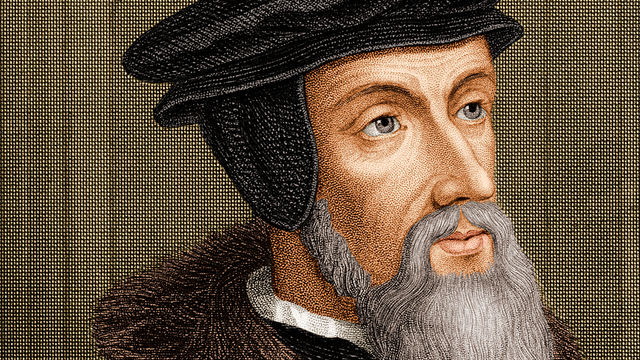
Just finished. This is the third book of Bruce Gordonās I have read over the years (his other books: on Calvin and Zwingli respectively). Overall, a good and informative and interesting read. It appears to me that, Bruce, at points, has imbibed too much of the higher critical palate when it comes to thinking of the supernatural nature of Scripture. His chapter on the Pentecostal appropriation of the Bible isnāt the strongest. But again, overall, I would commend this book to you. It will give you a greater appreciation for the Bibleās reception across the millennia and across the globe.
Category Archives: Bruce Gordon
Zwingli, The Pluralist Universalist
I am just finishing up Bruce Gordonās excellent bookĀ Zwingli: Godās Armed Prophet. In it, Gordon, almost in passing, notes that in Zwingliās final theological confession, hisĀ Exposition of the Faith,Ā in his dedication to Franceās king, Francis I, he writes the following. You will notice the universalistic intonations of Zwingliās correspondence; Luther, and the Germans
most certainly did. Indeed, in the following quotation, Gordon also supplies Lutherās acerbic response to what I would take, similarly, to be a highlyĀ unChristianĀ way to think about the salvation of pagan peoples.Ā Ā
In his dedication, Zwingli urged the king to rule well, that he might join the heavenly company of exalted monarchs:Ā
Then you may hope to see the whole company and assemblage of all the saints, the wise, the faithful, brave, and good who have lived since the world began. Here you will see the two Adams, the redeemed and the redeemer, Abel, Enoch, Noah, Abraham, Isaac, Jacob, Judah, Moses, Joshua, Gideon, Samuel, Phineas, Elijah, Elisha, Isaiah, and the Virgin Mother of God of whom he prophesied, David, Hezekiah, Josiah, the Baptist, Peter, Paul; here too, Hercules, Theseus, Socrates, Aristides, Antigonus, Numa, Camillus, theĀ CatosĀ andĀ Scipios, here Louis the Pious, and your predecessors, the Louis, Philips,Ā Pepins, and all your ancestors, who have gone hence in faith. In short there has not been a good man and will not be a holy heart or faithful soul from the beginning of the world to the end thereof that you will not see in heaven with God. And what can be imaginedĀ more glad, what more delightful, what, finally, moreĀ honourableĀ than such a sight?Ā
As Luther and others quickly noted, Zwingliās words were arresting. Alongside the kings of Israel and France, the blessed included Socrates and theĀ Catos. The virtuous pagans would find their place among the elect. From Wittenberg came the caustic reply:Ā
Tell me, any one of you who wants to be a Christian, what need is there of baptism, the sacrament, Christ, the Gospel, or the prophets and Holy Scripture, if such godless heathen, Socrates, Aristides, yes, the cruel Numa, who was the first to instigate every kind of idolatry at Rome by the devilās revelation, as St Augustine writes in the City of God, and Scipio the Epicurean, are saved and sanctified along with the patriarchs, prophets, and apostles in heaven, even though they knew nothing about God, Scripture, the Gospel, Christ, baptism, the sacrament, or the Christian faith? What can such an author, preacher, and teacher believe about the Christian faith except that it is no better than any other faith and that everyone can be saved by his own faith, even an idolater and an Epicurean like Numa and Scipio?Ā
The list was not the first time Zwingli had expressed himself on the salvation of non-Christians. Against his beloved Augustine, he was adamant that unbaptized infants would be saved. On the noble heathen, he had made his point most emphatically in his sermon on providence in 1530, when he claimed that Seneca was āthe unparalleled cultivator of the soul among pagansā. He was a ātheologianā and his works ādivine oraclesā.Ā Ā
Salvation was not limited to Israel or the visible Church. Zwingliās conviction was consistent: God is entirely free in election to choose whom he wills with reasons completely beyond human comprehension. Profound attachment to divine freedom led Zwingli to find God working through the deeds and thoughts of non-Christians. God was the source of all goodness, and faith and goodness were to be found among virtuous pagans as they were somehow part of Godās election. Unlike John Milton later, Zwingli felt no need to explain the ways of God to humanity.1Ā
Interestingly, Zwingli himself, according to Gordonās commentary, has no problem imposing his soteriology on Godās freedom; this is precisely what Karl Barth would not do. Barth, like Zwingli, had a high view of Divine freedom, but just because of that, definitionally, Barth rightly saw that a person, like Zwingli, could not foreclose on said freedom; and āmakeā Godās freedom the cipher by which an array of theologicalĀ adiaphoraĀ might be smuggled into the Divine way. This is what kept Barth et al. from following Zwingliās apparent universalistic-turn. At most, for Barth, Godās freedomĀ couldĀ allow for a hopeful universalism, but not of the sort that we find, ostensibly, in Zwingliās absolute, and even pluralistic form of universalism (I say anachronistically after Paul Tillich). Indeed, I find this rather striking; Zwingli seems to have an incipient form of what would later come to be Karl RahnerāsĀ anonymous ChristianĀ notion. Again, to read modern theologians, and their respective categories, back into someone like Zwingli would be, at best, anachronistic. But at a conceptual level it is interesting that there is at least some inchoate corollary between him and some moderns who would follow latterly.Ā Ā
I found this nugget interesting, and something I didnāt know in regard to Zwingliās soteriological imagination. Maybe youāll find this interesting as well, which is why Iāve shared this.Ā Solo ChristoĀ Ā
1 Bruce Gordon, Zwingli: Godās Armed Prophet (New Haven and London: Yale University Press, 2021), 238-39.

Ā
Reading Scripture with Calvin and the Inevitability of Theological Exegesis for All
The following is a post I wrote many years ago now; itās rather short and to the point, but itās about a very important thing that continues to remain a problem
for many a Christian. It can be a very positive thing once the Christian Bible reader can be humble enough, and/or critical enough to come to recognize the inevitable reality that it is. What I am referring to is the reality of theological exegesis; we all do it, and it has been done ever since the Patristic beginning (meaning the theology that was developed in the so called ecumenical councils; the theology we consider orthodox today relative to the Trintarian and Christological grammar we employ as Christians). The following post broaches this topic once again, I can only hope that if you donāt realize that the way you read Scripture comes from a particular theological tradition, that in fact you will indeed come to realize that you do in fact read Scripture from a particular theological tradition[s]. Hereās what I had to say, appealing to John Calvin, back some time ago.
. . . Calvin, like the other reformers, understood that scripture could not stand without a framework of intepretation. And that framework ultimately supported his theological conclusions. This was precisely how it worked in Reformed, Lutheran and Catholic churches of the sixteenth century.[1]
I have recently been in a dialogue with a guy who clearly loves the Lord. We have been discussing the idea thatĀ GodĀ isĀ the Gospel.Ā This idea actually troubles this fellow, āthat God is the Gospel,ā he has said:
Iāve been going over this and talking it over with people. I am unwilling to say that God is the gospel. The gospel is the proclamation of the saving redemptive work of Christ. That is the way scripture defines the word āgospelā. Itās very specific. To go beyond that is to go beyond the teaching of scripture, the way scripture defines the term for us and I am unwilling to go there.
The reasons supporting the phrase āGod is the gospelā presented so far are not based on exegesis of scripture, but rather on philosophical reasoning. In fact I find the reasoning to be specious. By the same reasoning one might conclude that God is the author of sin. Logic would lead us to believe that was true if we were not fenced in by the limits of scripture.
For this gentleman, the Gospel is strictly aĀ verb,Ā and is not aĀ subjectĀ too ā which it is. Not to digress, but to illustrate, in contemporary ways, the importance of Calvinās own approach to scripture. That is, part of interpretation is to recognize that we are indeedĀ interpreting.Ā And that it is okay, and necessary, to go deep into the inner logic and implication of scripturesā own assumptions. Calvin was aware of the fact that we all have grids of interpretation that we bring to the text, and part of this āspiralingā process of interpreting scripture is to allow scripture and Christās life to impose its own categories of thought upon our preconceptions.
In our case, with the fellow I mention above, if he realized that even his desire to read scripture in the way that he does (rather āwoodenlyā), is in fact a consequence of his prior commitment to an interpretive framework;Ā then he would quickly realize that āhis commitmentāĀ itself is not āscripture.ā That his interpretive paradigm in fact ā and I think this is safe to say ā is resting on a certain philosophical arrangement that, unfortunately, is unbeknownst to this well intending brother in Christ.
[1] Bruce Gordon, Calvin, 108.
Reading Calvin the Way He Intended: Calvin and the Calvinists, again . . .
The never ending debate of continuity between Calvin and the Calvinists will probably endure until the Lord returns. Bruce Gordon, amongst most ‘Reformed’ scholars, holds to the thesis that in fact there is continuity between Calvin and those who bear his name today; he says:
. . . Calvin’s discursive, humanist style, which he shared with his contemporaries, was replaced by new forms of argumentation that could be used in the schools and academies. The theology itself was not changing, and Calvin’s thought remained crucial to Reformed tradition, but the means by which it was taught reflected new requirements. Moreover, as he had lived, in death Calvin did not stand alone. He was read, studied and interpreted in various contexts all within a wider stream of Reformed thought that included Bullinger, Vermigli and their successors. Just as he had wanted, he belonged to the community of churchmen. (Bruce Gordon, “Calvin,”339).
I think, reading between the lines, Gordon is saying that much of the post-Calvin development was really only a matter of genre; that pedagogy, and historical circumstances — facing “the Calvinists” — required various
approaches and appropriations. I am sure this is true. But is it also sound to reduce Calvin’s thought, and the development of his thought to an issue of “style,” and not “material content,” as Gordon does? I am leery on this point.
Beyond this, and what is agreeable with what Gordon asserts, with qualification of course, is that Calvin was read “in various contexts all within a wider stream of Reformed thought.” What Gordon seems to be presuming, given his list of “Calvin’s readers” (i.e. Bullinger, Vermigli, et al.), is that this wider stream is what developed into what we now call “Orthodoxy” (i.e. corollary with the Westminster Divines, et al.). This is where “Evangelical Calvinism” wants to step in and say, “hello, wait a minute, what about the Scots and even some of the English?” Now certainly, if we assume that “Orthodoxy” is “Orthodoxy,” then the “stream of Reformed tradition” is delimited in ways that automatically preclude what we as “Evangelical Calvinists” want to say; and that is that there are readings of Calvin within the ‘Reformed tradition’ that do not fit into the “Orthodox” stream, per se (viz. depending upon what the standard of actual “Orthodoxy” is — is it sola scriptura, or self proclamation?).
Case in point, and on this I will close; Calvin had a very Trinitarian way of reading Union with Christ, it was ‘real’ and ‘ontological’ union — this is what Evangelical Calvinists believe as well. Do the Federal or Orthodox, predominately see it this way (I am generalizing here)? Julie Canlis, a Calvin scholars says:
My suspicion is that Calvinās scuffle with Osiander is largely to blame for our Reformed emphasis on justification to the exclusion (or downgrading) of adoption as spiritual union. Although Alister McGrath notes, āCalvin is actually concerned not so much with justification, as with incorporation into Christ,ā it seems as if Reformed theology traded this full-bodied trinitarianism for a narrower (though vital) christocentrism. Out of fear of Osianderās (and othersā) focus on union unaccompanied by an appropriate role for the cross, we have compensated by limiting union to the crossāthe method by which we are saved. With this move, however, we are no longer asking the questions that Calvin was asking: we suddenly are left with questions about how we are saved, from what we are saved, and what we should do now that we have received this salvation. They tend to be the questions that quench rather than nourish spiritual formation because they are stunted. Calvinās questions always centered around God (not ourselves, or even our salvation) and about the glory of Godāquestions that are not stunted because they open themselves up to a reality much larger than themselves and do not approach this reality with a (frankly consumerist) howcan- I-get-salvation mentality or a (primarily functional) what-should-I-do-now mentality. Calvinās questions took their cues from God in his trinitarian fullness and his inexplicable desire to bring us into this fullness. In distancing himself from Osiander, Calvin was not necessarily less radical than Osiander in his vision of union with God, he was just relentlessly trinitarian. Union, when explained as justification or friendship or even fellowship with God, doesnāt quite meet Calvinās standards. āNot only,ā Calvin says, ādoes Christ cleave to us by an indivisible bond of fellowship (societatis), but, with a wonderful communion (communione), day by day, he grows more and more into one body with us until he becomes completely one with us.ā It seems that Calvin himself is arguing for something more than fellowship: ānot only fellowship but communion, becoming one with us.ā What does this mean? I believe it is Calvinās desire to push us deeper, through the glory of being reconciled to God by justification, into a life of being spiritually formed by the Trinity itself (himself!). Adoption is Calvinās answer to both Osianderās non-trinitarian union and the sometimes-diluted āunionā that we in the Reformed tradition have unconsciously embraced. (Julie Canlis, “Calvin’s Institutes: A Primer for Spiritual Formation,” Resurgence [2007])
There is alot in this one quote (Osiander was one of Calvin’s theological opponents, btw); suffice it to say, besides the rich points that Canlis is making (theologically), this illustrates the way that Calvin can and should be read on “Union.” If this is the case, shouldn’t this be one of the salient points that we judge whether or not the “Orthodox Calvinist” has indeed read Calvin the right way? I think it should be. If this was a key of Calvin’s theology, shouldn’t it be a keynote in the “Orthodox” Calvinist’s theology?
I could provide more comment, in fact I want to quote TFT in his book “Scottish Theology,” wherein we see ‘Evangelical Calvinists’ reading “Union” much the same way as Calvin. The point would be, if “Scottish Theology” reads Calvin the way he intended, and “Federal Theology” (Classic Calvinists) do not; wouldn’t this at least suggest that “Evangelical Calvinism” should be included in the discussion of the “wider Reformed tradition?” I think so, thus an impetus for this blog. I wonder what you think . . .
Calvinists, "Not Christians!"
I just came across this great little quote from Bruce Gordon’s book, “Calvin:”
. . . Terms like ‘Calvinist’ and ‘Zwinglian’ were not badges worn with pride so much as insults used by opponents to indicate that the people were not Christians.” (p. 185)
The time frame this is referring to, is at least Calvin’s life time.
I suppose this is true today, as well; it all depends on what direction your looking at it from.