‘This Thing’, It Changed My Life …

I have really been feeling convicted lately—and I mean this—about getting back to something that I have somewhat abandoned over the last few years in my research and reading. And this something is the very thing that set me on the path, in the first place, to ever become The Evangelical Calvinist. This something, is something that I was really introduced to, for the first time, in seminary, by Ron Frost. It is something that is of utmost importance when working through theological alternatives, and it is the very thing that opened my eyes to the wonderful world of theology, in ways that I never knew were possible; that is until I was first introduced to this thing. It was introduction to this thing that allowed me to start understanding how Calvinism came to be, how it developed; and it was introduction to this thing that gave me a deep appreciation for the Reformed heritage that so many of us Protestants simply take for granted, even though we sup from its table in countless ways (without critically realizing that we do). It was introduction to this thing that kicked me out of the theological doldrums that I had brought from my undergrad training, in regard to systematic theology. If it wasn’t for this thing, I might have ended up becoming an analytical theologian, or philosopher of religion; but this thing kept me from that, and set me on a totally different trajectory—one I have yet to recover from, except for the fact that I have not been paying as close of attention to this thing as I should have been (but there is only so much time). Anyway, after I tell you what this thing is, you might feel let down, or that this build up ends in rather anti-climatic form. But for me it doesn’t; for me this thing is really important, and I will be seeking to recover this thing, once again, in a way that ought to provide me with the critical kind of distance that may have been lacking in some of my thinking over the past few years.

I will let you guess what this thing is. If you are unable to here; in my next post, I will reveal what this thing is, and discuss it further, and what it will mean for my studies moving forward.

The Politics of Theological Discourse: Calvinism, Arminianism, Barthianism, Wrightianism et al.

Something I have noticed is that being able to discuss material issues relative to Calvinism, Arminianism, Wrightianism, Barthianism, Torranceanism, etc. etc. is really an exercise in political and rhetorical maneuvering more than it is material conceptual maneuvering; in other words, actually engaging material things like: doctrine of God, informing metaphysical schemas, informing exegetical concerns, informing hermeneutical commitments, informing socio-cultural situations—none of these things really seem to be at the bottom of most discussions in this arena. For example, everyone knows me as someone who is predisposed to the teachings of Thomas Forsyth Torrance (and some of Barth), and also of John Calvin (as my header image currently hints at); and so anyone who has only heard funny things about these teachers, or are followers of other teachers who are at odds with the teachers I like, well, then, I cannot really get a good hearing (nor can others, potentially, get a good hearing from me) precisely because of the politics and connotations that have built up around such teachers and their followers over the years.

But, is what I am getting at, is this the Christian and ethical approach to engaging others? I know that there are all kinds of issues driving this kind of political posturing when we engage others within the fold of Christianity (theologically and biblically exegetically, that is). We are busy, we are doing real life, real ministry; and thinking deeply enough about real life exegetical and theological issues requires more time than we have to give to something. So instead of carefully considering other positions, we categorize (caricature) positions (and teachers associated with those); we often times give a yes (from the Lord), or no (demonize) to the category or caricature; and then we use this as a hedge to protect ourselves from actually having to engage other positions, with the posture that we already have, since we can throw out labels and names as if we have actually engaged said position. It is true, no one has the time to sit around all day everyday (unless you’re a PhD student 😉 ), and contemplate every theological position under the sun (with depth); but at the same time, it is never good to simply tar and feather teachers and positions without at least giving something a real hearing (i.e. going beyond the lazy man’s caricature approach).

Just reflecting. And by the way, I write this mostly to me; I am very guilty of doing just what I am writing of at various points. I know some could say that I have done this with my obsessive critiquing of classic Calvinism. Indeed, I will admit, at points, I have been guilty of caricaturing the classic Calvinist, etc. My intention is to give that position, and others, a fair hearing, and avoid caricature. I think all of this just boils down to a posture of humility; that we need to approach positions with this attitude. That is not to say that we cannot strongly disagree or speak against various positions and teachers within the church; but it is to say that we ought to consider what these teachers teach (and even preach) before we offer any kind of critique (or we shouldn’t create straw people).

An evocative picture of my Saviour

What do you guys think about this picture:

I asked the same question a bit ago on my Facebook wall, and a friend quoted this about this picture,

‘”That picture! That picture!” cried Muishkin, struck by a sudden idea. “Why, a man’s faith might be ruined by looking at that picture!” “So it is!” said Rogojin, unexpectedly.’ (Dostoevsky, “The Idiot”)

So this picture, painted by Hans Holbein, has been featured by Dostoevsky in his writings. And it is a picture that almost mesmerizes me; not in some sort of mystical sense, but in the sense that it evokes a depth response in me as it signifies the truth of the Christian kergyma. That is, of course, that God became man in Christ; and became obedient to the point of death, even death on a cross. As the Apostle writes:

Let this mind be in you which was also in Christ Jesus, who, being in the form of God, did not consider it robbery to be equal with God, but made Himself of no reputation, taking the form of a bondservant, and coming in the likeness of men. And being found in appearance as a man, He humbled Himself and became obedient to the point of death, even the death of the cross. Therefore God also has highly exalted Him and given Him the name which is above every name, 10 that at the name of Jesus every knee should bow, of those in heaven, and of those on earth, and of those under the earth, 11 and that every tongue should confess that Jesus Christ is Lord, to the glory of God the Father. ~Philippians 2:5-11

And,

For you know the grace of our Lord Jesus Christ, that though He was rich, yet for your sakes He became poor, that you through His poverty might become rich. ~II Corinthians 8:9

In the Christian Tradition this is also known as the mirifica commutatio or ‘the wonderful exchange’; and this serves as a central theme for how Evangelical Calvinists think of election-reprobation, viz. through a union with Christ theology.

Anyway, I am preaching a bit (and digressing); so how does this picture strike you? Is it too evocative and brutally scandalous? I know some Christians don’t think we should use images of Christ at all, and so for you (if that’s you), I know the answer to my question already. But I am really curious about how those of you who don’t have as much of an issue with icons like this think of this picture, and my current and recent usage of it for my blog header. It is hard to look at, admittedly for me; but it also conveys something about Christianity that I think has been lost and glossed over about Christianity in at least the American Western church—that is that Christianity and Christ crucified is skandalon or a stumbling block (the matter of my Masters thesis I Corinthians 1:17-25). Jesus is usually not presented in stumbling block kinds of ways today, and I think this picture re-invokes that kind of response. What do you think?

Is Barth the Orthodox Hegel?

Warning, academic alert!! I am reading, amongst other things, on Hegel’s thought, and Hegel directly; I thought I ought to do this if I am going to be a student again. Here is what one commenter writes on the difficulty of reading and attaining any kind of mastery (or even understanding of Hegel):

Yet Hegel is awesome as well as difficult to read. The Phenomenology,especially, is an intoxicating mixture of passionate intensity and convoluted obscurity. As Kroner writes: ’The work claims to be rational, but it shows every evidence of having been written under inspiration.’ The source of ’Hegel’s secret’ may remain a matter of faith. But there can be little doubt that the fusion of passion and profound complexity pervading his writings accounts to some extent for the widely diverging reactions to his philosophy. J. N. Findlay’s comment that in reading Hegel one is ’at times only sure that he is saying something immeasurably profound and important, but not exactly what it is,’1’ seems fair and should hearten anyone trying to make sense of Hegel. To quote one of his own aphorisms: ’The condemnation which a great man lays upon the world, is to force it to explain him.’12 This has certainly, in his own case, turned out to be a self-fulfilling prophecy. [Martin Henry, G. W. F. Hegel: A Secularized Theologian?, Irish Theological Quarterly 2005; 70; 195 DOI: 10.1177/002114000507000301, p. 196-97]

I am actually reading Peter C. Hodgson’s account of Hegel’s theology-philosophy entitled: Hegel & Christian Theology: A Reading of the Lectures on the Philosophy of Religion. In his accounting, it is altogether stunning how similar the virtuoso, Barth, sounds like the virtuoso, Hegel. Hodgson describes Hegel’s idea of God, and God’s movement from absolute substance to particular (or other than substance) subject and back through Spirit (geist)—as I read this I couldn’t get Barth’s self-replicating God of modes of being out of my head; Hodgson writes:

By descending from its eternal simplicity, the absolute being (the ‘Father’) attains for the first time its ‘highest being’—which is not the remote and inaccessible deity of rationalism, but a divesting, absolving, relational being that comes down into history and makes itself manifest (the ‘Son’). Essential being (Wesen) becomes existent, determinate being (Sein, Dasein)—and this is to say that it becomes spirit (Geist), ‘the being that is the process of retaining identity with itself in its otherness’. Spirit in the immediacy of self-consciousness is the particular individual Jesus of Nazareth, as contrasted with the universal self-consciousness of the religious community. But this individual human being, ‘as whom absolute being is manifest’, is subject to the conditions of time, space, and mortality: his being passes into having been and his sensible presence into spiritual presence. This is the passage from the Son to the Spirit.

These temporal and spatial categories, endemic to the representational form of religion, are not adequate to the truth of absolute spirit. Consequently, Hegel moves on to provide a speculative redescription of the central Christian theologoumenon, the Trinity, which contains the true content but in less that adequate form. The three constitutive moments, conceptually expressed, are pure thought, representation, and self-consciousness. Pure thought designates the immanent or intradivine Trinity, which is not an empty essence but already the implicit fullness of absolute spirit. Representation (Vorstellung) designates the second moment, that of creation, fall, incarnation, life and death, symbolically encapsulated in the figure of the Son. Representation is not merely an epistemological category but an ontological one. It designates a divine doing, not merely a human knowing. God sets godself forth (vor-stellen) in and as world; this is an essential element in the process of God’s becoming spirit. The referent of representation is real history, not fanciful myth, although what happens in history is often recounted in mythical form.

The third moment is that of self-consciousness or infinite intersubjectivity, which is associated by Christian faith with the Holy Spirit, resurrection, reconciliation, and the community of faith. Hegel observes that ‘absolute being’ would be an empty name if in truth there were an absolute other to it or an irreparable fall from it. ‘Absolute’ must mean then that there is nothing with which God cannot be related. Within the divine whole there is genuine otherness and recalcitrant difference, but it is only when essential being is reflected back into itself that it is spirit. Hegel launches at this point into a complex discussion of the ontological status of good and evil. Evil seems to take two forms: on the one hand, it is a withdrawal into self, a becoming self-centred, in other words a failure to make the move from the first moment to the second; but on the other hand, it is a matter of getting stuck in the second moment, revelling in separation and estrangement, failing to come back into self. In both cases, it is a stopping short of spirit, a failure in spiritualization. [Peter C. Hodgson, Hegel & Christian Theology: A Reading of the Lectures on the Philosophy of Religon, (New York: Oxford University Press, 2005), 38-9.]

I couldn’t help consider, as I just was transcribing this from Hodgson, that Thomas Torrance was the theologian who personalized pre-modern classical theism and metaphysics (through his onto-relationalism); while Karl Barth was the theologian who personalized the modern post-metaphysics (through his actualism). Or, Torrance personalized the Hellenization of Christianity; while Barth personalized the Hegelization of Christianity. What do you think, my Barthian brethren (and other brethren too)?

§1. Matt Chandler’s Calvinism Given Historical and Theological Background … Choose You This Day!

Okay, here we go. I am going to get into this issue, this way; i.e. by having you all watch this video interview with Matt Chandler done by John Piper. My point in sharing this video is not to use it as a piece that I critique materially; instead, I want what Chandler says to take up residence in your heart and mind so that you will be able to recall this as a reference point for some of the things I will be getting at later. What I mean is this; Matt Chandler says something very explicitly and up front that I’ve known to be true for along time, but I am afraid that many who listen to, not just Matt Chandler, but many others in his tribe, are failing to realize that the informing theology behind what Chandler & co. communicate to the masses is plain old 5 point Calvinism. Now, some folk are totally fine with this, but other folk didn’t realize this to be the case (until now); and so my motive is to expose where Chandler and The Gospel Coalition are coming from, and then offer an alternative way to approach scripture through a better Christian grammar and theological grid. Watch the video, please spend the time to do that, and then I will close this video with some brief reflections and set myself up for further posts.

Click Here: John Piper Interviews Matt Chandler on Calvinism.

One thing I don’t want this to turn into is another slam-fest on 5 point Calvinism; I want to take us somewhat deeper than that. I want to take us into the Holy of holies, or into God’s life; since this is where it all goes wrong for a 5 point Calvinist (which I will establish in posts to come). This is, as you heard Chandler mention in the interview, where a need for a God with two wills comes into the picture. Let me just assert right now, if you have a god with two wills you don’t have the God of the Bible revealed in Jesus Christ! And if you don’t have the God of the Bible Self-revealed in Jesus Christ; then you don’t have the full bodied version of the Gospel.

Just be prepared to have your thinking piqued, and maybe your beliefs challenged (which I hope is what happens if you appreciate or are a follower of Matt Chandler’s teaching). Just pray that I communicate in a fair, firm, and then loving way…. thank you!

Expectations: What You Should Expect From My Obervations of ‘The Young, Restless, Reformed’

I just wanted to do a little ground clearing on what you all can expect in regards to some future posts I am going to be doing on Matt Chandler’s and John Piper’s & the whole gang’s Calvinism:

  1. My intended audience is the lay and pastoral thinking person (academics can read and respond too, but I suspect you will be already aware of most things I will be highlighting).
  2. I don’t have any silver bullets, so I don’t want you to be underwhelmed by my observations. Most of what I will say is not original to me, and is already available elsewhere if you know where to look (of course that’s why some might be interested in what I have to say, because you might not know where to look).
  3. My tone will be to be as charitable as possible. I never have looked at this ‘divide’ (doctrinally) as one that questions anyone’s salvation or ultimate Christianity; my concern, while deathly serious, has to do with folk’s Christian spirituality and daily walk with Jesus. So I don’t want anyone to think that I am questioning any of these guys’ salvation—that notwithstanding, I am questioning the Christian moorings that 5 point Calvinism (esp. North American flavor) in the church/pulpit culture actually provides (or does not!).
  4. With the latter point noted, I will be passionate about what I write; I don’t believe in dispassionate scholarship or teaching, and so this passion of mine ought to be evident (even now!). That said, I do believe that we can and should be sober-passionate; meaning that I will seek to be fair and Christian in my characterizations and observations (that’s the benefit, for me, from doing this online … I have you all to keep me honest … of course I reserve the right to keep you honest too 😉 ).
  5. I will end this with a fifth point 😉 … The need I see for doing an observational project like this on the blog; is that there are still much needed voices who will sound off about what in fact is wrong in Evangelicalism, in general, and the impact that movements (within Evangelicalism) like The Gospel Coalition and Together For the Gospel (and to a lesser extent The Shepherd’s Conferences) are having upon my brethren and sistren in relation to the doctrinal trajectory that these movements are charting for all who are participating (whether directly or indirectly). This is my motivation, to simply notice the impact; and then to identify an alternative way to consider how we ought to think about God and the Church and Salvation for Evangelicalism in particular—and to do all of this in accessible, churchy level ways.

I Love You! I Disdain [westminster] Calvinism!

Why? Why? Why do I disdain classic Calvinism and Arminianism so much? Do I think it’s a game, and I just like to play “I’ll joust you games on the internet;” does this make my world go round? NO! I disdain classic Calvinism and Arminianism (classical theism for short, and through the rest of the post labeled CT) because it places people in bondage; people I love, YOU! My close family members! My family members in the church (even our local church, and we attend a Calvary Chapel of all places)! Some people must think I have a vendetta against CT; I do! Why? Am I disgruntled with it? Yes! Why? Because there are people I love (both known and unknown) who are trying to live through the strictures that the God of CT (Calvinism & Arminianism) has placed them in; a yoke of bondage (Gal. 5:1), and they’ve been conditioned to think that this is God’s freedom. These people I love live in a matrix that has conditioned them to think that their Calvinist-Arminian God (or maybe just their ‘Evangelical’ God) is a God who is defined by his ‘power’ and by his ‘Law’; and further, they have been cajoled into thinking that God is a navel gazer, or more explicitly that ‘God is for God’—or that God is inward curved, and that this inward curvature (or inward fixation) defines God’s glory. People I love and care for deeply have submitted themselves to this God, and, for some it is costing them their lives, their sanity, their hope. This is why I disdain Calvinism and Arminianism. It’s because I love YOU!

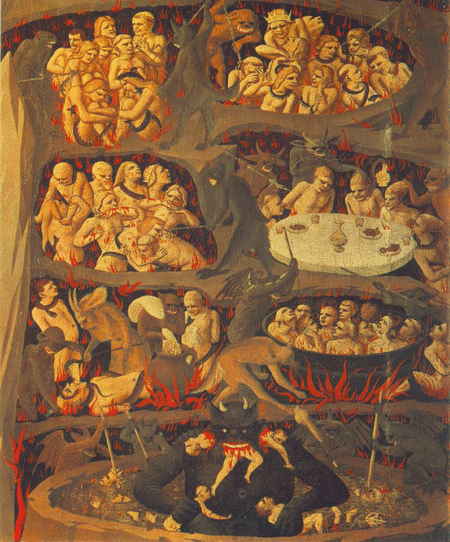
What Did Jesus Teach About Hell? Is it eternal, conscious, torment?

“Then he will say to those at his left hand, ‘You that are accursed, depart from me into the eternal fire prepared for the devil and his angels; . . . 46. And these will go away into eternal punishment, but the righteous into eternal life.” Matthew 25.41, 46 (NRSV)

 Craig S. Keener comments on this pericope in his New Testament Background Commentary in this way:

25:41-45. Some Jewish traditions (like Qumran War Scroll) report that Belial (Satan) was created for the pit; destruction was not God’s original purpose for people (4 Ezra 8:59-60). In many Jewish traditions, the demons were fallen angels (cf. comment on 2 Pet. 2:4). Jewish tradition was divided on the duration of hell; this passage’s description of it as “eternal” was certainly not merely a concession to a universal image in Judaism.

25:46. Eternal life was promised to the righteous after their resurrection at the end of the age (Dan. 12:2). Some Jewish teachers believed that hell was temporary and that at the end some people would be burned up and others released; other Jewish teachers spoke as if hell were eternal. Jesus here sides with the latter group.[1]

This begs the question; what did Jesus believe about what has been labeled the eternal conscious torment doctrine of hell (the Traditional teaching)? According to Keener, and in this particular dominical teaching of Jesus; Jesus held to the belief that hell (or the after-life separated from participation with God through Christ [my gloss]) does indeed articulate that there is a literal hell that involves eternal conscious torment. As the quote from Keener also illustrates, the Jewish context in which Jesus taught as a Rabbi was not monolithic on this doctrine; it is just that Jesus appropriated and taught the strand that articulated that hell fits with what today would be called the traditional view.

In concert with this assessment, none other than The Evangelical Universalist, Gregory MacDonald (aka Robin Parry) holds that the dominical (Jesus’) teaching is consistent with Keener’s perspective; that is that Jesus taught that hell was eternal conscious torment. Note MacDonald,

[G]ehenna was a place of punishment and fire but beyond that was generally left unexplained. When we find Jesus drawing on the idea of Gehenna, we must remember that it was not a clearly worked out concept. Beyond its being a place of fiery punishment for the wicked, the details, if anyone wanted to fill them in, were up for grabs. That said, I think that it is quite clear that Jesus’ contemporaries would not have thought the he was a universalist of any variety. To the traditionalist this settles the case, but I think that there is more to be said. I want to argue, first of all, that none of Jesus’ recorded teachings about Gehenna explicitly affirm the notion that it was everlasting; and nothing Jesus is recorded to have said rules out the possibility that some or all of its inhabitants may at some point come to salvation. I am not trying to show that Jesus taught universalism nor that he taught that those in Gehenna could or would be saved, for he did neither. My aim is the much more modest one of showing that what he did teach does not formally contradict universalist claims. This, of course, does not provide any reason to suppose that a universalist interpretation of Gehenna is biblical without substantive additional reasons for embracing such an interpretation. My second task is to show that we do have such reasons.[2]

MacDonald helps reinforce Keener’s commentary, that indeed Jesus taught the Jewish tradition (amongst the many available, just as there are many available today for Christians—but not viable for most Christians) that there is a literal place in the life after life (to borrow Wright’s quip) known as hell; and that this will be a place that is characterized by final eternal conscious torment.

So this represents the dominical teaching; the teaching that Jesus taught. But this does not serve as a death knell for ‘Evangelical Universalists’; as MacDonald notes. For Jesus, in his context, the teaching that hell was eternal could very well have been “just” for his particular context. In other words, as MacDonald later contends, Jesus’ pronouncement on this topic could have been  to reinforce the severity of God’s judgment; and yet at the same time, not intending to be the last word on it. MacDonald writes:

[W]e should not suppose that, because Jesus did not explicitly teach universal salvation or explicitly repudiate the idea that many people would never experience salvation, universalism is an un-Christian idea incompatible with Jesus’ ministry. If later revelation leads in universalist directions, as I have argued it does, then we need to understand the ministry of Christ in that light. It is the whole canonical story that we examined in Chapters Two to Four that forms the broader theological context within which we must understand Jesus’ teachings about Gehenna, and it is that very context that serves to modify some of the understandings of it common in Jesus’ own day.[3]

For MacDonald, for Jesus not to teach universalism does not mitigate the fact that the whole scope and sweep of the canonical teaching does in fact teach a Christian universalism. We will have to redress this at another time.

Conclusion

The question that I have been seeking to answer through this short piece has been “What did Jesus believe and teach about the view of hell that involves eternal conscious torment; did he teach this view or not?” The result of some cursory (yet I think substantial) musing has been to conclude that Jesus did indeed teach that there is a literal place that has become known as ‘Hell’, and that hell is unfortunately characterized by eternal conscious torment.

This is an important point to establish because it places the burden on those who disagree to disagree with Jesus. Are there ways to do that, and still honor Jesus’ own teaching, and even his person? MacDonald believes that there are, and in fact he thinks he has (found the way).

There are other prominent foci (or focal points) to consider towards helping us understand how to place Jesus’ teaching, in the book of Matthew for example. In other words, there is a strong theological case to be made for a Christian universalism that attends to who God is as Triune Love, full of grace. If God is Love (and he is), then we have to interpret Jesus’ views and teaching on hell through that lens (the lens of the cross, the penultimate expression of his love … the ultimate being his resurrection). MacDonald’s contention to annex Jesus’ teaching to a particular situation he was addressing might have teeth in light of the theological argument; it might leave the door open for a Christian theological reification or classification of hell in ways that might favor something like MacDonald’s Evangelical Universalism. There might be hope. Maybe Jesus didn’t intend his teaching to offer the last word after all; on hell that is.

No matter what, in the end, the conclusion must be that Jesus did teach what some would call the Traditional view of hell as ‘eternal conscious torment’. How one places that, in its ‘universal scope’ is what still needs to be contended with (MacDonald has, I’m still working on it).

My personal conclusion, at the moment, is that Jesus’ teaching on hell should serve as the standard; I see it with ‘universal force’ and thus am not willing, as of yet, to annex it, or particularize it to his specific audience in the 1st century (which would be what MacDonald does, amongst others). I continue to hold to the trad teaching, but I also am willing to hold out that once we are present with the LORD in the consummation that he could surprise us in keeping with his life of grace and love.


[1] Craig S. Keener, The IVP Bible Background Commentary, New Testament, (Downers Grove, Illinois: Intervarsity Press, 1993), 118-19.

[2] Gregory MacDonald, The Evangelical Universalist, (Eugene, OR: Cascade Books, 2006), 144-45.

[3] Ibid, 149-50.

What Do You Want Me to Address?

Is there anything, any topic, or biblical theological issue you the reader would like me to bring up and address? I am open to your suggestions; with the caveat that I might not have the time to address everything (if you all have any suggestions). Let me know.