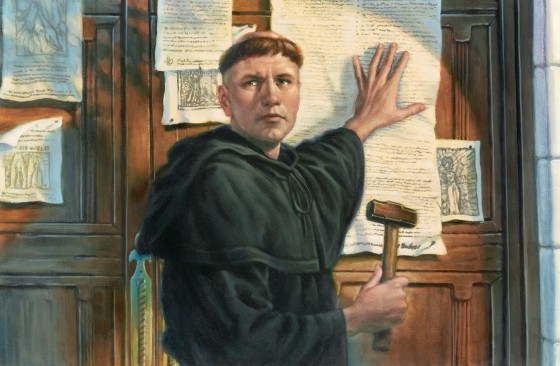
Luther: Humans After the Fall are Philosophers

Martin Luther on the natural state of being human after the Fall; Luther thinks that when it comes to God people in their fallen status can only elevate to the level of philosopher. It is an insight that Feuerbach, in his own way, would develop, but in a more antagonistic way towards religion in general; i.e. the idea that god is simply a human projection.

. . . Since the Fall every man has been a philosopher, for he has taken his experience of the world and his knowledge of reality — which he has succeeded in describing scientifically — as a standard by which to measure God. But the intellect does not suffice to grasp the God of Abraham, Isaac, and Jacob; He must be apprehended through the Scriptures. The “God” created by man is a false god of his own making.[1]

In a nutshell it is this reality that evangelical Calvinists press into; i.e. the idea that without God Self-exegeting Himself for us in Jesus Christ (which is exactly what John 1.18 says He does); without being given Christ’s heart in the resurrection (Rom. 6–8; II Cor. 3; Ezek. 36; etc.) all we can do is philosophize and conjure categories about God that we claim to have discovered by reflecting upon nature refracted by our personal and collective experiences as human beings. As evangelical Calvinists we are saying a loud Nein to this, and affirming what Luther holds true about humans after the fall.

[1] Heiko Oberman, Luther: Man Between God and the Devil, 170.


Theology and Cancer: Genuine Christian Theology and How it Comforts Through Revelation

Cancer and theology: my friend Todd Billings has written a book on the relationship between cancer and theology; motivated by his own diagnosis with an incurable cancer known as multiple myeloma. As many of you know I too, back in late 2009/2010, was diagnosed with an incurable/terminal (typically) cancer known as desmoplastic small round cell tumor (sarcoma), or DSRCT. Both Billings and I have miraculously survived our respective cancers, and by God’s grace carry on.

fallleavesThroughout the rest of the post I would like to reflect on cancer and theology, and how they relate and even can inform each other. I am prompted to write this post because of a mini Facebook discussion I had yesterday with my friend, Derrick Peterson. He had written a blog post himself on proofs for God’s existence. Eventually in the conversation I brought up cancer, and how God had worked through that in my own life to assuage and in fact rebuff serious doubts I’ve struggled with about God for many years. The type of doubts I had were not unhealthy doubts, but doubts I believe that God in Christ allowed to come upon me to push me deeper into Him. Nonetheless, I had them, and they were very strong; they caused depression and anxiety; and I just wanted them to go away, so I studied and prayed a lot (we are talking over a season of probably fifteen years). But I am starting to digress, let me move into the post now, and try to bring cancer and theology together.

Christian Theology

The first question, if we are going to talk about cancer and theology is to try and define what in fact the entailments of a genuinely Christian theology actually are. This will be an important step, because in order to understand how theology can inform and relate to cancer, we need to have a solid understanding of what Christian theology is. To help us develop what genuine Christian theology is Scottish theologian Thomas Torrance will have the honors as he is describing Karl Barth’s way of doing theology as well as his own:

Because Jesus Christ is the Way, as well as the Truth and the Life, theological thought is limited and bounded and directed by this historical reality in whom we meet the Truth of God. That prohibits theological thought from wandering at will across open country, from straying over history in general or from occupying itself with some other history, rather than this concrete history in the centre of all history. Thus theological thought is distinguished from every empty conceptual thought, from every science of pure possibility, and from every kind of merely formal thinking, by being mastered and determined by the special history of Jesus Christ.[1]

This is the way I approach theology as well. It is to understand that Jesus Christ in a principled and even absolute way must be the center for knowing God for us; since as the Apostle John makes clear, that was a fundamental part of Jesus’ mission.[2] There are other ways of doing theology out there that don’t do theology this way; as we have noted elsewhere on this blog, classical ways for doing Reformed theology (and I am Reformed, so I will camp on this) are much more abstract and speculative—i.e. they don’t necessarily start with Jesus Christ in an intense way for doing theology. This is not to say that the piety of some of these practitioners does not attempt to make up the difference in some of these other ways of doing theology, but they are not directly given shape by starting with Jesus in the ways that Barth and Torrance do (as does Athanasius).  In other words, I would contend that starting theology with Jesus in a principled way starts with the triune idea that God is love; it does not work its way discursively towards that reality as some classical theologies might be wont to do.

At base then, at least for me (as an evangelical Calvinist, and student of Karl Barth and Thomas Torrance), theology is Jesus; theology is objective in the sense that God is God, but genuine Christian theology moves the object into the subject (without losing its objective character) in Jesus Christ. In other words, genuine Christian theology is by definition, personal and relational. It is both of these because theology is not an idea, or simply a discipline, but genuinely Christian theology is a personal subject, it is the triune God Self-revealed and exegeted in Jesus Christ. It is this type of revelation that makes theology so inextricable to something like cancer; cancer is personal. So it is fitting, if God who is wise in Himself, if He is going to reveal Himself to us in Christ, does so where we are; hidden in the midst of our squalor and various forms of human suffering brought on by the fall of humanity into the abyss of sin.

To drive this reality of a genuine Christian theology home even further, let’s hear from Karl Barth directly as he writes about what Martin Luther called a theology of the cross versus a theology of glory. This will serve as the bridge that brings my desire to talk about cancer and theology together. Barth writes at length:

[I]n contrast Luther tries to draw attention to the vacuum, to the fact that passion (suffering) stands at the heart of life and speaks of sin and folly, death and hell. These fearful visible thing of God, his strange work, the crucified Christ — these are the theme of true theology. A preaching of despair? No, of hope! For what does that break in the center mean? Who is the God hidden in the passion with his strange work, and what does he desire? Explaining Heidelberg Thesis 16, Luther pointed out that the strange work leads on to the proper work, that God makes us sinners in order to make us righteous. The gap in the horizontal line, the disaster of our own striving, is the point at which God’s vertical line intersects our lives, where God wills to be gracious. Here where our finitude is recognized is true contact with infinity. He who judges us is he who shows mercy to us, he who slays us is he who makes us live, he who leads us into hell is he who leads us into heaven. Only sinners are righteous, only the sad are blessed, only the dying live. But sinners are righteous, the sad are blessed, the dying do live. The God hidden in the passion is the living God who loves us, sinful, wicked, foolish, and weak as we are, in order to make us righteous, good, wise, and strong. It is because the strange work leads to the proper work that there can be no theology of glory, that we must halt at the sharply severed edges of the broken horizontal line where what we find is despair, humility, the fear of God. For despair is hope, humility is exaltation, fear of God is love of God, and nothing else. The center of this theology, then, is the demand for faith as naked trust that casts itself into the arms of God’s mercy; faith that is the last word that can be humanly said about the possibility of justification before God; a faith that is sure of its object — God — because here there is resolute renunciation of the given character of scholastic faith (infused, implicit, and formed) as an element of uncertainty; faith viewed not as itself a human work but as an integral part of God’s strange work, sharing in the whole paradox of it.[3]

For Barth, and now for me, genuine Christian theology, as the Apostle Paul so eloquently declares is the wisdom of the cross (see I Cor. 1.18-25). God in His ineffable wisdom humbles himself to not only become a man, but humbles himself to the point of death, the death of the cross (see Phil. 2.5-10). God reveals Godself, hidden in the manger, in the body (which was His own human body) of a growing boy, and finally in the public ministry of Jesus Christ culminating in his death, burial,  resurrection (see I Cor. 15.1-4), ascension (see Acts 1; Col. 1–2), and coming again (see I Thess. 4; Rev. 19–22). When theology starts with God’s life revealed in the eternal Son, Jesus Christ, it cannot but help but to be meaningfully personal and cruciform in shape, since this is the shape that is most fitting for God become man by His own free and gracious choice; and this concordant with His character (in His inner triune life in se).

Cancer

Cancer is one of the most visceral fearful things, it seems, in our society of which people hope they never have to face. The sad reality though is that statistically more than fifty percent of all North Americans will receive some sort of cancer diagnosis in their life time (probably most towards their aging years, but that is also unfortunately changing quickly). I had to face it, and many of you (God forbid it!) might well have to face it yourself; if not, someone you know closely will in their life time. So cancer, among other ills produced by living in a fallen world, is an inevitability (although I think through proper diet most of cancer could be eradicated) that we will face one way or the other.

As I described theology above, that was not an abstract exercise for me; that is real life. When I received my “terminal” incurable cancer diagnosis it was the God revealed in Jesus Christ, in the cross and resurrection where I found immediate hope, confidence, and comfort. I did not have to work through an abstract apparatus of theology in order to work my way to God; because of the theological moorings I already had I knew He was ever present in this real time of trouble. I already knew that the God who I desperately needed was a humble, but all powerful God, who is able to enter into the depths of death and sin, and overcome it because of the inner-strength of His triune life of love. I knew that God first loved me, because He wasn’t a God who just talked the talk but He walked the walk before I was ever born or thought of (at least humanly speaking). I knew that I had an immediate and direct access to God because He had made clear to me in His Self-revelation in Christ that He had already come to me by enfleshing Himself with humanity and entering into all my suffering and despair. I found comfort in knowing that not only was God all powerful, but that His almightiness was shaped by immediate and personal love. I knew that He had power over death, because while He might appear to be hidden in the cross, for those with eyes of faith it was there where I could see Him most brightly.

Conclusion

When I started this post I had mentioned that discussion I had had with my friend Derrick about God and doubt. God revealed Himself, and met me so strongly in the midst of cancer that many of the doubts I had dealt with prior (for around fifteen long years) were crushed. It was through encounter with the living God in Christ, as I woke up every morning only to remember that “oh yeah, I have an incurable cancer in my body,” that this God of the cross broke in quickly on that fearful thought and made clear that nothing could separate me from the love of God in Christ Jesus. This is how good theology ought to work. It shouldn’t, at base, be an elaborate, even scholastic web of intellectualisms; instead it should be able to bring knowledge of God in the spaces of life where we would least expect to find Him.


[1] Thomas F. Torrance, Karl Barth: An Introduction to His Early Theology 1910-1931, 196.

[2] See John 1.18.

[3] Karl Barth, The Theology of John Calvin, 46.

 

Martin Luther’s Theology of the Cross for the Suffering and even the Arrogant Among Us

I was first introduced to Martin Luther’s theologia crucis, or “Theology of the Cross,” in seminary, in my Reformation Theology class. Once I heard of it, I was hooked! It is absolutely brilliant, and represents the best of Martin Luther’s theological offering for the church. My previous post was a tribute to Rory Wheeler, who just went home to be with the Lord as a result of the effects of cancer. Death, even for the Christian, presents lingering questions; the primary one being “why dear Lord, cannot you just vanquish this curse, right now?” It is obvious to all of those with eyes of faith, that the Lord works in ways that would appear “hidden.” He became man, a babe
christcrucifiedwrapped in swaddling cloths in a manger. He was born into a poor-man’s family from ridiculed Nazareth. The list of God’s hiddeness (Deus absconditus), of course, can be enumerated over and again. Indeed, this is where Luther’s theology of the cross finds its footing; that God works in ways that to the naked eye seem foolish (see I Corinthians 1:17-25, the passage of my Master’s thesis, and motivated by Luther’s theology of the cross). Randall Zachman provides one of the best descriptions of Luther’s theology of the cross that I have ever read. I am going to quote it in full, it is worth it; in fact if you want to continue to read my blog, your ticket 😉 is that you have to read this whole post because what Zachman has to say is that good! Here we go:

In the context of theologia crucis, faith means believing with certainty that God’s Word is true even when the whole world, the heart of the believer, and even God himself contradict the truth that is revealed in the Word, particularly the Word of promise. Thus, when God begins to show mercy, God does so by first revealing wrath (in law); when God makes alive, God does so by slaying. The same contradictions apply especially to those who have already come to faith. God promises the forgiveness of sins, yet our conscience feels nothing but sin and wrath; God promises life, yet we see nothing but death. Faith, therefore, is the art of believing the Word while experiencing, seeing, and feeling the opposite. We believe that Christ is the Son of God, even though we see and abandoned man on the cross; we believe that God cares for the church, even though we see nothing but a church persecuted by the world and apparently abandoned by God; we believe in eternal life, even though we see and feel nothing but death.

However, the primary locus of the theology of the cross is the experience of trial or tribulation (Anfechtung), when the very heart and conscience of the believer sense that God’s promise of grace and forgiveness is a lie. The believer must regard the promise of forgiveness as true and certain even though the conscience testifies to the contrary.

But under the cross which we experience, eternal life lies hidden. . . . We, too, experience the cross, and death appears to us, if not in fact, yet in our conscience through Satan. Death and sin appear, but I announce life and faith, but in hope. Therefore, if you want to be saved, you must battle against your feelings. Hope means to expect life in the midst of death, and righteousness in the midst of sins.

This is the very meaning of being simultaneously righteous and a sinner (simul iustus et peccator): to believe that we are righteous coram Deo even though we feel like condemned sinners.

Within the context of the theology of the cross, the grace of sanctification and its attestation in the testimony of a good conscience would necessarily be subordinated to the grace of justification and the promise of the forgiveness of sins. This is because the testimony of the good conscience confirms one’s faith in the promise, whereas the theology of the cross emphasizes that testimony of the conscience that contradicts faith in the promise; that is, Anfechtung. Therefore, although Luther continually insisted upon the necessity of sanctification and of the testimony of the good conscience, within the framework of theologia crucis he could not help but consistently subordinate the grace of sanctification to that of justification.

Luther’s concentration on the theology of the cross also accounts for his refusal to involve the Reformation directly in the external reform of the church. The Word of God does not deal with external, temporal things, but rather with invisible, eternal things; and such invisible things are revealed under an external appearance that contradicts what is being revealed. The theology of glory, in contrast—such as Luther found in the papacy—emphasizes externals to the point of neglecting the invisible truths revealed by the Word: indeed, to the point of calling God’s Word a lie. Thus, those in the Reformation who would introduce concern for externals—such as Karlstadt with his rejection of idols and the papal mass—misunderstanding the whole nature of the Word of the cross, and divert the attention of believers from the invisible, eternal things of God’s promises to the visible, temporal things of human reason and senses. Yet it is precisely reason and the senses that must be mortified if we are to believe that the Word of the cross is true.

Luther’s theologia crucis also explains his suspicion of those, such as the Anabaptists, who emphasized the external holiness and moral behavior of the church. If the Word of the cross reveals the truth of God under a contrary appearance, then one would expect the true church not to look like the church at all, but rather to look like God-forsaken sinners. The “synagogue of Satan,” on the other hand, with its theology glory, would look like the true church of God and would demonstrate a superior holiness externally—as in the monks and friars—but inwardly it would be rejected by God. The theology of the cross would therefore lead one not to stress the conformity of the appearance of the church with its faith, but rather stress the ways in which the appearance of the church denies its claim to be the people of God. The church looks like a gathering of sinners rejected by God and the world, whereas it is in truth the beloved people of God. The church cannot be judged by its appearance, but only by whether it has the Word of Christ crucified. Hence the primary task of the church is to preach the Word of God, while letting externals take their course. [Randall C. Zachman, The Assurance of Faith, 9-10]

How can that not bless you?! There is a lot in this, too much to talk about in toto; as far as the implications and applications, let me grab just a couple. But first I should also notice something else for us. You see Zachman refer to Luther’ “theology of glory,” this was in contrast to the theology of the cross; and it refers to (oversimplified) focusing on doing things for the praise and glory of men, instead of God (just do a word study or theology of glory study in the Gospel of John, you’ll see how this plays out) [Luther attacked the scholastic theology of his day as based upon the “theology of glory” instead of the “cross”]. Now to my applications.

1) It seems like a loving God would vanquish death so that humanity would no longer have to endure the torment of it. Indeed, he has, but it is only with eyes of faith that we understand the significance of the cross and resurrection and ascension. To the world if God is all powerful, and loving (David Hume) why doesn’t he do something about it now? The wisdom of God is displayed in hiddeness, in the unexpected; God is the God whose ways are not our ways, but the way of the cross, the unexpected! Why did the holocaust happen? Why do little kids die from cancer, or starvation? We have to interpret these kinds of questions through the hidden ways of God, through the cruciformity and cross-shaped work of God’s life. That’s the answer to Luther’s theology of the cross; the wisdom and knowledge of God is only penetrated by those who are wedded to him, in Christ, by the Spirit. And it is when we are pressed up against the most dastardly things of this life—tribulations—that we quit depending on ourselves, and throw ourselves on God’s mercy that we enter into the kind of life that God gives himself in his inner-life of mutual and interpenetrating love, Father, Son, and Holy Spirit. It is when we are pushed beyond ourselves that God’s glory in the face of Jesus Christ is just waiting to smile on is in the midst of our thlipsis, tribulation! Here is the wisdom of God, to take what is intended to destroy, and bring resurrection life out of it!

2) The second application here is a quicker observation. This one has to do with Luther’s/Zachman’s point about how the church should look vis-á-vis the theology of the cross. Frankly, it shouldn’t look like what Western, and in particular, American, upward mobile churches strive to look like. It shouldn’t look like people who have it all together. It should look like people who are broken, needy, and beggarly. When did Jesus do his greatest work of atonement? What was the crescendo of his work? When he went to the cross. When he was most broken. It was here that he brought life to all of humanity, through his death; by rupturing the bonds of self love (homo incurvatus in se), with the unbreakable bond that he shares consubstantially with the Father and Holy Spirit. That is, a life is given shape, by self-giveness; between the Father, Son, and Holy Spirit. It is through this kind of brokeness, in the mirror image of the cruci-shaped Son, that we can be the church for the world. That we have something to offer them; only when we are broken, and realize that we receive life as gift from the Father, in Christ, by the Holy Spirit.

Much more to say, but this has run long enough. I think I will talk more about the theologia gloriae “theology of glory,” in the near future.

*This is a repost, I really like what Zachman has to say on Luther’s ‘theology of the cross’; I hope you’re blessed by it today as well! Blessings.

Devotional with Martin Luther’s Theology of the Cross

I was first introduced to Martin Luther’s theologia crucis, or “Theology of the Cross,” in seminary, in my Reformation Theology class. Once I heard of it, I was hooked! It is absolutely brilliant, and represents the best of Martin Luther’s theological offering for the church. My previous post was a tribute to Rory Wheeler, who just went home to be with the Lord as a result of the effects of cancer. Death, even for the Christian, presents lingering questions; the primary one being “why dear Lord, cannot you just vanquish this curse, right now?” It is obvious to all of those with eyes of faith, that the Lord works in ways that would appear “hidden.” He became man, a babe wrapped in swaddling cloths in a manger. He was born into a poor-man’s family from ridiculed Nazareth. The list of God’s hiddeness (Deus absconditus), of course, can be enumerated over and again. Indeed, this is where Luther’s theology of the cross finds its footing; that God works in ways that to the naked eye seem foolish (see I Corinthians 1:17-25, the passage of my Master’s thesis, and motivated by Luther’s theology of the cross). Randall Zachman provides one of the best descriptions of Luther’s theology of the cross that I have ever read. I am going to quote it in full, it is worth it; in fact if you want to continue to read my blog, your ticket 😉 is that you have to read this whole post because what Zachman has to say is that good! Here we go:

In the context of theologia crucis, faith means believing with certainty that God’s Word is true even when the whole world, the heart of the believer, and even God himself contradict the truth that is revealed in the Word, particularly the Word of promise. Thus, when God begins to show mercy, God does so by first revealing wrath (in law); when God makes alive, God does so by slaying. The same contradictions apply especially to those who have already come to faith. God promises the forgiveness of sins, yet our conscience feels nothing but sin and wrath; God promises life, yet we see nothing but death. Faith, therefore, is the art of believing the Word while experiencing, seeing, and feeling the opposite. We believe that Christ is the Son of God, even though we see and abandoned man on the cross; we believe that God cares for the church, even though we see nothing but a church persecuted by the world and apparently abandoned by God; we believe in eternal life, even though we see and feel nothing but death.

However, the primary locus of the theology of the cross is the experience of trial or tribulation (Anfechtung), when the very heart and conscience of the believer sense that God’s promise of grace and forgiveness is a lie. The believer must regard the promise of forgiveness as true and certain even though the conscience testifies to the contrary.

But under the cross which we experience, eternal life lies hidden. . . . We, too, experience the cross, and death appears to us, if not in fact, yet in our conscience through Satan. Death and sin appear, but I announce life and faith, but in hope. Therefore, if you want to be saved, you must battle against your feelings. Hope means to expect life in the midst of death, and righteousness in the midst of sins.

This is the very meaning of being simultaneously righteous and a sinner (simul iustus et peccator): to believe that we are righteous coram Deo even though we feel like condemned sinners.

Within the context of the theology of the cross, the grace of sanctification and its attestation in the testimony of a good conscience would necessarily be subordinated to the grace of justification and the promise of the forgiveness of sins. This is because the testimony of the good conscience confirms one’s faith in the promise, whereas the theology of the cross emphasizes that testimony of the conscience that contradicts faith in the promise; that is, Anfechtung. Therefore, although Luther continually insisted upon the necessity of sanctification and of the testimony of the good conscience, within the framework of theologia crucis he could not help but consistently subordinate the grace of sanctification to that of justification.

Luther’s concentration on the theology of the cross also accounts for his refusal to involve the Reformation directly in the external reform of the church. The Word of God does not deal with external, temporal things, but rather with invisible, eternal things; and such invisible things are revealed under an external appearance that contradicts what is being revealed. The theology of glory, in contrast—such as Luther found in the papacy—emphasizes externals to the point of neglecting the invisible truths revealed by the Word: indeed, to the point of calling God’s Word a lie. Thus, those in the Reformation who would introduce concern for externals—such as Karlstadt with his rejection of idols and the papal mass—misunderstanding the whole nature of the Word of the cross, and divert the attention of believers from the invisible, eternal things of God’s promises to the visible, temporal things of human reason and senses. Yet it is precisely reason and the senses that must be mortified if we are to believe that the Word of the cross is true.

Luther’s theologia crucis also explains his suspicion of those, such as the Anabaptists, who emphasized the external holiness and moral behavior of the church. If the Word of the cross reveals the truth of God under a contrary appearance, then one would expect the true church not to look like the church at all, but rather to look like God-forsaken sinners. The “synagogue of Satan,” on the other hand, with its theology glory, would look like the true church of God and would demonstrate a superior holiness externally—as in the monks and friars—but inwardly it would be rejected by God. The theology of the cross would therefore lead one not to stress the conformity of the appearance of the church with its faith, but rather stress the ways in which the appearance of the church denies its claim to be the people of God. The church looks like a gathering of sinners rejected by God and the world, whereas it is in truth the beloved people of God. The church cannot be judged by its appearance, but only by whether it has the Word of Christ crucified. Hence the primary task of the church is to preach the Word of God, while letting externals take their course. [Randall C. Zachman, The Assurance of Faith, 9-10]

How can that not bless you?! There is a lot in this, too much to talk about in toto; as far as the implications and applications, let me grab just a couple. But first I should also notice something else for us. You see Zachman refer to Luther’ “theology of glory,” this was in contrast to the theology of the cross; and it refers to (oversimplified) focusing on doing things for the praise and glory of men, instead of God (just do a word study or theology of glory study in the Gospel of John, you’ll see how this plays out) [Luther attacked the scholastic theology of his day as based upon the “theology of glory” instead of the “cross”]. Now to my applications.

1) It seems like a loving God would vanquish death so that humanity would no longer have to endure the torment of it. Indeed, he has, but it is only with eyes of faith that we understand the significance of the cross and resurrection and ascension. To the world if God is all powerful, and loving (David Hume) why doesn’t he do something about it now? The wisdom of God is displayed in hiddeness, in the unexpected; God is the God whose ways are not our ways, but the way of the cross, the unexpected! Why did the holocaust happen? Why do little kids die from cancer, or starvation? We have to interpret these kinds of questions through the hidden ways of God, through the cruciformity and cross-shaped work of God’s life. That’s the answer to Luther’s theology of the cross; the wisdom and knowledge of God is only penetrated by those who are wedded to him, in Christ, by the Spirit. And it is when we are pressed up against the most dastardly things of this life—tribulations—that we quit depending on ourselves, and throw ourselves on God’s mercy that we enter into the kind of life that God gives himself in his inner-life of mutual and interpenetrating love, Father, Son, and Holy Spirit. It is when we are pushed beyond ourselves that God’s glory in the face of Jesus Christ is just waiting to smile on is in the midst of our thlipsis, tribulation! Here is the wisdom of God, to take what is intended to destroy, and bring resurrection life out of it!

2) The second application here is a quicker observation. This one has to do with Luther’s/Zachman’s point about how the church should look vis-á-vis the theology of the cross. Frankly, it shouldn’t look like what Western, and in particular, American, upward mobile churches strive to look like. It shouldn’t look like people who have it all together. It should look like people who are broken, needy, and beggarly. When did Jesus do his greatest work of atonement? What was the crescendo of his work? When he went to the cross. When he was most broken. It was here that he brought life to all of humanity, through his death; by rupturing the bonds of self love (homo incurvatus in se), with the unbreakable bond that he shares consubstantially with the Father and Holy Spirit. That is, a life is given shape, by self-giveness; between the Father, Son, and Holy Spirit. It is through this kind of brokeness, in the mirror image of the cruci-shaped Son, that we can be the church for the world. That we have something to offer them; only when we are broken, and realize that we receive life as gift from the Father, in Christ, by the Holy Spirit.

Much more to say, but this has run long enough. I think I will talk more about the theologia gloriae “theology of glory,” in the near future.

*This is a repost, I really like what Zachman has to say on Luther’s ‘theology of the cross’; I hope you’re blessed by it today as well! Blessings.

Karl Barth & Bobby Grow on Martin Luther’s ‘Theology of the Cross’

I am currently reading many books at the moment, most of them on John Calvin and his theology; one of these books is Karl Barth’s The Theology of John Calvin. In the beginning of the book he surveys the historical milieu into which John Calvin was reared in and thrust into as a theologian; this “surveying” necessitates that Barth discusses a bit of Martin Luther and his theology of the cross. The section I am going to quote is a wonderful description of Luther’s theologia crucis contra what Luther also labeled the theology of glory (which is error of theology which seeks to basically “fill the gap” of God’s revelation — the kind of theology that builds and builds upon itself, without ever referencing Christ or Scripture — the kind of theology that gets stuck on the horizontal, never really knowing how to get to the vertical [much like Federal Calvinism today], the kind of theology that seeks the praise of men instead of God). Here is how Barth describes Luther’s theology of the cross (PS. At the end of the quote you get a bonus video [homily like] I did about a year ago describing part of what Luther was attacking in regards to a “theology of glory”):

. . . In contrast Luther tries to draw attention to the vacuum, to the fact that passion (suffering) stands at the heart of life and speaks of sin and folly, death and hell. These fearful visible thing of God, his strange work, the crucified Christ — these are the theme of true theology. A preacing of despair? No, of hope! For what does that break in the center mean? Who is the God hidden in the passion with his strange work, and what does he desire? Explaining Heidelberg Thesis 16, Luther pointed out that the strange work leads on to the proper work, that God makes us sinners in order to make us righteous. The gap in the horizontal line, the disaster of our own striving, is the point at which God’s vertical line intersects our lives, where God wills to be gracious. Here where our finitude is recognized is true contact with infinity. He who judges us is he who shows mercy to us, he who slays usis he who makes us live, he who leads us into hell is he who leads us into heaven. Only sinners are righteous, only the sad are blessed, only the dying live. But sinners are righteous, the sad are blessed, the dying do live. The God hidden in the passion is the living God who loves us, sinful, wicked, foolish, and weak as we are, in order to make us righteous, good, wise, and strong. It is because the strange work leads to the proper work that there can be no theology of glory, that we must halt at the sharply severed edges of the broken horizontal line where what we find is despair, humility, the fear of God. For despair is hope, humility is exaltation, fear of God is love of God, and nothing else. The center of this theology, then, is the demand for faith as naked trust that casts itself into the arms of God’s mercy; faith that is the last word that can be humanly said about the possibility of justification before God; a faith that is sure of its object — God — because here there is resolute renunciation of the given character of scholastic faith (infused, implicit, and formed) as an element of uncertainty; faith viewed not as itself a human work but as an integral part of God’s strange work, sharing in the whole paradox of it. (Karl Barth, “The Theology of John Calvin,” 46)

repost

Good Works, The Work of the Great Deceiver

I am starting to become less and less convinced that Christians, at least in America, actually struggle with things like I am about to highlight in this post. It seems as if a folkism has overtaken American Evangelicalism in a way that pragmatism and utilitarianism rues the day, and principle and doctrinal concerns no longer, for some reason are important—I am somewhat rabbit trailing from where I want to take this post. I hit on this because I think that what this post is going to talk about might be down on the pole of significance for many of us; in fact I think that American Evangelicalism, in general, has so imbibed our feel good pop culture that the concept of ‘good works’ and right standing before God really have no functional meaning for people’s daily lives and spirituality. We are so busy with everyday concerns, trying to make ends meet, watching TV, and entertaining ourselves to death; that serious reflection about doctrinal concerns—like the relation between good works and saved by faith alone—really have no place of import in our lives.

Nevertheless, for those who might be the exception to my sketch above, this post might mean something to you. As you might have already picked up, I want to bring up the issue of ‘good works’ in the Christian’s life. And in particular, I want to get more insight into what Martin Luther, the Reformer thought, who is primarily known for emphasizing sola fide, ‘faith alone’. Maybe though, maybe I am wrong about what I was getting at in my first paragraph above; maybe in fact good works for Christians are alive and well, maybe good works (whatever those are) are what provides salvation, psychologically, for so many of us. Maybe when we do good things we feel good before God (coram Deo), and maybe when we do bad things we feel guilty before God; so maybe that’s why we try to comfort ourselves by the good that we do, and brushing the bad under the good in a way that makes us feel ‘justified’ before God (and of course we attribute the good to the power of God in our lives, and thus we even feel more justified when we see our good works; in fact we start to look at our good works as the basis for our assurance of salvation). According to John Webster, Martin Luther would totally disagree with you—if you think your good works are a sign of your salvation or something—here is how Webster describes Luther’s view here:

[…] Luther’s doctrine of justification b grace through faith severs the bond between acceptance and self-realization which he found in scholastic anthropology; in effect, his moral ontology calls into question the notion that self-conscious, self-actualizing selfhood is anthropologically primary. Indeed, in a crucial phrase he notes how, in good works as traditionally understood (i.e. as ‘religious’ works), ‘the self has been set up as an idol’. He acutely sees that religious works, and the understanding of the human person through which their significance is expounded, have become an exercise in self-preservation; good works are in league with human egotism, and their consequence is accordingly the deepening of human depravity and not release from it. For such works have become ‘merely acts of appeasement and self-righteous attempts at self-salvation. Luther recognised the depth of the corruption of the self which attempts to turn all goods to itself’. The target of Luther’s critique is thus the prudential calculation of benefits which might accrue to the agent on the basis of certain kinds of moral performance; acts undertaken in anticipation of rewards are ipso facto disqualified as good works, because within them lurks the sinful, self-realizing ego. If the Christian is related to his or her good works ‘self-centeredly’, the result is that chronic inflammation of the self which is the curse of sin. [John Webster, Barth’s Moral Theology, 163.]

This seems like a dilemma! If good works aren’t the sign of my salvation; if good works can’t provide me with assurance of salvation, then what or who can? If good works which are done by natural Pelagian impulse only serve to really further my own self-deception about how sinful I am—as T. F. Torrance would say ‘all the way down’—then I am of all men most to be pitied.

Of course the answer is ‘faith’, the faith of Christ at work in us by the Spirit. This is the ground of assurance, it is the faith of and the faith in Christ that resolves the dilemma. Good works, the ones we have been recreated in, in Christ (Eph. 2:10); are a result of the overflow of relationship that we already have with Christ. We don’t look to our good works as if those are our ‘Yes’ before God, He already said ‘No’ to them at the cross; instead, with the Apostle Paul we look to Christ where ‘all the promises of God find their Yes in him. That is why it is through him that we utter our Amen to God for his glory’ (II Cor. 1:20).

What Luther’s emphasis can provide is a way out of a moralistic Christian spirituality that can only produce introspective navel gazing Christians who ultimately are driven by angst, instead of the power of God, which is the true Gospel of Jesus Christ; the one that we are not ashamed of (Romans 1:16).

Christ the Key: My Developing Jesus Hermeneutic

*Sorry about the formatting with this post, I copy and pasted this one from another former blog of mine, and it translated to WordPress in this compressed form (as far as the paragraph breaks.
I have been seeking a hermeneutic, or a way beyond the impasse created by my move to what Gibson and Muller have called a principial & intensive method of biblical interpretation  (in reference to Barth on their part, no less). I have become disenchanted, over the past few years, with the hermeneutical framework (but not all of the ways) that I was trained in through both Bible College and Seminary; that is, theLiteral, Grammatical, Historical method. Certainly, though, I cannot, nor do I want to fully abandon the Grammatical, Historical, and Canonical realities that make up the shaping of what we call the Bible. So in other words, I have been in some personal conflict when it comes to my theory of hermeneutic; wanting to affirm a methodologically and principled way of reading scripture, in Christ. And on the other hand, not also wanting to reject the historical and canonical aspects of scripture that repose in it its Christic shape; so I want to continue to use the grammar, the syntax, the lexical, and the canonical markers of scripture that serve instrumentally to point beyond themselves to the deep reality they signify, in Christ.
In this seeking of mine, I have been reading Jens Zimmerman’s Recovering Theological Hermeneutics: An Incarnational-Trinitarian Theory of Interpretation. And unlike T. F. Torrance’s book Divine Meaning: Studies in Patristic Hermeneutics (which I thoroughly benefited from, of course, especially in serving the purpose in providing a general theory of hermeneutics that, indeed seeks to present a truly principled christocentric hermeneutic); Zimmerman’s book, and brief development of Luther (thus far in my reading of his chapter on Luther’s hermeneutic) has help to affirm the way that I want to proceed by being principially Christic in my biblical exegesis, and at the same time understanding that withinthis theoretical hermeneutical framework; that there is a viable way to employ all of the philological tools that one ought to employ when engaging the text of scripture, which isspecial literature.
The following two quotes from Zimmerman on Luther’s approach to biblical interpretation are the ones thus far that I have benefited from the most in my pursuit to provide some denouement to my, as of late, hermeneutical angst.
[I]t follows that the subject matter of the Bible, the good news of God’s love for humanity shown in the incarnation, cannot be understood through historical research alone. Nor in contrast to the historical school of the nineteenth century is historical distance a problem. The historical distance is nullified (not bridged) by the Word, which first created history and then was spoken into history. Luther concludes that it is the role of the Holy Spirit to make the incarnate Word present to the reader. Thus for Luther; a hermeneutics adequate to interpret the subject matter of the Bible is based on the unity of “Christ, Word, and Spirit” (EE, 365). Luther’s theory differed from a theory of verbal inspiration, for he insisted on a word behind the word that requires from the reader constant revisions in interpreting the written letter. . . . [59]
 In light of this, it is no surprise that someone like my friend, Matt, a Lutheran, is also a Barthian; for the above sketch of Luther’s hermeneutic sounds very much so like Barth’s (and T.F. Torrance’s, no less) approach to understanding the written word as it continually, and ever anew proximate the Living Word in whom the written and proclaimed word find their reality and orientation. As Karl Barth (I believe in his CD I/1) describes this, there is both the ‘outer-logic’ and ‘inner-logic’ of Scripture (playing off the Reformer’s perspicuity ‘outer/inner’ clarity dialectic); such that the written letter (outer logic) remains stable, our understanding of that is provisional and ever changing as we understand more and more the One, the Word, to whom this written word points (this is the ‘inner-logic’ according to Barth … and the reason that ‘theological exegesis’ should be understood as the norm for biblical interpretation).
Here is the second quote that again helps assuage and also confirm me in my own movement forward as a theological/Christological exegete of Holy Scripture; Zimmerman summarizes:
To sum up, for Luther, “the Word of God in the cosmic sense was the eternal Christ, and as the Word of God in the New Testament was essentially the historical Christ. Given his doctrine of the Word, it was logical for Luther to see Christ and the cross as the central theme of God’s redemptive word”…. Luther’s systematic Christological hermeneutic principle does not mean, however, that he simply read his opinion into the text; the assiduous use of all philological aids available at his time in his sermon and lecture preparation demonstrates Luther’s desire to develop theology from the text. That is not to say, of course, that sometimes his vivid imagination saw Christ in the text where modern scholarship does not. However, respected strands of contemporary scholarship have come to agree in principle with Luther’s reading of Paul and the plausibility of the Pauline assertion that Jesus the Christ is the fulfillment of Torah and the messianic promises in Isaiah pertain to his redemption and vindication of humanity … [Jens Zimmerman, Recovering Theological Hermeneutics, 59-60]
 As Zimmerman developed in an earlier iteration of his chapter on Luther; for Luther there is no understanding the historical word of scripture without the Word of Faith breathing life into the history as it is conjoined in Christ as he is the point and purpose of creation and creation’s history unfolded toward and in Christ. If this is the case, the words of scripture cannot have meaning or signification if they are abstracted from their reason for being as they are taken up in Christ. And yet, more constructively, this is exactly how higher-critical and historist approaches to biblical interpretation (some of which I have been discussing in previous posts, whether on the ‘Liberal’ side or the ‘Fundamentalist/Evangelical’ side) have colluded in their adumbration of the text of scripture (adumbrated because these ‘critics’ have place scripture into a pretext of their own construction, one that doesn’t have eyes to see and ears to hear, because if it did, these critics would understand that they can’t understand the text without understanding that it’s all about Jesus).
And so, since this post is now just over the reported attention span of blog readers (which is a 1,000 words, max.); I will close this post. Maybe you can appreciate a little better, then, where I am at in my own development; and maybe you can see why I have jettisoned my beloved LGH and even Dispensational hermeneutical theory.
PS. I am, at the end of the day, really quite pragmatic when it comes to all of this stuff; meaning that I have one principle that guides the way I proceed:“Jesus is the Key”. So, if it is Thomas Torrance, Karl Barth, John Calvin, my child-hood Sunday school teacher, or whoever else; if anyone or anyway serves my principle that ‘Jesus is the key,’ then I am willing to at least listen and test whether what one particular or another teacher communicates actually contributes to this principle or, instead, whether they quench this principle. Luther, and Zimmerman’s constructive reading of Luther is helpful towards my principle. That said, the only way we can really know if someone is helpful towards affirming my principle is to truly understand what said teachers really taught and thought; for this is the only way we can potentially benefit from their stated christocentrism. 
repost

Life is Hard!: A Reflection through the ‘Theology of the Cross’

Martin Luther writes (he was the one who constructed a theology of the cross versus a theology of glory):

But under the cross which we experience, eternal life lies hidden. . . . We, too, experience the cross, and death appears to us, if not in fact, yet in our conscience through Satan. Death and sin appear, but I announce life and faith, but in hope. Therefore, if you want to be saved, you must battle against your feelings. Hope means to expect life in the midst of death, and righteousness in the midst of sins. [taken from this post]

So there is a certain tension and dialectic that Luther is noting about the Christian life. Instead of me elaborating further on the theological context and depth of what Luther’s quote springs from, I want to simply use this quote from him to get us into an application of this in my own life—as I am experiencing it. The rest of what I am going to write, will be brief, and a simple reflection and thought that I am sure the Lord put on my heart yesterday as I was driving to work.

We all have trials and tribulations in this life, if we didn’t Jesus would have been a liar when he said this:

33 “I have told you these things, so that in me you may have peace. In this world you will have trouble. But take heart! I have overcome the world.” ~John 16:33

My family has been through one thing after the other it seems over so many years; poverty (by American standards), long term unemployment, cancer, unemployment again, my daughter needing emergency head surgery, employment that keeps me from seeing my family that often and keeps me, often, from going to church on Sundays, and many other things too intimate to get into here. And in the midst of this, it seems, at points, I have been striving to read all of these theology books and do theology; which, at points, seems to be an inane process. And it is this that the Lord really spoke to my heart about yesterday on the drive to work. He br0ught to mind I Corinthians 1 (the passage I wrote on for my Master’s thesis), and Martin Luther’s theology of the cross. I have been striving, in large part, to “do” theology by becoming in-formed through reading all of these theology books, etc.—a task, in an of itself which can be a fruitful and good thing [indeed, the fact that I know of Luther’s theology is because of this very kind of endeavor]—but the Lord spoke to my heart by reminding me that I don’t need to strive to do theology because he has already done (and is doing) theology in me, and in my family (and in all of us who are his). I don’t need to construct a space or situation wherein I can do a pristine and academic theology; instead, theology is God in Christ meeting me where I am at, in the mire (which unfortunately it seems to be so often) of my own circumstance. This is the wisdom of God, he humbled himself and became us (me), that I might, by adoption and grace become and participate what he has in his own resourcing life in Christ. In other words, the Lord impressed upon me that the very circumstances he has us currently facing in life (as a family, and individually), has been redeemed by his life in Christ; and all of the mundane, and, at points, dreary things facing us (me) are theological and chritologically rich situations wherein he reveals himself moment by moment as my sustenance, as my daily bread. It is not wrong to read theology books, but it is wrong when I think that “I” have to create some sort of situation that makes it so that I am doing theology. Instead, all of life is theological, all of life is christological, all of creation and its tumultuous circumstance has been reorientated to its orientation and purpose in Christ (cf. Col. 1:13ff). This perspective (which is what it is, ‘perspective’ providing) does not change the circumstances of life, it doesn’t really make things easier, but it does allow me to know that nothing that I am doing is in vain, because what I am doing has been placed into the context of what God is doing in Christ in and through the recreative activity of the Holy Spirit.

How does this relate to Luther’s theology of the cross? It gives me the perspective I need, to know that the only lens that can truly make any sense of anything in this life is the lens of the faith of Christ. Things don’t appear to be what they are (nakedly), just as the manger didn’t seem to be what it is for Christ; but to know that I can come to know God in rich and deep ways through every hard and rugged detail of this life gives me hope, I hope it gives you some too!

7 For we live by faith, not by sight. ~II Corinthians 5:7

Devotional with Martin Luther’s Theology of the Cross

I was first introduced to Martin Luther’s theologia crucis, or “Theology of the Cross,” in seminary, in my Reformation Theology class. Once I heard of it, I was hooked! It is absolutely brilliant, and represents the best of Martin Luther’s theological offering for the church. My previous post was a tribute to Rory Wheeler, who just went home to be with the Lord as a result of the effects of cancer. Death, even for the Christian, presents lingering questions; the primary one being “why dear Lord, cannot you just vanquish this curse, right now?” It is obvious to all of those with eyes of faith, that the Lord works in ways that would appear “hidden.” He became man, a babe wrapped in swaddling cloths in a manger. He was born into a poor-man’s family from ridiculed Nazareth. The list of God’s hiddeness (Deus absconditus), of course, can be enumerated over and again. Indeed, this is where Luther’s theology of the cross finds its footing; that God works in ways that to the naked eye seem foolish (see I Corinthians 1:17-25, the passage of my Master’s thesis, and motivated by Luther’s theology of the cross). Randall Zachman provides one of the best descriptions of Luther’s theology of the cross that I have ever read. I am going to quote it in full, it is worth it; in fact if you want to continue to read my blog, your ticket 😉 is that you have to read this whole post because what Zachman has to say is that good! Here we go:

In the context of theologia crucis, faith means believing with certainty that God’s Word is true even when the whole world, the heart of the believer, and even God himself contradict the truth that is revealed in the Word, particularly the Word of promise. Thus, when God begins to show mercy, God does so by first revealing wrath (in law); when God makes alive, God does so by slaying. The same contradictions apply especially to those who have already come to faith. God promises the forgiveness of sins, yet our conscience feels nothing but sin and wrath; God promises life, yet we see nothing but death. Faith, therefore, is the art of believing the Word while experiencing, seeing, and feeling the opposite. We believe that Christ is the Son of God, even though we see and abandoned man on the cross; we believe that God cares for the church, even though we see nothing but a church persecuted by the world and apparently abandoned by God; we believe in eternal life, even though we see and feel nothing but death.

However, the primary locus of the theology of the cross is the experience of trial or tribulation (Anfechtung), when the very heart and conscience of the believer sense that God’s promise of grace and forgiveness is a lie. The believer must regard the promise of forgiveness as true and certain even though the conscience testifies to the contrary.

But under the cross which we experience, eternal life lies hidden. . . . We, too, experience the cross, and death appears to us, if not in fact, yet in our conscience through Satan. Death and sin appear, but I announce life and faith, but in hope. Therefore, if you want to be saved, you must battle against your feelings. Hope means to expect life in the midst of death, and righteousness in the midst of sins.

This is the very meaning of being simultaneously righteous and a sinner (simul iustus et peccator): to believe that we are righteous coram Deo even though we feel like condemned sinners.

Within the context of the theology of the cross, the grace of sanctification and its attestation in the testimony of a good conscience would necessarily be subordinated to the grace of justification and the promise of the forgiveness of sins. This is because the testimony of the good conscience confirms one’s faith in the promise, whereas the theology of the cross emphasizes that testimony of the conscience that contradicts faith in the promise; that is, Anfechtung. Therefore, although Luther continually insisted upon the necessity of sanctification and of the testimony of the good conscience, within the framework of theologia crucis he could not help but consistently subordinate the grace of sanctification to that of justification.

Luther’s concentration on the theology of the cross also accounts for his refusal to involve the Reformation directly in the external reform of the church. The Word of God does not deal with external, temporal things, but rather with invisible, eternal things; and such invisible things are revealed under an external appearance that contradicts what is being revealed. The theology of glory, in contrast—such as Luther found in the papacy—emphasizes externals to the point of neglecting the invisible truths revealed by the Word: indeed, to the point of calling God’s Word a lie. Thus, those in the Reformation who would introduce concern for externals—such as Karlstadt with his rejection of idols and the papal mass—misunderstanding the whole nature of the Word of the cross, and divert the attention of believers from the invisible, eternal things of God’s promises to the visible, temporal things of human reason and senses. Yet it is precisely reason and the senses that must be mortified if we are to believe that the Word of the cross is true.

Luther’s theologia crucis also explains his suspicion of those, such as the Anabaptists, who emphasized the external holiness and moral behavior of the church. If the Word of the cross reveals the truth of God under a contrary appearance, then one would expect the true church not to look like the church at all, but rather to look like God-forsaken sinners. The “synagogue of Satan,” on the other hand, with its theology glory, would look like the true church of God and would demonstrate a superior holiness externally—as in the monks and friars—but inwardly it would be rejected by God. The theology of the cross would therefore lead one not to stress the conformity of the appearance of the church with its faith, but rather stress the ways in which the appearance of the church denies its claim to be the people of God. The church looks like a gathering of sinners rejected by God and the world, whereas it is in truth the beloved people of God. The church cannot be judged by its appearance, but only by whether it has the Word of Christ crucified. Hence the primary task of the church is to preach the Word of God, while letting externals take their course. [Randall C. Zachman, The Assurance of Faith, 9-10]

How can that not bless you?! There is a lot in this, too much to talk about in toto; as far as the implications and applications, let me grab just a couple. But first I should also notice something else for us. You see Zachman refer to Luther’ “theology of glory,” this was in contrast to the theology of the cross; and it refers to (oversimplified) focusing on doing things for the praise and glory of men, instead of God (just do a word study or theology of glory study in the Gospel of John, you’ll see how this plays out) [Luther attacked the scholastic theology of his day as based upon the “theology of glory” instead of the “cross”]. Now to my applications.

1) It seems like a loving God would vanquish death so that humanity would no longer have to endure the torment of it. Indeed, he has, but it is only with eyes of faith that we understand the significance of the cross and resurrection and ascension. To the world if God is all powerful, and loving (David Hume) why doesn’t he do something about it now? The wisdom of God is displayed in hiddeness, in the unexpected; God is the God whose ways are not our ways, but the way of the cross, the unexpected! Why did the holocaust happen? Why do little kids die from cancer, or starvation? We have to interpret these kinds of questions through the hidden ways of God, through the cruciformity and cross-shaped work of God’s life. That’s the answer to Luther’s theology of the cross; the wisdom and knowledge of God is only penetrated by those who are wedded to him, in Christ, by the Spirit. And it is when we are pressed up against the most dastardly things of this life—tribulations—that we quit depending on ourselves, and throw ourselves on God’s mercy that we enter into the kind of life that God gives himself in his inner-life of mutual and interpenetrating love, Father, Son, and Holy Spirit. It is when we are pushed beyond ourselves that God’s glory in the face of Jesus Christ is just waiting to smile on is in the midst of our thlipsis, tribulation! Here is the wisdom of God, to take what is intended to destroy, and bring resurrection life out of it!

2) The second application here is a quicker observation. This one has to do with Luther’s/Zachman’s point about how the church should look vis-á-vis the theology of the cross. Frankly, it shouldn’t look like what Western, and in particular, American, upward mobile churches strive to look like. It shouldn’t look like people who have it all together. It should look like people who are broken, needy, and beggarly. When did Jesus do his greatest work of atonement? What was the crescendo of his work? When he went to the cross. When he was most broken. It was here that he brought life to all of humanity, through his death; by rupturing the bonds of self love (homo incurvatus in se), with the unbreakable bond that he shares consubstantially with the Father and Holy Spirit. That is, a life is given shape, by self-giveness; between the Father, Son, and Holy Spirit. It is through this kind of brokeness, in the mirror image of the cruci-shaped Son, that we can be the church for the world. That we have something to offer them; only when we are broken, and realize that we receive life as gift from the Father, in Christ, by the Holy Spirit.

Much more to say, but this has run long enough. I think I will talk more about the theologia gloriae “theology of glory,” in the near future.

*This is a repost, I really like what Zachman has to say on Luther’s ‘theology of the cross’; I hope you’re blessed by it today as well! Blessings.

Reformation Day

Happy Reformation Day! If it wasn’t for Luther we wouldn’t have the Bible in the vernacular (English for me). If it wasn’t for Luther we wouldn’t have Calvin. If it wasn’t for Luther we might not be Americans. If it wasn’t for Jesus there wouldn’t be a Luther.