God’s Adversary and Ours: A Brief Theology of the Devil / A Book Impression

Just finished. It is a good provocative read. It is written in a nice narratival theological style, which definitely works within the spirit and ambit of the Barth style (i.e. engagement with Holy Scripture throughout). Philip re-places a doctrine of the devil into the second article, so, Christology and Soteriology (think Apostle’s Creed) versus the traditional placement as found in the first article with reference to original creation and God’s providence. This reorients thinking the devil from emphasizing him as a fallen angel, and instead sees him primarily in the scenery of the wilderness, as the adversary (of Christ), as adventitious, and anarchic. These three themes serve to organize the way that Ziegler seeks to place the devil within a dogmatic location of the second article. And it shouldn’t be forgotten that Ziegler is doing all of this work as a type of revitalization of a satanology for and within Reformed theology, proper.

One question I had going into this book was to see if Philip would hold to the idea that the devil is ā€œpersonal,ā€ or if the devil has an ontology of diabolical sorts. In the long and the short of it: yes, Ziegler affirms a type of nothingness beingness (my phraseology) which pairs well with Barth’s doctrine of sin or ā€œnothingnessā€ (das Nichtige)—which you can read about in CD III/3 (I also have some passages on that in my Barth Reader).

As a North American evangelical, like myself, I am conditioned to think of the Devil in the first article. As someone who reads Barth and Torrance and Calvin a lot, I am re-conditioned to think within the second article. And so, this clash continues for me, particularly when it comes to such matters as a satanology represents. Beyond that, as a basic evangelical Christian, there are too many real-life encounters that I have had with the demonic—ones that mirror those in the Gospels etc.—that experientially keep me from falling into any type of crass physicalism when it comes to the dark spiritual realm. Even so, the themes that Ziegler develops, therein, don’t contradict that reality, it just textualizes them in ways that some readers might think envelopes this matter into a purely intellectual exercise; but that would be wrong. Take it up and read for yourself.

Discoursing Our Way to an Angelology; Philosophy V the Bible; Thomas V Barth

Barth attempts to offer a Biblical Angelology. In the process he surveys some of the most primary developments on an angelology, in the history, as those were offered by Dionysius and Thomas Aquinas. Just on that level his treatment is interesting and rewarding. But in the midst of that, since he is slavishly beholden to the Protestant ā€˜Scripture Principle,’ he also identifies what I also take to be primary to a truly Christian presentation on the angels. As is typical, especially with reference to my own interests, Barth rightly recognizes the role that a prolegomena/hermeneutic will end up having on how a respective thinker will arrive at their veritable conclusion on what in fact angels (and demons) are. This a priori commitment to whatever hermeneutic someone deploys in their attempt to understand the supraphysical verities in God’s world, will in the end determine whether or not said thinker actually has a point of contact with God’s world or not.

In the following passage the reader will observe how Barth believes a philosophical/speculative attempt at developing a doctrine of the angels, as is present in Aquinas’ guiding habit, ends up providing something highly interesting and imaginative to contemplate; but beyond that, for Barth, this speculation only generates a notion of ā€˜angelness’ that only can get as high as the virtuoso’s genius. That is, Barth believes, for example, in Thomas’ attempt to prove the existence of angels, that insofar that he stays correspondent within his self-referencing universe, that Thomas does indeed offer something on ā€œthe angelsā€ that entails a coherence. But that’s what makes it something of interest to Barth, rather than something of substance (pun intended).

It cannot be contested that in a specific sphere and on a specific assumption proof is here given of the existence of a specific object interesting to the one who conducts the proof. It might be asked whether this sphere is real, and if so accessible, and if so able to be marked off in this way and approached with this assumption. It might be asked whether the proof furnished on this assumption and in this sphere is really conclusive and convincing either in detail or as a whole. But if we assume that everything is in order in this respect, and that Thomas has legitimately proved what he really could prove, there can be no doubt that with this assumption (or with the criticism or partial or total rejection of his demonstration) we are merely making philosophical and not theological decisions. Whether there are intellectual substances without bodies, and whether their existence can be proved in this or some other way, may be a question which is interesting and important in the sphere of philosophy. It may be one which can be discussed and even decided in this sphere. It may even be one which is decisive. But it is purely philosophical. On the basis of the Word of God attested in Holy Scripture we are not asked whether there are or are not substances of this kind, nor are we required to prove their existence in some way. If there are, and if their existence can be proved, this does not lead us to angels in the biblical sense of the term. And if there are not, and their existence cannot be proved, this is no argument against angels in the Christian sense. What are called angels in the Bible are not even envisaged in Thomas’ proof of the existence of these substantiae separatae [distinct substances], let alone is anything said for or against their existence, or anything meaningful states about them at all, with the eight proofs. And what Thomas later constructed upon the demonstrated existence of these substantiae separatae is very different from a doctrine of angels in the Christian sense of the term. In his demonstration Thomas has given us philosophy and not theology, and he has done so far more exclusively than Dionysius. He does so occasionally refer to Holy Scripture, and therefore it may be asked whether he does not incidentally and in some sense contrary to his own intention make some contribution to theological knowledge. But fundamentally and as a whole he simply offers us a classical example of how not to proceed in this matter.[1]

In nuce, if the Christian is going to attempt to offer a genuinely Christian doctrine of angels, they will, as Barth so rightly presses, be committed to the biblical categories rather than the philosophical ones. And of course, it is this methodology that funds the whole of Barth’s style of a confessional trinitarian-dialectical christologically conditioned way of doing theology from the reality of the Bible. The Christian philosophers among us would sneer at this; the classical theologians, the ā€˜Great Traditioners’ in our midst, would mock; how ironic.

Stay Biblical my friends.

[1] Karl Barth,Ā Church Dogmatics III/3 §50–51 [393] The Doctrine of Creation: Study EditionĀ (London: T&T Clark, 2010), 104.

Abortion, Sex Trafficking: Its Antidote in the Strength of the Babe from Nazareth

OĀ Lord, our Lord,
HowĀ excellentĀ isĀ Your name in all the earth,
Who haveĀ set Your glory above the heavens!

2Ā Out of the mouth of babes and nursing infants
You haveĀ ordained strength,
Because of Your enemies,
That You may silenceĀ the enemy and the avenger. –Psalm 8

I want to underscore one simple yet profound point by way of reflection on the above Scripture. ā€˜Out of the mouth of babes and nursing infants You have ordained strength.’ Ultimately, we understand as Christians that there is an archetype Babe elected for the world from eternity past, born of the Virgin Mary, wrapped in swaddling cloths and laid in a manger. We understand, in a proto-evangelical (cf. Gen. 3.15) way, that the Seed of the woman came and crushed the head of the serpent. Indeed, the strength of God was made manifest through the Babe for the world in Jesus Christ, the Man from Nazareth; obedient unto death, the death of the cross.

That is the most central aspect that I take from Psalm 8. But another, more sinister reality of this reality can be made by way of inference. One might wonder why the most innocent and vulnerable among us in the world—either children in the womb, or outside of it—are targeted so viciously by the abortionists and child sex traffickers; that is, why are pagans so bent on destroying the youth; whether that be through murder in the womb, or by taking their innocence from them in the process of sexualizing them? Why would the Enemy through his pagan spawn so target the ā€œleast of these.ā€ Why did Herod target children under the age of two in an attempt to wipe out the Messiah, the coming King? Exactly that. The Enemy of our souls, from first to last, hates nothing more than the idea that God has saved the world by first becoming a babe in the womb of a woman. This resonance for the serpent of old remains. He seeks to destroy the babes, the infants as much as is possible as an homage to his hatred for the Son of Man, come as a babe. The murder and destruction of young lives is the satanic sacrament of the religion of death he is lord of. Maybe this deathlord is so deluded that he still thinks he might be able to thwart yet the coming of the Son of God. Or maybe the coming of the Son of God in the womb of Mary, as the way of Life for the world so irritates the son of murder, that as an expression of his nugatory life, he is constrained by his hatred to bring death where in fact God has brought ultimate Life; through the gestation of His Life for the world in the womb of a mother.


The Father, The External Power of Our Existence

All creatures, since that are from nothing, to that extent share in nothing . . . and are in need of some external power for every moment that they exist.

–H. Heidegger cited by Heppe cited by Barth (CD III/3, 74)

All of humanity is sustained by the Word of God’s power. He came into this world, having made the world, and yet the world knew Him not. He is closer to us than we are to ourselves. If people could begin to lean into this point, made by the Reformed theologian, Heidegger (not the other Heidegger), we would lose so much of our angst and anxiety that we generate all the days of our weary lives. If we could come to recognize that the world is not contingent upon our waning ideas and breaths, and instead, that it is contingent upon God’s indestructible life; all of sleeplessness and depressions could be cast upon the One who cares for us. If we could submit to the idea, in worship, that God is God and we are not; we could finally repose in our Father’s everlasting arms of rest.

The Heavenly Dust: Christian Knowledge of God

As Christians we want to think about God as Christians. Christians, definitionally, aren’t profane persons. Indeed, according to Scripture, Christians are saints; i.e., set apart in Christ who is our Set Apart in the presence of the Father for us. This might seem scandalous to even recognize, but Christians are simply in a different place in regard to knowing reality as it is; insofar as the Christ (Jesus) allows us entrĆ©e in these, our bodies of death, in this in-between time. Some might want to push back and describe my observations as idealist. But it is just the opposite, in fact. Only Christians, in regard to thinking God and all else, can operate as non-idealists. That is to say, the Christian is confronted in their very beings with the fact that they, in themselves, left to their profane-selves, are sublated by the very dust and water their flatlander bodies consist of. Further, this entails that Christians, as they are confronted by reality in Jesus Christ, can acknowledge their subhuman statuses as profane persons; repent, because God in Christ first repented for us; and experience life re-created on the primordial plane of God’s elect and elevated life for us in Jesus Christ. On this new plane the dust the Christian consists of is no longer mortal and earthy, but immortal and heavenly; it is of a new body, with new capacities, which entail a capacity to actually think the living and true God from within a center in Himself for us in Jesus Christ. If this is the case, it behooves the Christian, who is distinct from the profane or secular person, to learn to imbibe and think from the sensory-tablet provided for by the Son of Man, as He sits at the Right Hand of the Father.

Torrance writes:

Here we are faced with another fundamental characteristic of the Truth of God as it is in Jesus; it is both divine and human. Knowledge of it, accordingly, is essentially bi-polar. This bi-polarity corresponds to the two-fold objectivity of the Word we have already noted. Knowledge of God is given to us in this Man, Jesus, but that knowledge does not allow us to leave the Man Jesus behind when we know Him in His divine nature. There is an indivisible unity in the ultimate Fact of Christ, true God and true Man. Theological knowledge rests upon and partakes of that duality-in-unity in the Person of Christ. In Him we know God in terms of what God is not, namely, man, for in Christ God, who is God and not man, has become Man and comes as Man, but in such a way that what God is in Christ He is antecedently and eternally in Himself. We know God is indissoluble unity with Jesus as we encounter Him through the witness of men, and we know Jesus in His human and historical actuality in indissoluble unity with God.[1]

The Christian inhabits another world whilst grounded in this world by the grace of God in the face of Jesus Christ. The Christian doesn’t have to leave this world to see the antecedent world of God’s Kingdom. Precisely because God’s Kingdom, in the wisdom of the Cross, the wisdom of God in Christ, comes to us; here, where we are in this mortal dust, in order to make us partakers of the heavenly dust of His recreated-resurrected-ascended humanity.

[1] Thomas F. Torrance, Theological Science (Oxford: Oxford University Press, 1978), 149.

“What is natural to him is life, not death”: On the Stupidity of Death

31Ā But regarding the resurrection of the dead, have you not read what was spoken to you by God:Ā 32Ā ā€˜IĀ am the God of Abraham, and the God of Isaac, and the God of Jacob’? He is not the God of the dead but of the living.ā€Ā 33Ā When the crowds heardĀ this,Ā they were astonished at His teaching. —Matthew 22:31–33

I remember when I was diagnosed with a rare and terminal-incurable cancer, called desmoplastic small round cell tumor-sarcoma (DSRCT), back in late 2009. My mortality was flung into my face in undeniable ways. The phone call from the doctor’s office, and of course the subsequent consultations, plunged me into a world of surreality, of the dislocated and disjointed; into a cosmos that seemed to be filled with ghosts, as if I no longer had concrete fixture on the earth beneath my feet. Death is not natural; humans were not created to die; they were not created to be disconnected from the fleshy bodies they were conceived with. Human beings were created for life, and not just life, but that more abundant life in the elevated reality of the living and triune God as that is mediated for us through the pre-destined humanity of the Son of God (Deus incarnandus). Unlike Confucian philosophy where life and death are simply an ebb and flow in the great circle of life, for the Christian we were created to worship God in Spirit and Truth; which, indeed, entails that we do so as we were created to be: i.e., in ensouled bodies built of the dust of the earth, with flesh and blood, hair and bones and teeth intact. The idea that people die is unnatural within the economy of God’s life for the world, the world He has pre-temporally predestined and freely chosen to be, in His choice to not be God without us, but with us, Immanuel.

Barth, as typical, has a really good insight on the dis-naturality of death:

In biblical demonstration of what has been said, we can first point only to the wholly negative character which the Old Testament gives to its picture of the nature and reality of death. In the perspective of the Old Testament, what is natural to man in his endowment with the life-giving breath of God which constitutes him as the soul of his body, not his subsequent loss of it. What is natural to him is the fact that he is and will be, not that he has been. What is natural to him is his being in the land of the living, not his being in the underworld. What is natural to him is life, not death. Death, on the other hand, is the epitome of what is contrary to nature. It is not, therefore, normal. It is always a kind of culpable extravagance to man when he longs for death, like Elijah under the juniper tree (1 K. 19.4) or Jonah under the gourd (Jonah 4.8). It is only hypothetically that Job protests to God: ā€œSo that my soul chooseth strangling, and death rather than my bones. I loathe my life; I would not live alwayā€ (Job 7.15f.). In extreme situations a man may curse the day of his birth (Jer. 15.10; 20.14f.; Job 3.3f). But he cannot rejoice at his death, or seriously welcome it. It is an exception which proves the rule when Job 3.21f. speaks of those who ā€œlong for death, but it cometh not; and dig for it more than for hid treasures; which rejoice exceedingly, and are glad, when they find the grave,ā€ or when reflection about all the injustice that there is under the sun culminates (Eccles. 4.2) in the statement: ā€œI praised the dead which are already dead more than the living which are yet alive.ā€ Hyperbolic statements of this kind do not mean that death is naturalised or neutralised or made into something heroic. When Saul (1 Sam. 31.4) falls upon his own sword, or when in later days Judas (Mt. 27.5) goes and hangs himself, these are deeds of despair which demonstrate their rejection of God and prove that death is the supreme evil of human life.[1]

When the Christian is faced with their respective mortality it is normal to have a feeling of angst and dearth. Indeed, as Christians, because of Christ, ā€˜though we die yet shall we live’; and this a ā€œfeatā€ that we are constantly living within as we, even today, by the Holy Spirit, count ourselves dead to sin and alive to Christ. Even so, the fact remains that when the days of our ā€˜now’ life are numbered, when the count is finished, and depending on the circumstances, like in the case of cancer or some other deadly prolonged disease, it is in fact rather normal to shrink back in disgust and disdain at the reality of our now exposed shadowy lives; not just in theory, but now in the concrete, in the practice of actually and consciously dying. Maranatha

[1] Karl Barth, Church Dogmatics III/2 §47 [599] The Doctrine of Creation: Study Edition (London: T&T Clark, 2010), 159.

The Primacy of Christ’s Seed: Contra Christendoms, Nationalisms, Traditionisms

Barth appeals to the primacy of Jesus Christ in all things. In one instance, in his Church Dogmatics, he is developing what it means to understand that Jesus is God’s ultimate plan for all of creation, all of history; which ultimately entails a disruption from all else, even as all else is taken up into the life of Christ as God’s history for the world. Here Barth is in the process of developing his treatment on such things, with particular reference to a doctrine of time vis-Ć -vis eternity. We will pick up with him mid-paragraph:

At any rate, as a human ministration it is related to the work of Jesus Christ in the same way as in the Old Testament the human act of blessing is related to the real word of blessing which has its power only from God, and which can therefore be uttered only by God Himself. However that may be, the birth of the Christian life ā€œof water and of the Spirit (Jn. 3.5) signifies a direct relationship of the individual Christian to Jesus. He does not follow father and mother or the line of his ancestors, but, taken out of this succession, or at any rate in independence of it, he follows Jesus. He believes that there is one holy catholic Church, and that he may be a living member of the same. Yet he does not believe in the Church, but in the Holy Spirit, who is consubstantial with the Father and the Son. He does not therefore honour and accept the Church’s tradition and order in becoming a Christian and confessing himself to be such, but he places himself behind and confesses the beginning which all ecclesiastical tradition and order can only serve, and which he can now recognise and receive as his own beginning. He believes, thinks, speaks and acts therefore, not as the member of a so-called ā€œChristian nation,ā€ but in gratitude to the Lord that even in his—in no sense Christian—country He has community, by and to whose ministry among this people he himself is called.[1]

This kicks against some of the Christian zeitgeist online right now; which is an extreme turn into postmillennial theonomy. But these types of immanentist turns are exactly what the true Gospel confronts, contradicts, and brings an end to. In the Gospel there is a mediated immediacy, in Christ, to the living and triune God; one that allows the Christian person to live before God rather than anyone else. To find a ground for Christian identity in anything other than the immediate and direct life of God for the world in Jesus Christ is to collapse and thus conflate God’s ways with the contingencies and particularities of the accidents of history; in the sense that Christian identity, in such a frame, begins to predicate God’s ways and in-breakings upon an a prior set of foundations and structures that He has not laid in Christ, but that we have laid in the power of our wit, albeit in the name of Christ.

Barth isn’t saying that salvation history isn’t important, that the historic Church isn’t important, that the catholic creeds aren’t important; He is simply noting that they aren’t the ends or circumscriptions of the reality they are ostensibly pointing beyond themselves and to, in their respective reality, as is all of creation’s, in Jesus Christ. The point is, there is no authority that supersedes the viva vox Dei (voice of the living God); that there is only one authority for the Christian person, as an individual member in the body of Christ (I Cor. 12.27), and His name is, Jesus Christ. The Christian’s birthright isn’t through a nation, an ethnicity, a Christendom, a political party, a ā€˜blood and soil,’ or anything else. The Christian’s birthright has been seeded in the seed of God as that was given life by the hovering work of the Holy Spirt within the womb of Israel, within the womb of Mary to be sure, but these only as vessels for the ultimate and prime reality of all of reality who is Jesus Christ.

I have grown very weary of being confronted with supposed ā€˜Protestant’ ā€˜Reformed’ ā€˜Lutheran’ ā€˜Anglican’ ā€˜Baptist’ ā€˜Wesleyan’ et al. ad infinitum theologies that end up being nothing more than appeals to some type of socio-politico construct that has been ostensibly harvested from the past as its best repristination for the 21st century church. There is an oppressiveness about all of this to me that does not evince the Spirit’s presence, which is liberty. Indeed, we are a social and political animal as creatures, but our end is not defined, or should not be defined, by this type of extension into space and time. We have been born directly from above, alongside the Son’s freely elected humanity for us, within the womb of the Father by the Holy Spirit. And it is from whence that we have our whither and warp in this fallen and decrepit world. It is by the blood of Immanuel’s veins, quite literally, that we have life; no matter what state, country, or church tradition we inhabit; if indeed we have such life at all.

[1] Karl Barth, Church Dogmatics III/2 §47 [585] The Doctrine of Creation: Study Edition (London: T&T Clark, 2010), 146.

The Gospel of the Forty Days

The resurrection of Jesus Christ is what all of history is contingent upon. All that we experience, linearly, has a ground behind, underneath, and after it that is in fact the resurrection of Jesus Christ. Without that centraldogma there is no history; there is no nothing. I think we, especially as Christians of all people, really need to get our heads around this reality. When we do we start living as those who have the hope of Christ in us, the purifying hope. We have a critical valence to look at the world from that is not purely conditioned by the immediate hype and circumstance. This is what Barth captures so well:

For the history and message of Easter contains everything else, while without it everything else would be left in the air as a mere abstraction. Everything else in the New Testament contains and presupposes the resurrection. It is the key to the whole. We can agree finally that acceptance or rejection of the Gospel of the New Testament, at any rate as understood by the New Testament itself, depends on our acceptance or rejection of the evangelium quadraginta dierum [gospel of the forty days]. Either we believe with the New Testament in the risen Jesus Christ, or we do not believe in Him at all. This is the statement which believers and non-believers alike can surely accept as a fair assessment of the sources.[1]

On one hand you can hear in Barth a critique of Bultmann’s demythologizing project. But more theologically significant is simply the establishment of the fact ā€œthat Christ is risenā€ explains everything immediate, in regard to the composition of the New Testament itself. But even more, the resurrection makes sense of the whole of reality in a very organic rather than totalizing way. That is to say, the resurrection of Jesus Christ presents us with an openness of life towards the triune God. It is here where a theology of nature, and a theology of everything else is resident; that is, in the resurrected humanity of Jesus Christ. Without His humanity there would have never been any tinder for this world to be formed by; never a purpose for it to rotate in the Milky Way. Until this radical reality is apprehended the Christian will continue to inhabit a wilderness like experience. They won’t have the eyes to see or the ears to hear the depth reality and intonation of God’s still small voice as it breezes by them afresh anew by the Spirit’s hovering life. The resurrection makes all things new. It puts to death the old (sorry natural law/theology), and presents humanity with God’s humanity for the world in Jesus Christ. If we are going to have any chance of knowing God, of accessing His created order, and its telos, we will only come to this through participation with Jesus Christ; through His union with us, that we might be in union with Him, in the triune life of the eternal God.

[1] Karl Barth, Church Dogmatics III/2 §47 [444] The Doctrine of Creation: Study Edition (London: T&T Clark, 2010), 7.

Created Grace

I have pressed the idea for decades now, after being alerted to these things by my former historical theology seminary professor (and still mentor), Dr. Ron Frost, in regard to Thomas Aquinas’ synthesis of Aristotelian categories with Christian [Augustinian] theology. I am referring to the Thomist thinking on created grace. There are many retrievers of scholastic Reformed theology these days, inclusive of Matthew Barrett, in his own idiosyncratic way. Richard Muller has identified the swath of Post Reformed orthodox theology as Christian Aristotelianism. This would be another way of simply saying (for the most part): Thomism or a neo-Thomism of sorts. This is why I have argued, along with others, that Tridentine Catholic theology, along with those who appropriated said theological categories, like the Reformed scholastic, have taken over a semi-Pelagian soteriology; or a cooperative theory of salvation vis-Ć -vis God and the human agent. Within the scholasticism Reformed frame, we see this type of cooperative model developed under the aegis of what is known as a Covenantal or Federal theology. The elect are provided with a created grace (distinct from the personal grace that is the Holy Spirit’s unction), by which, in the Federal scheme, they are able to cooperate with God in meeting the conditions of the promisso, or bilateral covenant betwixt God and man/woman, in regard to attesting to and appropriating their elect status.

There is more to be said about all of the aforementioned, but I wanted at least to provide a theological context or background for the points made by Gilles Emery, as created grace looked in the theology of Thomas Aquinas—as distinct and opposed to the personal grace of the Holy Spirit. The scholastics Reformed will often equate the personal grace of the Holy Spirit notion with created grace, with the point of downplaying the Thomistic/Aristotelian flare found in what can be called the habitus theology of Thomas Aquinas. Someone who doesn’t downplay these things though is indeed, Richard Muller. Emery writes,

Thomas actually emphasizes the necessity of a created grace. When the Holy Spirit is given to human beings, he does not enter into a synthesis with someone with whom he is ā€˜mixed’ or ā€˜fused’. Even in Christ, there is no mixture or conflation between the divine and the human nature. For a human being’s own nature to be raised into communion with God, it is necessary to recognize, from the moment of their participation in God onwards, a gift in her which will be the intrinsic principle of her sanctification, a reality which has a human size, and so is a created one, situated on the ontological plane of creatureliness: this is the grace which is called ā€˜created’. This gift comes from God alone, because it is God alone who divinizes, God alone who makes human beings participants in his own divine nature. But, even when he gives himself, God remains distinct from human beings. In the scholastic terminology, it is necessary to see that God is not the ā€˜formal cause’ of the life of grace, because he does not enter into formal composition with the human (both God’s simplicity and the created condition of human beings make this unthinkable, for we would then be faced with a conflation of the divine and human nature). In this light, grace is a created disposition which human beings receive from God. It is, so to speak, a gift from God which puts itself onto the ontological level of human nature, proportioning itself to the human in order to make it possible for men and women to be united to God from within their own human life. Such created grace disposes human beings to receiving the divine person. Thomas states,

the gift of sanctifying grace disposes the soul to possess the divine person; this is what the formula ā€˜the Holy Spirit is given through the gift of grace’ means. But the gift itself is the grace coming from the Holy Spirit; this is what Paul means when he says, The charity of God is poured forth in our hearts by the Holy Spirit.

The insistence on the necessity for a created gift (habitual grace with its gifts of wisdom and charity) must not make us forget that its aim is to make human beings capable of receiving the Holy Spirit himself, and, beside the Holy Spirit, the Father and the Son, who come to build their dwelling in the saints (ā€˜to possess the divine person’). St Thomas is very clear on this:

through the gift of sanctifying grace, the reasonable creature is not only perfected in such a way as to be able to make use of the created gift, but also in such a way as to enjoy the divine person himself…. the grace of the Holy Spirit is given to human beings in such a way that the actual source of the grace is given, to wit, the Holy Spirit himself.[1]

It is important to understand what a Thomist Intellectualist anthropology is at this point (which I clumsily wrote about in a seminary paper back in 2002, my first real exposure to these things). Suffice it to say, when a theologian starts with an Augustinian conditioned doctrine of predestination and election—wherein the elect (and reprobate) is thought of in abstract and individualistic ways—it is possible to end up with the thinking we see evinced in the outworking of Thomas’ theology of anthropology/salvation. There is an utter need to think the human agent away from the divine, to the point that when the Christ comes as God enfleshed, we end up with a necessary rupture between God’s person and work; to the point that even Christ’s human nature would need a created grace to cooperate with God in the work of salvation. This, in a Thomistic frame, is why a created grace is constructed in the first place: i.e., in order to keep the pure nature of an independent humanity in tact vis-Ć -vis the Creator/creature distinction, distinct. But this move becomes unnecessary, that is, the move to think of God’s grace in dualistic ways; i.e., personal and created. It is unnecessary because God’s Grace is God’s being in becoming for us; God’s grace is an eternal act of triune felicity (relative to the Deus incarnandus ā€˜God to be incarnate’).

There are things that need further detailing in order to tie up the dangling definitional ends in this post. But as usual, this will have to suffice for a blog post. I haven’t strung all of the dots together for you, but that’s part of the fun; I’ll leave it to you to bring some of the implications of what I have been writing on together.

[1] Gilles Emery, OP, The Trinitarian Theology of Thomas Aquinas (Oxford/New York: Oxford University Press, 2010), 253–54.
Disruptive Grace as Protology and Eschatology

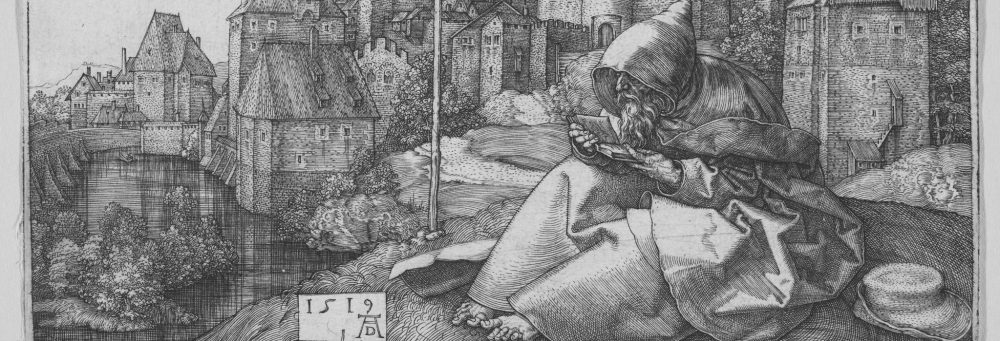
Grace was disruptive in the protology (beginning Gen 1:1ff) just as Grace is disruptive in the eschatology (the ‘end’ II Cor 5:17 etc). As such there is no stable creation (nature), there is only its enduring Word of upholding wherein stability is found. The continuity of the creation, and its various “properties,” is not based in an inherent independence of its own (waiting for discovery abstract from God’s intensive witness in the Christ), but upon the Grace of God’s Word that continuously gives it life, even in the face and reality of its certain death (Rom 8:18ff). That is to say: creation is a creatio ex nihiloĀ (creation out of nothing), which entails that its value and meaning is always contingent upon God’s Word as He presences (parousia) Himself, afresh anew, through the hovering breath of the Holy Spirit. To look to creation/nature as if a means of grace, is to confuse the creation with the Creator who is the Christ.