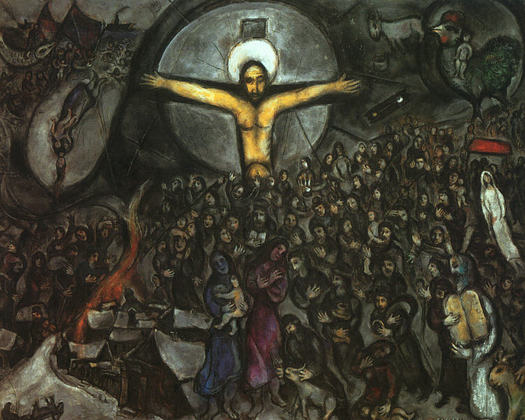
It seems as if we have domesticated everything in our culture, even sin. But this is precisely what Jesus will not let us do; this is precisely what the reality of the cross will not  let us do. The prophet Jeremiah writes in 17.9:
“The heart is deceitful above all things, And desperately wicked; Who can know it?
And the Apostle Paul following writes in Romans 3:
10 As it is written: “There is none righteous, no, not one; 11 There is none who understands; There is none who seeks after God. 12 They have all turned aside; They have together become unprofitable; There is none who does good, no, not one.” 13 “Their throat is an open tomb; With their tongues they have practiced deceit”; “The poison of asps is under their lips”; 14 “Whose mouth is full of cursing and bitterness.” 15 “Their feet are swift to shed blood; 16 Destruction and misery are in their ways; 17 And the way of peace they have not known.” 18 “There is no fear of God before their eyes.”
Karl Barth famously, and in keeping with his normal way, believes we can only know the depths of evil and sin by its reference to Christ. He believes that only as we concentrate on whom Christ is in His righteousness, can the gravity of sin come to be known. Barth works out his doctrine of evil (or ‘nothingness’) through his doctrine of election. For Barth, nothingness, or ‘evil’ is what God passes over and negates through the incarnation and cross-work of Jesus Christ. Mark Lindsay, after much development, writes the following:
At this place, we must qualify our earlier comment that God is not threatened by Nothingness. In the incarnation, God Himself becomes a creature and thus takes upon Himself the creature’s sin, guilt and misery. In “what befalls this man God pronounces His No to the bitter end.” The entire fury of Nothingness – and of God’s wrath directed towards it – falls upon Christ “in all its dreadful fulness…” Precisely, however, because this man is also God, “Nothingness could not master this victim.” It had power over the creature. It could contradict and oppose it and break down its defences. It could make it its slave and instrument and therefore its victim. But it was impotent against the God who humbled Himself, and Himself became a creature, and thus exposed Himself to its power and resisted it.
By confronting and decisively triumphing over Nothingness in Jesus Christ, God has relegated it to the past. In the light of the cross and the empty tomb, “there is no sense in which it can be affirmed that nothingness has any objective existence…” Barth rejects outright the suggestion that radical evil exists in the form of an eternal antithesis. On the contrary, he insists that it has no perpetuity. It is neither created by God, nor maintained in a covenantal relationship with Him. Thus, “we should not get involved in the logical dialectic that if God loves, elects and affirms eternally he must also hate and therefore reject and negate eternally. There is nothing to make God’s activity on the left hand as necessary and perpetual as His activity on the right.” Nothingness has been brought to its end, no longer having even the transient and temporary existence it once had. On this note of “cosmic optimism”, Barth concludes his presentation of his doctrine.[1]
We are reminded of Athanasius’ thinking on evil and sin in his little book On the Incarnation as we read Barth’s own uniquely worked out conception of evil and sin. Inherent to Barth’s understanding there is genuine hope. Because he doesn’t give evil (and its expression in sinful acts) a symmetrical place to God’s work and righteousness in Christ, he offers a way to think of evil/sin as a vanquished foe that in the end will be fully wiped out in a realized way. What stands out, in Lindsay’s description, is how it took God in Christ alone to overcome the wiles of evil’s reach into the human heart; and thus into all of creation.
It doesn’t seem as if folks appreciate just how deep rooted and satanically conditioned their ‘old hearts’ are outwith Jesus Christ. When you hear the ‘world’ speak you would think that they have seemingly overcome evil all by themselves; as if they have an objectively established goodness inherent to who they are, through which they are able to look ‘out’ and make judgments about good and evil as if the latter doesn’t ultimately affect them. On the contrary, the incarnation and cross of Jesus Christ asserts and proves just the opposite. There is no one good, and all our hearts are just as evil as the terrorist’s who shot up the mosque in Christchurch, New Zealand. The cross of Christ will not allow any of us to escape the terror embedded in each and every one of our hearts.
To press this further, Thomas Torrance underscores just how deep our darkness is by, like Barth, focusing on the depths God had to go to de-root it from our very ‘beings’ as human beings. Torrance writes on the ontological character of the atoning work of Christ, this way:
It is above all in the Cross of Christ that evil is unmasked for what it actually is, in its inconceivable wickedness and malevolence, in its sheer contradiction of the love of God incarnate in Jesus Christ, in its undiluted enmity to God himself—not to mention the way in which it operates under the cover of the right and the good and the lawful. That the infinite God should take the way of the Cross to save mankind from the pit of evil which has engulfed it and deceived it, is the measure of the evil of evil: its depth is revealed to be ‘absymal’ (literally, ‘without bottom’). However, it is only from the vantage point of God’s victory over evil in the resurrection of Christ, from the bridge which in him God has overthrown across the chasm of evil that has opened up in our violence and death and guilt, that we may look into the full horror of it all and not be destroyed in the withering of our souls through misanthropy, pessimism, and despair. What hope could there ever be for a humanity that crucifies the incarnate love of God and sets itself implacably against the order of divine love even at the point of its atoning and healing operation? But the resurrection tells us that evil, even this abysmal evil, does not and cannot have the last word, for that belongs to the love of God which has negated evil once and for all and which through the Cross and resurrection is able to make all things work together for good, so that nothing in the end will ever separate us from the love of God. It is from the heart of that love in the resurrected Son of God that we may reflect on the radical nature of evil without suffering morbid mesmerization or resurrection and crucifixion events, which belong inseparably together, has behind it the incarnation, the staggering fact that God himself has come directly into our creaturely being to become one of us, for our sakes. Thus the incarnation, passion, and resurrection conjointly tell us that far from evil having to do only with human hearts and minds, it has become entrenched in the ontological depths of created existence and that it is only from within those ontological depths that God could get at the heart of evil in order to destroy it, and set about rebuilding what he had made to be good. (We have to think of that as the only way that God ‘could’ take, for the fact that he has as a matter of fact taken this way in the freedom of his grace excludes any other possibility from our consideration.) It is surely in the light of this ontological salvation that we are to understand the so-called ‘nature of miracles’, as well as the resurrection of Jesus from death, for they represent not a suspension of the natural or created order but the very reverse, the recreation of the natural order wherever it suffers from decay or damage or corruption or disorder through evil. God does not give up his claim that the creation is ‘good’, but insists on upholding that claim by incarnating within the creation the personal presence of his own Logos, the creative and ordering source of the creation, thereby pledging his own eternal constancy and rationality as the ground for the redemption and final establishment of all created reality.[2]
Like Barth, Torrance points up the hope we have because of what Christ has won for humanity. But at the same moment, he also points out just how deep and pervasive sin is in the hearts of men and women, boys and girls. If it took God to become human to deal with each of our ‘desperately wicked’ hearts, how wicked do you think that makes us left to ourselves?
If the world is able to look out and recognize evil, it is only because they live under the grace and mercy of God given for it in Jesus Christ. And yet even as they rightly look at the despicable act that just took place in New Zealand, and condemn it as evil, they condemn themselves; that is, if they remain in an unrepentant state before God. Not only that, they confirm, unconsciously, the righteous judgment of God that not only hangs over terrorists’ heads, but their own. The spiritually dead heart can fabricate a state of self-righteousness only insofar as it borrows that righteousness from the economy of God’s Kingdom in Christ as that has invaded and continues to invade the world through the risen Christ’s life. Christ’s life for the world, the resurrected humanity, in itself, while standing as God’s Yes for the world, at the same moment issues a resounding No to the evil and sin that ALL humanity lives within (realized at various degrees or not). God’s Yes has already run its course and been actualized in the new humanity of Christ, as such anything outside of that lives in God’s No; which ultimately is hell.
Christians do not have ultimate solidarity with the world, even when the world, in parasitic fashion comes to some sort of sense of the heinous nature of evil. This does not mean Christians are superior to their pagan friends, it just means that Christians have an actual basis from which to rightly call darkness darkness and light light; this doesn’t mean Christians consistently live this way. Often Christians operate more like the pagan culture than the heavenly; which is why God’s Grace and Mercy will always remain so important.
[1] Mark R. Lindsay, Barth, Israel, and Jesus: Karl Barth’s Theology of Israel(UK/USA: Ashgate Publishing, 2007), 48-52.
[2] Thomas F. Torrance, Divine And Contingent Order (Oxford: Oxford University Press, 1981), 115-16.