The Soylent Green of American and Global Politics

God’s judgment, I would suggest, entails false choices often times. In this case, America is faced with a POTUS decision wherein Kamala Harris&co. seemingly are the archrivals of humanity all the way down. But then there is Trump. Trump has radically changed his tune in regard to abortion. He supports the accessibility of the abortion pill by mail; he has had the RNC, effectively, change their official platform on abortion and the abortion pill; he is for abortion in cases of rape and incest. Not to mention, he gave us the lockdowns, warp speeded the deadly vaccines, and is for the legalization of the recreational use of marijuana; among other things. We are where we are even with Trump in power for four years. Clearly, the leftists have done everything they can, even in an attempt to take Trump’s life, in order to keep their power intact. The leftists clearly are intent on destroying the United States of America as a country. They are so far wayward that they will literally stop at nothing to “win.”

Either way as I look at it there is no choice this presidential election. Our country, along with the rest of globe, is so underwater in the cesspool of immorality of every kind, that the only hope this old world has is Jesus Christ. It is not possible for me to vote for someone who supports the mass murder of babies in the womb, no matter what the alternative is. As I’ve written on before: the “logic of death” that funds abortion does not stop at the exiting of the womb; it carries into every other aspect of life. Whether Trump or Harris is the president said logic will be informing every decision they make. One is more masked than the other, and less dramatic, as far as immediate results, but just the same, both have the blood of the masses of dead babies on their hands. And to boot, they both, respectively, will offer the land the spilled blood of the masses (outside of the womb too) in regard to the ‘covenant of death’ they both (the DNC and RNC) have signed with the blood of the babies.

I’m afraid we have become too conditioned, too ‘frogged in the kettle,’ to see outside of the sheer wall of Soylent Green we have become ensconced within. When abortion becomes just another “issue” the plot has seriously been lost. In my view, it is better to simply recognize that as a global people, and in particular, as Americans, we are reaping what we have collectively sown; we are reaping death rather than eternal life. What convinces me of this is who God has given us for our presidential candidates. In this situation, under God’s judgement as we are, I think it’s best to recognize that, just as king David did after his sin with Bathsheba, and commit ourselves into the merciful hands of the living God. I do not believe the Lord is asking us to vote this time, as if some type of civic, or even kingdom mandate. Instead, He is asking us to wait on Him rather than on the depraved heart of men and women that has led us to where we are currently. I believe we are in the thralls of a Romans 1 judgment at the national and international level. As such, there is no human to “vote” for at this point; at least not at the POTUS level.

Let God be true and every man a liar.

Is America Really a Christian Nation?: The Enlightened ‘Self-Evidently’ Said, No

I am continuing to read through James Ungureanu’s most excellent book Science, Religion, and the Protestant Tradition: Retracing the Origins of Conflict. He hits on something that is pertinent to our societal moment as Americans. It is not the most popular demythologization that we could highlight among evangelical Christians, but it is important nonetheless. Mind you, Ungureanu is making a different point than I am going to make, but it isn’t totally unrelated either. Let me state it as bluntly as possible: America was not a “Christian Nation” in its founding, not exactly. This is not to say that America’s broad ideological bases aren’t funded by the so-called Judeo-Christian framework and value system. But it is to say that that system has more to do with a Unitarian deistic theological doctrinal basis than it does with anything resembling an orthodox Christian understanding of the world. This will not be a full-blown argument for my assertion, but it ought to serve as a placeholder and alerter for anyone interested in pursuing this fact further. Here, Ungureanu is writing about the rationalist (I would say: natural theology) ideology that stood behind three very important American ‘founders’’ thinking in regard to God and nature:

As we have seen, for may nineteenth-century thinkers, theology and revelation could no longer provide a sufficient answer to the question of religion, not only because of the religious disagreements that emerged during the sixteenth century, but also because the physical and historical science seemed to discredit orthodox Christian beliefs. Thus, such questions and their subsequent answers were collected in tracts or studies that followed a “rationalistic” or “naturalistic” approach. As Paine put it, natural religion is the “only religion that has not been invented, and that has in it every evidence of divine originality, is pure and simple deism. It must have been the first, and will probably be the last that man believes.” Other founding fathers concurred. Benjamin Franklin, in a letter to Ezra Stiles (1727–1795), then president of Yale College, expressed himself in the following terms: “you desire to know something of my Religion . . . Here is my Creed. I believe in one God, Creator of the Universe. That he governs it by his Providence. That he ought to be worshipped. That the most acceptable Service we render to him is doing good to his other Children. That the soul of Man is immortal, and will be treated with Justice in another Life respecting its Conduct in this.” When it comes to “revealed religion,” Franklin is clear about his disdain for sectarian differences and for any claims about the truth of the “supernatural” character of religion. Likewise, Thomas Jefferson attests to the prevalence of “natural religion.” In his 1803 letter to Philadelphia scientist, physician, and political leader Benjamin Rush (1726–1813), Jefferson similarly follows Franklin’s descriptions.[1]

This is just among many examples of this sort that could be enumerated in regard to the spirit of ‘naturalism’ that enlightened the days of the founders. I only highlight this because I think Christians need to be honest about the founding of the United States of America. Some of the founders were certainly orthodox, but what that even meant for them was colored by the naturalist mood of the day. It is better to recognize these things so that we avoid insinuating, or straight-out screaming, that America is a Christian nation. If America is a Christian nation, in its founding, then what we mean by ‘Christian’ ought to be tempered by the reality and role that a rationalistic naturalism—that led to Unitarianism and deism—played in establishing the spirit and trajectory of the American experiment.

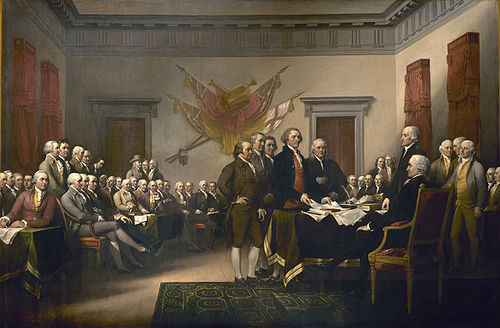
None of this is to say that America is an inherently evil nation, or that many of the values she is founded on aren’t indeed informed by the Christian religion. But it is to say that America’s understanding of the Christian religion, at its founding, had been watered down by Enlightenment rationalism and a form of natural theology that any orthodox Christian worth their Spirit-filled salt ought to be wary of. Notice the most famed clause in the Declaration of Independence:

We hold these truths to be self-evident, that all men are created equal, that they are endowed by their Creator with certain unalienable Rights, that among these are Life, Liberty and the pursuit of Happiness.[2]

The notion of ‘self-evident,’ is contra the revealed religion that Christianity is grounded upon in Holy Scripture’s reality in Jesus Christ. The notion of being ‘endowed by their Creator’ fits with the deistic religion noted above in the beliefs maintained by Paine, Franklin, and Jefferson, respectively. Again, none of this is to say that the principles upon which the American nation stands are bereft of anything valuable or even Christian, per se. But it is to say that these “Christian” principles have been modulated by an alien theological framework that is based on man’s reason, rather than God’s Self-revelation. These are important things to bear in mind, particularly for evangelical Christians, because we are too often wont to jump on the concept of manifest destiny and the idea that the Declaration of Independence and our Constitution are inspired by God Himself. If the Christian were to listen to David Barton or Glenn Beck, for example, they might think just the aforementioned; i.e. that America is the ‘new Israel,’ and ‘the shining city on a hill.’ I personally believe that America is an amazing nation, and I am proud as apple pie and baseball to be an American. I just want to hold these truths in hand in order to temper any propensity I might have towards thinking of America from a golden-age that never existed. Soli Deo Gloria  


[1] James Ungureanu, Science, Religion, and the Protestant Tradition: Retracing the Origins of Conflict (Pittsburgh, PA: University of Pittsburgh Press, 2019), 165-66 kindle.

[2] Declaration of Independence.

/Also see The Search for Christian America , editors Noll, Hatch, and Marsden (1989).

American Folk Religion and Political Identity

What I like to call American Folk Religion is a real thing. It transcends the socio-political demarcations and can be found on both sides and everywhere. It might be hidden behind facades of orthodoxy, or even heterodoxy; but it remains a pervasive reality. It is the religion of the American masses, one rooted in a history of ideas. John Webster describes this well as he sketches how pre-Nazi and Nazi Germany looked through Barth’s lights and theology:

A large part of Barth’s distaste is his sense that the ethics of liberal Protestantism could not be extricated from a certain kind of cultural confidence: ‘[H]ere was … a human culture building itself up in orderly fashion in politics, economics, and science, theoretical and applied, progressing steadily along its whole front, interpreted and ennobled by art, and through its morality and religion reaching well beyond itself toward yet better days.’ The ethical question, on such an account, is no longer disruptive; it has ‘an almost perfectly obvious answer’, so that, in effect, the moral life becomes too easy, a matter of the simple task of following Jesus.

Within this ethos, Barth also discerns a moral anthropology with which he is distinctly ill-at-ease. He unearths in the received Protestant moral culture a notion of moral subjectivity (ultimately Kantian in origin), according to which ‘[t]he moral personality is the author both of the conduct with which the ethical question is concerned and of the question itself. Barth’s point is not simply that such an anthropology lacks serious consideration of human corruption, but something more complex. He is beginning to unearth the way in which this picture of human subjectivity as it were projects the moral self into a neutral space, from which it can survey the ethical question ‘from the viewpoint of spectators’. This notion Barth reads as a kind of absolutizing of the self and its reflective consciousness, which come to assume ‘the dignity of ultimateness’. And it is precisely this — the image of moral reason as a secure centre of value, omnicompetent in its judgements — that the ethical question interrogates.[1]

While America (and the world) is in the midst of the current socio-political upheaval that we are I think what Webster is noting in regard to Barth’s understanding of the German mind (of his day) ought to serve as a cautionary tale for us today. No matter where we are situated in this moment, politically, and I’ve made it no secret about where I stand, it is always important to bear in mind that as Christians we ought to be under God’s Word; and importantly, we ought to avoid conflating God’s Word with the culture’s or our own—no matter how noble our perceived right might be. Remember, as Jesus said: ‘only God is good.’

But to press down further into how this sort of mode, that was present in Germany, has taken shape in our day, James Ungureanu offers a helpful sketch of what might be identified as American transcendentalism. You’ll notice, as you read Ungureanu how the American religion has roots in the German background (of the sort that Barth was critical of). James writes:

Rooted in European liberal Protestant ideas, American liberalism began as a distinctive movement in American thought with the emergence of Unitarianism and transcendentalism in the early nineteenth century. Theological Unitarianism, or the belief in the oneness of God, began in seventeenth-century England and was adopted by eighteenth-century American liberal theologians. But the rational religion advocated by the founders of the republic was eventually combined with such romantic movements as transcendentalism.

The transcendentalists had imbibed German idealism, avoided religious institutions, and preferred informal fellowship through intellectual and literary pursuits. They emphasized the presence of divinity within each human being. This divinity powered the self and was best fostered without the external control of religious institutions. Consequently, American transcendentalists encouraged individuals to pursue spiritual truth on their own. While seventeenth- and eighteenth-century liberal Protestants focused on the “inner light” of reason, liberal Protestants of the new theology looked to emotions as the final source of religious authority. Their primary religious focus was on the immanence of God, the notion that God’s presence pervaded all things.[2]

Some have identified this as a neo-Gnosticism, but whatever the designation of this American Folk Religion, it is pervasive and grounded in a turn-to-the-subject mode of being. My concern is that no matter how noble the cause, no matter how conservative or progressive, that people from all around, because of their socio-political identity, might presume that they are eternally justified before God as proven by their good [political and social] works. My concern is such adherents see themselves as ‘saved’ because of the measure of their passion for what they perceive to be the good and the beautiful. But only God is good. And insofar as people cannot discern God’s Word from their own, such people have been taken captive by Babylon rather than the Kingdom of Christ. Obtaining this sort of discernment requires much sweat and blood before the living God. Kyrie eleison


[1] John Webster, Barth’s Moral Theology: Human Action in Barth’s Thought, 35-6.

[2] James Ungureanu, Science, Religion, and the Protestant Tradition: Retracing the Origins of the Conflict (Pennsylvania: University of Pittsburgh Press, 2019), 154-55 kindle.  

Modifying the Theology Proper of the Declaration of Independence for a More Coherent Stance Against Tyranny

Anti-natural theology and small non-intrusive government go hand-in-hand. Anti-natural theology emphasizes God-possessed freedom, and as a counterpart, our participation by grace therefrom. In diffuse: when applied to political theory, the ground of political oversight is not vested to a hierarchical chain of commanders, but is grounded in the very liberty of God’s life. Because He is for us, our sense of liberty and governance comes not from men, but directly from and by Him in the humanity of Jesus Christ. Ironically, the Declaration of Independence is grounded in natural theology; a collapse of divine attributes into humans and their ability to infer the divine from within and back up the chain of being. But this gives too much place for demiurge-commanders to step in and attempt to speak as vicars of Christ in ex-cathedra intonation.

The aforementioned comes from a Facebook post I just published. I mentioned the Declaration of Independence (DI), an important document for us Americans; well, for some of us. I agree, de jure, with the principles of freedom and government, with the political theory embedded in the DI; but I am critical, as noted in the FB post, of the natural theology underwriting it. Here’s the pertinent language that I am critical of: “We hold these truths to be self-evident, that all men are created equal, that they are endowed by their Creator with certain unalienable Rights, that among these are Life, Liberty and the pursuit of Happiness.” This is natural theology, simplicter; i.e., the idea that ‘these truths’ are ‘self-evident’ does not cohere with a properly oriented understanding of Christian theology. And just as significantly, because the DI attempts to refer to the ‘Creator,’ in this context the Judeo-Christian understanding of the divine, it then leaves itself open to the sort of critique I am tacitly attempting here.

Natural theology, particularly of the Christian sort, claims as a preamble that the Christian (or even, non-Christian) person has an innate or intact capacity to think the divine based simply upon ‘self-evident’ truths built into the created order by the Creator. They maintain that the ratio and taxis of creation , as such, allows for the curious soul to reflect upon the various attributes of nature, primarily those found in human being (so the theological construct of analogia entis), and think its way back to God, through the interconnected chain of being of cause and effect left discoverable therein. Steven Ozment offers a helpful description of how this looks, particularly as that was developed in the theology of medieval theologian, Thomas Aquinas:

The assumption that real relations existed between God, man, and the world made possible Aquinas’s confidence in a posteriori proofs of God’s existence; finite effects led necessarily to their origin, because they were really connected with it. The same assumption underlay Aquinas’s distinctive views on the “analogical” character of human knowledge and discourse about God. According to Aquinas, one could speak meaningfully of one’s relationship to God by analogy with one’s relationship with one’s fellow man because a real relationship existed between the values of people shared and those God had prescribed.[1]

For our purposes it is important to focus on how God is wedded to nature and human being in this framework. While God remains distinct from creation, God’s reality, or human knowledge of that, becomes contingent upon human capacity to discern God and His freedom from nature rather than grace. As I noted in my FB post, when we think God in terms of first cause and secondary causes, when we think God from His effects (us) and in negation arrive back at who God is, nature supplants God’s grace for us, and allows us to coopt His authority, His freedom, for ourselves. Barth notes:

For has he not now exercised his mastery? Has he not won his battle against grace? If grace is alongside nature, however high above it it may be put, it is obviously no longer the grace of God, but the grace which man himself ascribes to himself. If God’s revelation is alongside a knowledge of God proper to man a such, even though it may never be advanced except as a prolegomenon, it is obviously no longer the revelation of God, but a new expression (borrowed or ever stolen) for the revelation which encounters man in his own reflection. If the miracle acknowledged by man—perhaps an inspired Scripture or an infallible Church—is included in his own reckoning, if it is placed by him alongside the other phenomena of his world, it is obviously no longer the miracle of God, but an astounding element in man’s view of the world and of himself. No supranaturalism which man can choose on this higher rung can hold its own against the fact that in the last resort, as chosen by man, it is only a higher, though masked, naturalism. God’s real revelation simply cannot be chosen by man and, as his own possibility, put beside another, and integrated with it into a system. God’s real revelation is the possibility which man does not have to choose, but by which he must regard himself as chosen without having space and time to come to an arrangement with it within the sphere and according to the method of other possibilities. By treating it as if it does not do the choosing but is something to be chosen, not the unique but just one possibility, Christian natural theology very respectfully and in all humility re-casts revelation into a new form of its own devising. But for all that its behavior is so respectful and forbearing, for all that it subordinates itself so consciously and consistently, natural theology has already conquered it at the very outset, making revelation into non-revelation. This will certainly show itself in what it does with the revelation that has been absorbed and domesticated by it. For the naturalism which already exists in the systematisation of the two possibilities will not leave permanently unmolested the supranaturalism of this higher stage which is at first respected and foreborne.[2]

This is what natural theology, of the sort that we find in the Declaration of Independence allows for. It allows for human beings, in a chain of hierarchical being, to assume levels of authority, insofar as they are in societal statuses of authority (like Caesars, Popes, Kings, state Governors, Kaisers etc.), and on an ‘upper rung’ of the interconnected chain of being between God and humans. But this is exactly what the Declaration of Independence (when read in full) wanted to defeat.

This is why Barth was anti-natural theology in his context. He understood how the collapse of grace into nature, as natural theology inherently does, can result in political powers and regimes like he saw with Hitler’s Nazi regime. Barth understood that this knot between nature and grace in a chain of being, between God and humanity, needed to be superseded by understanding that God’s relation to humanity comes directly to and for us as the immediate result of God’s free election to be with and for and in us in the vicarious humanity of Jesus Christ. This is the alternative Barth offered to the natural theologies of his day, and those of the medieval and early modern past. And by implication, when applied to political theory, I suggest that being anti-natural theology provides a much more coherent basis for what the Declaration of Independence had hoped to achieve in regard to guaranteeing ‘God given’ freedoms for the American Republic. To ground the American sense of human freedom in natural theology rather than in the anti-natural theology proper of God revealed in Jesus Christ, when internalized and put into practice, can only result in a sense of freedom that ends up being mediated by those in stations of power ostensibly granted by God and the people.

More to say, but this represents the beginning of a thought line I’d like to develop further. We can currently see the sort of tyrannical power rogue governors, mayors, and city magistrates in the US (and elsewhere) are assuming; the very sort of tyranny the Declaration of Independence sought to destroy. The ‘powers’ have natural theology and the God thereof in their corner. They can appeal to divine sanction for their power, and declare with fiat, that people must simply submit to their will insofar as they have the status they have as government officials. Even so, while the DI has this sort of errant natural theology underwriting it, de jure, the principles it articulates, as far as freedoms from tyranny, it has gotten things right; it just needs the sort of modification I am referring us to in this post. A government of the people, by the people, and for the people can only rightfully be vouchsafed when the God given freedom it hopes for comes directly for them from God’s life with them in Jesus Christ. This is the sort of liberty that defies all forms of tyranny, and has the genuine power of the God of resurrection behind it. But it also suffers from the scandal of particularity, which I’m sure the framers of the DI and Constitution hoped to avoid in the pluralist experiment they were attempting. The god of natural theology can remain generic and abstract; the God I am referring to, the anti-natural theology God, is particular and concrete. And so America is left with a concept of the divine, underneath its documentary existence, that in the end is discordant with the freedoms they had hoped to guarantee the Republic. Even so, even with this flaw, we must assert the principles it was still able to produce as the foundation-stone for defeating tyrannies from without and within. We can work on providing a more sound theology proper, for its basis, later.


[1] Steven Ozment, The Age of Reform 1250-1550, 49.

[2] Karl Barth, Church Dogmatics II/1 The Doctrine of God: Study Edition (London: T&T Clark, 2009), 136.

Is America Exceptional? The ‘new Israel’

Massachusetts Bay

I was just over at Roger Olson’s blog, and he has provided a mini and partial review of Peter Leithart’s book, Between Babel and the Beast. Apparently (I’ll need to read this when I get the chance), Leithart challenges a religion that he (amongst others) has labeled Americanism (or the worship of America as God’s special nation, like the new Israel). There are multiple trajectories that we can take to get into the implications and presuppositions of this ‘religion’. We could spend the time looking at how the ‘conservative Right’ largely embodies this kind of folk religion; or we could look even more particularly at how a movement like the Tea Party seeks to repristinate the perceived golden age of our Christian origins as a nation. I am going to broach this golden age idea that Tea Partiers are hearkening us back to, and then tie this into ideas of exceptionalism, and a comment that someone made over at Olson’s blog that typifies, I think, a common and popular notion of what it means for America to be an exceptional nation. Before we launch into this brief exercise, let me caveat that I am glad and even proud to be an American; we have freedoms (still!) that the rest of the world, by-and-large does not. But we need to hold these in perspective and understand how our nation became a nation, and how that continues to inform the theopolitical rhetoric even of today.

The Puritans originally came to America in order to gain freedom of religion, freedom from the persecution that they were experiencing at the hands of an antagonistic Church of England. And so they fled. In their fleeing they encountered all kinds of hardship and tribulation, and yet they endured and finally made it to the ‘Promised Land’. It was these kinds of experiences, and the relative success of establishing a new nation, that imbued Puritan pastors and theologians with the notion that Divine Providence had carried them into the new land of promise. Indeed, many (if not all) of the Puritans believed that they were truly the new Israel of God, and that they had been given Divine sanction to sack the native Americans (like the original Israel did with the Canaanites), and take their lands (manifest destiny). Here is what Noll, Hatch, and Marsden have written about how Winthrop, governor of Massachusetts Bay Company, conceived of America as the literal new Israel:

[…] The Old Testament clearly taught that God dealt with nations according to covenants, either explicit or implicit, the stipulations of which were God’s law. Covenant-breaking nations were punished; covenant-keeping nations were blessed. The people of God, Israel in the Old Testament times and the church in the New Testament age, stood of course in a special relationship to God. If they were constituted as a political entity, and here Israel seemed obviously the model to imitate, then they should make their social-political covenant explicit, following the examples in the Pentateuch. This is precisely what Winthrop and his fellow Puritans thought they were doing. The were becoming a people of God with a political identity, and so they stood in precisely the same relationship to God as did Old Testament Israel. Bercovitch explains this equation in terms of typology:

Sacred history did not end, after all, with the Bible; it became the task of typology to define the course of the church (“spiritual Israel”) and of the exemplary Christian life. In this view Christ, the “antitype,” stood at the center of history, casting His shadow forward to the end of time as well as backward across the Old Testament. Every believer was a typus or figura Christi, and the church’s peregrination, like that of old Israel, was at once recapitulative and adumbrative…. [Mark A. Noll, Nathan O. Hatch, and George M. Marsden, The Search For Christian America, 34.]

This is part of the heritage that the conservative Right appeals to today; theologically, a Calvinistic postmillennial heritage that believes that America has its rootage in Divine favor and blessedness—as God’s covenant people. [sidebar: the really interesting thing about this, is that most American’s who appeal to this age as constituting a “Christian” heritage to our nation, are not postmillennial, but premillennial dispensationalists, which is completely at odds with postmil thought!]  And it is this kind of mindset that believes that America is exceptional, that is, because we have been blessed of God (as his covenant nation), and thus we can offer things to the rest of the world (even if that means that we, in a utilitarian and pragmatic way impose ourselves on other nations for the greater good; i.e. which is the preservation of God’s new Israel, America) that the rest of the world needs; we are the dispensers of God’s covenant promises after all ;-). But are we really exceptional, and are we really God’s covenant nation who operates with Divine sanction? I will answer these questions more specifically in the days to come. Let me leave us with a comment made over on that post I mentioned earlier at Roger Olson’s blog; the comment typifies how, I would imagine, most Americans who believe that America is exceptional, conceive of this:

If America is not “exceptional,” please explain to me why millions of people from many other nations are so anxious to find a way of entrance into this country. They will endanger their lives to climb the highest obstructive fences, float the seas on inflated inner tubes, stowaway on leaky boats, cram into sealed semi-trailers in stifling heat, risk being shot or arrested, dig tunnels miles long, pay exorbitant prices to human traffickers, and upon arrival live in a 3-room safe-house with 30 other people; all rejoicing and praising God that they have finally arrived in the “Promised Land.” [taken from here]

I will admit that these kinds of pragmatic concerns make America exceptional in a certain way (but certainly not the “Promised Land”!). But usually exceptionalism is used much more politically, we will use virtues of America, like the comment does above, to then justify atrocities (like foreign policy, nation building, economic treaties—like with China, etc.) that we perpetrate in the rest of the world. And we do all of this garbed in the language of being the “Promised Land.”

There is much more to say, but I will have to pick up where I am leaving off later.

‘American Revolutionary spirit‘: Should You Repent?

I was just reading the book The Search For Christian America (which is an excellent book, if you haven’t read it, and you suffer from grandeurs of delusion about Americana’s genesis as a “Christian nation;” then you must read this book, it will cure you of such flights of fancy), and wouldn’t you know it; but I came across a few paragraphs that touch upon the impact that the American Revolution had upon attitudes towards five point Calvinism, in particular, and Theology in general. It notes that after the American Revolution, how people’s attitudes in general took on an individualistic bravado that sought to sluff off any kind of theological shackles that might stand in the way of self realization; an attitude by the way that would make our own Glenn Beck very proud today. Let me quote at length (you will catch something else in the quote which I will comment on briefly afterwords):

[I]n this period one finds evidence of a similar revolt against each of the so-called five points of Calvinism, a revolt that had implications far beyond the importance of Calvinism itself. For it was directed against the entire belief that the heritage of the church could be an important aid for the present. Calvinism, which was the dominant theological tradition in colonial America, merely happened to be the first to get in the way.

Just as notions of total depravity did not stand up well to the belief that individuals were capable of shaping their own destiny, so “unconditional election” seemed to deny that men were fully capable of determining the course of their own lives. The antidemocratic tendency of the doctrine of election emerged even more clearly in the idea of a “limited atonement,” that Christ’s death was somehow restricted to those whom God elected to salvation. Similarly, the concept of “irresistable grace” seemed to make God a tyrant of uncontrollable power, just that from which Americans had fought to free themselves. Finally, the focus on volitional commitment as the primary human obligation made the idea of the “perseverance of the saints,” that we are sustained by the choice of another, irrelevant, if not contradictory.

In short, Calvinism was being dropped not in response to theological arguments but because it violated the spirit of Revolutionary liberty. During the early history of the United States self-evident principles of democracy persuaded any number of former Calvinists to strike out for a new faith. One who did so was the Free-Will Baptist minister William Smyth Babcock, who found Calvinism antithetical to democractic common sense. He spoke of its “senseless jargon of election and reprobation” and concluded that it had covered salvation “with a mist of absurdities.” “Its doctrine is denied in the Practice of every converted soul in the first exercises of the mind after receiving liberty.”

This revolt meant not just the replacement of an older Calvinist system with a newer Arminian one. It was rather a revolt against theological systems in general, the whole creedal and confessional structure of the church, and the idea of God’s truth being mediated by educated theologians. “We are not personally acquainted with the writings of John Calvin,” two colleagues of Barton Stone, founder of the Church of Christ, admitted, “nor are we certain how nearly we agree with his views of divine truth; neither do we care.” Stone himself not only rejected traditional formulation about the Trinity, but also dismissed the whole subject as irrelevant: “I have not spent, perhaps, an hour in ten years thinking about the trinity.”

In the early republic, popular theologies, claiming to be based exclusively on the Bible, refused to grant any value to the theological work of those who had gone before. Theological systems of any stripe became suspect, and common people came to think that one could in fact be biblical without being theological. . . . [Mark A. Noll, Nathan O. Hatch, and George M. Marsden, The Search For Christian America, (Colorado Springs: Helmers & Howard, 1989), 118-19]

It seems that the “Revolutionary spirit” is still alive and well for many American Evangelicals. Surely five point Calvinism can be taken to task on theological grounds, but it is interesting to see how the socio can impact postures and attitudes for the populace towards particular theological traditions. What stands out to me the most, from above, is the last paragraph; this seems to stamp large swaths of American Evangelical Christians. That is, the idea that they can be a good biblical Christian without also “confusing” themselves with the theological intracacies that would seem to stand in the way of them realizing their personal best and actualized American Christian selves. I often wonder why there seems to be such a lack of value placed upon theological education, or even those of us who are theologian types, within the Evangelical ghetto; so what is sketched above provides some perspective on the kind of psycho-social that gives rise to this kind of disdain for thinking deeply upon the contours of what it means to be a Christian. Unfortunately this is commentary on my own Evangelical tradition and sub-culture.

Americans are interesting people. American Christians even more so. I wonder how Revolutionary you are this 4th of July; do you think you might need to repent?