
I was just reading the book The Search For Christian America (which is an excellent book, if you haven’t read it, and you suffer from grandeurs of 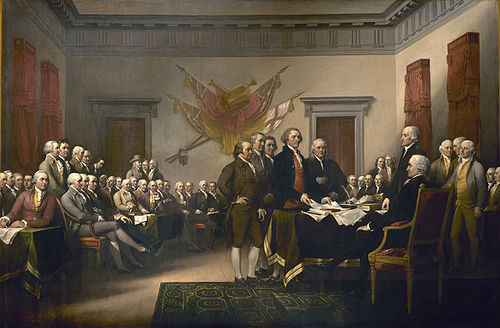 delusion about Americana’s genesis as a “Christian nation;” then you must read this book, it will cure you of such flights of fancy), and wouldn’t you know it; but I came across a few paragraphs that touch upon the impact that the American Revolution had upon attitudes towards five point Calvinism, in particular, and Theology in general. It notes that after the American Revolution, how people’s attitudes in general took on an individualistic bravado that sought to sluff off any kind of theological shackles that might stand in the way of self realization; an attitude by the way that would make our own Glenn Beck very proud today. Let me quote at length (you will catch something else in the quote which I will comment on briefly afterwords):
[I]n this period one finds evidence of a similar revolt against each of the so-called five points of Calvinism, a revolt that had implications far beyond the importance of Calvinism itself. For it was directed against the entire belief that the heritage of the church could be an important aid for the present. Calvinism, which was the dominant theological tradition in colonial America, merely happened to be the first to get in the way.
Just as notions of total depravity did not stand up well to the belief that individuals were capable of shaping their own destiny, so “unconditional election” seemed to deny that men were fully capable of determining the course of their own lives. The antidemocratic tendency of the doctrine of election emerged even more clearly in the idea of a “limited atonement,” that Christ’s death was somehow restricted to those whom God elected to salvation. Similarly, the concept of “irresistable grace” seemed to make God a tyrant of uncontrollable power, just that from which Americans had fought to free themselves. Finally, the focus on volitional commitment as the primary human obligation made the idea of the “perseverance of the saints,” that we are sustained by the choice of another, irrelevant, if not contradictory.
In short, Calvinism was being dropped not in response to theological arguments but because it violated the spirit of Revolutionary liberty. During the early history of the United States self-evident principles of democracy persuaded any number of former Calvinists to strike out for a new faith. One who did so was the Free-Will Baptist minister William Smyth Babcock, who found Calvinism antithetical to democractic common sense. He spoke of its “senseless jargon of election and reprobation” and concluded that it had covered salvation “with a mist of absurdities.” “Its doctrine is denied in the Practice of every converted soul in the first exercises of the mind after receiving liberty.”
This revolt meant not just the replacement of an older Calvinist system with a newer Arminian one. It was rather a revolt against theological systems in general, the whole creedal and confessional structure of the church, and the idea of God’s truth being mediated by educated theologians. “We are not personally acquainted with the writings of John Calvin,” two colleagues of Barton Stone, founder of the Church of Christ, admitted, “nor are we certain how nearly we agree with his views of divine truth; neither do we care.” Stone himself not only rejected traditional formulation about the Trinity, but also dismissed the whole subject as irrelevant: “I have not spent, perhaps, an hour in ten years thinking about the trinity.”
In the early republic, popular theologies, claiming to be based exclusively on the Bible, refused to grant any value to the theological work of those who had gone before. Theological systems of any stripe became suspect, and common people came to think that one could in fact be biblical without being theological. . . . [Mark A. Noll, Nathan O. Hatch, and George M. Marsden, The Search For Christian America, (Colorado Springs: Helmers & Howard, 1989), 118-19]
It seems that the “Revolutionary spirit” is still alive and well for many American Evangelicals. Surely five point Calvinism can be taken to task on theological grounds, but it is interesting to see how the socio can impact postures and attitudes for the populace towards particular theological traditions. What stands out to me the most, from above, is the last paragraph; this seems to stamp large swaths of American Evangelical Christians. That is, the idea that they can be a good biblical Christian without also “confusing” themselves with the theological intracacies that would seem to stand in the way of them realizing their personal best and actualized American Christian selves. I often wonder why there seems to be such a lack of value placed upon theological education, or even those of us who are theologian types, within the Evangelical ghetto; so what is sketched above provides some perspective on the kind of psycho-social that gives rise to this kind of disdain for thinking deeply upon the contours of what it means to be a Christian. Unfortunately this is commentary on my own Evangelical tradition and sub-culture.
Americans are interesting people. American Christians even more so. I wonder how Revolutionary you are this 4th of July; do you think you might need to repent?
Happy Fourth Bobby!
I dunno. I suppose when we think of this country as “Christian”, we mean ‘c’ “christian. We mean “people of faith”. I think it’s shorthand for people of a common interest, like not having a porn shop in the neighborhood.
We can argue and fight all day long about the 5 points of Calvinism, but when they start rounding up Jews again, we’ll be there, hopefully to put on the brakes.
Also, as a backlash against 5 point calvinism, I would think you would identify in part with the revolutionary spirit, even though the reverend quoted was neither educated in theology to be able to respond in the Spirit and with the mind. Personally I would hardly give one who has no use for the Trinity even a small ‘c’ “christian” moniker, but surely he is not necessarily representative of the whole population?
Finally, I’m not sure what we are after here. It seems we want a confession that says “nope, we never were a christian nation, we have just always been heathens and pagans, so just shut up about it. In fact just shut up. So you don’t like abortion or homosexuality? I don’t like that you don’t like them, and if I could, I would pass a law against you….”
You see Bobby, while I understand what the secularists are after, I do not understand what those who think the United States was founded by exclusively anti calvinists want?
There is still a small vestige of patriotism in me which seems predestined to be rooted out and burned more so than I’m predestined to believe in predestination.
I live my life in cynicism, about politics, my employer, my co-workers, my church, you name it. I’m in the midst of TRYING to repent cynicism.
You’re right. Maybe I should repent about repenting.
Hey Duane,
I think the point is a historical one, in principle; the one the quote is making. I applied it in a way that, in principle, might correlate to attitudes still present; viz. that we Americans, in general, suffer from an acute individualism — which is not biblical or Christian.
When has theology not been influenced by other thought forms and pressures external to the text alone? Augustine was clearly influenced by Plotinus and the Platonists.
I would love to see a study of the political and philosophical influences on Calvin. We know he held to Aristotelian cosmologies, interacted with the Scholastics and others. Was there also a political philosophy influencing him?
I wonder if his theology would have developed differently had he stayed in France during a period of persecution instead of fleeing to Switzerland?
In any event Americans do need to have clarity of how the political climate and theological influences shaped our country both in the beginning and since. To truly understand the dynamic of religious faith in America we need to go back to see the faith of the Pilgrims and the Puritans before 1776.
Did their faith make us a Christian colony at that time? Was England a Christian nation under King James or Cromwell? Some English Puritans had sought to establish England as a theocracy. Had they succeeded would England have been a Christian nation?
The concept of a Christian nation is confused and distracting. It is a part of our national mythology to assert that we were founded as a Christian nation. This has been both good and bad. It is an expression that seeks to recognize the religious impetus of those who established the early colonies and the continued influence of Christian values upon the laws and institutions of the this country. But it is too general a statement and fails to account for the nuances and variations of faith and lack of faith in our history.
It may be that Noll is making too simplistic an analysis when he says, “In short, Calvinism was being dropped not in response to theological arguments but because it violated the spirit of Revolutionary liberty.”
Does he elaborate what was happening in the Presbyterian and Calvinist churches at the time? We know that Presbyterians went through a number of internal disputes and divisions. How much of that and the historical propensity for Calvinists to persecute all other faiths contributed to some Baptists rejecting the Calvinism that lay behind it.
Much ferment accompanied the 2nd Great Awakening that Stone and Campbell were part of. Again how much was reaction to the established churches and how much can be attributed to the cultural milieu of the time? Stone was a Presbyterian and Campbell a Baptist before leaving their respective churches to found the Restoration Movement. Finney was also a Presbyterian, but an unhappy one.
Given all the connections to Presbyterians, it would no doubt prove fruitful to dig into the theological developments in that church to see what was driving people out to seek new formulations and practices of their faith.
@Jon,
Yes, you hit on many salient points. Noll et al develop their points and thesis much more extensively than the quote lets on. In fact their point wasn’t necessarily to develop this point on Calvinism; but instead to illustrate the change of posture post-Revolution in America.
But yes, the book itself argues convincingly against an “Christian America.” I’ve read a book on the influences that Calvinism made on the formation of America; it’s a new release, don’t recall the name, I’ll have to dig that up.
And yes, we are all culturally conditioned, all of us; I think the point though is that the attitude that led to the American Revolution was not one isolated to towards Briton alone.
My own view is that the Pilgrims and Puritans sought God’s favor for a place where they could worship and serve Him in freedom. God answered their prayers and gave them favor in establishing the colonies and then this country. That doesn’t make us a Christian nation. To me there is no such thing. It doesn’t mean everything we do or did is right or just or blessed by God. The same is true for Israel. They have favor, but not everything they do is right or should be supported. We are all called to a higher standard.
I do enjoy these kind of historical studies. I would like to see how the churches generally, including Calvinist churches, were changing in response to the post-Revolutionary spirit.
I agree that calls to return to the good old days, whether they be the Founding or the ’50s are naive and worthless dreams. We don’t return to the past, God calls us to return to Him and His ways. We can change direction, which our culture desperately needs to do in many, many areas, but we can’t go back and recreate the culture that was. Culture always moves forward and incorporates or rejects changes as they come. That applies to churches that want to return to the first century model. The Restoration Movement, which I was part of during 3 years in bible college, always talked about being a NT church. The truth was they were as much a part of their time as anyone else, they did not reflect the NT church in many ways. The most glaring omission was the adoption of cessationist theology. Hardly a NT pattern. Many think this is part of what it means to be a conservative church.
Conservative political philosophy values the established cultural institutions of family, community and church. That however, is not to return, but to uphold them against the progressive changes that move toward socialism or various forms of communitarianism. Conservative philosophy upholds the rights of individuals and liberty for all against movements toward collectivism and totalitarian impulses.
I think much that motivates the fundamentalist call to return to the faith and values of the Founders confuses these two kinds of conservatism, the one being political and the other being religious. Teasing them out in distinction is necessary for greater clarity so as not to confuse the mission of each group.
Bobby, everyone,
Thank you for making these connections between quasi-theological political movements, history, and our (Christian culture in general) current trend toward media influenced beliefs based on non-biblical and theological perspectives.
I’ve been reading Radical, by David Platt. It isn’t a theological/scholarly work, but an impassioned plea for the church and individuals to reexamine the gospel without all the dressings of modern culture. To quote,
“As the American dream goes, we can do anything we set our minds to accomplish. There is no limit to what we can accomplish when we combine ingenuity, imagination, and innovation with skill and hard work. We can earn any degree, start any business, climb any ladder, attain any prize, and achieve any goal. James Truslow Adams, who is credited with coining the phrase “American dream” in 1931, spoke of it as “a dream… in which each man and each woman shall be able to attain to the fullest stature of which they are innately capable and be recognized by others for what they are.”
“So is there anything wrong with this picture? Certainly hard work and high aspirations are not bad, and the freedom to pursue our goals is something we should celebrate. Scripture explicitly commends all these things. But underlying this American dream are a dangerous assumption that, if we are not cautious, we will unknowingly accept and a deadly goal that, if we are not careful, we will ultimately achieve.
“The dangerous assumption we unknowingly accept in the American dream is that our greatest asset is our own ability. The American dream prizes what people can accomplish when they believe in themselves and trust in themselves, and we are drawn toward such thinking. But the gospel has different priorities. The gospel beckons us to die to ourselves and believe in God and to trust in his power. in the gospel, God confronts us with our utter inability to accomplish anything of value apart from him. This is what Jesus meant when he said, “I am the vine; you are the branches. If a man remains in me and I in him, he will bear much fruit; apart from me you can do nothing””(Platt, David. Radical: Taking your faith back from the American dream. Multnomah. Colorado Springs, CO. 2010. pp. 45-46).
I’ve always thought it strange, that at the base of both political parties is the idea that the American system of government, and the individuals in it, will create a system that creates equality and justice. From my understanding, this is hogwash. Apart from Him we can do nothing… We cannot change the world unless the world is first changed by his grace, his power.
I think I’m a bit fatalist, but perhaps our goal is to glory in the victory of Christ, his complete intake of all sin and wrath, and our resulting joy in Him.
@Jon Sellers,
I agree; there needs to be a critical distinction between politics and the church. I don’t think most “Evangelicals” do this so well. I actually like the way Karl Barth parses the kingdoms through the analogy of the incarnation and hypstatic union. Identifying one kingdom, made up of the sacred/secular. Here’s a post I did supplied on this awhile ago: http://evangelicalcalvinist.com/2010/01/17/christ-and-the-state-a-federal-calvinist-approach-juxtaposed-with-an-karl-barthian-evangelical-calvinist-approach/
@Jon Weller,
Hey, hope all is well with you guys! Thank you for the Platt quote; I think he articulates the sentiment that Noll and the others are arguing for in the book I quote from. It is a dangerous thing, methinks, to collapse the Church into the world in an uncritical fashion. I’m afraid this is being done on either side of the coin, whether that be from conservative or liberal Christians. It seems to me that the only hope for this world and its system is to be recreated through the resurrection of Christ’s body; it further seems to me that our job, then, as the Church is to speak prophetically into the world and through Gospel proclamation alert the world and its system to the frailty and temporality of its structures. With the hopes that it will function within its proper God-given orientation. It seems to me that the Christian approach should identify the always tenuous state of affairs humanity finds itself in—whether that be the Church or the State—and thus recognize our constant need to be receiving our life on a daily basis from the bread of heaven. Will the state and its system bow the knee to this? No. But as the Church we need to be reminding them constantly of their God-given place as the state. I think what I’m saying is that all of humanity finds its proper orientation and being through its orientation to God in Christ. If the Church functions as it should (prophetically), then so will the state. I think the important thing though, is to recognize that there is in fact a real distinction between the Church and the State—theologically, that is.