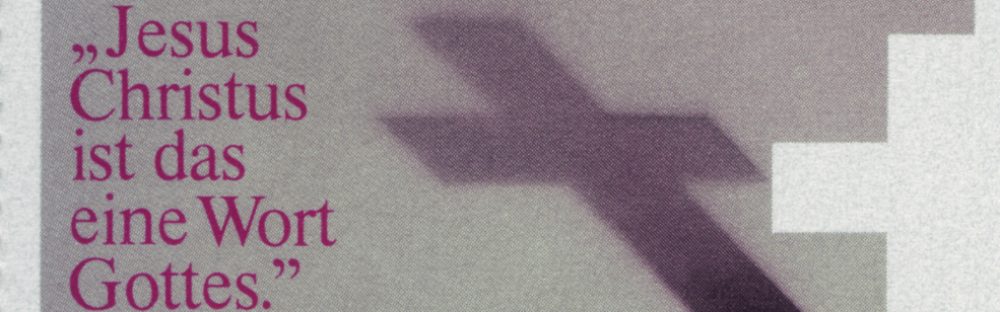
The Spoken Word of God Theology for Us: On a Dialogical Theology

Dialogical theology. It is one of our theses we put forward in our first Evangelical Calvinism book. What is it; what are its entailments; and why am I such a strong proponent of it? In nuce, dialogical theology is exactly what it sounds like: it is a theological “method” that allows the object of theology, who is also Subject for us, to confront us, to speak to us first that we might speak to Him; that we might come to know Him as He knows Himself from a center in Himself for us in Jesus Christ. So, this approach, this theological prolegomenon, starts as God starts with us in the vicarious humanity of Jesus Christ. This prolegomenon ingresses as God invades our humanity in and through His assumption of humanity in the humanity of Jesus Christ. It is in this [hypostatic] union that humanity comes to have the capacity to hear God’s Word, as God’s Word becomes us in the grace of Jesus Christ. It is here where a theological coinherence of knowledge can obtain, insofar as God has pre-destined Himself for this coinherence in His free election to become humanity in Jesus Christ; and all of this, in order that humans might come into the parousia (presence) of God, as God presences Himself with us in the vicarious humanity of Jesus Christ by the Holy Spirit’s free unction of adoptive grace. Underneath this total covenantal relationship between God and humanity in Jesus Christ there are the everlasting arms of God’s triune life of love for us. It is a purely relational, even marital and filial relationship wherein a genuinely Christian theology comes to have wings to breathe and fly freely over and within the hinterland of God’s city; where God’s Word serves as the foundation of everything.

As Evangelical Calvinists (or now, Athanasian Reformed), we have taken our cue from TF Torrance (along with Karl Barth) on thinking a dialogical theology. It will serve us well then to read along with Torrance as he develops his own thinking on a dialogical theology; indeed, as he does so as he engages with Barth’s ‘double objectivity’ of God (see CD II/1), in both God’s archetypal and ectypal reality for us (ab intra, ad extra).

We may note three important implications from this double objectivity.

(i) The object of theological knowledge is creaturely objectivity bound to divine objectivity, not just creaturely objectivity in general but that specific creaturely objectivity which the divine objectivity has assumed, adapted and bound to Himself, Jesus. Thus theological activity is concerned with that special creaturely objectivity in its relation to divine objectivity, and therefore with that creaturely objectivity as it is given ultimate objectivity over against all other objectivity within the created universe. We shall see how this distinguishes theological science from other sciences.

(ii) In the nature of the case we cannot break through to ultimate objectivity, to the sheer reality of God, simply by an examination of this creaturely objectivity, for of itself it can only yield knowledge of the empirical world of nature.

(iii) Nevertheless we are bound unconditionally to the creaturely objectivity of God in the Incarnation of His Word in Jesus Christ. What scandalizes rationalist man is that in his search for ultimate objectivity he is bound unconditionally to contingent and creaturely objectivity, in fact to the weakness of the historical Jesus. To try to get behind this creaturely objectivity, to go behind the back of the historical Jesus in whom God has forever given Himself as the Object of our knowledge, and so to seek to deal directly with ultimate and bare divine objectivity, is not only scientifically false, but the hybris of man who seeks to establish himself by getting a footing in ultimate reality. Scientific theology can only take the humble road in unconditional obedience to the Object as He has given Himself to be known within our creaturely and earthly and historical existence, in the Lord Jesus Christ.

(d) A fourth scientific requirement for theology arises from the centrality of Jesus Christ as the self-objectification of God for us in our humanity, that is, from the supremacy of Christology in our knowledge of God. All scientific knowledge has a systematic interest, for it must attempt to order the material content of knowledge as far as possible into a coherent whole. It would be unscientific, however, to systematize knowledge in any field according to an alien principle, for the nature of the truth involved must be allowed to prescribe how knowledge of it shall be ordered. In other words, the systematic interest must be the servant of objective knowledge and never allowed to become its master. The order is in the Object before it is in our minds, and therefore it is as we allow the Object to impose itself upon our minds that our knowledge of it gains coherence. In theological knowledge the Object is God in Christ whom we know as we allow Him to impose Himself upon our minds or as we allow His Word to shape our knowing in conformity to Him. Scientific theology is therefore the systematic presentation of its knowledge through consistent faithfulness to the divine, creaturely objectivity of God in Christ.

It is the centrality of Christ that is all-determinative here, for He is the norm and criterion of our knowing and it is out of correspondence to Him that theological coherence grows. Scientific theology is systematic, therefore, only through relation to Christ, but its relation to Christ cannot be abstracted and turned into an independent systematic principle by means of which we can force the whole of theology into one definite and fixed pattern. Some use of formal Christology is necessary in systematic theology for the way that the Word of God has taken in the Incarnation, life, death, and resurrection of Christ is the way in which God has revealed Himself to us and the way in which He continues to do so, but we cannot abstract it from dialogical encounter with God in Christ for it is only through sharing in the knowledge of the Son by the Father and the knowledge of the Father by the Son, that we can know God as He has given Himself to us in Jesus Christ.

Thus the organic unity of theology goes back to Christ to the unity of the Godhead, but in the nature of the case theology cannot, and must not try to seek knowledge of God apart from His whole objectivity, divine and human, in Jesus Christ. Therefore the modes and forms our theological knowledge must exhibit an inner structural coherence reflecting the nature of Christ. Moreover, it is because mystery belongs to the nature of Christ as God and Man in one Person that it would be unfaithful of us not to respect that mystery in our knowing of Him and therefore in our systematic presentation of our knowledge. It is upon this fact that every attempt to reduce knowledge of God to a logical system of ideas must always suffer shipwreck.[1]

The astute reader, among other things, will see how the above from TFT implicates a so-called natural theology, or a speculative theology. The aforementioned becomes an impossibility in the type of ‘dialogical’ ‘kataphysical’ ‘epistemological inversion[al]’ theology TFT is proposing. That is to say, for TFT (and me following), to do a genuinely Christian theology first presupposes that Godself in the objectivity of His own eternal and internal life as triune Father, Son, and Holy Spirit, freely chooses to make His objective Self known to His ‘very good’ creation; indeed, as that very good creation, that is “us,” was created to be a counterpoint of koinonia-fellowship that God might share His superabundant life with forever and into His eternal life of pleroma and bliss. The ground of this type of theological endeavor, for TFT, isn’t reducible to a ‘systematic’ frame wherein the would-be knower of God comes with an a priori and immanent frame of reflection to think ‘godness’ from. Instead, as TFT has made clear, it is a matter of God, the God who freely chose to become Creator because of who He eternally is in triune relationship, to impose Himself upon is, with the patterns and emphases of life and love that have always already formed His life as the Monarxia (‘Godhead’).

If you understand what Torrance is getting at in the “short” snippet above, then you will understand what has animated my own theological work for these last couple of decades. It really isn’t a matter of pointing to “my work,” or even “Torrances” though, it is a matter of pointing beyond ourselves to the risen and ascended Christ who intends on coming once again bodily; even as He comes to us moment-by-moment now by the Holy Spirit.

[1] Thomas F. Torrance, Theological Science (Oxford: Oxford University Press, 1978), 137–39.

Triune Time as Eternal Life and Rest

“If any man be in Christ, He is a new creation; the old has passed away, behold, the new has come.”

Time in abstraction, that is, time thought of in a way that is not thought from God’s triune time for the world in Jesus Christ, can only lead to a life of despair and futility. The 21st century’s busy-ness that most are preoccupied with often has the tendency to glaze over the futility of life, without Christ, which can often last someone a lifetime; that is until they are finally confronted with the reality of their mortality. Indeed, the reality of mortality is ultimately to face the Firstborn from the Dead, Jesus Christ. And to finally meet the ground of all reality, and the purpose of the created order in general, after a person has “expired,” is a fearful thing indeed. It is as if such a person has finally had to come to terms with the fact that they have trampled the blood of Christ underfoot, counting it a vain thing.

Barth writes:

Again by way of anticipation, the presence of Jesus in His community is full of import for the future. His presence impels and presses to His future, general and definitive revelation, of which there has been a particular and provisional form in the Easter history. Hence even the presence of Jesus in the Spirit, for all its fulness, can only be a pledge or first instalment of what awaits the community as well as the whole universe, His return in glory. But it must never be forgotten that He who comes again in glory, this future Jesus, is identical with the One proclaimed by the history of yesterday and really present to His own to-day. The thorough-going eschatology for which the interim between now and one day necessarily seems to be a time of emptiness, of futility, of lack, of a progressive and barely concealed disillusionment, is not the eschatology of New Testament Christianity. And again it is only an unspiritual community which can tolerate such a view. The fact that the man Jesus will be includes the fact that He is; but the fact that He is does not exclude that He is “not yet.”[1]

For about a decade, starting in the mid-nineties, the Lord, as He began to do a heavy work in my life, allowed me to feel what life would be like without Him as the ground of it all. I can only describe that season of time as a literal hell. Indeed, clinically it might have been “diagnosed” as depression and general anxiety, but it went much deeper than that. Its basis was indeed spiritual. It was tied into a heavy intellectual (although not affective) doubt of God’s existence I was experiencing; even as a Christian. I felt the hell of nihilism whilst in the depths of deep depression and deep anxiety (indeed, these became mutually implicating things). I only made it through that because God is gracious.

Even so, as Barth underscores, we are included in the time of Christ; the new time of God in recreation for us (pro nobis). We have the guarantee of the eschatological time to come even as He in-breaks, by the Holy Spirit, into our broken lives while we continue to inhabit this in-between time. But His parousia (presence) is just as real and weighty now as it will finally be when the consummate reality of the revealing of the sons of God ultimately enfolds us into its full participative esse (ground) as that has been, and always will be, mediated for us in the priestly humanity of our High Priest and Brother, Jesus Christ. Take heart, even though we might experience many and deep tribulations here, Christ has overcome the world!

[1] Karl Barth, Church Dogmatics III/2 §47 [468] The Doctrine of Creation: Study Edition (London: T&T Clark, 2010), 32–3.

God’s Triune Wrath as First an Instance of His Love

God is love. Unfortunately, for some, this entails an inherent Marcionism. Simplistically, this entails the notion that the God of the Old Testament is not the same God we encounter in the New Testament in Jesus Christ. Often people cannot imagine how the “God of war and wrath” in the Old Testament could ever correspond with the God revealed in the face of Jesus Christ in the New Covenant. But I would simply say that without the God of the Old Testament the God of the New Testament makes absolutely no sense. Jesus came as the Prophet, Priest, King (triplex munus); Jesus came in fulfillment of the Aaronic and Levitic priesthood framework; He came as the Lamb slain before the foundations of the world, as the second and greater Adam, as the seed of the woman who bruises His heel while crushing the serpent’s head. God’s wrath is really just an instance of His triune love. God is a jealous God who loves His creation more than He loves Himself (this is a rhetorical hyperbole). As such, when God sees His very good creation in a ruptured relationship with Him, He will not countenance such brokenness. His wrath is conditioned by who He eternally is as Father-Son-Holy Spirit love (which is simply a Self-givenness, one for the other, one in the other, which coinheres in the Divine Monarxia [Godhead]). He created humanity in His image, who is the Christ for us (cf. Col. 1.15); He created humanity in Christ’s humanity to be in an eternally ascendant and thus elevated and koinonial relationship with Him. The nothingness and concupiscence of sin broke that, and as a result He became sin that we might become the righteousness of God in Him (mirifica commutatio ‘wonderful exchange’).

God is love. He loves all of humanity in His vicarious humanity which stood in the gap between He and us because no one else could or would. Jesus, as the Baptizer exclaimed, is indeed the ‘Lamb of God who takes away the sins of the world.’ As the author to the Hebrews (Paul) says: “there no longer remains any other sacrifice for sin.” Christ is God’s first human, the firstborn, the first fruits of God for the world/us. This is how we know God’s wrath is first an instance of His love for us, in that ‘while we were yet sinners Christ died for us.’ God’s wrath cannot ever be thought away from or apart from His conditioning triune love. When ‘our theologies’ fall into that trap we end up with a distorted and nomist view of God, wherein God becomes simply the Judge, and not the Judge judged for us (pro nobis).

Because of this realization I can look out at the world and feel compassion, as if looking longingly at sheep without the Shepherd. My heart genuinely breaks for people who don’t have Christ; as Paul said “I wish all were like me, yet without these chains.” God desires to show His love in actualized ways wherein all of humanity might indeed ‘taste and see that God is good.’ God’s justice is coming, and yet has always already come in the cross of Jesus Christ. The very foundation of the cross is in fact the cruciformed (cross-shaped) triune life of the eternal God. If we don’t approach a reading of the Old Testament from this crossshaped lens we might fall prey to the siren call of the culture writ large as best represented in the thought and activity of Marcion (the heretic).

The Christian God’s ‘Multiplicity, Individuality and Diversity of Perfections’: Mysterium Trinitatis

When reflecting on the Holy Trinity, given the reality that it is as they say mysterium Trinitatis, I think it is best to recognize this doxological reality and allow that to shape the way the Christian wades into this Holy of Holies. Epiphanius once wrote:

God is one, the Father in the Son, the Son in the Father with the Holy Spirit . . . true enhypostatic Father, and true enhypostatic Son, and true enhypostatic Holy Spirit, three Persons, one Godhead, one being, one glory, one God. In thinking of God you conceive of the Trinity, but without confusing in your mind the Father, the Son and the Holy Spirit. The Father is the Father, the Son is the Son, the Holy Spirit is the Holy Spirit, but there is no deviation in the Trinity from oneness and identity.[1]

When thinking the Trinity it is a constant, as Barth would say, dialectic between thinking the one and the many, the many and the one; the reality of unity and multiplicity, and multiplicity and unity; or oneness (De Deo uno) and threeness (De Deo trino), and threeness and oneness. To complicate matters even further, the discussion of how the perfections or attributes of God can be spoken of as one and many, many and one; particularly given the inseparability of God’s operations ad extra (opera trinitatis ad extra sunt indivisa) as those reflect the in se origins of relation (or processions) of God’s antecedent eternal life. Here we enter the locus that is typically identified as God’s simplicity. But it is good to remember, as Epiphianus does above, that to think of God’s so-called simplicity, this ought never be devoid of thinking this from the triunity of God. We can affirm, and should affirm, that God is non-composite in His inner life; but this does not, nor should not entail the notion that God’s oneness nor His threeness can be thought away from each other—they must always be thought into each other in the koinonial and co-inhering life of eternal and filial relationship that God was, is, and always will be. Barth attempts to tackle these things in this way:

The multiplicity, individuality and diversity of the perfections of God are those of His simple being, which is not therefore divided and then put together again. In God multiplicity, individuality and diversity do not stand in any contradiction to unity. Rather the very unity of His being consists in the multiplicity, individuality and diversity of His perfections, which since they are His are not capable of any dissolution of separation or non-identity, and which again since they are His are capable of genuine multiplicity, individuality and diversity. The plurality which is to be predicated of God can therefore, even in its multiplicity, because it is the multiplicity of God, signify only the unity. The unity which is to be predicated of God must with equal necessity, because it is in reference to God, signify the plurality. Every individual trait which is to be affirmed of God can signify only the one, but the one which is to be affirmed of Him must of necessity signify also every individual trait and the totality of all individual traits. Every distinction in God can be affirmed only in such a way as implies at the same time His unity and therefore the lack of essential discrepancy in what is distinguished. But again, it would not really be the unity of God if no distinctions were recognised and confessed. Our doctrine therefore means that every individual perfection in God is nothing but God Himself and therefore nothing but every other divine perfection. It means equally strictly on the other hand that God Himself is nothing other than each one of His perfections in its individuality, and that each individual perfection is identical with every other and with the fulness of them all.[2]

Indeed, Barth is at his best dialectical form as he discusses the Trinity; this passage is a perfect example of how he attempts to speak of God’s oneness in one movement, and then the threeness in the next key; and allow each chord of the Divine orchestra to play its note in concert again with the whole piece. This is the right way to think the Trinity in my view. We shouldn’t attempt to crack this nut; we must simply attempt to think along with its melodic reality and allow its res to usher us into the Holy place that it is. We see Barth doing this rather masterfully here; he attempts to hold the whole Monarxia together by simply engaging its whole reality in terms of emphasis here, emphasis there, and back again. Soli Deo Gloria!

[1] Epiphanius, Anc., 10, cited by T. F. Torrance, The Trinitarian Faith, 234-3.

[2] Karl Barth, Church Dogmatics II/1 §28 The Doctrine of God: Study Edition (London: T&T Clark, 2009), 78.

*repost, Trinity Sunday.

Getting Beyond an Optical God: The Father-Son as the Pattern

Torrance is discussing the impact that dualistic Hellenism has had upon Western-thought-forms; namely the precedence that classical thought has given to the optical mode of thinking and verification (so the obsession with empiricism, etc.). TFT is highlighting the impact that this methodology and epistemology can have upon our construal of God’s “Father-hood” and “Son-hood,” and how Christian/Patristic theology, primarily through Athanasius’ influence, eschewed this “Hellenizing” effect by reifying it through Christian ontology.

The contrast between Christianity and Hellenism could hardly be greater than at this fundamental level, where biblical patterns of thought governed by the Word of God and the obedient hearing of faith (υπακοη της πιτεως) conflict sharply with those of Greek religion and philosophy. The issue came to its head in the Arian controversy over the Father – Son relation at the heart of the Christian Gospel. Are the terms ‘father’ and ‘son’ to be understood as visual, sensual images taken from our human relations and then projected mythologically into God? In that event how can we avoid projecting creaturely gender into God, and thinking of him as grandfather as well as father, for the only kind of father we know is one who is son of another father? To think of God like that, in terms of the creaturely content of images projected out of ourselves, inevitably gives rise to anthropomorphic and polymorphic notions of deity and in fact to polytheism and idolatry. However, if we think from a centre in God as he reveals himself to us through his Word incarnate in Jesus Christ, then we know him as Father in himself in an utterly unique and incomparable way which then becomes the controlling standard by reference to which all notions of creaturely fatherhood and sonship are to be understood. ‘God does not make man his pattern, but rather, since God alone is properly and truly Father, we men are called fathers of our own children, for of him every fatherhood in heaven and earth is named.’ Unique Fatherhood and unique Sonship in God mutually define one another in an absolute and singular way. As Athanasius pithily expressed it in rejection of Arian anthropocentric mythologising: ‘Just as we cannot ascribe a father to the Father, so we cannot ascribe a brother to the Son’.[1]

[1] T. F. Torrance, The Trinitarian Faith, 69-70.

An Even Quicker Word on the Trinity: Generation

The Father, Son, and Holy Spirit are in-generate in their inner and eternal being. Some want to think in terms of an origin of relation, and thus call the Father in-generate and the Son and Holy Spirit, following, generate. Here we get the notion of “eternal generation,” with the Father as the aitea or source of the Godhead. I affirm eternal generation, but only in a liminal way. That Father isn’t anymore the Father than the Son is the Son in relationship to the Father and vice-versa. This is a necessary and eternal relationship that resists, ultimately, the idea of generation and even in-generation.

I accept certain grammars in terms of heurisms, but then they break.

See my other recent post on the Trinity: click here

A Quick Word on the Trinity

The Father is not God by Himself, then the Son and the Holy Spirit on the side. This is a common mistake; a view that Christians, often, subconsciously, make. The Father, the Son, and the Holy Spirit are One in Three / Three in One; the three persons in interpenetrative subject-in-being relationship constitute what is called the Divine Monarxia (Godhead). To think the Father as the top God, and the Son and Spirit, as the under Gods is to think in terms of what is called subordinationism and or also tri-theism (a type of “Christian polytheistic” false-doctrine). These are historically considered deeply heretical beliefs about who God is. Christians are indeed monotheists, we believe in One God, but we are Trinitarian Monotheists. The One is the Three / the Three is the One. Muslims and Jews are what is called Unitarian Monotheists; which entails the rejection of the mysterium Trinitatis (mystery of the Trinity).

Why does this matter?: Because, get God wrong get every other descending doctrine wrong.

Being Robed in the Eschatos of God’s Triune Light

For Zion’s sake I will not keep silent,
And for Jerusalem’s sake I will not keep quiet,
Until her righteousness goes forth like brightness,
And her salvation like a torch that is burning. -Isaiah 62:1

“Arise, shine; for your light has come,
And the glory of the Lord has risen upon you.
 “For behold, darkness will cover the earth
And deep darkness the peoples;
But the Lord will rise upon you
And His glory will appear upon you.
“Nations will come to your light,
And kings to the brightness of your rising. -Isaiah 60:1-3

I will rejoice greatly in the Lord,
My soul will exult in my God;
For He has clothed me with garments of salvation,
He has wrapped me with a robe of righteousness,
As a bridegroom decks himself with a garland,
And as a bride adorns herself with her jewels. -Isaiah 61:10

And the man and his wife were both naked and were not ashamed. -Genesis 2:25


A quick reflection on the Eschaton. The thought just occurred to me, once again, of just how self-incurved we are as fallen, yet redeemed, creatures still. We suffer from an unquenchable thirst for attention. We inherently desire, as creatures of the sin, that we would be accepted by others; not for the others’ sake, but for our own self-incurved fantasies. When we walk by a pane of glass, lit-up by the sunshine, we often look at ourselves to make sure we still look good; with our brand-new kicks in tow. We often compare ourselves with others and think: I might not be a supermodel, but I’m definitely better looking than that guy or gal. We are born with vain hearts that are disorderedly in love with themselves. In our very hearts, as fallen creatures, we seek our kingdom, and our righteousness; and all these other things are ultimately lost unto us (as King Solomon and so many others have learned by experience over the millennia.)

But what of the glorified bodies that we will put on at the second coming of Christ? The Prophet says we will be, and are in fact, robed in the garments of salvation, the robes of righteousness; indeed, Christ’s righteousness. Moses by the Spirit says that Adam and Eve were both naked and yet were not ashamed. They were literally naked and weren’t stumbled by the physical form in the perverted ways that fallen creatures now are. We see the Prophet refer to God’s Light for us, in a radically eschatological sense. I would suggest, that even beyond what Adam and Eve experienced, we will be, and even are now (by eyes of faith), so shrouded about with the Life of God’s triune Light for us, that in the Kingdom-sense we simply are radiating the Light of Christ’s life; that our bodies are ensconced in the Light of Christ, as we are participants in His life, that it is not possible but to evince and emote His Light; that we have become, in Christ’s resurrected and ascended vicarious humanity, witness bearers, to the nth degree, of God’s Life, as we have become encapsulated in His radiating Light. In other words, when we finally receive our new glorified bodies, like Christ’s, we could be naked, and not be stumbled because we will so effuse the life of God, indeed as God’s triune Life, is in fact our life, by the adoption of grace, that we will no longer have the capacity, nor the desire to focus on ourselves any longer. We will indeed be like our Father, in the Son, by the Holy Spirit. We will be so other focused from within God’s being (ousia), just as He is as Father, Son, and Holy Spirit, that self-consumption in an abstract fallen sense will no longer be a possibility. We get a taste of what this might look like on the Mount of Transfiguration:

Six days later Jesus *took with Him Peter and James and John his brother, and *led them up on a high mountain by themselves. And He was transfigured before them; and His face shone like the sun, and His garments became as white as light. And behold, Moses and Elijah appeared to them, talking with Him. Peter said to Jesus, “Lord, it is good for us to be here; if You wish, I will make three tabernacles here, one for You, and one for Moses, and one for Elijah.” While he was still speaking, a bright cloud overshadowed them, and behold, a voice out of the cloud said, “This is My beloved Son, with whom I am well-pleased; listen to Him!” When the disciples heard this, they fell face down to the ground and were terrified. And Jesus came to them and touched them and said, “Get up, and do not be afraid.” And lifting up their eyes, they saw no one except Jesus Himself alone. -Matthew 17

I long for the day when faith is swallowed up by sight. When we will no longer have this inherent penchant to constantly be self-consumed, and only be consumed by the life of the triune God, and all those participant in that life. I can’t wait till this body of death is finally put under Jesus’ feet, as the last enemy that it is, only to consummately be risen afresh anew with the glorified body of our Lord’s.

When you think about it, all of the world’s ills are formed by the incurved heart, the “Enlightened” turn to the subject. We want and do not have, and so we either literally kill, or figuratively kill, to get what we don’t have, but want. May Christ have mercy sooner than later! Maranatha

Barth’s Analogy of the Filioque for His Theology of the Word

Karl Barth, in his Göttingen Dogmatics, takes from neo-Reformed Dutch theologian’s, Herman Bavinck’s notion of Deus dixit (‘God has spoken’), as a way to think about the way God has revealed Himself bound up in a radical doctrine of the Word of God. Many have probably heard of Barth’s threefold form of the Word of God; it is in the early years of his time at Göttingen that this line of thinking got started for him; particularly as he was pressed upon to teach a Reformed dogmatics within a Lutheran setting. The following showcases the way Barth articulated his understanding of a threefold form of the Word in his early German days as an honorary professor of Reformed theology:

‘Verbum domini manet in aeternum.’ It is no other in that it is now the first, now the second, now the third; and always, whenever it is one of the three, it is also, in some sense, the other two. The Word of God upon which dogmatics reflects is . . . one in three, three in one: revelation, Scripture, preaching . . . not to be confused, not to be separated. One Word of God, one authority, one truth, one power—and yet, not one but three addresses. Three addresses . . . and yet, not three Words of God, authorities, truths, and powers, but rather, one. The Scripture is not the revelation, but rather proceeds from the revelation. Preaching is neither revelation or Scripture, but rather proceeds from both. But Scripture is the Word of God no lass than revelation, preaching no less than Scripture. . .. no “prius” or “posterius” therefore; no “maius” or “minus”; the Word of God in the same glory, the first, the second, the third: ‘unitas in trinitate’ and ‘trinitas in unitate’.[1]

If the reader is familiar with the Latin (Western) doctrine of the filioque Barth’s development on the Word of God is immediately apparent. Barth’s appeal to an analogy of the Trinity is rather evident in the way he develops his thinking on the Word of God. Some might think there is an inherent subordination present within the Latin filioque; the Greek Orthodox church thinks so. Even so, Barth’s genius is to take the Latin dogma on the Trinity and use that pattern as the way he attempts to think God’s Word for us in and from the eternal Logos who is the Christ. It is his turn to Christ wherein he finally has a way to think a theological development from a genuinely Christ conditioned way; as is evident in his development of the threefold form of the Word of God. Once Christ becomes the center of Barth’s thinking, in concrete ways, his lights turn on in a way that begins to illumine his theological development for the rest of his life.

What the cash out is from all of this for me is to continue to see how a genuinely Christ concentrated theology looks; from the Word down, as it were. Christians need to have this type of grounding in order to genuinely think Christianly. As Christians our aim, as Paul asserts, is the perfection of Jesus Christ. As the evangelist and theologian, John, tells us of the Dominical teaching on the Holy Spirit: “These things I have spoken to you while abiding with you. But the Helper, the Holy Spirit, whom the Father will send in My name, He will teach you all things, and bring to your remembrance all that I said to you (Jn 14.25-6).” This is what Barth is picking up on in his theology of the Word; i.e., that any genuine Christian theology will avoid speculation, and instead listen to the concrete breath of the Holy Spirit as He points us to the verities that Christ has taught, and continues to teach us as the Word of God for us.

[1] Karl Barth, The Göttingen Dogmatics, 3 cited by Bruce L. McCormack, Karl Barth’s Critically Realistic Dialectical Theology: Its Genesis and Development 1909–1936 (Oxford: Oxford University Press, 1997), 339.

Torrance’s Theological-Exegetical Gloss on Romans 8:31-39: And a Word of Encouragement About God’s Unrelenting Love For Us

As I have been rereading TF Torrance’s The Christian Doctrine of God: One Being Three Persons, I came across a passage that struck me as a sort of theological-exegetical gloss of Romans 8:31-39. Torrance is often accused of not doing any biblical-exegetical work; but I would counter, that in his role as a Christian Dogmatist his work is saturated in the thematics that allow Scripture to say what it does about God and His works. I would contend that, Torrance, as a Christian Dogmatist, par excellence, has Scriptural themes and their reality in Christ, pervading all of his writings. What is required for the reader though, is that they be familiar enough with Scripture, as Torrance was, to be able to discern just how Scripturally rich and informed his theologizing is. In the following we will compare Romans 8:31-39 and the passage I came across from Torrance; and then in conclusion offer some reflection on its theological and spiritual implications.

31 What then shall we say to these things? If God is for us, who can be against us? 32 He who did not spare His own Son, but delivered Him up for us all, how shall He not with Him also freely give us all things?33 Who shall bring a charge against God’s elect? It is God who justifies. 34 Who is he who condemns? It is Christ who died, and furthermore is also risen, who is even at the right hand of God, who also makes intercession for us. 35 Who shall separate us from the love of Christ? Shall tribulation, or distress, or persecution, or famine, or nakedness, or peril, or sword? 36 As it is written: “For Your sake we are killed all day long; We are accounted as sheep for the slaughter.” 37 Yet in all these things we are more than conquerors through Him who loved us. 38 For I am persuaded that neither death nor life, nor angels nor principalities nor powers, nor things present nor things to come, 39 nor height nor depth, nor any other created thing, shall be able to separate us from the love of God which is in Christ Jesus our Lord.

And Torrance:

In the outgoing movement of his eternal Love God himself has come among us and become one of us and one with us in the Person of his beloved Son in order to reconcile us to himself and to share with us the Fellowship of Love which he has within his own Triune Life. Since in the Lord Jesus Christ the fullness of God dwells bodily we must think of the entire Godhead as condescending in him to be ‘God with us’ in our human life and existence in the world. This does not mean of course that the Father and the Spirit became incarnate with the Son, but that with and in the incarnate Son the whole undivided Trinity was present and active in fulfilling the eternal purpose of God’s Love for mankind, for all three divine Persons have their Being in homoousial and hypostatic interrelations with one another, and they are all inseparably united in God’s activity in creation and redemption, not least as those activities are consummated in the incarnate economy of the Son. In refusing to spare his dear Son but in delivering him up in atoning sacrifice for us all, God the Father reveals that he loves us with the very Love which he bears to himself, and that with Jesus Christ he freely gives us all things. If God is for us in this way what can come between us? And in giving us his one Spirit who proceeds from the Father through the Son and sheds abroad in our hearts the very Love which God himself is, God reveals that there is nothing that can ever separate us from him in his Love. Through the Son and in the Spirit, we are taken into the triune Fellowship of God the Father, God the Son and God the Holy Spirit. Thus in an utterly astonishing way the Holy Trinity has committed himself to be with us and among us within the conditions of our human and earthly life in space and time, but, it need hardly be said, without being subjected to the processes and necessities of created space and time, and without in the slightest compromising the mystery of his divine transcendence.[1]

We see Torrance creatively interweaving classical trinitarian locus like the opera trinitatis ad extra indivisa sunt (‘the works of the Trinity on the outside are indivisible’) into his thinking on God’s “for us-ness,” which in itself places an emphasis on the oneness of God in recognition of his works toward us in the economy of His life become revealed for us in the Son. Beyond that, we see how the canonical themes, and in particular in this passage, the themes of Romans are informing Torrance’s thought in regard to God’s love for us; and then what that love implies in its grounding in Jesus Christ.

More practically, the great hope this provides us with is without measure! I often feel like I’m just going through the motions of life; getting caught up in the necessary busy-ness of it all, and not really living into the full participatio Christ that I’ve been called to in Christ. What this passage from Torrance, as a gloss on Romans, encourages me to remember is that no matter what, it is the whole God—Father, Son, and Holy Spirit—who is holding me deeply in His grasp, and who cannot be deterred in His tremendous Love for me. I find great hope in knowing that no matter what the goings on of my life are, that God in Christ for us, for me will never allow me to be separated from Him; that I am as close to Him as the Son of God is to His Father in the bond of the Holy Spirit. While daily requisites of life seem to plague my existence moment by moment; while my energy is zapped by the long hours of work, and the financial responsibilities that seem to be at every turn and corner of life; while health issues, and other anxieties and fears seemingly seek to suck up the time that ought to only be God’s; while all of these things and more are present in our daily lives as Christians, what Torrance and the Apostle Paul encourage us with is the reality of “so what!” God is God, and He will not be thwarted in His great love for us; just as sure as His great Love just is who He is, and He has shown us that in His undivided work for us in the three persons, as revealed first in the Son.

[1] Thomas F. Torrance, The Christian Doctrine of God: One Being Three Persons(London: Bloomsbury T&T Clark, 2016), 162.