Against being ‘Curious’: In the Augustinian Mood, A Pastoral Reflection and Exhortation

aug

I am not going to say much, other than that this helps me. I am a sinner, and I still sin, frequently in fact. The only difference between me and the world is that I am a saved sinner (simultaneously justified and sinner); nevertheless, I still think in ways that terminate nowhere else but in the self, and by absolutizing material reality in a way that never gets back to material realities origin. Like the world I think foolishly (at points), and like ancient Israel, I have my high places. So what helps me, and maybe it will help you too, is Webster’s discussion of the vice of curiosity. Here is what he has written:

(2) Curiosity involves the direction of intellectual powers to new knowledge of created realities without reference to their creator. In curiosity, the movement of the mind terminates on corporeal properties of things newly known, without completing its full course by coming to rest in the divine reality which is their principle. In effect, curiosity stops short at created signs, lingering too long over them and not allowing them to steer intelligence to the creator. So Augustine against the Manichees:

Some people, neglecting virtue and ignorant of what God is, and of the majesty of the nature which remains always the same, think that they are engaged in an important business when searching with the greatest inquisitiveness and eagerness into this material mass which we call the world … The soul … which purposes to keep itself chaste for God must refrain from the desire of vain knowledge like this. For the desire usually produces delusion, so that the soul thinks that nothing exists but what is material.

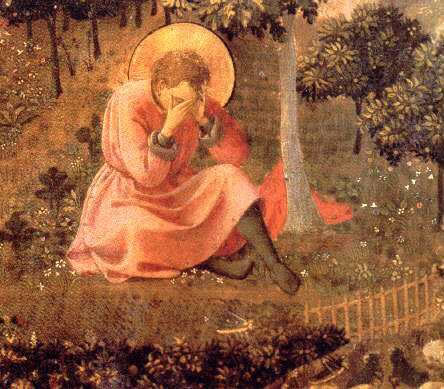
Curiosity, Augustine says elsewhere, is ‘eating earth’, penetrating deep and dark places which are still time-bound and earthly. Or again, in another idiom, curiosity is the ‘lust of the eyes’ (1 Jn 2.16), so called, Augustine says, because its origin lies in our ‘appetite for learning’, and ‘the sight is the chief of our senses in the acquisition of knowledge’. It is that ‘vain and curious longing in the soul’ which, ‘cloaked under the name of knowledge and learning’ is in reality a greed for ‘new experiences through the flesh’, a disordered ‘passion for experimenting and knowledge’ – flocking to see a lacerated corpse, attending a theatrical spectacle, letting contemplation be distracted by watching a lizard catch flies. Curiosity terminates on surfaces. [John Webster, The Domain of the Word, 196.]

I fall into the trap of curiosity more than I would like to admit! But I seek, by the Spirit, to live a life of (as Torrance would say) ‘repentant thinking’. Living a life that moves and breathes from the Spirit’s breath, the breath that animates the humanity of Jesus Christ for us. There is a depth dimension to Christianity and this life that most Christians will never experience in this life (and I am not supposing that the alternative is an elitist gnostic kind of Christianity!), because we are too curious and not contemplative and critical enough in our daily walks with Christ. As James writes “14 but each person is tempted when they are dragged away by their own evil desire and enticed. 15 Then, after desire has conceived, it gives birth to sin; and sin, when it is full-grown, gives birth to death.” Curiosity is the desire that terminates in sin and death. We so often give into this curiosity, and hardly ever do the hard work of actual Christian contemplation. We go the way of the world, we are just too curious.

Cancer, The Sick, The Outcasts, The Dying: Don’t Forget!

I wanted to take a moment and call us to remember a certain sector of people, of whom I was once apart (not too long ago), that are currently living in a reality that is worlds apart from the daily, mundane reality that ‘healthy’ jesusjairuspeople experience on a day to day existence. As Arthur McGill aptly notes of our society in relation to life and death:

[A]s we observe our lives in this country, we cannot help but be struck by the effort Americans make to appear to be full of life. I believe this duty is ingrained deeply in everyone. Only if we can create around us a life apparently without failure, can we convince ourselves that death is indeed outside, is indeed accidental, is indeed the unthinkable enemy. In other words, the belief that death is outside of life is not a fact to be acknowledged; it is a condition to be attained. Consider the American commitment to nice appearances. We often speak of the suburbs in terms of neat and flawless appearances. When we look at the lawns and the shrubs and the solid paint of those homes, who can believe the human misery that often goes on within them? And given the fine appearances of the suburbs, who can tolerate the slums of the inner city? After all, there we see life collapsing and going to pieces. Urban renewal is required, not to improve the living condition of the people, for they are simply moved elsewhere to less conspicuous slums. It is not to increase the tax revenue, because so much of urban renewal involves tax breaks, subsidized construction, and government office buildings. Rather, urban renewal is required in order to remove from the city that visible mark of the failure of life. [p. 18]

And following a little further on from this:

[W]hat about the people who do fail in America? And what about those who collapse of life? What about the sick and the aged and the deformed and the mentally retarded? Do they not remind us that the marks of death are always working within the fabric of life? No, because in the United States, deliberately and systematically, with the force of the law itself, we compel all such people to be sequestered where we cannot see them…. You’ll visit few homes where a very aged person is present and where that person’s imminent dying is integrated into the rhythm of family life. As for the insane, they are hidden in such well-landscaped institutions, behind such beautiful lawns and trees, that when we drive by in our shiny automobiles we cannot imagine the suffering that goes on within those walls. [Arthur C. McGill, Death And Life: An American Theology, (Eugene, Oregon: Wipf and Stock Publishers, 1987), 18-9.]

portlandtramI used to drive by that tall and shiny glass plated building with the sky tram connected to it in downtown Portland, OR, and not give that building a second thought—the building that had OHSU stamped on it; I just thought it contributed to the picturesque skyscape of the Portland metroplex. Before 2009 I never would have imagined the kind of death and suffering I was driving by; I never would have contemplated the kind of human suffering that was being experienced, the reality of life-together dreams being snuffed out as spouses, siblings, nieces, nephews, grandparents and grandchildren were slowly dripping away as each drop of poison fell into the veins of those hoping that somehow this magical cocktail would resurrect instead of quench their shared dreams and hopes. But my experience changed. Once I was diagnosed with my statistically terminal cancer, I broke through that glass house, and saw what it looked like from the inside looking out, looking out (literally) on all the cars and people driving by aloof to the fact that I, along  with a host of others, was sitting there dying (of course I generalize to a degree, I am only referring to those driving by who themselves are generally healthy and not on their way to a glass plated building of their own).

Anyway, I thought I would just offer this (cheerful) post by way of reminder. There is a universe next door (as James Sire has used in another context), and people, even in America, are suffering untold misery (even self imposed as it might be sometimes). As you drive by the freshly waxed luxury car today, or you drive by the shiny glass palaces of veneer,  just remember that everyday life looks entirely different from the inside (of those glassy buildings) looking out.

As Christians (and McGill gets to this in the second half of his book), we embrace death, the death that Christ took for us, that His life might also be made manifest through the mortal members of our bodies (II Cor. 4.10). And we glory in weakness, because God’s strength is made complete in our weakness, as we understand that we ec-statically and continuously receive our life as gift from the Son’s life for us. So we don’t hide behind glass windows, and well manicured lawns; we look past the mockery of all that, just as Jesus did when he walked past all of the window dressing and false-mourners at the little girls death. Jesus confronted death with His life, and gave life by absorbing her death through His spoken Word Talitha koum! (Mark 5:35-42). We need to penetrate through all the falsity offered by the worldly crowd, those who mock death, by not genuinely dealing with it; and remember the sick among us.

PS. I would appreciate your prayers, I have my next CT scan at the end of May (just to make sure the cancer is still gone).

Pastoral Pause: An Introduction

I am going to try and do a post like this once a week, they will be entitled Pastoral Pause. These posts will be moments where I pause and attempt to summarize all that I have been writing on throughout that particular week, and where I will seek to explain why I think whatever I might be writing upon in that week has important pastoral and real life implications and consequences. Recently I have had an unnamed person tell me that they have (basically) been observing my blog posts (and Facebook posts) over time, and that what I am doing is fine as a hobby (like academic theology is what they said), but that, in the end, all of my musing about deep theological things really is too abstract and aloof to have any value for real life daily Christianity; for affecting real life change in the lives of real life people, who are broken and hurting. This person suggested that I ought to abandon my writings, readings, and thinkings in the regard that I usually do; and instead, they suggested, that I engage in real life Christianity, by loving people, ministering to their needs through showing care and concern, and meet people’s real needs, spiritually. This person thought I should simply relegate all of my theological musings, etc. to an abstract category known as Hobby. 

Let me be very real and frank and personal (if I cussed, I would right now). I make absolutely NO apologies for being who I am (insofar as that magnifies Jesus, and comes from Him), and who the LORD has created me to be (in Christ)! Where I am, and who I am (and am continuing to become) are a result of years and years (now) of going through dire and deep stuff (and I’m not just referring to the cancer). Without getting into all of the details of my life, I think deeply and have deep concerns for God’s people (Christ’s church), because that is who the Lord has created me to be; so to deny this part of me (which is my whole part), would be to deny myself, and to deny myself, would be to deny Christ in me, the hope of glory! There are thousands and thousands of other Christians out there who think deeply (and/or who want to), and who are groping to find answers to their deepest theological questions. It is neither loving or caring to force these people into a mode where they suppress their deepest questions, and end up living their Christian lives in Fundy fear. In other words, it makes absolutely no sense to me to divorce thinking from loving. I have tried to live like that, and it (almost) literally drove me crazy (and I mean that!). The best I know how to do is to show God’s love to people, by surely, being sensitive to them, by listening to them, by praying with and for them, and then by pointing them to Christ (which is profoundly given shape by deep heartfelt thought and thus love of Christ).

This post has turned into something more than I had anticipated when I started writing it. I am not going to be solely doing these posts once a week because of this one person’s comments from Facebook, but they do represent an attitude that needs to be corrected (drastically) in many quarters of the American Evangelical church (if not elsewhere)! I want people to see how so called academic theology and pastoral theology (and Christian spirituality) are not equivocal, should not be divorced from each other; but instead these two realities ought to be understood as one and the same. Pastoral theology is simply the applied side of Academic theology; Pastoral Theology is akin to Principalization and Application in Inductive Bible Study, as is Academic Theology with Observation and Interpretation—and all of this is given regulative value through the only proper and Christian ‘rule of faith’ who is Christ Himself. And so this series of posts will be an attempt to draw lines between what is usually academic theology here on the blog, to its application and implication in Pastoral Theology; and just an attempt to make the connections that are often hard to make for some people (and I mean seeing how and why understanding the Covenant of Works or Perichoresis or whatever is significant for our daily lives).

So stay tuned …

The ‘Eternal Indicative’, Christian Grace: Torrance is Jammin’

I wasn’t sure I really wanted to post this; not because it isn’t stupendous, but because it is rather lengthy, and I am tired. But for you my dear readers I will sacrifice some sleep, and expose you to something that ought to make your day, or life (the reality of what is being communicated). I won’t provide any of my own commentary on this one, it speaks well enough for itself. I will say though, at the outset, that what is communicated here pretty much contradicts most conceptions of Grace that I have ever come across. Most conceptions of grace that I have come across (from a Christian perspective) speak of it as a thing and quality; something that God gives us that we don’t deserve. I suppose to an extent that part is true (i.e. the part about it being a reality we don’t deserve), but it is much more; and the round perspective of Grace, of course understands its actuality grounded personally in Jesus Christ and God’s action for us in Him by the creative and generative power of the Holy Spirit. At the end of the day—if you haven’t figured this out yet—it is either all Jesus, or it ain’t Christianity simpliciter. Here we go; Torrance lays it down here, he is flowing big time (which is why this is a little long, at least for me to transcribe … but it is worth it!).

[T]o sum up: Grace in the New Testament is the basic and the most characteristic element of the Christian Gospel. It is the breaking into the world of the ineffable love of God in a deed of absolutely decisive significance which cuts across the whole of human life and sets it on a new basis. That is actualized in the person of Jesus Christ, with which grace is inseparably associated, and supremely exhibited on the Cross by which the believer is once and for all put in the right with God. This intervention of God in the world and its sin, out of sheer love, and His personal presence to men through Jesus Christ are held together in the one thought of grace. As such grace is the all-comprehensive and constant presupposition of faith, which, while giving rise to an intensely personal life in the Spirit, necessarily assumes a charismatic and eschatological character. Under the gracious impingement of Christ through the Spirit there is a glad spontaneity about the New Testament believer. He is not really concerned to ask questions about ethical practice. He acts before questions can be asked. He is caught up in the overwhelming love of Christ, and is concerned only about doing His will. There is no anxious concern about the past. It is Christ that died! There is no anxious striving toward an ideal. It is Christ that rose again! In Him all the Christian’s hopes are centred. His life is hid with Christ in God. In Him a new order of things has come into being, by which the old is set aside. Everything therefore is seen in Christ, in the light of the end, toward which the whole creation groaneth and travaileth waiting for redemption. The great act of salvation has already taken place in Christ, and has become an eternal indicative. The other side of faith is grace, the immediate act of God in Christ, and because He is the persistent Subject of all Christian life and thought, faith stands  necessarily on the threshold of the new world, with the intense consciousness of the advent of Christ. The charismatic and the eschatological aspects of faith are really one. In Christ the Eternal God has entered into this present evil world which shall in due course pass away before the full unveiling of the glory of God. That is the reason for the double consciousness of faith in the New Testament. By the Cross the believer has been put in the right with God once for all—Christ is his righteousness. He is already in Christ what he will be—to that no striving will add one iota. But faith is conscious of the essential imminence of that day, because of the intense nearness of Christ, when it shall know even as it is known, when it shall be what it already is. And so what fills the forward view is not some ideal yet to be attained, but the Christian’s position already attained in Christ and about to be revealed. The pressure of this imminence may be so great upon the mind as to turn the thin veil of sense and time into apocalyptic imagery behind which faith sees the consummation of all things. Throughout all this the predominating thought is grace, the presence of the amazing love of God in Christ, which has unaccountably overtaken the believer and set him in a completely new world which is also the eternal Kingdom of God. [Thomas F. Torrance, The Doctrine of Grace in the Apostolic Fathers, 34-5.]

And you wonder why I read Torrance so much! Ha, I partake liberally of his writings, and the above is an example why! If this does not charge you, then you best be checking for a Christian pulse. I don’t really know what else to say, other than I have a kink in my back now from writing this out, but I think you are now blessed because of the cause of said kink (i.e. transcribing this). Why doesn’t this stuff get preached from pulpits all across the land? Oh yeah, pastors aren’t reading Torrance, and if they do they aren’t quoting him in large doses! I think I might just have to buy my own pulpit and start preaching or something; at least that’s what I feel like doing after contemplating the depths that Torrance has just helped plumb for us. If you are a pastor, I challenge you to quote some if not all of this in a future sermon; and quote it with the passion this deserves (pound the pulpit or stomp the floor a few times [if you don’t have a pulpit anymore] if you have too).

I am going to bed now; I think I will dream of grace (i.e. sweet Jesus)!

The Freedom and Refreshment of Grace as Person Instead of as Thing

Is grace simply an attribute that can be abstracted from its source, and thus paulgracebecome a quality that we can manipulate or manage under our own resources? Or is grace only really conceivable as an activity rooted and personified in the life of God in Christ for us?

I have grown up, as maybe you have, in a Reformed/Arminian-shaped Thomism that thinks of grace as a quality, a thing, depersonalised stuff that has been dropped into my humanity just waiting to be activated and worked out in my life as an elect Christian person. And through habitually activating the power of this created grace in my life, I can reach beatific vision and acquire eternal life (or so the tale goes).

To be honest as I write this, I am actually wondering if people even think like this anymore? I am wondering if the Evangelical life has enough pause in it to even reflect on such things? Does it really matter to anyone anymore whether or not grace is a quality, a thing versus being a person whose name is Jesus? I’ll just assume this still does matter, and offer what a young Thomas Torrance thought of this as he wrote his PhD dissertation on The Apostolic Doctrine of Grace in the Apostolic Fathers. He wrote:

[I]n the New Testament charis (χáρις) becomes a terminus technicus. While other meanings are still current, there is a special Christian sense of the word coined under the impact of Revelation to convey something quite unique. No doubt existing ideas are caught up within the word, such as kindness, gift, etc., but charis is such a new word (in fact a καινη κτíσις) that it cannot be interpreted in terms of antecedent roots or ideas. Rather it is to be understood in the light of a singular event which completely alters the life of man in basis and outlook: the Incarnation. God has personally intervened in human history in such a way that the ground of man’s approach to God, and of all his relations with God, is not to be found in man’s fulfilment of the divine command, but in a final act of self-commitment on the part of God in which He has given Himself to man through sheer love and in such a fashion that it cuts clean across all questions of human merit and demerit. All this has been objectively actualised in Jesus Christ, so that Christ Himself is the objective ground and content of charis in every instance of its special Christian use. Typical passages are [Torrance here offers these passages in the NT Greek, I will offer the NIV translation of these in its place]:

Romans 5.15: 15 But the gift is not like the trespass. For if the many died by the trespass of the one man, how much more did God’s grace and the gift that came by the grace of the one man, Jesus Christ, overflow to the many!

Romans 5.21: 21 so that, just as sin reigned in death, so also grace might reign through righteousness to bring eternal life through Jesus Christ our Lord.

I Corinthians 1.4: I always thank my God for you because of his grace given you in Christ Jesus.

2 Timothy 2.1: You then, my son, be strong in the grace that is in Christ Jesus.

Romans 16.20: 20 The God of peace will soon crush Satan under your feet. The grace of our Lord Jesus be with you.

Thus in its special New Testament sense charis refers to the being and action of God as revealed and actualised in Jesus Christ, for He is in His person and work the self-giving of God to men. Later theology thought of charis as a divine attribute, but it would be truer to the New Testament to speak of it less abstractly as the divine love in redemptive action. Grace is in fact identical with Jesus Christ in person and word and deed. Here the Greek word charis seems to pass from the aspect of disposition or goodwill which bestows blessing to the action itself and to the actual gift, but in the New Testament neither the action nor the gift is separable from the person of the giver, God in Christ. Even apart from the other characteristics of the word in the New Testament, this basic fact means that the Christian charis completely outdistances its etymological roots. There is doubtless a linguistic but no theological point of contact with charis in classical and hellenistic Greek. [Thomas F. Torrance, The Doctrine of Grace in the Apostolic Fathers, 20-1.]

In typical Torrance form, he argues from his methodological commitment that genuinely Christian thought was/is so apocalyptic and ground breaking in mode that it breaks in on (Greek in this instance) concepts in such a way that the word, ‘grace’, is taken from its original contextual usage, pretexted and retexted in a newly given (i.e. Revealed) conceptual universe of Christian jive. In other words, there is no lexical analogy in the Classical or Koine period of Greek that can be appealed to in order to unpack the theological and conceptual force that charis takes on as it is commandeered by the in-breaking Self-revelation of God in Jesus Christ. So we look to Jesus as the key for understanding its Christian (versus Greek) meaning.

The impact of thinking of grace in this way is that it is not viewed from a starting point found in humanity by itself; instead God’s freely Self-determined life is allowed to shape how we ought to understand grace. Not as a thing that we can control, but as a person who stoops down in accommodating love and gives his very life (Godself) for ours (which is what original creation itself comes from). This presupposes a conception of grace that by way of theological order (and just chronology for that matter) places God prior to us, and grace/covenant prior to creation (instead of vice versa). If we place creation (and thus Law) prior to grace/covenant (God’s life), then God’s free life of love shaped sovereignty is placed at our self-determined whim, and he becomes a thing who we can manipulate by our self-conceived form as a ‘pure-humanity’ of sorts (i.e. a humanity that is not logically conditioned by its necessary relation to the image that it bears/mirrors in Jesus Christ Col. 1.15ff).

The liberating thing about conceiving of grace as someOne who is outside of us (extra nos), and non-contingent upon us (and our appropriation of Him) is that the burden of salvation is lifted from our shoulders and placed on the shoulders of His Self governing life. We are free to look away from ourselves, and our works/peformance; and thus opened up to peer, as it were, into the holy of holies of God’s life. Thus through this gracious Spirit created unioning of divinity with humanity (ours) in Christ’s we are free to participate in God’s life, and thus be poured out as drink offerings on the sacrifice and faith of others. If we think of grace as a quality (the classical view), or attribute, we are again brought under the bondage of performing (through the enablement of “grace”) our salvation, and persevering in our good works.

It is for freedom that Christ has set us free. Stand firm, then, and do not let yourselves be burdened again by a yoke of slavery. ~Galatians 5:1 (NIV)

Jesus’ Plans and the Circumstances of Life

Here is a post I once wrote on my ‘cancer blog’ (when I had cancer a couple of years ago); I was reflecting upon why some people die from cancer and others don’t, and how this relates to God’s plan for us in Christ. Here is what 181614_1288569391916_1760647773_514257_7374350_nI wrote (originally written June 20th, 2010 here):

Something that has plagued me at points through this season is the question of “why” some folks die from cancer and some folks don’t. At moments the “enemy” has said ‘look they’re a good Christian, and yet they have died from their cancer; so will you’. The reality is, is that death has indeed been conquered by our Lord; so in moments like those, at the depth, I can say so what . . . but that’s usually not my response, truth be told — I want to continue to live!!!

But it does cause you to wonder “why;” why do some die and some don’t? The Lord has pointed me to a particular passage of scripture to help with this real life issue:

15When they had finished eating, Jesus said to Simon Peter, “Simon son of John, do you truly love me more than these?”
“Yes, Lord,” he said, “you know that I love you.”
Jesus said, “Feed my lambs.”
16Again Jesus said, “Simon son of John, do you truly love me?”
He answered, “Yes, Lord, you know that I love you.”
Jesus said, “Take care of my sheep.”

17 The third time he said to him, “Simon son of John, do you love me?”
Peter was hurt because Jesus asked him the third time, “Do you love me?” He said, “Lord, you know all things; you know that I love you.”

Jesus said, “Feed my sheep. 18 I tell you the truth, when you were younger you dressed yourself and went where you wanted; but when you are old you will stretch out your hands, and someone else will dress you and lead you where you do not want to go.” 19Jesus said this to indicate the kind of death by which Peter would glorify God. Then he said to him, “Follow me!”

20Peter turned and saw that the disciple whom Jesus loved was following them. (This was the one who had leaned back against Jesus at the supper and had said, “Lord, who is going to betray you?”) 21When Peter saw him, he asked, “Lord, what about him?”

22Jesus answered, “If I want him to remain alive until I return, what is that to you? You must follow me.” 23Because of this, the rumor spread among the brothers that this disciple would not die. But Jesus did not say that he would not die; he only said, “If I want him to remain alive until I return, what is that to you?”

This passage of scripture doesn’t necessarily answer the question “why” in detail; but it does say something to what can look very random (i.e. the fact that some die from cancer and some don’t). And that is that the Lord has a different plan for each one of us; He has tailored exactly how it is that He wants us to live out our lives in service to Him. For some that means He’s going to call us home (sooner) and for others of us later. This is what the Lord has constantly been impressing upon me through this season; that He’s in total control, and that just because “this” person or “that” person is taken through cancer, does not mean that I am necessarily going to go home through this cancer. In fact this cancer might just be a catalyst for something else the Lord has in mind for me and my family while on this earth.

Now I’ve applied what Jesus said to Peter in this context to my situation; but this is just as easily applied to any and all of our situations and life circumstances. The reality is, is that there is nothing normative about any circumstances we face in life; in other words there is a special plan laid out for each one of us, and our particular life stories and circumstances all differ one from the other — according to the plans and purposes of the Lord for us. I think sometimes we all fall prey to wondering why that person or this person seems to “make it;” and others don’t. The bottom line is that the Lord is in control of each of our lives in very personal and intimate ways.

Self-actualization, The Christianized Acceptance and Renaming of Sin: Calling the Crooked Straight

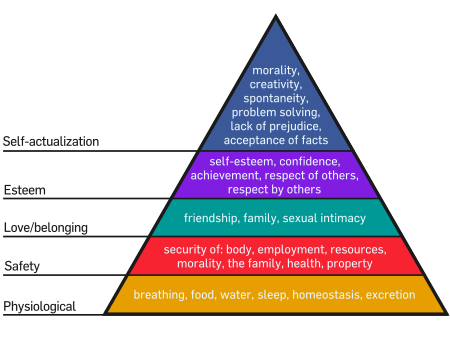
Can Sin be defined, theologically, as Self-actualization? If so, and I think so, then, no doubt much of our Western culture (and Eastern for that matter), and in particular, much of American (and Western) Christian ministry platforms are building their houses on sandy-land. Here is an example of what Self-actualization might mean for today’s winner and upwardly mobile movers:

Seeks to be a ‘way shower‘, cannot settle for mediocrity, always strives to reach greater plateaus, is self contemplative, and seeks to know even the mind’s shadows, doesn’t readily surrender to fear, sees the means as the important conquest, not the end. For the self-actualized there is no end, just a constant movement to expand and become and express more of Oneself! [Taken from The Center for Self Actualization, Inc.]

Or maybe, more famously Abraham Maslow’s hierarchy of Self-actualization might be more explicit and apropos:

Surely there is some truth, some pragmatic utilitarian reality to Maslow’s hierarchy, at least on a purely horizontal plane. But that is the point, right? We don’t live ‘purely’ on a horizontal plane, our  horizontal plane has vertical elevation and purpose that provides its ultimate shape and what it means to finally be ‘actualized’; if, that is, we are even willing to continue to use the language of actulization as a viable anthropological category for supplying us with what it means to be a human, and a successful one at that!

Maybe to get more to the point, and bring this closer to the American Evangelical home and ministry (because I know in the past and present this book is appealed to by leaders in Evangelicalism); what about that infamous book written by a Mormon The Seven Habits of Highly Effective People? Here are the Seven Habits:

Independence or Self-Mastery

The First Three Habits surround moving from dependence to independence (i.e., self-mastery):

  • Habit 1: Be Proactive

Take initiative in life by realizing that your decisions (and how they align with life’s principles) are the primary determining factor for effectiveness in your life. Take responsibility for your choices and the consequences that follow.

  • Habit 2: Begin with the End in Mind

Self-discover and clarify your deeply important character values and life goals. Envision the ideal characteristics for each of your various roles and relationships in life. Create a mission statement.

  • Habit 3: Put First Things First

Prioritize, plan, and execute your week’s tasks based on importance rather than urgency. Evaluate whether your efforts exemplify your desired character values, propel you toward goals, and enrich the roles and relationships that were elaborated in Habit 2.

Interdependence

The next three have to do with Interdependence (i.e., working with others):

  • Habit 4: Think Win-Win

Genuinely strive for mutually beneficial solutions or agreements in your relationships. Value and respect people by understanding a “win” for all is ultimately a better long-term resolution than if only one person in the situation had gotten his way.

  • Habit 5: Seek First to Understand, Then to be Understood

Use empathic listening to be genuinely influenced by a person, which compels them to reciprocate the listening and take an open mind to being influenced by you. This creates an atmosphere of caring, and positive problem solving.

  • Habit 6: Synergize

Combine the strengths of people through positive teamwork, so as to achieve goals no one person could have done alone.

Self Renewal

The Last habit relates to self-rejuvenation:

  • Habit 7: Sharpen the Saw

Balance and renew your resources, energy, and health to create a sustainable, long-term, effective lifestyle. It primarily emphasizes exercise for physical renewal, prayer (meditation, yoga, etc.) and good reading for mental renewal. It also mentions service to society for spiritual renewal.

Philosophically (and thus theologically through a Thomist synthesis, which I will need to discuss at a later date) all of this talk about self-actualization can be traced back to that Greek great, Aristotle. His notion of habitus, or habituating in certain kinds of behavior in order to shape an interior person that might be considered virtuous, successful, moral, or even upwardly mobile could be blamed for our culture that believes that Self-actualization is the only way to live an existentially fulfilling life. Maybe this mode of Self-actualization could be reduced and summed up to that all to familiar axiom of ‘fake-it-till-you-make-it’. So the focus is on the outside/in; it is on outward appearance, and it is this which counts as being a successful and effective person in our actualized age.

But what if all of this, this ‘Self-actualization’ is really just what the Bible calls ‘Sin’? John Webster reports how another theologian of import, Eberhard Jüngel believes that this rather modern (with pre-modern and classical rootage) turn towards the Self-actualized self is really and simply just sin. Here is what Webster writes of Jüngel; and within Webster’s commentary, he provides a quote from Jüngel:

Jüngel thinks of modern society as haunted, both theoretically and practically, by the image of the human person as achiever, by the axiom: ‘[W]ithout increased performance, no increase in the quality of life.’ His theological judgement on the image is that it reinforces that human compulsion to act (Zwang zur Tat) which is the essence of the disorder of human life. ‘Sin’is, simply put, the hopeless drive to self-realization: ‘amongst the worst human failures is the desire to realize oneself alone through one’s good acts, through one’s righteous action — whether it be only legalistic or even moral. The category of self-realization, which today is used in such an unreservedly positive sense, is more accurately to thought of as the quintessence of sin, according to the biblical understanding of the matter.’ The attempt at self-realization is condemned to failure precisely because humanity is essentially relational, …. Thus, in a passage typical of many others, Jüngel writes:

[W]hat Holy Scripture calls sin is … the drive to have one’s own right prevail at the expense of others and in this way to be the one nearest to oneself. We have set out and understanding of righteousness as the ordering of richness of relations between those existing with one another in such a way that justice is done to all those included without their needing to seize if for themselves. Sinners, however, are characterized by a belief that they must and can seize their own right. Those who try to seize their own right take away the right of others. And precisely in this way they break out of the well-ordered richness of relations in which they have been included by God. Sin is the Godless drive away from the diverse relations of created life protected by God, and into relationlessness. [John Webster, Barth’s Moral Theology, 188.]

If what Webster writes, and Jüngel thinks, is correct, and I think it is, then the trajectory of American culture in general, and insofar as Evangelical’s have imbibed this trajectory, in particular, is, again, on the sandy land of man’s own making—thus Sin!

As admirable as Stephen Covey’s Seven Habits might appear, even though he finally gets to others; he only first starts with the self. Even as apparently true as Maslow’s hierarchy of Self-actulization might appear it runs directly contrary to the ethic and direction that Christ’s kingdom does; remember this dominical teaching?:

25 “Therefore I tell you, do not be anxious about your life, what you will eat or what you will drink, nor about your body, what you will put on. Is not life more than food, and the body more than clothing? 26 Look at the birds of the air: they neither sow nor reap nor gather into barns, and yet your heavenly Father feeds them. Are you not of more value than they? 27 And which of you by being anxious can add a single hour to his span of life?[g] 28 And why are you anxious about clothing? Consider the lilies of the field, how they grow: they neither toil nor spin, 29 yet I tell you, even Solomon in all his glory was not arrayed like one of these. 30 But if God so clothes the grass of the field, which today is alive and tomorrow is thrown into the oven, will he not much more clothe you, O you of little faith? 31 Therefore do not be anxious, saying, ‘What shall we eat?’ or ‘What shall we drink?’ or ‘What shall we wear?’ 32 For the Gentiles seek after all these things, and your heavenly Father knows that you need them all. 33 But seek first the kingdom of God and his righteousness, and all these things will be added to you. ~Matthew 6:25-33

So Self-realization really equals Self-justification, or usurping godness for oneself. Doesn’t this remind you of this:

But the serpent said to the woman, “You will not surely die. For God knows that when you eat of it your eyes will be opened, and you will be like God, knowing good and evil.” ~Genesis 3:4-5

The Christian view of justification, salvation, is that salvation is primarily and antecedently inacted by God in Christ. Salvation for the Christian isn’t a se, or internal to the person, a possession innate to the person, simply waiting to be activated through habituating in certain kinds of behavior and activating activity; Nein! Salvation for the Christian is extra nos, or outside of us; it is an alien righteousness, as Luther might quip. It is a life that is received, passively; a life that is only ‘given’ activity through the life of God. So the conclusion then is that we ought to ‘seek first the kingdom of God and his righteousness, and all these things will be added unto us’.

If you want to be successful in the pyramid of God in Christ’s kingdom, then understand that his kingdom inverts the pyramid of this world. If the American Evangelical church wants to be successful, then take up your cross and follow Jesus; be willing to lose your soul that you might find it in Christ.

What is a Genuinely Christian Conception of the Conscience?

Have you ever thought deeply or self-reflectively about what the human conscience is; what your conscience is? The Apostle Paul did, he wrote:

12 For all who have sinned without the law will also perish without the law, and all who have sinned under the law will be judged by the law. 13 For it is not the hearers of the law who are righteous before God, but the doers of the law who will be justified. 14 For when Gentiles, who do not have the law, by nature do what the law requires, they are a law to themselves, even though they do not have the law. 15 They show that the work of the law is written on their hearts, while their conscience also bears witness, and their conflicting thoughts accuse or even excuse them 16 on that day when, according to my gospel, God judges the secrets of men by Christ Jesus. ~Romans 2:12-16

And:

10 these things God has revealed to us through the Spirit. For the Spirit searches everything, even the depths of God.11 For who knows a person’s thoughts except the spirit of that person, which is in him? So also no one comprehends the thoughts of God except the Spirit of God. 12 Now we have received not the spirit of the world, but the Spirit who is from God, that we might understand the things freely given us by God. 13 And we impart this in words not taught by human wisdom but taught by the Spirit, interpreting spiritual truths to those who are spiritual. ~I Corinthians 2:10-13

Usually when we think of conscience we think of it as some sort of autonomous inner light, a free floating island that serves as a self-governing, self-determined, deliberative ‘thing’ (Libertarian Free Agency) that we can appeal to as our objective (subjectively possessed) rudder that guides us through the complexities of our day to day lives. For Christians what I just described is usually qualified in a way that we have a Spirit guided or enabled conscience (which would be Semi-Pelagianism, theologically); nevertheless, it is still functionally understood as an autonomous thing with or without the Holy Spirit’s enablement.

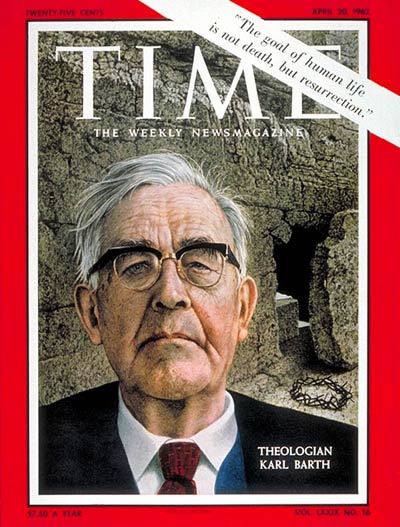
Karl Barth, as narrated by John Webster, offers an alternative account of what the conscience is; his account, true to form, starts, principally, in Christ. Barth saw Christ as the external ground of conscience; this is in contrast to the usual and classical (and even ‘secular’) conception of conscience as something that is an internal and introspective possession of the human agent. For Barth, according to Webster, the moral self does not primarily have ‘self reference’, but a Christic reference that is given to us in his Self giveness for us.  John Webster tells us of Barth (at length),

[T]his refusal of moral and temporal self-referentiality provides the backcloth for one of the most significant and successful discussions in the Ethics, the treatment of conscience in paragraph 16. From the beginning of the discussion, Barth very deliberately sets himself against the assumption that conscience is a natural, self-evident reality requiring no more than immediate self-reflection in order to establish its operations. Quite the opposite: it is ‘this very astonishing knowledge’, something known not as a depth dimension of our moral lives but as ‘our human knowing of what … God alone can know as he who is good, as the giver of the command and the judge of its fulfilment’. For most of the moral traditions of modernity, philosophical and theological, conscience has been an authoritarian and autonomous faculty of self-governance, increasingly detached from rational consideration of moral order. Conscience functions as a kind of nucleus of personal agency around which orbit external realities, such as public conventions or social norms and roles. Those external realities constrain conscience only in so far as they provide material for the deliberations of conscience: like the moral freedom of which it is a core aspect, conscience is authentic in the measure in which it is undetermined by nation or society. For Barth, on the other hand, conscience is quite other than introspective personal moral existence. It takes its place alongside a cluster of other eschatological notions – child of God; fellowship with God the Redeemer; the presence and activity of the Holy Spirit – all of which locate the centre of moral agency outside of the self. To have a conscience is ‘to look and reach beyond the limits of our creatureliness’, ‘to have the Holy Spirit’, to participate ‘in the truth itself’. This means that, over against ‘the ethics of naturalistic or idealistic subjectivism’, Barth does not consider conscience ‘a subjective principle by means of which we can measure the possibilities of life in general and once and for all’. Nor is conscience to be thought of as a faculty, in the sense of a capacity for making judgements, which is ready for our consultation – ‘a principle that we can control, a general principle that we can seize and use at any time’. All such views are anthropologically deficient, in that they envisage the agent’s interior moral life as existing in at least relative isolation from the determining presence of God. For Barth, however, to hear conscience is not to listen to some deeper, non-reflective voice of our own, less caught up in the immediacy of desire and action. It is to listen to ‘our own voice’ as ‘God’s voice’.

Some care needs exercising in grasping Barth’s point here. In speaking of conscience as ‘our own voice’, he is not falling back into the position from which he wishes to escape…. For Barth … the call of conscience summons us to participate in God’s knowledge, literally con-scientia, co-knowledge with God, ‘strictly moment-by-moment co-knowledge. It is not ‘human self-consciousness’, but a co-knowledge in God which is always to be characterized by ‘non-giveness’ or ‘pure futurity’. In the event in which our knowledge becomes this co-knowledge, the distance between God and our awareness is not abolished but bridged. Conscience then, cannot be understood apart from the act of prayer, appeal to the coming of God the Redeemer. Shorn of this eschatological dimension, the notion of conscience could promote ideas of the availability of God’s will as an object for moral reflection…. Without this caveat, conscience threatens to become simply ‘mad autonomism’ or ‘deeschatologised consciousnesses. [John Webster, Barth’s Moral Theology: Human Action in Barth’s Thought, 59-60]

Pastoral Implication

This promotes all kinds of avenues of response. Of primary import, though, as we close, is to highlight the impact that this kind of ‘Christ-conditioned’ understanding of the conscience should have on the Christian’s spirituality. Barth wrote against and from a context that was shaped by the great modern theologian Friedrich Schleiermacher, and others. It was this milieu which gave us theological liberalism, one of its primary hallmarks was that theology became an introspective exercise of the self turning in and finding the reality of God in a ‘feeling’. The effect was to produce a theology that was really anthropology, or a study of the self; a projection outward, only to immediately boomerang inward. Or, Barth’s thought could also be place in contrast to the kind of pietism constructed by Puritan theology (or even Augustine’s theology). Puritan theology, in almost all of its sectors, gave us a spirituality that required the self to look inward to see if they were one of the elect for whom Christ had died; they had to look at ‘their’ good works. All of this heritage has been bequeathed to us, the American Evangelical, and Christian, in general; we end up with a performative Christianity, and a self-centered ethics. And like Schleiermacher, we baptize our moral self determination in the name of Christ; but really this is only a projection of ourselves out onto a concept we know as God (Israel did this with the golden calf … remember?). So I think this hits home, doesn’t it?!

I think Barth is developing a Pauline understanding of conscience, one that is grounded in Christ, and one that we can participate in as we are united to Christ’s humanity (i.e. salvation) by the Holy Spirit. Conscience, a genuinely Christian conception of it, must be one that looks away from ourselves and to Christ.

The Sermon on the Mount [and Barth]: Living the Obedient Life, Now or Later?

The Sermon on the Mount, so called, is one of the most recognizable pieces of scripture ever to be written; even pagans (well some) have heard of it. There are many ways into this sermon, many interpretations and frames of it; but since I am reading on how Karl Barth interpreted this section of scripture, we will focus on his ‘way in’. Indeed, Barth’s resonance with this area of holy writ is resonate with my own understanding of this passage; Barth, of course, offers a Christ-centric reading of the sermon, and he does so biblically theologically. In other words, Barth sees Jesus as the fulfillment, the New Moses, who went up Mount Sinai and received the Decalouge; and yet in the case of Christ, for Barth, Jesus is the subject and fulfillment of the Law, he is the embodiment and particular point of the Law. Christ is the only ‘human’ who had a chance to fulfill the dictates of the Law, for us; and now we are invited to echo Christ’s life as we have been united to his mediating gracious humanity by the Holy Spirit’s recreative and ‘unioning’ work in our lives (this is my gloss). Here is the account of Barth’s reading that A. Katherine Grieb provides:

Barth insists that the Sermon on the Mount, like any other biblical text, must be read in light of its context, that is, in a special connection with the theme of God’s reign as it has come in the person of Jesus Christ in fulfillment of Old Testament prophecy. This is as true of the Sermon on the Mount as it is of the other great discourses in Matthew. Now it is Jesus himself who defines the sphere in which he is present with those whom he calls. The order that constitutes the life of the people of God, for that is what the Sermon on the Mount is, as it repeats and confirms the Ten Commandments and the rest of the Law, is now fulfilled by God in Christ for human salvation (II/2, 687). So even if the Sermon seems to be concerned with problems of human life (marriage, swearing, enemies, almsgiving, praying, and fasting), this is incidental and by way of illustration — which is why it has always proved impossible to construct a picture of the Christian life from these directions. The picture they offer is the picture of the One who gives these directions and of the one who receives them. The picture shows God’s reign, Jesus Christ, and the new human creature. They point, as the Ten Commandments point, to what God has done and is doing in Jesus Christ (II/2, 688).

So Barth can say: “If the Ten Commandments state where [humanity] may and should stand before and with God, the Sermon on the Mount declares that [it] really has been placed there by God’s own deed. If the Ten Commandments are a preface, the Sermon on the Mount is in a sense a postscript (II/2, 688). The only question now is whether the church will live or not live in the fullness of life already granted to it. The Sermon on the Mount declares: “God has irrevocably and indissolubly set up the kingdom of [God’s] grace … which as such is superior to all other powers, to which, in spite of their resistance, they belong, and which they cannot help but serve” (688). [Katherine A Grieb, Chapter 6: “Living in Righteousness: Karl Barth and the Sermon on the Mount,102 in Thy Word Is Truth: Barth On Scripture, edited by George Hunsinger.]

So in contrast to something like my lullabies, those that I was weaned on as a dispensationalist exegete, Barth does not see the Sermon on the Mount as an annex only to be realized by the Jewish people in the coming millennial kingdom (a theme which Grieb also highlights in this, her chapter I have just quoted from); no, Barth sees the ethos and Logos (two loci that Grieb also highlights as she appropriates Aristotle’s ‘pathos, ethos, and Logos’ from Jarisov Pelikan’s application of these to Augustine’s, Chrysostom’s, and Luther’s interpretation of this ‘Sermon’) of the Sermon on the Mount as Jesus himself. So we can see the difference between something like the dispensational approach (or even the ‘Liberal’ approach), and Barth’s. Barth offers a highly realized notion and application of this sermon; because he sees the ideals of the Sermon already fulfilled, already completed in the person of Jesus Christ. The Sermon, then, isn’t something we are waiting for; the Sermon has already come, and it is preached everyday, afresh and anew as we live from and through the Spirit anointed humanity of Jesus Christ. We have been called to an Spirit inspired obedience that is truly counter cultural (and I mean counter church cultural in many ways). We (if we follow Barth on this) understand that this world has already been crucified to us, and us to the world (to borrow a Paulinism from Gal. 6); and so we don’t do what might be considered expedient, instead we stand on and in the obedience of Jesus Christ. This obedience is an eschatological obedience that breaks in on us every morning when we wake up; it is an obedience that is waiting for us with Spirit formed breath and life; it is obedience, like poetry, that has already been written, just waiting for us to read, act, and respond from. It is an obedience, the obedience of Christ, that has contradicted this world system and everything this world system believes is real (which is an illusion in light of the reality of Christ!).

We ought, then to live from the obedience of Jesus Christ, from his humanity for us — which is still for us, just read Hebrews 7:25 — we aren’t waiting for the Sermon to be fulfilled; the Sermon’s reality is in the New Humanity of which Jesus Christ is its first fruits.

So then, just as you received Christ Jesus as Lord, continue to live your lives in him, rooted and built up in him, strengthened in the faith as you were taught, and overflowing with thankfulness.See to it that no one takes you captive through hollow and deceptive philosophy, which depends on human tradition and the elemental spiritual forces of this world rather than on Christ. ~Colossians 2:6-8 (NIV)

Peter’s Denial, Jesus’ Love

This is a rererepost. This post seems to get hits on an ongoing basis more than any other post I think that I have ever posted. I think I originally wrote this post probably 5 years ago. I might tweak the way I said some things, but all-in-all I still stand by what I originally communicated in this post. It is reassuring to me to know that God’s faithfulness in Christ is the objective and subjective ground upon which I stand in relation to him. I stand on and in the solid rock of Jesus’ mediating gracious humanity as the anchor of my soul. There is nothing that can separate us from the love of God in Christ Jesus; because if God be for us, in Christ, and he does not condemn us, then who can be against us?

I am quite certain that there are many people in the church today, because of bad teaching and theology, who struggle with issues surrounding assurance of salvation. In fact this is not a new phenomenon, but is as ancient as the rambunctious Apostle, Peter. Remember the emphasis of the “Last Supper,” and Jesus’ prediction that one of His disciples would deny any relationship to, or knowledge of Himself. And we all know what happened, Peter most certainly denied any knowledge of or relationship with Jesus (see Mk. 14:66-72, amongst the other synoptics and the Gospel of John); and of course his response was one of sheer horror, and remorse. I think at that moment, and the immediate time following this incident, Peter was most unassured that he would have any further part in the “Kingdom of God.”

But you see, his relationship with Jesus was not dependent on his faithfulness to any kind of commitment or “covenant” that he may have made with God, and His Son; oh no, rather the relationship was completely dependent on Yahweh’s covenant faithfulness to His people (in fact all of humanity, objectively speaking). Let’s go back to the Old Testament for a moment to further substantiate Yahweh’s faithfulness, indeed Jesus’ faithfulness to humanity. In fact there are so many examples of this throughout the Old Testament, that we have our pick, so to speak; lets quickly look at Ezekiel 36 verses 22-32 (click on citation for full text). Here we come across Yahweh speaking to Israel, and coming to them in a time of great, great, sustained unfaithfulness, on their part. He admonishes them, and makes clear His intention to bring judgment on them (per the Levitic curses, Lev. 26; Deut. 28–30); but, and this is the hopeful part, He shows Himself faithful to them, inspite of their unfaithfulness to Him. In fact He promises to bless them beyond belief, at His initiation, and because of who He is, in Himself, inspite of their own unbelief and outright disobedience. Let’s just get a sampling of Yahweh’s staggering, and gracious nature towards an unbelieving people:

Therefore say to the house of Israel, ‘Thus says the Lord God, ‘It is not for your sake, O house of Israel, that I am about to act, but for My holy name, which you have profaned among the nations where you went. 23. I will vindicate the holiness of My great name which has been profaned among the nations, which you have profaned in their midst. The then nations will know that I am the LORD, declares the Lord God, when I prove Myself holy among you in their sight. 24. For I will take you from the nations, gather you from all the lands and bring you into your own land. 25. Then I will sprinkle clean water on you, and you will be clean; I will cleanse you from all your filthiness and from all your idols. 26. Moreover, I will give you a new heart and put a new spirit within you; and I will remove the heart of stone from your flesh and give you a heart of flesh. . . . (Ez. 36:22-26ff)

Notice the “I–you” pattern, in the section above; this pattern continues on through verse 32 of this chapter another seven times. This is an important pattern, and is used for emphasis in this passage. It is a movement, a unilateral one, where Yahweh is seen to be the One who is always faithful, and does everything because of His love (which we know defines His nature as Father loving Son, Son loving Father, and Holy Spirit loving both bringing communion amongst the three); which we creatures partake of as He showers us with His surplus and super-abundance. So then, when we come to Peter and Jesus we should not be surprised that Jesus responds just as graciously to a fearful Peter, cowering in remorse and sheer angst of soul. Notice the response, and special notice paid to Peter in Mark 16:7 (this is the angel’s message, just after Jesus has resurrected):

. . . But go, tell His disciples and Peter, He is going ahead of you to Galilee; there you will see Him, just as He told you. . . .

And Paul in his first epistle Corinthians also makes this special distinction of Peter:

. . . and that He appeared to Cephas [Peter], then to the twelve. 6. After that He appeared to more than five hundred brethren at one time, most of whom remain until now, but some have fallen asleep; . . . (I Cor. 15:5, 6)

The point to take away from this, is that even though Peter denied Him, Jesus remained faithful in His love for Peter. This is illustrated by the pin-pointed pursuit by God to single out a desperate despairing Peter. The LORD pursues us, and He keeps us as His, no matter what. This relationship between Peter and Jesus was presupposed by who Jesus was (in relationship to the Father and Holy Spirit), and is for us; instead of who Peter (and we are) was and is for Jesus.

What this incident further illustrates is that “assurance of salvation” is not even a scriptural category. In other words, we don’t see this ever communicated as a viable situation in the scriptures. The scriptures presuppose Yahweh’s faithfulness, as well as humanity’s unfaithfulness; which is the point of the cross. It is the cross that reverses the curse and the subsequent doom and gloom of humanity’s fallen situation. Our response to the Father, is firmly located in Jesus’ response to the Father on the cross, “. . . Father into thy hands I commit my spirit. . . .” It is not until much later, within church history that “assurance of salvation” becomes a doctrinal “pastoral” category. The next post will further touch on the system of theology (esp. as developed in English Puritanism) that brought us this deplorable teaching on “assurance.”

Stand firm today in the confidence that it is not our faithfulness, but His faithfulness, and LIFE, that is the source of our confidence and hope!