Old Debate, New Day: Calvinism — Was Calvin a Calvinist?

The debate on Calvinism that just happened in Chicago last week continues to be the source of some discussion online, so I thought I would say at least one more thing.

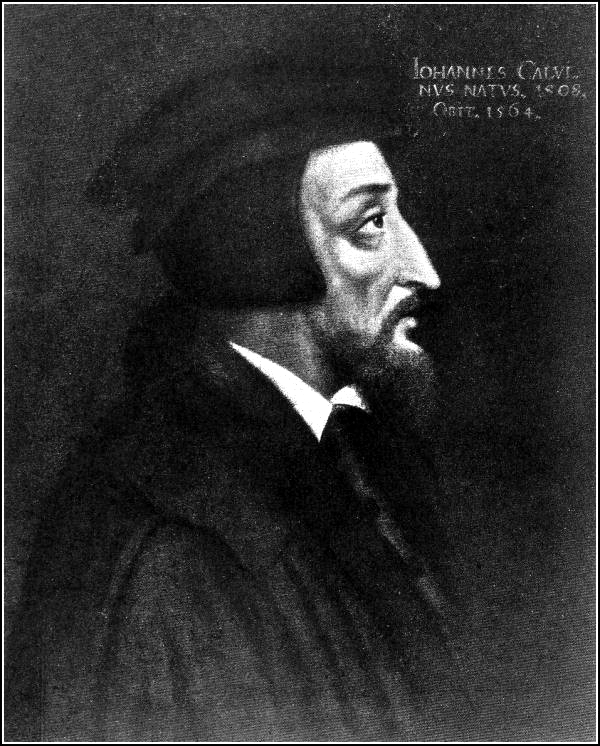
During the debate the non- Calvinist side, particularly Brian Zahand continuously made the charge that John Calvin was the founder of Calvinism. The reality is though, that Calvin did not found Calvinism, while he was an important teacher within the then burgeoning Reformed ground swell, he himself never founded Calvinism. Instead, Calvinism developed post-Calvin, particularly among the scholastic post Reformed orthodox theologians (like Vermigli, Ursinus, Olevieanus, even Beza, and then of course culminating later at the Westminster Assembly).

In order to discuss this continuity/discontinuity between Calvin and the Calvinists, let me refer to a post I wrote about 5 years ago. In this post there is a quote from Richard Muller that helps to develop my points further.

Sharing this post of mine from the past will also illustrate how I think Calvin’s relationship to Calvinism actually helps to provide more instances of Calvinism that go beyond what most people think of Calvinism today.

Primarily I simply want to drive home the point that Calvin was not the founder of Calvinism, which runs counter to what Brian Zahand continuously appealed to throughout his debate with the Calvinists. Here’s that post:

Here Muller confirms what I have been asserting all the while; that he sees an organic thread between Calvin and the “orthodox, Calvinists.” He says:

In the early years of the Reformation emphasis on the faith of the individual and stress on a new found sense of Christus pro me placed atonement at the center of theological concern. Even so, the work of Christ as mediator occupies the center of Calvin’s thought. The following essay will argue in similar terms that Protestant orthodoxy did not depart from this emphasis, that it developed a doctrinal structure more formal in definition and more scholastic in method but nevertheless concerned to maintain a doctrinal continuity with the soteriological emphasis and christological center of the theology of Calvin and his contemporaries. In this development, orthodoxy completed the transition (already evident in the work of Calvin) from piety and the preaching of reform to the system of Reformed doctrine. New structures, like the threefold office and the two states of Christ were integrated into systems of doctrine as formal principles, indeed, as new doctrinal contexts elicited from scripture, in terms of which dogmas received from the traditions — the Chalcedonian christological definition, for example — would be understood and, to a certain extent, reinterpreted. In this context also, the doctrine of the atonement, because it manifested the gracious will of God, moved into close relation with the doctrine of election. (Richard Muller, “Christ and the Decree: Christology and Predestination in Reformed Theology From Calvin to Perkins, 10)

Like I said, a “seamless whole.” Muller represents, as one of the “Reformed’s” best scholars (and let me just say, he is exceedingly brilliant, an amazing scholar), the atttitude that I’ve been trying to engage here. That is, what Muller calls “orthodoxy” is the only “live” option for what it means to consistently and coherently appropriate the thought of Calvin — thus the exclusive claim (by Federal theology) to the name “Calvinist.” It is this thesis that becomes the a priori force that shapes the sectarianism that is now evinced by Calvinists, today. That is, if someone says that there are other, even historic, ways to appropriate Calvin (much more in line with his Evangelicalism); these folks are considered heterodox.

Karl Barth’s Critique of John Calvin’s View of Election and Reprobation: Getting Beyond the ‘Absolute Decree’

johncalvinIf Jesus only elects certain individuals for salvation, and then elects others for damnation (reprobation); from whence does someone’s assurance of salvation come from? How do they know that they are one of the elect for whom Christ has died, or for whom Christ has interceded (cf. Heb. 7:25)? This is a dilemma that one is presented with if you follow John Calvin’s view of double predestination, or any of the post Reformed orthodox, Calvinist theologians who followed Calvin and the Augustinian lead on this. It is this view of election and reprobation that Karl Barth critiqued thusly:

How can we have assurance in respect of our own election except by the Word of God? And how can even the Word of God give us assurance on this point if this Word, if this Jesus Christ, is not really the electing God, not the election itself, not our election, but only an elected means whereby the electing God—electing elsewhere and in some other way—executes that which he has decreed concerning those whom He has—elsewhere and in some other way—elected? The fact that Calvin in particular not only did not answer but did not even perceive this question is the decisive objection which we have to bring against his whole doctrine of predestination. The electing God of Calvin is a Deus nudus absconditus.[1]

To be fair to Calvin, he was working from what David Gibson has identified in his published PhD dissertation Reading the Decree: Exegesis and Christology in Calvin and Barth following Richard Muller’s distinction between Barth and Calvin as: ‘soteriological christocentrism and principial christocentrism (Calvin follows the former).[2]That notwithstanding, at a material level, Barth’s critique, I believe stands. If there is a decree that is ontologically distinct and outwith God’s life in Christ (as there is in Calvin)[3], a decree  (or a will in God that is not necessarily related to Jesus) by which God chooses some to salvation and reprobates others to damnation, then can we really ever look to Jesus for assurance of salvation? It would seem that instead, as Barth is noting, that we must look behind the back of Jesus to the decree itself in order to know whether or not we are truly saved. But this decree, impersonal as it is (and not necessarily or personally related to God’s life), cannot provide any real lively hope; only Jesus can.

I go with Barth’s critique of Calvin on this issue. It could be said at this fork in the road, that Calvin offers up a ‘God behind the back of Jesus.’ Meaning that there is an inaccessible decree, even through Jesus, that is determining the way that God chooses or not people for salvation. The decree is an abstraction, and thus not personally related to God in any meaningful way.


[1] Karl Barth, “CDII/2,” 111 cited by Oliver D. Crisp, “I Do Teach It, but I Also Do Not Teach It: The Universalism of Karl Barth (1886-1968),” in ed. Gregory MacDonald, All Shall Be Well: Explorations in Universalism and Christian Theology, from Origen to Moltmann (Eugene, OR: Cascade Books, 2011), 355.

[2] David Gibson, Reading the Decree: Exegesis and Christology in Calvin and Barth (London: T&T Clark A Continuum Imprint, 2009), 6. See the hyperlink to a post I have written that elaborates further on the definitional reality associated with this hermeneutical distinction between Barth and Calvin’s hermeneutics.

[3] This would fit well with Calvin’s voluntarism (i.e. that God’s will and commands or decrees are arbitrarily and thus non-necessarily related to God’s being/persons in relation. See the Stanford Encyclopedia of Philosophy for further explication of ‘voluntarism’.

John Calvin and Theological Exegesis

Randall Zachman makes a great point in highlighting Calvin’s understanding of the relationship between Biblical exegesis/interpretation and “Sound theology”/dogma:

. . . The Institutes and the commentaries are intended by Calvin to open access to Scripture for future pastors, whereas the catechism and the weekly sermons are meant to open access to Scripture for members of the young-calvincongregation. For Calvin, the proper understanding of Scripture depends on familiarity both with the summary of the rudiments of doctrine and with Scripture itself. Those who lack this kind of training, even though they are expert in the Hebrew language, will inevitably misunderstand Scripture. “But it generally happens with men who are not exercised in the Scripture, nor imbued with sound theology, although well acquainted with the Hebrew language, yet hallucinate and fall into mistakes even in first rudiments.” [Calvin’s Comm. on Ps. 73:26] As a teacher and preacher, Calvin sought to exercise his students in Scripture and imbue them with sound theology; . . . [brackets mine] (Randall C. Zachman, “John Calvin As Teacher, Pastor, And Theologian: The Shape of His Writings and Thought,” 108)

This is what dawned on me somewhere between Bible College and Seminary. When I went to Bible College I was full of the idealism that I was going to learn the Biblical languages (so I minored in NT Greek), and thus be able to thoroughly understand and interpret the concepts and doctrine of Scripture (on that basis alone). What I began to realize, as I did syntactical analysis, is that even knowing the “languages,” I still had to make interpretive decisions (even in doing translation work — from the Greek to English). So I went on to seminary and did a Masters thesis which was an “exegetical/language” based thesis (on I Corinthians) — although my passage was really inspired by Martin Luther’s theology of the cross — and I took further language classes (like Hebrew and Greek); but this time it was alongside historical theology (not just systematic like in the undergrad). Anyway, what I’m getting at, and what has led me down the path I’ve been on now since seminary, is the point Zachman is highlighting on Calvin’s thinking. That is that just knowing the Biblical languages isn’t enough. Every Biblical exegete operates and moves within a theological milieu or system; and this “system” is going to impact the way that particular exegete makes his/her interpretative decisions as they approach the text of Scripture (it’s just how it is). So what motivates me is to engage the implications, the “inner logic” of Scripture (e.g. deal with the underlying theological framework that the Scripture writers and Apostles assume in their largely occasional writings) so that I am aware of what is informing my “interpretive decisions” as I approach the text. I think this is what Calvin was on about, and I think it’s something we all need to be mindful of as we endeavor to grow in the grace and knowledge of our Lord and Savior, Jesus Christ.

Furthermore, working through the dogmatic concepts implied by the text and Christ’s life is not just a negative concern (my point above: e.g. “so that I am aware of what is informing my ‘interpretive decision'”), but there is a very positive side to doing the “inner logic” stuff too. And that is that we become aware of the implied intentions of the particular writers and Holy Spirit as we engage the text of Scripture. In short, we become quickly aware that the canon of Scripture has a very Trinitarian/cruciformed-christoformed shape to it. The grammar and syntax of the text is really only intended to be in service to this undeniable and great reality: Jesus Christ!

“You search the Scriptures because you think that in them you have eternal life; it is these that testify about Me; . . . ” ~John 5.39 (NASBU)

Providing Some Historical Background for Evangelical Calvinism through Calvin

The never ending debate of continuity between Calvin and the Calvinists will probably endure until the Lord returns. Bruce Gordon, amongst most ‘Reformed’ scholars, holds to the thesis that in fact there is continuity between Calvin and those who bear his name today; he says:

. . . Calvin’s discursive, humanist style, which he shared with his contemporaries, was replaced by new forms of argumentation that could be used in the schools and academies. The theology itself was not changing, and Calvin’s thought remained crucial to Reformed tradition, but the means by which it was taught reflected new requirements. Moreover, as he had lived, in death Calvin did not stand alone. He was read, studied and interpreted in various contexts all within a wider stream of Reformed thought that included Bullinger, Vermigli and their successors. Just as he had wanted, he belonged to the community of churchmen. (Bruce Gordon, “Calvin,”339).

I think, reading between the lines, Gordon is saying that much of the post-Calvin development was really only a matter of genre; that pedagogy, and historical circumstances — facing “the Calvinists” — required various approaches and appropriations. I am sure this is true. But is it also sound to reduce Calvin’s thought, and the development of his thought to an issue of “style,” and not “material content,” as Gordon does? I am leery on this point.

Beyond this, and what is agreeable with what Gordon asserts, with qualification of course, is that Calvin was read “in various contexts all within a wider stream of Reformed thought.” What Gordon seems to be presuming, given his list of “Calvin’s readers” (i.e. Bullinger, Vermigli, et al.), is that this wider stream is what developed into what we now call “Orthodoxy” (i.e. corollary with the Westminster Divines, et al.). This is where “Evangelical Calvinism” wants to step in and say, “hello, wait a minute, what about the Scots and even some of the English?” Now certainly, if we assume that “Orthodoxy” is “Orthodoxy,” then the “stream of Reformed tradition” is delimited in ways that automatically preclude what we as “Evangelical Calvinists” want to say; and that is that there are readings of Calvin within the ‘Reformed tradition’ that do not fit into the “Orthodox” stream, per se (viz. depending upon what the standard of actual “Orthodoxy” is — is it sola scriptura, or self proclamation?).

Case in point, and on this I will close; Calvin had a very Trinitarian way of reading Union with Christ, it was ‘real’ and ‘ontological’ union — this is what Evangelical Calvinists believe as well. Do the Federal or Orthodox, predominately see it this way (I am generalizing here)? Julie Canlis, a Calvin scholar says:

My suspicion is that Calvin’s scuffle with Osiander is largely to blame for our Reformed emphasis on justification to the exclusion (or downgrading) of adoption as spiritual union. Although Alister McGrath notes, “Calvin is actually concerned not so much with justification, as with incorporation into Christ,” it seems as if Reformed theology traded this full-bodied trinitarianism for a narrower (though vital) christocentrism. Out of fear of Osiander’s (and others’) focus on union unaccompanied by an appropriate role for the cross, we have compensated by limiting union to the cross—the method by which we are saved. With this move, however, we are no longer asking the questions that Calvin was asking: we suddenly are left with questions about how we are saved, from what we are saved, and what we should do now that we have received this salvation. They tend to be the questions that quench rather than nourish spiritual formation because they are stunted. Calvin’s questions always centered around God (not ourselves, or even our salvation) and about the glory of God—questions that are not stunted because they open themselves up to a reality much larger than themselves and do not approach this reality with a (frankly consumerist) how can- I-get-salvation mentality or a (primarily functional) what-should-I-do-now mentality. Calvin’s questions took their cues from God in his trinitarian fullness and his inexplicable desire to bring us into this fullness. In distancing himself from Osiander, Calvin was not necessarily less radical than Osiander in his vision of union with God, he was just relentlessly trinitarian. Union, when explained as justification or friendship or even fellowship with God, doesn’t quite meet Calvin’s standards. “Not only,” Calvin says, “does Christ cleave to us by an indivisible bond of fellowship (societatis), but, with a wonderful communion (communione), day by day, he grows more and more into one body with us until he becomes completely one with us.” It seems that Calvin himself is arguing for something more than fellowship: “not only fellowship but communion, becoming one with us.” What does this mean? I believe it is Calvin’s desire to push us deeper, through the glory of being reconciled to God by justification, into a life of being spiritually formed by the Trinity itself (himself!). Adoption is Calvin’s answer to both Osiander’s non-trinitarian union and the sometimes-diluted “union” that we in the Reformed tradition have unconsciously embraced. (Julie Canlis, “Calvin’s Institutes: A Primer for Spiritual Formation,” Resurgence [2007])

There is alot in this one quote (Osiander was one of Calvin’s theological opponents, btw); suffice it to say, besides the rich points that Canlis is making (theologically), this illustrates the way that Calvin can and should be read on “Union.” If this is the case, shouldn’t this be one of the salient points that we judge whether or not the “Orthodox Calvinist” has indeed read Calvin the right way? I think it should be. If this was a key of Calvin’s theology, shouldn’t it be a keynote in the “Orthodox” Calvinist’s theology?

I could provide more comment, in fact I want to quote TFT in his book “Scottish Theology,” wherein we see ‘Evangelical Calvinists’ reading “Union” much the same way as Calvin. The point would be, if “Scottish Theology” reads Calvin the way he intended, and “Federal Theology” (Classic Calvinists) do not; wouldn’t this at least suggest that “Evangelical Calvinism” should be included in the discussion of the “wider Reformed tradition?” I think so, thus an impetus for this blog.

Stop It! Stop It! Quit Looking at Yourself: Knowledge of God, Knowledge of Self

Karl Barth, hearkens back to John Calvin in many ways; but of course Barth doesn’t do so uncritically, or in ways that remain abstract from Barth’s own theological categories and emphases, formed as they are by his centraldogma of election in God’s life for us, with us, and thus not without us.

So in true to expected form, when discussing salvation and personal knowledge of God, Barth sounds a lot like Calvin, when it comes to Calvin’s basic understanding about knowledge of God and knowledge of self that is then oriented by the proper order of knowing God first. Calvin famously writes in his Institute:

Again, it is certain that man never achieves a clear knowledge of himself unless he first looked upon God’s face, and then descends from contemplating him to scrutinize himself. For we always seem to ourselves righteous and upright and wise and holy–this pride is innate in all of us–unless by clear proofs we stand convinced of our own unrighteousness, foulness, folly, and impurity….[1]

Barth follows this theme in Calvin, but radicalizes it; again, based upon his reified understanding of election and how that implicates both God and humanity in Christ and his unio personalis. In other words, Barth has a thick, robust, and even more explicit and non-dualist theological-anthropology at play when he considers knowledge of God, and knowledge of self. Humanity is objectified, by the subjective humanity of Christ for all; as such, if we really really are serious about understanding ourselves, understanding what it means to be human, what it means to be in relation to God (which is to be rightly human as sustained by the indestructible life of the Son for us) we will always look to complete and all sufficient life of Christ. We won’t engage in the pietist turn of constant self-examination; we won’t psychologize ourselves to death; we won’t be obsessed with an individualist style of Christianity; we will, instead, look out and up toward Christ. This approach definitely changes how we think of our daily walks and spirituality (I will have to comment on how I think that looks later). Here is the way Karl Barth, according to George Hunsinger, understood this kind of Calvinian approach to things:

Therefore, if we sinful human beings are to find the truth of our existence, the reality of our salvation, and the ground of our selfhood before God, the basic rule is that we should look away from ourselves to Jesus Christ. “The greater the concentration with which we look at him, the better will be the knowledge that we have of ourselves” (IV/2, 269). We are not to seek knowledge of our salvation by means of introspection or self-examination. We are to look away from ourselves as consistently as possible. “It is a matter of knowing ourselves . . . in Christ,” writes Barth, “and therefore not here in ourselves, but there outside ourselves in this Other who is not identical with me, and with whom I am not, and do not become, identical, but in whose humanity God himself becomes and is and always will be another, a concrete antithesis” (IV/2, 283). Our self-knowledge as the knowledge of who we are in Christ (who stands over against us even in uniting with us) can only occur as we learn to recognize ourselves in him, since “in truth” we are not outside but are so within him that he is our “truest life” (IV/3, 545).[2]

How badly need this kind of outlook is, in North American evangelicalism in particular. We currently are living in the contemporization and repristination of our Puritan pietist past that emphasizes a spirituality with an undo specter of exhorting Christian people to look inward, to the fruits of their labor, and contrition of their souls to prove to themselves, the church, and the world that they are indeed Christians. And so a Barthian/Calvinian antidote to this kind of (The Gospel Coalition and likeminded movements among evangelicals) ‘spirituality’ as sorely needed. If Jesus is the ground, if he is THE human, and you derive your existence, your human being by participation with and from his by the miraculous re-creative activity of the Holy Spirit; then looking away and to Christ ought to become the balm to the overly burdened and individualized soul who wanes under the weight of its own laborious proof of life.


[1] John Calvin, Institute, 1.2.37.

[2] George Hunsinger, How To Read Karl Barth: The Shape of His Theology (New York/Oxford: Oxford University Press, 1991), 119, Nook. 

Darren Sumner on the extra Calvinisticum

I am finally getting around to reading my friend’s, Darren Sumner‘s, essay, “The Twofold Life of the Word: Karl Barth’s Critical Reception of the Extra Calvinisticum,” International extraJournal of Systematic Theology 15 (2013). Darren is a recent PhD from the University of Aberdeen who studied with John Webster (who is now at St. Andrews). 

The Extra has actually been around longer than Calvin, but Calvin deployed it in its most Protestant and Reformed expression in his debates with Luther around the eucharist and the ubiquitous presence of the body of the Lord therein. I have read others (and Calvin himself) on the Extra (Bruce McCormack, Myk Habets, et. al.), and so Darren’s engagement will be good and interesting because he is a former student of McCormack’s at Princeton Theological Seminary, and he interacts with Myk Habets’ essay on the same topic (and as I understand it, is constructively critical). I thought though, without getting into the nitty gritty, in case some of you have never heard of this, or would like a precise definition of what the Extra entails; that I would share what Darren shares about it, briefly, in the introduction to his essay.

The purpose of this article is to examine the dogmatic place of the ‘so-called’ extra Calvinisticum in an effort to determine whether it is an indispensable tenet of Christology – particularly in the Reformed tradition. This doctrine states that the Word of God is not entirely circumscribed by his assumed humanity, but continues to fill and sustain the universe even while he is incarnate in Jesus Christ. In other words he exists in two ways, both ensarkos and asarkos, because – as the Reformed  dogmatics typically put it – finitum non capax infiniti.1 The term has its origins in Reformation debates over the Eucharist: the Reformed rejected both the bodily presence of Christ in the sacrament and the Lutherans’ innovative expansion of the communicatio idiomatum that undergirded it, since, they argued, there is no sharing of attributes between the natures. In its origins as a piece of negative theology – as the denial of Lutheran ubiquity and the genus maiestaticum – the extra Calvinisticum aimed at nothing more than this. It was an attempt by the Reformed to maintain: (1) the proper, Chalcedonian distinction between the natures, and (2) that the natures remain unaltered and undiminished. Therefore the Word is fully incarnate in the human Jesus, but is etiam extra carnem – also outside the flesh.

peace to you.

John Calvin and Evangelical Calvinists on Assurance of Salvation, Thesis 7 from EC Book: Prompted by Derek Rishmawy’s TGC Article

Fellow blogger and Facebook compadre, Derek Rishmawy, just wrote a short article calvincalvinfor the The Gospel Coalition’s blog (the only time you’ll find me reading something on TGC’s blog is when Rishmawy posts something of interest or I am researching for something specific) on why he enjoys reading John Calvin’s commentaries, and why he thinks others should or would too. In the comments to his article a commenter named Steve Martin wrote this about Calvin and the doctrine of the assurance of salvation:

Calvin was ok…. Luther was much better because he didn’t send you back into yourself for assurance of salvation…. Calvin had a weak understanding of the external Word and sacrament. If that were not so then Calvin would be a much more reassuring read. [see]

And so in response and clarification to that, I thought I would post Myk Habet’s and my seventh thesis from our edited book, Evangelical Calvinism: Essays Resourcing the Continuing Reformation of the Church. We co-wrote this chapter (15), which is made up of fifteen theological theses or statements that Myk and I hold to as the contours of what we consider formative for our style of evangelical Calvinism. Without further ado (footnote numbering has been altered from its original for this blog post):

Thesis Seven.Assurance is of the essence of faith.

Coordinate with theses 2 and 3, Evangelical Calvinism understands assurance of salvation to be inseparably linked with union with Christ. Salvation is not understood as “our” salvation so that our subjectivity over-rides the objective ground in Christ; instead it is of upmost importance that we see both the objective and subjective sides of salvation rooted in the person of Jesus Christ. The basis for assurance of salvation, then, flows from the faith that is founded in Christ’s vicarious faith/fullness for us; so the subjective side of Christ’s faith becomes ours as we are united to Christ “spiritually” by the Holy Spirit’s inveterate movement of gracious action, co-extending from the once for all faith realized in the person of Jesus Christ. Commensurate with this understanding, John Calvin framed “assurance” through similar foci; as Charles Partee points out:

The conviction that salvation is not conditional but certain is an almost forgotten mark of the Protestant Reformation. According to Calvin, doubting the certainty of one’s salvation is sinful. We do not understand the goodness of God apart from full assurance (III.2.16). “[F]aith is not content with a doubtful and changeable opinion . . . but requires full and fixed certainty” (III.2.15). If salvation were not certainly known to believers, election “would have been a doctrine not only lacking in warmth, but completely lifeless.” In summary, Calvin insists, “Our faith is nothing, unless we are persuaded for certain that Christ is ours, and that the Father is propitious to us in Him. There is, therefore, no more pernicious or destructive conception than the scholastic dogma of the uncertainty of salvation” (Com. Rom. 8:33, 34). . . . Union with Christ is exactly the direction Calvin’s theology moves. For Calvin certainty is not to be found in a principle or a book but a person. That is, in union with Jesus Christ. Our task is “to establish with certainty in our hearts that all those who, by the kindness of God the Father, through the working of the Holy Spirit, have entered into fellowship with Christ, are set apart as God’s property and personal possession” (IV. 1. 3). . . .[1]

With Calvin and early Reformed thought generally, assurance teaches us we are elect. Tony Lane clearly shows how Calvin considered assurance to be of the essence of faith and how this was coordinated with various other aspects of this theology, notably with the doctrine of election.[2] Salvation is not salvation if one is unsure of possessing it. That, at least, was Calvin’s argument when he wrote:

Now we shall possess a right definition of faith if we call it a firm and certain knowledge of God’s benevolence toward us, founded upon the truth of the freely given promise in Christ, both revealed to our minds and sealed upon our hearts through the Holy Spirit.[3]

As it is for Calvin at this point, so it is for the Evangelical Calvinist. The root of assurance is found in Christ himself, and Christ’s faith and faithfulness is mediated to us through our union with him by the personal work of the Holy Spirit, a work which brings humanity into the effervescent and indestructible life of God’s eternal Logos.


[1] Partee, The Theology of John Calvin, 205–6.

[2] Lane, “Calvin’s Doctrine of Assurance Revisited,” Tributes to John Calvin: A Celebration of His Quincentenary, 270–313.

[3] Calvin, Inst., 3.2.7.

After Calvin: A wee history

Here is a little paper/article I put together (rather quickly — a couple years ago) on the history surrounding the debate between understanding Calvin as either 1) a Calvinist, calvinbible_phixr-1_phixror 2) not a Calvinist. I wanted to put this up again, because I think it still, at least, illustrates some of things at stake in this rather technical/sticky issue. It’s probably an issue that most could care less about (and to be honest I don’t care as much about it either anymore, but I still think it’s important).

The following represents a mini-paper I just wrote on the issue of Calvin vs. the Calvinists. What I want to provide for you all is what is at stake for Evangelical Calvinism and her place in the complex known as “Calvinism” or “Reformed” theology. The following is just an introduction to the major approaches to how we understand and frame this issue. I will be following this up with later posts, providing more flesh to the bones that this post present us with. The reason this is important is because if we follow the reading provided exclusively by Richard Muller, Evangelical Calvinism cannot be fitted into the framework known as “Calvinism,” in general. That is problem, 1) because it is not accurate relative to the history, but more importantly 2) because it mutes a rich conceptual and “doctrinal” heritage from being considered ‘orthodox’ by the broader body of people known as “Reformed orthodox.” What I will ultimately seek to demonstrate, of which this paper is only an introduction to, is that Muller does indeed provide a helpful corrective to some of what has been said by the “older scholarship;” but that he is inconsistent with his own thesis of “continuity,” because he in fact fails to include strains of Calvinism within the “Reformed orthodox” tradition. He says that he is only really concerned with methodology, and that he just wants to give us the real “history” around this issue; but upon further reading (which I’ll bring out later), he actually smuggles the conceptual back into his project — the very thing he accuses the “older scholarship” of doing. In other words, Muller demonstrates that his motivation is as much “theological” as those he accuses this of, and seeks to correct through his historizing. Anyway, here’s what I have thus far:

Introduction: Stating the Problem, Complexity and Conceptuality in the Readings of the ‘Reformed Tradition’

Engaging the period of Protestant history known as the ‘Reformed period’ has many and complex issues involved with it. Not least of which is how we should understand the relationship between what Richard Muller has called the ‘early’, ‘high’, and ‘late’ eras of this broader category that makes up the ‘Reformed period’. In other words, in the literature there has been reconstruction of this period, and the inter-relationship that inheres between the “three eras” just noted, that is in competition.

The “competition” revolves around how we should understand the continuity or discontinuity between the earlier Reformers and the high and later Reformers (the latter two classifications known as the ‘post-Reformed orthodox’). The so called older school of interpretation made up by folks like Thomas Torrance and Brian Armstrong (and even Karl Barth) are caricatured to have interpreted this issue in overly simplistic form, and through a biased dogmatic appropriation of the “history.” Muller says,

The older scholarship, exemplified by the writings of Ernst Bizer, Walter Kickel, Brian Armstrong, Thomas Torrance, and others has typically modified the term “orthodoxy” with the pejorative terms “rigid” and “dead,” and modified references to “scholasticism” with the equally pejorative terms “dry” or “arid.” Such assessment bespeaks bias, but it also reflects a rather curious sequence of metaphors. The implied alternative to such a phenomenon as “scholastic orthodoxy” would, perhaps, be a flexible and lively methodological muddle of slightly damp heterodoxy. . . .[1]

Muller takes issue with these “older approaches,” and seeks to clarify this issue by revisiting and sharpening how the key language of “scholastic” and “orthodox” should be understood within their historical context. He believes that the “older scholarship” has too quickly and anachronistically read their respective theological agendas into the history, thus subverting the history for their own usage; in the end what they give us, according to Muller is a revisionist reconstrual of the actual history.

Carl Trueman along the lines provided by Muller forwards the same thesis in regards to the way this issue has been framed and interpreted by the “older” school. He believes that people like Torrance and Armstrong have co-opted the “history” to provide credibility to their own theological constructive work; he seeks to correct this paradigm,

In the last twenty-five years many scholars . . . have moved away from the traditional models whereby Protestant scholasticism was judged by the standards of later theology, whether Barthian, neo-Calvinist or whatever, to developmental models which attempt to set the movement within the context of its own times and within the ongoing Western theological tradition. . . .[2]

It is this problematic that Muller, Trueman, and company seek to “revise” through providing, what they believe is the proper way to frame and understand this oversimplified approach that the older school has bequeathed upon us.

I will seek to elucidate how Muller, specifically, seeks to reify the understanding provided by the “old school,” and what in fact he believes is the proper way for moving forward. But, before we get there we should visit, for a moment, how this “older scholarship” sought to appropriate the “history” represented by the “Reformed period.” What is it that Muller and others are protesting in regards to the ways that these elder “theologians” and “church historians” approached this salient issue?

Answering this question is really not that difficult, at least not for Muller; he holds that the oversimplification provided by the “old school” was both a definitional and methodological quagmire. That is that the “old way” of interpretation was shaped by over-simply framing the issue by a misunderstanding of what “scholasticism” actually was, and by trying to orientate all of their reconstruction around how the “post-Reformed orthodox” (the ‘high and late’ reformers) related, or not, to John Calvin. In other words, their error, according to Muller is that they tried to correlate Calvin’s theology and methodology with the ‘reformers’ who followed him; and insofar as the post-Calvin reformers failed to cohere with Calvin’s “apparent” theological approach, this became the point of departure that served to disrupt and in fact thwart the “doctrinal” focus set by the early Reformers (e.g. Luther, Zwingli, Calvin, et al.). In short, the early Reformers were focused on confessional and christological concerns; while the latter Reformers became embroiled with rationalistic and speculative concerns that were not in continuity with the trajectory that was seminally set early on. Here’s Muller,

Scholarly perspectives on the phenomenon of post-Reformation Protestantism have altered dramatically in the last three decades. Studies of the Reformed or Calvinistic theology of the late sixteenth and seventeenth centuries written before 1970 or even 1975 tended to pose the Reformation against Protestant orthodoxy or, in the phraseology then common to the discussion, “Calvin against the Calvinists.” This rather radical dichotomy between the thought of the great Reformer and even his most immediate successors — notably, Theodore Beza — was constructed around a particular set of highly theologized assumptions, concerning the Reformation and Protestant orthodoxy, humanism and scholasticism, piety and dogma. At the heart of the dichotomizing argument was a contrast between the “biblical humanism” and christological piety of John Calvin and the Aristotelian scholasticism and predestinarian dogmatizing of nearly all of the later Reformed theologians, the sole exceptions being those who followed out the humanistic patterns of Calvin’s thought into fundamentally antischolastic modes of thought.[3]

Thomas Torrance, in line, somewhat, with Muller’s characterization certainly held that people like Muller (or the view that he represents) were the ones who have revised the “history” around this pivotal period; and in fact for the same reasons that Muller says that people like Torrance tried to revise this period — viz. for theological purposes. Torrance says in the context of his “Scottish church”,

. . . It was the imposition of a rigidly logicalised federal system of thought upon Reformed theology that gave rise to many of the problems which have afflicted Scottish theology, and thereby made central doctrines of predestination, the limited or unlimited range of the atoning death of Christ, the problem of assurance, and the nature of what was called ‘the Gospel-offer’ to sinners. This meant that relatively little attention after the middle of the seventeenth century was given to the doctrine of the Holy Trinity and to a trinitarian understanding of redemption and worship. Basic to this change was the conception of the nature and character of God. It is in relation to that issue that one must understand the divisions which have kept troubling the Kirk [church] after its hard-line commitment to the so-called ‘orthodox Calvinism’ of the Westminster Standards, and the damaging effect that had upon the understanding of the World of God and the message of the Gospel. . . .[4]

We see Torrance exemplifies exactly what Muller charges him, and others like him with; and that is the notion that Torrance believes that the “federal system of thought” (or the post-Reformed orthodox) placed the “Reformed church” on a problematic trajectory, a trajectory discontinuous with the original shape set by John Calvin.

This is too simple according to Muller. Similarly, Brian Armstrong — another “historian” in Muller and Trueman’s cross-hairs — follows suit with Torrance’s conception, and in fact up until Muller came along represents the scholarship which articulated a view that placed Calvin against the later “Calvinists.” His basic thesis, and the one that Muller seeks to problematize and correct is that once Calvin went off the scene, his successor in Geneva, Theodore Beza reintroduced Aristotelian scholasticism into the “Reformed” project, at odds with Calvin the Humanist (which was a method which sought to go back to the “sources” ad fontes or scripture and the Church Fathers), and schematized Reformed theology by what has been called the centraldogma. This was the idea that we could construe God through a rigid and deductive system of thought oriented and shaped around a deterministic supralapsarianism (or double-predestination) which was incompatible with his predecessor’s (Calvin’s) own understanding. Furthermore, Armstrong believes that Beza’s orientation was motivated by his devotion to Aristotle. Let me quote Armstrong at length:

This brief look at Calvin’s religious thought [which Armstrong just sketched] should make it clear that his whole theological program is at odds with the orientation of scholasticism as it has been characterized above. In general we must say, however, that scholasticism, not Calvin’s theology, prevailed in Reformed Protestantism. We are not here prepared to judge why Reformed theology developed as it did but only to recognize the phenomenon itself. Men like Martyr, Zanchi, Beza, Antoine de Chandieu, and Lambert Danaeus represent this divergence from a theology which had been carefully constructed by Calvin to represent faithfully the scriptural teaching and so usually presented a certain tension or balance of doctrines. . . . Of these men it was probably Beza who was most influential, and for this reason one may lay much of the blame for scholasticism at his feet. His very influential position as professor of theology at, and unquestioned supervisor of, the Genevan Academy gave him uncommon opportunity to direct the theological program of the Reformed Church. It was he who was responsible for the return to Aristotelian philosophy as the basis of the Genevan curriculum in logic and moral philosophy. As is well known, it was Beza who refused the humanist Peter Ramus a teaching post at the Genevan Academy because of Ramus’ anti-Aristotelian program.[5]

It is clear from Armstrong’s assertion that Muller has understood both of his interlocuters correctly in regards to their view of the Calvin and the Calvinists. Both Torrance and Armstrong believed that Calvin, conceptual-doctrinally, presented a different flavor and emphasis when juxtaposed with those who have come to be known as the “Calvinists.”

What I will argue later is that Muller is right to highlight the fact that the precision that folks like Torrance and Armstrong use in articulating their thoughts on this is probably too precise, and in fact comes short in doing justice to how this whole complex should be understood. Nevertheless, what I will point out, relative to Muller, is that even though he will try and argue that the issue of discontinuity that supposedly is present between Calvin and the Calvinists is simply one of different methodology and not one of conceptuality. More than that though, he wants us to believe that even though there is discontinuity between Calvin and the Calvinists on methodological concerns (e.g. Calvin being ‘confessional’ and the Calvinists being “dogmatic”); that when this issue is broadened what becomes apparent is that even method (between all of the early Reformers [not just Calvin] and the high and later Reformers) should be construed as continuous, and that the context for understanding this needs to be placed back into the late medieval period, and not simply from the ‘early Reformed era’ (as Torrance and Armstrong have done). When we do this we will see a thread of methodological concern that weaves all the way through the whole period; starting with the appropriation of Aristotelian method, which is consonant with both Agricolan and Ramist place logic and dialectical methodology. What is interesting about Muller’s argument, as I have already alluded to, is that he wants to say that all of this discontinuity talk — between Calvin and the Calvinists — should be jettisoned because of what I just mentioned (that the “old school” thesis faltered because they are short-sighted in their thinking, and they believe that the issue revolves around the “apparent” conceptual and material difference that obtains between Calvin and the Calvinists). Yet, what comes later in his book After Calvin is that Muller says that, in fact, by-and-large Aristotelian philosophy of some appropriation or form is present in most of the “later Reformers” who supposedly merely developed Calvin’s thinking (which of course the difference, previously, according to Muller was just a methodological one given the different historical concerns they were faced with). What this tells me is that Muller is playing fast and loose here. I think, and I’ll argue some of this later, that he is right in noting that there is more complexity and background than Torrance and/or Armstrong allowed into their interpretation of this issue; but that he is inconsistent because he actually smuggles “conceptual” stuff back into the criteria for adjudicating the question of continuity or discontinuity between Calvin and the Calvinists.

An aside: It is rather strange to me, when I first started this blog I had some very knowledgeable guys on this stuff reading here; they informed me that I was naive, and needed to read more of Muller (and now I have read all of the books they said I should of Muller, and in fact more — like many of his journal essays). The assumption was, that once I read more of him I would repent, and see it their way on this issue; yet, what is becoming more and more clear to me is that Muller, in some ways, plays fast and loose with his framing of this rather daunting historical conundrum. In short, I can appreciate, quite a bit more relative to the past, some of Muller’s more general themes that he helps to correct in this area; but I can now also more critically see where his thinking is flawed, and not sustainable at certain points (which I will have to get to later).


[1] Richard A. Muller, “After Calvin: Studies in the Development of a Theological Tradition,” 25.

[2] Carl R. Trueman and R. S. Clark, “Protestant Scholasticism: Essays in Reassessment,” xviii.

[3] Richard A. Muller, “After Calvin,” 3.

[4] Thomas F. Torrance, “Scottish Theology: From John Knox to John McLeod Campbell,” x-xi)

[5] Brian Armstrong, “Calvinism and the Amyraut Heresy,” 37-8 (Brackets and emphasis mine).

Calvin on Christocentrism, Sounds like Brother Torrance

Here is John Calvin commenting on Colossians 1:15:

The sum is this — that God in himself, that is, in his naked majesty, is invisible, and that not to the eyes of the body merely, but also to the understandings of men, and that he is revealed to us in Christ alone, that we may behold him as in a mirror. For in Christ he shews us his righteousness, goodness, wisdom, power, in short, his entire self. We must, therefore, beware of seeking him elsewhere, for everything that would set itself off as a representation of God, apart from Christ, will be an idol. (John Calvin, “Commentaries on the Epistles of Paul the Apostle to the Philippians, Colossians, and Thessalonians,” trans. John Pringle, 150)

And on Philippians 2:6:

. . . As, then God is known by means of his excellences, and his works are evidences of his eternal Godhead, (Rom. I. 20,) so Christ’s divine essence is rightly proved from Christ’s majesty, which he possessed equally with the Father before he humbled himself. As to myself, at least, not even all devils would wrest this passage from me — inasmuch as there is in God a most solid argument, from his glory to his essence, which are two things that are inseparable. (John Calvin, “Commentaries on the Epistles of Paul the Apostle to the Philippians . . .,” 56)

Two eloquent statements, by Calvin, on (a.) Positive Theology, so that “knowledge of God” is limited to Christ alone — and not searching around for other “[sophist]icated” ways to talk about God (all you conceptually oriented scholastics out there). And (b.) on the relationship between the ontological/immanent nature of God, and the ‘evangelical’/economic nature of God. Calvin believed that the ‘works and miracles’ (“his glory”) are the external and univocal expression of His eternal being perichoretically united to the Father and the Holy Spirit. In other words, Calvin didn’t think that there was “a God behind the back of Jesus;” but that who Christ revealed Himself to be, was the ‘exact representation’ and externalization of the coinhering glory (Jn. 17) that He has always shared with the Father by the communion of the Holy Spirit. So as John the Evangelist records Jesus saying:

If ye had known me, ye also should have known my Father also: and from henceforth ye know him, and have seen him. 8. Philip saith unto him, Lord, shew us the Father, and it sufficeth us. 9. Jesus saith unto him, Have I been so long time with you, and yet hast thou not known me, Philip? He that hath seen me hath seen the Father; and how sayest thou then, shew us the Father? 10. Believest thou not that I am in the Father, and the Father in me? The words that I speak unto you I speak not of myself: but the Father that dwelleth in me, he doeth the works. 11. Believe me that I am in the Father, and the Father in me: or else believe me for the very works’ sake. John 14:7-11 KJV

This is all Calvin is getting at. When we do theology, when we work in the realm of “Christian epistemology,” we are strictly limited to doing Christology. If we want to know what the Father is like, if we want to talk about what God is like; then we are limited to looking at Jesus for all the proper boundaries and emphases that He wants us to know. Calvin would probably be appalled to see how his name has been applied to an theological methodology that has gone astray from this narrow framing provided by Calvin in his commentaries.

**repost

Worshiping God Aright: Torrance and Calvin on ‘radical inversion’

We were created to worship. Humanity will worship, left to themselves; themselves, and various post-scripts of themselves. So what is the key to worshipping in the way we were created for? Thomas Torrance has a good answer as he continues to comment on Calvin’s doctrine on sin and ‘Total Perversity’; he writes:

[I]n order to worship God aright, that is, in accordance with the motion of grace, man must learn to serve God against his own nature, [Calvin’s, Sermon on Job 10:16f.; 37:1 f.; Commentary on Romans 7:9 ff.] “acknowledging that he lives not by his own power but by the kindness of God alone, and that his life is not an instrinsic good, but proceeds from God alone. He cannot otherwise retain it than by acknowledging that it was received of God.” [Calvin’s, Commentary on Gen. 2:9] This means that Calvin defines the life-motion of man made in the image of God as the motion of faith, while the contrary motion of unthankfulness and rebellion he speaks of as incredulity and unbelief. “God does not manifest Himself to men otherwise than through the Word, so neither is His majesty maintained, nor does His worship remain secure among us any longer than while we obey His Word. Therefore unbelief is the root of defection; just as faith alone unites us to God.” [Calvin’s, Commentary on Gen. 3:6; Institutes 2.2.4; 2.2.12] Hence knowledge of God is possible only if the inverted motion of the soul in mind  and will is re-inverted by an acknowledgment of grace such that it is dragged out of its self-assertion or concupiscence, out of its self-imprisonment and blindness, in order to find life and being only as deposited in the Word. The radical inversion of all human wisdom and understanding that this entails indicates how deep going and total is the perversion of sin. A complete conversion of man’s relation with God is required. [brackets mine] (T. F. Torrance, Calvin’s Doctrine of Man, 115)

The cool thing that happens when you read Torrance on Calvin is that you get both at the same time; you get Calvin, but you get Torrance’s Calvin, which for me is the best of both worlds. Anyway, if you are struggling with how you ought to worship God; then you ought to consider radical inversion!

*This post dovetails somewhat with the last one, where we so both Torrance and Calvin thinking from an Augustinian frame, wherein the locus (or location) for a proper understanding of what constitutes humanity is by God’s grace in Christ, and thus the turn elsewhere is into the abyss of ourselves or nothingness. -repost