
“The Humanity of God”

What does the term “Humanity of God” mean to you? Figuring out, developing what this means, for the Christian, is what my doctoral research is focusing on. I am at the very early inchoate stages of my research on the vicarious humanity of Christ. My first focused book on the subject is (a review copy from Wipf & Stock) Christian Kettler’s excellent volume The Vicarious Humanity of Christ and the Reality of Salvation (his PhD dissertation completed at Fuller Theological Seminary in the late 80’s). I am jumping us into a brief synopsis he is providing on the question I open this post up with ‘The Humanity of God’. He is summarising this by sketching Christopher B. Kaiser’s understanding of Karl Barth’s answer to this question, in Kaiser’s The Doctrine of God (Westminster, IL: Crossway Books, 1982), pp. 116-118. This synopsis should help some of you understand better some of things I will be considering in my research for my own dissertation on an overlapping issue (the ‘vicarious humanity of Christ’). Here is Kettler,
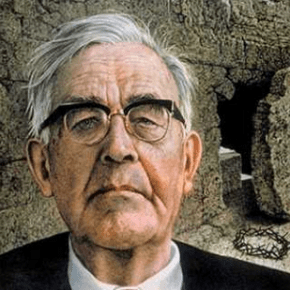
[G]od acts because of his desire to be a partner with humanity “though of course as the absolutely superior partner.” This is an expression of God’s freedom, for he is under no compulsion to be in communion with humanity. And this freedom defines the essence of God’s deity. “It is precisely God’s deity which, rightly understood, includes his humanity.” How is this known? This is known only through Jesus Christ, in whom God is not isolated from humanity, nor humanity from God. Jesus Christ as the Mediator and Reconciler comes forward as human being in behalf of God and to God on behalf of humanity.

If Jesus Christ is the only place where both true deity and true humanity are found, then this leads us to another meaning of the humanity of God, according to Kaiser: God himself in Jesus is the foundation of true humanity. That which is hinted at in Barth’s essay “The Humanity of God” is developed further in the Church Dogmatics III/2. In the midst of discussing the nature of the covenant between God and humanity, Barth observes that its origin is in God himself. The covenant is not an afterthought, but is ontological. It becomes “revealed and effective in time in the humanity of Jesus,” but he hastens to add that this is something which “we might almost say [is] appropriate and natural to Him.” In the covenant, God makes a “copy” of himself. “Even in His divine being there is relationship” as Father, Son, and Holy Spirit.

He is Himself the One who loves eternally, the One who is eternally loved, and eternal love; and in this triunity He is the original source of every I and Thou, of the I which is eternally from and to the Thou and therefore supremely I.

However, Barth does not want to deny that Jesus’ incarnate humanity was creaturely humanity. Since Jesus belongs to this creaturely world, his humanity is like our humanity. This is not an analogy of being, therefore, but an analogy of relationship. The relationship between the being of God and that of humanity, and the relationship in the being of God himself as Father, Son, and Holy Spirit is an analogia relationis. Barth puts this in the context of God’s freedom. God is free to posit himself in relation as Father, Son, and Holy Spirit from all eternity. So, also, he is free to create humanity in his own “image.” Therefore, we need not look for the meaning of true humanity elsewhere than in the humanity of Jesus Christ. We shall see that this can be the basis for a decisive critique of contemporary soteriologies. [Christian D. Kettler, The Vicarious Humanity of Christ and the Reality of Salvation, 84]

What do you think?

The Feminist Doctrine of Vicariousness in Liberation Theology

Christian Kettler in his ‘The Vicarious Humanity of Christ and the Reality of Salvation’ has this to say about how ‘Vicariousness’ works in the Liberation Theology of Latin American theologian Leonardo Boff:

Christ is the absolute mediator, being both God and human (I Tim. 2:5) yet this absolute meditation does not rule out “the mediations of his sisters and brothers. Rather it grants them, penetrates them, confers upon them their raison d’ รชtre.” The most immediate mediation in the light of Christ is that of the Blessed Virgin Mary. She answers the question “How does the feminine reveal God? And from the opposite direction, How is God revealed in the feminine?” As the “Mediator of All Graces” the mediation of Mary has, of course, been prominent in traditional Catholic theology. But because modernity has chosen to define itself as “logocentric”, i.e. “to assign primacy of the spirit to rationality and the power of ideas,” a profoundly masculinizing tendency, the feminine has become “marginalized” along with the distinctive traits of the feminine: “purity, self-sacrifice, and the protection of the weak and the oppressed.” Thus, the mediation of Mary becomes even more important today. Boff declares, “As we see it, each new generation finds itself in Mary, projecting its dreams, its social-cultural ideals upon her.” Today’s society finds Mary its “deliverance from the captivity of a political and economic system that exploits human work.” So Mary is the avenger of the weak and oppressed, although this must not be held in tension with the historical Mary, and particularly her humility. [Christian D. Kettler, “The Vicarious Humanity of Christ and the Reality of Salvation,” (Eugene, OR: Wipf and Stock Publishers, 2011), 34]

Aside from the obvious riff on the co-mediatrix of Mary; this makes for an interesting application of the doctrine of ‘Vicariousness’. In this scenario we have “social” categories predicating what humanity entails, and is characterized by. In other words, we have a doctrine of vicariousness that takes shape from ‘below’; so that what it means to be human (and female) is determined by the apparent attributes of what that looks like through the extension of that through female interaction with the world. While there are features of the female sex that are generally identifiable—like maternal, sensitive, compassionate, emotional, etc—these are not hard and fast characteristics. Ultimately, one of the problems with Boff’s proposal; is that its mode of operation moves from below. Humanity is actually given its raison d’ รชtre through the humanity of Jesus Christ (who is the imago Dei cf. Col. 1.15). There is no deficit in the reach of Christ’s humanity that needs to be augmented by a ‘feminine side’, like that puported by the analogy of Mary; NO! Mary’s humanity, like the rest of humanity, needs to be augmented by the humanity of Christ imago Christi.

This scenario helps, though, to illustrate the tension between trying to work out what being ‘human’ actually means in the first place; tension, between the Divine penetration of that in the hypostatic union of the eternal Logos with humanity (enhypostatic). In what way can we understand the Chalcedonian mantra of ‘distinct, but inseparably related’ (as to the natures of the person of Christ)? What does a theological (or christological) anthropology look like? And how would that implicate the vicarious humanity of Christ ‘for us’? The ‘for us’ is where I see the tension. How is the ‘us’ not swallowed up by ‘His’ humanity; and at the sameย  time, how does ‘His’ humanity make ‘us’ who we are? Mary needed a recreated humanity as much as the rest of us (cf. I Tim. 2.5-6). There is just ‘One Mediator between God and humanity’; humanity remains my question.

Has God’s Kingdom Really Come?: The Problem of Reality and the Resolution of the Vicarious Humanity

Just getting into Kettler’s book now; working through the introduction, and I have come across a bit that intends to create hook that the rest of the book (presumably) will seek to provide resolution for.

[T]he historical situation since the Enlightenment has increased the crisis in soteriology dramatically. Previous to the Enlightenment, theology tended to see salvation as primarily an other worldly eschatological reality, “a radically different world in another time and place.” God was “the sole source of salvation.” This changed with the Enlightenment focus on human happiness and social welfare. This change was basic and profound. Braaten is again very perceptive:

The interesting difference in respect between Voltaire and Rousseau, or between Comte and Darwin, or between Marx and Mao all appear miniscule from a soteriological point of view compared to the difference between a belief in salvation based on human power and one that trusts in the power of God.

But existentially, the doctrine of salvation is also in crisis as well. This is what we will term the “reality” of salvation. The question is this: Does the Christian preaching of salvation through Christ really make any difference in a world in which sin, evil, and suffering continue to run rampant? Braaten puts it quite bluntly: “Has Christian preaching of salvation noticeably changed the world?” It is this very existential crisis which has been the source of the modern theological shift in the doctrine of salvation from trust in the power of God to salvation as based on human power. This has had very negative results in the life of the church, according to Braaten:

Is this not why some church groups desparately reach for every modern secular substitute for salvation, whether psychological for the individual person, or more political for the larger collectivities?

As we shall see, we share this negative critique by Braaten. Yet, the question of reality of salvation must be answered by the church, and particularly by its theological community.

Our premise is that the root problem in contemporary crisis of the reality of salvation is found in the anthropocentric, experience-oriented approach to salvation particularly characteristic of Christian theology since the Enlightenment. We may even be bold enough to say that in this theology the gift of God has been exchanged for a bowl of anthropological pottage. Yet the question still remains: How can we speak of the reality of salvation in a world which hardly looks like it has been invaded by the kingdom of God? Our proposal is that the teaching on the humanity of God in the thought of Karl Barth and Eberhard Jรผngel provides both a critique of anthropocentric soteriologies, and a positive alternative, but only as it is fulfilled in the doctrine of the vicarious humanity of Christ as particularly elaborated by T. F. Torrance. Our goal is to see the humanity of God as a bridge between the contemporary problem of the reality of salvation and its resolution in the reality of the vicarious humanity of Christ. [Christian D. Kettler, The Vicarious Humanity of Christ and the Reality of Salvation, (Eugene, Oregon: Wipf & Stock Publishers, 2011 [re-print]), 12-13]

This gives a feel for the book, and the way Kettler will have us heading in the pages to come.

This hints at what issues are at stake in this discussion; especially within the confines of the modern (and contemporary) theological landscape. And more than just a dry, arid, abstract theological tome; this issue, as we can see, addresses something that is very close to home for each one of us — viz. our own skin! And yet the trick in answering this question, and still remain faithful to the primacy of God’s grace in salvation is to frame the answer to this question with the right dogmatic order and theological optics. Meaning, that while seeking to answer a genuinely human and existential question (like what Kettler has highlighted in the quote); we want to make sure that this human question doesn’t swallow up the divine answer (like the christological heresy of adoptionism does). The remedy is one that God already thought of long before the world was created; that humanity is given its image in the image of His beloved Son. God has humbled himself in Christ, that he might exalt humanity in Christ. It is this humiliation of God wherein the real life rubber meets the road questions of our daily wanderings in life are given concrete paths to walk on. We have a Saviour who can sympathize with our suffering and weaknesses because he suffered the cumulative sufferings of all humanity in our stead and into the ontological depths of his very being (and this for us, because he loves us). It is as we participate in his resurrected humanity that we are given his eyes of faith; the eyes required to move beyond the dilemma that Kettler has set up in the above quote (i.e. that it appears as if the kingdom of God really hasn’t entered planet earth given all of the current and ongoing strife, travail, and suffering that still seems to be marching full speed ahead in an unrelenting world).

Ultimately the way I see it; it is a matter of trusting the LORD! While human suffering is real, it is only real because Jesus suffered it first. This must be the way we think of this (before we suffer [cf. Mt. 7], because if we wait until we’re in the midst of the storm it may well be too late to find hope). If Jesus pentrated the lining of our skin with his life (and didn’t “just” pay a penalty as if he was the Divine debit card); then we are saved from the inside-out, and up.

I think Kettler’s book is going to be good …

The Vicarious Humanity of Christ and the Reality of Salvation

I just received a review copy of Christian D. Kettler’s book The Vicarious Humanity of Christ and the Reality of Salvation from James Stock at Wipf & Stock Publishers. I will be doing a full review here at the blog immediately following my completion of this book (let me say thank you though to James Stock for getting me this book!). Christian Kettler is someone I look to being in contact with once I start getting a bit further into my doctoral research on this doctrine (the vicarious). This book represents his PhD dissertation which he did at Fuller Theological Seminary (some years back now) under the watchful eyes of Ray Anderson and Geoffrey Bromiley. Kettler also had the opportunity to serve as Thomas Torrance’s Teaching Assistant for a bit while at Fuller (presumably) in the 80’s. I just wanted to share the brief blurb from the back cover of this book:

In this book, the problem of the reality of salvation is addressed by T. F. Torrance’s doctrine of “the vicarious humanity of Christ.” Through this approach, salvation as humanization is affirmed, yet without the problems of anthropocentric theologies. This book is unique in that it offers both a survey of contemporary Christian thinking on salvation as well as a constructive alternative based on Torrance’s doctrine, a significant yet neglected contribution to modern theology.

This book is one of the best places I can think of to officially kick off my doctoral research on the vicarious humanity of Christ! Kettler’s approach seems to deal much more closely with this doctrine within its modern theological context and discussion. My research will press, in contradistinction a bit, back further into the Tradition of the Church; and will develop and unearth how this doctrine first received its legs through seminal figures scattered throughout the span of Church history starting in at least the 4th century A.D., and moving through the Reformation period into the Modern (with Thomas Torrance), finally placing all of this into the discussion that Kettler mostly focuses on in his own research.

I was thinking of sharing the Table of Contents from this book, but I think I’ll do that later.