The Christian Humanists versus the Scholastic Theologians: The Bible versus the Philosophers

Charles Partee in his book Calvin and Classical Philosophy, by way of introduction, offers a nice treatment on the entailments of a mediaeval Christian Humanism versus a theological Scholasticism, as both of those were present in the early formation of the Protestant Reformation; with, of course, particular reference to John Calvin. I am going to share a long passage from Partee because it is rather pertinent to the way I see myself operating; as far as both mood and method goes. I will provide the passage, and then offer up some closing thoughts (the usual).

In the sixteenth century, however, the term “Christian philosophy” is used in a different and important sense by some of the Christian humanists in referring to their program of reforming Christian thought by returning the correct understanding of Holy Scripture and purer Christianity in opposition to what they consider to be fruitless speculations and philosophical accretions of scholastic theology. These reformers seek not only a proper and faithful understanding of the Scriptures and patristic theology, but also a better and freer use of the wisdom of classical thought which does not jeopardize the revealed truth of God. For them revelation is not auxiliary to reason, rather reason is auxiliary to faith. That is to say, they object to the speculative use of reason to seek out hidden things, but not to its humble application to the understanding of God’s word. Christian philosophy in the sixteenth century does not attempt a synthesis of revealed and reasoned theology in the Thomistic manner, but is willing, and even eager, to use the insights of classical philosophy as an aid to the exposition of Christian theology and as an admirable example of the fact that God has not left himself entirely without witness even among the pagans. Thus the Christian humanists study the philosophers not in order to achieve a balance between the unaided and the enlightened mind, but to point out the approximations of Christian truth which may be seen by the light of nature and also the darkness into which the errors of the philosophers lead.

Of course, the entire Renaissance recovery of the enthusiasm for classical learning involved in the knowledge and appreciation of classical thought and culture on the part of the humanists. Moreover, since many; if not most, of the humanists are Christians in some sense, it is difficult to distinguish the Christian humanists from other humanists with precision. Paul Kristeller suggests that the Christian humanists “are those scholars with a humanist classical and rhetorical training who explicitly discussed religious or theological problems in all or some of their writings.”

It is true that the rhetorical tradition is an important identifying mark. As the Christian humanists use rhetoric, its relation to dialectics is a matter of emphasis. That is to say, they do not deny the value of dialectic, but they are more interested in the persuasive clarity of the truth than the irrefragability of logic. In Plato and Isocrates one sees a conflict between rhetoric and philosophy. Plato opposes rhetoric, the art of persuasion, to dialectic, the art of correct division and generalization. Plato thinks of persuasion as a matter of opinion based on probability; dialectic he regards as a matter of knowledge based on truth. The discussion develops in Aristotle’s seeking to rescue rhetoric from the obloquy of Sophistic flattery, by teaching that rhetoric is the counterpart of dialectic. In Cicero, whose ideal is the combination of rhetoric and philosophy which he sees exemplified in both Plato and Aristotle, wisdom is to be combined with rhetoric.

The same emphasis on the combination of rhetoric and dialectic is seen in Augustine. Augustine, who was trained as a rhetorician, insists that dialectics is of great service in understanding the Scripture. In Book Four of his Christian Doctrine he makes the point that rhetoric is necessary for the Christian orator, but truth is more important than the style of expression. The youthful study of the rules of oratory is not to be despised, but the study of the sacred writers who combine eloquence and wisdom, is sufficient to teach the wise man both what and how to communicate.

Likewise the Christian humanists are concerned with clarity in the service of truth rather than with syllogisms in the service of logic or embellishment in the service of persuasion. Since Melanchthon thinks that truth and clarity go together, he defends the clarity of rhetoric in opposition to the obscurity of some philosophy, but insists that dialectic and rhetoric are joined by nature. The Christian humanists associate scholasticism with sophistry and dialectical pride which seeks to find God at the end of a series of logical distinctions rather than with the attempt to make the truth evident and therefore persuasive. Moreover, as Rice observes [sic],

The Scholastics answered the question “Is theology a science?” in the affirmative; the fathers answered it negatively. Theology is not a scientia, but a sapiential, not a systematically ordered body of true certain but undemonstrable principles of revelation, but a doctrina sacra of Scripture, a holy rhetoric in the humble service of the text, unprofaned by the syllogism of the Posterior Analytics.[1]

As Partee makes clear, in general, the Christian humanists, along with the church fathers, were interested in following the contours of Holy Scripture, rather than the speculative and discursive reasonings of the profane philosophers (which the scholastics were generally attuned to). These distinctions, as in any human endeavor, are not always nice and neat in the history; so the goal, of this development, is simply to provide demarcations available between two distinct approaches and methodologies that were profoundly informative, for our purposes, with reference to the Protestant Reformation. Partee argues that Calvin’s orientation was along the lines provided for by the Christian humanist rather than the scholastic tradition; so, Calvin’s form and style found within his Institutes of the Christian Religion. Even so, Calvin still operates with certain scholastic categories of his day, and yet he reifies them under a Christ conditioned, and thus Scriptural way, that fits well with the Christian humanist mood; indeed, as we have been considering that, with Partee’s help, in this post.

In regard to modern theologians, I consider both Karl Barth and Thomas F. Torrance, respectively, as the clearest examaples of those following in the steps of the Christian humanist mood; and so in step even with Calvin and Luther in that way. There is a commitment to Holy Scripture and its reality in Jesus Christ, and the categories that come directly from this revelation that they attempt to pay attention to in theological ways. This cuts across the scholastic way, which involves the dialectics of thesis, antithesis, synthesis, so on and so forth. The scholastic way, as Partee helps us understand, involves a series of logico-deductive decisions, based primarily, not on a direct engagement with the text and reality of Scripture, but with an engagement with the commentary tradition the schoolmen prior to them offers up. This presents scholastic theologians with the problem of engaging, not with Scriptural categories, per se, but instead with the accretions of the sectarian theologians that had been developing in the mediaeval church for centuries upon centuries. This of course is a problem because as Christian theologians we are concerned not with the speculations of others, in regard to God and His ways, but, in principle, are concerned with the Word of God as He confronts afresh anew through the relational and organic sitz im leben of His life as He encounters us, as He is for us, in Jesus Christ.

People are still failing to recognize these really basic things as they have developed in the theological history of the church. Modern Christians, whether professional or lay, are too often uncritically controlled by the accretions and speculations of the schoolmen, rather than being contradicted and formed by fresh encounters with the Logos of God. This situation needs to be remedied. Of course, this takes thoughtfulness and work among the church’s membership; and I have grown weary of holding out hope that people are actually willing to put in the work to come to see how all of these things matter and impinge upon their daily Christian existences. X/Twitter, Youtube, Facebook etc. are not sufficient in coming into the light of these greater realities.

[1] Charles Partee, Calvin and Classical Philosophy (Netherlands: E.J. Brill, Leiden, 1977), 8–11 kindle.

St. Martin Luther, the Christian Humanist Against the Glory Theologians

Definitions are important; if for no other reason but to understand what something means. Context provides meaning, and thus definition, for words; whether that is in sentences, paragraphs, chapters, books, so on and so forth. When attempting to understand where a particular theologian lies, as far as classification, within the alternative types of being a theologian, it is important that we get a handle on the definitions used to ascertain that. In the medieval period, generally, a theologian could be classified as a scholastic theologian, or a Christian humanist; or potentially, both, depending on the way someone enters into the reconstruction of said history. There are general markers that broadly characterize a scholastic theologian from a Christian humanist theologian. 1) A scholastic theologian was, methodologically, committed to the dialectical methodology. This methodology entailed a presentation of: a) thesis, b) antithesis, c) synthesis. Beyond its formality, more materially, the scholastic was often an Aristotelian, and later, after Thomas Aquinas’ synthesis of Aristotle with Christian dogmatics, a Thomist. 2) A Christian humanist theologian was typified by an attempt to ad fontes (go back to the sources, behind the layers and accretions of beliefs the scholastics had developed), with a focus on understanding the original biblical languages (so getting beyond Latin); and by way of methodology, the Christian humanist didn’t necessarily attempt to synthesize ideas. The humanist believed, by reference to their set of literary and linguistic and historical tools, that they could arrive at a scenario, when deciding on the validity and soundness of this or that theological loci, that the theologian should be able to say: Yes or No.

The above is the world that Martin Luther, and the magisterial reformers in general, were birthed into. There is argument on whether or not Luther was more scholastic or more humanist in his approach. For my money, Luther, fit more broadly, within the school of the Christian humanists (we could refer to Lorenzo Valla here to underscore the genesis of the humanist way). Some would argue that to drive too hard of a wedge between the scholastics and the humanists in the late medieval and early reformation period, would be to engage in presenting a false dilemma. These folks would prefer that we understand that these “schools” were not as nice and tidy as we might make them today; that there was an organic crossover between the schools, materials, and methods of the two camps. Be that as it may, Brian Gerrish, via Charles Partee’s engagement, believes Luther fits the Christian humanist, or even the biblical humanist classification; as both a theologian and reformer of the Latin church.

Brian A. Gerrish raises “the possibility that perhaps Luther may be, indeed should be, classed with the so-called ‘Biblical Humanists” [sic] A sounder basis for excluding Luther, not from humanism in general, but from the notion of Christian philosophy in particular, is the fact that Luther insists that philosophy and theology should be carefully distinguished. Luther sees philosophy as the theology of the heathens. With this understanding Luther is less interested in studying philosophy with appreciative intent than others.[1]

Theologically, we might suggest that Luther’s infamous theologia crucis (‘theology of the cross’) fits well with the Christian or Biblical humanist orientation. It rejects the philosophical and speculative measures deployed by the theologians of glory, and instead focuses on the concreto of God’s Self-revelation in Jesus Christ; particularly as the character of God is given full magnification in the Son’s “obedience of death, even unto death on the cross.” The theology of the cross, repudiates speculating about a God up yonder, and entrenches itself within the Light of Light of God that is given for the world in God’s life for the world, in the person of God for the world in Jesus Christ.

This type of orientation, as the one we have just ostensibly observed in Luther, is present in someone like John Calvin; and beyond, into the modern period, we see this mood picked up by folks like Karl Barth and Thomas Torrance, respectively. It is this orientation that has drawn me to such theologians. I am, broadly speaking, a proponent of a form of Chrisitan humanism, as described in this post; and as illustrated by a suggestive proposal with reference to St. Martin Luther. So let it be written, so let it be done.

[1] Charles Partee, Calvin and Classical Philosophy (Leiden, Netherlands: E. J. Brill, 1977), 12-13.

John Calvin, The Proto-Barth (and Torrance)?

Here is Charles Partee on imago Dei (Image of God) and imago Christi (Image of Christ):

Having praised the original creation of human understanding and will, Calvin concludes that God is comprehended in Christ alone (II.6.4) until such time as we shall see God as he is (II.14.3). God cannot be known apart from Christ because “all thinking about God outside Christ is a vast abyss which immediately swallows up all our thoughts.” Those who philosophize about God without Christ are deluded (compare 1 Pet. 1:20; I John 2:22). Since Calvin’s theology is based on faith, not on reason, the Christian life is not linked by chains of reasoning but guided by faith in Christ, which is the principal work of the Holy Spirit. “We hold ourselves to be united with Christ by the secret power of his Spirit (III.11.5). “Therefore, that joining together of head and members, that indwelling of Christ in our hearts—in short that mystical union—are accorded by us the highest degree of importance, so that Christ, having been made ours makes us sharers with him in the gifts with which he has been endowed” (III.11.10).

Image and Likeness. The same dynamic from created to fallen to restored also applies to Calvin’s view of the image of God. Mankind was originally created in God’s image, which means “that man was blessed, not because of his own good actions, but by participation in God” (II.2.1). The image of God is not to be understood only as a possession but a relationship—and “participation in God” involves “union with Christ.” In the fall, while “God’s image was not totally annihilated and destroyed in [Adam], yet it was so corrupted that whatever remains is frightful deformity” (I.15.4). Human sin means that the image of God cannot be understood solely in terms of creation or fall but in the true image of God restored in Jesus Christ. In other words, Calvin defines the image more in terms of redemption than creation. Regeneration is nothing else than the reformation of the image of God in the godly, but the second creation of the image in the restoration by Christ is a far more rich and powerful grace (Com. Eph. 4:24). The grace of God exhibited in Christ exceeds all miracles. Indeed the redemption that he has brought surpasses even the creation of the world (Com. Is. 9:6).

Since Christ is the perfect image of God and we are united to him, we are restored to God’s image. . ..[1]

In Partee’s splicing of things John Calvin sounds like a proto-Barth-Torrance. I think this is safe to assume, that is if the reader reads Calvin in context. Both Calvin and Luther, respectively, are unique vis-à-vis the Post Reformed orthodox (and Lutheran), in the sense that for their day, they operated with a radical Christocentrism. Even if, of course, either Barth or Torrance, respectively, go further and even more ‘radical’ than Calvin (and Luther), Calvin, nonetheless, stands head and shoulders over most of those following him; indeed, those who supposedly bear his name: i.e., ‘the Calvinists.’

[1] Charles Partee, The Theology of John Calvin, 86-87.

A ‘Metaphysical Christ’ Simply Will Not Do

A purely alien Christ, a Christ over our heads, a “metaphysical Christ,” simply will not do. Karl Barth knew this, as did John Calvin:

The real advance has obviously been made when we come to the INSTITUTIO of 1559, in which unio cum Christo [union with Christ] has become the common denominator under which Calvin tried to range his whole doctrine of the appropriation of the salvation achieved and revealed in Christ. For now in the Third Book, before he can speak of faith, of conversion and renewal, of the vita hominis christiani, of abnegatio nostri as its sum, of the necessary bearing of the cross, of the relation between this and the future life, then — and only then — of justification, of Christian freedom and prayer, of eternal election as the ulitmate presupposition of the whole, and finally of the future resurrection, according to the view attained in 1559 he has first to make it plain how it can come about at all that what God has done for us in Christ, as declared in the Second Book, can apply to us and be effective for us. The answer given in the noteworthy opening chapter of the Third Book is to the effect that it comes about through the arcana operatio Spiritus, which consists in the fact that Christ Himself, intead of being extra nos, outside the man separated from Him and therefore irrelevant to us, becomes ours and takes up His abode in us, we for our part being implanted into Him (Rom. 11:17) and putting Him on (Gal. 3:27).[1]

[1] Karl Barth CD 4.3.2, 550-51 cited by Charles Partee, The Theology of John Calvin, 195.

Responding to a Sleight in Michael Allen’s Book, Sanctification: The Torrances and Charles Partee as Calvin Scrubs

I am continuing to read Michael Allen’s new book, Sanctification. I am going to register a little gripe in regard to what might seem nit-picky, but it bothered me; it’s a rather nerdy-editorial observation, but it says something to me—and I think that’s an intentional move by Allen. Here he is discussing John Calvin’s double grace (duplex gratia), and how Calvin fits in with other theological standouts of his time, following his time, and the post reformed orthodox theology that developed later in the 16th and 17th centuries respectively. Before we hear from Allen, in case you’re unaware, there has been no small debate about Calvin and the Calvinists, and their relationship (or not). Richard Muller has spent substantial amounts of time arguing that there is material theological continuity between Calvin’s inchoate theology (relative to what would be developed later), then, and what post reformed orthodoxy (or “Calvinism”) developed later. You can see Allen’s tip of the hat to the Mullerian argument here, and how he wants to make it appear that the opponents of Muller et al. are less than directed by primary texts in their own engagement with Calvin (which they argue that there is discontinuity between Calvin and the Calvinists). Allen writes:

There have been historiographic debates as of late regarding the way that Calvin’s theology of union with Christ is or is not similar to Luther’s, Melanchthon’s, and the Lutheran confessions’, and whether it is or is not consistently developed by later reformed theologians, such as those federal divines who prepared the Westminster Standards in the seventeenth century. Mark Garcia and others in the so-called “Gaffin School” have argued that Calvin and the Lutheran tradition offer markedly different approaches to union with Christ, and that Calvin in no way identifies justification as a cause for sanctification. James Torrance, Thomas Torrance, and Charles Partee, among others, argue that Calvin was not faithfully followed by later Calvinists, who failed to maintain his focus on union with Christ. And yet, leading scholars of Reformation and post-Reformation theology on just these doctrines—in particular, J. Todd Billings, J.V. Fesko, and Richard A. Muller—have argued at length from primary sources that both dichotomies are false. Calvin stood alongside Lutherans (like Melanchthon, in particular) in affirming the priority of justification as well as the necessity of sanctification; and Calvin’s insistence on union with Christ as the context for the double grace was developed in a faithful or continuous way by later federal theologians (and in the Westminster Standards). We do well, mindful of those debates, to look at the wider theological context of Calvin’s theology.[1]

Not so fast. Do you notice what Michael does? He stacks the deck in his favor, and sleights his opponents. In other words, as he mentions the Torrances, Partee, and some amorphous others (whoever they might be), he doesn’t actually provide any sort of bibliographic information on them; you know, so we all could go and see if this is so (what he asserts about them). He also contrasts them with his scholars who “have argued at length from primary sources,” making it appear that Partee, the Torrances, et al. are not “leading scholars” themselves. Let’s just focus on Charles Partee by himself; Partee is a true blue Calvin scholar who has written treatises on the theology of John Calvin—in other words, he is just as much a Calvin scholar as the folks that Allen appeals to (and a senior one to boot!).

As a reader, a critical one, this does not play well with me; it is far from being persuasive, for example, and makes it appear that Allen is simply appealing to the people (his). Whether or not what he is arguing, or signaling, is the case or not (in regard to Calvin and the Calvinists) is beside the point. To me it represents poor form to not give us some bibliographic information for the Torrances and Partee, while at the same time providing biblio for his privileged sources. Here’s the bibliographic information he gives us via a footnote after he brings up Billings, Fesko, and Muller:

See esp. J. Todd Billings, “The Contemporary Reception of Luther and Calvin’s Doctrine of Union with Christ: Mapping a Biblical, Catholic, and Reformational Motif,” in Calvin and Luther: The Continuing Relationship, ed. R. Ward Holder (Göttingen: Vandenhoeck & Ruprecht, 2013), 158–75; as well has his larger study, Calvin, Participation, and the Gift: The Activity of Believers in Union with Christ (New York: Oxford University Press, 2007); Richard A. Muller, Calvin and the Reformed Tradition: On the Work of Christ and the Order of Salvation (Grand Rapids: Baker, 2012); and J.V. Fesko, Beyond Calvin: Union with Christ and Justification in Early Modern Reformed Theology (1517–1700) (Göttingen: Vandenhoeck & Ruprecht, 2012).[2]

And yet we don’t have a corresponding footnote for material from the Torrances, Partee, or the others that Allen refers us to. The net effect is to make the Torrances, Partee, et al. look like mere scrubs compared to the venerable sources Allen elevates as the “leading scholars.” This is at best an oversight, but since I don’t think Allen would make such an oversight, I’d have to say it’s an intentional sleight towards the Torrances, Partee, et al. All I can say is: What the?!

There is obviously some intramural banter taking place here, and Allen lets us know exactly where he lines up. It’s not surprising at this point, he’s already taken other swipes at the Torrances, The Evangelical Calvinists (like our book[s]), et al. But his form here is poor, I think. At least let people know what Partee, the Torrances, et al. have produced in their own right in regard to the scholarship in this area; and don’t make it appear that, again, they are just the scrubs who really don’t know what they’re talking about (i.e. avoid genetic fallacies, poisoning the well, and other types of fallacies).

[1] Michael Allen, Sanctification (Grand Rapids, Michigan: Zondervan, 2017), 174.

[2] Ibid., 174-5 n16.

How John Calvin Found Comfort in Regard to His Physical Frailty and Sicknesses: And Application of that to My Cancer Diagnosis and Human Suffering in General

Sickness, disease, suffering, death, and evil, among other such trifles, are all things that Christians have a capacity to face, before and because of God, with an utter sense of hope and sober trust. Often evil, and all of its attendant realities (including human suffering!), is used as a scalpel to cut God to pieces; leaving him as nothing more than a corpse that the modern person can look at with kind of perverted joy, and yet somber realization that all they are left with is themselves (they’d have it no other way).

John Calvin, pre-modern as he was, was no stranger to human suffering, sickness, and disease. Indeed, as W. Allen Hogge, M.D. and Charles Partee detail in their contribution to our Evangelical Calvinism: Volume 2 book, through their chapter entitled Calvin’s Awful Health and God’s Awesome Providence, we come to see, with some precision, the scope of suffering that Calvin endured; particularly with regard to his physical health. We see how Calvin dealt with his fragile constitution, coram Deo, by intertwining his theological framework with his interpretation of his own predicament as a broken and ill person. We see how Calvin’s doctrine[s] of predestination, election, Divine Providence, so on and so forth informed the way he attempted to deal with the ostensible problem of suffering, disease, and the brokenness with which he was so familiar.

In an attempt to provide some good context on how Calvin dealt with all of this theologically, I thought I would appeal (at some extensive length) to Hogge’s and Partee’s writing on the matter; and then offer some reflections of my own in light of Calvin’s approach to suffering. I thought I would tie my own experiences of dealing with severe depression, anxiety, doubt of God, and diagnosis of a terminal and incurable cancer into Calvin’s own approach when it comes to God’s Providence and care in these instances. So at length here is a section from Hogge’s and Partee’s chapter (I’m thinking this is actually a section that Partee wrote):

An Alternative Conclusion

Granted the erstwhile power of Calvin’s exposition of God’s almighty providence, this once shining heirloom is tarnished for many in recent generations. If God is the author of everything and evil is clearly something, then simple logic seems to dictate the conclusion that God is responsible for evil. In other words in the light of his strong affirmation of God’s providence, Calvin’s equally strong denial that God is the author of evil is not as convincing as once it was. Obviously, the sweeping philosophical conundrum of the origin and existence of evil (of which physical illness is a painfully personal example) has exercised serious reflection from the beginning with no satisfactory end in sight. Therefore, if a completely satisfactory resolution is unlikely, at least Calvin’s conclusion can be gently modified by his own suggestion.

Among the alternative possibilities for resolution, Calvin did not for a moment consider that God might be limited in nature (as in process theology) or self-limited by choice (as in Emil Brunner)83 or that God’s interest in “soul-making” requires the existence of evil.84 The regnancy of God is unquestioned. Calvin believed all things are governed by God including human free will. We are to understand “that on both sides the will is in God’s power, either to bend the hearts of men to humanity, or to harden those which were naturally tender.”85 In a bold metaphor Calvin even claims that God fights against us with his left hand and for us with his right hand.86 In both events we are in God’s hands.

Two modern, major, and massive theological acquisitions have provoked a climate change of opinion that Calvin could not have anticipated and which require integration into the family heritage. First, a particularly contentious debate over Calvin’s doctrine of Scripture continues to roil his descendants. There is, of course, no gainsaying that Calvin did not feel the impact of the Critical Historical Method, and, while his response to this development cannot be predicted, its adoption by most mainstream biblical scholars today means that the distinction between human and divine in Scripture is less adamantine than Calvin thought. Thus, a biblical citation no longer closes a discussion but opens it to furtherdevelopment.87

The second wider and deeper change concerns the role of reason. The dream of reason in Western intellectual culture stretched from Plato to Spinoza, but the famous wake-up call which sounded from David Hume alarming Immanuel Kant and rousing him from his dogmatic slumbers, leads to the claim that “The Copernican revolution brought about by Kant was the most important single turning point in the history of philosophy.”88 If so, it is now impossible for Western theologians to ignore Kant’s strictures on pure reason to make room for deep faith. Additionally, the necessity and universality of reason has been challenged by anthropological studies of differing cultures and gender studies within the same culture. Moreover, the developing scientific study of the human and animal brain modifies the confidence of Hamlet’s appeal to “godlike reason” (Hamlet IV.4.38).

Calvin’s epistemological reliance on Scripture and reason is an immense and complicated subject on its own.89 He believed the Bible was the divine Word of God but he also noted its human elements. Likewise, Calvin both praised and blamed reason. “Reason is proper to our nature; it distinguishes us from brute beasts.”90 At the same time, because of sin human reason is not able to understand God nor God’s relation to humanity. 91 Therefore, “Christian philosophy bids reason give way to, submit, and subject itself to, the Holy Spirit.”92 Still at the end of the day, although Calvin rejects “speculation,”93 he thinks there must be a reason for the existence of illnesses, even if we do not know exactly what it is. Among his explanations, Calvin offers the punishment of human sin, God’s hidden will, the malignancy of Satan and the demons, and the evil will of other human beings. According to Calvin, the proper human response to this situation is faith, humility, patience, and so on. Nevertheless, the variety of these explanations does not challenge Calvin’s basic confidence that the divine intellect has its reasons even though they are hidden from us.

An alternative category of “mysteries beyond reason” is sometimes employed by Calvin and should be noted. That is, Calvin affirms many divine things that humans do not, and cannot, know. For example, he admits the existence of sin as “adventitious”94 meaning it has no rational explanation. Calvin did not, but he might have, applied this category to disease suggesting that while medicine seeks to describe “what” and “how,” theology cannot explain its “why.” This situation has some affinity with Kant’s distinction between the phenomenal and noumenal realm leading to the concept of “antinomy”—a category impervious to pure, but not to practical, reason. If then we humans can recognize and treat the penultimate and medical causes of disease, we might admit that we do not understand the “reason” for illness and are not obligated to insist ultimately and theologically that there is one. One might leave the painful puzzle to reason and the trustful victory to faith.

Many contemporary students of Calvin’s theology, both clerical and medical, cannot with best mind and good conscience adopt the obvious conclusion that Calvin draws concerning the existence and meaning of disease. Still, seeking a life of faith, hope, and love, one can appreciate Calvin’s passionate conviction that in neither prosperity nor adversity are we separated from the love of God. Therefore, leaving the study of “material,” “efficient,” and “formal” causes to the scientific community, theologians might come full stop before the “final” causes of illness. Affirming in faith with Calvin God’s good creation and encompassing providence, the impenetrable mystery of assigning a “final cause” for disease might be approached with the modesty and humility which Calvin sometimes evinces.

Following this interlude of thundering silence, theology could resume with the glorious theme of hope in life everlasting and abundant where, delivered from pain and death, all tears are dried, all sorrows past, the lame walk, the deaf hear, the blind see, lepers are cleansed—the dead being raised up made alive in Christ.[1]

Following Hogge’s and Partee’s treatment of Calvin, we can see that Calvin himself, because of his historical location, would defy the modern attempt to peer into the ‘abyss’ of God’s secret council when it comes to trying to understand the ‘cause’ of evil, sickness, and disease. But precisely because of Calvin’s location, theologically, he will consistently defer to God’s sovereign hand of providence in the affairs of this world order, and all of us ensconced within it. So while he will not attempt to speculate or press in the type of rationalist ways that moderns might want to; at the same time he rests and trusts in the reality that God is providentially in control of sickness and disease. He doesn’t have the type of scientific acumen that moderns have ostensibly developed, but he rests in the always abiding reality of God’s almighty ability to succor the needs of all of us frail and indolent humans as we inhabit a world of contingencies and ailments not of our own making, per se.

As modern and now “post-modern” people we want more scientifically derived answers than Calvin can offer us. When we get sick, when we suffer immeasurable diseases and anxieties in our apparently cold and chaotic world, we look to the lab-coats to offer us a cure-for-what-ails-us. But for anyone, particularly those of us, who like Calvin, abide in a deep union with God in Jesus Christ, we will most consistently end up right where pre-modern Calvin always ended up; we will repose in God’s faithful care to never leave us or forsake us; we will rest in the reality that God is both sovereign, and that he providentially walks with us through the valley of the shadow of death, even more than we realize.

When I was diagnosed with desmoplastic small round cell tumor sarcoma (DSRCT), an incurable and terminal cancer for which there is no known treatment, I ended up right where Calvin ended up; I had to simply rest and trust in God’s providential and loving care. I did due diligence, in regard to pursuing all known treatment avenues, both traditionally and alternatively, but at the end of the day, and in every instance, I had to rest in the reality that God was in control. Like Calvin, as Hogge and Partee highlight, I had to find assurance and hope in the fact that the God who I couldn’t control was in control, indeed, of my every waning anxiety and fear; that he was in control of the chaos (the cancer) inside of my body that wanted to consume me like a voracious monster. I did find rest and hope in God’s providential care; not in the abstract, but as God broke into my life moment by moment, every moment of everyday during that season.

While sickness, disease, suffering, evil, and the like might not have an easy answer—as far as causation—what we can rest in, like Calvin did, is the fact that we know the One who is in control; who is in control of what might even look like absolute chaos and destruction upon us. We can rest in the fact that, in Christ, we are in union with an indestructible life that death couldn’t even hold down. This is my comfort in life, even now. I rest in the fact that God in Christ gives me every breath that I breathe, literally; the same breath that the risen Son of God rose with on that Easter morning.


[1] W. Allen Hogge, M.D. and Charles Partee, “Calvin’s Awful Health and God’s Awesome Providence,” in Myk Habets and Bobby Grow, eds., Evangelical Calvinism: Volume 2: Dogmatics&Devotion (Eugene, OR: Pickwick Publications an Imprint of Wipf&Stock Publishers, 2017), 285-88.

From “evangelical” Salvation to Evangelical Salvation

[T]he real advance has obviously been made when we come to the INSTITUTIO of 1559, in which unio cum Christo [union with Christ] has become the common denominator under which Calvin tried to range his whole doctrine of the appropriation of the salvation achieved and revealed in Christ. For now in the Third Book, before he can speak of faith, of conversion and renewal, of the vita hominis christiani, of abnegatio nostri as its sum, of the necessary bearing of the cross, of the relation between this and the future life, then — and only then — of justification, of Christian freedom and prayer, of eternal election as the ultimate presupposition of the whole, and finally of the future resurrection, according to the view attained in 1559 he has first to make it plain how it can come about at all that what God has done for us in Christ, as declared in the Second Book, can apply to us and be effective for us. The answer given in the noteworthy opening chapter of the Third Book is to the effect that it comes about through the arcana operatio Spiritus, which consists in the fact that Christ Himself, instead of being extra nos, outside the man separated from Him and therefore irrelevant to us, becomes ours and takes up His abode in us, we for our part being implanted into Him (Rom. 11:17) and putting Him on (Gal. 3:27).[1]

How much of “Evangelical” theology has missed this point? By “only” viewing Christ as the instrument of salvation; what’s missed is the fact that God in Christ through the Spirit is salvation! Union with Christ becomes the center which all other soteriological concerns should find their orbit. If we hope to be “saved” at all, it will only be because we participate with God through Christ by the Spirit. In this way salvation is understood in personal, relational, trinitarian terms versus the usual “Evangelical” instrumentalist, substantialist, qualitative terms. There is a huge difference between the two approaches. I wonder if you too appreciate the significant weight in this difference of approach and understanding?

[1] Karl Barth CD 4.3.2, 550-51 cited by Charles Partee, The Theology of John Calvin, 195.

The Imago Dei Imago Christi in the Theology of John Calvin

Here is Charles Partee on Imago Dei (image of God) and Imago Christi (image of Christ) in the theology of John Calvin:

Having praised the original creation of human understanding and will, Calvin concludes that God is comprehended in Christ alone (II.6.4) until such time as we shall see God as he is (II.14.3). God cannot be known apart from Christ because “all thinking about God outside Christ is a vast abyss which immediately swallows up all our thoughts.” Those who philosophize about God
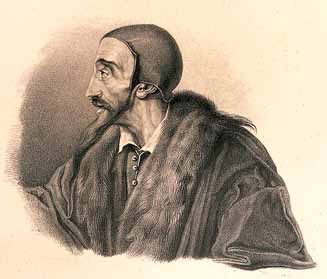
young-calvinwithout Christ are deluded (compare 1 Pet. 1:20; I John 2:22). Since Calvin’s theology is based on faith, not on reason, the Christian life is not linked by chains of reasoning but guided by faith in Christ, which is the principal work of the Holy Spirit. “We hold ourselves to be united with Christ by the secret power of his Spirit (III.11.5). “Therefore, that joining together of head and members, that indwelling of Christ in our hearts—in short that mystical union—are accorded by us the highest degree of importance, so that Christ, having been made ours makes us sharers with him in the gifts with which he has been endowed” (III.11.10).

Image and Likeness. The same dynamic from created to fallen to restored also applies to Calvin’s view of the image of God. Mankind was originally created in God’s image, which means “that man was blessed, not because of his own good actions, but by participation in God” (II.2.1). The image of God is not to be understood only as a possession but a relationship—and “participation in God” involves “union with Christ.” In the fall, while “God’s image was not totally annihilated and destroyed in [Adam], yet it was so corrupted that whatever remains is frightful deformity” (I.15.4). Human sin means that the image of God cannot be understood solely in terms of creation or fall but in the true image of God restored in Jesus Christ. In other words, Calvin defines the image more in terms of redemption than creation. Regeneration is nothing else than the reformation of the image of God in the godly, but the second creation of the image in the restoration by Christ is a far more rich and powerful grace (Com. Eph. 4:24). The grace of God exhibited in Christ exceeds all miracles. Indeed the redemption that he has brought surpasses even the creation of the world (Com. Is. 9:6).

Since Christ is the perfect image of God and we are united to him, we are restored to God’s image. . . . [Charles Partee, “The Theology of John Calvin,” 86-87]

Rich stuff, and stuff that correlates well with what we might find in the theology of Thomas Torrance, and of course Athanasius. I think bringing TFT, Athanasius, Barth, and others into a discussion with Calvin on imago Dei/Christi could be a fruitful exercise and one that would serve and edify the body of Christ well! Being images of the image of God in Christ is a fantastic reality that at least personally I can’t meditate on enough!


Something Really Important to Understand If You are Going to Read Karl Barth and Thomas Torrance [oh, And Calvin Too!]

barth… They both were Dialectic Theologians. Which means that they both were willing to live with what Analytical or Scholastic Theologians would consider probable if not necessary contradictions internal to certain held theological trajectories and beliefs. George Hunsinger helps us how to appreciate this when he writes of Barth:

[…] A high tolerance for mystery is a hallmark of Barth’s theology—a tolerance which at once separates him from standard modern theologies and unites him with the historic faith of the ecumenical church. His loyalty to the particularities of the biblical witness led him to not shrink from various anomalies as they arose from the subject matter. These anomalies might take the form of unresolved conceptual antitheses, as for example in the doctrine of the Trinity or in the doctrine of the Incarnation. Or they might take the form of discrepancies between eye and ear, as for example in the doctrine of reconciliation, which announces that the world has been reconciled to God, whereas the world as ordinarily observed would seem to be far from being so reconciled. Governed by the particularities of the biblical witness, Barth was inclined to approach such anomalies not by explaining them away, but simply by letting them stand. He was more concerned to avoid premature closure, than to achieve orderly conceptual outcomes. In this sense, the motif of particularism entailed a deep respect for mystery. It was an expression of Barth’s conviction that we walk by faith and not by sight. [George Hunsinger, How to Read Karl Barth: The Shape of His Theology, 44-5 Nook edition]

And then Hunsinger quotes Barth to illustrate his (Hunsinger’s) point in regard to Barth’s particularism and how that worked out for Barth, say in his conception of Divine Freedom:

[I]t is not, then, the rigid presence of a being whose nature we can, so to speak, formulate in this or that principle. God is free to be present with the creature by giving himself and revealing himself to it or by concealing himself and withdrawing from it. God is free to be and operate in the created world wither as unconditioned or as conditioned. God is free to perform his work either within the framework of what we call the laws of nature or outside it in the shape of miracle…. God is free to conceal his divinity from the creature, even to become a creature himself, and free to assume again his Godhead…. God is free to clothe himself with the life of the world in all its glory as with a garment; but free likewise himself to die the death which symbolizes the end of all things earthly, in utter abandonment and darkness…. God is free to be wholly inward to the creature and at the same time as himself wholly outward: totus intra et totus extra and both, of course, as forms of his immanence, of his presence, of the relationship and communion chosen, willed and created by himself between himself and his creation. This is how he meets us in Jesus Christ. His revelation in Jesus Christ embraces all torranceportraitthese apparently so diverse and contradictory possibilities. The are all his possibilities. If we deny him any one of them, we are denying Jesus Christ and God himself. [Karl Barth CD II/1, 314-5 cited by George Hunsinger, How to Read Karl Barth, 45 Nook edition]

All of the above, can also be applied to how to read Thomas Torrance (and Torrance has his own nuances, but in general the above can apply). And none of this kind of approach is far from the spirit of John Calvin’s approach as what Charles Partee has labeled as a Confessional approach; here is how Partee describes Calvin’s mode (and read this as if it is in the premodern spirit of what we see evinced in the modern one of Barth and Torrance):

Calvin’s theology is properly concerned for right answers, but his right answers should be understood not as a logically unassailable system of ideas but in terms of their adequacy as a heartfelt confession of faith attempting to protect the mystery of God’s revelation. This confessional nature of theology takes precedence over all its rational truth, not even a system rationally explicating revealed truth. Calvin’s theology is a systematic offering of faithful witness to the truth revealed by God in Jesus Christ. [Charles Partee, The Theology of John Calvin, 31 cited in our edited book (Evangelical Calvinism: Essays Resourcing the Continuing Reformation of the Church) from chapter 15 co-written by Myk Habets Myself, from Thesis Statement Nine Evangelical Calvinism is a form of dialectical theology.]

It is improper to come to Barth, Torrance (and/or Calvin for that matter), and expect them to fit into a nice and neat scholastic and analytic form of theologizing; they won’t fit, they fear Procrustean beds too much! And they revere the dynamism and personalism (and in this case particuarlism) of God’s Self-revelation in Jesus Christ too much. So while there is actually much less speculation in their approach to doing Revealed Theology (juxtaposed with classical theology), at the same time, this also, given the strict commitment to following the implications of the Incarnation as they impose and give themselves to us under the weight of its own conceptual calvin_phixruniverse of giveness and the categories therein, Barth and Torrance in particular are unwilling to finish-things-off in a way that certain gaps might be filled in to satisfy our own curiosity.

So I think this is important to keep in mind when approaching Barth, Torrance (and even Calvin). It is true that we can definitely do our work After Barth, After Torrance, After Calvin; but we should bear in mind when doing this, that we are constructively engaging with them, and oft times taking them somewhere where a kind of necessitarian logic might want to take us (even being led by things that Barth and Torrance articulated); and yet, Barth and Torrance resisted such moves themselves (and for the reasons noted above).

John Calvin contra ‘two wills in God’ Methodology

Here is J.K.S. Reid in his Introduction to his translation of John Calvin’s Concerning The Eternal Predestination of God. He is concerned with underscoring Calvin’s procedure of thought and method per his “system” of things. Calvin’s appropriation by the post-Reformed (those who followed Calvin, through Beza, Zanchi, Perkins, Ames, and others) is a very “logic” driven system of coherence; i.e. they “finish off” where Calvin supposedly “left off.” Certainly they could’ve, but then again they “could’ve not.” This alerts us to the reality that Calvin, given his procedure, is open to multi-appropriations, which would explain why, in the history, there in fact are multiform articulations on Calvin’s theological trajectories — thus the existence of “Evangelical Calvinism” in Scotland, and what Janice Knight has called The Spiritual Brethren in Old England (where they predominated for a time), and New America (where they were overshadowed by The Intellectual Fathers, or Federal/Classic Calvinists). Here is Reid:

. . . A good deal of nonsense is talked about Calvin, as though his system were logical in the sense of being rounded off and complete; and the statement by frequent repetition has become almost a commonplace. In fact his system has not this character at all. It is certainly logical in the sense that the argument moves carefully step by step from one point to the next. But, to do it justice, it must be recognized as including elements not easily (or at all) capable of being harmonised — a complexio oppositorum, as H. Bauke says of it (see J. T. McNeill, The History and Character of Calvinism, Oxford University Press, New York, 1954, p. 202). Of special relevance to the purpose here is the following example. Pighius objects to Calvin that the dominical command to preach the Gospel universally conflicts with the doctrine of special eleciton (§VIII. I). Calvin’s brief answer to this conundrum is that Christ was ordained for the salvation of the whole world in such a way that only those who hear are saved. The universality of the grace of Christ is symbolised by a promiscuous preaching of the Gospel; the universality of the Mediator is paralleled by the universality of the call to penitence and faith. But at this point the harmony ends; the offer of salvation is made equally to all, but salvation itself is for those who are elect. It is the bare bones of the argument, then, that are exposed, even if the result manifests a certain awkward untidiness. There is no attempt to compel harmony or to systematise by force. That there is a consequent practical difficulty is obvious; and it is one which, whatever Calvin thought of it, was compelling enough to drive his opponents into another camp. The situation for Calvin is not really significantly relieved by what he adds to the argument. The universal offer of the Gospel does indeed have a meaning for those in whose case it is not effective. Quoting St Paul, Calvin says that for them it can only be a “savour of death unto death.” The logicality of the exposition is so far preserved that the universal offer of salvation has at least some effective consequence in all cases. But the parallelism on analysis is found to be specious; the awkward untidiness reappears at a different point. It does not now consist in the fact that the same offer of the Gospel sometimes has and sometimes has an effect commensurable with its nature and with the purpose with which God designed it, and that sometimes, on the other hand, it has a quite opposite effect, incommensurable with its nature and the saving purpose of God — it precipitates death instead of life, destruction in place of salvation. This goes to show that Calvin’s first loyalty is directed, not to formal adherence to abstract logicality, but to the facts of the case and situation as he conceived them, or rather as he conceived the Scriptures to depict them. The logicality of his thought is dedicated not to the formation of a system, but rather to the eliciting of the meaning and the implications of those facts which, as it seemed to him, belong the body of Christian truth. (John Calvin, trans., J.K.S. Reid, “Concerning The Eternal Predestination Of God,” 13-14)

This fits well with Charles Partee’s point on Calvin as a “confessor,” more than a dogmatician; Calvin certainly had a logic and method to his theologising, but it was driven by his ineluctable commitment to say what scripture says — even if coherence remains tenuous. Richard Muller and his followers, and those he follows in the history of post-Reformed orthodoxy, have sought to provide, by and large, the “rounded-offness,” or logical coherence to Calvin’s enthymemic (unstated premises) articulation. It is this crux upon which this school claims to be orthodox, its orthodoxy is proximate to its genealogical lineage to Calvin himself (and of course, Muller and co. also claim that the lineage that ‘orthodoxy’ stems from is broader than Calvin himself, nevertheless, Calvin plays a significant role in this regard, definitionally); or so goes the thinking. Of course this claim remains questionable at best, since enthymeme is by definition “unstated;” the danger with discerning the unstated is that we might “state” where or what Calvin, in this instance, never intended.

Since, if as Reid has stated, the “lack of logicality” is real in Calvin; the door is open for, as stated before, multiform appropriation of Calvin. My contention is not that the “orthodox” don’t have a credible claim on Calvin, instead that their’s is not to be understood as exclusive. The history of “Calvinism” bears witness to this, amen, amen!

P.S. The theology that Reid brings up in the quote will have to be addressed at a later date, it is substantial.

*Repost: There has been some concern with my post on Matt Chandler’s and John Piper’s ‘two wills in god’ theology. The concern has been driven by a commenter named “Bri,” and another named “Jeremy” (whose comment I deleted, and whom I have banned for the moment from commenting at the blog given his assertions about my status of acting like a believer or not relative to how I responded to Bri … I found his comment to be unnecessary and ad hominen, and not something I am willing to allow at the blog; but he too, like Bri, have argued (rather pragmatically) for a two wills theology. I say pragmatically because both of their rationale is driven by the kind of rationale that John Calvin (according to Reid’s account and Partee’s) bucked in his own approach. In other words, when there is tension in the teaching of Scripture then it is best, by way of method, not to abstract a methodology from that tension and then impose that back upon God; that’s not following a scientific method of theology that takes its cues from what has been Revealed, but instead it is to shape God into our image answering our questions the way we have constructed them. This is why I am reposting this, because it illustrates, at least for Calvin (if Reid and Partee are right, which I think they are) how we just need to live with confessional tension versus scholastic math. **Jeremy, if you’re reading this, reconsider how you want to interact on the blog, and I might reconsider letting you interact here at the blog.