A Christian Apologetic: Torrance and “Justin Martyr,” Proving Jesus

Thomas Torrance, in his Theological Science (his theological method, and a title of one of his books), follows what he calls an epistemological inversion; in short, epistemological inversion is the approach that holds out that an object or subject (or both as in the case of Christian Theology) acts upon us (the knowers and inquirers), such that it itself opens up to us its own reality and structures of thought—this process remains an open structured event. It is from within this context that we can better understand Thomas Torrance’s appropriation of someone like Justin Martyr, and his defense of Christian reality and the Christic event itself (one and the same). Let’s follow along as Torrance engages Martyr, this quote will end with Torrance quoting Justin (which is the piece I really want to get to with this post—viz. Martyr’s “argument”):
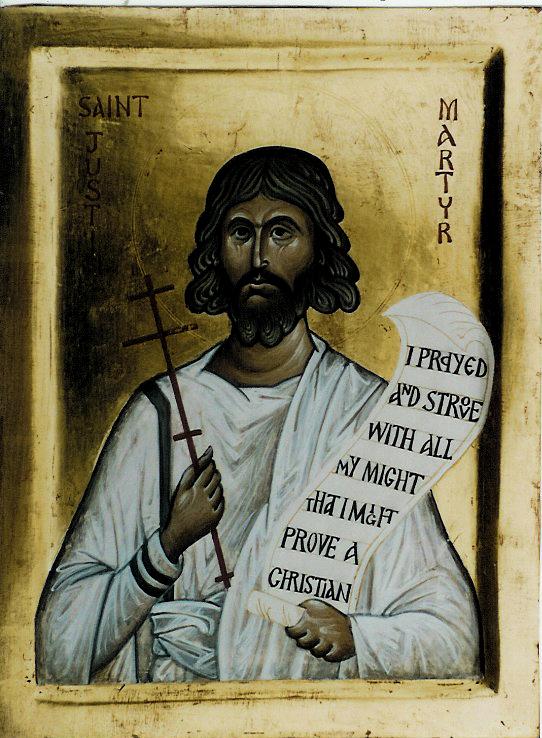
The distinctive feature of this Word is its relation through the Spirit to historical facts and events. It is when we allow the Scriptures to direct us to these facts and events that our minds fall under the power of their truth and we are compelled to believe for they carry in themselves their own demonstration. This is not, of course, any kind of logical proof, but the kind of demonstration that arises immediately out of the facts and events themselves through their self-evidence. This is particularly well expressed in a fragment of a lost work on the resurrection that has survived through John of Damascus and attributed to Justin.

[T]he Word of truth is free, and carries its own authority, disdaining to fall under any skilful argument, or to endure the logical scrutiny for its hearers. But it would be believed of its own sake, and for the confidence due to him who sends it. Now the Word of truth is sent from God, wherefore the freedom claimed by the truth is not arrogant. For being sent with authority, it were not fit that it should be required to produce proof of what is said, since neither is there any proof beyond itself, which is God. For every proof is more powerful and trustworthy than that which it proves, since what is disbelieved, until proof is produced, gets credit when such proof is produced, and is recognised as being what it was stated to be. But nothing is more powerful or more trustworthy than the truth; so that he who requires proof of this, is like one who wishes it demonstrated why the things that appear to the senses do appear. For the test of those things which are received through the reason, is sense; but of sense itself there is not test beyond itself. As then we bring those things which reason hunts after, to sense, and by it judge what kind of things they are, whether the things spoken be true or false, and then sit in judgment no longer, giving full credit to its decision; so also we refer all that is said regarding men and the world to the truth, and by it judge whether it be worthless or no. But the utterances of truth we judge by no separate test, giving full credit to itself. And God, the Father of the universe, who is the perfect intelligence, is the Truth. And the Word, being his Son, came to us, having put on flesh revealingย  both himself and the Father, giving to us in himself resurrection from the dead and eternal life afterwards. And this is Jesus Christ our Saviour and Lord. He, therefore, is himself both the faith and the proof of himself and of all things. [Thomas F. Torrance, Divine Meaning, 95-6; the quote from Justin, De resurrectione, 1.1f, from the Sacra Parallela of John of Damascus. E.T. from Ante Nicene Christian Library, vol. 2, pp. 341ff. This is not generally accepted as Justin’s own work, but like the Cohortatio ad Graecos was at least written under his influence.]

For all those weary souls who have labored under the Evangelical mantle of ‘Fighting Fundamentalism’ and the Apologetic Faith (as Warfield called it); won’t you join me in commending yourself to a more Christian Way? A ‘Way’ that does not entangle itself in the realm of rationalist-historicism, that seeks to ‘prove’ Jesus to themselves and the world. I am sure that it is the other way around … we are in need of ‘proving’. And I think the “Martyr” quote helps us to think in this order, and not the order of the “world.”
Piety and Faith and Theology

Adam Kotsko wrote (at his blog An und fรผr sich):

Jeremy Ridenour sent me a link to this post by Kait Dugan, which fulfills what is apparently a ritual requirement of all theology bloggers who donโ€™t blog at AUFS: declaring that personal faith and piety is required to be a theologian. Specifically, she asks whether theology might be different from other disciplines:

Do the rules and procedures change when the object of inquiry is God? What are we doing here if they donโ€™t? What does it mean that the object of inquiry is one that summons us to obedience, faithfulness, and worship? When the object is actually our Lord?

To which I would respond: How do you know all those things? What if God isnโ€™t really like that? What if itโ€™s unworthy of God to assume he demands something like obedience and worship? What if itโ€™s harmful to us to idolize a being that would make such demands? Such questions are necessary if theology is to be a critical intellectual pursuit, and it strikes me as a lot more likely that those questions will be raised if people who arenโ€™t concerned about maintaining their good standing in existing religious institutions are part of the conversation. (see here)

_______________________

He is responding, obviously to Kait Dugan (an MDiv student at Princeton Theological Seminary).

To which I would respond to Adam (with his help): How do you know all those things aren’t the case? What if God is really like that? What if it’s worthy of God to assume he demands something like obedience and worship? What if it’s beneficial for us to idolize a being that would make such demands? ‘Such questions are necessary if theology is to be a critical intellectual pursuit, and it strikes me as a lot more likely that those questions will be raised if people who are concerned about maintaining their good standing’ with Jesus Christ (like fellowship and communion) are part of the conversation.

I think the difference between what is informing Kait’s question and Adam’s comes back to the ominous question of prolegomena. Kait obviously follows what Barth has called the ‘analogy of faith’, and Adam follows what has been called (taken to its logical conclusion in Adam, presumptuously I say, on my part) the ‘analogy of being’—or a full blown natural theology (emphasis on natural).

The Philosopher’s Theology, and Calvinism

I am writing a review for this book right now, for the Pacific Journal of Baptist Research; I should be done with the review by tomorrow. But I thought I would throw something up here from the book for your consideration. Michael Rea writes:

The methodological divide between systematic theologians and analytic philosophers of religion is ripe for exploration. It is of obvious theoretical importance to both disciplines, but it also has practical import. The climate in theology departments for analytic theologians is muck like the climate in English-speaking philosophy departments for continental philosophers: often chilly. Moreover, the methodological divide is surely the most significant obstacle to fruitful interdisciplinary dialogue. The problem isn’t just that academics with different methodological perspectives have trouble conversing with one another. Rather, it is that, by and large, the established figures in both disciplines don’t even view mutual conversation as worth pursuing. They ignore one another. They (implicitly or explicitly) encourage their students to ignore one another. They allow their methodological preferences to play a very large role int their judgments about hiring and about the quality of papers they referee for professional journals. And the divide only grows deeper. No doubt many (on both sides) will thin that all of this is perfectly legitimate. Maybe it is, but that is beside the point; its legitimacy shouldn’t just be taken for granted. It is an open and interesting question whether theology can sensibly be done in the analytic mode. [Michael C. Rea in Analytic Theology: New Essays in the Philosophy of Theology, edited by Oliver D. Crisp and Michael C. Rea, 2]

For some of you you could care less about what appears to be cutting the bologna way too thin. But I assure you this represents a substantial issue with real life fall-out (which I understand personally). The divide that Rea is speaking about represents a substantial methodological difference between how folk “do” theology. The difference is the difference between starting with Christ, in principle (principially) and methodologically (which is the method I follow); or starting with generic philosophical abstractions about nature and the god of nature, and from this set of principles working toward God and Christ. This divide works its way out, finally, to the issue that I am often harping on here at the blog; the distinction that I often draw between classical Calvinism and Evangelical Calvinism—viz. the disparate doctrines of God, for example (do we have a substance metaphysic [classic Calvinism] or a [onto] relational metaphysic [Evangelical Calvinism] shaping how we conceive of God and all the subsequent doctrines that follow? etc.).

I realize that I moving fast, from one thing to the other; but I want to illustrate how this “divide” that Rea is speaking about can play out THEOLOGICALLY.

How To Think Theologically and Historically, or Christianly, as an Evangelist

Analytic theology would have us bound by analytics, and even foundationalism. The general populace at large has been infected by this disease of “faith seeking proof of the self.” This bait is always present for the theologian and biblical exegete; that is the bait of establishing the self as the canon of all that is right and true in the world. I recently fell prey to this bait when in discussion with someone from the general populace side. The bait, in this instance was “proving” the historicity of the resurrection of Christ through the canon of self (or maybe positivism). The Apostle Paul admonishes us, and writes: “For although we are walking in the flesh, we do not wage war in a fleshly way, since the weapons of our warfare are not fleshly, but are powerful through God for the demolition of strongholds. We demolish arguments and every high minded thing that is raised up against the knowledge of God, taking every thought captive to the obedience of Christ.” [II Corinthians 10:3-5] We are Christians, and we are guardians of the truth of the Gospel as we participate with Christ in his ongoing priestly ministry. We don’t fight to establish ourselves so that we can establish Christ; Christ fought for us through his battle with the principalities and powers [Col. 2:15] so that he might establish us and our humanity in his!

Thomas Torrance has a good word on how we ought, as Christian theologians, operate in a way that demolishes arguments against the knowledge of God. It is not through engaging the world on their terms (the constant battle and bait), but it is through approaching the world through a differentiated mode of witness. In other words, we assume a posture that stands from within the uniqueness and weirdness of the Gospel and the Incarnation of Christ. Here is Torrance,

[T]he mystery of Christ is presented to us within history — that historical involvement is not an accidental characteristic of the mystery but essential to it. That is the problem.

Let us first put it this way, recalling the bi-polarity of our theological knowledge. If God has become man in the historical Jesus, that is an historical event that comes under our historical examination so far as the humanity of Jesus is concerned, but the fact that God became man is an event that cannot be appreciated by ordinary historical science, for here we are concerned with more than simply an historical event, namely, with the act of the eternal God. So far as this event is a fact of nature it can be observed, and so far as it is historical in the sense that other natural events are historical, it can be appreciated as such; but the essential becoming behind it cannot be directly perceived except by an act of perception appropriate to the eternal event. That act of perception appropriate to the eternal event is faith, which is an enabling of reason given to it in the very act of receiving revelation.

But now we have not said too much? The act of perception appropriate to an eternal act, or divine act, would surely be the pure vision of God, which we do not have in history. Here on earth and in time we do not see directly, face to face, but see only in part, as through a glass enigmatically, in a mystery. We see the eternal or divine act within history, within our fallen world where historical observation is essential. Faith would be better described then as the kind of perception appropriate to perceiving a divine act in history, an eternal act in time. So that faith is appropriate both to the true perception of historical facts, and also to the true perception of God’s action in history. Nor is it the perception of history by itself, divorced from revelation, but it is the way we are given within history to perceive God’s acts in history, and that means that faith is the obedience of our minds to the mystery of Christ, who is God and man in the historical Jesus. What is clearly of paramount importance here is the holding together of the historical and the theological in our relation to Christ.

If the two are not held together, we have broken up the given unity in Christ into the historical on the one hand, and the theological on the other, refracting it into elements which we can no longer put together again. We then find that we cannot start from the historical and move to the theological, or from the theological and move to the historical without distortion, and nor can we rediscover the original unity. We can only start from the given, where the historical and the theological are in indissoluble union in Christ. [Thomas F. Torrance, Incarnation: The Person and Life of Christ,” edited by Robert T. Walker, 6-7]

We can hear Torrance’s influences, from Polyani and his Tacit Knowledge, and maybe some of Anselm’s Fides Quaerens Intellectum (faith seeking understanding) tradition. This has led to Torrance’s epistemological inversion and kata physin (according to the nature of the thing, or scientific knowledge); wherein the object of consideration acts upon the knower, and the object opens itself up more and more as the knower engages with the object (and subject in our case) on its own terms. This is Torrance’s way of demolishing arguments against the knowledge of God. It is not to fall prey to the constant bait of self; it doesn’t take the self that seriously. Instead it is to work within the canons of knowledge that God has revealed of himself in Christ. It rebuffs Cartesian foundationalism; so that humanity is not engaged in proving their structures of thought prior to their ability to affirm God’s existence, the historicity of the resurrection and a whole host of other things. Instead, what justifies humanities’ belief is faith (so Barth and Torrance’s, amongst others, ‘analogy of faith’ methodology). It isn’t rationalist certitude; it isn’t basic ideas formed in the halls of the academy; it is Faith!

So how am I supposed to interact with someone at my workplace who operates from a convoluted, water downed rationalist mode of thinking (where the self is king)? My method, even amongst the most hostile, is to frame the whole discussion by starting out with; “as a Christian,” and then begin to explain what it is that Christians (like Evangelical Calvinists) believe about God (as love and Triune etc.). At the end I can invite that person into a participatory relationship with the God of the resurrection. I have done this often in Evangelistic situations (even in the church ๐Ÿ˜‰ ), and it is one of the best ways to counter the world’s mode of rationalist self perpetuation. And it allows me to freely talk about Christ, without also having to prove Christ (that’s just not proper theological method). Battle on!

A Brief Reflection on Analytic Theologians

Okay, it’s no secret; I am obviously engrossed in this issue right now, simply because I am reading Analytic Theology edited by Oliver Crisp and Michael Rea. I have lot’s of personal history with this tradition of thought (which my last post, and comments make clear). All I want to voice here is two more groups of thoughts on this issue, and then I’ll probably be done with this for awhile.

Another problem I have with Analytic Theology is that I often get the sense that without the Analytic Theologian we couldn’t be sure that God. It is this unstated thing that we ought to be reliant upon the Analytic Theologian to lead us into all truth (since they love knowledge as philosophers). This is an eery thing to me. I feel this angst as I read these folk; it seems to me, that they believe that if they can’t argue a coherent whole or prove that the Bible is Inspired Scripture or something—through their means—that the whole thing (Christianity) could evaporate into thin air. That they give and charge Christianity with its glory and life breath.

Another issue is that I get the sense that Analytic Theologians (and its probably not just them, and not all of them) seem to have a sense of power about them. That they can marshal the semantic and grammatical pieces of the knowledge-warranted-belief puzzle like no one else can. I get this sense that they think that the rest of us “theologians” [I’m just one in training] are at their mercy (or should be).

I am not anti-intellectual, or anti-thinking; I am anti-Analytic (for the most part) though. [That does not mean that I don’t respect many of these so-named Analytic Theologians; I do!]

The “Mad” Theologians, Too Analytic

I am continuing to read Crisp’s and Rea’s Analytic Theology; should complete it sometime tomorrow. Many of you don’t know, and don’t care to know, that there is a difference between analytic theology and what has been called ‘Continental Theology’ (which is the influence you get here when you read my blog). The foremost example of Continental Theology is Karl Barth. ‘CT’ takes its cues from following the philosophical paths ofย European philosophers like: Hiedeggar, Husserl, Hegel, [Einstein, for good measure — even though not a philosopher, per se]ย and Kant; to name a few. Analytic Theologians follow in the footsteps of Hellenistic philosophy, and other European philosophers; like: Aristotle, Plato, Descartes, and a host of others. Ultimately, I really have no empathy for Analytic Theology. When I read it, or try to think it; it actually upsets me! I think it represents an abject loss for providing fruitful and creative ways for thinking about and articulating who God is. I would suggest that the reason this is the case is primarily because of their metaphysics (substance), and their method (mathematical). To this end, let me give you an example of what I mean. The following is from Thomas Crisp’s (an Analytic Theologian-Philosopher who teaches Philosophy at Biola University in La Mirada, CA — very close to where I grew up) chapter in the book ‘Analytic Theology’ (his chapter is entitled: “Believing the Scriptures Divinely Inspired). Hereย he is doing some preliminary work that I am hoping will set up the rest of his chapter in some comprehendible way; he is sketching Alvin Plantiga’s critique of natural theology’s capacities to provide something helpful for establishing the justification for “Believing the Scriptures Divinely Inspired.”

[P]lantiga has argued that attempts to argue for ‘the great things of the gospel’ (i.e. incarnation, atonement, Jesus’ resurrection) on the basis of natural theology and historical argument suffer from a problem he dubs the ‘Principle of Dwindling Probabilties’.

The Principle of Dwindling Probabilities afflicts arguments with a certain structure. Suppose you want to show some proposition P probable on our background knowledge K. You might do that by producing some other proposition A, showing that P (A/K) and P (P/A&K) are high, and concluding that, by the probability calculus, it follows that P (P/K) is high.

You might however, try to show that P (P/K) is high by iterating the above procedure, arguing that some proposition A is probable on K, that some other proposition B is probable on A&K, and that P is probable on A&B&K, concluding that, therefore, P is probable on K. But such an argument is subject to Plantiga’s Principle. If all you’ve said is that P (A/K), P (B/A&K), and P (P/A&B&K) are high, say around .8 each, then, so far, all that follows from the probability calculus is that P (P/K) is greater than or equal to .8 x .8 x .8, a tad higher than .5. Though the conditional probabilties P (A/K), P (B/A&K), and P (P/A&B&K) are each high, the probabilties ‘dwindle’ when you multiply them through.

This Principle of Dwindling Probabilties (PDP), then, makes trouble for arguments with the foregoing iterative structure, arguments that attempt to motivate the claim that P (P/K) is high for some P by arguing, for some Q1 . .ย . Qn, that P (Q1/K), P (Q2/Q1&K), . . . , P (Qn/Q1& . . . Qn-1&K), and P (P/Q1& . . . &Qn&K) are high. [Thomas Crisp in “Analytic Theology,” eds. Oliver Crisp & Michael Rea, 190-91]

I know that was complex; let me explain for the dense of heart. So if ABCDEFGHIJK then LMNOPQRSTUVWXY&Z. Further there are some who like to use A1 on their KFC; which for others equals a no go in their 300Z.

Just today I made a cryptic comment on my Facebook wall that I was sure that most ‘Analytic Theologians’ must’ve been engineers or something in their former life. Ironically, I checked out Thomas Crisp’s CV; and his undergrad degree is in Civil Engineering from UCLA.

As I have mentioned before, doing theology as math should have no place in the theologian’s mode of operation. In my view, the effect this has when done, supposedly in the service of God, is to depersonalize Him through using cold formulaic apparatus that does not befit the Christian God of love. I would love to see an Analytic Theologian go home to his wife, and describe his love for her through calculus formula, statistics, and mathematical theorems and equations; that probably wouldn’t go over to well. If this is the case, why do said ‘Analytic Theologians’ feel justified when talking about humanties’ relationship to the Greatest Lover of all, God, in this way? No thank you . . .

god of the philosophers

I am currently reading Analytic Theology: New Essays in the Philosophy of Theology edited by Oliver D. Crisp and Michael C. Rea. I will be writing a review of it for the Pacific Journal of Baptist Research. I am currently reading chapter 2 entitled Systematic Theology as Analytic Theology by William J. Abraham. The whole book is, as it were, making an argument for the place of ‘Analytic Philosophy’ in Systematic Theology. If you are unaware, there is a schism (of sorts) between Analytic Theologians and Systematic Theologians. Ultimately the division between the two has to do with methodological commitments that impact material theological conclusions. The Analytic theologian wants to argue that their craft (Analytic Philosophy) is a necessary tool for the theologian to wield, in order for said theologian to think with rigor and respectability amongst other academic disciplines. At the end of the day, for the two main camps in this discussion—Analytic Theologians V. Continental Theologians—the question comes back to an issue of how the theologian perceives the role of Revelation. In other words, the question that Barth and Brunner debated over; viz. the question of the viability that a so called ‘natural theology’ (analogia entis) has within a prolegomenon for Systematic Theology. Or, do we start with Christ or Nature. Most Western Systematic Theology (in the Evangelical world) has gone the way of Analytic Theology and starting with Nature, methodologically—this move effects everything (all other doctrinal development).

In the following quote, Abraham describes the scorn that comes from non-Analytic theologians towards Analytic Theologians as he perceives it (as an Analytic Theologian).

Consider how analytic theology might proceed in articulating a robust doctrine of God. At present there is stout resistance in some theological circles to deploying philosophical skill in articulating a Christian vision of God that has multiple sources. There is, at the outset, the long-standing contrast that pits the god of the philosophers over against the God of Abraham, Isaac, and Jacob. From as far back as Tertullian and at least from Pascal onwards in the modern period we have been told that there is the dead, abstract god of the philosophers and the living God of scripture and faith. Karl Barth’s arguments against natural theology have aided and abetted this contrast sharply and made it the staple diet of three generations of theologians. To read for the god of the philosophers is to seek to justify ourselves by our works; it is to invent an idol rather than turn to the one true God of divine revelation; and it is to make revelation subordinate to human reason. In addition it has been suggested from the side of recent liberation theology that the omnipotent, omniscient, omnipresent god of the philosophers is the top-down god of the masters, the god of empire. An omnipotent god will end up, like it or not, being brought in to support the unilateral omnipotence of empire. Thus the god of the philosophers is, if only by default, in synch with the new North American, neo-colonial empire. From another angle the god the philosophers is a god one comes to know through cold, clinical logic divorced from genuine spirituality and from the special revelation through whom God is supremely known and loved. So the god of the philosophers is really the god of pagan thinking rather than the God known and worshipped in the faith of the saints and martyrs. [William J. Abraham, chpt. 2, Analytic Theology, 61]

[One caveat, Abraham polarizes the characterization of the ‘Liberation Theologian’s’ disdain for the god of the philosophers. In truth, Abraham’s ‘Liberation Theology’ doesn’t just gripe against the god of the philosophers, but against the God of the Christian Tradition—I am assuming Abraham thinks that the god of the philosophers is univocal with the God of the Christian Tradition. In some quarters this may be the case, but not in all, and not in the best of the Tradition.]

In our forthcoming book, Evangelical Calvinism: Essays Resourcing the Continuing Reformation of the Church. Princeton Theological Monograph Series. Eds. Myk Habets and Bobby Grow. Foreword by Alasdair Heron. Eugene, OR.: Pickwick Publications, my particular chapter is entitled: “Analogia Fidei or Analogia Entis: Either Through Christ or Through Nature.” My area of interest, in my chapter, revolves around the very questions that Abraham is addressing. I follow the ‘Analogy of Faith’ (through Christ) contra what Abraham would follow the ‘Analogy of Being’ (or through ‘Natural’ Theology). Some would say that this presents a false dichotomy, that a chaste approach would understand that we need both working in tandem with each other. But I would suggest that this fails to understand the critique on theological method that this dichotomy reflects. Do we start with God’s ‘Self-revelation’ and ‘Self-interpretation’ in his ‘Self-interpreting-Word’ (cf. Jn. 1.18); or do we start with seeking the glory of man theologia gloriae (cf. Jn. 5.39-47)?