From “Evangelical” Salvation to ‘Evangelical’ Salvation

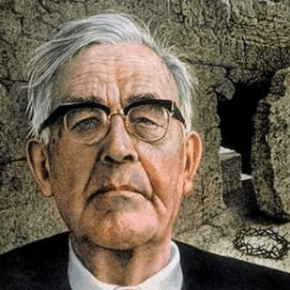
[T]he real advance has obviously been made when we come to the INSTITUTIO of 1559, in which unio cum Christo [union with Christ] has become the common denominator under which Calvin tried to range his whole doctrine of the appropriation of the salvation achieved and revealed in Christ. For now in the Third Book, before he can speak of faith, of conversion and renewal, of the vita hominis christiani, of abnegatio nostri as its sum, of the necessary bearing of the cross, of the relation between this and the future life, then — and only then — of justification, of Christian freedom and prayer, of eternal election as the ultimate presupposition of the whole, and finally of the future resurrection, according to the view attained in 1559 he has first to make it plain how it can come about at all that what God has done for us in Christ, as declared in the Second Book, can apply to us and be effective for us. The answer given in the noteworthy opening chapter of the Third Book is to the effect that it comes about through the arcana operatio Spiritus, which consists in the fact that Christ Himself, instead of being extra nos, outside the man separated from Him and therefore irrelevant to us, becomes ours and takes up His abode in us, we for our part being implanted into Him (Rom. 11:17) and putting Him on (Gal. 3:27). (Karl Barth CD 4.3.2, 550-51 cited by Charles Partee, The Theology of John Calvin, 195)

How much of “Evangelical” theology has missed this point? By “only” viewing Christ as the instrument of salvation; what’s missed is the fact that God in Christ through the Spirit is salvation! Union with Christ becomes the center which all other soteriological concerns should find their orbit. If we hope to be “saved” at all, it will only be because we participate with God through Christ by the Spirit. In this way salvation is understood in personal, relational, trinitarian terms versus the usual “Evangelical” instrumentalist, substantialist, qualitative terms. There is a huge difference between the two approaches. I wonder if you too appreciate the significant weight in this difference of approach and understanding?

Classic Repost: John MacArthur juxtaposed with English Precisianism (Puritanism)

Here’s a classic re-post of a short article I wrote maybe 5 years ago for a blog of mine. It is inspired by this post here.

Below I am going to provide two quotes, the first will be from Theodore Dwight Bozeman discussing the emergence and factors that shaped the thinking of the yet to come English Puritans; and the second will be from John MacArthur, and his discussion on the role that changed behavior and moral values have in a genuinely “saved life.” What I am highlighting, and want you all to see, is the striking correlation of thought and practice that both camps share, relative to emphasizing the importance of outward moral behavior in the “elects” life. Here is Theodore Bozeman discussing the early factors that led to English Puritanism:

English penitential teaching expressly echoed and bolstered moral priorities. In contrast, again, to Luther, whose penitential teaching stressed the rueful sinner’s attainment of peace through acknowledgment of fault and trust in unconditional pardon, several of the English included a moment of moral renewal. In harmony with Reformed tendencies on the Continent and in unmistakable continuity with historic Catholic doctrine that tied “contrition, by definition, to the intention to amend,” they required an actual change in penitent. For them, a renewal of moral resolve was integral to the penitential experience, and a few included the manifest alteration of behavior. They agreed that moral will or effort cannot merit forgiveness, yet rang variations on the theme that repentance is “an inward . . . sorrow . . . whereunto is also added a . . . desire . . . to frame our life in all points according to the holy will of God expressed in the divine scriptures.” However qualified by reference to the divine initiative and by denial of efficacy to human works, such teaching underscored moral responsibility; it also adumbrated Puritan penitential and preparationist teaching of later decades. [italics mine] (Theodore Dwight Bozeman, “The Precisianist Strain . . . ,” 20-21)

It is important to keep in mind that Bozeman is not even discussing actual English Puritanism yet, rather he is highlighting the streams and emphases, present within England just prior to the full-fledged emergence of Puritanism, that actually brought shape and form to the disciplinary “religion” known as Puritanism. Notice the correlation he makes between this kind of Protestantism with Roman Catholic spirituality. . . .

Conversely, John MacArthur sounds very much like this incipient Puritanism described above by Bozeman. You will notice this similarity as MacArthur, like these early penitentialists, emphasizes the function and necessity of moral reformation in the life of the “truly saved” individual; notice:

. . . They’ve been told [Christians in the typical evangelical church in the West] that the only criterion for salvation is knowing and believing some basic facts about Christ. They hear from the beginning that obedience is optional. It follows logically, then, that a person’s one-time profession of faith is more valid than the ongoing testimony of his life-style in determining whether to embrace him as a true-believer. The character of the visible church reveals the detestable consequence of this theology. As a pastor I have rebaptized countless people who once “made a decision,” were baptized, yet experienced no change. They came later to true conversion and sought baptism again as an expression of genuine salvation. [brackets mine] (John MacArthur, “The Gospel According to Jesus,” 17)

Striking is it not? Both English Penitentialism (early and full blossomed English Puritanism), and MacArthur’s approach are intended to curb moral laxity, by emphasizing the moral conduct and “performance” of the truly “saved.” As MacArthur underscores, as a good follower of the “English Puritan” (and for that matter Roman Catholic) ethic and spirituality, genuine salvation is only noticeable and discernible via an “. . . an ongoing testimony of his life-style.” Bozeman speaking of the moral laxity within England (in the 16th century and onward) notes how this affected the “Reforming spirit” of that locale, he says: “. . . There the Reformation emerged in a period of deeply felt concern about social order. . . . (Bozeman, 13) This motivation similarly, and unabashedly, motivates MacArthur’s emphasis on performance, duty, and obedience, as he states: “. . . Why should we assume that people who live in an unbroken pattern of adultery, fornication, homosexuality, deceit, and every conceivable kind of flagrant excess are truly born again? . . .” (MacArthur, 16-17) In other words, the remedy for both camps (i.e. between the 16th and 17th cent. and 20th and 21st cent.) is to hang people over hell in order to foster an supposed environment of holiness and moral uprightness, this is by way of EMPHASIS. Both of these camps spoke and speak of solifidian (faith alone), but this is not enough, external moral transformation needs to accompany “faith alone,” otherwise there was never any faith to begin with (i.e. later on we will discuss how this thought came to be tied to concepts like “preparationism” and “temporary faith”).


John MacArthur is at it Again …

My “e-friend,” Randy Boswell has posted and made a good observation on John MacArthur’s recent rant against the Young, Restless, & Reformed crowd. I haven’t been in the mood lately to comment on Mac, but I’m glad someone still is:

John MacArthur and the Young, Restless, and Reformed Movement

Go over there and give it a read. Unfortunately, I think MacArthur has pretty much framed himself as a guy standing in the corner. Not even fellow 5 pointers are good enough for MacArthur. Beyond doctrinal issues, MacArthur’s gripe against the YRR crowd is the way they dress and talk. I think MacArthur was born in the wrong era, he would’ve been better off in the 17th century Puritan England, or better, America. That way his Lordship salvation, his functional practical syllogism & experimental predestinarianism would not only have legs in Sun Valley, California; but it would also be interwoven into the society and culture at large.

I do believe that holiness is sorely lacking in the American church, but I don’t think that the issue is whether or not someone has holes in their jeans; it is an issue of the heart, and posture toward God and others that the Lord cares about.

I Am Reformed, Even an [Evangelical] Calvinist, but Allergic to TULIP’s

Just in case you are still under the delusion that being a ‘Reformed’ Christian equals or necessitates being a 5 point Calvinist; let us hear from I. John Hesselink in his book “On Being Reformed” (which I just finished):

All this not withstanding, we are also children of the Reformation with its recovery of certain evangelical themes: the Word alone, by grace alone, and by faith alone. More particularly, we are a part of a specific Reformation tradition known as Reformed or Presbyterian. Although many in this tradition call themselves “Calvinists,” others do not rally around the five points of Calvinism: total depravity, unconditional election, limited atonement, irresistible grace, and the perseverance of the saints (often referred to by the acronym TULIP). These so-called points do not come from Calvin but from the Canons of Dort, which were composed in the Netherlands over fifty years after Calvin’s death. The Reformed tradition does not stem from Calvin alone. Before him there were other Reformed reformers—Zwingli, Bucer, Oecolampadius, and Farel, to name only a few—and there were others who worked with him or were indebted to him such as Bullinger, Knox, and Beza. [I. John Hesselink, On Being Reformed, 89]

And this coming from a man, Hesselink, who would probably affirm all five points of the TULIP. I just want to make this point clear for anyone who might wrongly assume that being a Reformed Christian, or even a “Calvinist,” means that this person or theologian must then also affirm the TULIP; they do not! That is all …

PS. Oh, when Hesselink refers to “Presbyterian” in his quote, he is not referring to the denomination, but a form of church government and polity.

On Being ‘Reformed’ and “non-Reformed”

I like to contemplate on what it means to be ‘Reformed,’ because that’s where I find myself, theologically. I reflected on this a few posts ago, a bit; I was communicating how being ‘Reformed’ has certain connotations associated with it, usually negative (well, if you’re ecclesially situated, as I am). My friend is reading I. John Hesselink’s classic little book On Being Reformed: Distinctive Characteristics and Common Misunderstandings, he encouraged me to pick it up, so I have (I have intended to get to him, at some point anyway, so now is the point). In his first chapter he deals with the misunderstanding “That the word “Reformed” refers primarily to those denominations which bear that name, especially those of Dutch origin (this is his title for chapter 1). He underscores how his understanding of being ‘Reformed’ developed over time. He grew up the son of a Dutch Reformed pastor in Michigan, and so this is all he knew. Later, he did his doctoral work under Karl Barth, and he also studied with Emil Brunner. Anyway, he came to appreciate something that I have been trying to trumpet here often (and we do in our book as well), and that is that being ‘Reformed’ represents a spirit more than a letter or a particular cluster of denominations. You see, I grew up the son of a Baptist preacher-man, and currently we happily attend a Calvary Chapel (which by constitution are against the ‘Reformed’ tradition — of course that’s only because folk in Calvary Chapel have a very limited view of what being ‘Reformed’ means and what it entails [and this is not limited to Calvary Chapel folk] — if they understood what it meant, I think many of them would realize that in fact they fit within the ‘spirit’ of what it means to be Reformed both formally and materially); both of my ecclesial situations are in the ‘Free-church’ tradition, and both are congregational (somewhat) in format. Here is what Hesselink has to say about what it means to be ‘Reformed’, beyond the common misconception that this is dictated  by, by being associated with certain “Reformed-denominations” (like the Pressies):

[I]n the United States and the British Commonwealth there are numerous ministers and theologians who serve Baptist, Congregational, and Anglican (Episcopelian) Churches but who consider themselves basically “Reformed” in their theology. I find it intriguing, for example, that for many years the standard text in systematic theology at Western Seminary [Holland, Michigan] was not that by the famous Presbyterian Charles Hodge or by Christian Reformed scholar Louis Berkhof, but the three volume work of Augustus Hopkins Strong, a Baptist theologian from Rochester Seminary. One of the leading Calvin scholars in the United States, the late Ford Lewis Battles, was of Congregational background, and many of the finest Calvin scholars in the English-speaking world are Anglicans: Philip Hughes, James I. Packer, and T.H.L. Parker.

In conclusion, then, Reformed comprehends a large, international group of churches as well as countless individuals who belong to denominations that are called neither Reformed nor Presbyterian. Hence, any time we who belong to the Dutch Churches (RCA or CRC) here in the United States imagine that we are the principal representatives of the Reformed tradition, we are both presumptuous and in egregious error. On the other hand, there is no need to be shy or defensive about the name simply because in the Anglo-Saxon world the term Presbyterian is better known. Few ecclesiastical theological terms are more respected and honored that that of Reformed. 

We can be justly proud as long as we remember that the word denotes a task more than an accomplishment. Ecclesia reformata semper reformanda est! “A Reformed church must ever be reforming itself”—in accordance with the Word of God. [I. John Hesselink, On Being Reformed, 7-8]

I am one of those Congregationalist ‘Reformed’ guys, and of course I walk and breath in the ‘spirit’ of what that means, and in the ethos of the Reformed mantra that Hesselink ends with. In fact our forthcoming book entitled: Evangelical Calvinism: Essays Resourcing the Continuing Reformation of the Church, is squarely situated in the very place that  Hesselink sketches above. And of course what it means to be ‘Reformed’ also has a multi-faceted conceptual/material range; there is not a monolithic voice when it comes to every duck in the ‘Reformed’ row. And that is what I continue to hope to clarify for so many folks who seem to think that being Reformed equals being a 5 point Calvinist. It doesn’t.

What I Like To Study … And Being ‘Reformed’ so I am

I have to say, I am realizing that my theological interests are more in the realm of historical theology than what some might call modern theology. The furthest I move into modern theology is with Thomas Torrance, and then of course, by training, TFT was a patristics scholar; which, then, gets me right back into historical theology. I certainly can appreciate Barth, and probably from what I have come to realize, the earlier Barth; but Barth, at the end of the day is not my final cup of tea. I have been trying to read some Jüngel, and then of course, Schleiermacher, but this era of theologizing just doesn’t get me going like patristic and Reformation theology (inclusive of post-Reformed) do. My favorites from historical theology to study are: Calvin, Luther, and the Scottish evangelical Calvinists, along with ‘The Spiritual Brethren’ Calvinists of England. I actually like to study Augustine, and Pelagius; I like Athanasius and the Cappadocians; and I like to study Thomas Aquinas and the medieval scholastics. Oh, and I like to study the Bible 😉 . Anyway, since this is a blog, and I felt like writing, I thought I would declare my space in the theological game; and in so doing, let you know what I like to study and research.

On a different note: it is interesting to come across the misconceptions that people have about ‘Reformed theology’. We attend an awesome church, but I am afraid that the culture in which are church is ensconced is rather horrified at the thought of ‘Reformed Theology’. I am afraid that Reformed Theology has become synonymous with 5 Point Calvinism, or rigid logico-deductive deterministic and fatalistic systems of of thought; and thus if someone claims to be a ‘Reformed-Theology-guy’, like I do, that this stereotype is associated with my ‘Reformed’ views (so guilt by association). This only motivates me more to break down such stereotypes by clarifying the depth and breadth that ‘Reformed Theology’ actually represents in the history itself. One thing, though, that certainly makes me ‘Reformed’ is my belief in the primacy of God’s grace and choice in salvation. Of course the way that my own view parses that, my Evangelical Calvinist view, is much different than the 5 Point articulation; but it is not any different than how it has been parsed in the history of Reformed thought (by some Scots and Brits, at least). And it is this point that needs-be clarified for folks who continue to suffer under the old binary notion of Calvinism versus Arminianism. I mean, I don’t blame anyone for thinking this is how it is—especially for those who don’t spend a lot of time studying theology and the history of interpretation—nevertheless, there is no reason that this delusion need continue to prevail in the body of Christ. I am a Reformed theologian (notice I used a small “t” instead of a big one “T” 😉 ), and thus I feel the need to let folk know that it is not careful or accurate to characterize such folk as myself in a narrow way. So my mode is to operate as “lets-be-careful-police”, or something 😉 . At the end of the day what ultimately matters is that folks have a healthy view of Jesus (not all of these labels, but if we are going to use them we should be careful in how we do … I say to self as well).

Blowing Off Steam; The Calvinist-Arminian Abyss

I must say, at this point in my life, it is rather discouraging to still come across folks who seem to think that the only way to think about Biblical Studies is either through classic Calvinism or classic Arminianism; to one degree or the other! I have spent hours and hours and hours and hours and hours trying to alert people to the fact that this is just not the case (see my old blog: The Evangelical Calvinist). There will always be those who are ardently in favor of classic, Five Point, and/or Federal Calvinism (same with the Arminian side); but what baffles me is that folks who are not ardently in either of these camps (because of study) continue to rest on their laurels and remain in the realm of lethargic haze that presumes that in fact this dichotomy is the case (the either or between Calvinism or Arminianism). The reality is, is that you don’t have to even follow Karl Barth or Thomas Torrance to find strands of Calvinism, in the history, (both English and Scottish, at least) that are not Five Point in orientation. And yet people in the blogosphere, and especially folks who warm the pews, continue on in their hazey state of being relative to this issue. And to be quite honest, it gets really old!!

People need to be taught, and now I am talking about in the church itself (not the blogosphere). There are people sitting in the pews with lingering questions about this very issue (and many more), that Sunday mornings can never really address. There needs to be more Christian education in the church; even if there is only a small percentage within the church who care enough to push deeper and wider on such things. This small group of people, once educated (and I am not just referring to this issue), can have a huge impact on the broader body life of the church, regionally and nation wide. I come across people (did just last night) who have been adversely affected by this issue (the issue of Calvinism/Arminianism … it apparently caused a split in a former church of theirs while growing up — the person I was in contact with last night), and now it continues to have a lingering affect that can impinge on people’s daily spirituality; that is, left unaddressed.

I think this problem goes both ways. There is lack of resources in the church in general, and then also, there is lack of motivation on the part of the pew sitters side to push deeper (they often just remain in a state of unnecessary suspense).

Anyway, this is obviously a blowing off steam post; but I must say that I find this to be a real and present danger to the vitality and health of someone’s daily spirituality — that of course presupposes that folks take their walk and growth in the grace and knowledge of Jesus Christ seriously!

Why I am not a 5 Point Calvinist

I am still working on my responses to my friend on 5 point Calvinism. I have been talking with him by phone quite a lot lately, and about this very issue; so the urgency for me to pump out posts here is somewhat mitigated. I will, at some point, finish my responses to the actual passages of scripture he brought up to me via email; but that might not be for another month, or it may be by tomorrow. Having said that, let me just blog for a minute, and share just some of my personal reflection on why I never have or ever will be a 5 point Calvinist.

1). The first reason why I am not a 5 point Calvinist is because I can not justify it from my Bible study. I know some people say, rhet0rically, that they became 5 point Calvinists by simply reading their Bibles, and through personal Bible study. I find that highly unlikely, and at worst, arrogant! 5 point Calvinism took some time, by some great theological minds, to construct. It is not a “natural system” of thought per Scripture’s constraints; instead it requires, at least, a commitment to a particular idea of metaphysical causation. All one has to do is become quickly familiar with Reformation history, and you will quickly realize where these metaphysics come from. That in and of itself is not damning; the damning thing is, to me, is that these metaphysics do not do the best job explaining the categories of Scripture. They just don’t! They don’t offer a correlative grammar through which Scripture’s triune God, who is defined by his relationship in himself, is able to flourish. Furthermore, these metaphysics–the kind that 5 point Calvinism presupposes upon–don’t naturally allow us to speak about a God of love, nor do they allow us to believe that this God of love could save everyone–given the “Law-based” Covenant of Works (and the decrees that make that work) that God is supposedly constrained by–and this clearly is not scriptural! The first condition, in my mind, for something to be scriptural, is that God is love, and as a result, he is free to save and die for the whole world; and in fact, according to Scripture, he has (cf. II Cor. 5.14; Col. 1:15ff; etc. etc.)! These are some of the primary premises I have lived with, and that have been inculcated into my psyche ever since I have been a small boy; these premises have not changed for me!

2). The second reason why I am not a 5 point Calvinist is because of the damage that I have seen it do to those who hold to this system. Now I know that this is an emotional argument, but I don’t care! I know that people who are 5 point Calvinists who I have said this to before believe that I am overstating and mis-characterizing their position, because they are 5 point Calvinists, and this hasn’t been their experience; and all I can say is, I am sorry, look at the Puritans!! I have seen people who are introspective types, internalize the teachings of 5 point Calvinism, and almost go crazy; because they don’t “feel” that they have enough good works in a day to know if indeed they are one of the elect. I have seen these people struggle with the issue of assurance of salvation to no end, because according to their 5 point Calvinism, they must meet some sort of subjective nebulous threshold of good works in order to know that they indeed are one of the elect for whom Christ has died. Anyway, this is another reason why I cannot be a 5 point Calvinist; it doesn’t pass the livability test.

3.) The third, and my last reason that I’ll share (I have plenty of other reasons), is that I am not a 5 point Calvinist because there are better more fruitful ways of doing and thinking theology than 5 point Calvinism allows for. The history of interpretation, in the Christian Church, is littered with ways of thinking about our Lord, and his salvation, that far out-strip the grammar that 5 point Calvinism purports to provide. I’m not going to give any examples here, but this is a genuine reason why I am not a 5 point Calvinist. I simply believe that it is not true, that it places scripture and God’s self-Revelation on mute, and that it ultimately robs me from enjoying God the way he would have me enjoy him (e.g. worship Him)!

There are three reasons why I am not a Calvinist. Not all that in-depth, but what do you expect at a blog 😉 !? If you are a 5 point Calvinist, I should hope that you will quickly repent 😉 , and remember that Jesus loves you and your neighbor all the same!

§2. Letters To My Friend: Just Say No To Five Point Calvinism, A Trinitarian Way To Think Hermeneutically

This is the second of my posts to my friend in response to an email he sent me, and the exegetical questions he is facing in regards to the Calvinist concept of Limited Atonement. You can read my introductory post here. I am going to change my approach to answering the question from my friend, and actually jump into prolegomena issues; and highlight how an exegete’s theological methodology, a priori, will impact and shape his/her exegetical decisions and conclusions. In that vein, I am going to talk about why it is so important, if we are going to do Christian exegesis, to start with the Christian God’s own specification; which is triune. In my recent reading (of just a few minutes ago), I just came across some helpful words from Eberhard Jüngel, as he interprets the way that Karl Barth approached this very issue. That is, how does God as triune impinge upon how we think from him; both, then, theologically (in its truest sense), and exegetically. I just want to lay this out a bit in order to clear ground for later, when I actually try to answer my friend’s questions in specifics, in regards to the passages of Scripture that he has provided in support of a classic Calvinist understanding of a Limited Atonement. Here is what Jüngel has to say about Barth and the significance of God as triune should have on theological and exegetical work:

[B]ecause revelation concerns the being of God, since it is God who reveals himself there, the doctrine of the Trinity is ‘a constituent part, the decisive part, of the doctrine of God’. This part is decisive because the doctrine of the Trinity makes a fundamental distinction between ‘the Christian doctrine of God as Christian’ and ‘the Christian concept of revelation as Christian, in contrast to all other possible doctrines of God or concepts of revelation’. Because for Barth the ‘problem of the doctrine of the Trinity’ necessarily arises from our encounter with the Bible, then we ask after the being of God with ‘the question put to the Bible about revelation’, the solution of this problem is also decisive for the Christian concept of revelation and thereby for the understanding of the being of God. Hence Barth places the doctrine of the Trinity at the beginning of his Dogmatics in order that ‘its content be decisive and controlling for the whole of dogmatics’.

This location, which lets the doctrine of the Trinity stand at the entrance of the Church Dogmatics as a whole, is a hermeneutical decision of the greatest relevance. This is already seen formally in the fact that the doctrine of the Trinity is to be found in the prolegomena, that is, at exactly the place where the treatment of hermeneutical problems is expected. For Barth also hermeneutical problems are — despite other misleading statements — in no way merely more or less unpleasant preliminary questions. It is more that Barth’s insight that, without ‘anticipating material dogmas’, neither a doctrine of Scripture nor, even less, a doctrine of the Word of God can be formulated, may provide evidence that, at the point where he decides hermeneutically about the path of the Dogmatics (both formally and materially), he sees himself compelled to decide about the hermeneutic by which he is deciding. The placing of the doctrine of the Trinity at the beginning of the Church Dogmatics is therefore a hermeneutical decision of the greatest relevance because, on the one hand, the whole Church Dogmatics finds its hermeneutical foundation here, and, on the other hand, with this decision hermeneutics itself finds its own starting-point. . . . [Eberhard Jüngel, God’s Being Is in Becoming, trans. by John Webster, 16-17]

It is this principle that becomes hermeneutically important. That is, if we are going to follow God, and his lead into the ‘Far Country’ (as Jüngel says), we must start with his lead! If his chosen lead is his self-Revelation, his so called ‘self-interpreting-Word’ (cf. Jn. 1.18); then as Christians we need to honor that in our theological method, and hermeneutical prowess. Meaning, as Jüngel says above, that, in principle (de jure) Jesus as the Son of the Father in communion by the Spirit, needs to shape the questions that serve to explicate what he wants to reveal about himself. So in a sense, everything I am trying to say is: that we need to jump back quite a bit and consider our hermeneutical moorings (theologically), before we dive head first into passages of Scripture which ‘seem’ to correlate with particular ‘theological’ assessments that purport to come from the ‘Text’ itself.

So then, these are the questions we are faced with:

  1. What does the ‘Text’ of Scripture presuppose, theologically?
  2. Does the Arminian and Calvinist (classic) grammar present the only viable theological paradigm through which to interpret Scripture?
  3. Is the TULIP theology itself actually Christian Theology? Does it take shape by following God’s lead, or does it follow another leader (like ‘nature’)?
  4. Doesn’t it seem that Theological concerns precede and impinge upon hermeneutical concerns, so that what hermeneutics purport to explain actually correspond back to and signify its inner-theological ground?
  5. Should we follow a more ‘Theological Exegetical’ approach or a Literal, Grammatical, Historical approach to biblical interpretation?

There are definitely more questions to be broached, but I wanted to stop with 5 😉 . I don’t really plan on developing or answering all of the above questions in detail, but at least I intend to broach them at some level. How we understand Divine speech, acts, and works will directly shape our hermeneutical approach, and exegetical conclusions. And so, this is why I think it is important to move forward in this way. I am sure I have only really created more questions than answers. Isn’t that the joy of knowing God; isn’t this the source of worship and thus the form of Theology!

§1. Letters To My Friend: Just Say No to Five Point Calvinism

The following is the first part of an email that one of my best friends sent to me in regards to his move towards a five point Calvinism. You will notice that he says that the response he got from his interlocutor (which is what he shares below), comes in two levels. I will allow that to provide the structure of my response, then. So there will be three posts responding to my friend’s one email. Each dealing with each level of his response (I say three, because the email actually leaves off with the most important level to answering this whole question, and that is hermeneutics, and the LGH methodology my friend and I both were trained under … I have moved further away from this [not totally] than my friend has I think – it might be smarter to start with my friends level first [the LGH], but I am going to follow the flow of his email as the structure of my response. There will be overlap in each of my responses, necessarily).

Let me give a quick history of my relationship to my friend, and who he is (without sharing his name). We were roommates in undergrad at Multnomah Bible College, and our friendship took shape through spending time together fellowshipping around God’s Word, ministry, and evangelism. My friend, a few years after undergrad, went on for further study at Dallas Theological Seminary, and earned his ThM. He is currently Senior Pastor of a Bible church with his wife and cute kids.

The following is the first chunk of the email my friend sent to me:

As for scriptural evidence for limited atonement:

When I asked my friend for scriptural evidence for L a few weeks ago, I was given some. (Keep in mind that I asked without any expectation of getting some. I asked, “show me from scripture where it says or teaches, Christ died only for the elect.”)

Here is what I got. It came in two levels:

1. Verses that spoke about Christ’s death being for a specific/limit group

e.g., You will call his name Jesus for his [sic]  will save HIS People from their sins; The Good shepherd lays his life down for HIS Sheep; He lays his life down for HIS Friends; (and the most compelling for me) was Eph 5: Eph. 5:23 For the husband is the head of the wife, as Christ also is the head of the church, He Himself being the Savior of the body. Eph. 5:24 But as the church is subject to Christ, so also the wives ought to be to their husbands in everything. Eph. 5:25 ¶ Husbands, love your wives, just as Christ also loved the church and gave Himself up for her, Eph. 5:26 so that He might sanctify her, having cleansed her by the washing of water with the word, Eph. 5:27 that He might present to Himself the church in all her glory, having no spot or wrinkle or any such thing; but that she would be holy and blameless.

These were unexpected answers to my challenge. Do these preclude his death applying to a wider group? Of course not. But his death sure seems to be intended to benefit a specific group. Additionally, his death seems to have a specific purpose in mind which WILL be accomplished for those for whom he died. Which brings me to the second area of scriptural evidence – the meaning of specific biblical words in their context.

You know what I am going to do. I think I will just post this as an opening post this short little series I am going to do, and allow any of you (readers) to respond to this if you would like, first. [I don’t want this to be too long of a post, and it is already heading that way … so just read this, let it stew, provide a response if you would like; and know that my next post will be responding to the points raised by my friend here.]