Keep Me from Sin! An Academic Theology of Glory V. A Chastised Theology of the Cross

I’ve been reading a lot lately, more than I usually do; I think it’s because I am determined to not let my current job (which has dreadful graveyard hours, and “10s” on top of that!) dictate and/or determine or deprive me of fellowshipping with and growing in the grace and knowledge of my Lord—through sustained study and reading of His Word, and teachers (theologians) of His Word. My job might deprive me of sleep—which physically, mentally, etc. is not good—but I am determined to not let it deprive me of my Lord (in the way I just described). So I am reading some good theological stuff from John Webster, Matthew Levering, Donald Bloesch, and Thomas Torrance right now; and then as usual I am reading Scripture (I’m in Proverbs as I read through right now). But a recurring question and reality continues to confront me as I engage myself in theological thought; does reading these books and theologians have the power to transform my life more into the image of Christ, in the kind of way that simply stated, keeps me from sinning?

Psalm 119:11 says: ‘Thy word have I hidden in my heart that I might not sin against Thee’. What does this mean? For the Psalmist, David, in context it appears that he is referencing the Scriptures, and what he had at that point, the Torah or Instruction of Yahweh found in the first five books of the Bible (i.e. the Book of Moses). So in context, David was most probably referencing covenantal obedience, which was a condition for what we refer to as  fulfilling not only the demands of the Mosaic Covenant (cf. Deut. 28—32; Lev. 26), but also of the promise Yahweh made to him through Samuel in II Samuel 7; what we refer to as the Davidic Covenant (which the son of David, Jesus Christ finally has fulfilled in the unveiling of salvation history). Nevertheless, David apparently is relaying a belief that memorizing and meditating (see Psalm 1 and Joshua 1:8-9) on Holy Scripture has the moral affect and capability to mitigate occurrences of sin in his own life.

Sometimes I wonder, as I was alluding to in my first paragraph, what Academic theology hath to do with Personal theology and Christian spirituality. Ideally academic theology would be concerned with providing a grammar and reflection for the church of Jesus Christ that provides a robust clarity of God’s Word, the Scriptures in particular. But in my experience, at points (not always), academic theology often does not seem to correlate with a simple reading and reflection of Scripture (at least by way of the power it has to bring fresh encounter with Christ). I am having a hard time articulating what I am sensing at this point, but maybe it is that I am concerned that academic theology, even the kind that is grounded in a trajectory that methodically starts in a Triune shape and Christ-ward slant only stays in the academic; it becomes a predicate of what we might call a theology of glory. Maybe this is where the crux of my concern resides; that even theology that emphasizes God as love, that thinks of God in cruciform ways, and cross-like form ends up only being abstract schemata that creative and constructive theologians string together with an intent of having it peer reviewed; and this peer review being the terminus, the end for which said theologian’s engage their craft. And maybe because the person and the work, that being and act are mutually implicating and inseparable realities; this kind of ‘academic’ tone cuts through the theological grammar said theologian has constructed. Maybe it is at this point, that an actual theology of the cross is denuded of its power as it becomes a theology of glory, seeking the approval of men—something that started out in the power of the Spirit, only to be perfected by the flesh (Gal. 3). It was this kind of theologizing that Jesus rebuked throughout the Gospel of John, the kind that seeks the approval of men; he said, explicitly, that this kind of approach contributes to the unbelief of men (in the powerful working of God in Christ … the kind that can keep us from sin).

I am just reflecting. I just don’t want to waste my time! And I also don’t want to sin. Sorry for the fragmented form of this post …

Reading Matthew Levering on Predestination, and Habets and Grow on the Same

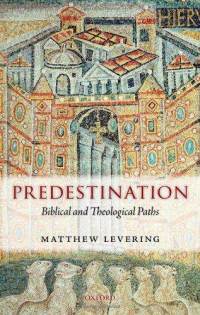
I just picked up a new book to read, and I am very excited to read it! It is by Matthew Levering, and is on the doctrine of Predestination. Here’s the biblio:

Matthew Levering, Predestination: Biblical and Theological Paths, (New York: Oxford University Press, 2011).

I have just finished the Introduction chapter, and it makes me want to read it even more! Here is what the summary of the book communicates on the back jacket:

Predestination has been the subject of perennial controversy among Christians, although in recent years theologians have shied away from it as a divisive and unedifying topic. In this book Matthew Levering argues that Christian theological reflection needs to continue to return to the topic of predestination, for two reasons. Firstly, predestination doctrine is taught in the New Testament. Reflecting the importance of the topic in many strands of Second Temple Judaism, the New Testament authors teach predestination in a manner that explains why Christian theologians continually recur to this topic. Secondly, the doctrine of predestination provides a way for Christian theologians to reflect upon two fundamental affirmations of biblical revelation. The first is God’s love, without any deficiency or crimp, for each and every rational creature; the second is that God from eternity brings about the purpose for which he created us, and that he permits some rational creatures freely and permanently to rebel against his love. When theologians reflect on these two key biblical affirmations, they generally try to unite them in a logical synthesis. Instead, Levering argues, it is necessary to allow for the truth of each side of the mystery, without trying to blend the two affirmations into one.

Levering pairs his discussion of Scripture with ecumenically oriented discussion of the doctrine of predestination through the ages using the writings of Origen, Augustine, Boethius, John of Damascus, Eriugena, Aquinas, Ockham, Catherine of Siena, Calvin, Molina, Francis de Sales, Leibniz, Bulgakov, Barth, Maritain, and Balthasar. He concludes with a constructive chapter regarding the future of the doctrine.

Sounds great, right?! Before I even finish reading this book, I am going to recommend it to you 🙂 . Alongside this one, you ought to also read Suzanne McDonald’s excellent book: Re-Imaging Election: Divine Election as Representing God to Others & Others to God. 

These issues, Predestination and Election continue to represent perennial discussion that seems to never go away; and seems to cause confusion and appeal to mystery like no other doctrine[s]. As Levering notes in his Introduction John Milton depicts this kind of discussion as one that shapes the demonic; note: […] in Paradise Lost, John Milton depicts the demons in hell as conversing ‘of providence, foreknowledge, will, and fate, / Fixed fate, free will, foreknowledge absolute, / And found no end, in wandering mazes lost.’ (Levering, p. 1)

Myk and I don’t take such an negative view of this doctrinal reality; here is what we wrote in our edited book, and in our last chapter which we co-wrote wherein we present 15 theological Theses that we hold. This Thesis, obviously, is the one that seeks to capture what Myk and I think about this doctrine[s]:

Thesis Five. Election is christologically conditioned.

This follows on as a corollary from the thesis above. Christ’s work is perfect and requires no supplement, such as the faith of an individual. In forms of Classical Calvinism the subjective elements of salvation have tended to dominate its theology so that an experimental predestination (syllogismus practicus) developed and faith was separated from assurance in an unhealthy manner as Christ was separated from his work. The resultant crises of faith and assurance threw believers back onto themselves and their own works for assurance, rather than onto Christ our perfect mediator and redeemer. Christ has been sanctified, and in his sanctification he has sanctified the elect in him. Believers find their subjective sanctification in Christ’s objective work, and not the other way round. This reflects the duplex gratiaCalvin made so much about and yet contemporary Reformed theology has tended to separate—through union with Christ flows the twin benefits of justification and sanctification.25

Thomas F. Torrance is instructive as he comments on Scottish Calvinist, John Craig’s approach to articulating what a christologically conditioned doctrine of election looks like; with a carnal and spiritual union providing its orientation:

Craig regarded election as bound up more with adoption into Christ, with union with him, and with the communion of the Spirit, than with an eternal decree. The union of people with Christ exists only within the communion of the redeemed and in the union they conjointly have with Christ the Head of the Church. . . . Union with Christ and faith are correlative, for it is through faith that we enter into union with Christ, and yet it is upon this corporate union with Christ that faith and our participation in the saving benefits or “graces” of Christ rest. John Craig held that there was a twofold union which he spoke of as a “carnal union” and a “spiritual union.” By “carnal union” he referred to Christ’s union with us and our union with Christ which took place in his birth of the Spirit and in his human life through which took place in his birth of the Spirit and in his human life through which he sanctifies us. The foundation of our union with Christ, then, is that which Christ has made with us when in his Incarnation he became bone of our bone and flesh of our flesh; but through the mighty power of the Spirit all who have faith in Christ are made flesh of his flesh and bone of his bone. It is only through this union, through ingrafting into Christ by faith and through communion with him in his Body and Blood, that we may share in all Christ’s benefits—outside of this union and communion there is no salvation, for Christ himself is the ground of salvation. . . . 26 27

Thus election is grounded in a personal union with Christ through his “carnal union” with humanity in the Incarnation, and our “spiritual union” with him through his vicarious faith for us by the Holy Spirit. Christ, in this framework, is known to be the one who elects our humanity for himself; by so doing he takes our reprobation, wherein the “Great Exchange” inheres: “by his poverty we are made rich.”

_______________________

24. Historical antecedents to such an approach in which a doctrine of God correctly shaped their doctrines of Christology and soteriology would include, amongst others, Richard St. Victor and John Duns Scotus. For both, Theology Proper was robustly Trinitarian, thus relational, personal, and pastoral.

25. See further in Johnson, chapter 9.

26. Torrance, Scottish Theology, 52–53.

27. See further in Habets, chapter 7.

-Taken from our book, Evangelical Calvinism, pp. 432-33

As you can see we are articulating our view of election, but this entails how we think of predestination as Christologically conditioned as well. For more depth you would need to read Myk’s personal chapter 7 on his Christologically Conditioned view of Election. We also hold to a Christological conditioned understanding of Supralapsarianism, which is our Thesis number 8. If I had more time I would share that one too, since it overlaps with this whole discussion (maybe another time).

As you can see from what I have shared, Myk and I follow some Scottish lines, some Barthian lines, some Torrancian lines, and hopefully some biblical lines. Our view follows from our commitment to a Depth Dimension hermeneutic which sees Christ, in principled ways, as the touchstone for exegeting all of Scripture’s depth and breadth. Having published a particular perspective on this, as Myk and I have, I look forward to being challenged by Levering in reading his conclusions, and how he gets there. What he writes might very well add depth and layers of nuance to my own perspective, and might even morph mine to one degree or another; one never knows—which is the exciting thing about studying such things, and growing in the grace and knowledge of Jesus Christ in this way.

Self-actualization, The Christianized Acceptance and Renaming of Sin: Calling the Crooked Straight

Can Sin be defined, theologically, as Self-actualization? If so, and I think so, then, no doubt much of our Western culture (and Eastern for that matter), and in particular, much of American (and Western) Christian ministry platforms are building their houses on sandy-land. Here is an example of what Self-actualization might mean for today’s winner and upwardly mobile movers:

Seeks to be a ‘way shower‘, cannot settle for mediocrity, always strives to reach greater plateaus, is self contemplative, and seeks to know even the mind’s shadows, doesn’t readily surrender to fear, sees the means as the important conquest, not the end. For the self-actualized there is no end, just a constant movement to expand and become and express more of Oneself! [Taken from The Center for Self Actualization, Inc.]

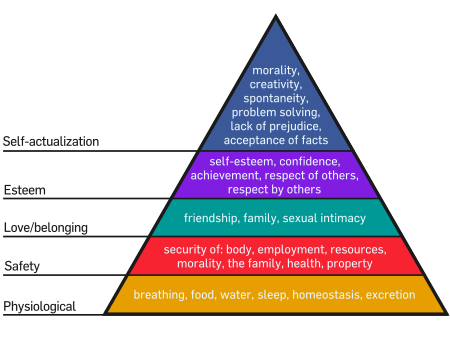
Or maybe, more famously Abraham Maslow’s hierarchy of Self-actualization might be more explicit and apropos:

Surely there is some truth, some pragmatic utilitarian reality to Maslow’s hierarchy, at least on a purely horizontal plane. But that is the point, right? We don’t live ‘purely’ on a horizontal plane, our  horizontal plane has vertical elevation and purpose that provides its ultimate shape and what it means to finally be ‘actualized’; if, that is, we are even willing to continue to use the language of actulization as a viable anthropological category for supplying us with what it means to be a human, and a successful one at that!

Maybe to get more to the point, and bring this closer to the American Evangelical home and ministry (because I know in the past and present this book is appealed to by leaders in Evangelicalism); what about that infamous book written by a Mormon The Seven Habits of Highly Effective People? Here are the Seven Habits:

Independence or Self-Mastery

The First Three Habits surround moving from dependence to independence (i.e., self-mastery):

  • Habit 1: Be Proactive

Take initiative in life by realizing that your decisions (and how they align with life’s principles) are the primary determining factor for effectiveness in your life. Take responsibility for your choices and the consequences that follow.

  • Habit 2: Begin with the End in Mind

Self-discover and clarify your deeply important character values and life goals. Envision the ideal characteristics for each of your various roles and relationships in life. Create a mission statement.

  • Habit 3: Put First Things First

Prioritize, plan, and execute your week’s tasks based on importance rather than urgency. Evaluate whether your efforts exemplify your desired character values, propel you toward goals, and enrich the roles and relationships that were elaborated in Habit 2.

Interdependence

The next three have to do with Interdependence (i.e., working with others):

  • Habit 4: Think Win-Win

Genuinely strive for mutually beneficial solutions or agreements in your relationships. Value and respect people by understanding a “win” for all is ultimately a better long-term resolution than if only one person in the situation had gotten his way.

  • Habit 5: Seek First to Understand, Then to be Understood

Use empathic listening to be genuinely influenced by a person, which compels them to reciprocate the listening and take an open mind to being influenced by you. This creates an atmosphere of caring, and positive problem solving.

  • Habit 6: Synergize

Combine the strengths of people through positive teamwork, so as to achieve goals no one person could have done alone.

Self Renewal

The Last habit relates to self-rejuvenation:

  • Habit 7: Sharpen the Saw

Balance and renew your resources, energy, and health to create a sustainable, long-term, effective lifestyle. It primarily emphasizes exercise for physical renewal, prayer (meditation, yoga, etc.) and good reading for mental renewal. It also mentions service to society for spiritual renewal.

Philosophically (and thus theologically through a Thomist synthesis, which I will need to discuss at a later date) all of this talk about self-actualization can be traced back to that Greek great, Aristotle. His notion of habitus, or habituating in certain kinds of behavior in order to shape an interior person that might be considered virtuous, successful, moral, or even upwardly mobile could be blamed for our culture that believes that Self-actualization is the only way to live an existentially fulfilling life. Maybe this mode of Self-actualization could be reduced and summed up to that all to familiar axiom of ‘fake-it-till-you-make-it’. So the focus is on the outside/in; it is on outward appearance, and it is this which counts as being a successful and effective person in our actualized age.

But what if all of this, this ‘Self-actualization’ is really just what the Bible calls ‘Sin’? John Webster reports how another theologian of import, Eberhard JĂźngel believes that this rather modern (with pre-modern and classical rootage) turn towards the Self-actualized self is really and simply just sin. Here is what Webster writes of JĂźngel; and within Webster’s commentary, he provides a quote from JĂźngel:

JĂźngel thinks of modern society as haunted, both theoretically and practically, by the image of the human person as achiever, by the axiom: ‘[W]ithout increased performance, no increase in the quality of life.’ His theological judgement on the image is that it reinforces that human compulsion to act (Zwang zur Tat) which is the essence of the disorder of human life. ‘Sin’is, simply put, the hopeless drive to self-realization: ‘amongst the worst human failures is the desire to realize oneself alone through one’s good acts, through one’s righteous action — whether it be only legalistic or even moral. The category of self-realization, which today is used in such an unreservedly positive sense, is more accurately to thought of as the quintessence of sin, according to the biblical understanding of the matter.’ The attempt at self-realization is condemned to failure precisely because humanity is essentially relational, …. Thus, in a passage typical of many others, JĂźngel writes:

[W]hat Holy Scripture calls sin is … the drive to have one’s own right prevail at the expense of others and in this way to be the one nearest to oneself. We have set out and understanding of righteousness as the ordering of richness of relations between those existing with one another in such a way that justice is done to all those included without their needing to seize if for themselves. Sinners, however, are characterized by a belief that they must and can seize their own right. Those who try to seize their own right take away the right of others. And precisely in this way they break out of the well-ordered richness of relations in which they have been included by God. Sin is the Godless drive away from the diverse relations of created life protected by God, and into relationlessness. [John Webster, Barth’s Moral Theology, 188.]

If what Webster writes, and JĂźngel thinks, is correct, and I think it is, then the trajectory of American culture in general, and insofar as Evangelical’s have imbibed this trajectory, in particular, is, again, on the sandy land of man’s own making—thus Sin!

As admirable as Stephen Covey’s Seven Habits might appear, even though he finally gets to others; he only first starts with the self. Even as apparently true as Maslow’s hierarchy of Self-actulization might appear it runs directly contrary to the ethic and direction that Christ’s kingdom does; remember this dominical teaching?:

25 “Therefore I tell you, do not be anxious about your life, what you will eat or what you will drink, nor about your body, what you will put on. Is not life more than food, and the body more than clothing? 26 Look at the birds of the air: they neither sow nor reap nor gather into barns, and yet your heavenly Father feeds them. Are you not of more value than they? 27 And which of you by being anxious can add a single hour to his span of life?[g] 28 And why are you anxious about clothing? Consider the lilies of the field, how they grow: they neither toil nor spin, 29 yet I tell you, even Solomon in all his glory was not arrayed like one of these. 30 But if God so clothes the grass of the field, which today is alive and tomorrow is thrown into the oven, will he not much more clothe you, O you of little faith? 31 Therefore do not be anxious, saying, ‘What shall we eat?’ or ‘What shall we drink?’ or ‘What shall we wear?’ 32 For the Gentiles seek after all these things, and your heavenly Father knows that you need them all. 33 But seek first the kingdom of God and his righteousness, and all these things will be added to you. ~Matthew 6:25-33

So Self-realization really equals Self-justification, or usurping godness for oneself. Doesn’t this remind you of this:

4 But the serpent said to the woman, “You will not surely die. 5 For God knows that when you eat of it your eyes will be opened, and you will be like God, knowing good and evil.” ~Genesis 3:4-5

The Christian view of justification, salvation, is that salvation is primarily and antecedently inacted by God in Christ. Salvation for the Christian isn’t a se, or internal to the person, a possession innate to the person, simply waiting to be activated through habituating in certain kinds of behavior and activating activity; Nein! Salvation for the Christian is extra nos, or outside of us; it is an alien righteousness, as Luther might quip. It is a life that is received, passively; a life that is only ‘given’ activity through the life of God. So the conclusion then is that we ought to ‘seek first the kingdom of God and his righteousness, and all these things will be added unto us’.

If you want to be successful in the pyramid of God in Christ’s kingdom, then understand that his kingdom inverts the pyramid of this world. If the American Evangelical church wants to be successful, then take up your cross and follow Jesus; be willing to lose your soul that you might find it in Christ.

Good Works, The Work of the Great Deceiver

I am starting to become less and less convinced that Christians, at least in America, actually struggle with things like I am about to highlight in this post. It seems as if a folkism has overtaken American Evangelicalism in a way that pragmatism and utilitarianism rues the day, and principle and doctrinal concerns no longer, for some reason are important—I am somewhat rabbit trailing from where I want to take this post. I hit on this because I think that what this post is going to talk about might be down on the pole of significance for many of us; in fact I think that American Evangelicalism, in general, has so imbibed our feel good pop culture that the concept of ‘good works’ and right standing before God really have no functional meaning for people’s daily lives and spirituality. We are so busy with everyday concerns, trying to make ends meet, watching TV, and entertaining ourselves to death; that serious reflection about doctrinal concerns—like the relation between good works and saved by faith alone—really have no place of import in our lives.

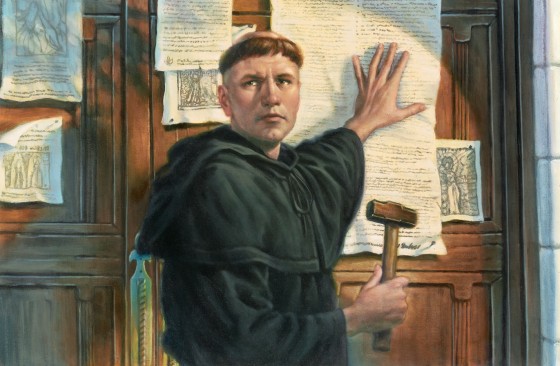
Nevertheless, for those who might be the exception to my sketch above, this post might mean something to you. As you might have already picked up, I want to bring up the issue of ‘good works’ in the Christian’s life. And in particular, I want to get more insight into what Martin Luther, the Reformer thought, who is primarily known for emphasizing sola fide, ‘faith alone’. Maybe though, maybe I am wrong about what I was getting at in my first paragraph above; maybe in fact good works for Christians are alive and well, maybe good works (whatever those are) are what provides salvation, psychologically, for so many of us. Maybe when we do good things we feel good before God (coram Deo), and maybe when we do bad things we feel guilty before God; so maybe that’s why we try to comfort ourselves by the good that we do, and brushing the bad under the good in a way that makes us feel ‘justified’ before God (and of course we attribute the good to the power of God in our lives, and thus we even feel more justified when we see our good works; in fact we start to look at our good works as the basis for our assurance of salvation). According to John Webster, Martin Luther would totally disagree with you—if you think your good works are a sign of your salvation or something—here is how Webster describes Luther’s view here:

[…] Luther’s doctrine of justification b grace through faith severs the bond between acceptance and self-realization which he found in scholastic anthropology; in effect, his moral ontology calls into question the notion that self-conscious, self-actualizing selfhood is anthropologically primary. Indeed, in a crucial phrase he notes how, in good works as traditionally understood (i.e. as ‘religious’ works), ‘the self has been set up as an idol’. He acutely sees that religious works, and the understanding of the human person through which their significance is expounded, have become an exercise in self-preservation; good works are in league with human egotism, and their consequence is accordingly the deepening of human depravity and not release from it. For such works have become ‘merely acts of appeasement and self-righteous attempts at self-salvation. Luther recognised the depth of the corruption of the self which attempts to turn all goods to itself’. The target of Luther’s critique is thus the prudential calculation of benefits which might accrue to the agent on the basis of certain kinds of moral performance; acts undertaken in anticipation of rewards are ipso facto disqualified as good works, because within them lurks the sinful, self-realizing ego. If the Christian is related to his or her good works ‘self-centeredly’, the result is that chronic inflammation of the self which is the curse of sin. [John Webster, Barth’s Moral Theology, 163.]

This seems like a dilemma! If good works aren’t the sign of my salvation; if good works can’t provide me with assurance of salvation, then what or who can? If good works which are done by natural Pelagian impulse only serve to really further my own self-deception about how sinful I am—as T. F. Torrance would say ‘all the way down’—then I am of all men most to be pitied.

Of course the answer is ‘faith’, the faith of Christ at work in us by the Spirit. This is the ground of assurance, it is the faith of and the faith in Christ that resolves the dilemma. Good works, the ones we have been recreated in, in Christ (Eph. 2:10); are a result of the overflow of relationship that we already have with Christ. We don’t look to our good works as if those are our ‘Yes’ before God, He already said ‘No’ to them at the cross; instead, with the Apostle Paul we look to Christ where ‘all the promises of God find their Yes in him. That is why it is through him that we utter our Amen to God for his glory’ (II Cor. 1:20).

What Luther’s emphasis can provide is a way out of a moralistic Christian spirituality that can only produce introspective navel gazing Christians who ultimately are driven by angst, instead of the power of God, which is the true Gospel of Jesus Christ; the one that we are not ashamed of (Romans 1:16).

Barth’s Contradiction of Evangelical Theologies through the Gospel

Have you ever wondered what explaining the Gospel entails? Karl Barth wondered such things, and gave voice to what he thought was the best way to do such; explain the Gospel that is. Here is how he thinks we should do that:

[T]o explain the Gospel is to define and describe the nature, existence and activity of God as Creator, Reconciler and Redeemer, the grace, the covenant and the work of reconciliation with all that these include and in the living terms of the manifestation, life, death and resurrection of Jesus Christ. It is to do all this, according to the measure of God’s Word, in the constantly changing forms of human consideration, thought and expression. It is to introduce this whole occurrence onto the human scene in a way in which it is not knowable but at least intelligible and perspicuous. It is to cause it to be told to men in human terms. The vital thing in so doing is that the whole content of the Gospel in all its elements and dimensions should be allowed to be its own principle of explanation, that under no pretext or title should alien principles of explanation in the form of metaphysical, anthropological, epistemological or religio-philosophical presuppositions be intruded upon it, that it should not be measured by any other standards of what it is possible than its own, that answers should not be given to any other questions than those raised by itself, that it should not be forced into any alien scheme but left as it is and understood and expounded as such. [Karl Barth, CD IV/3, p. 849 cited by John Webster, Barth’s Moral Theology, 146-47.]

So for Barth, the Gospel is not contingent on man or woman’s explanation; instead, we are contingent upon it, the Gospel, Jesus. For Barth, we don’t possess the Gospel, the Gospel possesses us; it gives itself to us, with its own categories of explanation. It is this reality that shapes Barth’s view of apologetics, analytical theology, etc. And it is probably this reality that Evangelical theology and Evangelicals find so repulsing about Barth; his approach counters the rationalist underbelly upon which Evangelical theologies, in general, rest. For Barth a proper Dogmatic order requires that God and knowledge of God in Christ precedes and contradicts our arguments for him.


Part 2. The Impasse, God’s Sovereignty & Human Responsibility: God’s Freedom for Himself as the Sustaining Freedom For Us, For Him

Addendum: This will be my last installment in this mini-series. If you are interested in finding out further how Barth might frame this issue then pick up John Webster’s book ‘Barth’s Moral Theology’ and give it a read.

This is the next installment in my ongoing series on God’s Sovereignty and Human Responsibility. As we all know this issue has embroiled us in, it seems, a never ending battle in-house amongst Christians. I want to suggest though that this ongoing battle could be elided, and should be, if we adopt a truly Trinitarian, and genuinely Christian methodology in attempting to engage such tenuous questions like these one’s (i.e. God’s Sovereignty & Human Freedom) give rise to. Such is the way that Karl Barth and John Webster provide for us; an approach that moves beyond the impasse that philosophical scholastic theology has given us, and onto a mode of theological discourse that truly gets us through the bog that so many of us have grown accustomed to. Indeed, it is this customization amongst the Western Christian to such categories and emphases, that I am afraid will keep some of you from seeing what Barth presents (through Webster) as the salvation from this unending abyss (e.g. the classic debate under consideration in these posts of mine) that it actually is. Nevertheless, we will move boldly forward and enter into the life giving waters that truly provides us an occasion to worship our God who is Sovereign, free, loving, gracious, and inclusive of us in his kind of life; indeed, it is his kind of life where human freedom/responsibility can finally flourish. Here is what Webster says that Barth says:

In concrete terms, this means that, for Barth, God’s freedom is his freedom as Father, Son and Holy Spirit. ‘God’s freedom is not merely a limited possibility or formal majesty and omnicompetence, that is to say empty, naked sovereignty.’ Rather, ‘God’s freedom is the freedom of the Father and the Son in the unity of the Spirit … God’s own freedom is trinitarian.’ Talk of God as free is, therefore, not talk about some quality of God’s life anterior to his trinitarian revealedness, nor is it a matter of making God’s name as Father, Son and Spirit into a cipher for abstract, absolute liberty. The ‘essence of God which is seen in His revealed name is His being and therefore His act as Father, Son and Holy Spirit’; and so God’s freedom is a predicate of his trinitarian being. Crucially, for Barth, it is as this triune God that God is free for us. Because God is Father, Son and Spirit, his sovereign freedom is neither abstract nor monadic, but ‘relational freedom’. And further, because God’s immanent trinitarian relatedness is not closed but self-giving in the majestic acts of the incarnation of the Son and the sending of the Spirit, it is a freedom which grounds and does not suppress the creature’s freedom. As the trinitarian God, God is ‘partner to himself’; and ‘this understanding of God as a partner in himself has serious consequences for the understanding of humanity as partner. That humanity is elected by this God in no way means humanity’s disqualification. Rather, humanity is elected by one who knows partnership intimately, and whose intention’ is to set humanity on its feet. [John Webster, Barth’s Moral Theology: Human Action in Barth’s Thought, 106-07.]

At the end of the day, and in summary, human freedom is what we were re-created for in Jesus Christ, for God. It is in this nexus of relationship, being brought into the intra-triune life of God that humanity has space to be human, and free; but as you probably are starting to see, a human freedom of the kind being described here is one that is limited and constrained from within God’s life. Thus, to try and conceive of a human freedom (and thus responsibility) from some sort of autonomous construct of human freedom that somehow has an abstracted ontology and life of its own apart from the freedom present, and only present, in God’s life, and for God’s life, within the divine union and communion represents a non-starter (at least for Christianly revealed discourse). If this is so, no wonder we have had the debate we have had for so long; Christians have unwittingly (and wittingly) been participating in philosophical diatribes and abstractions of which is contrary and antagonistic to the kind of apparatus and categories that God has provided for us to consider such things through, through His Self-revelation in His dearly beloved Son.

God’s Sovereignty and Human Freedom/Responsibility cannot be framed in competition with one another; as the classical debate does. This discussion cannot flow from an innate dualism, the kind made and sustained by human force. Instead, if we are going to have fruit going forward we will and must start where God does, in His own life in Christ for us by the Holy Spirit’s presencing work. There is no other kind of freedom apart from the kind that God has in His own life. If we are going to be truly free then we must participate in God’s life, and as we do, we will have the kind of orientation God has always intended for us in Christ, to be for Him and not against Him.

This post begs some questions. We will get to those in the next installment (which might be my last installment in this short series). We will, with Webster’s and Barth’s help, discuss the Holy Spirit’s role in providing the kind of relational context necessary in order for human freedom/responsibility to flower in the way it only can, in Christ.

Here are the other posts I have done in this series:

1

2

3

A Gap Post: On Human Freedom

This isn’t the “next post” I had in mind in my series on God’s sovereignty and Human responsibility; yet, the quote I am going to provide contributes to layering more depth of context in regard to the kind of modern conception of human freedom and thus responsibility that is counter to what I will be proposing as a genuinely Christian understanding in its stead. Like I just said this post will be a short quote provided by John Webster; he is quoting Charles Taylor, who is commenting on Hegel’s thought. Here is the quote, I bet this will resonate with you and your experience of how you might conceive of human freedom and/or how your neighbors do; here it is: “the

modern notion of subjectivity has spawned a number of conceptions of freedom which see it as something men win through to by setting aside obstacles or breaking loose from external impediments, ties, or entanglements. To be free is to be untrammelled, to depend in one’s action only on oneself. Moreover, this conception of freedom has not been a mere footnote, but one of the central ideas by which the modern notion of the subject has been defined, as is evident in the fact that freedom is one of the values most appealed to in modern times. At the very outset, the new identity as self-defining subject was won by breaking free of the larger matrix of a cosmic order and its claim.” [Charles Taylor, Hegel and Modern Society, p. 155 cited by John Webster, Barth’s Moral Theology, 122]

This rings true for me as I look out on the world, and even in my own life. There is this constant pursuit, it is the American dream, to be set free and delivered from shackles of financial bondage, to be master of my own universe, to construct an imaginary world of my own making that nobody else has any say in but me. Of note, even in this quote, and behind it, what is clear is that a modern conception of freedom is seeking to recreate a relational network where “I” am at the center, “I” am calling the shots; and this then is what it means to be free, over and against the other. It is interesting though, human freedom is always limited by other humans; even if we construct a world of our own (supposedly), it is still in a world amongst others, and thus we must construct our own worlds (where we think we are free) by way of negotiating that freedom in relation to the other people around us, who are trying to achieve this same kind of navel gazing freedom. So our freedom, no matter how hard we try is always delimited by someone else’s freedom; and so forth.

This helps set up context as we jump into a discussion on God’s Sovereignty and Human Responsibility/Freedom. Stay tuned for the next post where we will dive head first into some theological definitions and descriptions of what God’s Sovereignty and Human Freedom/Responsibility look like when thinking from a Christ conditioned, Christ centered orientation.

Part 1. The Classical Calvinists V. The Arminians: An Introduction to the Problem (Divine Sovereignty & Human Responsibility)

This post represents the first of many (I think, we’ll see how that goes) on engaging the issue of God’s Sovereignty and Human Responsibility in the realm of salvation. I had intended on getting into the text of John Webster’s Barth’s Moral Theology: Human Action in Barth’s Thought, in this post; which is where I will be endeavoring to explicate a way beyond the impasse represented by the polarizing ends of either framing this issue of salvation in terms of God’s sovereignty and/or Human Responsibility, as if these can be pulled apart this way (which as we will see, they really can’t, or shouldn’t be). But given the breadth and depth of this topic, I think this post will have to contain itself with some necessary ground clearing that will provide a little more context to what I will be intending to resolve, or reframe. So this post will be just that, an exercise in ground clearing through problematizing the issue at hand: i.e. God’s Sovereignty in salvation and Human Responsibility just the same.

Thus, the following will be a minimalist comparison, and abductive exercise in teasing out the differences that have provided fuel for the fire of the long contested debate that has inhered between those rascally Calvinists and curmudgeonly Arminians over the last few centuries. In order to accomplish this task what better place to go than the documentary source of the debate in the first place; to Holland we must go! We turn then to the 5 Articles of the Remonstrance which Jacobus Arminius penned (by and large), which have provided the space for Arminian theology to grow in; and then the response from the Calvinists, their Canons of Dort (which later became popularized by the acronym TULIP). We will not look at the whole of either document (although I will have linkage to both of them so you can survey them in total for yourselves, if you like); instead, for our purposes, I will only be comparing what I deem the most salient points of contact for us. That is, we will pay attention to the ‘points’ that illustrate the difference (or maybe the similarity, surprisingly in some ways) that has provided the kindling for the fire that continues to burn between the Calvinists and Arminians. Here is the first article of the remonstrance:

Article 1.

[Conditional Election – corresponds to the second of TULIP’s five points, Unconditional Election]

That God, by an eternal and unchangeable purpose in Jesus Christ his Son before the foundation of the world, has determined that out of the fallen, sinful race of men, to save in Christ, for Christ’s sake, and through Christ, those who through the grace of the Holy Spirit shall believe on this his son Jesus, and shall persevere in this faith and obedience of faith, through this grace, even to the end; and, on the other hand, to leave the incorrigible and unbelieving in sin and under wrath and to condemn them as alienated from Christ, according to the word of the Gospel in John 3:36: “He that believes on the Son has everlasting life: and he that does not believe the Son shall not see life; but the wrath of God abides on him,” and according to other passages of Scripture also. [See all the Articles, here]

So the emphasis falls on those who ‘shall believe’ as the basis of God’s choice of them in election. Old school theologian, and Arminian theologian, Henry Thiessen states the logic of this article very clearly when he writes,

[…] It was an act of grace [election], in that He chose them “in Christ.” He could not choose them in themselves because of their ill desert; so He chose them in the merits of another. Furthermore, He chose those who He foreknew would accept Christ. The Scriptures definitely base God’s election on His foreknowledge: “Whom He foreknew, He also foreordained, … and whom He foreordained, them He also called” (Rom. 8:29, 30); “to the elect … according to the foreknowledge of God the Father” (1 Pet. 1:1, 2). Although we are nowhere told what it is in the foreknowledge of God that determines His choice, the repeated teaching of Scripture that man is responsible for accepting or rejecting salvation necessitates our postulating that it is man’s reaction to the revelation of God has made of Himself that is the basis of His election…. [brackets mine] [Henry C. Thiessen, Lectures In Systematic Theology, (Grand Rapids, MI: Wm. B. Eerdmans Publishing Company, 1971), 344.]

This could be a more contemporary rendition and elucidation of what was originally written in the first article of the Remonstrant back in 1610. So God’s election to salvation, in this schema, is based on his ability to look down the corridor of time, see those individuals who will respond in the affirmative to His call of salvation; and then it is on this basis, that God is said to elect these individuals. God’s election is contingent on the choice of the person, God’s election in salvation is grounded in the human being’s Yes or No to Him.

And then the seventh article, in response, from the Canons of Dort:

Article 7: Election

Election is God’s unchangeable purpose by which he did the following:

Before the foundation of the world, by sheer grace, according to the free good pleasure of his will, God chose in Christ to salvation a definite number of particular people out of the entire human race, which had fallen by its own fault from its original innocence into sin and ruin. Those chosen were neither better nor more deserving than the others, but lay with them in the common misery. God did this in Christ, whom he also appointed from eternity to be the mediator, the head of all those chosen, and the foundation of their salvation.

And so God decreed to give to Christ those chosen for salvation, and to call and draw them effectively into Christ’s fellowship through the Word and Spirit. In other words, God decreed to grant them true faith in Christ, to justify them, to sanctify them, and finally, after powerfully preserving them in the fellowship of the Son, to glorify them.

God did all this in order to demonstrate his mercy, to the praise of the riches of God’s glorious grace. [see in full the Canons of Dort here]

In contrast, then, to the Remonstrance; the Calvinists, the Canons of Dort make clear that they believe that God’s choice of humanity is not contingent on the individuals who choose Him. Instead, salvation, for the Dortians is grounded in God’s choice of particular, and thus ‘elect’ individuals. The emphasis is on God’s choice and not man’s or woman’s.

Summary

Hopefully this has been an effective exercise in highlighting the historic differences between the classical Calvinist and Arminian distinctions on this highly debated topic. In the next post I will resummarize this debate, and use this as the backdrop towards a solution to this conflict that is provided through the grammar and theo-logic of Karl Barth and John Webster. For the classic Calvinist and Arminian salvation is either based solely on God’s choice or Humanity’s. But the reality is, is that it can be both; and the both can still all be grounded in God’s choice without denigrating the Human choice and responsibility therein.

Introducing a Series on: God’s Sovereignty & Human Responsibility, Reframing the Divide

I think I am going to try and do (as time suffices) a series of posts on human
freedom, or more popularly known as ‘human responsibility’; which is usually placed in contrast with God’s sovereignty. It is this duality that has fueled debate in the Christian church about such things starting with Augustine and Pelagius (and John Cassian after that), and then again with Calvin and Pighius, and later and more contemporaneously with the whole classical Arminian and Calvinist debate. People who take Christian ideas seriously—and even those who don’t, really—this debate remains a central point of consternation to those of us who claim the name of Christ (even my describing this, using the language of ‘claim’ the name of Christ could be read a certain way because of this debate). Are we morally free, in ourselves (with the Holy Spirit’s help of course), to accept or reject Christ; do we have deliberative and autonomous power to make such a choice? Or does God irresistibly make the choice for us; thus rendering our subjectivity and individuality moot in light of God’s overpowering (sovereign) objectified life?

I think there is a better way to construe this issue; a way that sees the classical debate as a secondary issue, one that shouldn’t have the power to shape this issue the way that it does. Indeed, I think this starts at the wrong spot, so it ends us at the wrong spot; illustrated by the ongoing irretrievable debate, that hitherto seems to leave the whole lot of us in an abyss to deep to traverse. I think that this classical debate has been given too much shrift, as if it has adequate material categories to provide conceptual hangers strong enough to hang our theological hats on; that is, relative to the issue of ‘human freedom’.

Do we have ‘freedom’? That is the question. The answer, I think, when properly framed—in Christ, no doubt!—will be surprisingly profound, and re-foot this kind of classical debate, around such things, on the solid ground, the solid rock of Christ’s life. And since this is what the wise person does (i.e. builds their house on the rock of Christ’s life, and not the sandy land of man-ward ways cf. Mt 7), we will proceed thusly.

The way I will seek to provide trajectory toward answering this question will be to work through one little section of John Webster’s book Barth’s Moral Theology: Human Action in Barth’s Thought. I am going to try and explain this in a way that is accessible to folk who are not familiar with the lingo of theological code, but at the same time I will expect that you the reader will do due diligence in thinking deeply with me about this rather salient issue. Really, the answer to this is pretty simple; I think more simple than people usually want it to be.

Over or Under Scripture

My friend, Myk Habets linked to a quote provided by Chris Spinks over at the Wipf and Stock editors’ Running Heads blog. The quote comes from Lutheran theologian Robert Jenson, and he is referring to a distinction he sees accruing between what he calls ‘guild exegetes’ and the ‘churches’ theologians’. What he is noticing highly resonates with me, maybe it will for you too; he writes:

No reading of Scripture as Scripture in fact proceeds without theological presumptions. Since many guild exegetes pay no attention to this point, the theology that goes into their exegetical mill is subliminal and almost always childish; and so what comes out is the same. And of course, those scholars who have ceased to read Scripture as Scripture are then simply engaged in a possibly interesting antiquarian enterprise, rather like excavating nineteenth-century pots in Manhattan. [quote and biblio info can be found here, from the original post by Chris]

This is important. If you are going to read scripture as a Christian, then read scripture as Christian. I am afraid that Christians—the ones who actually read scripture—confuse the work that New Testament historians do with a theological reading of scripture. This is my own experience, growing up as an Evangelical; we inherited the rationalist ways of reading scripture that are naive to the fact that in fact scripture is the place that God, without apology, has decided to encounter us, in Christ, as Sovereign Lord. This reminds me of something that Martin Luther pressed; the distinction between the ministerial and magesterial approach to scripture. Do we sit under it, or over it. Jenson would be asserting that the guild exegetes sit over it, and that the churches’ theologians sit under it (or they should) by way of attitude, posture, and thus methodology.