
The Middle East is burning, indeed, the world in which we live is burning! Sometimes it is easy for the theologian or biblical exegete not to take notice of the world around them; sometimes the only world this kind of person knows is the world of books that surround them, and the book that stands open before them most immediately (and the world that these books conjure up for the reader). But there is contact between the materiality of the theological books, the Bible, and the contemporary world in which we live—I don’t necessarily want to get into this reality much further, my only point by opening up like this is to suggest that the Christian thinkers and 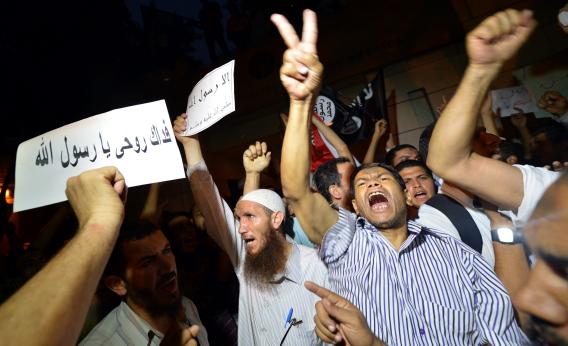 readers amongst us ought to try and consider how all of the theological reflection we do provides a cipher through which to engage and interpret current day events that are impacting us to one degree or another (especially dependent upon where someone is regionally located). Ultimately, if we are indeed Martin Luther’s theologian’s of the cross, we have this kind of cruciform template through which to try and read and understand the God-world relation in light of the current events that we are most particularly experiencing, at the moment, in the Middle East. So the rest of this post will be an on the fly (so blogging) reflection, by me, on the Middle East, and what kinds of lenses Christians, in America often interpret such things through.
As I mentioned above, there are ways to try and get at the events unfolding in the Middle East right now. I would assert, from the out set that the most Christianly way to try and read God’s interaction with the world in the Middle East, in particular, must be through the cross of Christ—this is the primary theological lens that will make sense of how a loving God could preside over such chaos and murderous mayhem without apparently acting in the midst of it. This must be the frame for how we think about such things or we will end up with a philosophically abstract God like David Hume’s; if you don’t know his little anecdotal rendition of his conclusion, here it is:
“Epicurus’s old questions are still unanswered: Is he (God) willing to prevent evil, but not able? then he is impotent. Is he able, but not willing? then he is malevolent. Is he both able and willing? then whence evil?”
But this is not the god that Christians worship, we worship the God revealed in Jesus Christ whose power is displayed in apparent weakness; the kind that takes form in a cross shape.
But I want to go even more idiosyncratic in regard to how Christians in America are interpreting the events currently unfolding in the Middle East. A popular way to consider and interpret the realities on the ground in North Africa and the Middle East is through the lens of biblical prophetic (construed in a wooden literalist way). So scripture, in this kind of approach, is overlaid with a geo-political lens through a modern day pesher; so that every little nuance and event that is unfolding currently and most particularly in the Middle East and Africa is somehow part of the end times schema prophesied of in the Old Testament scriptures. The upheaval and chaos we are currently experiencing in the world is read through this kind of biblical prophetic lens with the guiding assumption that all of this rage is finally directed at the nation of Israel (and America then as Israel’s primary supporter, at at least she was historically). This kind of American biblical prophetic geo-political reading (dispensationalism) believes that the nation of Israel is the prophetic key for understanding and interpreting scripture, and thus all of this chaos in the Mid-East will finally eventuate in Jeremiah’s (chapter 30) “Jacob’s Trouble.” So this represents another and primary way that American Christians, in particular, are reading the events currently unfolding in the Mid-East.
I have quickly surveyed two different ways that Christians might be interpreting the realities on the ground in the Mid-East and North Africa (and the rest of the globe for that matter). There seems to be a kind of platonic split between these two approaches; we have the spiritual way to read things (like through the cross of Christ), and then we have the physical-literal way to read the events unfolding in the Mid-East (like through the American dispensational mantle). And yet I don’t think the physical and spiritual can be read in disjointed ways, they must be read in integrated ways; at least that’s what the analogy of the incarnation requires. The spiritual and physical are one reality, integrated wholes, and thus we ought to consider the physical realities inextricably related to spiritual realities. But these realities are only related to each other in Christ, and so we must start with Christ (not the nation of Israel or America) as the mode through which we see reality integrated. If we do this we won’t allow geo-political realities to high-jack a truly Christian reading of things. If we start with Christ we will read all of this through the concrete particularity of God’s life revealed in Jesus Christ on the cross (cf. Phil. 2:5ff); we will, in contrast to David Hume, understand that God has acted and is acting in his salvation history that is shaped by his cruciform-Triune love. Does this mean that we, as Christians, can no longer be familiar with geo-political issues? No, of course not! Does this mean that God has not given a prophetic apocalyptic backdrop through which we ought to understand the things currently unfolding in the Mid-East and North Africa? Of course not! What it means is that we will, as Christians, understand that God’s love in Christ is redemptively active in these events, and that through the death and chaos his life has risen once and for all providing the hope and perspective that we all need as we live through these last days (which started at Christ’s first coming) of salvation history. He’s not impotent, he’s just impotent by the world’s standards (which by the way are the standards that have been causing all of the un-rest in the world!). So …
7 For we live by faith, not by sight.
See I told you this post would be rather random and off the top.