A Psalm for the Dark Night

Where is God? Why doesn’t he care? Why does he let me go through these dark shadows of existence? There is a deep waning in what appears to be his absence. As if ‘greater are the circumstances of life, than he who is at the right hand of the Father.’ This is what the serpent whispers into the ear-gate as I continue to sputter in what seems to be the darkness of the abyss. Where are you, O Lord? Why have you abandoned me? It seems like your cross, rather than bringing light, only brings darkness in the torment of my soul. Why do the evil seem to flourish, whilst those in Christ are left to wax and wane in the midnight hours. Indeed, the dark soul of the night seems to circumscribe and eclipse even the sunshine of the noon day. Where art thou, O Lord? My body shivers with a crippling anxiety, an angst that pulsates through my very being. And yet am I not a child of the living God? Why have you forsaken me, O Lord? While your Word is a lamp unto my feet and a light unto my path, it seems as if a bushel has been placed over your Word, such that all I can do is trip and fall over my own two feet. My soul is in despair, O Lord! How much longer until you roll the heavens of bronze back like a scroll; how much longer till you release me from these black hours of my daily life? My breath is scorched by the pain of my own agony. My fleeting thoughts seem to be what life has become. Please, Lord, never leave me or forsake me. You promised you wouldn’t, but then where are you now? In my greatest hour of need it is as if you are hidden behind a horrible decree that keeps you from understanding that my frame is but dust. Where art thou, O Lord? If this anguish continues to consume me, I am sure my everlasting bed will be with the earth worms of the blighted soil. Why is this happening to me, O Lord?

Take heart, little child, I have overcome this world. Your momentary anguish now, shall be and has been swallowed up by the very ardor of my Holy life. I remember your frame is as dust, as is mine now; even glorified at the Right hand of our Father. I am your hope, in the midst of the darkness; I am your power in the midst of your greatest weakness. I am carrying you now in the bosom of our Father. You feel absence, but in the economy of my life for you, that is what me holding you ever more tightly comes to feel like. Your feelings might betray you this night, this day, this season of time, but I will never leave or forsake you. I see you trembling, even now. I trembled and quaked in the manger, in the garden, on that old rugged cross, even for you; even as I had you with me in those dire moments of the parched life. But just as I had you with me in those moments, just as I was you and for you in those moments of despair, even now I am with you as the risen One. I have not forgotten you; au contraire! I have brought you up with me, in the ascension into the heavenly places. Whilst you continue to inhabit the body of death, I inhabit the body of everlasting life and eternal life for you; I have reversed the curse, and the very body you experience as death now, will finally be raised in consummate exaltation, just as my body of death was for you. And this resurrected life, this recreated life I bring to you even now, even in the midst of your waning moments, by the Holy Spirit. I am closer to you than you are to yourself. Be not afraid, little child.

‘The Hallucination of Divine Immutability’ and Prayer

God’s “Constancy,” as Barth refers to his preferred term for Immutability, is a key doctrine in regard to God’s constant steadiness of ousia (being), as Father, Son, and Holy Spirit (hypostases). But when a notion of immutability is derived from the classical Greek philosophers rather than what is Self-revealed in God in Christ, we end up with a notion of godness that ends up having no correlation between the living God and a god of phantasm. Below, Barth is driving this point home as he relates it to a theology of prayer.

The objection that God cannot hear man’s prayer without as it were “losing face,” without abandoning Himself in some sense to the creature, fades into nothingness when seen in this light. If ever there was a miserable anthropomorphism, it is the hallucination of divine immutability which rules out the possibility that God can let Himself be conditioned in this or that way by His creature. God is certainly immutable. But He is immutable as the living God and in the mercy in which he espouses the cause of the creature. In distinction from the immovability of a supreme idol, His majesty, the glory of His omnipotence and sovereignty, consists in the fact that He can give to the requests of this creature a place in His will. And does He not do this in profoundest accord with Himself by doing it precisely where in the creation He is concerned with Himself, His beloved Son and those who are His? It obviously takes place in complete faithfulness too Himself when He lets the creature, in its unity with Himself, participate in His omnipotence and work, in the magnifying of His glory and its own salvation, by commanding it to ask and hearing its requests, and when He truly gives it a place at His side in the kingdom of grace and the kingdom of the world. God cannot be greater than He is in Jesus Christ, the Mediator between Him and man. And in Jesus Christ He cannot be greater than He is when He lets those who are Christ’s participate in His kingly office, and therefore when He not only hears but answers their requests. And therefore it is not an insolent but a genuinely humble faith, not a particularly bold but simply and ordinary Christian faith, which is confident and assumes that God will grant what it asks, indeed that He has already done so even as it asks. This faith is not, then, an additional and optional achievement for religious virtuosos. It is absolutely obligatory for all those who want to pray aright. Any doubt at this point is doubt of God Himself, the living God who in Jesus Christ has entered into this fellowship and intercourse with His creature. Any vacillation or questioning is the horrible confusion of God with that immovable idol. The worshipper of the idol must not be surprised if he calls upon it in vain. But true reverence and humility before God, and real submission to His will, are to be found when man adopts his allotted place in that fellowship with God, when he enters into that intercourse with Him, when he takes quite seriously acceptance of His command and promise, and therefore when he is no less certain of the hearing of his request than of the God to whom he turns. For this God is not only occasionally but essentially, not only possibly and in extraordinary cases but always, the God who hears the prayers of His own.[1]

The so-called ‘classical theist’ (a very modern term, by the way) would kick hard against these goads. Even so, the case remains that the living God will not be circumscribed by the profane categories of human machination. If the Christian is genuinely committed to the ‘Scripture Principle,’ and its attested reality in Jesus Christ, then what Barth is saying should resonate deeply with the Christian heart of hearts. We worship the God who is Father of the Son by the Holy Spirit’s bonding fellowship of eternal koinonia and Self-giving, one for and in the Other, love. Not only has God spoken, and doth speak, but He also listens to and hears our prayers, as if ascending incense wafting over His triune nostrils. If He won’t listen to us as our Father, who really will? What a hope the Christian has. We are never alone. Our God, as Father of the Son by the Holy Spirit who He is, will never leave or forsake us! amen

[1] Karl Barth, Church Dogmatics III/4 §53 [109] The Doctrine of Creation: Study Edition (London: T&T Clark, 2010), 102–03.

The Father’s Loving Discipline

4 You have not yet resisted to the point of shedding blood in your striving against sin; 5 and you have forgotten the exhortation which is addressed to you as sons,

“My son, do not regard lightly the discipline of the Lord,
Nor faint when you are reproved by Him;
6 For those whom the Lord loves He disciplines,
And He scourges every son whom He receives.”

7 It is for discipline that you endure; God deals with you as with sons; for what son is there whom his father does not discipline? 8 But if you are without discipline, of which all have become partakers, then you are illegitimate children and not sons. 9 Furthermore, we had earthly fathers to discipline us, and we respected them; shall we not much rather be subject to the Father of spirits, and live? 10 For they disciplined us for a short time as seemed best to them, but He disciplines us for our good, so that we may share His holiness. 11 All discipline for the moment seems not to be joyful, but sorrowful; yet to those who have been trained by it, afterwards it yields the peaceful fruit of righteousness. -Hebrews 12:4-11


I was just reflecting on this passage tonight. As I’m going through a particular trial right now—some of it having to do with my personality and the way I’m wired—I was thinking about how the LORD might be using this literal fire in my life right now. There are certain areas in my life that have been unhealthy, I think. That I have been living in an undisciplined way in certain aspects of my life; that I have been allowing certain pet sins to go unchecked and unmortified; and that the LORD as a faithful and loving heavenly Father only allows His children to stay wayward in certain ways for so long, then He acts. But He doesn’t act with vindictive, but with the heart of a Father for a son or daughter that He has unmatchable love towards. And so, in His ways that aren’t our ways, He brings discipline into our lives in ways that might, in the moment seem like a touch of hell. Of course, it isn’t a touch of hell, but in fact, and instead, it is Christ’s death, which is greater than hell, that we come to experience as sons and daughters of the living Father. Nevertheless, this taste of Christ’s death can and does feel precisely like hell, at points. And yet as the author of the Hebrews, by the Holy Spirit, is noting: God’s ‘scourging’ reflects His deep Fatherly love for us; even though in the moment it might ‘feel’ like He hates us. He is able to reverse this ‘scourging’ in such a way, and at such a time (usually at the point that you feel beyond capable) that we come to recognize that He loves us just as much as He loves the Son who first died for us, that we might die, and then live with Him. Part of the Father’s discipline of us is what Paul identifies in II Corinthians 4:10 as: “always carrying about in the body the dying of Jesus, so that the life of Jesus also may be manifested in our body. For we who live are constantly being delivered over to death for Jesus’ sake, so that the life of Jesus also may be manifested in our mortal flesh. So death works in us, but life in you.” It is this reality of Christ’s death in us, by the Spirit, that the reality of Christ’s life becomes ever more effervescent and apparent as we grow and walk with Him as maturing sons and daughters of the eternal Father.

I feel like I’m on the ‘death’ side of this dialectic right now. It is not fun, and yet the Father is being the Father. He remembers our frames are but dust (apparently dust is a lot sturdier than I realized, or had hoped for), and thus takes us as far as a wise Father knows He can before it is finally too far (and that is a statement of faith). God isn’t the punisher, but the Father; and as such, He disciplines so that we’ll look more and more like the ground of our life in the eternal Son, Jesus Christ. As a corollary, He also knows each one of us intimately. In other words, He knows how to work the soil of our lives in such a way that it is tailored to who we are as individual members of the body of Christ. This is why when Peter is wondering about John’s future vis-à-vis his, Jesus says the following to him:

18 Truly, truly, I say to you, when you were younger, you used to gird yourself and walk wherever you wished; but when you grow old, you will stretch out your hands and someone else will gird you, and bring you where you do not wish to go.” 19 Now this He said, signifying by what kind of death he would glorify God. And when He had spoken this, He *said to him, “Follow Me!”

20 Peter, turning around, *saw the disciple whom Jesus loved following them; the one who also had leaned back on His bosom at the supper and said, “Lord, who is the one who betrays You?” 21 So Peter seeing him *said to Jesus, “Lord, and what about this man?” 22 Jesus *said to him, “If I want him to remain until I come, what is that to you? You follow Me!” 23 Therefore this saying went out among the brethren that that disciple would not die; yet Jesus did not say to him that he would not die, but only, “If I want him to remain until I come, what is that to you?” -John 21:18-23

Each one of us has a different story being told through us of God’s poetic work of re-creation that first took place in the one for the many, Jesus Christ. Peter’s story, and the way the Father through the Son by the Spirit was working in Peter’s life would end up looking completely different from the way He ended up working in John’s life, in regard to their trajectories, and even their deaths. I can’t help but think that Jesus didn’t have Isaiah’s teaching in mind, in regard to the way that Yahweh works sensitively per the “soils” He has before Him:

23 Give ear and hear my voice,
Listen and hear my words.
24 Does the farmer plow continually to plant seed?
Does he continually turn and harrow the ground?
25 Does he not level its surface
And sow dill and scatter cummin
And plant wheat in rows,
Barley in its place and rye within its area?
26 For his God instructs and teaches him properly.
27 For dill is not threshed with a threshing sledge,
Nor is the cartwheel driven over cummin;
But dill is beaten out with a rod, and cummin with a club.
28 Grain for bread is crushed,
Indeed, he does not continue to thresh it forever.
Because the wheel of his cart and his horses eventually damage it,
He does not thresh it longer.
29 This also comes from the Lord of hosts,
Who has made His counsel wonderful and His wisdom great. -Isaiah 28:23-29

Our Father knows how to “work us over,” but with a Father’s love. It might not ‘feel’ like love in the moment, but in the end, based on the fruit cultivated it will be ‘a sweet-smelling aroma leading to life.’


Valley of the Shadow of Death: Please Keep Me in Prayer

I have really been going through it. I won’t disclose exactly the source of it all (not sinful or anything), but I have a load of anxiety pulsating through my body even as I type this. The Lord is working, and things are getting better; but I would desperately ask that you hold me up in prayer as you remember me. I literally felt as if I was walking through the valley of the shadow of death, as near as last night. I’m still in that valley, but hopefully mostly through it, and on the upward bound. Stress and anxiety do strange things to the body, and that has been, in a vicious circle sort of way, what has been plaguing most over these last couple of weeks. The LORD is faithful, and he does know that my frame is but dust, and He moves in and brings relief and restoration. I pray that that is what I am starting to experience right now, and that it continues into the Sunshine of His life in Jesus Christ. It is easy to forget what this is all about—theology and such—until the LORD puts the breaks on and brings you back to reality. That’s what this feels like, and it certainly is having that effect. Just keep me in prayer if you will.

A Talking-Theology Rather Than A Thinking-Theology

Photo credit, Mikhail Shankov circa. 1995

I am a proponent of what we have called Dialogical Theology. This form of theology is given its most pointed development, as far as I’m aware, by Karl Barth and Thomas Torrance. There are different aspects of this type of theology, but the primary point of interest for me, at least in this post, has to do with the conversational nature of theology. For Athanasian Reformed types doing theology as if God has spoken (Deus dixit), and continues to speak with us, is the basis for all subsequent theologizing. We are not theologians of an artifact; we are not archeologists seeking relics to serve as means of grace between us and God; we are theologians first and foremost because we have come to personally know the living and triune God as we have been confronted by Him, and continue to be, afresh and anew, through the voice of the living Christ.

Contrariwise, my sense with much that passes as Christian theology these days doesn’t start with this dialog between the theologian and the LORD in the way I have been describing. This stems, I’d argue, from a theological methodology at odds with the biblical way of engaging and/or encountering God in Christ therein. That is, classical theology tends towards starting with God as object rather than subject; to think What God is rather than Who He has personally revealed Himself to be by the Spirit in Jesus Christ. As such, classical theology, or neo-classical theism, because of its awry taxis vis-à-vis God, starts with their thoughts about God, and bring those to the God revealed in Christ. Once they synthesize their thoughts, or that of the god of the philosophers, with the God revealed to Abraham, Isaac, and Jacob, in Jesus Christ, they feel that they have established a solid foundation from whence the conversation between them and God can get started. This is not the way of the Man from Nazareth.

Jesus, the Son of Man, didn’t approach God through the god of the philosophers prior to starting discussion with His Father. He simply worshipped, praised, lamented, petitioned, and con-versated with the Father, by the Spirit, from the get-go. This is the model of dialogical theology. It is one that starts from within the center of God for us in the vicarious humanity of Jesus Christ. The dialog is an evangel-shaped discussion that starts from the within the mysterium Trinitatis, as that is given for us in God’s Self-revelation in the Logos ensarkos, Jesus Christ. This is the condition, the basis of dialogical theology; it is the simple, but profound notion that we have an immediate audience with the triune God through the torn veil, the broken body of Jesus Christ. It starts from the premise that we are co-heirs with Christ, adopted sons and daughters of the living God, and that God is thus our Father. As such, dialogical theology is a talking-theology, it isn’t a “thinking” theology, per se. That is, it isn’t the theology of the schoolmen, but instead the theology of the paideia, the children of the living God.

The above might sound ‘more-pious-than-thou.’ But that isn’t my fault, I am simply pointing out that the theology of neo-classists is not the theological way revealed in Jesus Christ. Dialogical theology is a theology of immediacy before God as that is supplied for through the mediatorial humanity of Jesus Christ. Neo-classical theology, or the speculative way, is a theology of mediacy that comes through abstract human speculation about God, which then becomes the self-proclaimed holy ground upon which the theologian must think God; and at some point, gets around to talking with God. Some might call what I’m referring to as neo-classical theology, as foundationalism, if we were having a discussion about postmodernity; but we aren’t. My suggestion to all, as Christians, those would-be theologians: just start talking to the God revealed in Jesus Christ, and authoritatively borne witness to in Holy Scripture. In this discussion, the theologian will be transformed from glory to glory, able to behold the Glory of the living God with that much greater clarity and intimacy. Soli Deo Gloria 


Prayer Request: CT Scan and Cancer

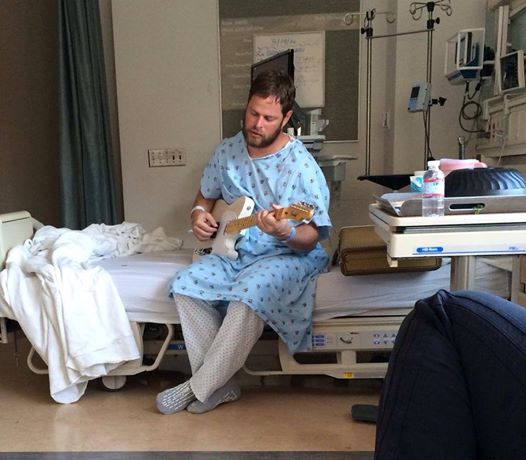
As most of you, my readers, know by now I was diagnosed with a rare and typically incurable and thus terminal cancer back in November 2009 called Desmoplastic Small Round Cell Tumor (DSRCT), which is in the sarcoma category of cancers. After really hard chemotherapy and then invasive resection surgery they were able to remove the cancer (miraculously)–along with my right kidney and a chunk of my inferior vena cava–back in May of 2010. After some follow up chemo I’ve been cancer free ever since then; so going on six years. Later today I am going in for what is to be my last CT scan to make sure I’m still cancer free. It is a thoroughly anxious time for me and my wife, and so we would appreciate your prayers! Even now as I write this it is the middle of the night; I can’t sleep because I am so anxious!

I appreciate your prayers! One more thing please: later today I will also find out if I am going to be laid off from my job with the railroad, it seems very likely! So as you can see there is a lot of stress going on right now. Again we covet your prayers!

Thank you, blessings!

Paris Needs Prayer, Jean Cauvin

What a terrible day in Paris! People in general, but the Parisian in particular, needs to know that they are safe even when they are pressed into the reality–as we all are!–of the circumstances of the day, that they really aren’t; at least not humanly speaking. As the events of November 13th, 2015 illustrated in an horrific and unimaginable way, the Parisian today needs to peacefrenchknow that even if such horrific types of events intersect with their lives and their psyches, that God in Jesus Christ is for them; that He loves them, and that He demonstrated this love for them at His cross (cf. Romans 8.6). The Parisian needs to know and rest in the evangelical reality that God in His providential care has them in His big hands, and that no-one can pluck them out of His hands, not even a terrorist with a Kalashnikov or hand grenade. The Parisian knows better, or as well as anyone else today, how fragile this life is, and how the circumstances of life can change in an instant and in a very violent way! In the face of this they need prayer; they need dialogue with the Triune God who loves them, He desires that the Parisian would cry out to Him, and seek their rest and security in Him and in His mighty care. French theologian, Jean Cauvin or John Calvin says this to his countrymen about their need for prayer, and what it will supply for them in this very trying time,

Words fail to explain how necessary prayer is, and in how many ways the exercise of prayer is profitable. Surely, with good reason the Heavenly Father affirms that the only stronghold of safety is in calling upon his name [cf. Joel 2:32]. By so doing we invoke the presence both of his providence, through which he watches over and guards our affairs, and of his power, through which he sustains us, weak as we are and well-nigh overcome, and of his goodness, through which he receives us, miserably burdened with sins unto grace; and, in short, it is by prayer that we call him to reveal himself as wholly present to us. Hence comes an extraordinary peace and repose to our consciences. For having disclosed to the Lord the necessity that was pressing upon us, we even rest fully in the thought that none of our ills is hid from him who, we are convinced, has both the will and the power to take the best care of us.[1]

I cannot think of a more timely word from Calvin for our French-Parisian compatriots. The reality is that things like this can continue to happen, in Paris and elsewhere; and they most likely will! Is the ultimate answer for individual people going to be live in fear and paranoia; is the answer going to be for more surveillance, or the boning up of weaponry, is that the answer? No, the answer as Calvin has so eloquently lain bare, is for the Parisian to talk with God; to pray. To commit themselves into His hands, and it will only be here where an ‘extraordinary peace’ and sense of security will take hold; as the petitioner to God finds this in the One who holds all things together in His big hands and by the word of His power.

I am praying for the Parisians today, please join me!  le Seigneur a pitiÊ !

[1] John Calvin, Institutes II/2, 851.

Dedicated to Sean Mathison: A Reflection on Suffering and Jesus Christ

seanmathisonThis short essay is dedicated to a brother who I know through a mutual friend (Pastor Carlos Velasquez a  la Redondo Beach, CA), Sean Mathison. Sean just underwent a cancer resection surgery today (March 24, 2014) to remove a cancerous tumor from his brain; he still has one tumor that remains inoperable. Sean is just a young guy (mid-thirties) who loves Jesus, and serves the Lord at church through music-worship and other ways (I am sure!). Sean was only diagnosed with this condition just last week as he became symptomatic; so this is all happening ever so fast. I dedicate this post to Sean Mathison for the primary purpose and call on all of you who are reading this to keep him and his family in prayer. His prognosis is bleak (humanly speaking)–but then so was my cancer diagnosis–but we do not serve a God who is bounded by the ‘bleak’, but who is all powerful, and who is all loving! I will reflect on human suffering throughout the remainder of this essay.

Karl Barth in his short book Dogmatics In Outline, which is his explication of The Apostles’ Creed, offers a deep and rich reflection upon suffering, the cross of Christ, and how we ought to approach suffering in the light of God’s wondrous grace demonstrated therein. Let’s here from Uncle Karl:

But the present time of His life is really suffering from the start. There is no doubt that for the Evangelists Luke and Matthew the childhood of Jesus, His Birth in the stable of Bethlehem, were already under the sign of suffering. This man is persecuted all His life, a stranger in His own family—what shocking statements He can make!—and in His nation; a stranger in the spheres of State and Church and civilization. And what a road of manifest success He treads! In what utter loneliness and temptation He stands among men, the leaders of His nation, even over against the masses of the people and in the very circle of His disciples! In this narrowest circle He is to find His betrayer; and in the man to whom He says, ‘Thou art the Rock . . .’, the man who denies Him thrice. And, finally, it is the disciples of whom it is said that ‘they all forsook Him’. And the people cry in chorus, ‘Away with him! Crucify him!’ The entire life of Jesus is lived in this loneliness and thus already in the shadow of the Cross. And if the light of the Resurrection lights up here and there, that is the exception that proves the rule. The son of man must go up unto Jerusalem, must there be condemned, scourged and crucified—to rise again the third day. But first it is this dominant ‘must’ which leads him to the gallows.

What does it mean? Is it not the opposite of what we might expect from the news that God became Man? Here there is suffering. Notice that it is here for the first time in the Confession that the great problem of evil and suffering meets us directly. Already, of course, we have frequently had to refer to it. But according to the letter this is the first time we have an indication of the fact that in the relation between Creator and creature everything is not at its best, that lawlessness and destruction hold sway, that pain is added and suffered. Here for the first time the shadowy side of existence enters into our field of view, and not in the first article, which speaks of God the Creator. Not in the description of creation as heaven and earth, but here in the description of the existence of the Creator become creature, evil appears; here afar off death also becomes visible. The fact that this is so at least means this: that discretion is demanded in all descriptions of wickedness and evil as being to some extent independent. When that was done later, it was more or less overlooked that all this enters the field only in connexion with Jesus Christ. He has suffered, He has rendered visible what the nature of evil is, of man’s revolt against God. What do we know of evil and sin? What do we know of what is called suffering or what death means? Here we get to know it. Here appears this complete darkness in its reality and truth. Here complaint is raise and punished, here the relation between God and man is really made clear. What are all our sighs, what is all that man thinks he knows about his folly and sinfulness and about the lost state of the world, what is all speculation about suffering and death beside what becomes manifest here? He, He has suffered, who is true God and true man. All independent talk on the subject—that is, talk cut loose from Him—will necessarily be inadequate and imperfect. Unless talk on this matter goes out from this centre, it will be unreal. That man can bear the most frightful strokes of Fate and comes through untouched by anything as through a shower of rain: that can be seen by us to-day. We are simply untouched either by suffering or by evil in its proper reality; we know that now. So we can repeatedly escape from the knowledge of our guilt and sin. We can only achieve proper knowledge, when we know that He who is true God and true man suffered. In other words, it needs faith to see what suffering is. Here there was suffering. Everything else that we know as suffering is unreal suffering compared with what has happened here. Only from this standpoint, by sharing in the suffering He suffered, can we recognize the fact and the cause of suffering everywhere in the creaturely cosmos, secretly and openly.[1]  

As usual there are a diverse amount of rich threads ready to be pulled upon by this tightly packed précis on suffering by Barth, but I want to focus on the dominant thread. The thread which dominates Barth’s indomitable commitment to a Christ-centered reading of everything; in this case, suffering. What Barth develops is the idea, as we just read, that we do not really understand suffering and its purpose within the grander scheme of things apart from understanding it in Christ. When we suffer, according to Barth, it is not part of some sort of random, abstract thing fragmented from other things and other people; but it is part of the grand narrative that God in Christ has entered into for us, and where our understanding, as with everything else, becomes informed by God’s life which sustains and undergirds all of reality; including the foreign reality brought on by the atmosphere of evil, sin, suffering, and a host of other attendant things.

Personal Application

When I was living through my own experience of cancer I had moments where something like what I just wrote might have helped me and my perspective, but most days, it would not have. And so this kind of thinking about suffering (above) might be more for people around Sean, in particular, and those of us praying for him in general.

One of the scariest things for me, when I first found out that I had cancer, was this idea that some sort of alien force had entered my body, and that it was running around in my body in an insidious way as if it was totally out of control. I remember, specifically one night, when I was at work (Toyota Logistics Services at the time), driving around in new Toyotas (at this point I only knew I had a large mass in my body, presumably cancer, but we did not know what kind it was yet), and thinking about this invasive monster in my body. And as I was just beginning to think this way, and give way to the fear that came with it, the Lord broke into my heart and contradicted this kind of demonic inspired thinking; he said to my heart: ‘that He is the Lord of my body, and that He is even Lord of this mass in my body,’ and this instantly brought peace to my heart, at least in regard to this line of fearful thinking.

We are all different, and respond to trauma inserted into our lives in different ways, and even as Christians, based upon where we are at with the Lord, etc. But whatever way we respond, whatever kinds of fears we entertain or rebuke, the Lord suffered first. He is the touchstone of all suffering. He places it into its proper and intelligible order within the economy of his life, and thus provides us with the conceptual capacities to know how to think about suffering when we are able. When we are faced with tragedy upon tragedy like this (like Sean’s cancer), we don’t do so independent from God’s life, but right from the center of His life for us in Jesus Christ.

I am praying for you, my dear brother, Sean, and for your family and friends as the days and nights continue to unfold for you and you all within the domain of God’s life in Jesus Christ for you. amen.  


[1] Karl Barth, Dogmatics In Outline (London: SCM Press, 1949), 102-04.

What is a Genuinely Christian Conception of the Conscience?

Have you ever thought deeply or self-reflectively about what the human conscience is; what your conscience is? The Apostle Paul did, he wrote:

12 For all who have sinned without the law will also perish without the law, and all who have sinned under the law will be judged by the law. 13 For it is not the hearers of the law who are righteous before God, but the doers of the law who will be justified. 14 For when Gentiles, who do not have the law, by nature do what the law requires, they are a law to themselves, even though they do not have the law. 15 They show that the work of the law is written on their hearts, while their conscience also bears witness, and their conflicting thoughts accuse or even excuse them 16 on that day when, according to my gospel, God judges the secrets of men by Christ Jesus. ~Romans 2:12-16

And:

10 these things God has revealed to us through the Spirit. For the Spirit searches everything, even the depths of God.11 For who knows a person’s thoughts except the spirit of that person, which is in him? So also no one comprehends the thoughts of God except the Spirit of God. 12 Now we have received not the spirit of the world, but the Spirit who is from God, that we might understand the things freely given us by God. 13 And we impart this in words not taught by human wisdom but taught by the Spirit, interpreting spiritual truths to those who are spiritual. ~I Corinthians 2:10-13

Usually when we think of conscience we think of it as some sort of autonomous inner light, a free floating island that serves as a self-governing, self-determined, deliberative ‘thing’ (Libertarian Free Agency) that we can appeal to as our objective (subjectively possessed) rudder that guides us through the complexities of our day to day lives. For Christians what I just described is usually qualified in a way that we have a Spirit guided or enabled conscience (which would be Semi-Pelagianism, theologically); nevertheless, it is still functionally understood as an autonomous thing with or without the Holy Spirit’s enablement.

Karl Barth, as narrated by John Webster, offers an alternative account of what the conscience is; his account, true to form, starts, principally, in Christ. Barth saw Christ as the external ground of conscience; this is in contrast to the usual and classical (and even ‘secular’) conception of conscience as something that is an internal and introspective possession of the human agent. For Barth, according to Webster, the moral self does not primarily have ‘self reference’, but a Christic reference that is given to us in his Self giveness for us.  John Webster tells us of Barth (at length),

[T]his refusal of moral and temporal self-referentiality provides the backcloth for one of the most significant and successful discussions in the Ethics, the treatment of conscience in paragraph 16. From the beginning of the discussion, Barth very deliberately sets himself against the assumption that conscience is a natural, self-evident reality requiring no more than immediate self-reflection in order to establish its operations. Quite the opposite: it is ‘this very astonishing knowledge’, something known not as a depth dimension of our moral lives but as ‘our human knowing of what … God alone can know as he who is good, as the giver of the command and the judge of its fulfilment’. For most of the moral traditions of modernity, philosophical and theological, conscience has been an authoritarian and autonomous faculty of self-governance, increasingly detached from rational consideration of moral order. Conscience functions as a kind of nucleus of personal agency around which orbit external realities, such as public conventions or social norms and roles. Those external realities constrain conscience only in so far as they provide material for the deliberations of conscience: like the moral freedom of which it is a core aspect, conscience is authentic in the measure in which it is undetermined by nation or society. For Barth, on the other hand, conscience is quite other than introspective personal moral existence. It takes its place alongside a cluster of other eschatological notions – child of God; fellowship with God the Redeemer; the presence and activity of the Holy Spirit – all of which locate the centre of moral agency outside of the self. To have a conscience is ‘to look and reach beyond the limits of our creatureliness’, ‘to have the Holy Spirit’, to participate ‘in the truth itself’. This means that, over against ‘the ethics of naturalistic or idealistic subjectivism’, Barth does not consider conscience ‘a subjective principle by means of which we can measure the possibilities of life in general and once and for all’. Nor is conscience to be thought of as a faculty, in the sense of a capacity for making judgements, which is ready for our consultation – ‘a principle that we can control, a general principle that we can seize and use at any time’. All such views are anthropologically deficient, in that they envisage the agent’s interior moral life as existing in at least relative isolation from the determining presence of God. For Barth, however, to hear conscience is not to listen to some deeper, non-reflective voice of our own, less caught up in the immediacy of desire and action. It is to listen to ‘our own voice’ as ‘God’s voice’.

Some care needs exercising in grasping Barth’s point here. In speaking of conscience as ‘our own voice’, he is not falling back into the position from which he wishes to escape…. For Barth … the call of conscience summons us to participate in God’s knowledge, literally con-scientia, co-knowledge with God, ‘strictly moment-by-moment co-knowledge. It is not ‘human self-consciousness’, but a co-knowledge in God which is always to be characterized by ‘non-giveness’ or ‘pure futurity’. In the event in which our knowledge becomes this co-knowledge, the distance between God and our awareness is not abolished but bridged. Conscience then, cannot be understood apart from the act of prayer, appeal to the coming of God the Redeemer. Shorn of this eschatological dimension, the notion of conscience could promote ideas of the availability of God’s will as an object for moral reflection…. Without this caveat, conscience threatens to become simply ‘mad autonomism’ or ‘deeschatologised consciousnesses. [John Webster, Barth’s Moral Theology: Human Action in Barth’s Thought, 59-60]

Pastoral Implication

This promotes all kinds of avenues of response. Of primary import, though, as we close, is to highlight the impact that this kind of ‘Christ-conditioned’ understanding of the conscience should have on the Christian’s spirituality. Barth wrote against and from a context that was shaped by the great modern theologian Friedrich Schleiermacher, and others. It was this milieu which gave us theological liberalism, one of its primary hallmarks was that theology became an introspective exercise of the self turning in and finding the reality of God in a ‘feeling’. The effect was to produce a theology that was really anthropology, or a study of the self; a projection outward, only to immediately boomerang inward. Or, Barth’s thought could also be place in contrast to the kind of pietism constructed by Puritan theology (or even Augustine’s theology). Puritan theology, in almost all of its sectors, gave us a spirituality that required the self to look inward to see if they were one of the elect for whom Christ had died; they had to look at ‘their’ good works. All of this heritage has been bequeathed to us, the American Evangelical, and Christian, in general; we end up with a performative Christianity, and a self-centered ethics. And like Schleiermacher, we baptize our moral self determination in the name of Christ; but really this is only a projection of ourselves out onto a concept we know as God (Israel did this with the golden calf … remember?). So I think this hits home, doesn’t it?!

I think Barth is developing a Pauline understanding of conscience, one that is grounded in Christ, and one that we can participate in as we are united to Christ’s humanity (i.e. salvation) by the Holy Spirit. Conscience, a genuinely Christian conception of it, must be one that looks away from ourselves and to Christ.

A Quick Update On My Daughter, Madeline

Just a quick update. My daughter Madeline is doing well, recovering now at home (since Friday), and getting stronger and better everyday. We so appreciate all of your prayer support, and are grateful for all of you! Thank you everyone, and to our God be the praise!!