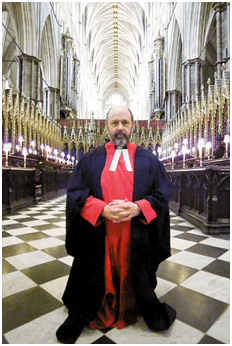
Today I watched a video where NT Wright and 5 other Biblical exegetes-Theologians/interlocuters interact with Wright around papers they had previously delivered; all oriented to responding to Wright’s audacious and adventurous approach to the “New Paul” — and other related topics  like, eternity, salvation, etc. You can catch that video here (this was at a conference that Wheaton hosted last Spring, Wright was the honored guest and lecturer at the conference).
I wanted to just broach something here. I have had more than one person say that Evangelical Calvinism seems to be a good fit with what NT is doing; to be honest, that has puzzled me a bit. One of the things that Wright says in the panel discussion is that “the Reformation provided right answers to the wrong Medieval questions” (my close paraphrase). What he means is that Luther, Calvin, and all the rest of the Protestants have really and utterly failed at grasping what the text of Scripture emphasizes internal to its own ‘Jewish’ and ‘1st century” context. Wright, as many of you know, wants to say that ‘how’ someone gets saved (by faith alone) isn’t the point of the Apostle Paul, in particular, at all; instead it is about Yahweh’s ‘Covenant’ and a shifting in identity from being outside the ‘Covenant’ incoporated into the ‘Covenant’ grounded in Christ. It’s not about imputation, and some sort of alien legal righteousness; it’s really about being related to Yahweh through the Covenant that He made with Abraham. It’s not about personal or particular salvation; it’s about universal salvation (although not universalism), through rightly being related to the ‘Covenant’.
Now, I can see how some folks would say that this fits well with EC’s idea on the ‘ontological’ nature of the atonement, and the close relation to the Incarnation. I can see how folks would think that EC’s de-emphasis upon the legal/forensic imputative aspects of salvation, fits well with what Wright is saying. But I think there is still a difference.
First, I think that Wright over-states things when he says that the “Reformation provided right answers to the wrong Medieval questions;” as if the Reformation was built upon false pre-tenses to begin with. Second, I think Wright is right to emphasis the universal scope of the Covenant; but I think, from what I know of Him, he fails in allowing for a robust understanding of the ‘personalising’ nature of the Covenant; since, really, he still works with a dualism of “Covenant” (as historical event) juxtaposed with the fulfillment of that in the person of Christ. In other words, a gapping hole in Wright’s construal is that he doesn’t provide any real discussion on how vicariousness helps relate the divine and human (eternity and time) in the one person of Christ. In so doing, again, there is a failure to adequately cope with the saturated Trinitarianism presupposed within the corpus of Pauline theology — or a failure to press the “Evangelical” and even subjective or ‘personal’ nature (Torrance’s ‘logic of grace’) of God’s redemptive purposes (I think Wright needs to read Torrance’s The Mediation of Christ). Third, what I am sensing with Wright, is that much of what he has characterized Reformed theology as; really fails to grasp the nuance that particular early Reformed theologians offered in their work relative to dealing with “textual” questions, and Pauline questions — this is what Calvin’s mystical union theology is all about.
As I understand Wright (I still have much more reading to do on him), the primary point of convergence between him and EC is an emphasis upon thinking about salvation as particularly grounded in Yahweh’s Covenant (which I also think, as I note above is a weakness for Wright, in the way that he casts this); so that we don’t think of salvation as separate prongs (justification, sanctification, glorification), but as the whole enchilada (which has different aspects to it) grounded in Christ (I don’t see Wright being as explicit on the ‘in Christ’ as EC, he seems to be saying ‘in Covenant’ which certainly has christological presuppositions, but they don’t seem as explicit as EC).
In the end, I think there are some fruitful lines provided by Wright; I just think though, he has moved to fast in his rejection of any theology post 1st century (which he says he is doing, you’ll see that in the video). I think he is right in trying to reign in fast and loose theologizing that is not ‘text-grounded’, but then I think he is wrong in assuming that any theology that has developed in the church ‘catholic’ has somehow erred in every way; simply because it was being communicated in non-Jewish situations (I’m thinking of the ecumenical Church councils as examples). I think this is where theologians need to step in and provide some chastity for Wright in his zeal to promote his unique and even peculiar approach to history and textual Biblical studies.
Is EC in line with Wright? In some ways, yes; in some ways, no. I think Wright offers some nice corrective for overstatement and over-theologizing; but I also think that some of what Wright is saying needs to be tempered by some theologizing and asking the question: SO, what are the implications?
PS. My reflection here is a little soft, I think; as I recall, in the past, after reading some of Wright, I’ve been riled up a little more than this post might intimate. I think the Scriptures clearly speak to ‘personal salvation’, I just think that the Person it is most concerned with is Jesus Christ; and that our relation (in an ‘EC’ ordo salutis) to Him is preceded by questions about ‘Us’ . . . but I also think that the Incarnation, itself, shows how important the ‘Us’ is to God in Christ ‘for us’ (pro nobis). I think Wright has wrongly junked talk about ‘us’ in regards to salvation, and this is the primary distinction between ‘us’ (EC) and Wright — and for that matter ‘us’ and Classic Calvinism (on the opposite front) . . . EC is rather ‘contra mundum’ (against the world 😉 ).

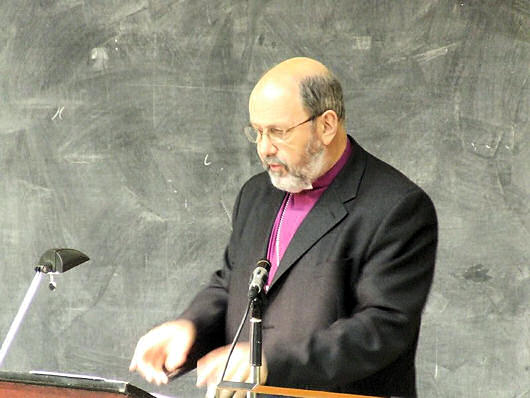 critique Charles Hill, because he frames justification in purely ‘juridical’ or ‘forensic’ terms. Here’s the link: