‘The Mystery of God’, Knowing God Even If He Appears Unknowable

COMMENTS ARE GOING TO BE OPEN FROM NOW ON! (What good is a blog without comments?)

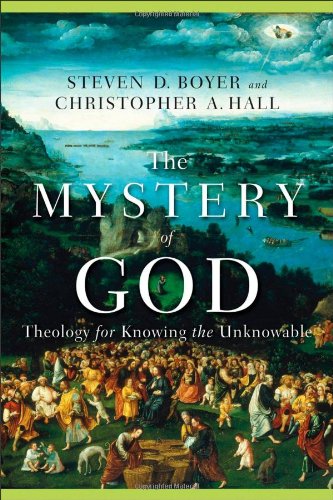
I just started reading Steven D. Boyer and Christopher A. Hall,Ā The Mystery of God: Theology for Knowing the UnknowableĀ (Grand Rapids, MI: Baker Academic, 2012), 3-244.; in the introduction they begin to break down the compound hallboyerwordĀ Theo-ology,Ā and use this as an occasion to explicate the kind of impulses that will be driving them throughout the rest of the book.Ā MysteryĀ andĀ GodĀ are on tap in this volume, and so this should make for an interesting read, especially for someone, like myself, who is more committed to a kataphatic instead of an apophatic way of doing theology; for someone who is more committed to revealed theology rather than natural theology. That said, there is a strong bent within someone like Karl Barth’s theology toward apophaticism; that is the mysteriousness and impenetrable conclave that God’s life represents for us mere mortals. Indeed, maybe, and in fact in reality, there must be a strong apophatic bent, if indeed a Revealed theological approach is going to be truly appreciated; indeed further, it is only by emphasizing God’s ineffable reality wherein Revealed theology has its real place—aĀ locusĀ that displaces our ground of rationalizing about who God is, and allowing Him,Ā kata physinĀ (as Thomas Torrance would say ‘according to His nature and being’), to Reveal and shape for us exactly who He is, by His own Self-definition in His dearly beloved Son, Jesus Christ. So if apophatic theology, if mysterious theology is rightly conceived, it will actually magnify and enhance the kind of Revealed theology I am interested in, and not diminish it into some sort ofĀ a prioriĀ inner mystical experience or aesthetically pleasing theology style.
And so Boyer and Hall write this:

If theology is really to involve the fullestĀ logosĀ applied to the truestĀ theos,Ā then it begins to look as if “getting the right answers” or “solving the puzzles” cannot be the authentic task of the theologian. There will, of course, be “right answers.” To abandon the distinction between truth and falsehood would be not to maximizeĀ logos,Ā but to sacrifice it from the very outset. Yet the rightness of the answers will have to consist in something more than descriptive fidelity, since there will be no ordinary, created object to be simplistically described. God is not a puzzle, and to relate rightly to him is not to analyze or classify or master, but to worship. It is in this spirit that the Eastern Orthodox Christian tradition has always insisted that, while correct theological formulations are crucial to one’s being a Christian, no amount of correct formulating can make one a theologian. A theologian, in the technical sense, is a person who hasĀ seen the very face of God.Ā Following such a definition might quickly thin the ranks of “theologians” in our seminaries and colleges. [Boyer and Hall,Ā The Mystery of God,Ā xvi.]

We see Boyer and Hall end this paragraph with a kind of Augustinian idea. That is, that a true theologian will have a moral purity blazoned within them by the purifying fire of God’s always present and penetrating eye. And so we do see an inward, moral, component to the kind of theological mode that Boyer and Hall are going to attempt to develop for us as we work through its pages (that is if I have the time to blog much more from it). It will be interesting to see if this mode gives way to the kind of Revealed theological approach I am interested in, or instead into an approach that ends up being more ‘naturally’ formed by way of depending on reflection and experience of God revealed as Creator and Redeemer. We will see.

Augustine and Torrance in Discussion: The imago Dei and Knowledge of the Triune God

I find Thomas Torrance’sĀ stratified knowledge of GodĀ and St. Augustine’sĀ exercitatio mentisĀ (spiritual exercises), and their relative correspondence to be quiteĀ trinity-iconintriguing, and yet in this intrigue there is also recognition of a fundamental difference. Here is how Ben Myers describes Torrance’s ‘stratified knowledge’ (if you want to read Torrance on this see hisĀ Christian Doctrine of God, One Being Three Persons):

Thomas F. Torrance’s model of the stratification of knowledge is one of his most striking and original contributions to theological method. Torrance’s model offers an account of the way formal theological knowledge emerges from our intutive and pre-conceptual grasp of God’s reality as it is manifest in Jesus Christ. It presents a vision of theological progression, in which our knowledge moves towards an ever more refined and more unified conceptualisation of the reality of God, while remaining closely coordinated with the concrete level of personal and experiential knowledge of Jesus Christ. According to this model, our thought rises to higher levels of theological conceptualisation only as we penetrate more deeply into the reality of Jesus Christ. From the ground level of personal experience to the highest level of theological reflection, Jesus Christ thus remains central. Through a sustained concentration on him and on his homoousial union with God, we are able to achieve a formal account of the underlying trinitarian relations immanent in God’s own eternal being, which constitute the ultimate grammar of all theological discourse. [Benjamin Myers, ā€œThe Stratification of knowledge in the thought of T. F. Torrance,ā€ SJT 61 (1): 1-15 (2008) Printed in the United Kingdom Ā© 2008 Scottish Journal of Theology Ltd doi: 10.1017/S003693060700381X]

And here is how Gilles Emery, O. P. describes Augustine’sĀ exercitatio mentis:

Augustine emphasizes in particular that in order to glimpse God, the spirit must purify itself of corporeal representations and “phantasmata.” The spirit must not stop at created images but must rise to what the created realities “insinuate.” This is precisely the usefulness of the study of creatures and the goal of the exercise. TheĀ exercitatioĀ proposed by Augustine is anĀ ascension …Ā toward God from the image that is inferior and unequal to him, and it is at the same time a gradual movementĀ toward the interiorĀ (introrsus tendre). From these corporeal realities and sensible perceptions, Augustine invites his reader to turn toward the spiritual nature of man, toward the soul itself and its grasp of incorporeal realities, in a manner ever more interior (modo interiore), in order to rise toward the divine Trinity. The exercise of the spirit is “a gradual ascension toward the interior,” in other words, anĀ elevationĀ from inferior realities toward interior realities. One enters, and one rises in a gradual manner by degreesĀ (gradatim).Ā Such is the way characteristic of Augustine: “pull back into yourself [in teipsum redi]…, and transcend yourself.” [Gilles Emery, O. P.,Ā Trinitarian Theology as Spiritual Exercise in Augustine and Aquinas,Ā inĀ Aquinas the AugustinianĀ edited by Michael Dauphinais, Barry David, and Matthew Levering, p. 14.]

[For further reading on a Reformed version of ascension theology check out Julie Canlis’ sweet bookĀ Calvin’s Ladder: A Spiritual Theology of Ascent and Ascension.]

One fundamental and important difference—even given some apparent similarity between Torrance and Augustine, like on stratification or graded movement towards Triune knowledge of God—becomes an issue of theological anthropology and the difference between Augustine’sĀ a prioriĀ versusĀ Torrance’sĀ a posteroriĀ approaches in relation to theĀ imago Dei/Christi.Ā 

For Augustine, knowledge of God is already present (even if soteriologically and christologically construed) by way of analogical reflection upon the image of God (which is opened up soteriologically by Christ). For Torrance, knowledge of God is not a result of turning inward, but looking outward to Christ. So we don’t know what it is to really be in the image of God, there is not resonant knowledge of God available in the human being, per se. It is only as we are recreated in Christ in the resurrection by the Spirit that genuine knowledge of God can be acquired by observing and spiritually participating in the knowledge of God through Him. So the analogy for both of the these theologians—by which we come to knowledge of the Triune God—is grounded in reflection upon the image of God. But the difference is that for Augustine, the image of God isĀ grounded in each individual person (which would help to explain his view of election/reprobation as well); for Torrance the image of God is grounded in Christ (Col. 1.15), and thus the supposition is that God’s image has a ground external to creation in Christ, which allows us to think of knowledge of God as something external to us, and not something resonant within us (even if like Augustine we try to explain this in his kind of soteriological way).

My Reduction

I don’t like doing this, but for sake of blogginess and reception let me do so: For Augustine knowledge of God happens by turning inward to the self (by Christ to be sure) and attending to personal piety; For Torrance knowledge of God happens by turning outward to Christ, and attending to personal intimacy therein.

This kind of movement (inward a priori and outward a posterori) has some other interesting implications that get fleshed out in subsequent centuries and theologies that continue to affect us to this day. We will have to talk about this later.

Worshiping God Aright: Torrance and Calvin on ‘radical inversion’

We were created to worship. Humanity will worship, left to themselves; themselves, and various post-scripts of themselves. So what is the key to worshipping in the way we were created for? Thomas Torrance has a good answer as he continues to comment on Calvin’s doctrine on sin and ‘Total Perversity’; he writes:

[I]n order to worship God aright, that is, in accordance with the motion of grace, man must learn to serve God against his own nature, [Calvin’s, Sermon on Job 10:16f.; 37:1 f.; Commentary on Romans 7:9 ff.]Ā “acknowledging that he lives not by his own power but by the kindness of God alone, and that his life is not an instrinsic good, but proceeds from God alone. He cannot otherwise retain it than by acknowledging that it was received of God.” [Calvin’s, Commentary on Gen. 2:9] This means that Calvin defines the life-motion of man made in the image of God as the motion of faith, while the contrary motion of unthankfulness and rebellion he speaks of as incredulity and unbelief. “God does not manifest Himself to men otherwise than through the Word, so neither is His majesty maintained, nor does His worship remain secure among us any longer than while we obey His Word. Therefore unbelief is the root of defection; just as faith alone unites us to God.” [Calvin’s, Commentary on Gen. 3:6; Institutes 2.2.4; 2.2.12] Hence knowledge of God is possible only if the inverted motion of the soul in mindĀ  and will is re-inverted by an acknowledgment of grace such that it is dragged out of its self-assertion or concupiscence, out of its self-imprisonment and blindness, in order to find life and being only as deposited in the Word. The radical inversion of all human wisdom and understanding that this entails indicates how deep going and total is the perversion of sin. A complete conversion of man’s relation with God is required. [brackets mine] (T. F. Torrance, Calvin’s Doctrine of Man, 115)

The cool thing that happens when you read Torrance on Calvin is that you get both at the same time; you get Calvin, but you get Torrance’s Calvin, which for me is the best of both worlds. Anyway, if you are struggling with how you ought to worship God; then you ought to consider radical inversion!

*This post dovetails somewhat with the last one, where we so both Torrance and Calvin thinking from an Augustinian frame, wherein the locus (or location) for a proper understanding of what constitutes humanity is by God’s grace in Christ, and thus the turn elsewhere is into the abyss of ourselves or nothingness. -repost

Thomas Torrance and St. Augustine in Conversation: Creatio ex Nihilo and imago Dei

Matthew Drever in the Harvard Theological Review offers a nice argument using a doctrine of creation and the imago Dei to dispel the common misunderstanding about Augustine’s so called psychological conception of the Trinity; i.e. the inner structure of anthropology (mind, will, affections) served as the lens by which Augustine supposedly conceived of the inner relation of God’s life as Triune—so a sort of proto-social-Trinitarianism. In order to understand augustine2Drever’s full argument, and how he utilizes Christian conceptions of creation and imago Dei, you will have to read his essay in full.

Within Drever’s essay, and as he is dispelling said myth, as I already noted, he engages with the imago Dei as a lens through which to reify Augustine’s understanding of the movement from God to creation, and how that is mediated through the images (humans) of the image (the Son, Jesus) in the soteriological combine (so to speak). And it is this that I find very resonant with my own Torrancean understanding of the primacy of Christ as the ground and condition of what it means to be human, and in fact “saved” or reconciled to God—which then funds human conception (as conceived from the Christ as the imago Dei, simpliciter) in regard to God, and the economy of His triune life. Here is how Drever opens his comments on imago Dei in Augustine:

[A]ccording to Augustine, all creation receives its order—its essence, or definition—through the Son. For most of creation this order comes via theĀ rationesĀ or ideas, eternally held within the Son, which are infused in creation as theĀ rationes seminales.Ā These seminal ideas provide the pre-established structure that governs the coming into existence of material objects. The order imposed on material creation through these ideas allows for the delineation of creation into a genus/species framework. Humans, however, are unique in material creation in that their order—essence, definition—does not follow pre-establishedĀ rationes seminales,Ā but rather arises through their turning to and recognition of God. This is what it means for humans to be created according to the image and likeness of God. One consequence of this is that the essence of human nature cannot be understood within the genus/species paradigm that orders the rest of the material creation. The true essence of human nature is defined (if this term remains appropriate) by how it images God, and not the one God of Plotinus but the Trinity—”man is the image of the Trinity.”

Augustine is careful to differentiate the way the Son images God from the way in which humans do so. This is an important distinction, and one in which the key Nicene trinitarian themes of divine simplicity, inseparable operation, and unchangeability are operative. The Son is distinct from creation precisely because the Son is God as the Father is God. The Son is unchanging wisdom and blessedness as the Father is (and so also the Spirit). Augustine, being the close reader that he is, contrasts this with humans who areĀ accordingĀ to the image rather than the image itself. One way of parsing this distinction is in terms of the doctrine ofĀ creatio ex nihilo.Ā InĀ Gen. litt.,Ā Augustine describes the human imaging of God at creation as the turning of humans to God and compares it with the redemptive turning of humans back to God that occurs though [sic] the Word. In both instances, this turning is a movement away from nothingness. In the latter case, it is a turning from the moral nothingness of sin; in the former case, it is a turning from the nothingness out of which all finite existence arises.

This has significant consequences for understanding the project ofĀ Trin.Ā If the true essence of human nature is theĀ imago DeiĀ and this is given in the turning of humans to God from the nothingness out of which they were created, then the resources available within the self for understanding God are also given in this turning to God. The self opens to God or to nothing, so that apart from God the self has no real or true form through which to understand God. Hence, Augustine’s inward turn into the self has as its precondition God’s self-revelatory actions of creating and redeeming the self, in which God is revealed as the triune God. [Matthew Drever, “The Self Before God? Rethinking Augustine’s Trinitarian Thought,” Ā Harvard Theological Review/Volume 100/Issue 02/April 2007,Ā pp. 240-41.]

So for Augustine, Christ is the key, and not in an overly neo-Platonized and psychologized philosophical way, but in a Christian, Christic way.

I will place this into conversation with Thomas Torrance’s conception of things with Augustine (as described by Drever), at a later date. There are some significant parallels here.

Against Polemics: Augustine on the Superabundance of God’s Life, and Rest In Him

I once read a book by Peter Leithart, his book on Athanasius; an excellent book! He prologued his book on Athanasius, ironically, with a reflection by Augustine; and it is brilliant, I love it. Here it is:

visioaugustine

[W]hat is the nature of things? What are things, ultimately and in their most basic structures and essence? You, O Lord, know, for you made them all, sustain them all in existence, direct and guide all things to your good ends. You know every thing, love every thing, are good to every thing. You know them all more nearly than they know themselves. But how shallĀ weĀ know?

Should I even ask, O Lord? Should I even ask? You have spoken, and you have acted, and you have called us to believe. You have taught us that we walk by faith and not by sight, by trust in your good promises of goodness, and not by understanding. It is enough that you know the nature of things. Should I ask?

If I ask, will I receive an answer? You are beyond all my thoughts, greater than all that I can say, incomprehensible in your eternal communion as Father, Son, and Holy Spirit. You cannot be encompassed with any concept, bounded by anything greater than yourself, since you are greater than all. All my efforts to encompass you are acts of idolatry and not true worship. And you made all things and all things shine with the bright radiance of your glory. Your world seems as incomprehensible as you yourself.

Should I even ask? Can I ask? Dare I ask?

Have not some of your servants turned to such idols? Have they not bound you in forms and substances and concepts of their own imagining and bowed to worship what their own hands have made? Have they not turned your glory, the glory of the incorruptible God, into idols more ethereal than four-footed beasts and crawling creatures, and worshiped and served the creature rather than you, the Creator? Have not your servants all but denied that you were Creator, following vain philosophers who spoke of eternal matter and changeless forms? Have they not said that you are subject to time and development, denying that you are eternally complete and fulfilled? Have they not danced and sung before other gods? They asked, what is the nature of things? And were they not turned from your ways?

Dare I ask?

Yet, I cannot escape the question, for others have spoken before me. Others have asked, what is the nature of things? and have given answers. Are their answers true? Should I, O Lord, ignore their questions and answers and devote myself to prayer and service to the poor? Or shall I seek to answer? Shall I seek to determine if they speak the truth? How can I not? Can I tell whether their answers are true without asking the same questions? If a philosopher says that all things exist by participation in forms, should I, O Lord, believe him? If another says that matter is eternal, shall I, O Lord, accept that? If yet another says that all substances are informed matter, shall I receive that? If another says that we can know nothing of things beyond their phenomenal appearances, what shall I say? If the philosophers are correct about the nature of things, do they also describe your nature, O God? Are you one of the the things whose nature these philosophers describe?

If you would not have me believe these philosophers, I would know why. And if they are false, I would know what truth to speak in place of their falsehoods. [Peter J. Leithart,Ā Athanasius,Ā xv-xvi]

Augustine is not being anti-intellectual, but he is seeking to find rest in God’s own Revelation, and confident that God is able to speak and communicate Himself to us through Christ in contrast to the un-restful quest provided by the Philosophers.

I often feel, as I engage with people online, as if there really is not this kind of posture of doxology and rest in our discourse; a looking away from ourselves (including our philosophical and exegetical arguments), and a looking to the One who sustains all of reality by the Word of His power conditioned by the life of love that He is in the intercourse of His life. What Augustine rightfully notes, is that even though Christian grammar uses the forms provided by the Philosophers, it does so in a non-correlationist way, such that these forms or these kinds of metaphysics are evangelized (as Leithart would say) in a way that the original philosophical context is given a new pretext and thus new context that is determined to be what it is by the reality being referred to in God’s life in Jesus Christ. It is not that we don’t engage with ideas, it is just that we do so from a posture of Confession, and most of all Faith. Which presupposes that we can trust the Revelation of God to be more than adequate in moving beyond the normal and mundane reflections of the Philosophers, and actually provide a way into the Holy of holies through the torn veil of Christ’s body for us. There is rest here from the wranglings of men and women who are trapped by trying to gain approval from other men and women; we have rest where the Father has rest, in His dearly beloved Son (Hebrews 3).

I just feel burdened by being in a state of polemic, and not in a state of doxology.

Against being ‘Curious’: In the Augustinian Mood, A Pastoral Reflection and Exhortation

aug

I am not going to say much, other than that this helps me. I am a sinner, and I still sin, frequently in fact. The only difference between me and the world is that I am a saved sinner (simultaneously justified and sinner); nevertheless, I still think in ways that terminate nowhere else but in the self, and by absolutizing material reality in a way that never gets back to material realities origin. Like the world I think foolishly (at points), and like ancient Israel, I have my high places. So what helps me, and maybe it will help you too, is Webster’s discussion of the vice ofĀ curiosity.Ā Here is what he has written:

(2) Curiosity involves the direction of intellectual powers to new knowledge of created realities without reference to their creator. In curiosity, the movement of the mind terminates on corporeal properties of things newly known, without completing its full course by coming to rest in the divine reality which is their principle. In effect, curiosity stops short at created signs, lingering too long over them and not allowing them to steer intelligence to the creator. So Augustine against the Manichees:

Some people, neglecting virtue and ignorant of what God is, and of the majesty of the nature which remains always the same, think that they are engaged in an important business when searching with the greatest inquisitiveness and eagerness into this material mass which we call the world … The soul … which purposes to keep itself chaste for God must refrain from the desire of vain knowledge like this. For the desire usually produces delusion, so that the soul thinks that nothing exists but what is material.

Curiosity, Augustine says elsewhere, is ‘eating earth’, penetrating deep and dark places which are still time-bound and earthly. Or again, in another idiom, curiosity is the ‘lust of the eyes’ (1 Jn 2.16), so called, Augustine says, because its origin lies in our ‘appetite for learning’, and ‘the sight is the chief of our senses in the acquisition of knowledge’. It is that ‘vain and curious longing in the soul’ which, ‘cloaked under the name of knowledge and learning’ is in reality a greed for ‘new experiences through the flesh’, a disordered ‘passion for experimenting and knowledge’ – flocking to see a lacerated corpse, attending a theatrical spectacle, letting contemplation be distracted by watching a lizard catch flies. Curiosity terminates onĀ surfaces.Ā [John Webster,Ā The Domain of the Word,Ā 196.]

I fall into the trap of curiosity more than I would like to admit! But I seek, by the Spirit, to live a life of (as Torrance would say) ‘repentant thinking’. Living a life that moves and breathes from the Spirit’s breath, the breath that animates the humanity of Jesus Christ for us. There is a depth dimension to Christianity and this life that most Christians will never experience in this life (and I am not supposing that the alternative is an elitist gnostic kind of Christianity!), because we are too curious and not contemplative and critical enough in our daily walks with Christ. As James writes “14Ā but each person is tempted when they are dragged away by their ownĀ evil desire and enticed.Ā 15Ā Then, after desire has conceived, it gives birth to sin;Ā and sin, when it is full-grown, gives birth to death.” Curiosity is the desire that terminates in sin and death. We so often give into this curiosity, and hardly ever do the hard work of actual Christian contemplation. We go the way of the world, we are just too curious.

Praying Trinitarianly with Augustine

I don’t have a lot of time today, and obviously haven’t over the last few (given the dearth of fresh posts here). But I wanted to leave you with a Trinitarian prayer for today, provided by, Augustine. This prayer is actually cited by Khaled Anatolios at the end of his book Retrieving Nicaea: The Development and Meaning of Trinitarian Doctrine. I intend over the next few weeks (we’ll see if this actually happens) to work through the last chapter of Anatolios’ book here at the blog. The last chapter is basically an offering of theological conclusions and synopses of the preceding work that Anatolios has already done through the rest of the book on the theologies of Athanasius, Gregory of Nyssa, and Augustine. The points that we will cover as we look at these ‘conclusions’ (which are very fruitful!) are: Revelation, Scripture, Tradition and Ecclesial Scriptural Interpretation, Worship, The Primacy of Christ, The Person of the Holy Spirit, Creation, Christian Salvation, Humanity in the Image of the Trinity, Divine Being as Trinity. Hopefully this whets your appetite to see what Anatolios and I (as I reflect on Anatolios’ thought) have to say on these central topics of the Faith. Let me close, as I said we would do, with Augustine’s Trinitarian prayer:

O Lord our God, we believe in you, Father and Son and Holy Spirit. Truth would not have said, “God and baptize the nations in the name of the Father and of the Son and of the Holy Spirit” (Matt. 28:19), unless you were Trinity. Nor would you have commanded us to be baptized, Lord God, in the name of any who is not Lord God. Nor would it have bee said with divine authority, “Hear O Israel, the Lord your God is one God” (Deut. 6:4), unless while being Trinity you were still one Lord God. And if you, God and Father, were yourself also the Son your Word Jesus Christ, were yourself also your gift the Holy Spirit, we would not read in the documents of truth, “God sent his Son” (Gal. 4:4), nor would you, only-begotten one, have said of the Holy Spirit, “whom the Father will send in my name” (John 14:26), and, “whom I will send you from the Father” (John 15:26). Directing my attention toward this rule of faith as best I could, as far as you enabled me to, I have sought you and desired to see intellectually what I have believed…. Do you yourself give me the strength to seek, having caused yourself to be found and having given me the hope of finding you more and more…. Let me remember you, let me understand you, let me love you. Increase these things in me until you refashion me entirely. [Augustine, Trin. 15.28.51, cited by Khaled Anatolios, Retrieving Nicaea, 292.]

amen.

‘Dare I?’ Worshipping in Augustinian Tune, Leithart, part 1

This is long, and sweet! I can’t not share this with you. I read this this morning at work (on break), and the Lord ministered to me through this. It was a time of doxology. Notice the two distinct movements in the prayer. Leithart offers a prayer in the tune of Augustinian; from his recent book on Athanasius. The following is his Introduction to the book, the intro is entitled: Scripture and Metaphysics (in the Augustinian Mode). And it is sweet! I have provided a link to some reading music below (which is what I was listening to when I first read this). Leithart,

[W]hat is the nature of things? What are things, ultimately and in their most basic structures and essence? You, O Lord, know, for you made them all, sustain them all in existence, direct and guide all things to your good ends. You know every thing, love every thing, are good to every thing. You know them all more nearly than they know themselves. But how shall we know?

Should I even ask, O Lord? Should I even ask? You have spoken, and you have acted, and you have called us to believe. You have taught us that we walk by faith and not by sight, by trust in your good promises of goodness, and not by understanding. It is enough that you know the nature of things. Should I ask?

If I ask, will I receive an answer? You are beyond all my thoughts, greater than all that I can say, incomprehensible in your eternal communion as Father, Son, and Holy Spirit. You cannot be encompassed with any concept, bounded by anything greater than yourself, since you are greater than all. All my efforts to encompass you are acts of idolatry and not true worship. And you made all things and all things shine with the bright radiance of your glory. Your world seems as incomprehensible as you yourself.

Should I even ask? Can I ask? Dare I ask?

Have not some of your servants turned to such idols? Have they not bound you in forms and substances and concepts of their own imagining and bowed to worship what their own hands have made? Have they not turned your glory, the glory of the incorruptible God, into idols more ethereal than four-footed beasts and crawling creatures, and worshiped and served the creature rather than you, the Creator? Have not your servants all but denied that you were Creator, following vain philosophers who spoke of eternal matter and changeless forms? Have they not said that you are subject to time and development, denying that you are eternally complete and fulfilled? Have they not danced and sung before other gods? They asked, what is the nature of things? And were they not turned from your ways?

Dare I ask?

Yet, I cannot escape the question, for others have spoken before me. Others have asked, what is the nature of things? and have given answers. Are their answers true? Should I, O Lord, ignore their questions and answers and devote myself to prayer and service to the poor? Or shall I seek to answer? Shall I seek to determine if they speak the truth? How can I not? Can I tell whether their answers are true without asking the same questions? If a philosopher says that all things exist by participation in forms, should I, O Lord, believe him? If another says that matter is eternal, shall I, O Lord, accept that? If yet another says that all substances are informed matter, shall I receive that? If another says that we can know nothing of things beyond their phenomenal appearances, what shall I say? If the philosophers are correct about the nature of things, do they also describe your nature, O God? Are you one of the the things whose nature these philosophers describe?

If you would not have me believe these philosophers, I would know why. And if they are false, I would know what truth to speak in place of their falsehoods. [Peter J. Leithart, Athanasius, xv-xvi]

This is just the first part. We will have to finish the rest tomorrow. This is honestly one of the coolest, dramatic, and worshipful things I have read for quite some time. Really, we are just breaking off right before we get into the second (kataphatic) movement of Leithart’s ‘Augustinian’ tune; the best part. The answer.