
I am reading through Calvin’s Institutes right now, you would think that if I am going to write a chapter on Calvin I’d better have read Calvin’s “Institutes.” I have read large sections of the Institutes, probably 2/3rds of it; but never read through the whole of it, from Book I 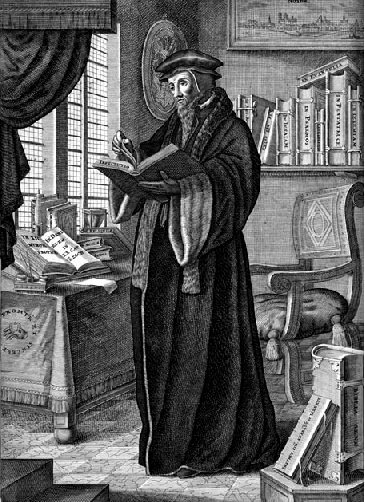 to IV. I’ve also read many of his commentaries, little peeks into what in fact informed his thoughts in the Institutes. And I’ve read his On Predestination; and then all kinds of secondary literature on him. So I’m not totally naked when it comes to Calvin; nevertheless I still thought it would be important to actually read the “Institutes” through, and get the flow of his thought that way too.
Another quick point, I wonder how many people claim to be a Calvinist today; and yet have never read Calvin or at least good secondary stuff on him. I’ve found that many today, at a popular level, believe that their Calvinism is so congruent with Scripture, or vice versa; that reading Calvin or the history of how Calvinism developed turns out to be a waste of time. Are you one of these folks? So in other words these folks claim the points and doctrine and categories articulated by a whole continuum of development, i.e. Calvinist history (e.g. Post-Reformation stuff), that came to be known as Calvinism; but at the same time just end up saying that they came to the same conclusions that Calvin and the the Calvinists came to (if you follow the continuity arguement of Muller) by simply reading the Scriptures . . . huh? 😉
I wonder how many people claim to be a Calvinist today; and yet have never read Calvin or at least good secondary stuff on him.
OOOOH.
Aside from my fear of elevating Calvinism to be the exact equivalent of Biblical Christianity, the other main deterrent to officially calling myself “Calvinist” is that I’m largely ignorant of his personal view.
The closest I’ve gotten to studying Calvinistic teaching is trying to understand TULIP, which I guess is actually a reaction to Arminian teaching which was a reaction to Calvinism of the time.
Have fun studying up 🙂
Hi Bobby,
I understand that Institutes was originally 5 or 6 chapters, which was expanded to 17 in the 2nd edition. The resource (I’m sorry, I do not have a reference) seemed to believe that that revision reflects Calvin’s answer to the catholic charge of antinomian. He chose the traditional interpretation of “faith without works is dead” (as is, by extention, it’s bearer). In other words, an apparently changed life, will of necessity follow a regenerated one. Luther may have been a little more liberal on this, but I think all theologians have struggled with the concept of God saving someone and then apparently allowing them to embarrass Him by continuing in their sin indefinately.
I expect we’ll meet the full spectrum of christians in Heaven, those who were ashamed at His coming, to those who were uber-humbled at the magnificent work the Lord had done in their lives. I figure praise/humility or shame/humility are the 2 options.
Anyhow, I expanded your topic again. Sorry. Maybe you could keep an eye out for what I’m talking about and tell us what you think.
Heather,
MOst Calvinists haven’t personally studied Calvin 🙂 . I would say most people in the Protestant church in America are at least Calvinistic, even if they are Arminian 😉 .
But there is a huge difference between studying John Calvin’s theology and Calvinism’s theology . . . they are different in many ways — that’s the point of Evangelical Calvinism (Calvin can be read more than one way, and EC does it more faithfull 😉 ).
Yeah Duane,
You bring up a huge issue. Luther had his law vs. Gospel and Calvin his 3 usages of the law. I have a post on this somewhere; I’ll dig up the link . . .