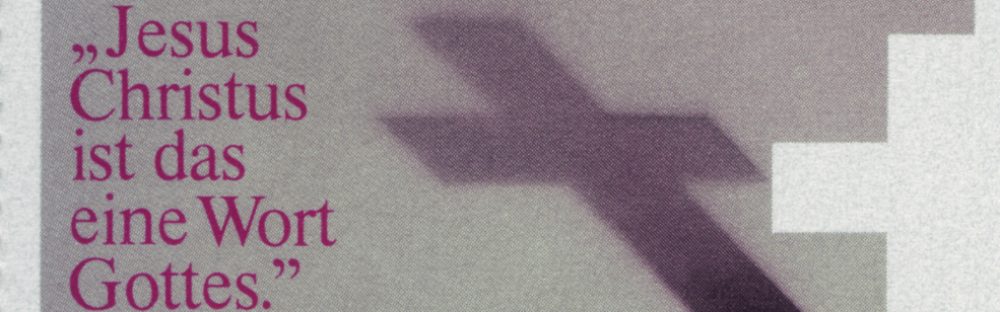
Something that has always been important to me in the realm of the theological task is understanding how God’s Self-revelation pressures the language used to explicate His-revelation. Peter Leithart in his book on Athanasius describes this usage of language, often of philosophical and metaphysical origin, as ‘evangelizing metaphysics.’ There is often confusion here: because the philosophical  language/conceptual matter is pressed into more than the revelation itself. In the best of the history of Christian theological development what takes place is reification of philosophical language, such that the language is used but with completely different conceptual and referential matter. In other words, the philosophical symbol or word is used, but the conceptual matter making usage of that word or phrase gives it a completely new contextual and conceptual frame of reference for its meaning and purpose in the string of God’s intention and meaning for the world.
Helmut Thielicke, an underappreciated German theologian of the early to mid 20th century offers some really helpful thinking on how philosophical words come to be used in a way that has nothing to do with their original origination, and everything to do with the revelation of God in Christ that commandeers such words for its own otherworldly, but thisworldly purpose. He writes:
Theological reflection arises when the message—the primary event—finds forms and figures of thought in which the people of a particular time reflect. The message comes first. It cannot be fused into the forms and figures. It is always in tension and competition with them. But if it prevails, if it leads on to faith, the paradoxical state arises that we have to state and express it in our time-bound categories if we are not to relapse into dumbness and silence. The tension between the eternal that is present and the time-bound means of appropriation is always noticeable. Concepts begin to flicker when they have to express something that does not conform to their previous ideological content but transcends it. When John’s prologue speaks about the incarnation of the Logos, it uses Stoic or Gnostic terms. But it only “uses” them. For the term Logos, to express the mystery of the incarnation, has to shed its previous meaning as a symbol for the cosmic principle and fill itself with a content that is basically alien to it.
Thus language reaches its limit and the vessels of words are shattered by their contents. A sign of this is that paradox is unavoidable. Paul, Luther, and later Kierkegaard all take refuge in paradox, and Karl Barth could refer to the “impossible possibility” of speaking God’s Word in our human words.[1]
To grasp this, in my view, is to grasp one of the most fundamental aspects of the Christian theological task. To engage in this task improperly, though, can result in egregious theological error; to the point that who God is is hybridized into a god that has no concrete correlation to the God revealed in Christ. This is what I am constantly pushing against when I offer critique of classical theism, in general, and classical Calvinism’s appropriation of classical theism’s mode of synthesizing Aristotelian substance metaphysics with Christic revelation. This is the primary rub, in fact, between my opponents and me; I maintain that they operate in a tradition that has done rather poorly in the work Thielicke has described for us. In other words, I contend that, by and large, classical theism, particularly its mediaeval iteration, has allowed the conceptual matter of the philosophical words they use to explicate God, to intrude into the revelation itself; that in fact the philosophical message has come to take precedence ‘over’ the revelation.
This is why I have deliberately chosen to work in the After Barth tradition of things. I think Barth offers a corrective to orthodox theologizing in the main. He pushes the theological task back to grounding its raison d’être in the overriding all consuming reality of God’s Self-revelation rather than allowing the philosophical verbiage to intrude unwanted. This will always, probably, be the rub between me and those who have simply received the ‘Great Tradition’ as if it comes, for the most part, in unerring ways from the Apostles (i.e. Apostolic Succession) of the Church. Theology is always a matter of translating the kerygmatic reality into the language ‘of the day.’ Often I think theologians forget this most basic of realities when it comes to the task of the theologian. Theologians, at least in my Western 21st century evangelical and Reformed context, seem to think that the task of the theologian is to simply receive (even if they claim it to be constructive) the Great Tradition as normative, and translate that Trad into the terms of the day. But in fact what is to be translated is not the Great Tradition, but God’s Self-revelation itself. This is not to suggest that the theologian must recreate the wheel, but it is to recognize that what is normative, and not just in word only, is God’s Self-revelation in Christ and not the Trad that has ostensibly risen up over the centuries in order to help the Church to understand this revelation in its own contexts and periods. There is quite a bit of confusion about all of this, I think.
[1] Helmut Thielicke, Modern Faith & Thought, trans. by Geoffrey Bromiley (Grand Rapids, Michigan: William B. Eerdmans Publishing Company, 1990), 4-5.
Thanks. Quality writing and important insights once again. â For the term Logos, to express the mystery of the incarnation, has to shed its previous meaning as a symbol for the cosmic principle and fill itself with a content that is basically alien to it.â Yes. Missioner Leslie Newbigin said something similar. He pointed out that for the gospel in the Indian context it was The Dharma that became flesh, and dwelt among us.
Trevor Faggotter 4 Berwick St. Clare, SA, 5453 M 0438259206
>
Pingback: The Logos is Greater than the Greek: The Resurrection of Language | The Evangelical Calvinist
Thanks, Trevor. Yes, hermeneutics is probably the most important thing a Christian can come to understand in regard to understanding who, what, and why they believe what they do; as they understand how they believe and from where.