
I don’t have a lot of time to write this, but let me try and get something out here that has some meaning to it.
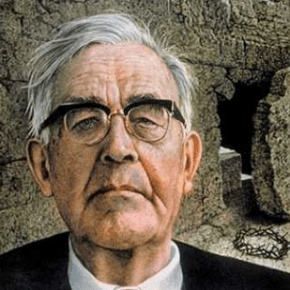 What I am going to write isn’t for those (primarily) who know Barth (and better than I), but what I am going to write is simply something that I don’t think a lot of Evangelical folk appreciate when it comes to Karl Barth, and a primary aspect of what Barth is about, at that. Put simply, Barth does not want to offer a theological method or approach that makes God bound (or a predicate) to his own creation—so Barth wants to make sure that anything we say or do, Christianly/theologically, understands that God is sovereign and free. Here is something Barth wrote (and spoke) in the Gifford Lectures (at the University of Aberdeen, 1937 and 38 ) so long ago:
. . . As a Reformed theologian I am subject to an ordinance which would keep me away from “Natural Theology,” even if my personal opinions inclined me to it. I am of course aware that both in the past and in recent times there have been Reformed theologians also, to whom “Natural Theology,” at least in a rather weakened and obscure sense of the term, appeared to be no impossible pursuit. I feel, however, that precisely the strong and clear understood the term—and he was perfectly correct in understanding it in this way—there does exist a knowledge of God and His connection with the world and men, apart from any special and supernatural revelation. This is a knowledge which perhaps requires and is capable of development and cultivation, but is none the less a knowledge which man as man is master of, just as he is of chemical and astronomical knowledge. . . . [Me citing Barth in our book, in my chapter 4]
So Barth is being a bit rhetorical in what he is communicating. He is pointing out that there is a natural knowledge of God, but this God, man is able to be master over; and so this God is not the Christian God revealed in Jesus Christ. The concern is that when we use philosophy to give us our primary categories about God; or when we use linguistic positivism to give us our theory of language and biblical hermeneutics; or when we use naturalistic historiography to give us our theory of revelation—then we have become masters of God. We are no longer in a position to sit under and be confronted and contradicted by God, but we sit over God. So God should never be something or someone that we can grasp, he grasps us! We should never try to create a situation where we are comfortable with our God, or create a situation that creates a sentimentalism about God, or pursue scenarios where we create settings wherein we have a sense of stability, relative to God, that is a result of our own making. We are not the masters, God is!
Nice post Bobby! I like the , “He grasps us”. One of my mentors, Ron Story, from Visalia, Ca…. used to sign his stuff… “In His grip!”. I like that. And… I sure like your name….. “Grow”. That’s what I want to do in my faith.
Pingback: The DNC and god-talk. | Near Emmaus
Hi Pete,
Thank you! And great to hear from you!!