
Apparently Daniel Wallace of Dallas Theological Seminary recently debated the infamous Bart Ehrman at Ehrman’s home campus, at 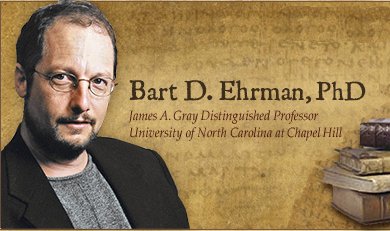 the University of North Carolina, Chapel Hill. Wallace isn’t the only Evangelical biblical scholar who has taken the podium against Ehrman; Craig Evans, along with Darrell Bock (also of Dallas Theological) have debated Ehrman as well. You can read Wallace’s recap of his debate with Ehrman over at the Parchment and Pen blog where he blogs sometimes.
Ehrman grew up as a Fundamentalist and/or Evangelical Christian, and like many, once “educated” he could no longer honestly maintain his faith as a Christian. And, so of course, he appears to be hell bent on destroying the once for all faith delievered the saints one Greek manuscript at a time. His method of antagnoism against Christianity finds expression through his discipline as a New Testament and Biblical scholar. He has coupled his training with his past experience as a formal debater; and he has made an appeal, not unlike his forefathers before him (like the Jesus Seminar), to the popular masses. He hosts these kinds of sensational debates—like the kind he just had with Wallace—in order to gain more of a hearing, and sensationalize the whole process of undercutting people’s faith in the reliablity the Scriptures—sensationalism sells, and Ehrman has sold himself and his message quite well.
My frustration with the continued attention given to Ehrman by so many of these Evangelical Biblical scholars is that it simply gives Ehrman that much more of a voice and platform. Certainly his message needs to be challenged, and yet I think the best way is to challenge him through the literature instead of through the spectacles that these ongoing public debates have turned out to be.
The problem with Ehrman is not the data or evidence; it is actually a theological problem, a heart problem. Ulitmatley, like Jesus said, he loves the darkeness rather than the light. If you read Wallace’s post, you’ll see that he seems surprised or shocked at Ehrman’s skepticism. Why? Ehrman is skeptical and atagonistic not because of the manuscriptual evidence (that’s trojan horse) for the New Testament; but because he is held captive by himself, and chooses himself rather than Christ.
I guess I will always be surprised when I come across Christians who are surprised that unbelievers or the ‘world’ act like unbelievers and the world. And that Christianity, and persuading someone is not primarily an issue of winning an intellectual argument, or marshalling the evidence in a way that any intellectually honest person would just have to agree with the soundness (so I think) of my argument. And yet this is the torch that folks like Wallace and others seem to continue to carry on; that the evidence, if presented clearly, is self-evident to those who are confronted with it. I think, theologically, the reality is, is that the issue, like in Ehrman’s case, comes back to his desire to win the approval of men instead of God. Jesus said, against the Pharisees (in John 5), that this kind of posture can only lead to unbelief. Ehrman is Martin Luther’s Theologian of Glory.
As a historian, Erhman is top notch (if a little biased). I enjoy listening to some of his Early Christian history lectures I have. However, as a textual critic/critic of Christianity, he’s half-rate. Metzger would be rolling in his grave…
Yeah, Metzger would not be happy! I don’t have time for Ehrman, there are other historians of this period I’d rather spend time with.
Bobby, I don’t think you understand my view of things. You said, “And yet this is the torch that folks like Wallace and others seem to continue to carry on; that the evidence, if presented clearly, is self-evident to those who are confronted with it.”
I happen to be a Calvinist who does not think that argument can bring a person to salvation. I use argument to stifle the intellectual resistance, revealing that the real problem is one of the heart. I agree with you on that. But I also don’t think that debates with Bart Ehrman are giving him a platform. If you’ve seen the sales of his books vs. evangelical responses, you would know that Ehrman sells far more than all the evangelical books in response to his writings. These debates give evangelicals a platform. They encourage believers who are struggling with their faith, and give pause to those who are not.
Regarding my surprise at Ehrman’s skepticism, I think you have also misunderstood the situation. Ehrman’s skepticism is far more radical than just about any other textual critic’s out there. David Parker and Eldon Epp are probably on part with Bart, but almost no one else is–including scholars who are unbelievers. You cannot use your presuppositionalism simply to state that since Bart is an unbeliever his views must be as radical as they are. I, too, am a presuppositionalist (of the Gerstner variety), but I also know that precisely because so many scholars are interested in the opinions of others–as you noted–they cannot hold on to their radical skepticism in the face of overwhelming evidence that even other unbelievers embrace.
Professor Wallace,
Thank you for taking the time to clarify. Let me say first, that without you, Dale Wheeler and Rex Koivisto I wouldn’t know Koine Greek; so thank you!
My post was written very quickly, which is probably quickly noticeable. I understand the kind of “popular” force that Ehrman has, and so yes, he needs to be rebutted—full force. And so I do see what you and others like you are doing is just that; filling that gap. I also realize that Ehrman can be used as a springboard to introduce Christians to the depth available for those who actually want to think critically about their faith.
I do understand the radical nature of Ehrman’s skepticism, relative to the broader scholarship in the field (he’s somewhat of a lone-ranger with a very loud blow horn). I guess my only concern, which is what I was raising with this post, is in regard to feeding into the culture of sensationalism—the one that Ehrman (and his book sales) has tapped into. So while I understand why folk like Ehrman need to be met by folk like you; it just seems to me that the best mode of engagement would be through a pamphlet/literature battle. This would do away with the sensationalist hype (in some ways) that allow folk like Ehrman to continue to have the kind of platform he currently has. What if the rest of scholarship simply ignored him? There are a bunch of fringe “scholars” out there who self promote their ideas who never get the kind of platform that Ehrman has obtained; and I would argue that that is somewhat because folks simply don’t pay attention to them (and thus they are labeled what they should be—fringe if not quack scholarship). In other words, when I see credible scholars in the field, like you, Evans and Bock engaging Bart over and again; you guys imbue him and his ideas with more credibility than he deserves (reminds me of the Christian fish eating the Darwin fish approach); so to me this cheapens the credible scholarship (like yours). In other words, Ehrman is so out there I don’t think he deserves all the time he continues to receive from guys such as yourself.
Anyway, I appreciate your scholarship, Dr. Wallace; and I will continue to learn my Koine Greek grammar and syntax from you! Blessings.
Bart E. is a good N.T. textual critic, he knows the field well, makes conclusions based on sound arguments, and tries to make his findings available to the interested public. I see nothing wrong with a skeptic pressing conservatives to tighten and clarify their positions. I agree that ultimately an argument based on evidence can’t change ones heart, since “evidence” is a term in contention. But I do like what Evans and Wallace do in those debates, in that they present their “evidence” which is in dialogue with other “evidence.” This conversation allows us, the non textual critics, to hear viable scholarly positions and be informed where the bones of contention lay. I found the debates to be encouraging and interesting. I like that they were on youtube for free.
@Kenny,
I think it’s fine for anyone to debate whatever they want. I think my only point was that I wondering about the prudence in continuing to engage, Ehrman; a lone-ranger relative to most of the rest of scholarship in this field (believe and unbeliever alike). It makes it seem like Ehrman is actually saying something substantial. I do think Ehrman should be responded to, but I just wonder where that line is wherein Ehrman becomes played out as it were?