
This looks like an interesting book, The Joy of Calvinism: Knowing God’s Personal, Unconditional, Irresistible, Unbreakable Love by Greg Forster. Ted Kluck has a review of the book over at The Gospel Coalition’s Website 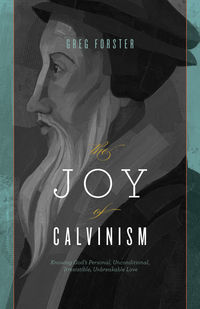 (just click on The Gospel Coalition). Here’s a quote from the book that Kluck puts in his review of the book:
Few would disagree with the statement that a true Christian is a person who clings for salvation, not to the church; not to the sacraments; not to the Bible; not even to the proclamation of the gospel or the believer’s belief in it; but to the cross and the empty tomb. Calvinism is just the systematic application of this truth in all doctrine, piety, and life. If you make this truth your theological touchstone and resolve to reject everything that comes into conflict with it, and carry out that resolution consistently, you will find yourself a Calvinist.
I will definitely be giving this new book a read! The above sentiment, in the quote, sounds all too common to these ears. I can recall engaging with many many Calvinists over the years, and amongst most of them; their most common refrain was the sentiment sketched above by Forster—i.e. that they simply read the Bible for all its worth, took it to heart, and they came out a Calvinist. Of course, I’ve heard Arminians say something similar to their Arminianism, and Charismatics, likewise; etc. There must be something more to this; something more than simply ‘the systematic application of this truth in all doctrine, piety, and life’. This reminds me of when Charles Spurgeon famously said:
I have my own private opinion that there is no such thing as preaching Christ and Him crucified, unless we preach what nowadays is called Calvinism. It is a nickname to call it Calvinism; Calvinism is the gospel, and nothing else. I do not believe we can preach the gospel, if we do not preach justification by faith, without works; nor unless we preach the sovereignty of God in His dispensation of grace; nor unless we exalt the electing, unchangeable, eternal, immutable, conquering love of Jehovah; nor do I think we can preach the gospel, unless we base it upon the special and particular redemption of His elect and chosen people which Christ wrought out upon the cross; nor can I comprehend a gospel which lets saints fall away after they are called, and suffers the children of God to be burned in the fires of damnation after having once believed in Jesus. Such a gospel I abhor.“(From A Defense of Calvinism.)
But, really, it can’t be this simple; or everyone who genuinely read the Bible would pop out a Calvinist. There obviously is something more at play, but what? Kluck notes something else in Forster’s book that I find particularly troubling—indeed, because I think it is an accurate and true sentiment—Kluck writes of Forster’s book:
As young Calvinists there are a number of markets that we’ve “cornered” in recent years. We’ve pretty much locked down the “knowing our theology” market, we almost single-handedly killed the emergent church a few years ago, and we’re beginning to see Calvinists influencing broader non-historically-Calvinistic denominations and universities. These are all good things, because as the author effectively explains, Calvinism isn’t a “brand” or a list of points, it’s a framework for understanding scripture and the Bible that results in the greatest possible amount of truth, comfort, and joy. Yet the question remains: Are we living joyful lives?
Boy, I find this really troubling! Especially when Kluck wrote this, “and we’re beginning to see Calvinists influencing broader non-historically-Calvinistic denominations and universities.” This is true though, and movements like The Gospel Coalition are making great strides in seeing this kind of American Calvinist push through … even in non-Calvinist denominations, as he notes.
Once I read this book, I’ll give some kind of report on it here at the blog. What we need is to get our book out for you all, then The Joy of Being an Evangelical Calvinist will bring the kind of perspective we all need!
I was wondering when you’d get around to commenting on this book. That Spurgeon quote (and the idea behind it) irritates me to no end, honestly.
😉
As young Calvinists there are a number of markets that we’ve “cornered” in recent years. We’ve pretty much locked down the “knowing our theology” market,
At the popular evangelical level, this is indisputable. The scope of this theological knowledge is more limited than I would like (no Barth, no Schleiermacher), but this is a non-objectionable observation.
we almost single-handedly killed the emergent church a few years ago,
Also true, and thank God for it! Does anyone call themselves emergent anymore? Perhaps a few stalwarts of the movement, but that’s it.
and we’re beginning to see Calvinists influencing broader non-historically-Calvinistic denominations and universities.
How is this disturbing? How much vehemence do you harbor, Bobby, against classical Calvinism? I’m serious.
These are all good things, because as the author effectively explains, Calvinism isn’t a “brand” or a list of points, it’s a framework for understanding scripture and the Bible that results in the greatest possible amount of truth, comfort, and joy.
Just as you believe that Torrance-style “evangelical Calvinism” is a framework for understanding scripture and the Bible that results in the greatest possible amount of truth, comfort, and joy.
@Kevin,
It is disturbing. I don’t have much affinity for classic Calvinism at all, as you know. So I ‘harbor’ quite a bit, Kevin; and I am sincerely serious about that. I see a fundamental disparity between a Torrancean/Barthian prolegomenon and the classic one relative to its. How do you not?
It is true, I do believe this about ‘EC’ Torrance style; but my only really point with that is that I think it would be healthy if folk could critically distance their Calvinist reading from the text and the text itself. In other words at least admit that there is a theological superstructure guiding said persons reading of scripture (hopefully dialectically so); that way the reader can make a more informed judgement about whether or not they are actually doing exegesis V. eisogesis.
And Kevin, I should be clear, I am really serious about this myself. I know at points I come off as cavalier, maybe, but my primary mood is hyper serious … not kidding!
@Kevin,
But I want to be clear; I have plenty of friends who are ‘classic Calvinist’; in fact one of my best friends is on his way to Westminster Theological Seminary, East Coast. So don’t misread my disdain as disdain for the people; read it simply as disdain for that system of theology—I just don’t like it for various reasons, ones that you know of since you’ve read me for long enough. I am not challenging the idea that there are warm hearted well intending Christ loving people who are classic Calvinists; I am just challenging the idea that the theological framework they are committed to is the best one for support their love of Christ and others.
The “disdain” itself is what I find disturbing, to speak frankly. I really like what you do, Bobby, and I have encouraged and will continue to encourage you along the way. But, consider this from Barth on the Dort fathers:
“Dort’s own doctrine is, as a whole, nothing other than the comprehensive, level-headed, judicious, thorough expression of what had to be said about the majesty of God, if one were not willing to haggle. With this dogma the Reformed church had raised the banner against the old church some eight or nine decades earlier. With the same dogma it was now setting out the boundaries over against the emerging new church [Remonstrants/Liberals]. It is difficult to see what right one might have to call oneself Reformed today if one is not able to engage in the essentials of this thinking.” (The Theology of the Reformed Confessions, 215)
That’s the sort of appreciative attitude that John Webster, Oliver Crisp, et al. display in their own work. Barth never harbored the disdain you have for the old orthodoxy, and his scholarship was the better for it. In fact, despite his significant adjustments to the Reformed tradition, Barth was a scholastic divine in line with the past greats of Protestant divinity. Hence, we have Brunner’s criticism that Barth wasn’t anti-scholastic enough!
@Kevin,
I’ve read that myself as I worked through ‘The Theology of the Reformed Confessions’ over a year ago now; and yet, the way I read this is not suggestive that Barth was approving of the Canons of Dort, per se, but that one, as a Reformed theologian, must work through them. And with this I totally agree. I can appreciate the history and contextual force that the Canons of Dort had—Robert Letham’s book on ‘The Westminster Assembly’ which we both read was great on drawing the significance of this period out—but it is their repristination as part of the scholastic Reformed today (through the 3 Forms of Unity etc), that I have problems with (and I would think given Barth’s “adjustment” that he would and did too). So don’t get me wrong, Kevin, I am not in any way seeking to ignore the significance of post-Reformed orthodoxy (in fact I think I have written on this at the blog more than anyone else in the blogosphere—save you—that I know of); but I do want to see it through a properly formed understanding of what it means to operate in the spirit of the Reformed tradition; i.e. sola scriptura, semper reformanda.
PS. I read an edited book (newer) called Scholasticism Reformed (http://books.google.com/books/about/Scholasticism_Reformed.html?id=ihkBD76TWisC) there is a great essay in there on Barth’s reliance upon Amandus Polanus (and reification); but I don’t disagree with you that Barth is quite scholastic in orientation.