This question, which for some should simply be abandoned as a non-starter [for people who would rather not think], continues to be one, at least for me, that should be dealt with. It is not because I haven’t concluded something on this, personally; it is because I think this question occasions an even more important one that lies underneath or behind it. That is, who is God? The way we deal with this question will largely be shaped by what we think about God and how he reveals and deals with his creation, or us.
But before we get to who God is, lets deal with this issue; the issue of whether or not hell should be understood as a place where people who are reprobate (so to speak), or unbelievers when they die (or maybe not so limited?), end up for an eternal, and conscious, and tormentuous time. I have been reading, slowly (relatively speaking), David Bentley Hart’s book Atheist Delusions: The Christian Revolution and Its Fashionable Enemies; and while his major focus is not this particular quagmire, he does broach it. And it is his broaching that I want to use as the portal into dealing with this question (or not, maybe it’s a non-starter for you). Hart doesn’t commit to anything, himself (he is Eastern Orthodox, so he probably tends towards a Universalism of sorts, but maybe not!), but he does sketch this in a way that might place some question marks, or at least moments into this query that should make some of us pause more. He writes:
[…] The threat of eternal torment is an appeal solely to spiritual and emotional terror, and to the degree that Christians employed it as an inducement to faith, their arguments were clearly somewhat vulgar. The doctrine of hell, understood in a purely literal sense, as a place of eternally unremitting divine wrath, is an idea that would seem to reduce Christianity’s larger claims regarding the justice, mercy, and love of God to nonsense. But, even here, one must take care to make proper distinctions, for it is not at all clear to what degree such an idea was central or even peculiar to the preaching of the early Christians. The earliest Christian documents, for instance—the authentic epistles of Paul [editor’s note: they are all authentic, Hart … don’t play that trope!]—contain no trace of a doctrine of eternal torment, and Paul himself appears to have envisaged only a final annihilation of evildoers. The evidence of the Gospels, moreover, is far more ambiguous on this point than most person imagine; even Christ’s allegorical portrait of the final judgment in Matthew chapter 25 allows considerable latitude for interpretation, and patristic theologians as diverse as Origen, Gregory of Nazianzus, Gregory of Nyssa, and Isaac of Nineveh saw in the phrase aionios kolasis (typically translated as “eternal punishment,” but possible to read as “correction for a long period” or “for an age” or even “in the age to come”) no cause to conclude that hell was anything but a temporary process of spiritual purification. Indeed, it the testimony of several of the church fathers is to be believed, this “purgatorial” view of hell was far from being an eccentric minority opinion among the Christians of the first few centuries, especially in the Eastern reaches of the empire. All that said, though, one must grant that the idea of eternal punishment for the wicked or for unbelievers formed part of Christian teaching from an early date. But one should also note that the idea of eternal punishment was not a uniquely or even distinctively Christian notion; its pagan precedents were many; it was an idea well established among, for instance, the Platonists; and it is not wholly fanciful to suggest that its eventual ascendency in Christian teaching was a result as much of the conventional religious thinking that Christianity absorbed from the larger culture as of anything native to the gospel. Whatever the case, it is doubtful that Christian teaching succeeded much in exacerbating fear of death or the afterlife. All the documentary evidence suggests that the special attention attraction of Christianity in ancient society lay elsewhere, in aspects of the faith that clearly set it apart from other contemporary versions of reality. [David Bentley Hart, Atheist Delusions, 154-55.]
One of the reasons I like this quote from DBH is because it compresses major disciplinarian ways into this doctrine of hell; i.e. Historical Theology, Exegetical Theology, and Dogmatic Theology. This elicits something, or it should, that there are more ways into considering this issue than a simple commitment to scripture all by itself (solo scriptura, nuda scriptura) will, or can, yield. There are fields of meaning and context that need to be considered when discerning this issue of hell.
The grammatical/exegetical aspect is not as cut and dry as Hart demonstrates (quickly); the history of interpretation is not as precise as us conservative evangelicals would like, and the Dogmatic reality of God as love is thrown into relief when we consider what this means for the eternality of hell (maybe it is temporary).
We all have to come down somewhere (some choose to remain agnostic, but that’s no fun!), and all of the above needs to be considered as we begin our descent downwards to ‘somewhere’. God is love, is hell a loving place; is a concept of eternal unremitting divine wrath (as Hart phrases it) commensurate with the grander doctrine that God is love? Can creation be said to be fully redeemed (Romans 8) and death put under foot (I Cor. 15) if hell continues to be an eternal unremitting reality? Is there an eternal shadow side of God, or is God unremitting light in Christ? Is the koine (NT) Greek able to bear the weight of this question all by itself (lexically, grammatically, and syntactically)? Do earlier Christian thinkers have anything of value to say on this? What did Jesus think?
These are all questions that I won’t try to answer here, I’ll just leave them dangling and let you. I will say though that it won’t do to simply yell your position louder; not if you are serious.
I want to thank Jackson Baer for promptly sending me this review copy from his own resources. The following review ends up being a bit critical of Jackson’s presentation, but I want him to know that I still respect him as a brother in Christ; even though I disagree with him. Ultimately, as you will read throughout the review, my disagreement with Baer—in regard to his book—is not as much with his conclusion (although I am not in total agreement with him, and I am not an Evangelical Universalist), but with his form and method of argument (or non-argument). I realize that Jackson Baer is not pretending to be a scholar, and that he obviously writes for the lay people amongst us; but even so, in the end, his method is more than I can bear (pardon the pun). You will have to read the rest of the review to find out what I am talking about. It is rather long (approx. 2700 words), but I wanted to be as thorough and fair to Jackson as I possibly could.
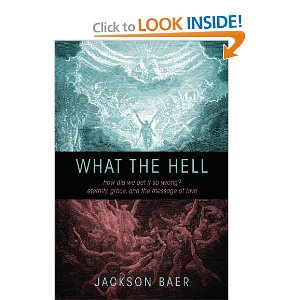
Jackson Baer is a former Youth and Teaching Pastor in an Evangelical church. He was released from his duties as a result of his belief that the doctrine of Hell does not include the Traditional teaching that it involves Eternal Conscious Torment. According to Baer, he wrote this book after spending four years of intense study to understand whether the traditional doctrine of hell was accurate, relative to the teaching of Scripture. Jackson Baer has an undergrad degree from a Bible College, is married with four young children. Baer is not an expert, a trained theologian, or biblical exegete; this reality should be brought to bear as the reader interacts with what Baer has put to print. The following is a review of Jackson Baer’s recently released (self published) book, What The Hell: How Did We Get It So Wrong? Eternity, Grace, and The Message of Love.
The book is made up of eleven short chapters; the total length of the volume is a hundred and thirty-nine pages. There are no footnotes, endnotes, or bibliographic material at the end of the book. The reader should understand that Baer’s book does not intend (it appears) to provide any global arguments, any engagement of recent or past scholarship (biblical or theological), any appeal to the original biblical languages, nor any sense of duty to accurately engage this hot issue in a way that reflects serious, objective, well thought out arguments. In other words, Baer’s book reflects more of a diary of his own personal struggle through the important issue of whether or not the traditional teaching of hell is viable. With that noted, let us enter into the body of Baer’s book.
Chapter 1 is titled, Stuck in Traffic: When One Hour Feels Like Forever. The title, straightforward as it is, identifies Baer’s primary purpose; he is seeking to suggest that time is relative, and thus the punishment of an eternal conscious torment in hell is not necessary in order for God to provide a just punishment for someone’s sins. Baer engages in anecdotal stories in order to “suggest” (versus argue) his point. At the end of this chapter Baer offers one more anecdote about how hell need not literally involve eternity in order to be hell. In the anecdote he is noting a plane trip he made from Seattle, Washington to Portland, Oregon; he gets stuck next to a chap who will not shut up. Baer uses this to describe how time and hell might relate to each other. We jump into the story as Baer is exiting the plane. He writes:
[I] didn’t want to bash this guy because he was obviously lonely. But as soon as he got off that plane all I could think was, “I’m free!” I felt like I had just finished a prison sentence and was tasting freedom for the first time in years. I was so grateful to be out of that seat. I said to myself as I walked into the airport, “That guy just convinced me that Hell is not eternal.” (p. 22)
Other than the humorous nature of this story; it serves to illustrate a very serious point that Baer is contending with. That is, that hell requires the belief that it involves an indefinite period of eternal conscious torment. Baer seems to want to suggest that hell can be temporal conscious torment, and still be hell. Chapter 2 is titled, You Speak Greek, I Read English. In this chapter Baer seeks to describe and argue how semantics, linguistics, and grammar work in the Bible. This is a key chapter for Baer, it is here where he attempts to relativize the biblical language of words like eternal, fire, and more. Since Baer does not know Koine Greek (New Testament Greek), he relies on Young’s Literal Translation. The YLT translates the Greek word, found in Matthew 25:46, αíων, or aeon as ‘age-during’; instead of as eternal. Baer takes this translation as a repudiation of the normal translation of eternal; and thus he sees this as a way to understand this passage as denoting a quality instead of a quantity of existence. Or, that hell does not need to be understood as a literal place of eternal conscious torment; instead it could be a place of temporal conscious torment (so ‘age-during’ instead of eternal). I am giving Baer a charitable reading here (I think). Baer presses this as an opportunity to highlight how modern, contemporary translations are ultimately biased (and thus interpretations); and thus the serious Bible student (English speaking only) ought to refer to an “unbiased” translation like Young’s Literal Translation supposedly represents. Chapter 3 is entitled, Gehenna, the Grave, and the Invention of Hell. A very self-explanatory title; here Baer seeks to deconstruct the ‘traditional’ understanding of hell by explaining the way words like ‘Gehenna’, ‘the Grave,’ came to be interpreted as Hell. Baer argues that these words should be understood in metaphoric ways, and that it is a mis-translation (and thus interpretation) to translate these words with the signifier as ‘Hell’. His basic point is that this serves to mis-lead people into teaching that hell is taught in the Bible, when in fact the word hell is never used. He wants Bible students to refer back to the literal language (i.e. YLT), and thus disassociate ourselves from a doctrine that the New Testament in particular never teaches. Chapter 4, Good Dad v. Bad Dad, is a chapter that argues a fortiori of sorts; Baer argues that as a good earthly father, he will protect his children at all costs. Similarly he argues; that if this is true of earthly fathers, how much more must it be true of the Heavenly Father (p. 53-4). Chapter 5, entitled, What About The Old Testament, suggests that the God of the Old Testament is harsher than the God of the New Testament, and that the God of the Old Testament requires a works-righteousness salvation; while the New Testament is salvation by grace. Baer writes:
. . . The Old Testament is full of stories where people are sacrificing animals to atone for their sins. It’s a work based faith that required men and women to make a sacrifice in order to be forgiven from their sins. It also shows the darker side of God where He wipes out complete nations and seems harsher than most New Testament portrayals. (p. 69)
Baer continues along this line of thought; his method seems to be one where he is trying to provide a plausible account for how we should understand the apparent disparity between the ‘harsher’ God of the Old Testament, with the God revealed in Christ in the New Testament. He seems to think the best way to understand the dealings of God in the Old Testament is to see them as metaphorical; he writes:
. . . Another thought is that many of the stories are simply metaphorical and didn’t actually happen. This belief might sound heretical to some Christians but it’s also a valid interpretation. (p. 69)
Baer then ties this into the way Jesus taught, parabolically. Baer seems to be suggesting that the ‘genocidal’ God of the Old Testament can be the God of grace in the New Testament; if we understand some of the ‘harsher’ language in the Old Testament as hyperbolic or parabolic. Thus the language should be understood in way that presents God as someone who is intensely adverse to sin, and not actually a mean, wrathful God—the kind of God who would condemn people to an eternal conscious and tormenting place known traditionally as, Hell. Chapter 6 is, All Merciful Now, Pent Up Rage Later? Here Baer asks his most pivotal question (according to him); it is: Why would God be forgiving here on Earth but extremely harsh and final in his punishment after death? (p. 77) In this chapter, Baer engages multiple passages of scripture—Ephesians 2:4-5; I Chronicles 16:34; Pslam 136; Titus 3:4-7; II Thessalonians 1:9; I Thessalonians 5:9-10; Matthew 18—to suggest (argue) that God’s mercy and grace far over-shadow God’s wrath and sense of justice towards sin. This chapter is Baer’s attempt to appeal to God’s nature, which as Baer would argue, means that God is not vindictive or wrathful forever; and Baer believes that the traditional doctrine of hell portends otherwise. Chapter 7 is labeled, When a Metaphor’s a Metaphor. Again, this is straightforward and self-explanatory. He tackles metaphor and its usage in scripture; he seeks to deconstruct the reality of a literal place called hell by ascribing it to the literary form of metaphor. Baer says it best when he writes of the dominical teaching of Jesus found in Mark 9; note, Baer:
[W]hen you are reading metaphorical language, you have to study it to see what the author was truly saying. In that same passage from the book of Mark, we see Jesus talking about being in danger of Gehenna (incorrectly translated as Hell) if you are not turning from those sins. This metaphorical language shows us that there is a punishment for sin and we are in danger of that punishment after we die. Did I miss the part about eternal torment and burning Hell for all of eternity? I didn’t miss it because it’s not there. Jesus didn’t say that, not even metaphorically, several times. That shows me that punishment for sin will not be pleasant but that there is also hope. God’s judgment is a serious thing to encounter. (p. 90)
Chapter 8 is titled, Aren’t We Forgetting Something? I Didn’t Ask To Be Born . . . . His basic suggestion in this chapter is that none of us chose to be born; so therefore, how would it be fair for God to then condemn us to hell? Baer intones that it is not fair and further, that this is incommensurate with God’s nature and demonstration of grace. Baer writes, “Why would He not be merciful on judgment day, after a person’s time of punishment and correction? Why would he choose for someone to be born, live their life, and send them to Hell for eternity?” (p. 102) He follows this question, with many other skeptical questions about the fairness of God sending people to hell. You will have to read the book to find out what those are. Chapter 9, It’s Either Good News or It’s Not, continues to ask questions about God’s fairness; if in fact there is a literal place known as hell which lasts forever. His basic premise in this chapter is an “all or nothing” proposition; either the Gospel is good news or not. For Baer that means that everybody is included in the life everlasting offered by the Gospel; and not the eternal condemnation of hell (that would be bad news, and according to Baer negate the Good News). Baer writes, “If the Good News of Jesus Christ is only saving 10-20% of the world’s population, like most Christians estimate, then the news is good for a very small percentage of humanity and horrific for the majority of mankind. It’s either good news or it’s not.” (p. 110) The rest of the chapter follows this kind of “logic.” Chapter 10 is entitled, The Battle of Epic Proportions. In this chapter Baer engages the book of Revelation. Baer believes that “if” Revelation is an actual book that should be included in the Canon [he is ambiguous on his belief here, he appeals to the early Luther who questioned this book’s inclusion in the canon of Scripture (p. 124)—and then he questions the clarity of this book given its notoriously enigmatic history of interpretation (p. 129)], then it might teach that hell involves eternal conscious torment. But he elides this, again, by suggesting that the book of Revelation is a crux interpretum, and thus should not be appealed to in establishing doctrine. Baer seems to be appealing to the analogia scriptura (or fidei), where scripture should interpret scripture (the more clear interpreting the less clear); although he does not identify this, in explicit terms, as his approach at this point. Finally he closes this chapter by pointing the more motivated reader to PBS (Public Broadcasting Service), where he notes that, “PBS online has a great article on the history and facts about the book of Revelation.” (p. 129) Baer’s method in this chapter seemed to be to marginalize the clarity of Revelation, since if taken too literally it would seem to articulate that hell is eternal conscious torment. Chapter 11 is the final chapter of the book, and it is entitled, Restoring a 57’ Chevy. Baer uses this image [the 57’ Chevy] as a picture of what God does; he restores. Here, Baer, presents the Good News, the Gospel Message. Baer makes it clear that while he rejects the Tradition of the historic Christian Church on the doctrine of Hell; that at the same time, he still affirms the historic teaching of Christendom, that the only way to have a relationship with God is through faith in Jesus Christ! Baer is hopeful!
Strengths
The primary strength of Jackson Baer’s book is that it has the potential to cause Christians to return to scripture once again, and test to see if what Baer is asserting is true. Baer is able to write in a way that the reader will feel his heart, passion, and burden to get scripture right. Throughout the book Baer continuously references scripture after scripture; seeking to prove his argument from the holy writ. This book illustrates what it looks like for a non-specialist to engage a timely topic of our day in a heartfelt way.
Weaknesses
Jackson Baer, throughout his book, engages in fallacy after fallacy. This review has already run way too long, so I cannot illustrate this any further at this point (you will simply have to read the book to find out what I mean). He poisons the well, engages the genetic fallacy (over and again), sets up straw men, and probably the most prominent fallacy in Baer’s argument is ‘question begging’ (petitio principii). Baer overstates his case, many times, in order to undercut the traditional teaching of hell. In other words, he is so focused on deconstructing the doctrine of Hell, that he, in the process, tarnishes the integrity of the scriptures (even though he also wants to affirm that). Furthermore, Baer, undercuts the readers ability to trust modern biblical translations; again, simply so that he can make his point about hell (i.e. he believes that modern translations are more akin to interpretations, thus his appeal to a literal ‘translation’ “Young’s Literal Translation [which is actually a terrible literal translation]). There is also a prominent factual error that runs throughout Baer’s book; on pages 40, 124, and 127 he refers to the book of Revelation as apocryphal literature, instead of what it should be, apocalyptical literature—this error does not inspire confidence in the rest of Baer’s research. Finally, for this review, Baer runs rough-shod over any kind of scholarship. He ignores all of the history of interpretation, and only makes cryptic allusions to the history on this issue. This is a great oversight, and in my mind discredits the entire book (with everything else just noted).
Recommendation
As I wrote at the beginning of this review; this book would be more in the genre of diary, and personal reflection on how Jackson Baer has worked his way to his position on the traditional teaching on hell. If you are interested in understanding Jackson Baer’s road to a Christian Universalism, of sorts (he never self-identifies this way); then I could recommend this book to you on those merits. If you are seriously interested in reading a book that critically engages this issue, in a way that reflects careful thinking and argumentation; then I cannot recommend this book to you. For that I would recommend Gregory MacDonald’s (aka Robin Parry) The Evangelical Universalist. In fact, I would recommend that the author of the book under review here (if he has not), read MacDonald’s book. I think Baer would agree with what I have written here, after he does that.
Reading Jackson Baer’s book, “What The Hell,” and the fact that my brother is about to read, and my mom has already read Gregory MacDonald’s (Robin Parry) The Evangelical Universalist; has made me return to MacDonald’s book to review and reconsider his argument for a Christian Universalism. It is obviously not the majority report amongst the history of interpretation in the Christian Church, but it is not without historical precedent; nor does it necessarily require that it be considered heresy (maybe just heterodoxy, at most).
What I want to highlight in this post is how Parry seeks to argue for universalism through biblical exegesis. In his book he works through all the difficult passages and classic passages that “seem” to teach about a literal hell that involves eternal conscious torment. But Parry isn’t totally on the defensive, which is one of the things that make his book so good; he also offers his positive case for Evangelical Universalism. To get a flavor of this let me quote Parry’s closing paragraphs of his exegesis of Colossians 2:15ff; he is using this universalist passage to provide framework and scope for the rest of his argument and biblical theology of Evangelical Universalism. He writes:
[W]hat we find in Colossians, then, is a theology that locates the origin of creation, the revelation of God, and the salvation of the world in Christ. It recognizes the massive rupture introduced into the world through sin, and it sees the solution to this problem in the death of Christ. It requires a response of obedient faith to share in Christ and in the inheritance of eternal life. It offers no hope of a nice God letting everyone into heaven no matter how they live or what they believe. However, in spite of that, it holds before us a confident hope in the salvation of the whole creation. It is God’s covenant purpose that his world will one day be reconciled in Christ. For now, only the Church shares in that privilege, but this is not a position God has granted his people so they can gloat over the world. On the contrary, the Church must live by gospel standards and proclaim its gospel message so that the world will come to share in the saving work of Christ. This is the outline of the evangelical universalist theology I wish to commend to the reader. . . .
This chapter has set out to argue that Colossians works with a vision of reconciliation for the whole creation. We have seen that this vision is perfectly compatible with a strong doctrine of sin . . . , with a Christ-centred account of salvation, with the necessity of faith, with the current division between the elect and those lost in sin, and with a high ecclesiology. This vision, I suggest, can provide the contours for an evangelical, gospel-centred universalism. . . . [Gregory MacDonald, The Evangelical Universalist, (Eugene, OR: Wipf & Stock Publishers, 2006), 52-3]
This gives a sense into how Parry communicates, and how he will be proceeding in presenting his case for what he calls, evangelical universalism.
Without a doubt this is a controversial issue, and something that, probably most Christians know very little (to nothing) about. If you hold to the ‘Traditional’ view of hell (“Eternal, Conscious Torment”); then you need to read Parry’s book! I would imagine most Evangelical Christians wish that Eternal Conscious Torment hell was not a reality; well, MacDonald’s book provides argument that articulates a view that says that you don’t have to believe in ECT. In fact, if you are going to follow the Bible, according to Parry, then you must reject ECT.
No, silly, J.A.T. Robinson isn’t really Rob Bell’s “Grandpa,” I used that to provoke a little hook in order to grab some readers for this post. Yet, there is “some” truth to it; theologically. Robinson offers a more robust version of Bell’s apparent “hopeful universalism” before Bell was ever born [by the way, this post isn’t primarily about Bell, it’s more about presenting Robinson’s view of Christian universalism — but of course this will affect how someone might think of the apparent “novelty” of Bell’s points on this subject in his recent book]. I am just beginning to read a volume entitled: Universalism And The Doctrine Of Hell: Papers Presented at the Fourth Edinburgh Conference on Christian Dogmatics, 1991. I was actually hoping to be able to pick up Greg MacDonald’s Evangelical Universalist, but was unable to secure a copy until a later date; in lieu of that I am reading this compiliation, and while it is a bit dated (1991), I think it should prove to be a helpful piece in working through the contours of this particularly lively topic nowadays (plus, it has a chapter from T.F. Torrance, how could we go wrong then?). Alright, now that that’s cleared; let me get right to it and present J.A.T. Robinson’s ‘Christian Universalism,’ summarized by Trevor Hart (then I’ll follow with a brief parting comment):
The essence of Robinson’s universalism consists in fact in the confident assertion that ultimately all will be saved because all will in time come to choose the salvation offered through Christ’s atoning death and resurrection. Thus there is no suggestion that any will be saved other than through faith in Christ, since salvation itself consists precisely in the free choice of life through the death of Christ and the rejection of that hell which is the deserved fate of human beings. Thus, he contends, ‘there could be no greater calumny than to suggest that the universalist either does not preach hell or does so with his tongue in his cheek’. On the contrary, both hell and judgement must be preached with integrity as existentially real alternatives to salvation. ‘Only the man who has genuinely been confronted by both alternatives can be saved. To preach heaven alone . . . is to deny men the possibility of salvation. For salvation is a state of having chosen; and in the moment of choice . . . , both alternatives are existentially as real.’ It is thus that Robinson is able to make sense of the biblical dualism between the saved and the lost. This is, as it were, a perfectly true and necessary account for the person facing the choice between salvation and its alternative. ‘From below’ hell and judgement are indeed realities, since no person can reject Christ and face anything other than eternal death. Thus we must not be too dismissive of Robinson’s ‘kerygmatic hell’ as it has been called. It is kerygmatic not in the sense that it belongs only to the kerygma and not to the real world (a view which would rob the kerygma of its integrity, turning its dark side into an empty threat), but rather in the sense that it is absolutely necessary that the kerygma should present what is the only real alternative to choosing life in Christ. Being saved involves rejecting this dark alternative to life in all its fulness; and that which is rejected is indeed real enough. It is because Robinson is equally convinced that all will in fact make this choice under the compulsion of divine love that he speaks of universalism as the ‘truth as it is for God’ (i.e. from above), and biblical dualism as the all too real scenario facing human beings in their existential viewpoint prior to this decision of faith. All will choose life: but the choice is only a real and significant one precisely because neither the reality of hell nor the urgency of choice is in any way lessened. Thus Robinson concludes that the divine love ‘will take no man’s choice from him; for it is precisely his choice that it wants. But its will to lordship is inexhaustible and ultimately unendurable: the sinner must yield.’ [Trevor Hart, “Chapter 1, Universalism: Two Distinct Types,” in, Universalism And The Doctrine Of Hell, edited by Nigel M. de. S. Cameron (UK: The Guernsey Press Co. Ltd., 1991), 21-2.]
So for Robinson, God’s love in Christ is going to win! It’s important to note, that this indeed is an “Evangelical” and “Christian” form of ‘universalism’; faith in Christ is still required, it’s just that his love is so compelling that all “eventually” will respond (and in their response, their true human freedom is finally realized — pace Robinson). This is in contrast to John Hick’s ‘Pluralist Universalism’ — the other kind that Hart is sketching — that avers that all will be “saved” with no need for Christ (it will just be based upon, basically their habituation in the “light” their particular “tradition” provided for them). There are, Scriptural and Dogmatic problems for Robinson’s proposal; I may try to work through Hart’s work on those (in response to Robinson’s view) in the next post (we’ll see). Anyway, I think, at least, it’s important to note that Bell is not presenting something novel with his recent and dramatic book; Robinson, at least (if not others like Origen, Maximus et al) beat him to the punch — and in much more rigorous ways (and then of course there are more recent proposals like that of Greg MacDonald’s which I hope to get to in the next month or so).

 haven’t concluded something on this, personally; it is because I think this question occasions an even more important one that lies underneath or behind it. That is, who is God? The way we deal with this question will largely be shaped by what we think about God and how he reveals and deals with his creation, or us.